Entryway decor mistakes are the fastest way to shrink a small entry, and most of them are measurement mistakes, not taste mistakes. The entryway is the first thing guests see and the last thing you touch every day, so a console that is two inches too deep or a mirror hung six inches too high is not a small detail. It is the whole first impression.
This guide covers 9 entryway decor mistakes written for small entries, each with what goes wrong, the fix, and what the fix costs. Every fix is renter-friendly, every number is in inches, and the whole entry can be fixed for under $150. If you are starting from scratch rather than fixing, the pillar post Entryway Decor Ideas for Small Spaces has the 8 setups that work, this article is about what not to do inside them.
Table of Contents
The numbers first
Best for: every mistake in this guide, measure first, buy second.
Six numbers decide whether a small entryway works:
- Walkway: keep 30 to 36 inches of clear walking space. Less than 30 inches and you turn sideways every time you come home.
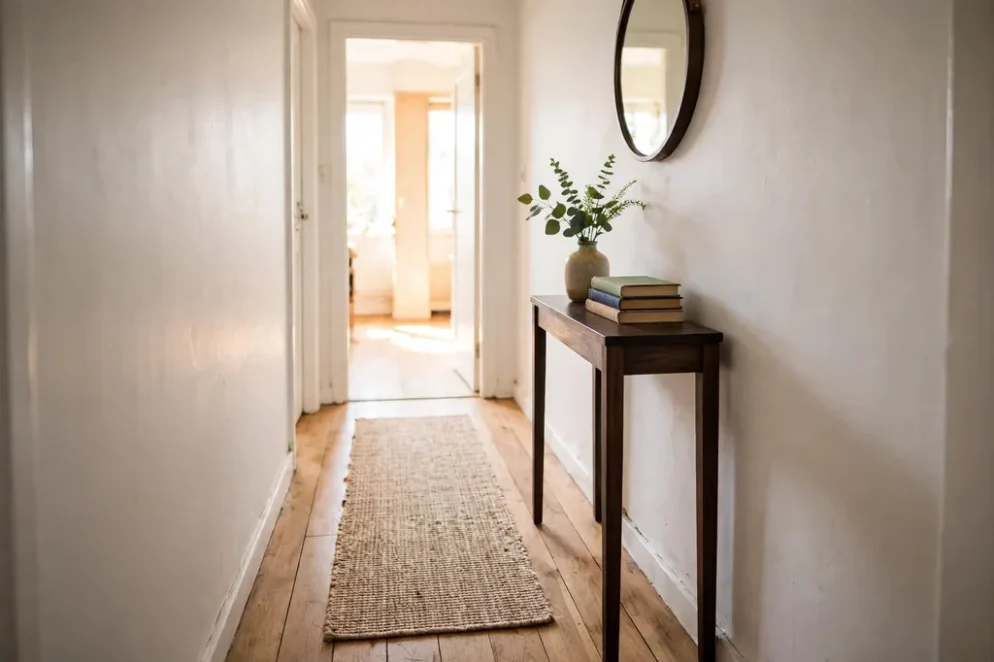
- Console depth: a console table should be 10 to 14 inches deep in a narrow hall. A standard 16- to 18-inch console belongs in a wide foyer, not a 48-inch hallway.
- Bench: an entryway bench seat sits 17 to 19 inches high, and the bench itself should be 15 inches deep or less in a narrow hall.
- Mirror and art: hang the center at 57 to 60 inches from the floor, with the bottom edge 4 to 6 inches above the console. The mirror should be about two-thirds to three-quarters of the console’s width.
- Hooks: adult coat hooks go at 60 to 66 inches, kid hooks at 36 to 48 inches.
- Rug: a 3 by 5 foot or 4 by 6 foot rug fits most entries, with 6 to 12 inches of floor showing around it. A runner should leave 4 to 6 inches of floor visible on each side.
- Light: warm bulbs, 2700K to 3000K. Cool white light makes a small entry feel like a corridor.
Measure the wall, the depth, and the door swing before you buy anything. Every mistake below breaks one of these numbers. Avoiding these entryway decor mistakes starts with those six numbers.
1. Furniture that’s too deep
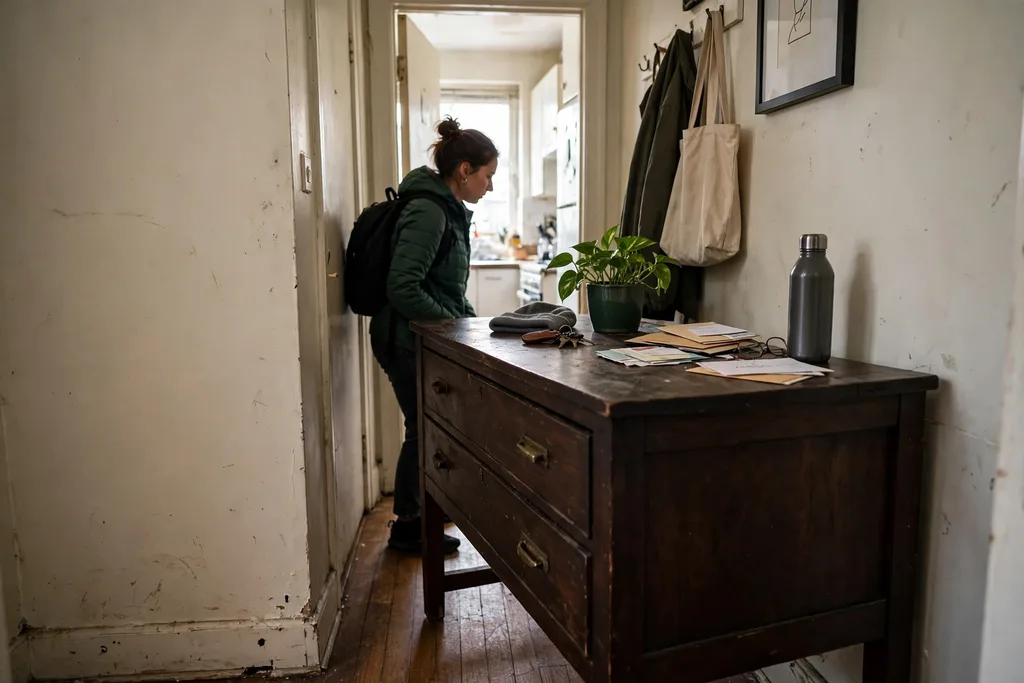
Best for: the number-one mistake, furniture bought before measuring, found in every single competitor list.
What goes wrong: a console that is 16 or 18 inches deep looks fine in the shop and eats the hallway at home. In a 48-inch-wide hallway, an 18-inch-deep console leaves 30 inches of walkway, the bare minimum, and once shoes and bags pile up beside it, you are turning sideways to get through your own front door. The same mistake happens with benches: a full-size bench, a console, and a coat stand crammed into one small entry leave no room to actually enter. Furniture that is too deep also blocks the door swing, so the door hits the console every time it opens. It is one of the most common entryway decor mistakes in a small home.
The fix: measure the hallway width first, then subtract 36 inches for the walkway, what is left is the maximum depth of your furniture. In a 48-inch hallway, that is 12 inches. Choose a console 10 to 14 inches deep and 30 to 34 inches high, a bench 15 inches deep or less, and a shoe cabinet under 10 inches deep. If the entry is under 3 feet wide, a wall-mounted console no deeper than 10 inches is the only table that fits. One piece of furniture per wall, a console or a bench, not both plus a coat stand. Measuring first is how you avoid these entryway decor mistakes for free.
Fix cost: $0 if you move the deep console into the living room and use a bench you already own. A slim secondhand console, 10 to 14 inches deep, costs $40 to $80.
2. Too many small decor pieces
Best for: the console that looks like a gift shop, ten tiny objects and no focal point.
What goes wrong: lots of small decor pieces on a console read as clutter, not styling. A small entryway makes it worse: five tiny frames, three candles, two vases and a bowl on a 42-inch console leave no empty surface, no place to put keys, and nothing for the eye to rest on. Small objects also collect dust fast in a high-traffic spot, and a console covered in breakables is the first thing a bag knocks over. That clutter is one of the entryway decor mistakes guests notice first.
The fix: use the one-tall, one-horizontal, one-small formula. One tall element (a vase with branches, 12 to 18 inches high), one horizontal element (a tray or a stack of two books), and one small personal touch (a framed photo, 5 by 7 inches). That is three things, not ten. Leave at least a third of the console surface empty, the empty space is what makes the three things look intentional. If a piece is smaller than your hand and does not hold keys, mail, or light, it does not earn a spot on the console.
Fix cost: $0, take things off. A tray to corral the three things that stay costs $10 to $15.
3. One harsh overhead light
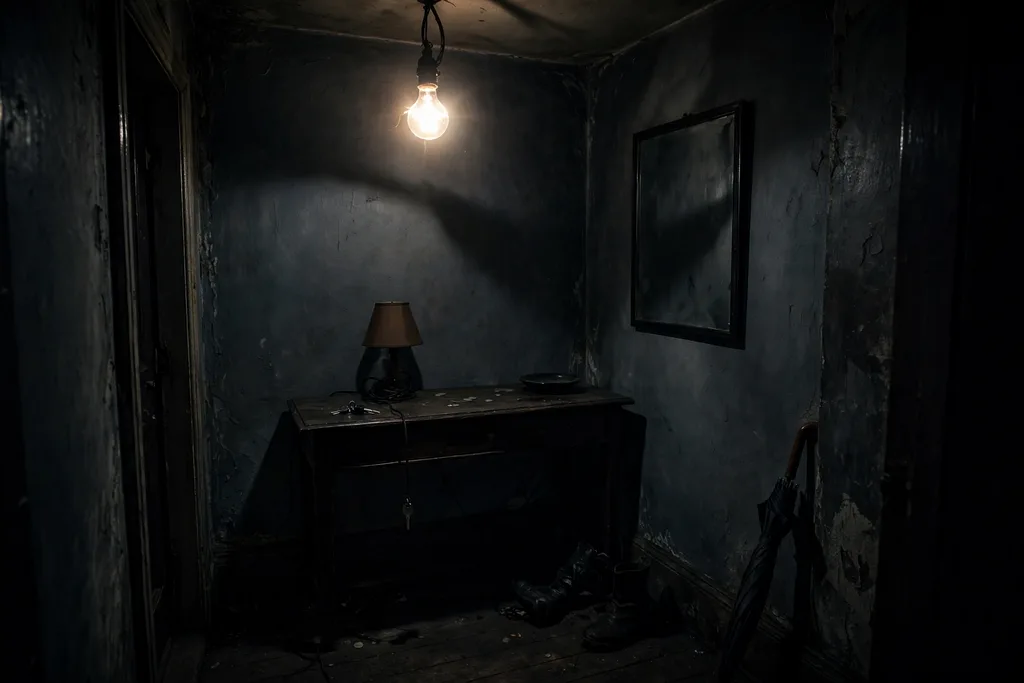
Best for: the entry that feels like a corridor at night, one ceiling bulb, hard shadows, cold color.
What goes wrong: a single overhead light is the only light in most entries, and it is usually the wrong one: a cool white bulb (4000K and up) that makes white walls look grey and skin look tired. One light source also means hard shadows on faces and on the mirror, so the entry feels smaller and darker than it is. A pendant hung too high is the same mistake in a prettier fixture, light that never reaches the console or the floor. It is one of the entryway decor mistakes that makes a small entry feel smaller at night.
The fix: layer the light. Keep the overhead fixture, but switch the bulb to warm white (2700K to 3000K) and add one low light: a small table lamp on the console, a plug-in sconce with a cord cover, or a rechargeable lamp if you rent and cannot add wiring. A pendant over a console should hang 30 to 32 inches above the console surface. Two warm light sources at different heights beat one bright ceiling bulb every time.
Fix cost: warm bulbs $5 to $10. A small rechargeable lamp costs $15 to $25, a plug-in sconce $20 to $35.
4. A rug that fights the door
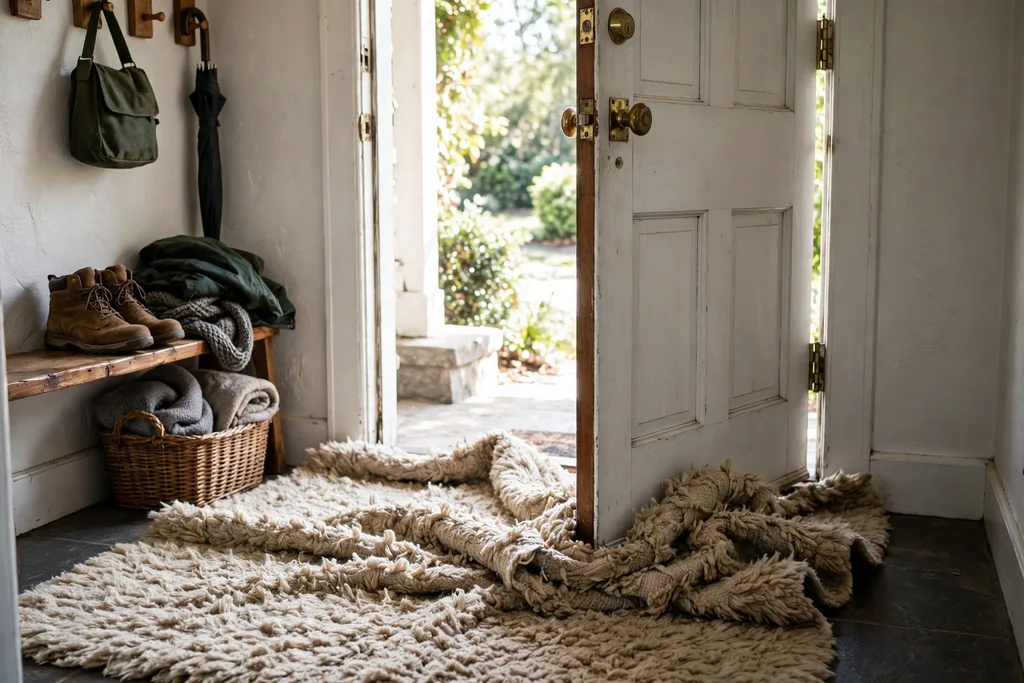
Best for: the mistake almost nobody numbers, a rug that is too small, or too thick for the door to open over.
What goes wrong: two versions of the same mistake. A rug that is too small, a postage-stamp mat in front of a 36-inch door, looks lost and does nothing for the room. A rug that is too thick is worse: the door drags across it, bunches it up, and curls the edge into a trip hazard. A thick rug also hides the real problem, which is that nobody measured the gap under the door. And a boot tray sitting on a fabric rug traps moisture underneath, which stains the rug and smells within weeks. Both versions are classic entryway decor mistakes.
The fix, the clearance test: close the door slowly and measure the gap under it. Most interior doors clear the floor by ½ to ¾ inch. Your rug pile plus its pad must be thinner than that gap, if the door catches, the rug is too thick. Choose a low-pile rug (under ¼ inch pile) with a thin non-slip pad, and test the door swing before you keep it.
For size, a 3 by 5 foot or 4 by 6 foot rug fits most entries, with 6 to 12 inches of floor showing around it; a runner should leave 4 to 6 inches of floor visible on each side. Put the boot tray on the bare floor beside the rug, never on top of it.
Fix cost: a low-pile rug $25 to $45, a non-slip pad $10 to $15.
5. No landing zone
Best for: the entry where keys, mail, and shoes have no home, so they live everywhere.
What goes wrong: an entryway with no designated landing zone becomes a spillover zone. Keys land on the console, then under the console, then in a coat pocket. Mail piles on the bench. Shoes form a mountain by the door, the “shoe mountain” is the single most common complaint in small entries. Without a landing zone, the entry never gets cleaned because nothing has a place to go back to. These are quiet entryway decor mistakes, because nothing looks broken until you live with it.
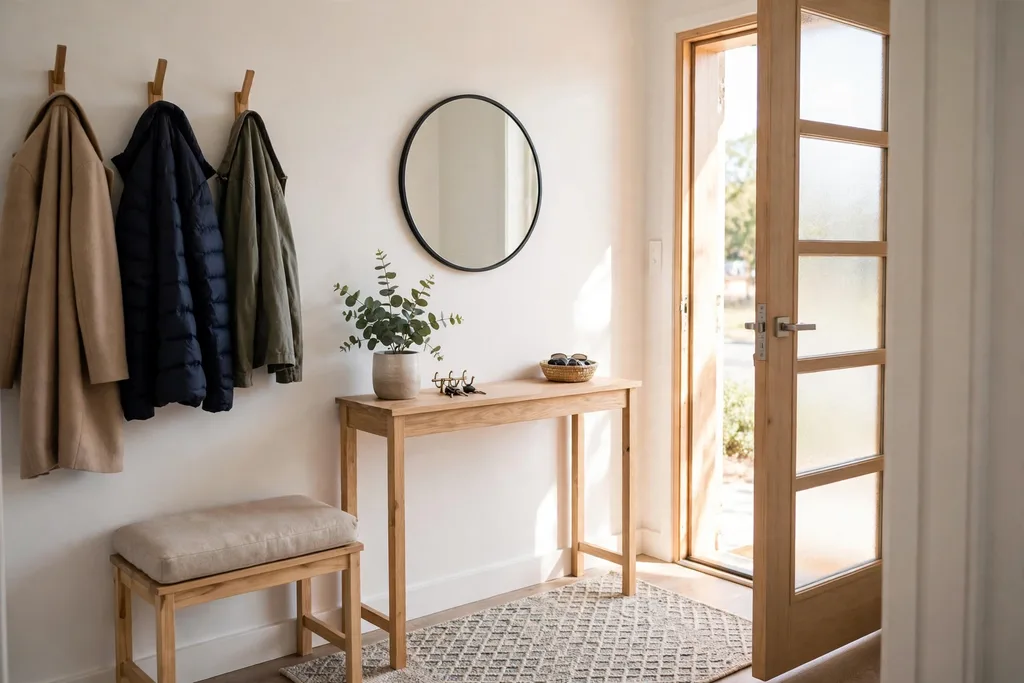
The fix: give everything a spot within arm’s reach of the door. A small tray or bowl for keys (no wider than 10 inches, so it does not eat the console), two hooks at 60 to 66 inches for coats and bags, and a basket or a slim shoe cabinet (under 10 inches deep) for the shoes you actually wear this week. The landing zone is one tray, two hooks, and one basket, not a full furniture set. If the entry is too small for a console at all, a floating shelf with hooks above it does the same job in 10 inches of depth.
Fix cost: a key tray $5 to $10, two adhesive or over-door hooks $5 to $15, a basket $10 to $15.
6. A mirror hung too high, or the wrong size
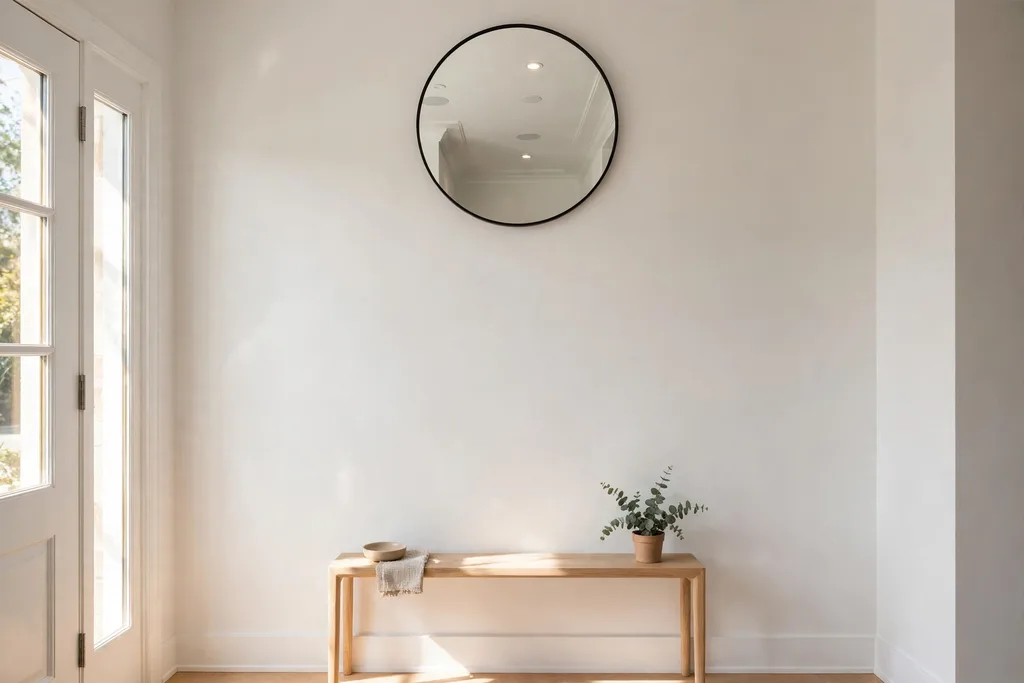
Best for: the entryway mirror that reflects the ceiling and nothing else.
What goes wrong: a mirror hung too high is the most visible of all entryway decor mistakes. Its center sits at 70 inches or more, it reflects the ceiling and the top of the door, and nobody can actually use it to check themselves before leaving. The second version is a mirror that is too narrow for the console below it, a 16-inch mirror over a 48-inch console looks stranded, and a mirror wider than the console looks top-heavy. And almost nobody checks the reflection before hanging: a mirror that reflects a cluttered corner doubles the clutter.
The fix: hang the entryway mirror so its center is 57 to 60 inches from the floor, with its bottom edge 4 to 6 inches above the console. Size it at about two-thirds to three-quarters of the console’s width, on a 42-inch console, that is a mirror 28 to 32 inches wide. Before you hang it, hold it in place and check the reflection: it should show the room and the window light, not the ceiling and not the mess. If you rent, lean the mirror on the console instead, leaning needs no holes at all.
Fix cost: $0 to rehang a mirror you already own. A leaning round mirror, 28 to 32 inches, costs $40 to $80 secondhand.
7. Overloaded hooks
Best for: the hooks that rip off the wall, the mistake with a weight number attached.
What goes wrong: three winter coats, two bags, and a dog leash on one small adhesive hook is not storage, it is a countdown. Adhesive hooks fail in two ways: too much weight, and paint that was not fully cured when the hook went up. A hook that rips off takes paint with it, which is a deposit problem in a rental. The same mistake happens with shelves and mirrors hung on adhesive strips rated for pictures, not for glass. Heavy items on adhesive hooks are the one renter mistake that costs real money. That overload is one of the entryway decor mistakes with a real safety cost.
The fix: match the hook to the load. Small adhesive hooks hold 1 to 3 pounds, medium hooks 3 to 5 pounds, large hooks 5 to 7 pounds. A winter coat weighs 3 to 5 pounds and a loaded tote bag 5 to 8 pounds, so one coat per medium hook, and bags go on a large hook or an over-door hook, never on a small one.
Let adhesive hooks cure 24 to 48 hours before you hang anything on them, and only on smooth, fully cured paint, they fail on textured walls. For heavy loads, use a freestanding hall tree or a coat rack: a hall tree combines hooks, a bench, and shoe storage in one piece and needs no holes at all. Mirrors and shelves always need proper anchors, never adhesive alone, and an unsecured leaning mirror needs an anti-tip strap.
Fix cost: a set of properly rated adhesive hooks $5 to $10, an over-door hook rack $10 to $20.
8. The front door treated as an afterthought
Best for: the door itself, scuffed, ignored, and doing nothing for the first impression.
What goes wrong: the front door is the largest surface in the entryway, and it is the one most people never touch. Scuffed paint, loose hardware, a flat dead mat, and no light by the door make the whole entry feel tired, no matter how good the console looks. A door with no mat means dirt walks straight onto the rug. A door with no wreath, no numbers, and no color reads as a back door, not a front door. It is one of the easiest entryway decor mistakes to overlook.
The fix: clean the door, tighten the hardware, and give it three cheap things: a coir mat outside (18 by 30 inches is the standard size), a wreath or a simple hanging on a removable over-door hook, and a small light by the door if there is an outlet nearby. In a rental, do not paint the door without permission, use a removable wreath, peel-and-stick house numbers, and a mat instead. The door is the first thing guests touch; it should feel finished.
Fix cost: a coir mat $10 to $20, an over-door wreath hook $5 to $10.
9. Blank walls
Best for: the entry where the walls do nothing, no mirror, no art, no hooks, just paint.
What goes wrong: blank walls waste the only free space a small entryway has. The floor is full, the console is full, and the walls, the one surface with room to spare, hold nothing. A blank entry feels unfinished and smaller than it is, because there is nothing for the eye to land on except the door. Ignoring the walls is also a storage mistake: the vertical space above the console is where hooks, art, and a mirror belong, and leaving it empty pushes everything onto the floor. Leaving walls blank is one of the entryway decor mistakes that wastes free space.
The fix: put one thing on the wall above the console, a mirror, one piece of art, or a row of hooks, with its center at 57 to 60 inches from the floor. Add a second layer only if the wall is wide enough: a small floating shelf (10 inches deep or less) for a plant or a book. In a rental, lean the art on the console instead of hanging it, a leaning frame needs about 1.5 inches of depth and no holes. One wall, one job: the wall above the console is the focal wall, and the wall beside the door is for hooks.
Fix cost: two leaning frames with prints $15 to $40.
Small entryway layout: a 36-inch hallway
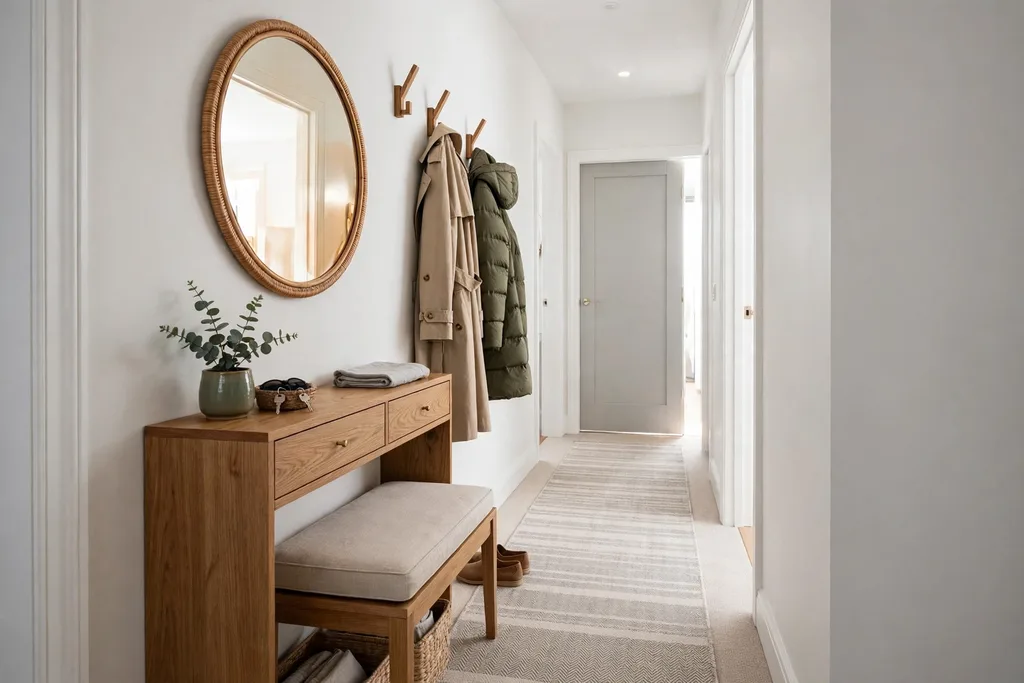
Best for: the whole entry, where the fixes above fit in a real hallway.
Take a 48-inch-wide hallway. A console 12 inches deep leaves exactly 36 inches of walkway, the number every mistake in this guide comes back to. On a 60-inch wall, the worked example is a 42-inch console, 10 to 12 inches deep, with a 28- to 32-inch mirror above it, its center at 57 to 60 inches. The entryway bench goes on the opposite wall if there is room, 15 inches deep or less, seat height 17 to 19 inches, and only if the walkway stays at 30 inches or more after it goes in. This layout avoids the entryway decor mistakes above by keeping the walkway clear.
Spend the budget in this order, because the order is the fix: first clear the circulation (nothing may narrow the walkway below 30 inches), then the landing zone (tray, hooks, basket), then outerwear storage (shoe cabinet or hall tree), then lighting, then the rug, then the mirror and art, and only then decor extras. The most common budgeting mistake is spending the whole budget on a beautiful console while shoes and coats still have nowhere to go. Spending in that order fixes the entryway decor mistakes that cost the most first.
If there is no entryway at all, the door opens straight into the living room, the same rules still apply, and the mistake is thinking you have no entry. Mark the zone with a rug, put a console behind the sofa, or use a screen or a bookcase as a partition. A rug and a console are enough to make an entry where there was not one. The same entryway decor mistakes apply here, just without a separate room.
Renter-friendly fixes
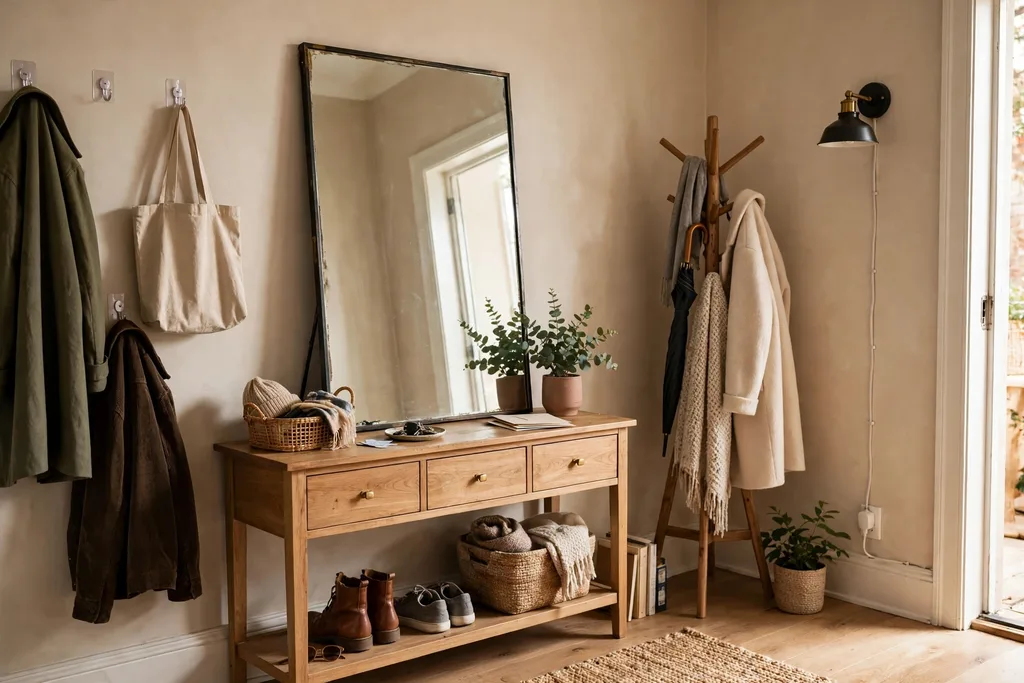
Best for: every fix in this guide, done without drilling, because in a rental, the walls are the landlord’s, not yours.
Every mistake above has a no-drill version. Lean the mirror instead of hanging it, and add an anti-tip strap so it cannot fall forward. Use adhesive hooks, but match the rating to the load, small hooks 1 to 3 pounds, medium 3 to 5 pounds, large 5 to 7 pounds, and let them cure 24 to 48 hours before use.
Hang a plug-in sconce with a cord cover instead of hardwiring one. Use peel-and-stick wallpaper on one wall instead of paint, and a freestanding hall tree or coat rack instead of a mounted rail. For walls specifically, Rental Friendly Wall Decor Ideas has the no-drill versions of everything, hooks, leaning art, and removable wallpaper, with the weight ratings attached. That covers every entryway decor mistake in the guide, without a single hole.
Three renter rules cover all of it: lean, do not drill; plug in, do not hardwire; and test one adhesive hook first, because adhesives fail on textured walls and on paint that has not fully cured. Everything in this guide moves with you when you leave.
Entryway decor mistakes under $150
Best for: the whole entry, every fix in this guide, added up.
| Mistake | Fix | Cost |
|---|---|---|
| Furniture too deep | Slim secondhand console, 10–14 in deep | $40–$80 |
| Too many small pieces | Remove pieces + one tray | $0–$15 |
| Harsh overhead light | Warm bulbs + rechargeable lamp | $15–$35 |
| Rug fights the door | Low-pile rug + non-slip pad | $35–$60 |
| No landing zone | Key tray + 2 hooks | $10–$25 |
| Mirror too high | Rehang it (free) | $0 |
| Overloaded hooks | Proper hooks + over-door rack | $10–$20 |
| Front door ignored | Coir mat + wreath hook | $15–$30 |
| Blank walls | Two leaning frames + prints | $15–$40 |
| Total (everything at once) | $140–$305 |
That is over $150 at the top end, so here is the honest version. Do the free fixes first: take things off the console and rehang the mirror, which costs $0 and changes the entry the most.
Then the low-pile rug ($35), the key tray and hooks ($20), warm bulbs ($10), and the coir mat ($15), the first round comes to $80. Swap the console secondhand ($40 to $80) and add the leaning frames ($15 to $40) next month. An entry fixed in two rounds looks better than one fixed in one rushed round, because the second round is the one where you know what the space actually needs.
The free fixes: removing five things from the console, rehanging the mirror at 57 to 60 inches, and moving the deep console into the living room cost nothing, and they change the entry more than any purchase. Fixing entryway decor mistakes starts with taking things away, not adding them. Fixing entryway decor mistakes starts with the free ones.
FAQ
What’s the biggest entryway mistake?
Buying furniture before measuring. A console that is too deep is the mistake every competitor list puts first, because it breaks the walkway, the one number the whole entry depends on. Measure the hallway, subtract 36 inches for the walkway, and what is left is the maximum depth of your furniture. It is the first of the entryway decor mistakes in this guide for that reason.
How do I decorate a small entryway?
Spend in this order: first clear the circulation, then the landing zone (tray, hooks, basket), then outerwear storage, then lighting, then the rug, then the mirror and art, and only then decor extras. A small entry decorated in that order works; a small entry decorated backwards, decor first, storage never, does not. That order also fixes the entryway decor mistakes in the order that matters most.
How high should I hang a mirror or art in an entryway?
The center at 57 to 60 inches from the floor, with the bottom edge 4 to 6 inches above the console. The mirror should be about two-thirds to three-quarters of the console’s width, on a 42-inch console, a mirror 28 to 32 inches wide. Check the reflection before you hang it: it should show the room, not the ceiling.
What size rug is best for a home entrance?
A 3 by 5 foot or 4 by 6 foot rug for most entries, with 6 to 12 inches of floor showing around it. A runner should leave 4 to 6 inches of floor visible on each side. And run the clearance test: the rug pile plus its pad must be thinner than the gap under the door (usually ½ to ¾ inch), or the door will catch on it.
How can I make a small entrance look welcoming?
Warm light (2700K to 3000K), one mirror at the right height, a low-pile rug, one plant or branch, and a clear landing zone. A welcoming entry is not a decorated entry, it is an entry where everything has a place and the light is warm. Those five things undo most entryway decor mistakes at once.
What should I put in my entryway?
A console or a bench, a mirror, two or three hooks, a rug, a tray for keys, and one light source besides the ceiling bulb. That is the whole list. Anything beyond it is decoration, and decoration comes last.
How do I create an entryway when my door opens into the living room?
Mark the zone with a rug, put a console behind the sofa, or use a screen or a bookcase as a partition. A rug and a console are enough to make an entry where there was not one, the zone is defined by the furniture, not by the walls.
What type of lighting is ideal for an entrance?
Warm light, 2700K to 3000K, from two sources at different heights, the overhead fixture plus a table lamp, a plug-in sconce, or a rechargeable lamp on the console. One cool ceiling bulb is the mistake; two warm lights are the fix.
Start today
Entryway decor mistakes do not need a shopping trip, they need a tape measure. Measure the hallway, measure the gap under the door, and check the mirror’s height. Take five things off the console, rehang the mirror at 57 to 60 inches, and put a tray by the door for your keys.
That is the whole first round, and it takes an afternoon. Start by taking away. The entry will tell you what it needs next.