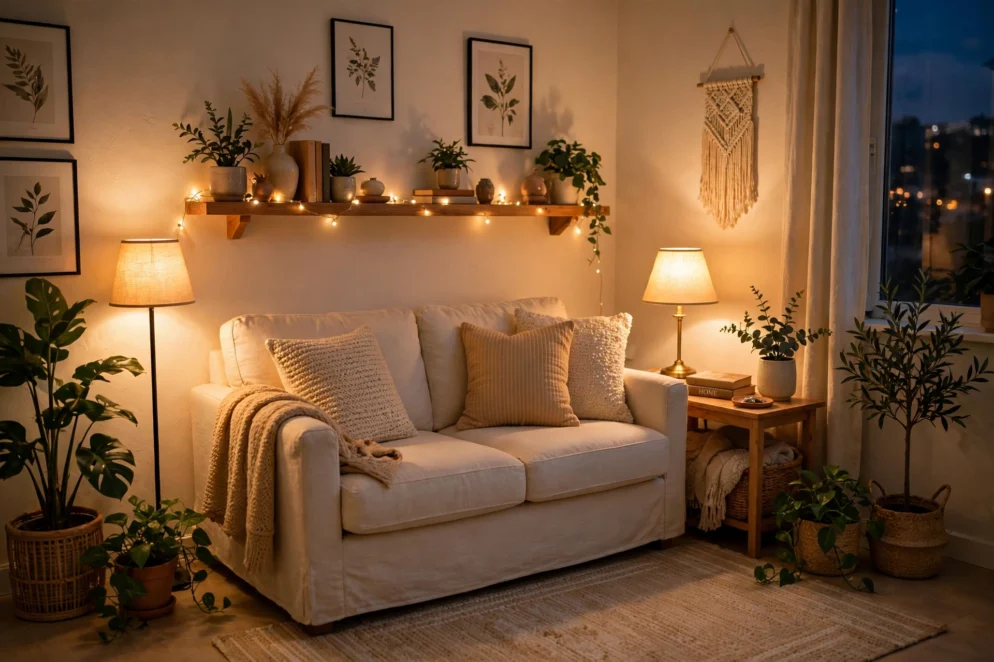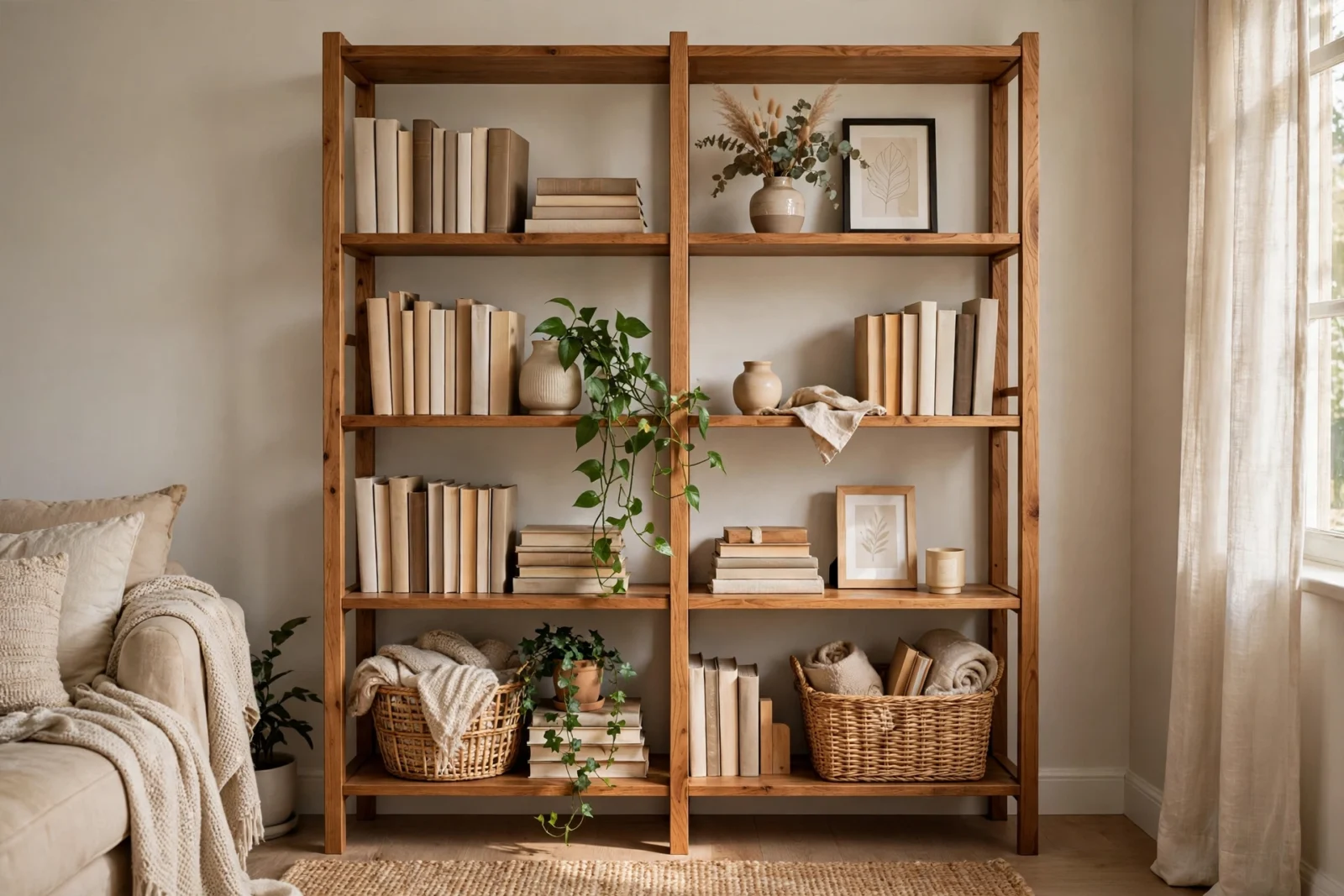
Learning how to style a bookshelf feels harder than it should. You stand in front of empty shelves with a vase in one hand and a stack of books in the other, and nothing you place looks the way it did in the photo you saved. The shelf either looks bare, like you forgot to finish it, or crowded, like everything you own fell onto it at once.
Here is the good news: designer shelves are not talent. They are a short list of rules, repeated shelf by shelf, with real measurements behind them. This guide gives you those rules, the rule of threes, height changes, color flow, negative space, and depth, sized for a small living room and done without a single drill hole. Most of it costs nothing, because you already own the books and the objects. The whole refresh stays under $150 even if you buy every extra piece thrifted or secondhand.
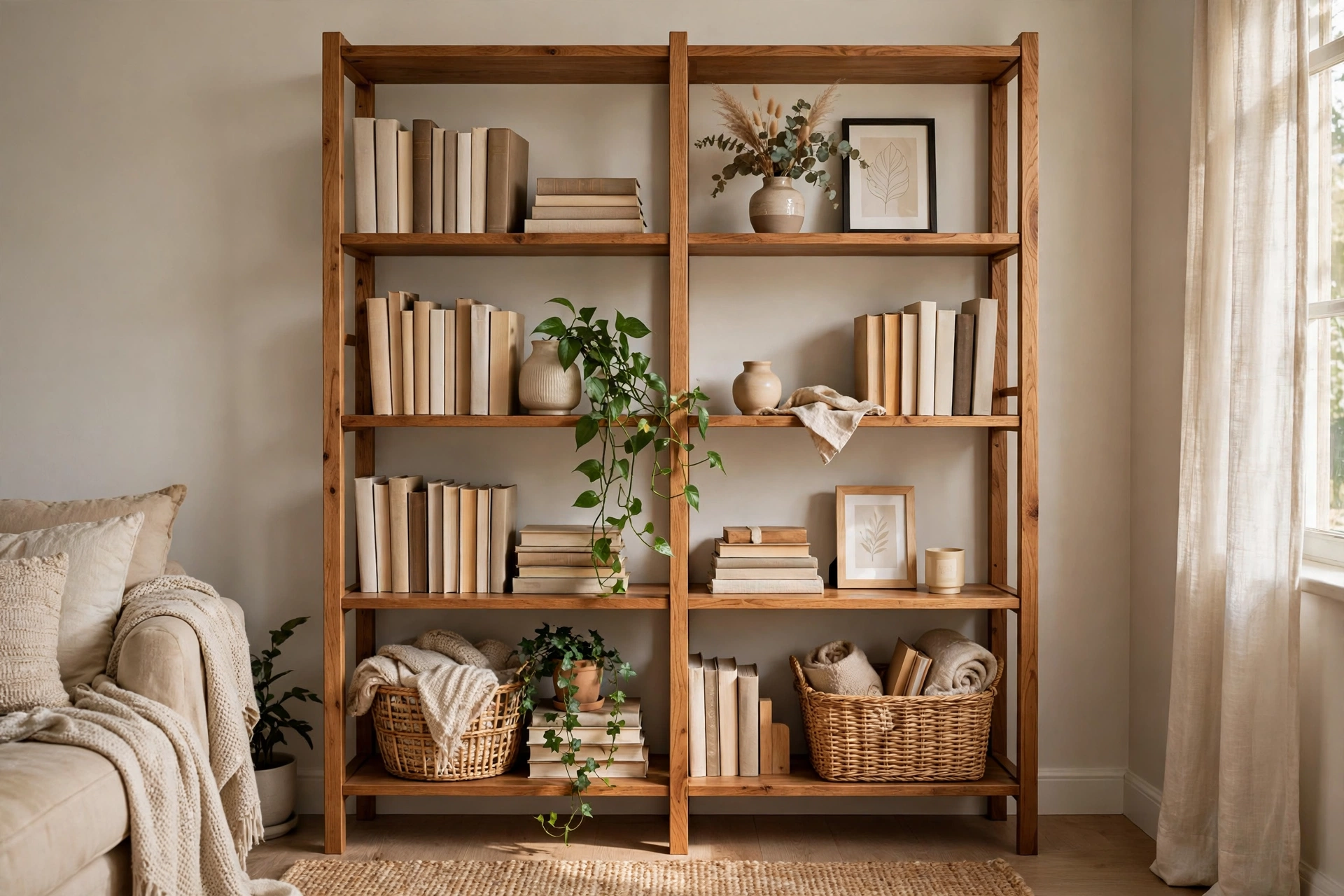
Table of Contents
The Numbers First: Measurements That Make a Shelf Look Designer
Best for: everyone, measure first, style second. These numbers are the difference between a shelf that looks styled and one that looks stuffed. Keep these numbers beside you while you learn how to style a bookshelf shelf by shelf.
- Shelf depth: most bookcases are 10 to 12 inches deep. That is enough for a hardcover (about 6 to 9 inches deep) plus a small object in front of it. If your case is deeper than 14 inches, push books to the back and use the front 3 to 4 inches for a low object, or the back of the shelf becomes a dark cave.
- Shelf spacing: a standard gap between shelves is 10 to 12 inches. Paperbacks need about 8 inches of clearance; hardcovers and art books need 11 to 13 inches. If your shelves adjust, set the bottom two gaps at 12 to 13 inches for tall books and the top gaps at 10 inches for objects.
- Book stack height: a horizontal stack should be 2 to 4 books high, which is roughly 5 to 8 inches tall. One book looks like a coaster. Five or more looks like a pile you meant to put away.
- Object sizes: the tallest object on a shelf should be 8 to 14 inches tall, leaving at least 2 to 3 inches of air above it. Small objects should be at least 4 inches tall, anything smaller disappears between books.
- Pull from the edge: keep books and objects 1 to 2 inches back from the front edge of the shelf. Flush with the edge looks like a store display and risks a fall; pushed 3 inches back or more, things look lost and dusty.
- Negative space: leave 25 to 35 percent of every shelf empty. On a 30-inch-wide shelf, that means 8 to 10 inches of clear space, about one open stretch per shelf.
- The eye-level shelf: the shelf at 54 to 60 inches from the floor, about eye level from the sofa, carries your strongest composition. Spend the most effort there and keep it the calmest.
Write these numbers on a sticky note and keep it on the shelf while you work. Every rule below hangs off them.
1. Decide What the Shelf Is For
Before you move a single book, answer one question: is this shelf mostly for storing books, or mostly for showing things off? Designer Taniya Nayak starts every project the same way, identify the purpose first, because a library and a display are styled differently, and neither is wrong. Knowing the job first makes it far easier to learn how to style a bookshelf that actually gets used.
2. Empty It and Edit Before You Style
Every designer starts the same way: take everything off. You cannot see what you have while it is crammed on the shelves, so dust the shelves and wipe the back panel while they are bare, five minutes, and the shelf photographs twice as well after. That blank shelf is the best place to start learning how to style a bookshelf from scratch.
Then sort into three piles: keep (books you will read again), donate (books you finished, did not like, or bought for a past version of yourself), and display (beautiful spines, oversized art books, titles that say something about you). Be honest, the donate pile is where the shelf gets its breathing room. Editing first makes it much easier to learn how to style a bookshelf with only pieces you love.
While the shelves are empty, look at the room. Note the dominant tones: the wood of the floor, the color of the sofa, the rug under the coffee table. Your shelf palette should echo the room, not fight it. Pick two to three main colors from the room, one metal or accent finish, and one natural texture (wood, woven fiber, or linen). Take a photo of the room before you start, it is your bookshelf styling inspiration and your before picture in one. You will repeat those deliberately across the shelves. If your rug is layered and patterned, this same palette discipline keeps the shelf from competing with the floor, our guide to rug layering in a small living room uses the same rule.
3. Put the Books Back First
Most styling advice starts with the objects, a little brass thing here, three books topped with a candle there. Follow it shelf by shelf and you end up with a store display that holds almost none of the books you own. The better way, and the one designers who style real libraries use, is to put the books back first. Books first is the quiet rule behind how to style a bookshelf so it stays tidy.
Start with the heaviest and tallest books on the bottom two shelves, heavy books low keeps the bookcase grounded and stable, and tall books fit better low, where the shelf gaps are usually widest. Daily-use titles and series go between knee and eye level, roughly 24 to 60 inches from the floor, where you can reach them without a step stool or a crouch.
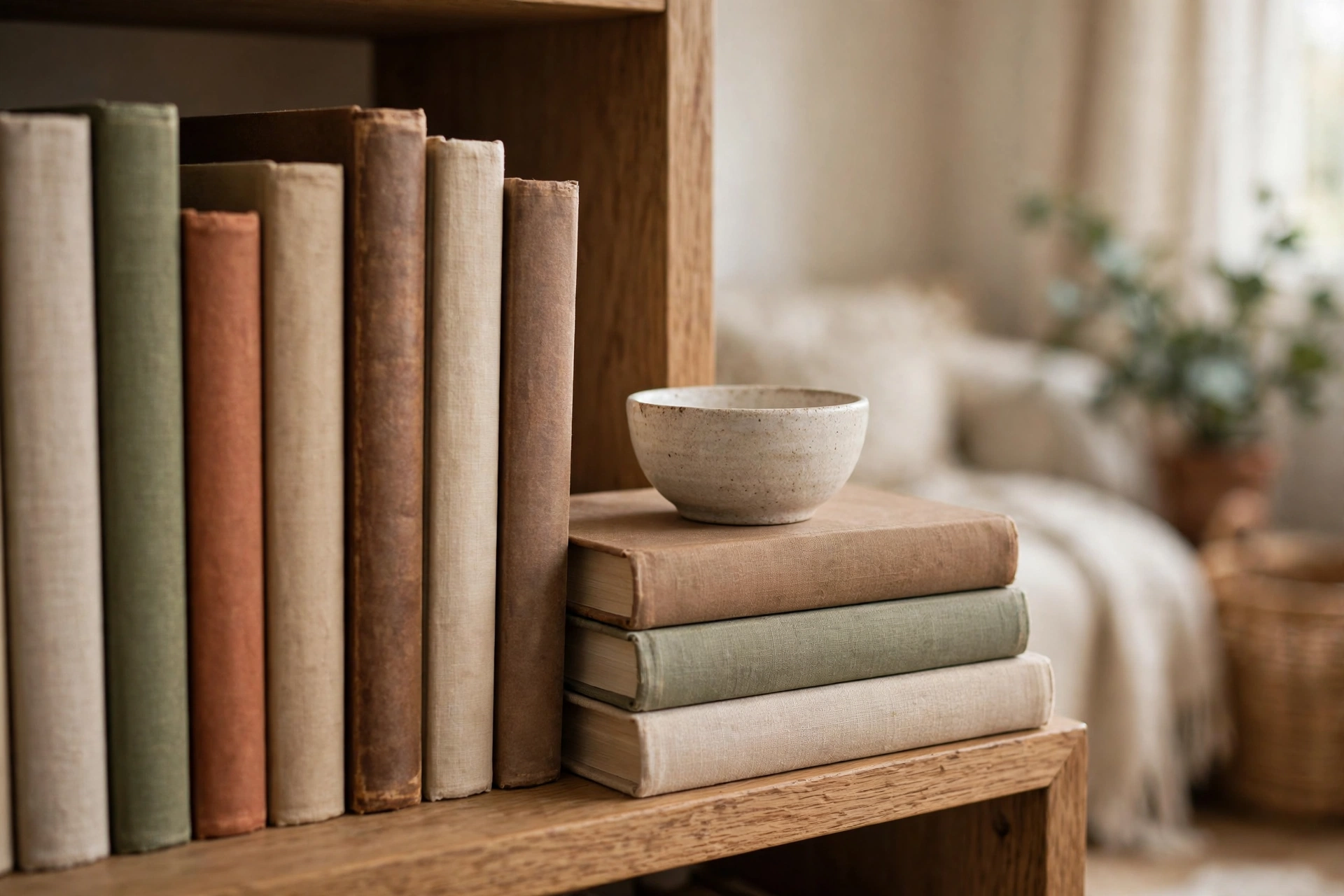
Stand most books upright, spines facing out. Skip the rainbow sort and skip turning spines backward. A full rainbow makes books hard to find and dates a room fast, and backward spines look calm in photos but mean you cannot find a single title. If you want a quieter palette, slip the dust jackets off a few hardcovers, the cloth underneath is often a soft, muted color. That rhythm is a practical part of how to style a bookshelf that stays easy to use.
Leave gaps as you go: an 8- to 10-inch opening on each shelf for a horizontal stack or an object. The books are the foundation; the gaps are where the styling happens. This is the heart of how to style a bookshelf with books: the books go in first, and everything else earns its place around them.
4. The Rule of Threes: How to Style a Bookshelf Like a Designer
If you learn one designer rule, learn this one. Group objects in threes, or fives on a wide shelf, and the arrangement looks natural and relaxed. Pairs look stiff, like bookends at a formal dinner. Four in a row looks like a lineup. Three looks like a collection. Grouping in threes is the first step in learning how to style a bookshelf like a designer.
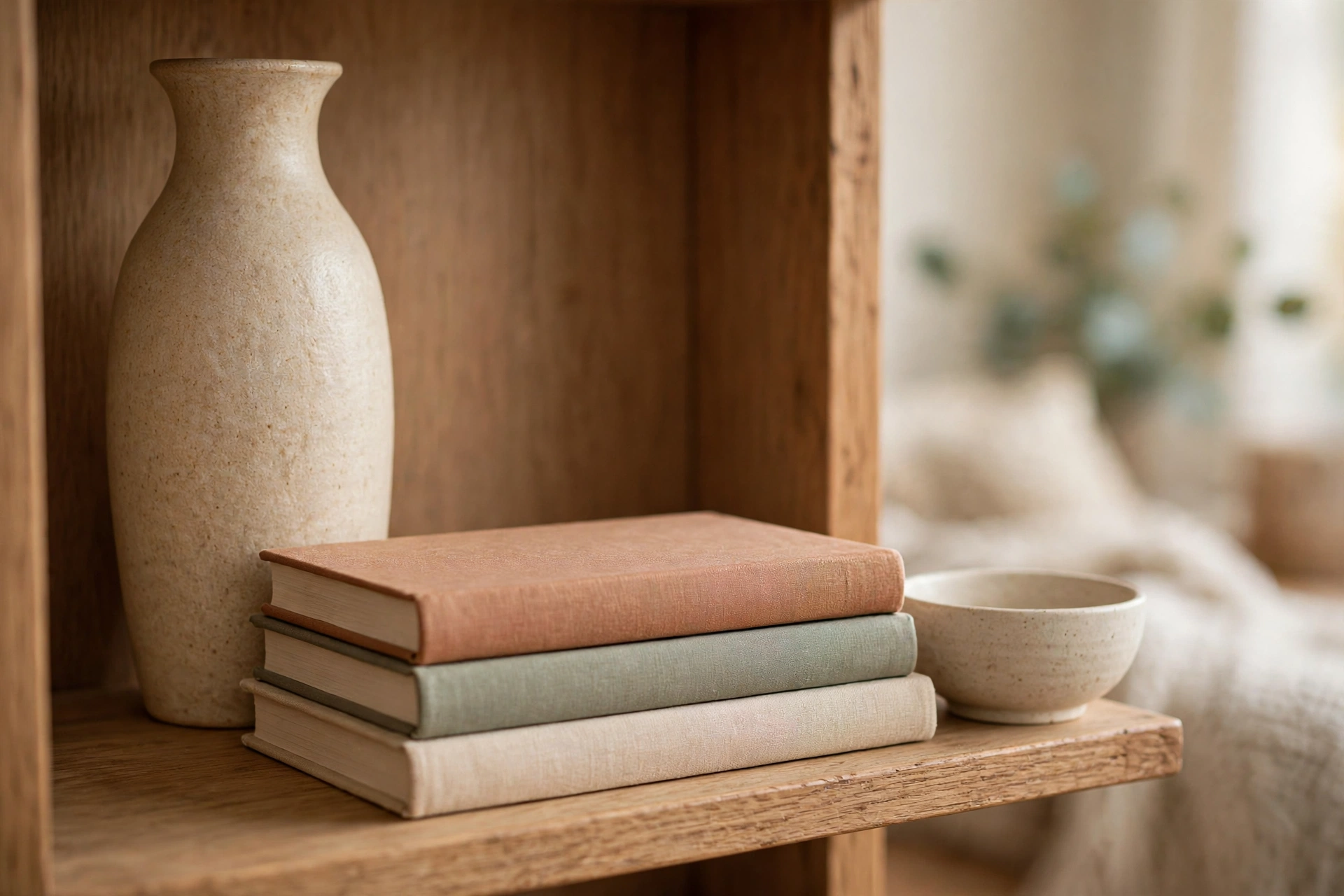
A group of three works best as a loose triangle, not a straight line: one tall piece, one medium piece, and one low piece. A tall vase (10 to 14 inches), a horizontal stack of three books (5 to 8 inches tall), and a small bowl (3 to 4 inches tall) make a triangle your eye reads in one glance. Vary it across shelves, tall on the left this shelf, tall on the right the next, so the bookcase does not slope the same way.
This is the core of how to style shelves like a designer: the rule is not “buy three matching things”, it is “stop at three things per group.” A shelf with one group of three and one stretch of empty space looks styled; a shelf with nine small things looks like a souvenir stand. Home stagers use the same odd-number trick — see how home stagers style a bookshelf.
5. Mix Upright Books With Horizontal Stacks
Rows of upright books read as library. Short horizontal stacks read as styled. You need both, and the mix is what keeps a shelf from looking like a storage unit. That mix is what makes learning how to style a bookshelf feel doable, shelf by shelf.
Stand books upright in runs of 5 to 8 books, then break the run with a horizontal stack of 2 to 4 books. The flat stack does two jobs: it breaks the vertical rhythm, and it becomes a pedestal. A small object, a bowl, a candle, a tiny plant, sitting on top of a flat stack looks intentional in a way the same object sitting on a bare shelf never does, because the stack lifts it 5 to 8 inches closer to eye level and gives it a base.
Vary which end of each shelf the upright run starts on. If every shelf starts with books on the left and ends with a stack on the right, the whole bookcase leans. Alternate: books left on one shelf, books right on the next. The zigzag this creates is the visual flow designers talk about, your eye travels across the bookcase instead of sliding down one side. That is how to style a shelf so the eye keeps moving.
6. Vary the Heights and Build a Skyline
A shelf where everything is the same height looks flat, even if the objects are beautiful. Designers picture shelves as a skyline, peaks and dips, not one flat horizon. Here is how to build yours. Height is the fastest way to learn how to style a bookshelf that looks collected, not flat.
On each shelf, aim for three heights: tall (10 to 14 inches), medium (6 to 9 inches), and low (3 to 5 inches). The tall piece might be a vase, a leaning framed print, or a stack of books with a tall object on top. The medium piece might be a shorter vase, a candle, or a small stack. The low piece might be a bowl, a small plant, or a single book lying flat. Together they make a skyline with a peak and a valley, and the valley is just as important as the peak, it is the breathing room.
If everything is the same height, stand one book upright behind a flat stack to add 4 to 6 inches, or set a small object on top of a stack you already have, a stack of books is a riser you already own.
7. Mix Books With Objects (and Keep the Ratio Right)
Books alone look like storage. Objects alone look like a shop. The mix is the styling, and the ratio matters more than any single object you choose. That balance is the heart of how to style a bookshelf for a small living room.
Aim for roughly two-thirds books and one-third objects across the whole bookcase. Most bookshelf styling ideas fail on ratio, not taste, so get this number right before you buy anything. On a five-shelf unit, that means three shelves are book-heavy and two shelves carry the display moments, usually the eye-level shelf and one shelf above or below it. Count objects, not inches: no more than three decorative objects per shelf, including plants. Three is the ceiling. A shelf with one good object and space around it beats a shelf with six small ones every time.
What to put on a bookshelf besides books? Start with what you already own: a framed photo, something inherited, a souvenir from a trip, a vase, a bowl from the kitchen. Pieces with a story do more than anything bought to match. Then add texture on purpose: matte ceramic next to glossy glass, natural fiber next to smooth metal, warm wood next to a painted object. Three textures per shelf is plenty, and if the shelf feels busy, remove one material instead of adding a new one.
8. Color Flow: Repeat, Don’t Match
Color is the fastest way to make a shelf look intentional, and the most common way to make it look chaotic. The rule is simple: repeat, don’t match. You do not need every object in the same color. You need each color to appear at least twice, on different shelves, so the eye connects them. A tight palette is one of the easiest ways to learn how to style a bookshelf without buying anything new.
Pick a tight palette: two main colors plus one neutral. Warm wood, cream, and soft green from plants is a combination that works in almost any small living room. Or navy, cream, and brass. Or terracotta, warm white, and black. Whatever you pick, pull it from the room, the rug, the sofa cushions, the art on the wall, and repeat each color on two to three shelves at different heights. A terracotta vase on the second shelf and a terracotta book spine on the fourth shelf make the whole bookcase feel planned, even though the two objects never sit together.
One warning for small rooms: a shelf with five bright colors reads as five different shelves, while two colors and a neutral read as one piece of furniture. If your books are a riot of color, calm everything around them, neutral objects and a plain vase let colorful spines be the color story.
9. Negative Space: Leave a Third of Every Shelf Empty
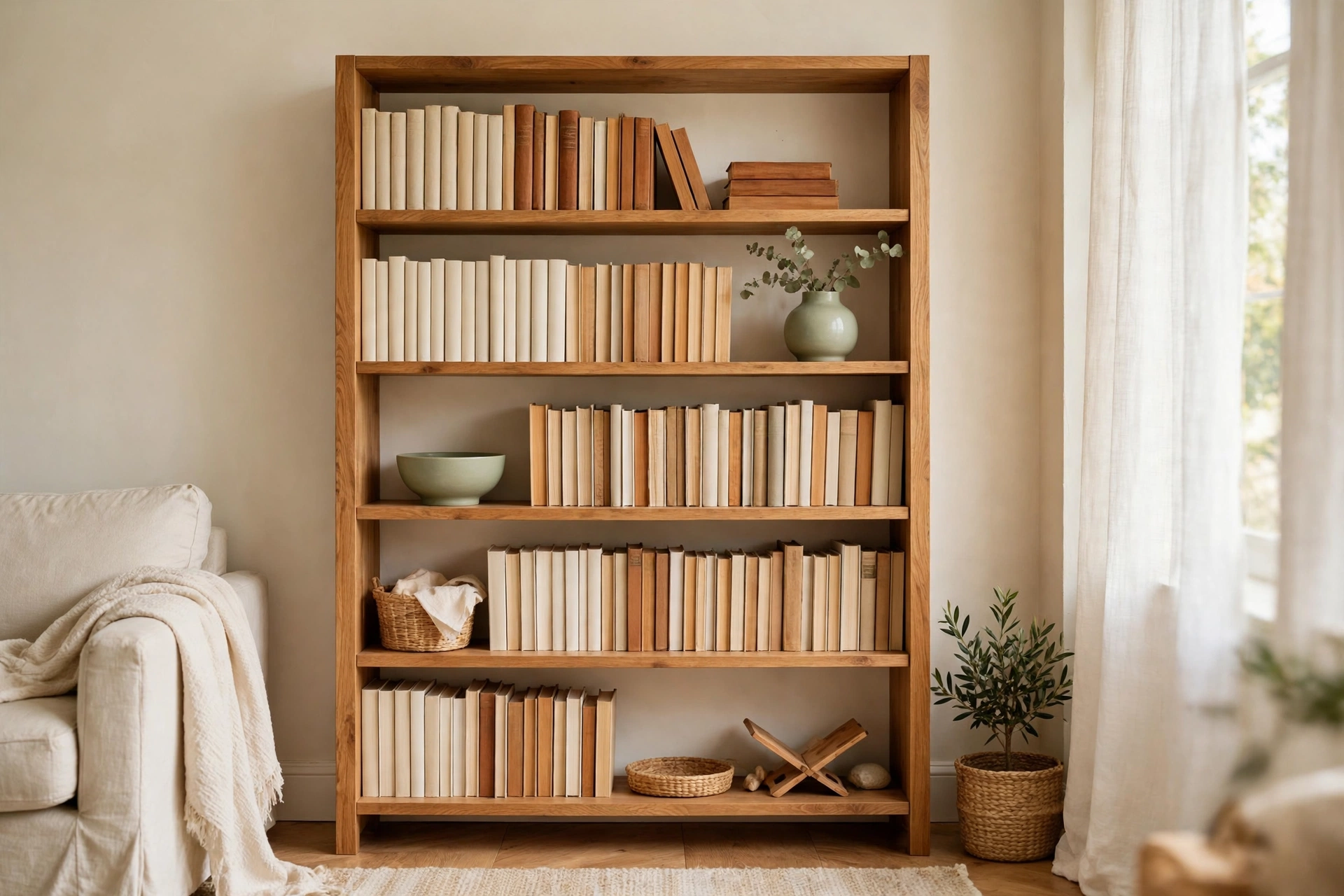
Negative space is the element people forget, and it is the one that separates a styled shelf from a full one. A styled bookshelf is not a storage locker. Designers protect roughly a third of every shelf as breathing room, 25 to 35 percent empty, and that emptiness is what turns a collection into a composition. Leaving space is a big part of how to style a bookshelf so it can breathe.
On a 30-inch shelf, a third empty means 8 to 10 inches of clear space: one open stretch beside a stack of books, one shelf end left bare, or a whole shelf holding a single vase. It feels like wasting space in a small room, but it is the opposite, a packed shelf makes the walls feel closer, while an airy shelf makes the room feel calmer and bigger.
Here is the practical way to do it: after you style a shelf, remove one item from it. Even if you love it. Especially if you love it. Then step back and take a photo on your phone. Clutter is easier to spot on a phone screen than in person, because the camera flattens the shelf and shows you the pattern instead of the individual objects. If the photo looks crowded, remove one more item. If it looks calm, you are done.
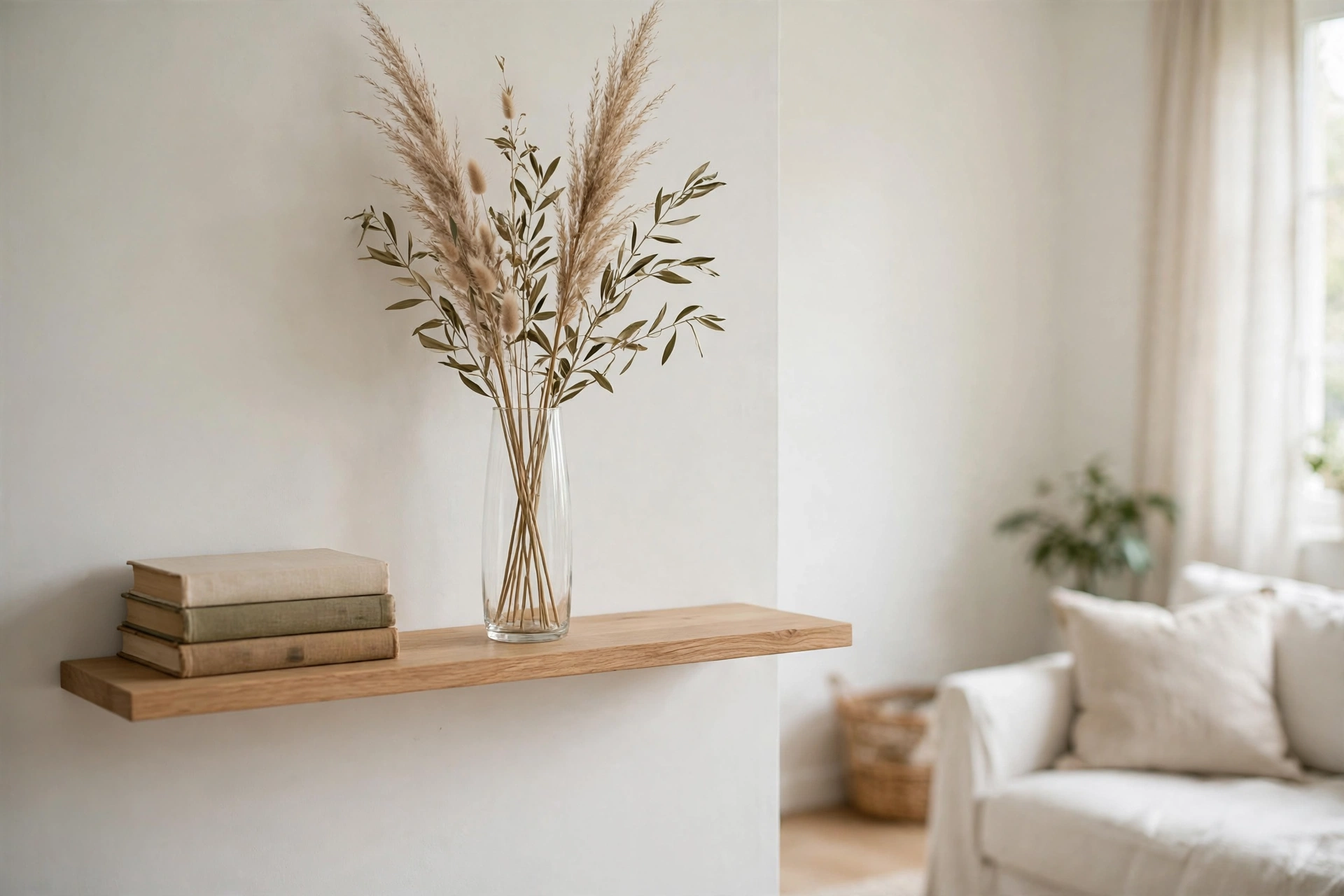
The one exception: a full wall of real books. If you own a few hundred books and read them, let the shelves be full, then give them rhythm by breaking up long runs every few feet with a horizontal stack or one larger object, and keep just the eye-level shelf a little more open.
10. Depth: Lean, Layer, and Pull Things Forward
Flat styling makes shelves look like retail displays, everything in a straight line at the same depth. Depth is what makes a shelf feel like a home, and it costs nothing. Layering is how to style a bookshelf so it looks deep instead of flat.
Work in three layers on the shelves that need it most: a small framed print (5×7 or 8×10 inches) leaned against the back panel, a medium object in the middle, and a small piece 1 to 2 inches back from the front edge. The layered shadows make the composition feel architectural, two or three layered shelves in a whole bookcase are enough.
Leaning is the renter’s best friend: no nail, no hook, no hole. Lean a frame at a slight angle against the back of the shelf, with a stack of books in front to hold it steady. A small leaning mirror (8 to 10 inches wide) bounces light around a small room and doubles the sense of space. Keep heavy leaning pieces below eye level, and never lean anything wider than the shelf is deep.
Pull things forward. Objects pushed to the back of a 12-inch-deep shelf disappear into shadow, so pull the front row 2 to 3 inches forward to catch the light. When a shelf looks crowded, the fastest fix is often pulling everything an inch forward rather than removing something.
11. Style the Top of the Bookcase
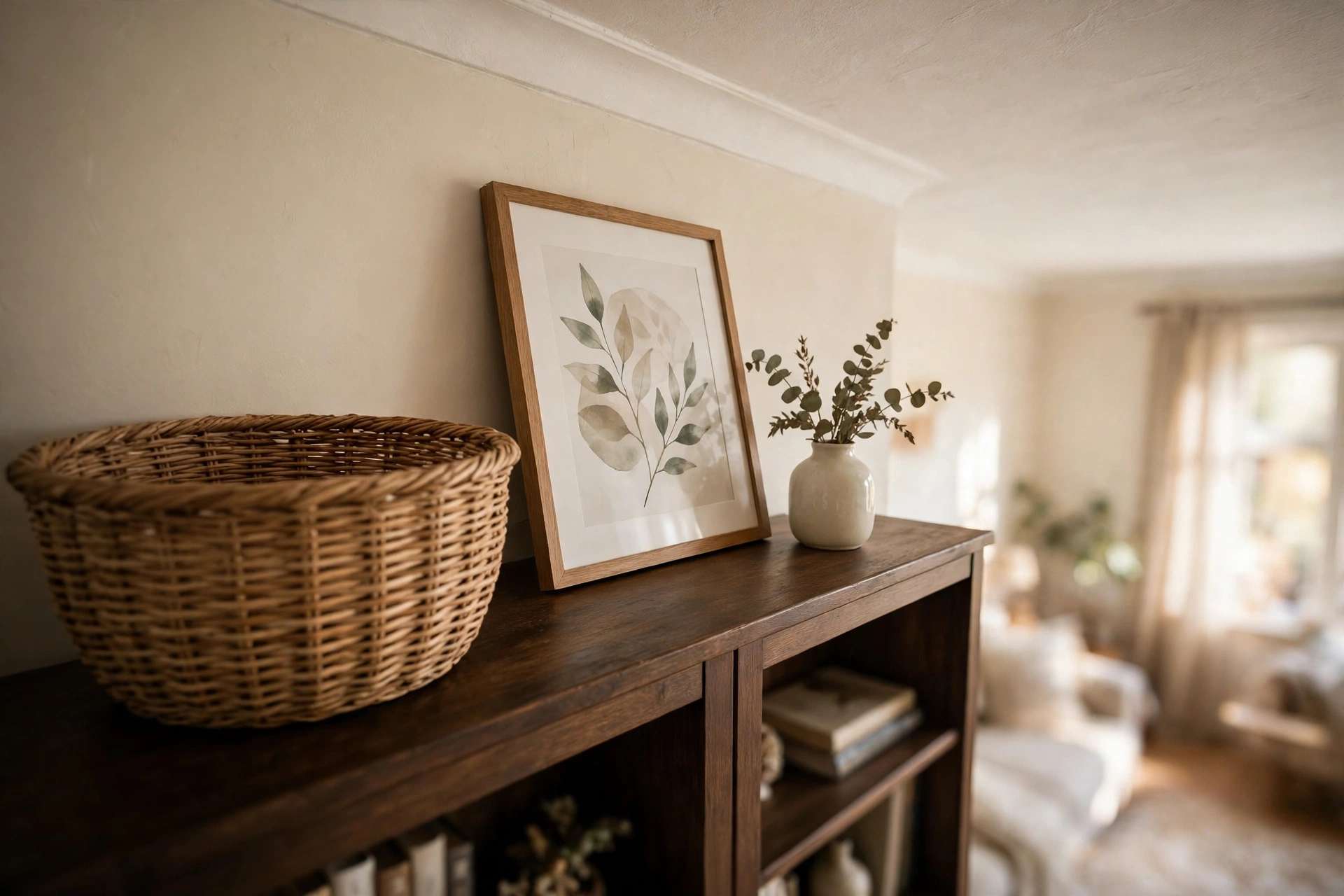
The top of the bookcase is not storage. It is a vignette, the crown of the composition, and it gets one to three larger pieces, never many small ones. If you have ever wondered how to style a bookcase so the top does not become a dumping ground, the answer is one to three large pieces and nothing else. These bookcase styling ideas work whether your unit is thrifted or flat-pack. One generously sized basket, a leaning framed artwork, and a vase will do more than a row of small trinkets. Treat the top as part of how to style a bookshelf as one finished composition.
Leave at least 6 inches of air between the tallest object on top and the ceiling. In a standard 8-foot room with a 6-foot bookcase, that means the top arrangement should stay under 18 inches tall. If the ceiling is low, keep the top arrangement low and wide, a long, low basket or a horizontal stack of books, so the bookcase does not look like it is about to touch the ceiling.
Connect the top to the shelves below by repeating a finish, the metal tone from a bowl, the warm wood of a frame, a color from the rug. And keep the top honest: board games and extra blankets go in one beautiful lidded basket. A lidded basket looks styled; a pile looks like the shelf gave up.
12. How to Style a Bookshelf Without Books
No rule says shelves require books. Most bookshelf decorating ideas assume you own a library; this section is for everyone else. If you own few books, or you want a quieter look, treat each shelf as a small stage and use the same rules with different players. That is how to style a bookshelf without books and still make it feel intentional.
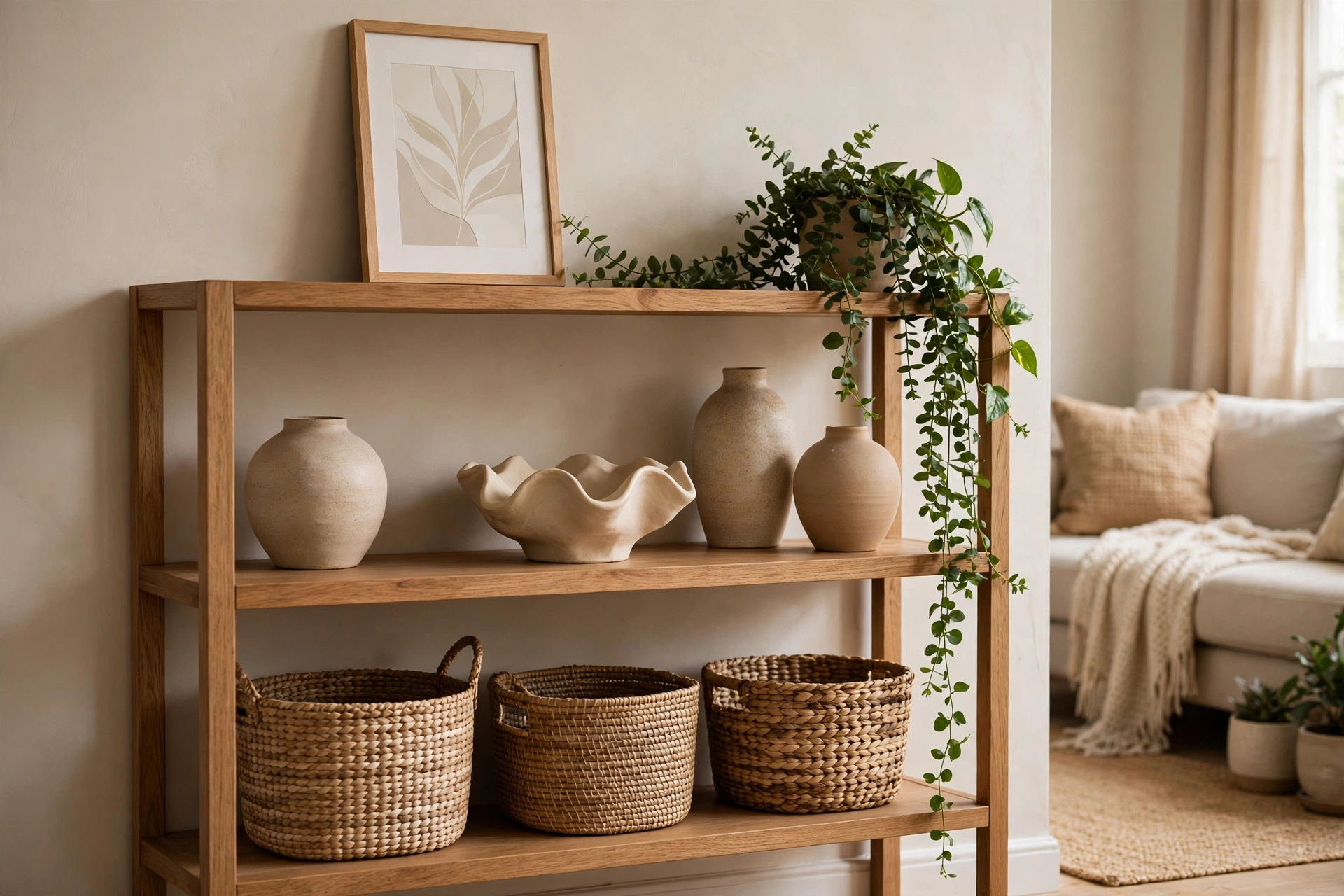
On the bottom shelf, use closed storage: lidded boxes, woven baskets, or sculptural storage jars. The visual weight near the floor grounds the whole piece, and the baskets hide the unglamorous things, chargers, remotes, notebooks, that every living room has. Two matching baskets side by side are calmer than a scatter of mismatched organizers, and a basket 10 to 12 inches wide fits a standard shelf without crowding it.
On the middle shelves, move to form and silhouette. Mix a cylinder with a footed bowl and a low stack of magazines. A single art object centered on an otherwise spare shelf is more persuasive than five smaller trinkets. Group in threes at different heights, a tall vase, a medium bowl, a low stone piece in a loose triangle, and the shelf reads as intentional.
These small bedroom bookshelf ideas use the same approach, softer and more personal, with a low shelf holding a small stack of reading and a simple bowl for glasses or jewelry, and closed boxes for the rest.
13. Small Bookshelf Ideas for Small Living Rooms
A small living room does not need fewer books or less personality. It needs a shelf that fits the wall, a clear color story, and enough empty space for the eye to rest. These small shelf decor ideas work hardest in tight rooms, and they are the core of how to style shelves in living room layouts where floor space is the scarcest resource. Fit, not fewer books, is the key to how to style a bookshelf in a small living room.
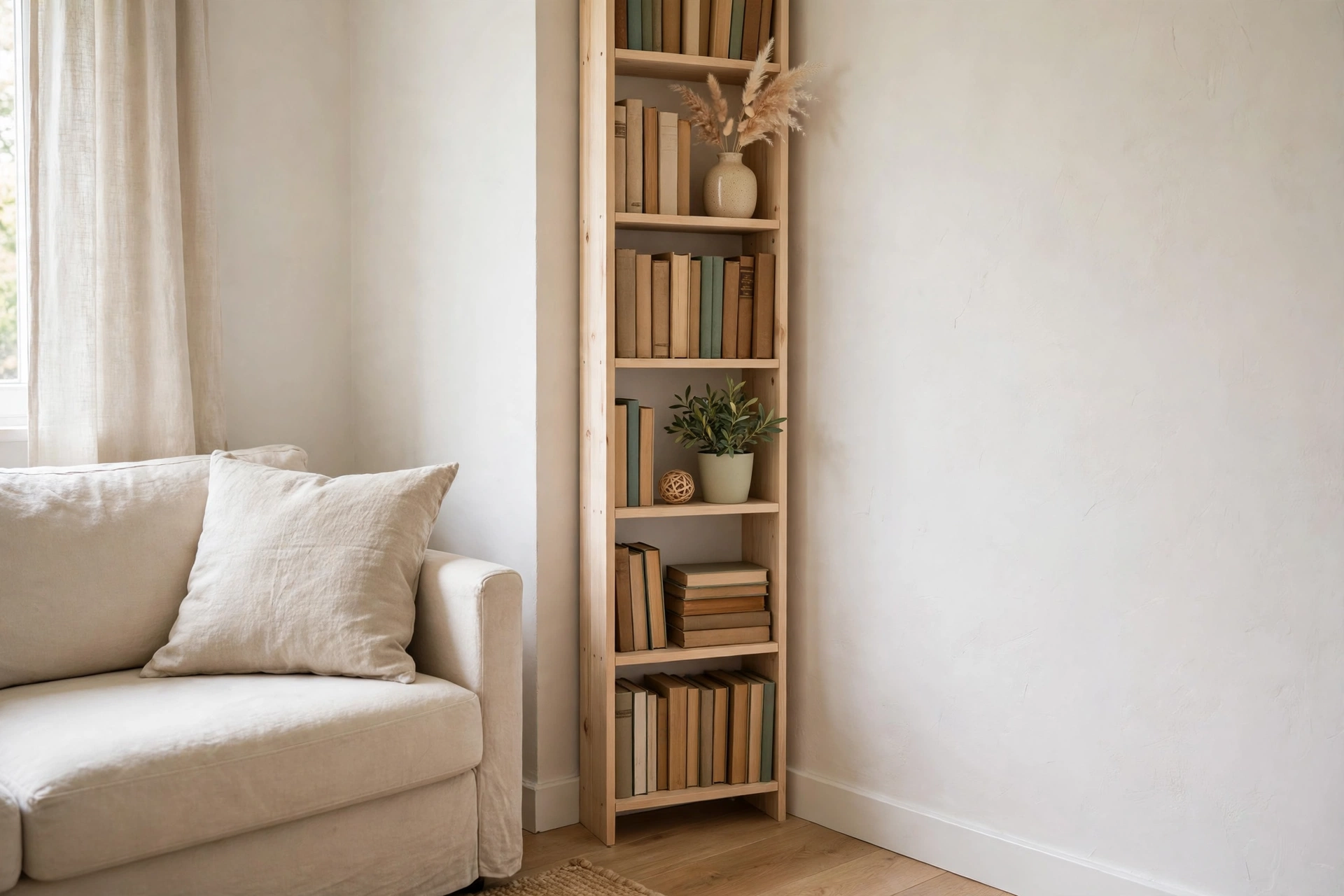
Go tall and narrow instead of wide and low. Small bookshelf decor ideas start with the unit itself: a tall, narrow bookcase uses wall space instead of floor space and draws the eye upward, which makes the ceiling feel higher. Choose a unit no deeper than 10 inches if you can, standard bookcases run 12 inches deep or more, and that extra depth is exactly what makes a small room feel cramped.
Style one shelf at a time, top to bottom. Finish a shelf, step back, then move to the next one. Plan for the bottom shelves first, two woven baskets on the lowest shelf, books above, display in the middle.
Use the wall beside the shelf, not just the shelf. A leaning mirror beside the bookcase or a small plant on the floor next to it extends the composition without adding another piece of furniture. And if the whole room is tight, our small apartment living room ideas cover the room-level numbers, sofa width, walkways, and rug size, that decide whether any single piece of furniture actually fits.
DIY bookshelf ideas for small spaces do not need to mean building furniture. The best small-space DIY is a rearrangement: move the shelf to the short wall, turn it sideways as a room divider, or swap a deep bookcase for two narrow ladder shelves flanking the TV. A ladder shelf leans, no drilling, and its open frame keeps a small room feeling open. Cost: $0 if you move what you own, $25 to $60 secondhand for a narrow tower or ladder shelf.
14. Light: The Cheapest Designer Trick
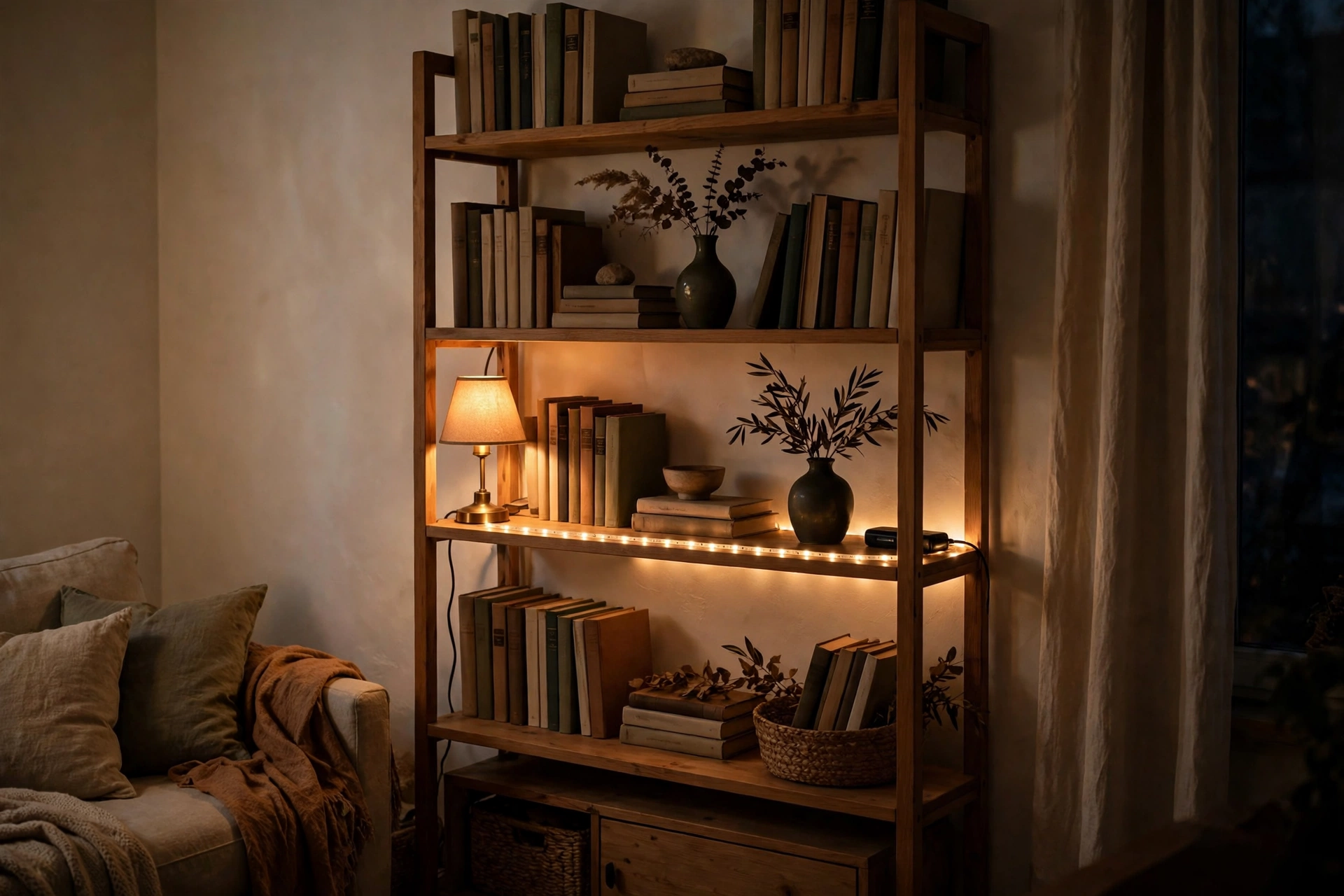
Light changes how objects read, and a dark shelf makes even good styling look muddy. You do not need wiring. A small plug-in lamp on one shelf, a battery LED strip tucked under a shelf lip, or a nearby floor lamp aimed upward can lift the entire arrangement. Good light is the cheapest part of learning how to style a bookshelf that photographs well.
A battery LED strip costs about $8 to $15, sticks with adhesive backing, no holes, no wiring, and peels off cleanly when you move out. Run it along the underside of a shelf so the light washes down the books instead of shining in your eyes. Buy warm white (2700 to 3000K); cool white makes wood look gray. One strip on the eye-level shelf is enough, lighting every shelf looks like a shop window.
Keep cords hidden behind the case or routed through adhesive cable clips ($5 to $8 for a pack). And check the shelf from the sofa after dark, the shelf you see in lamplight is the one you live with.
15. The Under-$150 Budget Breakdown
You do not need to buy a new bookcase to learn how to style a bookshelf like a pro. You need a few supporting pieces, and almost all of them are cheaper secondhand than new. Here is a realistic budget for a full refresh, using thrifted and secondhand prices you can actually find in most US cities:
- Two woven baskets (bottom shelf storage): $8 to $15 each, $16 to $30 total
- One substantial ceramic vase, thrifted: $5 to $12
- One small framed print or leaning art, thrifted frame + print: $5 to $15
- One trailing faux plant or small potted plant: $8 to $15
- One bowl or stoneware piece: $4 to $10
- Battery LED strip light, warm white: $8 to $15
- Adhesive cable clips and non-slip shelf liner: $5 to $10
- Two or three beautiful books from a thrift store, if you need display copies: $2 to $5 each
Total: roughly $55 to $115, and the books you already own, the objects in your cupboards, and the frames on your walls cost $0 and do most of the work. If your budget is tighter, buy in this order: baskets first (they hide the mess), then the vase, then the light. If you already own everything on the list, the whole project costs $0 and one afternoon. That is the best version of diy bookshelf decor ideas: no new furniture, one afternoon, and a shelf that finally looks finished.
16. Renter-Friendly Rules: No Drilling, No Damage
Everything in this guide is renter-safe, because a styled shelf should never cost you a deposit. The rules are short: Every trick here shows how to style a bookshelf without drilling a single hole.
- Lean, don’t hang. Frames, art, and mirrors lean against the back panel or the wall. Nothing needs a nail.
- No adhesive on walls or wood. LED strips and cable clips stick to the shelf itself, not the wall, and only where the adhesive is made to peel off cleanly. Never use double-sided tape on a painted wall or a wood finish.
- Use non-slip shelf liner. A roll costs $5 to $8 and stops vases and stacks from sliding when someone bumps the case. Cut it 1 inch smaller than the shelf on each side so no edge shows.
- Anchor tall units the renter-safe way. A loaded 6-foot bookcase is heavy. If your landlord allows it, use the included anti-tip hardware into a stud. If not, keep the case bottom-heavy, heaviest books on the bottom two shelves, nothing heavy above eye level, and keep freestanding shelves under 60 inches tall where possible. Bottom-heavy cannot tip the way top-heavy can.
17. Common Mistakes to Avoid
These bookshelf styling tips are really a list of things to stop doing, fix one, and the shelf improves at once. Fixing one mistake at a time is the simplest way to learn how to style a bookshelf that looks calm.
Filling every shelf edge to edge. The most common mistake, and the easiest to fix. A fully packed shelf looks cluttered even when the objects are beautiful. Leave a third of every shelf empty.
Using only one texture. All books, or all ceramics, with nothing to break it up. Mix at least three textures per shelf, wood, ceramic, and one organic texture, and the shelf comes alive.
Grouping in even numbers. Pairs and rows of four look stiff and lined up. Group in threes or fives, in loose triangles, and vary which side the tall piece sits on.
Too many small objects. Five tiny trinkets do less than one substantial vase. Swap a cluster of small things for one larger piece, and the shelf instantly looks calmer and more expensive.
FAQ
How do you style a bookshelf with a lot of books?
Lean into it. Edit out the books you won’t read again, then fill the shelves with the rest, mixing upright rows with a horizontal stack every few feet. Break up long runs with a framed print or one larger object, and keep just the eye-level shelf a little more open.
How many decorative objects should go on a bookshelf?
There’s no magic number, but fewer and bigger almost always beats lots of small pieces. On a full library wall, an object every few feet adds rhythm; on a display shelf, one or two larger pieces with space around them does the trick. As a ceiling, keep it to three decorative objects per shelf, including plants.
How do you make a bookshelf look less cluttered?
Start with the books, not the decor. Donate what you don’t reach for, swap a cluster of small trinkets for one larger piece, and leave about a third of one shelf empty. Then take a photo, clutter is easier to spot on a phone screen than in person. If it still looks crowded, remove one more item from each shelf.
Should books be arranged by height?
It helps. Tallest and heaviest books on the lower shelves keep the bookcase grounded, and ordering books tallest to shortest within a run looks calm. Just vary which end of each shelf the tall books start on, so the whole case doesn’t slope the same way.
What can you put on a bookshelf besides books?
Pieces with a story work best: framed photos or small prints leaned against the back, something inherited, or a souvenir from a trip. A substantial vase, a small lamp, or LED strip lights add shape and warmth without crowding the books, and baskets on the lower shelves hide remotes and chargers.
What’s the simplest way to style a bookshelf if I’m overwhelmed?
Use the anchor, layer, edit routine: a few substantial pieces, supporting objects with varied heights, then remove something from each shelf. Keep about a third of the shelf empty. If even that feels like too much, style just the eye-level shelf today and one more tomorrow. That routine is a gentle way to learn how to style a bookshelf when you feel overwhelmed.
How do I style a bookshelf with books and objects so it doesn’t feel messy?
Alternate vertical rows of books with occasional horizontal stacks. Tuck smaller objects onto those stacks, keep larger items as anchors, and repeat your palette three times across the bookcase so the whole unit reads as one composition instead of six separate shelves.
Can I style a bookshelf without books and still make it feel authentic?
Yes. Treat each shelf as a vignette: closed storage low, sculptural forms in the middle, light and airy pieces up top. Repeat wood, stone, and ceramic up the shelves, and fill only half to two-thirds of each shelf so objects can breathe. A shelf of objects you love beats a shelf of books you never read.
How much negative space is enough?
Aim for roughly 30 to 40 percent open space per shelf, on a 30-inch shelf, that is 8 to 10 inches clear, about one open stretch per shelf. It sounds generous, but that breathing room is what makes styling look professional.
Should I organize books by color or subject?
Both work. Color creates visual cohesion for open living rooms where the shelf is always visible; subject makes books easier to find for avid readers. The compromise: organize most books by subject or size, use color to group within categories, and keep one display shelf color-coordinated.
What if I don’t have enough books to fill my shelves?
Use baskets or decorative boxes on some shelves to hide storage, throw blankets, office supplies, the things that would otherwise clutter the room. Mix open styled shelves with closed storage shelves, or embrace minimalism: fewer books styled well beats shelves packed with books you don’t care about.
How do I make cheap bookshelves look expensive?
Style them well. Even a basic flat-pack bookcase looks elevated with the right mix of books, objects, and space. Remove any cheap-looking backing or paint the back panel a soft contrasting color, add non-slip shelf liner, and follow the rule of threes with one substantial object per shelf.
Start Today
You do not need a new bookcase, a design degree, or a shopping trip to learn how to style a bookshelf. You need one afternoon, the books you already own, and the rules in this guide: books first, groups of three, heights that rise and fall like a skyline, a tight color palette repeated across the shelves, and a third of every shelf left gloriously empty. Start with the eye-level shelf, one tall vase, one stack of three books, one low bowl, and eight inches of breathing room, and take a photo. When that one shelf looks like a designer styled it, you will know exactly what to do with the rest. The shelf is already yours. Now make it look like it. Start with one shelf today, and you will see how to style a bookshelf is a skill you build shelf by shelf.