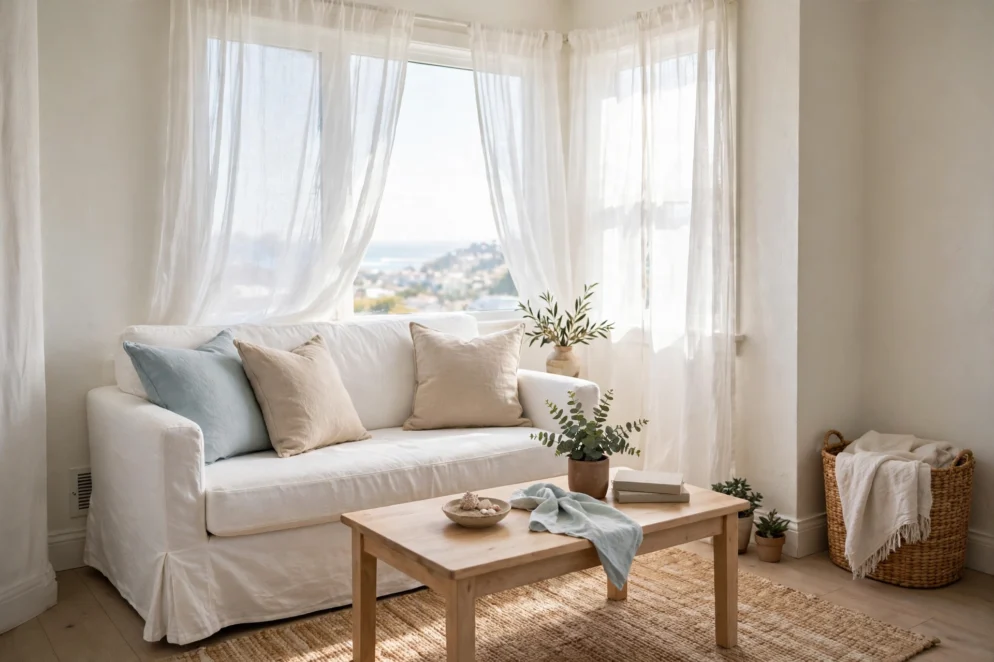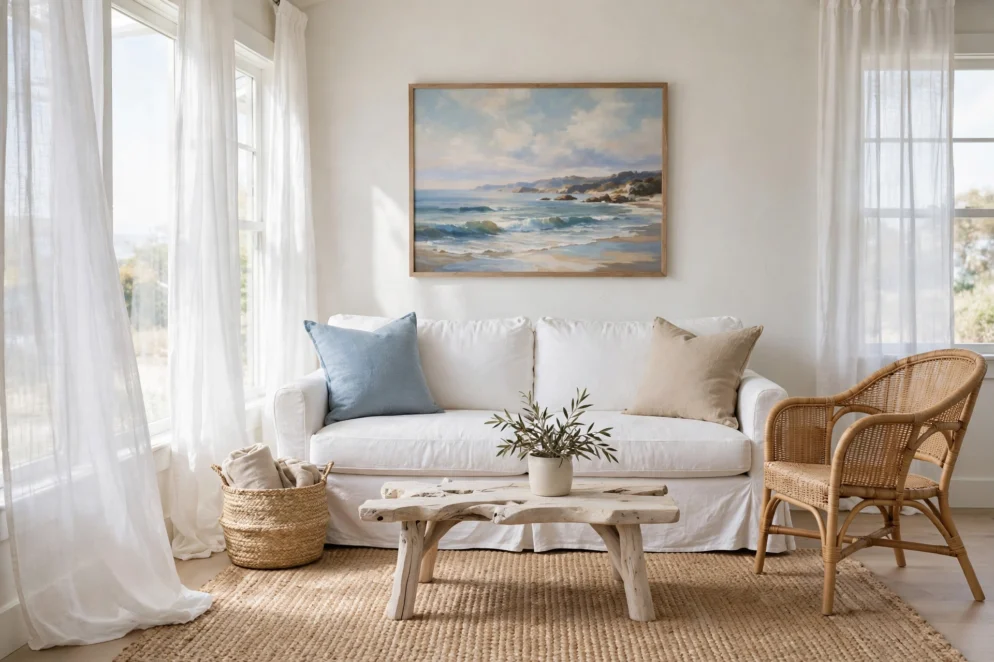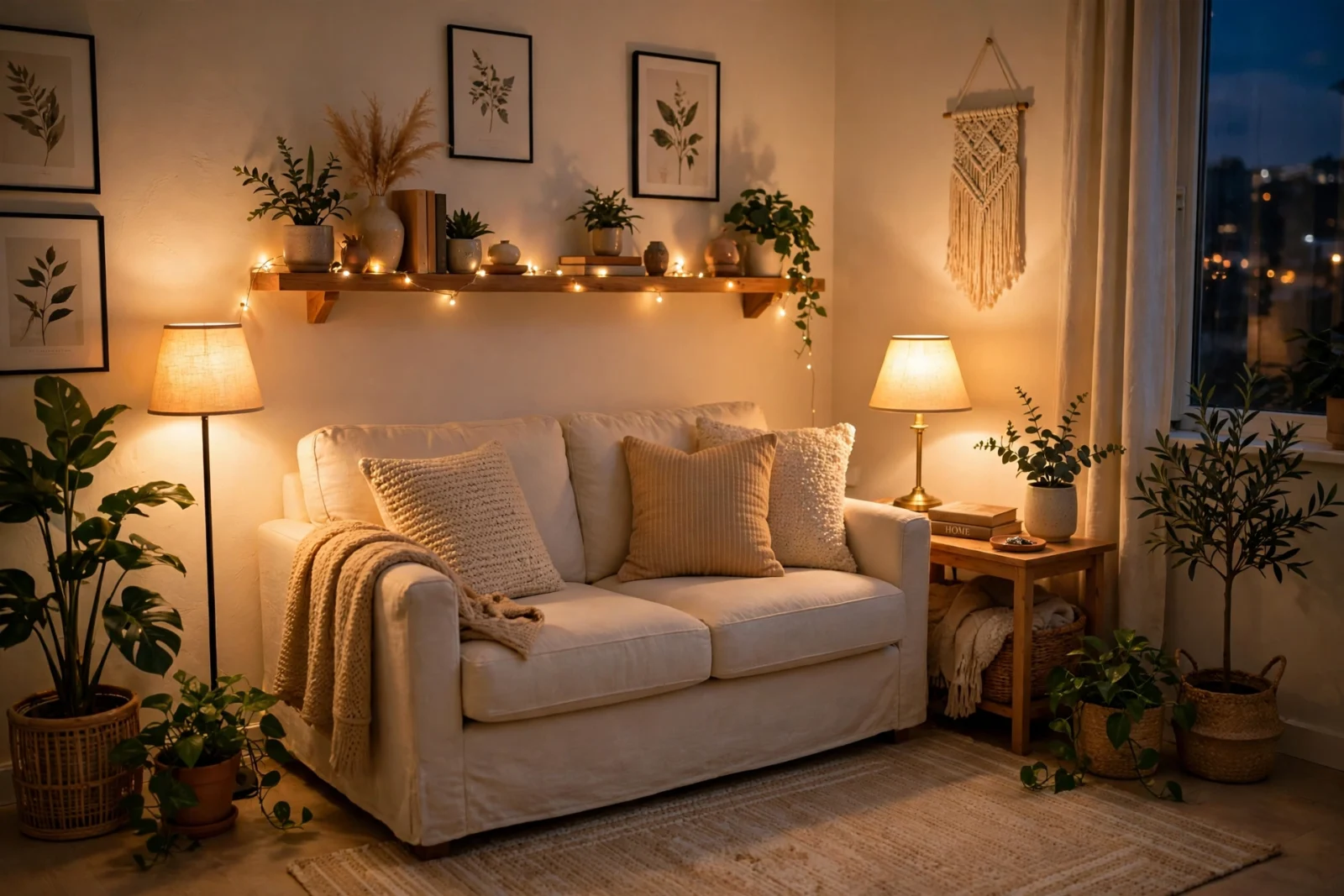
Good living room lighting is the fastest way to make a small rental feel bigger, faster than a new sofa, cheaper than paint, and it needs no drilling, no hardwiring, and no landlord permission. Most small living rooms come with one ceiling bulb and nothing else. That single light throws hard shadows into the corners, flattens every color, and makes the walls close in. The fix is not one brighter bulb. It is three or four small, warm lights at different heights, and this guide shows you exactly where each one goes, how tall it should be, and what the whole refresh costs.
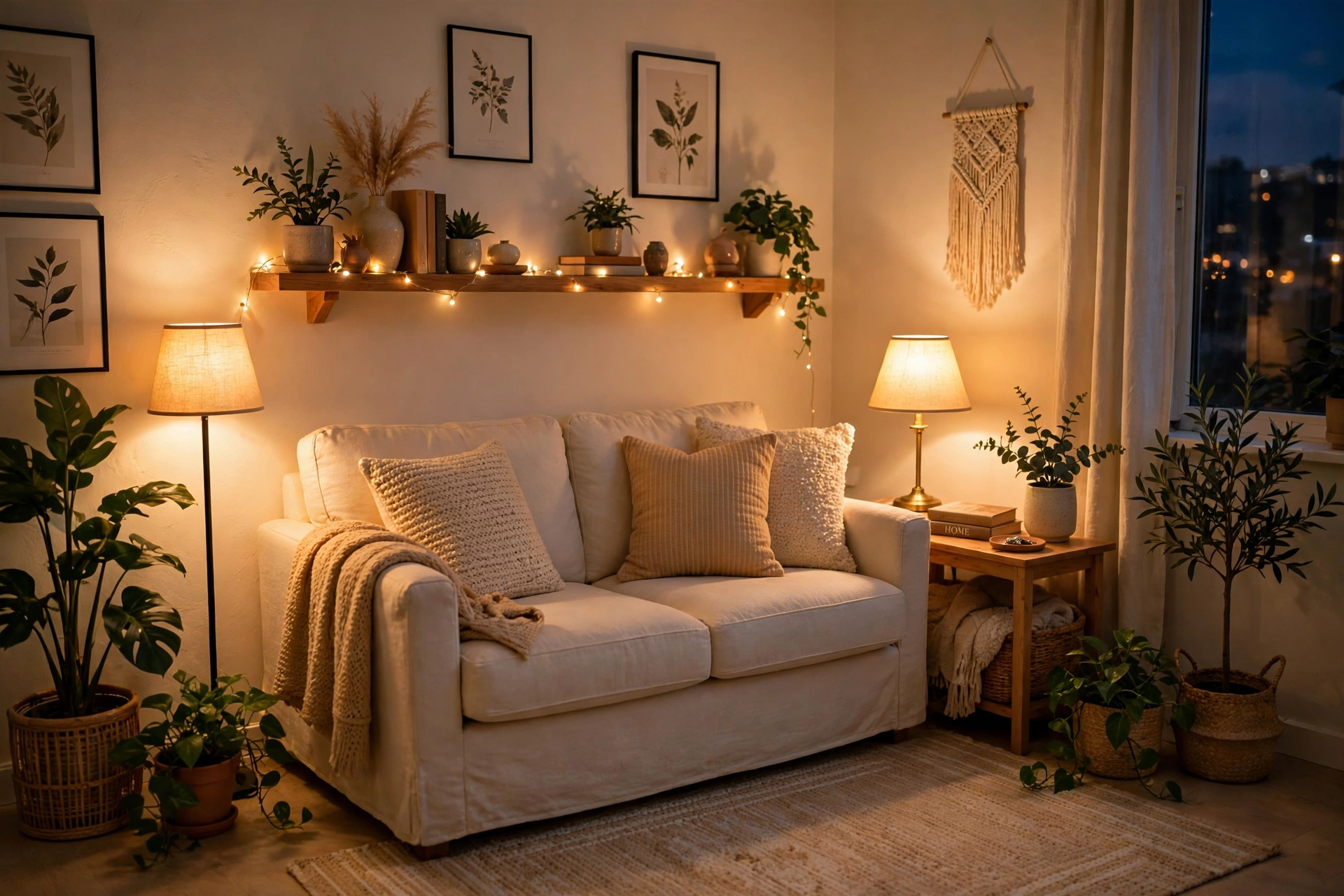
Table of Contents
The numbers first
Best for: every idea in this guide, six numbers decide whether your room lights work or fight each other.
- How many lights: a small living room needs 3 to 5 light sources at different heights. Fewer than 3 and the corners stay dark; more than 5 in a room under 150 square feet starts to feel like a shop display.
- How bright: aim for 10 to 20 lumens per square foot, or roughly 1,200 to 2,400 lumens total in a 120-square-foot room (10 by 12 feet). A standard 60-watt-equivalent LED bulb gives about 800 lumens, so two or three lamps plus the ceiling light gets you there.
- Bulb warmth: 2700K to 3000K warm white in every lamp. 2700K is candle-warm and cozy; 3000K is a touch cleaner and still warm. Anything 4000K and up looks like office lighting and makes white walls look grey.
- Sconce height: the center of a wall sconce sits 60 to 66 inches from the floor beside a sofa, or about 28 to 30 inches above the seat you sit in.
- Table lamp height: the bottom of the shade should sit at about your seated eye level, 42 to 48 inches off the floor. On a 24-inch side table, that means a lamp 22 to 28 inches tall.
- Floor lamp height: a straight floor lamp should be 58 to 64 inches tall; a torchiere runs 68 to 72 inches so its light clears the sofa and bounces off the ceiling.
Measure the room, the side table, and the sofa before you buy anything. Lighting is a set of measurements, not a shopping list. Those measurements keep your living room lighting sized to the room, not to the box.
Why layered lighting makes a small room feel bigger
One ceiling light makes a small room feel smaller for a simple reason: it lights the middle of the room and leaves the corners dark, so your eye reads the dark corners as the walls closing in. Layered living room lighting does the opposite. Light at three heights, high, middle, and low, fills every corner, so the eye keeps traveling and the room reads wider, taller, and deeper than it is. For a designer’s take on the same approach, see this guide to layering living room lighting.
The three layers are simple:
- Ambient light is the general wash that lets you move around safely. In a rental, it usually comes from the ceiling fixture you already have, plus one tall floor lamp.
- Task light is focused light for what you actually do: reading on the sofa, scrolling on your phone, working on a laptop. A table lamp or a reading lamp beside your seat does this job.
- Accent light is the quiet layer, small pools of warm light on a shelf, behind the TV, or washing a wall. It adds depth, and depth is what makes a small room feel designed instead of cramped.
You do not need to buy all three layers at once. Start with the layer you are missing. Most rentals are missing the middle and the low light, so that is where this guide starts. For the rest of the room, the rug, the layout, the seating, see our small apartment living room ideas, which plans the whole 10 by 12 foot room around the same renter-friendly rules. Pick the layer your living room lighting is missing most.
1. Swap the bulbs first, the $10 change
Best for: the fastest change in this guide, five minutes, no tools, no new lamp. It is the cheapest first step for better living room lighting.
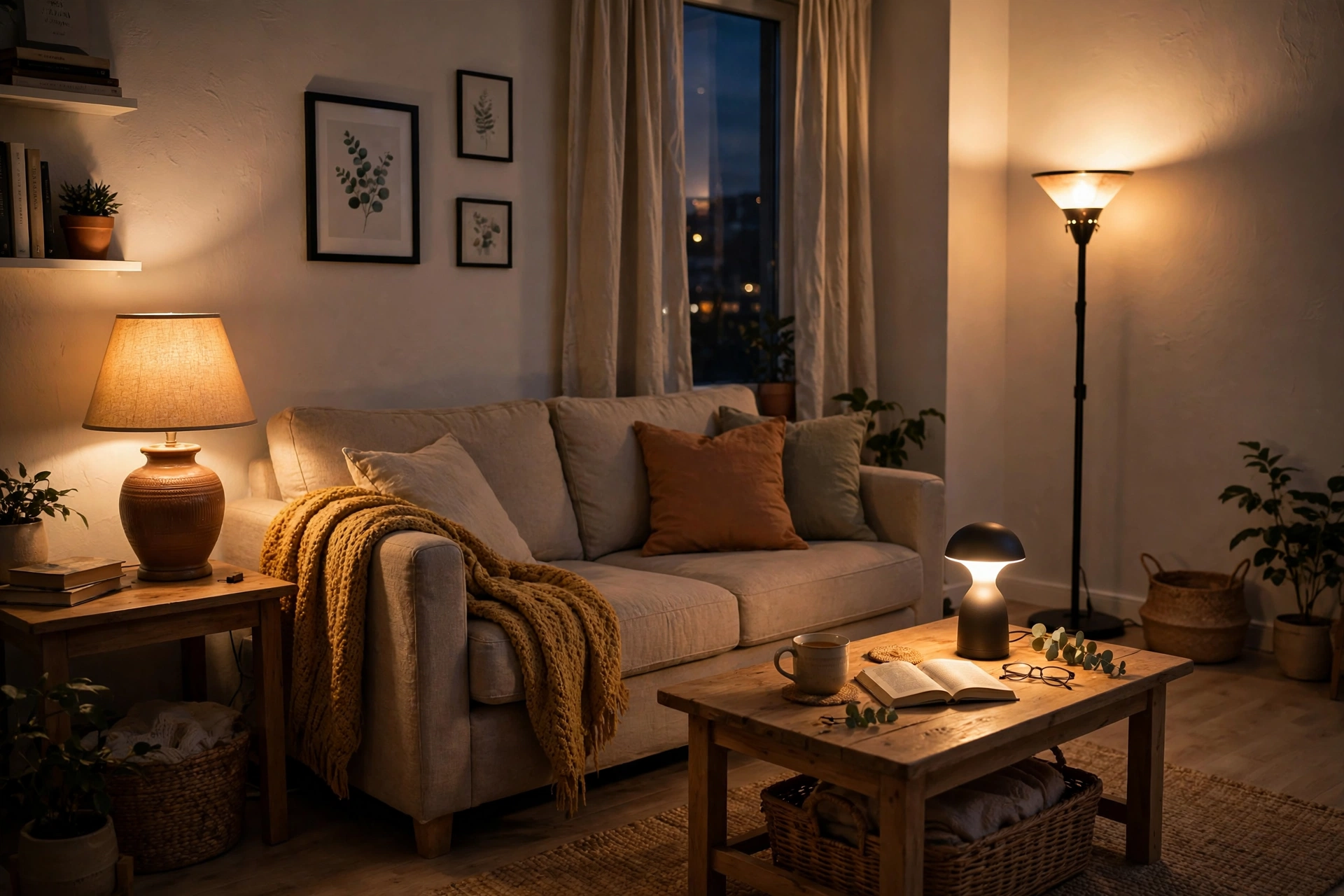
Before you buy a single fixture, change what is already in the sockets. Most rentals come with cool white or daylight bulbs, and one cool bulb undoes three warm ones. Swap every bulb in the living room, including the one in the hallway you can see from the sofa, for warm white LEDs at 2700K. It is the quickest win in all of living room lighting.
- What to buy: LED bulbs labeled warm white, 2700K to 3000K, about 800 lumens each (the 60-watt equivalent). A pack of four costs $5 to $8.
- Dimmable matters: if your ceiling fixture is on a dimmer, buy dimmable bulbs. A non-dimmable LED on a dimmer flickers and buzzes. If there is no dimmer, a plug-in dimmer switch (idea 11) fixes that for $10 to $15.
- Match them all: every bulb in the room should be the same warmth. Mixed warm and cool bulbs make the room look like two different rooms stitched together.
- What to watch: do not buy the brightest bulb you can find. One 1,600-lumen bulb in a small room creates a harsh pool of light and dark edges. Two 800-lumen bulbs in two lamps beat one very bright bulb every time.
Budget: $5 to $8 for a pack of warm bulbs. This is the cheapest mood in this guide, and the one most rentals are missing entirely. It is a small price for noticeably better living room lighting.
2. A torchiere in the darkest corner
Best for: the ambient layer, the closest thing to a ceiling light that needs no ceiling work at all. It is the simplest way to add real living room lighting without touching the ceiling.
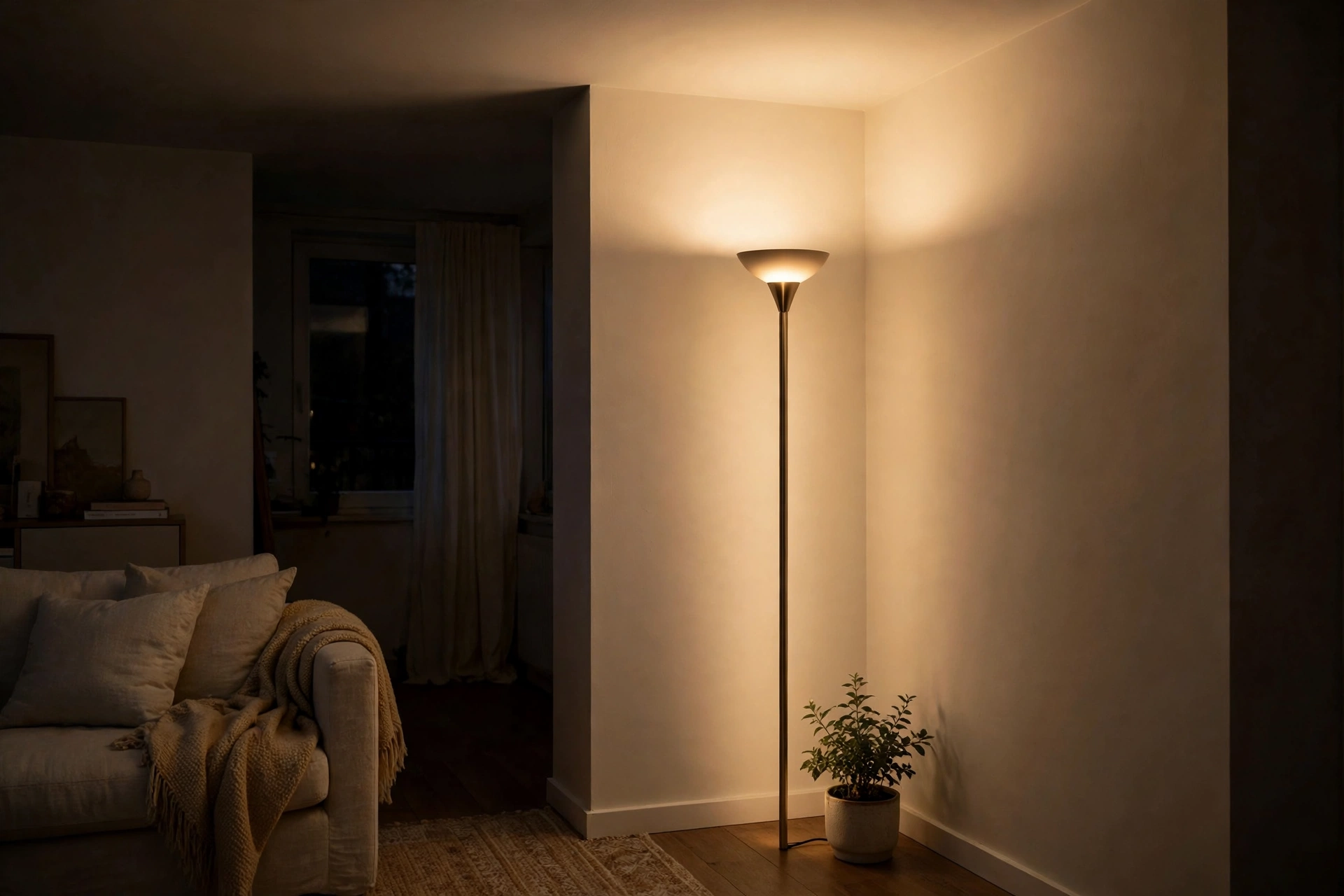
A torchiere is a tall floor lamp that points straight up. Its light hits the ceiling and bounces back down as a soft, even wash, which is exactly what a ceiling fixture does, except this one plugs into a wall outlet and moves with you when you move out. Put it in the darkest corner of the room, the one farthest from the window, diagonally opposite your main seat. For a rental, that bounce is the secret to soft, even living room lighting.
- Size: a torchiere should be 68 to 72 inches tall so the light clears the top of the sofa and reaches the ceiling. Shorter than 66 inches and the light hits the back of the sofa instead of the ceiling.
- Placement: tuck the base 6 to 12 inches from the corner walls, behind or beside the sofa arm. The base should sit flat on the floor, not on the rug edge, so the lamp cannot wobble.
- Brightness: look for 1,800 to 2,200 lumens on the brightest setting, that is your main ambient source for the whole room. A dimmable torchiere is worth the extra few dollars because it doubles as your evening mood light.
- What to watch: do not put a torchiere where someone walks past it in the dark. The base is narrow, so it belongs in a corner or behind furniture, never in a walkway. And keep the top of the lamp at least 12 inches below the ceiling so the light has room to spread.
Budget: a basic torchiere costs $25 to $40 new, $10 to $20 secondhand. One torchiere plus warm bulbs is often enough ambient light for a whole 10 by 12 foot room. That is solid value for living room lighting that covers the whole room.
3. Plug-in sconces flanking the sofa
Best for: the mid-height layer, wall light that frees up your floor and your side tables. They add mid-height living room lighting exactly where the sofa needs it.
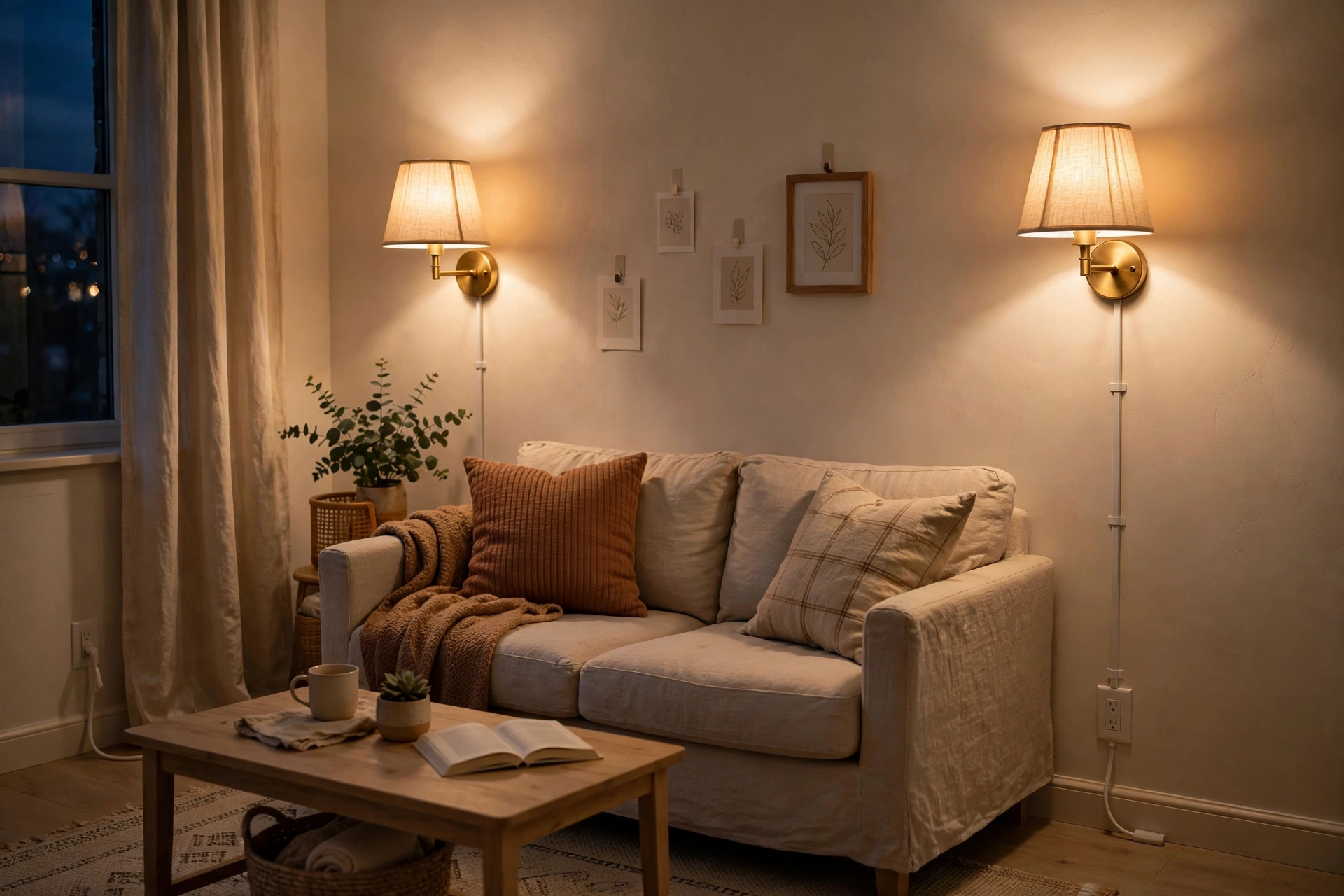
Plug-in wall sconces are the renter’s best lighting trick. They look exactly like hardwired sconces, but they mount with adhesive strips or a single small screw and plug into a standard outlet. Two matching sconces flanking the sofa give you light at eye level, which is the height a ceiling bulb never reaches, and they take up zero floor space. For renters, they are one of the most flexible pieces of living room lighting.
- Height: mount them so the center of the shade sits 60 to 66 inches from the floor, about shoulder height when you are sitting on the sofa. Too high and they light the ceiling; too low and they glare in your eyes.
- Spacing: place each sconce 12 to 18 inches out from the sofa’s arms, or 24 to 30 inches from the center of a piece of art they flank. A pair should be symmetrical, two matching sconces look deliberate, one alone looks like an afterthought.
- The cord: the one thing people hesitate about is the cord. Run it down the wall in a slim paintable cord cover ($8 to $12), or tuck it behind the sofa. Once a cord cover is painted the wall color, it disappears.
- No-drill mounting: use large picture-hanging strips rated for the sconce’s weight, usually 3 to 5 pounds. Press and hold for 30 seconds, then wait an hour before hanging the fixture. On textured walls, strips do not hold, use a single small screw in that case and fill the hole with spackle when you move out.
- What to watch: do not mount a sconce directly above a seat where someone leans back. The shade should sit at least 6 inches clear of the sofa back so nobody bumps it, and the bulb should be shaded from seated eye level.
Budget: a pair of plug-in sconces costs $30 to $60 for budget styles, $40 to $80 for a set of two with linen shades. Cord covers add $8 to $12. That is a fair price for living room lighting you will use every evening.
4. A table lamp at reading height
Best for: the task layer, the lamp that makes the sofa usable after dark. It is the workhorse of everyday living room lighting.
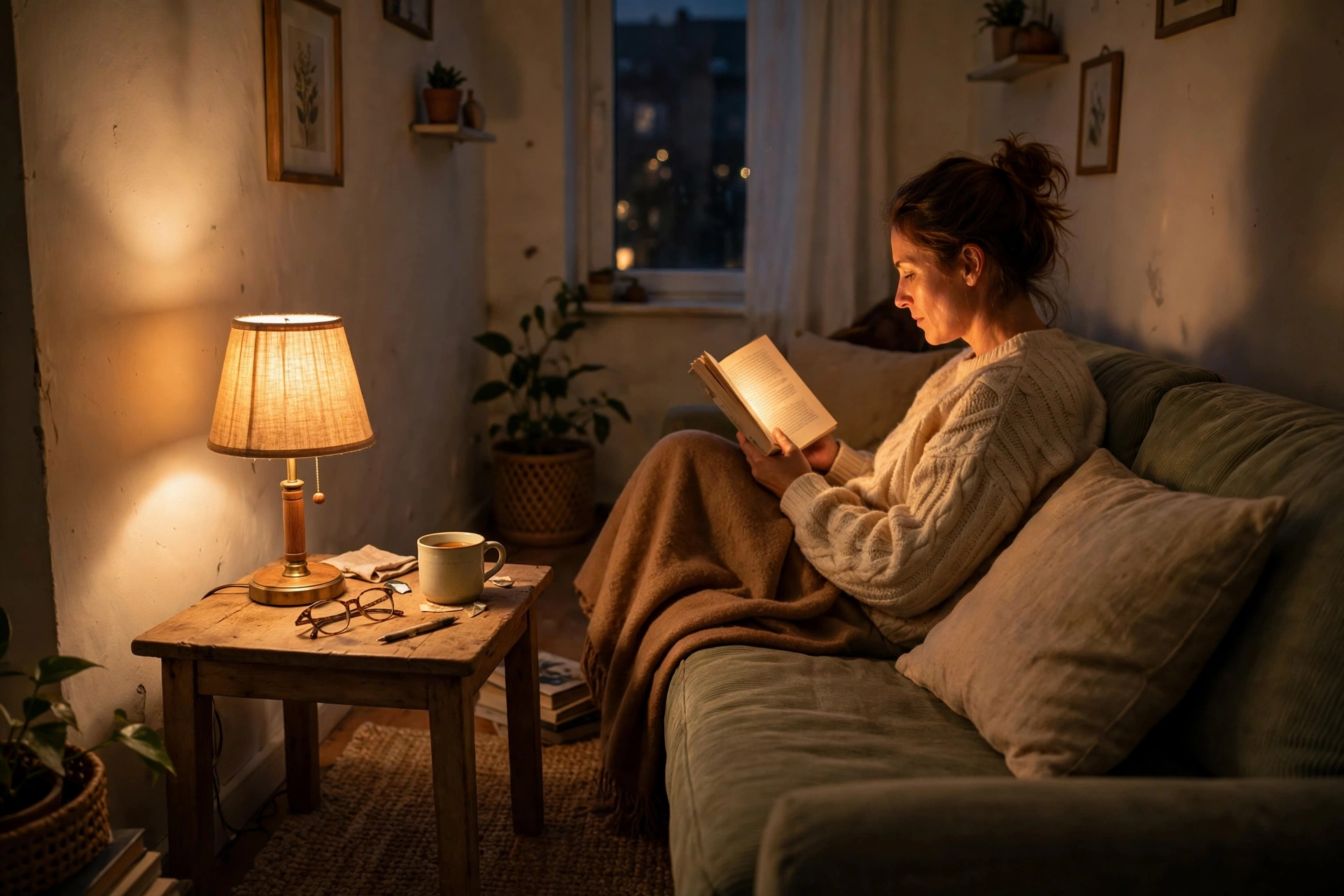
A table lamp beside the sofa is the most-used light in most living rooms, and the one most people get wrong by buying too short or too tall. The rule is simple: the bottom of the shade should sit at your seated eye level, so you see the page and not the bulb. Getting the height right is what makes living room lighting comfortable to read by.
- Height: on a standard 24-inch side table, the lamp should be 22 to 28 inches tall, putting the shade bottom at 42 to 48 inches off the floor. On a taller console (30 to 32 inches), a shorter lamp of 18 to 22 inches works better.
- Placement: set the lamp 6 to 12 inches from the sofa arm, on the side of your dominant reading hand if you read there. The light should fall over your shoulder onto the book, not into your eyes.
- Shade size: the shade should be about two-thirds the height of the lamp base, and its widest point should be no wider than the table it sits on. A shade that overhangs the table edge gets knocked over.
- Brightness: 400 to 800 lumens is comfortable for reading, a 40- to 60-watt-equivalent bulb at 2700K. Brighter than that and the lamp glares; dimmer and you squint.
- What to watch: do not put the only table lamp behind the TV. The glare on the screen ruins the picture and the lamp lights nothing you sit in. And do not mix a cool bulb in this lamp with warm bulbs everywhere else, one cool bulb undoes the whole room.
Budget: a thrifted table lamp costs $10 to $20, a new budget one $20 to $35. Warm bulbs cost $3 to $5 each. A thrifted lamp is the cheapest way to upgrade your living room lighting.
5. An arc lamp over the sofa
Best for: rooms with no ceiling light at all, an arc lamp is a pendant light that plugs in. It brings pendant-style living room lighting to a room with no ceiling fixture.
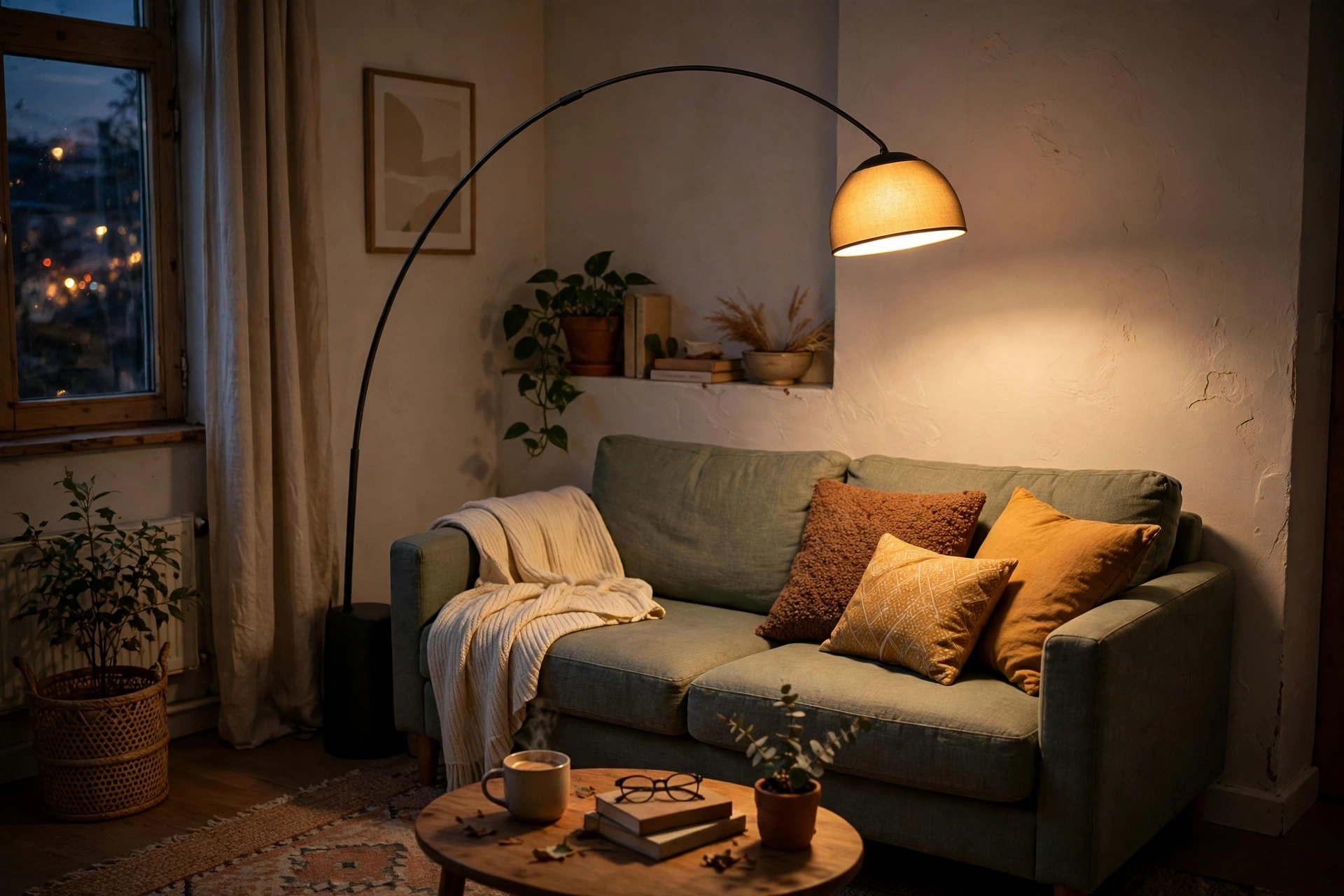
An arc floor lamp has a thin, sweeping stem and a heavy base that tucks behind the sofa, with the light hanging over the coffee table or the seating area like a pendant. It is the renter’s answer to a missing ceiling fixture, and it does the job of both an ambient light and a reading light. That sweep is what makes living room lighting feel intentional, not improvised.
- Size: the arc should reach 72 to 84 inches tall, with the shade hanging 60 to 66 inches above the floor, high enough to clear your head when you stand up from the sofa, low enough to feel like a pendant.
- Placement: tuck the base behind the sofa corner, 6 to 12 inches from the wall, and let the arm reach 24 to 36 inches out over the coffee table or the seat. The shade should sit roughly above the center of the coffee table.
- What to watch: arc lamps are top-heavy, so the base must sit flat on a hard floor or a low-pile rug, never on a thick rug edge. Keep the walkway clear of the stem, and do not hang the shade lower than 60 inches or tall guests will bump it. In a room under 120 square feet, a slim arc lamp beats a wide one: look for a base under 12 inches across.
Budget: a budget arc lamp costs $40 to $70 new, $20 to $35 secondhand. It is the priciest single piece in this guide, so buy it only if you have no ceiling light at all, otherwise a torchiere does the same ambient job for less. It is worth the spend when it is your only overhead living room lighting.
6. LED strips behind the TV and under shelves
Best for: the accent layer, the glow that makes the wall behind the TV feel farther away. It is the accent layer that makes living room lighting feel deeper.
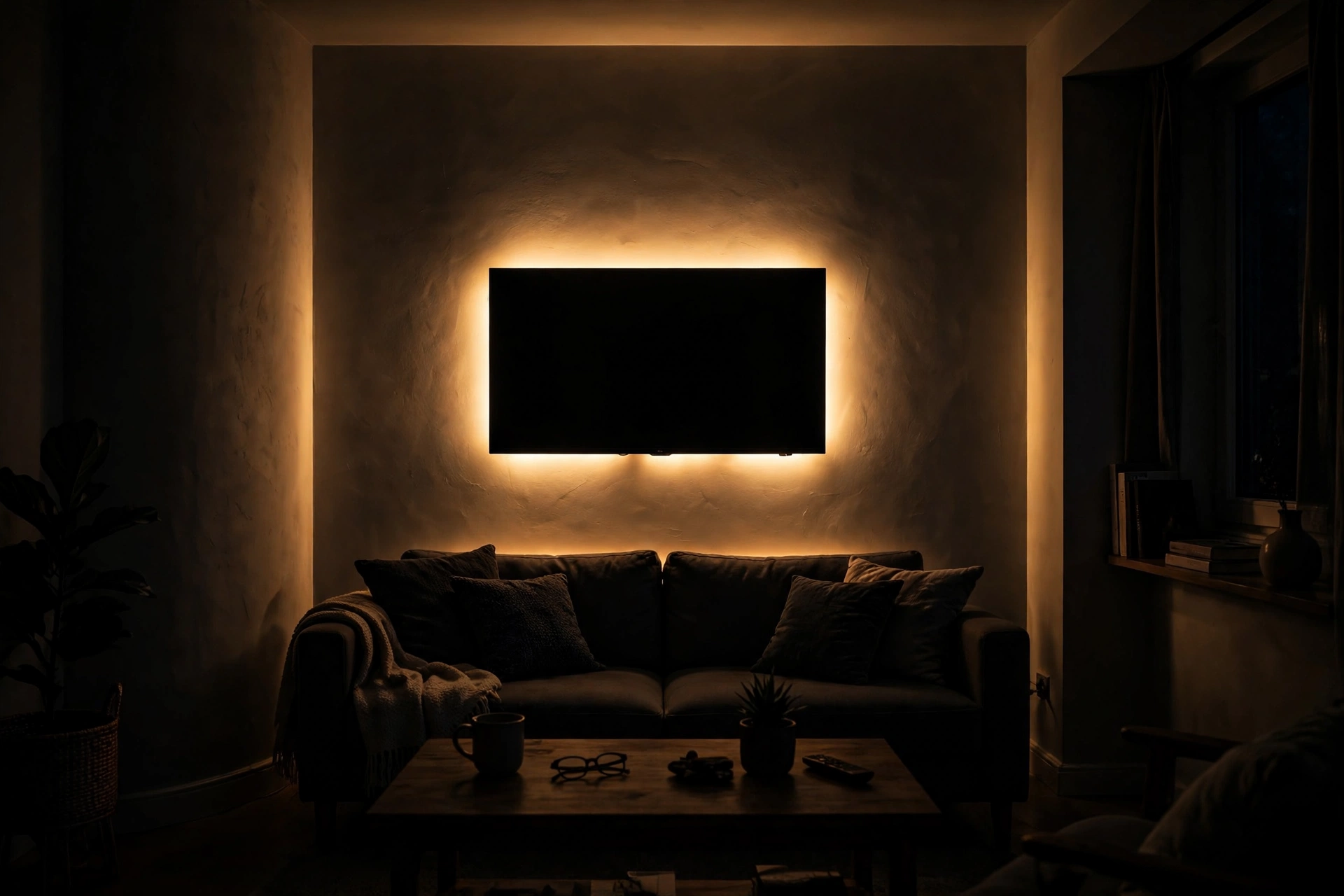
LED strip lights are peel-and-stick, plug-in, and cost less than a takeout dinner. Stuck behind the TV, they throw a soft halo on the wall that reduces eye strain in a dark room and pushes the wall visually backward. Under a floating shelf, the same strip turns a plain shelf into a lit display. Used sparingly, it is one of the most flattering kinds of living room lighting.
- Behind the TV: run the strip around the back edge of the TV, 2 to 3 inches in from the edge, so the glow is even on all four sides. A 6.5-foot strip fits most TVs up to 55 inches. Set it to warm white, 2700K to 3000K, colored modes look fun for a night and tired after a week.
- Under shelves: stick the strip to the underside of the shelf, 1 inch back from the front edge, so you see the glow on the wall and the objects, not the strip itself. One 3-foot strip lights a 24-inch shelf.
- Along the base of furniture: a strip along the base of a media console or sofa, 2 inches up from the floor, makes heavy furniture look like it floats. Keep it dim, accent light should be under 300 lumens, a glow, not a floodlight.
- What to watch: clean the surface with rubbing alcohol first and let it dry, or the adhesive peels off in a week. Do not run strips across a walkway or a door frame. And keep the power supply and controller hidden behind the TV or the console, a visible black box ruins the floating effect.
Budget: a 6.5-foot warm white LED strip kit costs $10 to $15; a second short strip for a shelf costs $8 to $12. That is a tiny budget for living room lighting with such a big visual payoff.
7. String lights, hung the right way
Best for: instant cozy lighting in a rental, the cheapest mood light there is, if you hang them with care. Hung with care, they are the coziest form of living room lighting in this guide.
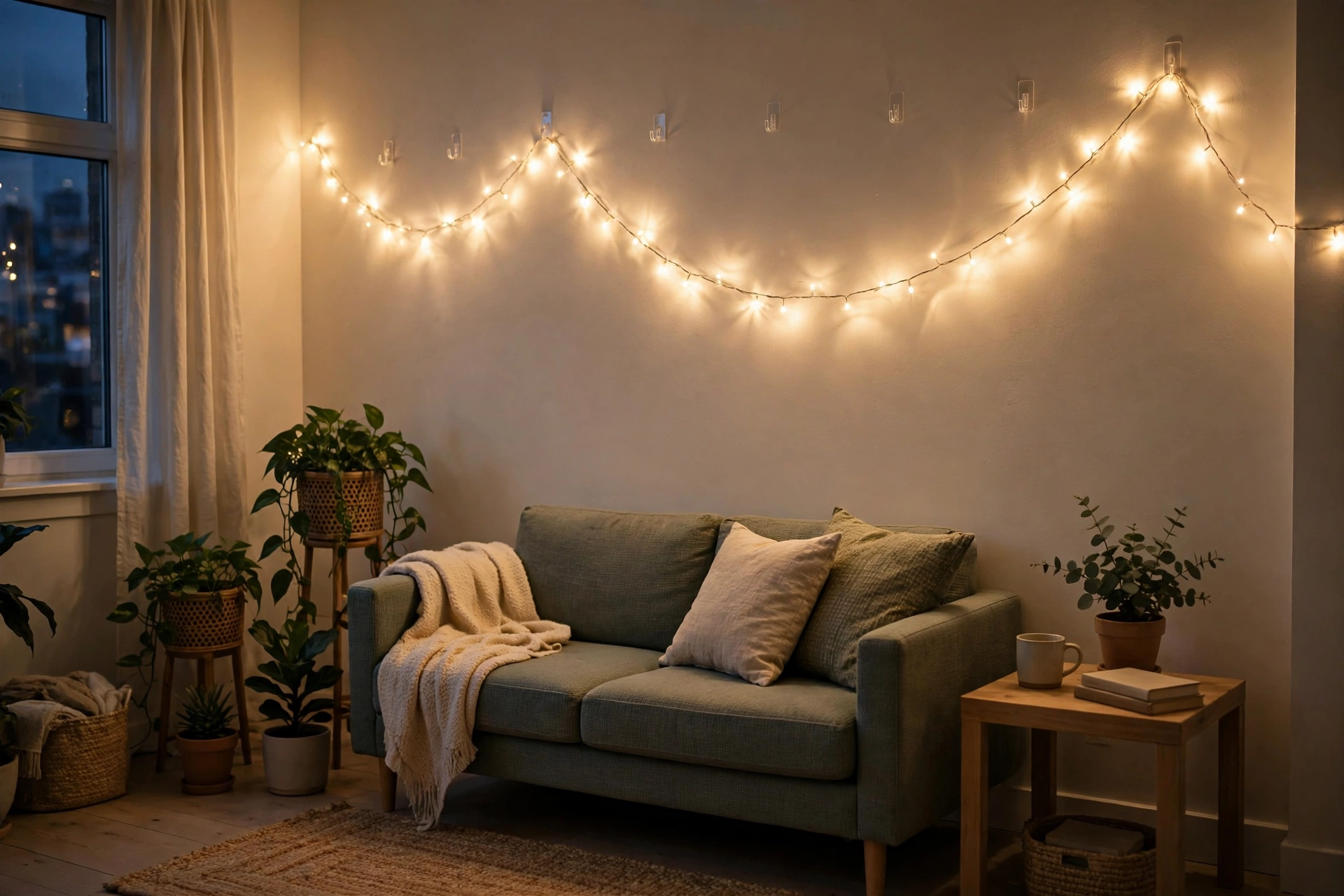
String lights (fairy lights) are the most forgiving accent light for a renter, but most people hang them wrong: one long drooping line across the whole wall, or wrapped tight around a window frame until it looks like a dorm room. The trick is a gentle swag and a clear job, frame one wall, not the whole room. The trick is treating them as living room lighting, not as party decoration.
- Height: hang the swag so the lowest point of the drape sits 72 to 78 inches off the floor, above head height, below the ceiling. The hooks go 6 to 12 inches below the ceiling line.
- Spacing: place small clear adhesive hooks 18 to 24 inches apart along the wall, and let the lights dip 6 to 8 inches between hooks. That soft scallop is what makes them look intentional instead of thrown up.
- Length: for one 8- to 10-foot wall, a 16- to 20-foot strand gives you two gentle swags with a little slack. Measure the wall first, a strand that is too short ends mid-wall and looks unfinished.
- Bulb choice: warm white only, 2700K, with small bulbs spaced 4 to 6 inches apart. Cool white fairy lights look like Christmas in July; warm ones look like a restaurant patio.
- What to watch: use adhesive hooks rated for the strand’s weight and press them on for a full 30 seconds. Do not use nails, and do not run the cord across a doorway. Battery-operated strands avoid the outlet problem entirely, one set of AA batteries runs a 20-foot strand for about 3 to 4 weeks of evening use.
Budget: a 20-foot warm white strand costs $8 to $12; a pack of clear adhesive hooks costs $4 to $6. That is the lowest-cost living room lighting in the whole guide.
8. Battery puck lights and rechargeable sconces
Best for: the spots with no outlet nearby, inside shelves, above art, in a dark hallway corner. They fill the gaps where other living room lighting cannot reach.
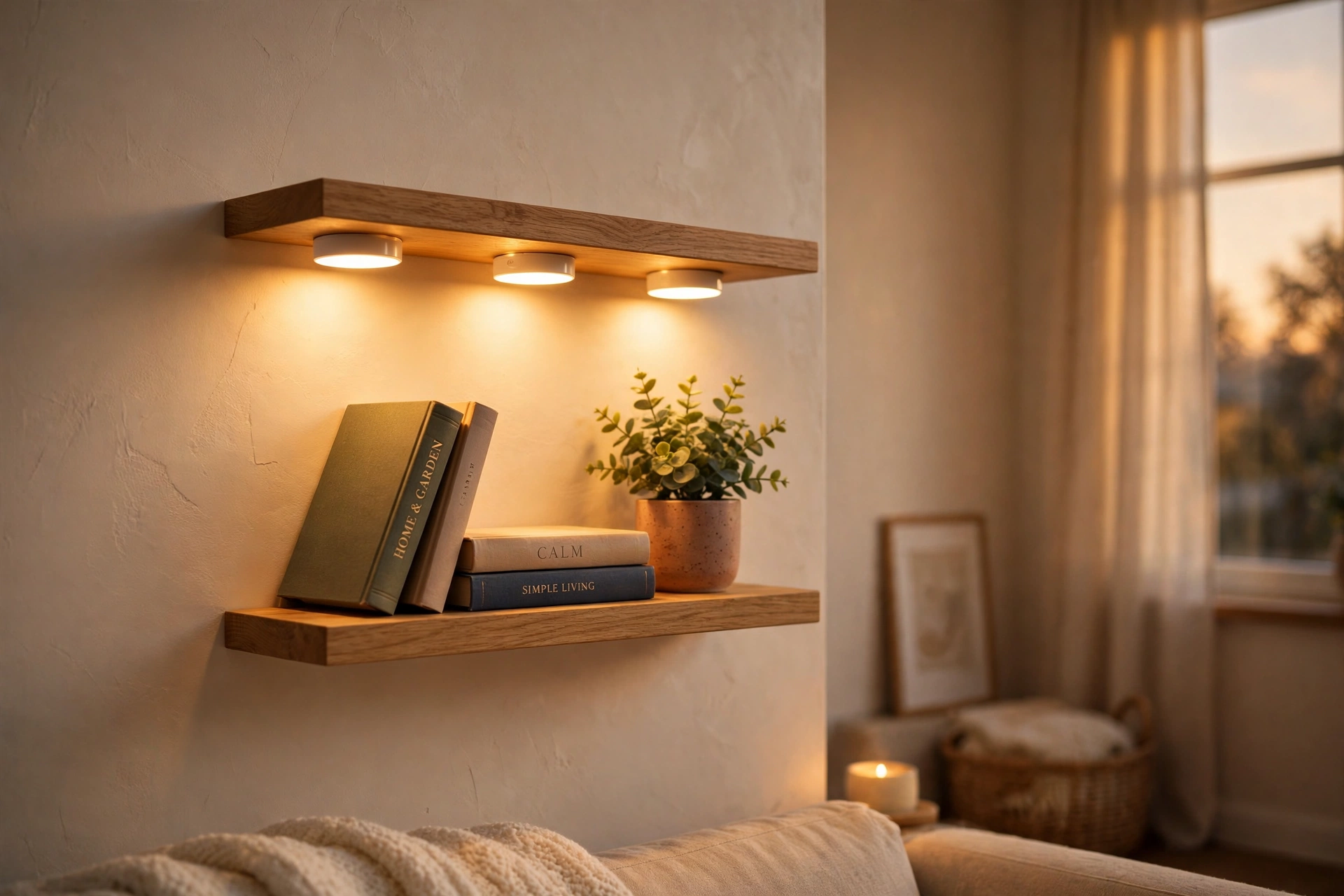
Battery puck lights are small round LED discs, about 2 to 3 inches across, that stick to any surface with adhesive and turn on with a tap or a remote. Rechargeable sconces are the bigger version: a proper wall light with a built-in battery that charges over USB-C and runs for days. Both solve the same problem, light where there is no socket and no cord can reach. They are a handy backup when your main living room lighting leaves a shelf dark.
- Puck lights: stick one under each shelf, 6 to 8 inches back from the front edge, or inside a dark bookcase. One puck gives about 50 to 100 lumens, enough to light the shelf, not the room. A pack of three costs $10 to $15 and runs on AA or AAA batteries for several weeks of evening use.
- Rechargeable sconces: mount with adhesive strips, charge over USB-C, and run 2 to 3 days on a full charge with normal evening use. Hang them where a plug-in sconce cannot reach, above a console in the entryway, on either side of a mirror, or in a reading nook with no outlet. A pair costs $30 to $60.
- The rechargeable bulb trick: a rechargeable bulb screws into any standard socket, so you can mount any decorative sconce you love with picture-hanging strips and power it with the bulb, no cord, no outlet, no wiring. A two-pack costs $15 to $25. These bulbs suit ambient and decorative light, not bright reading light.
- What to watch: check the battery before guests come over, a dead sconce is worse than no sconce. Keep one spare charged battery or a spare set of AA batteries in the drawer by the door, and set a phone reminder to charge the sconces every Sunday night.
Budget: puck lights $10 to $15 for three; rechargeable sconces $30 to $60 a pair; rechargeable bulbs $15 to $25 for two. Keep the total small, since this is supporting living room lighting, not the main layer.
9. Clip-on lamps where nothing else fits
Best for: the last dark spot, a shelf, a headboard, the arm of the sofa, or the side of a bookcase.
A clip-on lamp clamps onto anything about 1 to 2 inches thick: a shelf edge, a headboard, the arm of a chair. It is the smallest, cheapest task light there is, and it goes exactly where a floor lamp cannot stand and a table lamp has no table.
- Where to clip: on the shelf above your reading chair, on the arm of the sofa (if the arm is flat and at least 4 inches wide), or on the side of a bookcase beside the seat. The clip needs a flat, stable edge, it will not hold on a rounded or padded arm.
- Aim: point the head down at the book or the laptop, 12 to 18 inches above the surface. A clip-on lamp with a flexible gooseneck lets you aim it precisely and fold it away when you are done.
- Brightness: 200 to 400 lumens is enough for reading, a small warm bulb at 2700K. Brighter than that and it glares off the page.
- What to watch: check the clip’s grip before you walk away, a lamp that slips falls on the book, the laptop, or the floor. Do not clip onto anything that moves, like a folding chair, and keep the cord (if it has one) routed behind the furniture, not across the seat.
Budget: a clip-on lamp costs $10 to $18; a battery-operated clip-on costs $12 to $20 and needs no outlet at all.
10. A mirror that doubles your light
Best for: free brightness, a mirror is not a lamp, but it is the cheapest way to make the lamps you own work twice as hard.
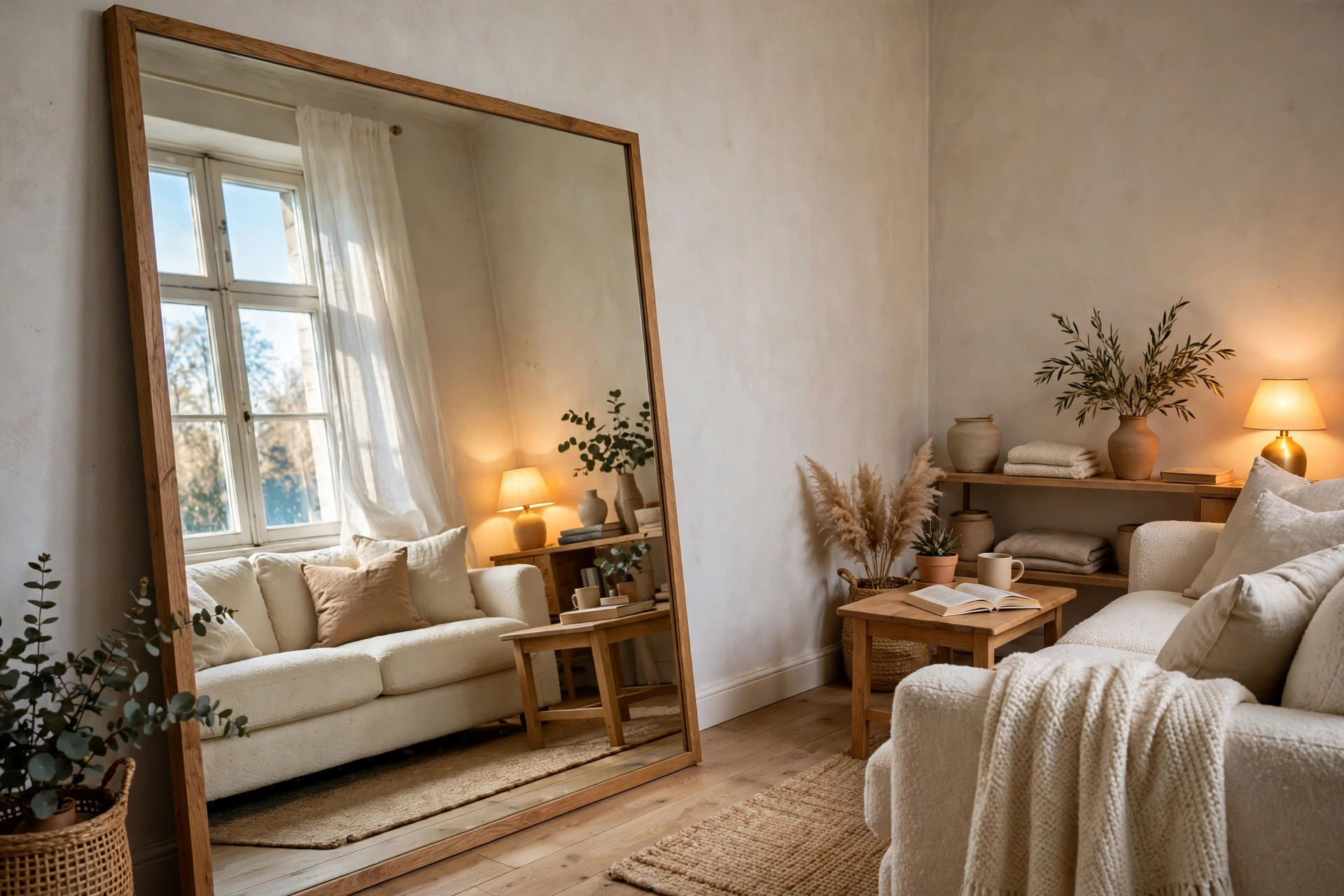
A large mirror opposite or beside a light source bounces that light back into the room, so one lamp lights two spots. In a small room, this is the closest thing to free square footage: the reflection adds visual depth, and the doubled light fills the corner the lamp never reached.
- Size: the mirror should be at least one-third as wide as the wall it hangs on. On a 10-foot wall, that is a mirror 36 to 40 inches wide. Smaller than that and the reflection reads as a decoration, not a second window.
- Placement: lean it opposite the window to bounce daylight deep into the room, or opposite your brightest lamp to double the evening light. A leaning mirror needs no hook and no hole, lean it at a slight angle, with the bottom 4 to 6 inches out from the wall and the top resting against it.
- Height: the center of a hung mirror sits at about 57 inches from the floor, eye level for most people standing. A mirror hung too high reflects the ceiling; too low and it reflects the floor.
- What to watch: point the mirror at the window or the lamp, not at the clutter. A mirror opposite a messy shelf doubles the mess. And do not hang a mirror opposite the TV, the reflection competes with the screen.
Budget: a leaning mirror 24 to 30 inches wide costs $20 to $40 secondhand. If you already own one, this idea costs nothing.
One switch for everything: dimmers and smart plugs
Best for: the finishing touch, turning four lamps on with one tap, like a ceiling light.
Four lamps are only convenient if you can turn them all on at once. Otherwise you walk around the room flipping four switches every evening, and within a week you are back to using just the ceiling bulb. Two cheap fixes solve it:
- Smart plugs: plug each lamp into a smart plug ($8 to $12 each, or $20 to $25 for a pack of four) and group them in the app under one name, like “living room.” One tap, or one voice command, turns them all on and off together. Set a schedule and they come on at sunset by themselves.
- Plug-in dimmers: a plug-in dimmer ($10 to $15) sits between the lamp and the outlet and lets you dim any lamp that has a dimmable bulb. Dim the torchiere to half for movie night and the room goes from bright to candlelit without touching a bulb.
- What to watch: smart plugs only work with lamps that have a physical on-off switch left in the on position. If the lamp has a touch switch or a remote, a smart plug will not control it, use the lamp’s own remote instead.
Budget: a pack of four smart plugs costs $20 to $25; one plug-in dimmer costs $10 to $15. Buy the plugs first, they change how the room feels every single evening.
The 10 by 12 foot apartment lighting plan under $150
Here is the whole refresh for a standard 10 by 12 foot (120 square foot) apartment living room, using the ideas above. Every item is plug-in or battery-powered, no drilling, no hardwiring.
| Layer | What to buy | Cost |
|---|---|---|
| Bulbs | Pack of 4 warm white LED bulbs, 2700K, 800 lumens | $5 to $8 |
| Ambient | Torchiere floor lamp, 68 to 72 inches, dimmable | $25 to $40 |
| Task | Thrifted table lamp, 22 to 28 inches, beside the sofa | $10 to $20 |
| Accent | LED strip behind the TV, 6.5 feet, warm white | $10 to $15 |
| Accent | String lights, 20 feet, warm white, one wall | $8 to $12 |
| Accent | Battery puck lights, pack of 3, under the shelf | $10 to $15 |
| Control | Smart plugs, pack of 4 | $20 to $25 |
| Total | $88 to $135 |
That leaves $15 to $60 of the $150 budget for the extras that suit your room: a pair of plug-in sconces instead of the string lights, a leaning mirror from a thrift shop, or a clip-on lamp for the reading chair. The order to buy in matters: bulbs first, then the torchiere, then the table lamp, then the accents. If you buy the accents first, you end up with a room that looks lovely in photos and is still too dark to read in.
If you want the same measured approach for the rest of the room, the rug size, the sofa width, the walkway, our cozy small living room decor guide plans the whole room the same way, with the same under-$150 rule.
7 mistakes to avoid
1. One ceiling bulb doing all the work. A single overhead light creates dark corners and flat colors. Three to five sources at different heights beat one bright bulb every time.
2. Mixing warm and cool bulbs. One cool white bulb at 4000K undoes three warm ones. Check every bulb in the room, including the hallway you can see from the sofa, and make them all 2700K to 3000K.
3. The wrong lamp height. A table lamp taller than 28 inches on a 24-inch side table puts the bulb in your eyes. A floor lamp shorter than 58 inches lights the sofa back instead of the room. Measure the table, then buy the lamp.
4. Too many lights. More than five sources in a room under 150 square feet over-lights it and turns a cozy room into a showroom. If every corner is equally bright, there is no mood left. Dim the accents, or take one lamp away.
5. Bare bulbs where you sit. If you can see a bare bulb from the sofa, it needs a shade or a lower position. A visible bulb glares; a shaded bulb glows.
6. Cords across walkways. A lamp in the perfect spot with its cord across the walking route is a trip hazard and a visual mess. Route cords behind furniture or inside a cord cover, and put the lamp near the outlet instead of the outlet near the lamp, battery and rechargeable lamps exist for exactly this reason.
7. Buying the pretty accent first. LED strips and string lights are the fun purchase, but they cannot fix a room with no ambient light. Buy the bulbs and the torchiere first. Accent light is the last layer, not the first.
FAQ
How many lights should a living room have?
At least three sources: one ambient light, one task lamp for reading, and one low ambient or accent light. In a small living room, three to five sources at different heights is the right range. Larger rooms need more, usually one lamp per seating area plus the ceiling light.
How many lights do I need in a small living room?
Three to five light sources across three layers. A good minimum is one torchiere or floor lamp for ambient light, one table lamp beside the sofa for reading, and one accent source such as LED strips or string lights. Above five fixtures in a room under 150 square feet usually over-lights it.
What is the best lighting for a small living room?
Layered lighting: a warm ambient source, a task lamp where you sit, and one or two low accent lights. Use warm white bulbs at 2700K to 3000K, keep the light at three different heights, and put the lamps on one switch with smart plugs so the room turns on like a single ceiling light.
How do I light a living room with no ceiling light?
Build the lighting from the floor up: a tall torchiere in the darkest corner for ambient light, a table lamp on the side table for reading, and an arc floor lamp over the sofa if you want an overhead feel. Add one accent layer, LED strips behind the TV or battery puck lights under a shelf, and put everything on smart plugs so one tap turns the whole room on.
What color temperature is best for living room lighting?
Warm white, 2700K to 3000K. 2700K is candle-warm and cozy; 3000K is a touch cleaner and still warm. Anything 4000K or above looks like office lighting and makes white walls look grey. Use the same warmth in every bulb in the room.
Can a living room work without overhead lighting?
Yes. Most rentals do it already, many apartments have no living room ceiling fixture at all. A torchiere bouncing light off the ceiling, a table lamp beside the sofa, and one accent light give you the same three layers a ceiling fixture would, and because each light is at a different height, the room often feels warmer and bigger than it would under one overhead bulb.
Is plug-in lighting safe in a rental?
Yes, as long as you follow the basics: keep cords out of walkways, do not overload one outlet with a power strip full of lamps, use the bulb wattage printed on the lamp, and keep lamps stable so they cannot tip. Adhesive hooks and strips hold light fixtures only, heavy fixtures need a screw, and a small screw hole filled with spackle when you move out is a normal part of renting.
How much does it cost to light a small living room?
A full refresh costs $88 to $135 for a 10 by 12 foot room: warm bulbs, a torchiere, a thrifted table lamp, LED strips, string lights, puck lights, and smart plugs. If you already own one or two lamps, it costs less. The single highest-impact spend is the bulb swap at $5 to $8.
Start today
The best living room lighting plan is the one you start tonight, not the one you keep researching. Swap the bulbs first, it takes five minutes and costs less than a coffee run, then put one warm lamp where you sit in the evening. Tomorrow, add the torchiere to the darkest corner. By the weekend, your small rental will have light at three heights, warm color in every bulb, and corners that finally feel like part of the room instead of shadows closing in. That is how a small living room starts to feel bigger: not with more space, but with better light.