You found the perfect console table online. It looked slim in the photos, the reviews were glowing, and it arrived in a box bigger than your hallway. You wrestled it into place, stepped back, and realized you now have to turn sideways to get past it. The table is not the problem. The fit is the problem, and fit is decided before you buy, with a tape measure, not after delivery, with regret. This guide gives you a slim entryway table that actually fits your hall, with exact numbers for clearance, depth, height, and length, a ten minute test you do before you order, and a whole entryway finished for 148 dollars.
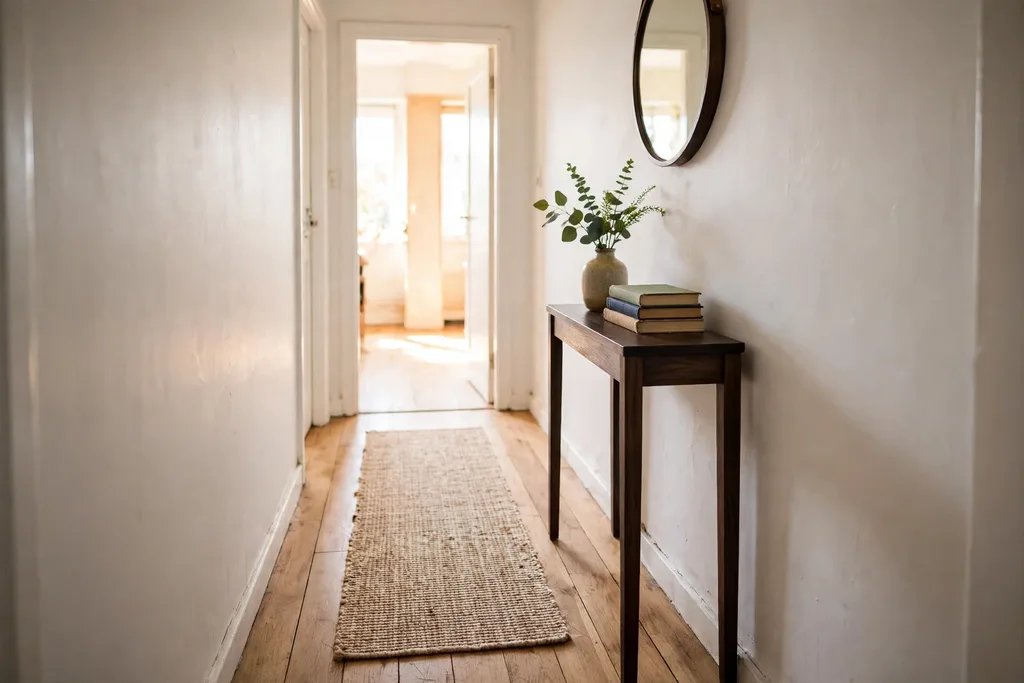
Table of Contents
The clearance formula: hallway width minus table depth
Every console table decision starts with one subtraction. Measure your hallway from wall to wall, in inches, at the narrowest point. Then subtract the depth of the table you want. What is left is your clearance, the space you actually walk through. Clearance equals hallway width minus table depth. That one number tells you whether the table fits or whether you will be brushing past it with grocery bags for the next three years.
Keep 32 to 36 inches clear for comfortable daily use. That is enough to walk through carrying a bag, pass someone coming the other way, or carry a laundry basket without turning sideways. Thirty inches is the absolute minimum. Below 30 inches of clearance, the hallway stops working as a hallway. You will catch your hip on the table corner, the door will not open fully, and the entry will feel like an obstacle course instead of a welcome.
Measure at the narrowest point, not the widest. Hallways narrow at door frames, at baseboard heaters, at the spot where the front door swings open, and anywhere a radiator or a thermostat sticks out. Measure in three places, at the front door, in the middle of the hall, and at the far end, and use the smallest number. A table that fits the wide end of your hall and blocks the narrow end does not fit.
Here is how the formula works in real halls. A 42 inch hallway with a 10 inch deep table leaves 32 inches clear, and that works. A 40 inch hallway with a 12 inch deep table leaves 28 inches clear, and that fails. A 38 inch hallway with an 8 inch deep table leaves 30 inches clear, the minimum, acceptable but tight. Do the subtraction before you fall in love with a table.
One more number matters: the usable wall width. Measure the flat wall where the table will sit, from door casing to door casing, from the light switch to the corner. Switches, outlets, and door trim all eat wall space, so a 48 inch wall with a switch 6 inches from the corner gives you 42 inches of usable wall. A slim console table for entryway use has to fit that usable width, with 6 to 12 inches of breathing room on each side.
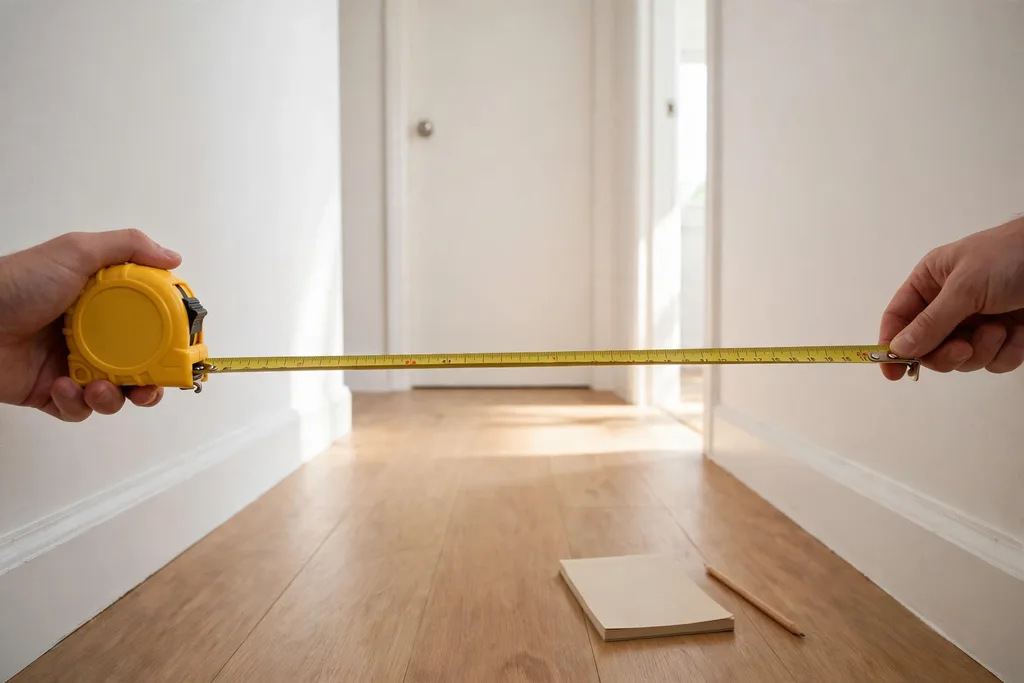
Depth by hallway width: the table that fits your hall
Once you know your hallway width, the depth picks itself. Use this table and stop guessing. For how under-12-inch depths look in real homes, see this roundup of narrow console tables for slim entryways.
Hallway width 36 to 40 inches: table depth that fits 6 to 8 inches deep, clearance left 30 to 32 inches.
Hallway width 40 to 44 inches: table depth that fits 8 to 10 inches deep, clearance left 32 to 34 inches.
Hallway width 44 to 48 inches: table depth that fits 10 to 12 inches deep, clearance left 34 to 36 inches.
Hallway under 36 inches: no table, use a floating shelf and hooks, full width stays clear.
A hallway 36 to 40 inches wide needs a truly slim entryway table, 6 to 8 inches deep. This is the hardest hall to furnish and the easiest to get wrong, because most console tables sold as slim are 12 inches deep or more. A 12 inch table in a 38 inch hall leaves 26 inches of clearance, and that is a fail. Shop by the depth number in the product specifications, not by the word slim in the product name. Slim is a marketing word. Eight inches is a measurement. Look for an entryway table slim enough to leave 32 inches clear, and check the depth number before you check the price.
A hallway 40 to 44 inches wide gives you an 8 to 10 inch deep slim entryway table, which opens up far more choices. Drawer consoles, demilune tables, and slim shoe cabinets all live in this range. A hallway 44 to 48 inches wide takes a 10 to 12 inch deep table comfortably, with 34 to 36 inches of clearance left, which feels generous. Above 48 inches, a 12 inch deep table is safe, and you can stop worrying about depth and start thinking about storage.
Check the depth the manufacturer prints, then check it again, because the listed depth is often the tabletop only. Legs that splay outward, drawer handles, and a bottom shelf can add an inch or two. Measure the maximum depth, including handles and legs. If the listing gives no maximum depth, assume the real depth is one inch more than listed and run the formula again.
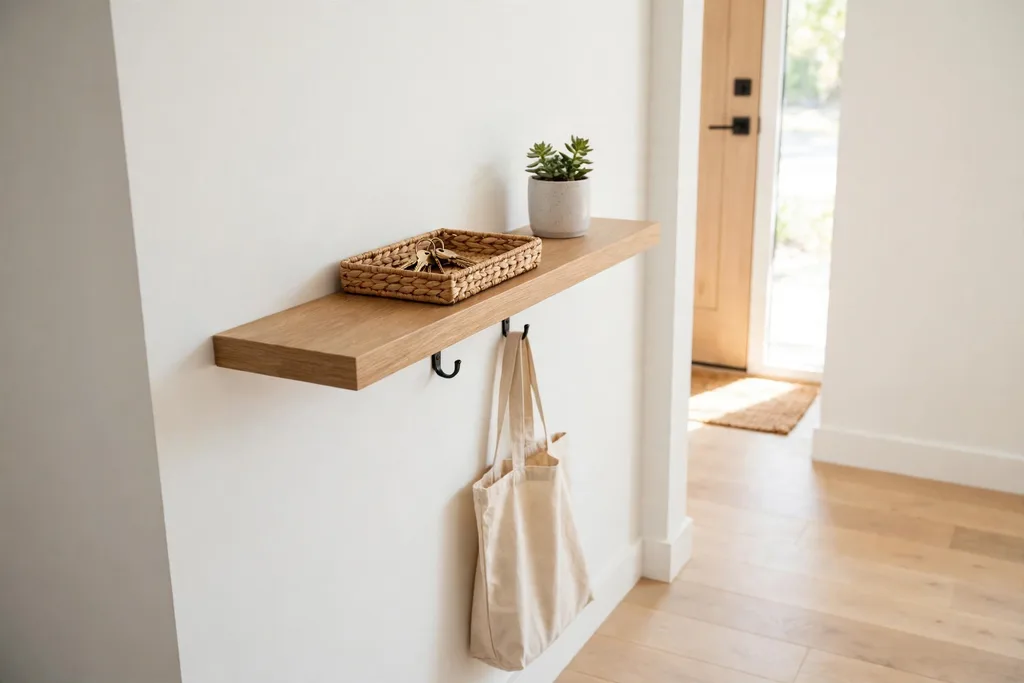
Slim entryway table types compared by fit, not by style
Most guides compare console tables by style, modern, rustic, farmhouse, industrial. Style does not decide whether the table fits. Hallway width decides, so here are the types compared by fit.
A floating or wall mounted table is 4 to 8 inches deep and mounts 30 to 34 inches high on the wall. It is the slimmest option that exists, and the best choice for a 36 to 40 inch hallway. Because it has no legs, the floor underneath stays open, which makes a tight hall feel wider, and you can sweep and mop under it without moving anything. For renters, a floating table needs screws in the wall, so check your lease first. A leaning ladder console gives you the same open floor feeling with no wall holes at all, which makes it the renter friendly pick when drilling is not allowed.
A demilune slim entryway table, the half moon shape, is 9 to 12 inches deep at its widest point and much shallower at the edges. That curved front is a real advantage in a tight hall, because there are no sharp corners sticking into the walkway. It fits a 40 to 44 inch hallway well, and the curve makes passing it feel natural instead of awkward. Small console tables for entryway use in this shape work best against a flat wall with a mirror above it, because the mirror fills the visual space the curve leaves open.
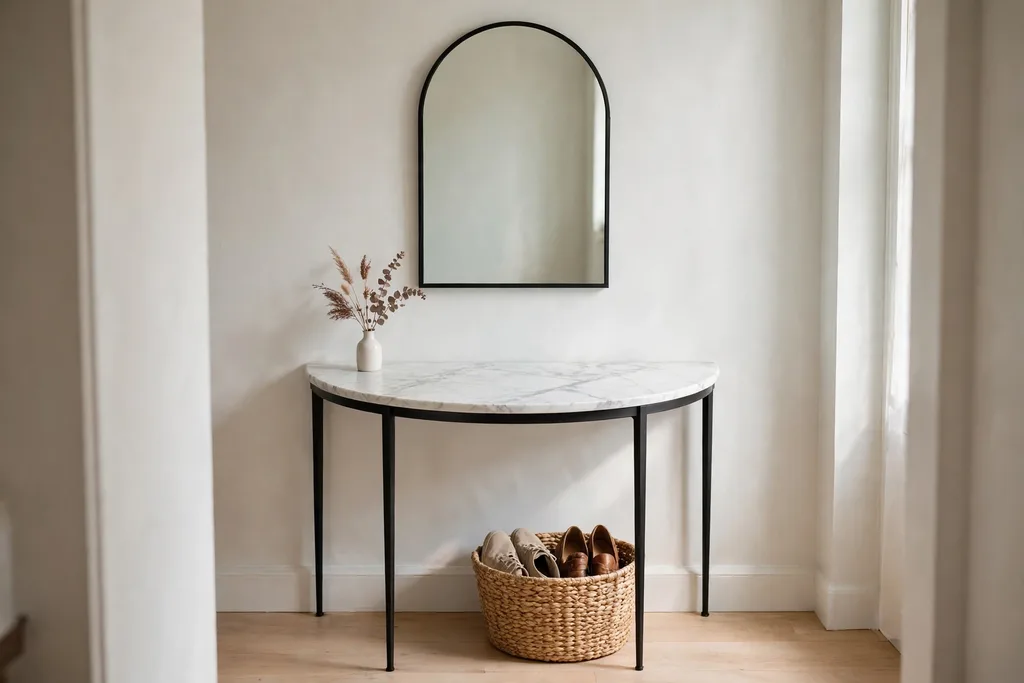
A drawer console is 8 to 12 inches deep and gives you one or two shallow drawers for keys, mail, and sunglasses. It fits a 40 to 44 inch hallway, but only if you check the drawer open clearance. A drawer that pulls out 8 inches into a 32 inch walkway leaves you 24 inches while it is open, so plan to open it, grab what you need, and close it. Do not buy a drawer console for a hallway where you need the drawer open while someone else walks past.
A slim shoe cabinet is 6 to 8 inches deep and holds 8 to 12 pairs of shoes in tilt out compartments. It is the only table type that solves shoes and the landing zone in one piece of furniture, and it fits even a 36 to 40 inch hallway. The trade off is a flat top with no drawers, so your keys and mail need a small tray or a wall mounted shelf above it. If shoes are your biggest entryway problem, this type wins.
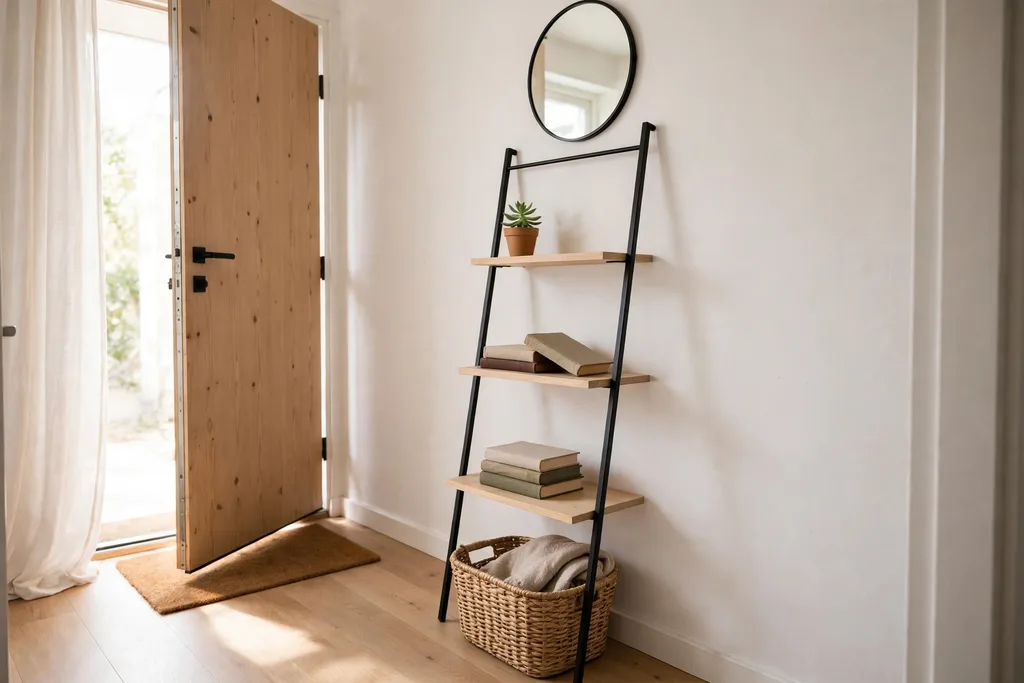
A ladder console is 10 to 12 inches deep with shelves above the tabletop, and it fits a 44 to 48 inch hallway. The shelves hold baskets, plants, and books, and the open frame keeps the hall feeling light. Skip it in a hallway under 44 inches wide.
A drop leaf table folds down almost flat against the wall and opens to a full table when you need it. It is 14 inches deep when open, so it needs a 44 inch hallway or wider. A fold down wall mounted table does the same job with no legs at all.
Pick by your hallway width first. A 38 inch hall gets a floating table or a slim shoe cabinet, a 42 inch hall gets a demilune or a drawer console, and a 46 inch hall gets a ladder console or a 12 inch drawer console. Style comes second, after the fit is decided.
The 10 minute tape test: do this before you buy anything
The tape test for a slim entryway table takes ten minutes and saves you a return, a restocking fee, and a table that blocks your hallway. Do it before you order, not after the box arrives.
Start with painter’s tape and your measurements. Tape the full footprint of the table on the floor, the full width and the maximum depth, including legs, handles, and any overhang. Tape it exactly where the table will sit, against the wall, and mark the drawer extension too if the table has drawers. A strip of tape on the floor is honest in a way a product photo never is.
Open every door. Open the front door fully, open the closet door, open the bedroom door, and open any cabinet near the entry. Doors swing in arcs, and a table that clears a closed door can block an open one. If a door hits the tape, the table is too deep or too wide for that spot. Move the tape or pick a slimmer table.
Walk the route. Walk from the front door to the kitchen, to the bedroom, and back, at a normal pace. Then do it again carrying a grocery bag, then a laundry basket. If you have to turn sideways or lift the bag over the tape, the fit is wrong. Now walk it with someone else coming the other way. Two people passing in the taped space tells you the truth about daily life.
Test the drawer and the drop zone. Stand at the taped table as if you just came home, reach where the tray will sit, and pull the taped drawer line open. If your elbow hits the opposite wall, the table is too deep for the way you use it. Check the lamp and tray footprint too. A lamp base 8 inches wide does not fit on a table 6 inches deep, so measure the base of the lamp, the tray, and the bowl, and make sure each one is at least one inch narrower than the table depth.
Check the delivery path last. Measure the front door, the building door, and the elevator. A table that fits your hallway is useless if its box does not fit through your front door, so check the packaged dimensions, not just the assembled ones. If the box is bigger than your door, look for a table that ships flat packed in smaller pieces.
If the tape test passes, buy the table. If it fails, you just saved yourself the worst kind of furniture mistake, the one you have to live with because returning it costs more than keeping it.
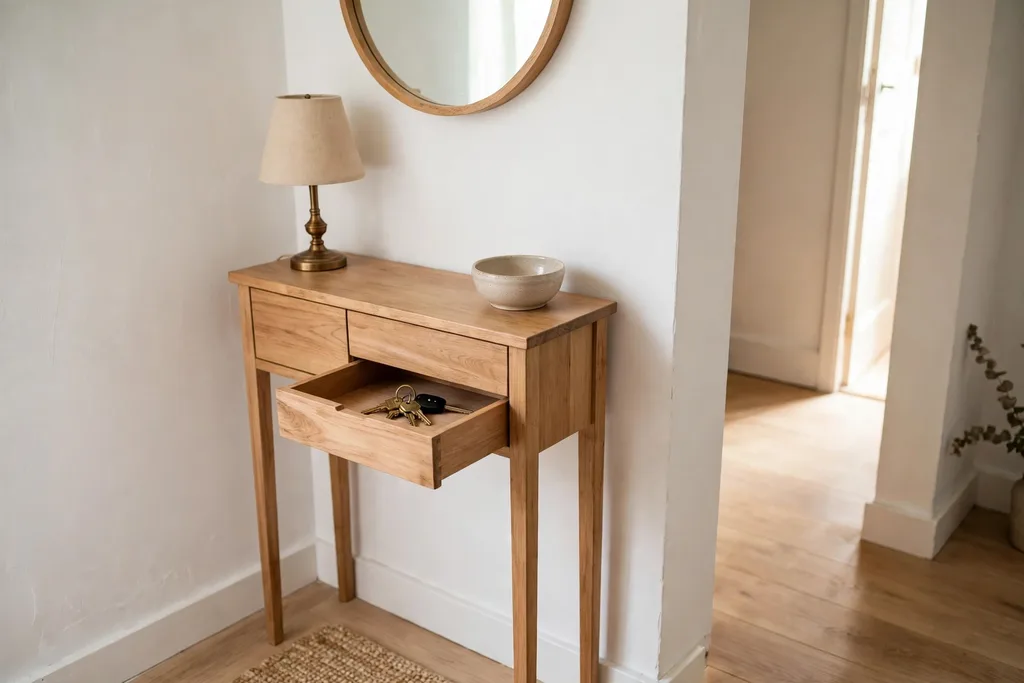
Hallway under 36 inches: the no table entry that still works
Some hallways are under 36 inches wide, and no slim entryway table fits them. A 6 inch deep table in a 34 inch hallway leaves 28 inches of clearance, and that fails the formula. The answer is not a thinner table. The answer is no table at all, and a complete entry system built on the wall instead.
Start with an entryway slim table alternative, a floating shelf 10 to 12 inches deep, mounted 30 to 32 inches high. A shelf that shallow holds a tray, a bowl, and your keys, and it takes zero floor space because it has no legs. Mount it with screws into a stud if your lease allows it, or use a heavy duty adhesive shelf rated for the weight if it does not. Of all the small entryway table ideas for a hall this tight, the best one is not a table at all, it is a shelf doing a table’s job.
Add hooks below the shelf. Three to four hooks at 50 inches high for adults and 36 inches for kids hold coats, bags, and dog leashes. Hooks take no floor space and no walkway space, and they solve the coat problem that a table never could. Put a small mirror above the shelf, 20 to 24 inches wide, with its bottom edge 6 to 8 inches above the shelf and its center 57 to 60 inches from the floor. The mirror gives you the last look check before you leave, and it bounces light down a dark hall.
Shoes go in a slim shoe cabinet 6 to 8 inches deep against the opposite wall, or in a low basket tucked under the shelf if the hall is too narrow even for a cabinet. A basket 10 inches tall slides under a shelf mounted at 30 inches, and it holds two to three pairs of everyday shoes. A washable runner 2 feet wide and 6 feet long protects the floor and marks the entry zone without adding any furniture at all.
This no table entry costs less than a table, fits a hall no table can fit, and does every job a table does. Drop zone on the shelf, coats on the hooks, shoes in the basket or cabinet, mirror above, light from a wall sconce or a plug in puck light. Nothing touches the floor except your shoes and the runner, and the full width of the hallway stays clear for walking.
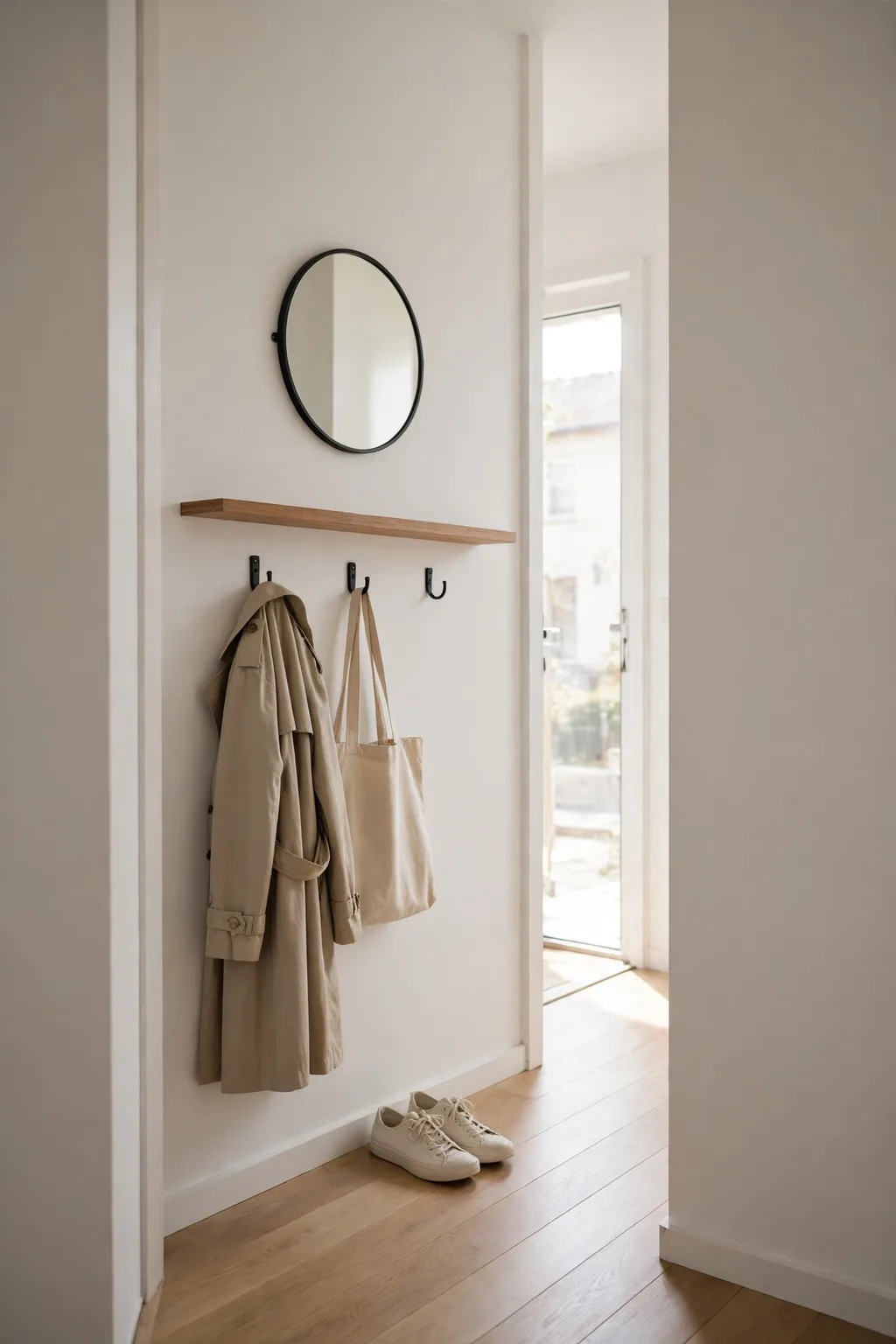
What actually fits on a 6 to 8 inch deep table
A 6 to 8 inch deep slim entryway table looks generous in a product photo and tiny when it arrives. The question is what actually fits on it, and the answer is less than you think and more than you fear.
A tray fits if it is 5 to 6 inches deep. A tray 10 to 12 inches long and 5 inches deep sits comfortably on an 8 inch deep table with room to spare. A tray wider than 6 inches hangs over the front edge of a 6 inch table, and anything that hangs over the edge gets knocked off by a passing bag. Measure the tray before you buy it, and buy the tray after the table, not before.
A lamp fits if its base is at least one inch narrower than the table depth. A lamp base 5 inches wide fits on a 6 inch deep table. A lamp base 8 inches wide does not fit on a 6 inch table, and it does not fit on a 7 inch table either. Slim table lamps with a base 4 to 5 inches wide exist, and they are the right lamp for this table. A lamp 22 to 28 inches tall with a narrow shade lights the entry without blocking the mirror.
A bowl for keys fits easily. A ceramic catch all bowl 4 to 5 inches wide holds keys, coins, and a lip balm without crowding anything else. A vase fits if it is 3 to 4 inches wide at the base and 10 to 14 inches tall. Anything wider tips over when the front door slams. A book stack fits if it is one or two books, not five, and 3 to 6 inches high reads as styled. Any taller reads as storage and eats the whole surface.
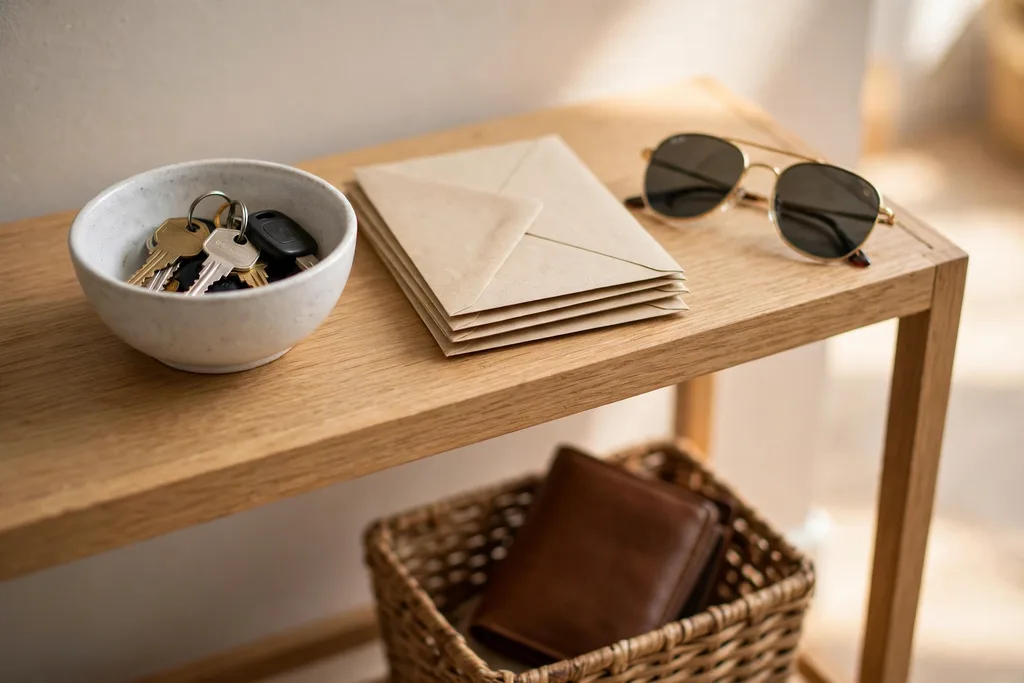
What does not fit: a wide tray, a big lamp, a large vase, a basket on top of the table, or more than three objects total. Three objects is the rule for a 6 to 8 inch deep table. One tall thing, one medium thing, and one low thing, and about a third of the surface left empty. Four objects on a table this slim looks cluttered the moment you walk in, and five looks like a shelf at a thrift store.
Use the space below the table too. A slim basket 10 inches tall fits under a table 30 inches high without touching the walkway, and it holds dog supplies, reusable bags, or one pair of shoes. A lower shelf on the table itself does the same job, as long as it does not stick out past the tabletop.
Shoes and storage: one measured plan with your slim console
Shoes are the reason most entryways fail. A slim console with storage sounds like the answer, but it cannot hold many shoes, and forcing it to try makes both jobs worse. The fix is one measured plan where the table and the shoe storage work together instead of competing.
Start with the shoe count. Count the pairs your household actually wears in a normal week, not the pairs you own. Two people usually wear three to four pairs each in rotation, so six to eight pairs need a home by the door. A slim shoe cabinet 6 to 8 inches deep holds 8 to 12 pairs in tilt out compartments, and it pairs perfectly with a slim console on the opposite wall or above it. A small console table for entryway use with one drawer for keys and a shoe cabinet for shoes beats a single piece of furniture trying to do both jobs badly.
If you have room for only one piece, choose by your biggest problem. Shoes everywhere means a shoe cabinet first, with a floating shelf above it for keys. Keys and mail everywhere means a drawer console first, with a basket underneath for the two pairs you wear most. Either way, the plan is the same: one home for shoes, one home for keys, and one home for mail.
A slim entryway table with storage works when the storage is shallow and honest. One drawer 3 to 4 inches deep holds keys, sunglasses, and dog treats. A lower shelf holds one basket, not three. An open shelf under the table holds two pairs of shoes, not six. The moment you ask a slim console to store more than that, you have bought the wrong furniture, and the entry will look crowded no matter how tidy you are.
Build the plan in this order. First, the shoe home, cabinet or basket, measured to fit the wall. Second, the table or shelf, measured to fit the clearance formula. Third, the hooks, at 50 inches for adults. Fourth, the mirror. Fifth, the tray and bowl. Each piece has a measurement and a job, and none of them fight the others for the same six inches of wall.
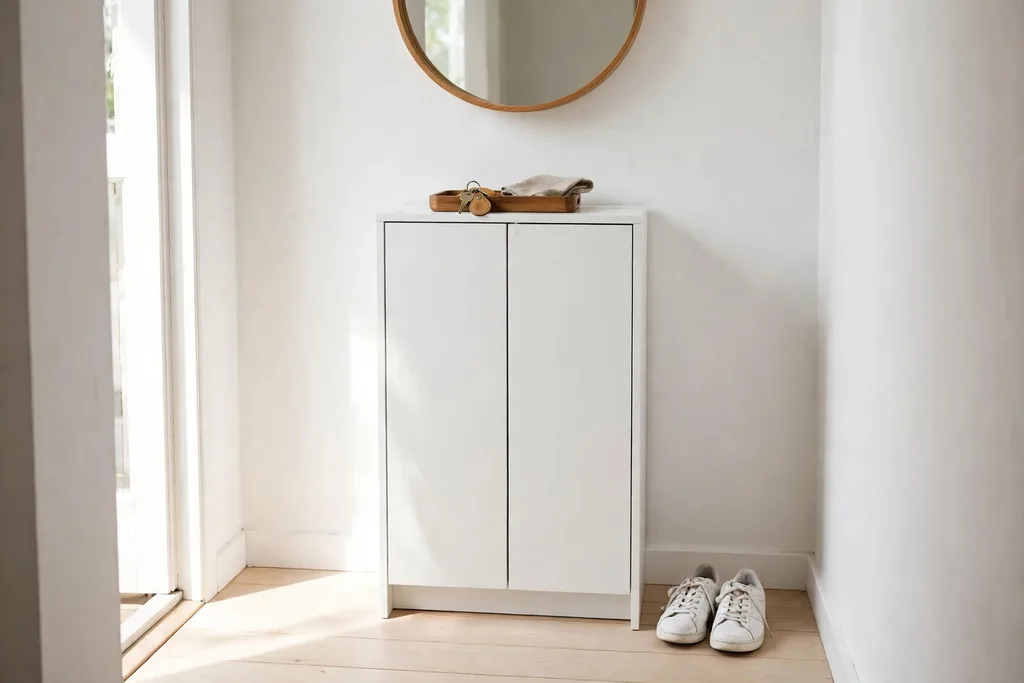
Door swing, drawer open, and delivery: the three checks everyone skips
Three checks decide whether a slim entryway table works in real life, and almost nobody does them before buying. Do all three and your table will work on the first day and the hundredth day.
Check the door swing first. Open your front door all the way and watch where it goes. Many front doors swing inward, and the arc eats 30 inches or more of wall space. A table inside that arc gets hit every time someone comes home. Measure from the hinge to the edge of the open door and keep the table outside that arc. The same rule applies to closet, bedroom, and bathroom doors near the entry.
Check the drawer open clearance second. Pull a tape measure out to the full depth of the drawer plus the table depth, and stand in what is left. A drawer console 10 inches deep with a drawer that pulls out 8 inches needs 18 inches of space when open. In a hallway with 32 inches of clearance, that leaves 14 inches while the drawer is open, fine for the five seconds you need to grab your keys, but not fine if someone needs to walk past. Plan your routine around it. Open, grab, close. Do not leave the drawer open as extra storage.
Check delivery and assembly third. Read the packaged dimensions in the listing, not the assembled dimensions. A table 48 inches long may ship in a box 50 inches long, and a 50 inch box does not fit through a 32 inch apartment door. Look for flat packed tables that ship in two smaller boxes, or tables that assemble in place with no single piece longer than your narrowest doorway. Read the assembly instructions before you buy if they are available online. A table that needs wall anchoring into studs is a different purchase for a renter than a freestanding table that needs no holes at all, and you want to know which one you are buying before the box arrives.
Renters get one extra check: anchoring. A tall or top heavy table needs an anti tip strap or a wall anchor, and that means a hole in the wall. A low, wide, freestanding slim console usually does not need anchoring, and a leaning ladder console needs no holes at all. If your lease forbids drilling, choose a table that stands on its own, use felt pads under the legs, and hang the mirror with adhesive hooks or lean it on the tabletop.
Styling a slim entryway table: three objects and done
Styling a slim entryway table is not a separate project. It is the last five minutes of the fit project, and it takes three objects. One tall thing, one medium thing, and one low thing, and then you stop.
The tall thing is usually a lamp or a vase. A lamp 22 to 28 inches tall with a narrow shade and a warm bulb, 2700 to 3000K, gives the entry light and height. A vase 10 to 14 inches tall with a few stems does the same job without an outlet. Pick one, not both, because two tall things on a slim table fight each other and block the mirror.
The medium thing is the mirror or the art above the table. A mirror 50 to 75 percent of the table width, with its bottom edge 6 to 8 inches above the tabletop and its center 57 to 60 inches from the floor, makes a narrow hall feel twice as wide and gives you a last look before you leave. A narrow entryway console table under 35 inches wide takes a mirror 20 to 24 inches wide. Anything wider crowds the wall, and anything narrower looks like an afterthought.
The low thing is the tray or the bowl. A tray 10 to 12 inches long with a lip holds keys and mail in one place, and a ceramic bowl 4 to 5 inches wide holds keys on its own. One of the two, not both, and about a third of the tabletop left empty. Empty space is not wasted space on a slim table. It is what makes the three objects look intentional instead of crowded.
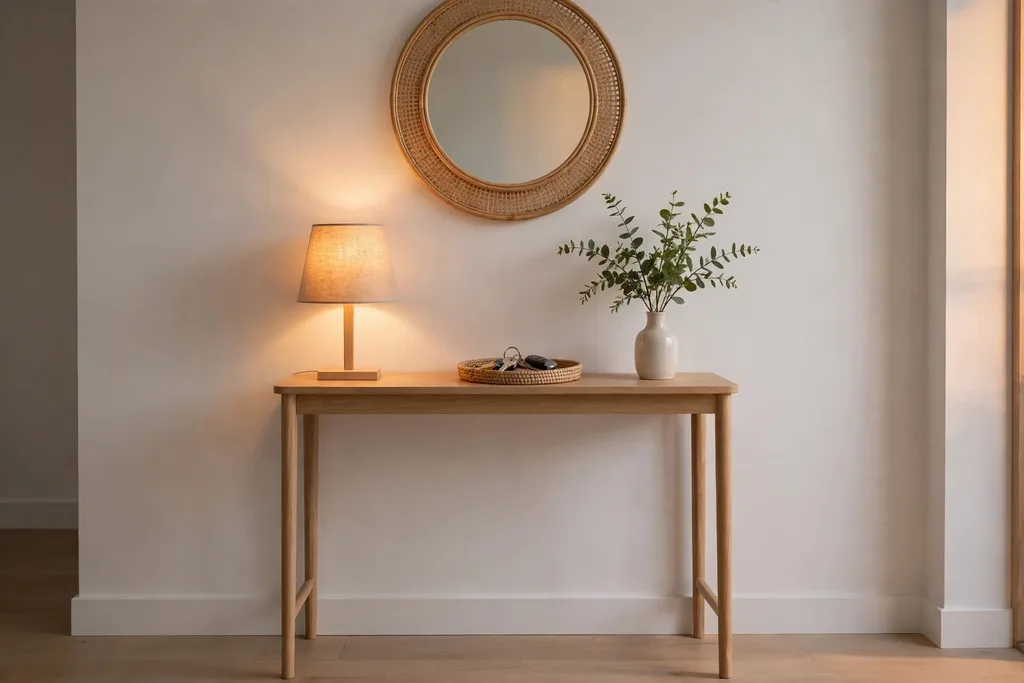
That is the whole decor system. If you want the full styling detail, with the drop zone method and the seasonal swap plan, our entryway table decor guide covers it step by step. Find it at https://honeyandhomestyle.com/entryway-table-decor-ideas/ and if you are starting from scratch with a bare entry, our entryway ideas for small spaces lay out the whole room first at https://honeyandhomestyle.com/entryway-decor-small-spaces/
The whole entryway for $148: the budget table
No competitor totals a whole entryway, so here it is. Every item below is a real typical US retail price for a budget pick, and the total is verified by adding the table.
Slim entryway table, 8 to 10 inches deep: $68
Round mirror, 24 inches: $22
Small table lamp, narrow base: $18
Woven tray for keys and mail: $9
Ceramic catch all bowl: $7
Adhesive wall hooks, pack of 2: $6
Slim woven basket under the table: $8
Washable runner rug, 2 by 6 feet: $10
Total: $148
Check the sum: 68 plus 22 is 90, plus 18 is 108, plus 9 is 117, plus 7 is 124, plus 6 is 130, plus 8 is 138, plus 10 is 148. The whole entryway, table, mirror, lamp, tray, bowl, hooks, basket, and rug, costs 148 dollars.
Buy in this order, and the prices add to the same total. First the table, 68 dollars, because everything else is sized to it. Then the mirror, 22 dollars, the lamp, 18 dollars, the tray, 9 dollars, and the bowl, 7 dollars. Then the hooks, 6 dollars, and the basket, 8 dollars. Last the runner, 10 dollars. If you need to spend less, the cheapest path is the table, the mirror, the tray, and the hooks, which is 68 plus 22 plus 9 plus 6, or 105 dollars, and that gives you a working entry on day one. Add the rest later, one at a time, as the budget allows.
Entryway console table decor ideas do not need to be expensive to look finished. What makes an entry look finished is fit, not price. A 68 dollar table that fits your hall looks better than a 300 dollar table that blocks it.
Slim specific mistakes checklist
Buying by the word slim instead of by the depth number. Slim is a marketing word. Eight inches is a measurement. Read the specifications.
Measuring the wide end of the hall instead of the narrowest point. The narrowest point decides the fit.
Forgetting the legs, handles, and overhang. The maximum depth is the real depth. The listed depth is the tabletop only.
Choosing the right depth and the wrong length. A table that fits the clearance but traps itself between the door casing and the corner is still the wrong table. Leave 6 to 12 inches of breathing room on each side.
Buying a lamp with a base wider than the table. Measure the lamp base before you buy the lamp.
Leaving a drawer open as storage. An open drawer in a narrow hall is a bruise waiting to happen.
Putting a shoe cabinet and a console on the same wall in a narrow hall. They fight for the same space. Put one on each wall, or pick one.
Skipping the tape test. Ten minutes with painter’s tape is cheaper than a return.
Forgetting delivery dimensions. The box has to fit through your door, not just the table through your hallway.
Hanging the mirror too small or too high. A mirror under half the table width looks lost, and a mirror hung with its center above 60 inches is a mirror for someone much taller than you.
Filling the whole tabletop. A slim table needs a third of its surface empty, or it looks cluttered from the front door.
Frequently asked questions
How deep should a slim entryway table be?
A slim entryway table should be 6 to 12 inches deep, depending on your hallway. A hallway 36 to 40 inches wide needs 6 to 8 inches deep, a hallway 40 to 44 inches wide takes 8 to 10 inches, and a hallway 44 to 48 inches wide takes 10 to 12 inches. Use the clearance formula, hallway width minus table depth, and keep 32 to 36 inches clear, with 30 inches as the absolute minimum.
How long should a slim entryway table be in a narrow hallway?
A table 24 to 48 inches long works best. Fill about two thirds of the usable wall, and leave 6 to 12 inches of breathing room on each side. Measure the usable wall first, because switches and outlets eat wall space.
How high should a slim entryway table be?
A slim entryway table should be 28 to 32 inches high. That height lines up with your hand when you walk in, so dropping keys feels natural, and it sits below the mirror without crowding it.
Do I need drawers on a slim entryway table?
You do not need drawers, but one shallow drawer helps. A drawer 3 to 4 inches deep holds keys, sunglasses, and mail. Check that the open drawer does not block the walkway. If your hallway is very tight, choose an open lower shelf with a basket instead.
Can I use a shoe cabinet instead of a slim entryway table?
Yes, and for many small entries it is the better choice. A slim shoe cabinet 6 to 8 inches deep holds 8 to 12 pairs of shoes and gives you a flat top for a tray and keys. Pair it with a floating shelf or a small mirror above it, and you have a landing zone and shoe storage in one piece of furniture. If keys and mail are your bigger problem, a drawer console with a basket underneath is the better pick.
How high should I hang a mirror above a slim entryway table?
Hang the mirror with its bottom edge 6 to 8 inches above the tabletop and its center 57 to 60 inches from the floor. Make the mirror 50 to 75 percent of the table width. On a 48 inch table, that is a mirror 32 to 36 inches wide, and on a table under 35 inches wide, a mirror 20 to 24 inches wide fits best.
What do you put on a slim entryway table?
Three objects: one tall, one medium, and one low. A lamp 22 to 28 inches tall or a vase 10 to 14 inches tall, a mirror above the table, and a tray 10 to 12 inches long or a bowl 4 to 5 inches wide for keys. Leave about a third of the tabletop empty. Anything more than three objects on a 6 to 8 inch deep table looks cluttered.
How do I keep a slim entryway table from looking cluttered?
Give everything a home and keep a third of the surface empty. Keys go in the tray or bowl, mail goes in the tray, shoes go in the cabinet or basket, coats go on the hooks. When something does not have a home, it lands on the table. A weekly reset helps too: once a week, take everything off, keep the three objects, and put the rest where it belongs.
Start today
You do not need a new hallway. You need three numbers for your slim entryway table and ten minutes with a tape measure. Measure your hallway at its narrowest point, subtract the table depth, and keep 32 to 36 inches clear. Tape the footprint on the floor, open every door, and walk the route carrying a bag. If the tape test passes, order the table that fits, not the table that looked good in a photo. A slim entryway table that actually fits turns the most awkward corner of your home into the easiest one, and the whole entry costs 148 dollars. Measure first, buy second, and enjoy walking through your own front door without turning sideways.