Small Bedroom Lighting Ideas: No Overhead Light? Try This
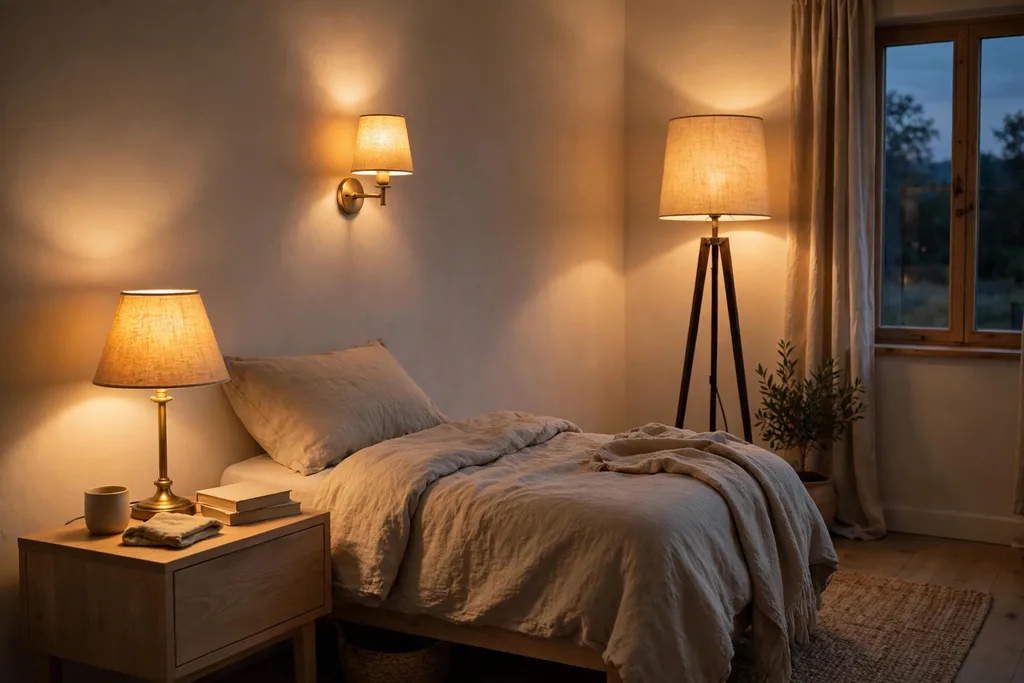
Your small bedroom has one ceiling bulb, or no ceiling light at all, and every evening it shows. One harsh light from above flattens the room and leaves the corners dark. These small bedroom lighting ideas fix that without an electrician and without drilling. Three layers of warm light at three different heights do the job a single ceiling light never could, for less than $150. Nothing here needs hardwiring or your landlord’s permission.
This guide is built for a real rental bedroom: a 10 by 12 foot room, one bed, and a ceiling that may or may not have a fixture. Measure first, build the layers one at a time, and end up with a room that feels bigger, calmer, and easier to fall asleep in.
Table of Contents
Measure First: The 5 Numbers That Decide Everything
Best for: everyone, before you buy a single lamp. Most bedroom lighting fails because it was bought for a room that was never measured.
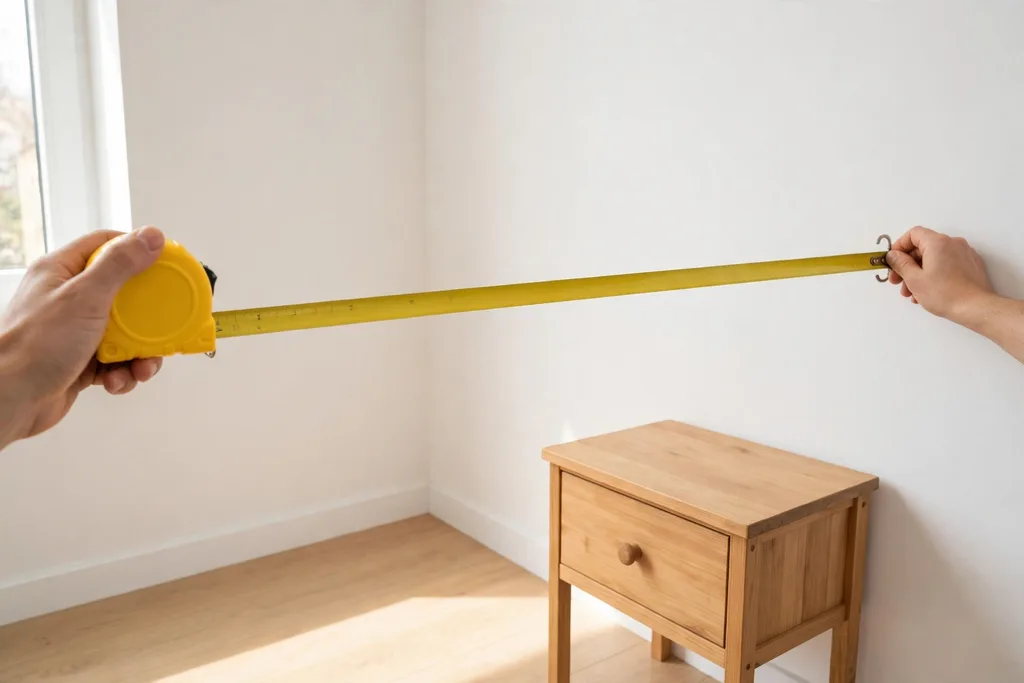
Small bedroom lighting starts with five numbers. Write them down before you spend anything. Measuring first is the habit that makes the rest of these small bedroom lighting ideas fall into place.
- Room length and width: measure wall to wall. A typical small bedroom is 10 by 12 feet, which is 120 square feet. Add the two numbers together to size any ceiling fixture: 10 plus 12 is 22, so a 22 inch fixture fits. For rooms under 120 square feet step down to 12 to 16 inches.
- Ceiling height: most rentals have 8 foot ceilings. Nothing may hang below 7 feet, so skip pendants and chandeliers under 8.5 foot ceilings.
- Nightstand height and depth: measure both. A standard nightstand is about 24 to 28 inches tall and 14 inches deep. A lamp base takes 8 to 10 inches of that depth, which is more than half the surface.
- Mattress top height: measure from the floor to the top of your mattress. Sconces sit 30 to 36 inches above the mattress top.
- Total lumens needed: a bedroom needs 10 to 20 lumens per square foot. A 120 square foot room needs 1,200 to 2,400 lumens in total, spread across the layers.
Here is the whole system for a 10 by 12 foot bedroom in one table.
| Zone | What goes there | Height or size | Lumens |
|---|---|---|---|
| Bedside, each side | Table lamp or plug-in sconce | Lamp 24 to 30 inches tall; sconce 60 to 65 inches off the floor | 450 to 800 per reading lamp |
| Dark corner | Torchiere or arc floor lamp | 54 to 60 inches tall | 600 to 1,200 |
| Headboard wall | Warm LED strip | Behind the headboard, out of sight | 200 to 300 |
| Ceiling (if you have a fixture) | Flush or semi-flush mount | 12 to 16 inches wide; drops 4 to 8 inches | 800 to 1,600 |
| Whole room total | All layers together | 1,200 to 2,400 |
One rule runs through the whole table: warm white everywhere. Use 2700K to 3000K bulbs in every lamp, and keep all bulbs within about 500K of each other. Above 4000K feels clinical in a bedroom, and mixed colour temperatures clash. A 60W replacement bulb gives about 800 lumens, a 100W replacement about 1,600. Look for CRI 90 or higher on the box, because colour rendering matters more than colour temperature for how your room actually looks. Keeping one colour temperature everywhere is one of the simplest small bedroom lighting ideas to follow, and it costs nothing.
For the full room layout system, including where the bed goes so the light lands where you need it, see the companion guide: https://honeyandhomestyle.com/small-bedroom-layout-ideas/
The 3 Layers That Make a Small Bedroom Feel Bigger
Best for: every small bedroom, and the reason one ceiling light always disappoints.
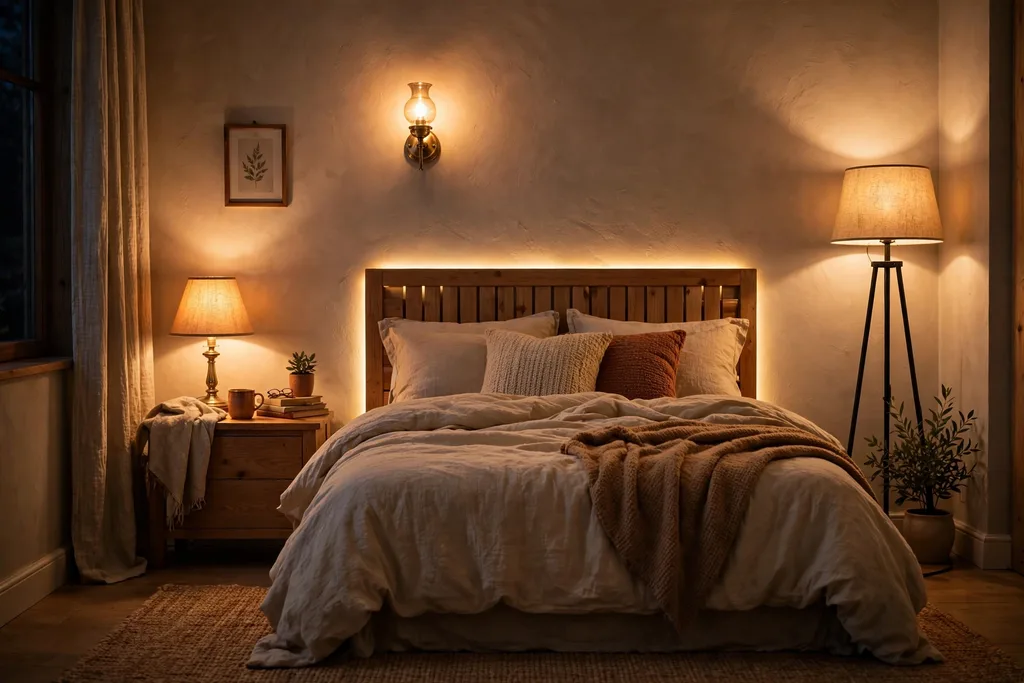
A bedroom needs three kinds of light, each doing one job. When one layer is missing, the room feels wrong even if it is bright enough. Layering like this is the core of these small bedroom lighting ideas: no single bulb has to do every job.
Ambient light is the general glow that lets you walk around, get dressed, and find things. With a ceiling fixture, that is the flush mount on a dimmer. With no overhead light, ambient comes from a tall floor lamp in the corner plus the two bedside lamps together. It should be soft and spread out, never a single bright point.
Task light is the focused light for reading, working, or getting ready. The bedside reading lamp is the main one, aimed at the page, not at your eyes. A desk lamp or a vanity light does the same job in its zone.
Accent light is the low, warm glow that makes the room feel finished: an LED strip behind the headboard, a small lamp on the dresser, string lights along a shelf. It adds almost no useful brightness, and that is the point.
The rule is at least three points of light at three different heights: a bedside lamp at eye level, a taller floor light, and a low accent like an LED strip under the bed. Layered schemes like this are credited with lifting perceived spaciousness by up to 30 percent. If you can see a bare bulb from the pillow, change the shade or the angle. Light-coloured or sheer shades spread light wider; dark or metal shades throw it in one direction and work poorly as a replacement for an overhead light. Three heights, three jobs: that is the short version of these small bedroom lighting ideas.
For the full decorating plan for the room these lights go in, including colour and layout, see the companion guide: https://honeyandhomestyle.com/small-bedroom-decorating-ideas/
Small Bedroom Lighting Ideas That Work With No Overhead Light
Best for: rentals with no ceiling fixture, or a fixture you are not allowed to touch. This is the spine of the whole plan.
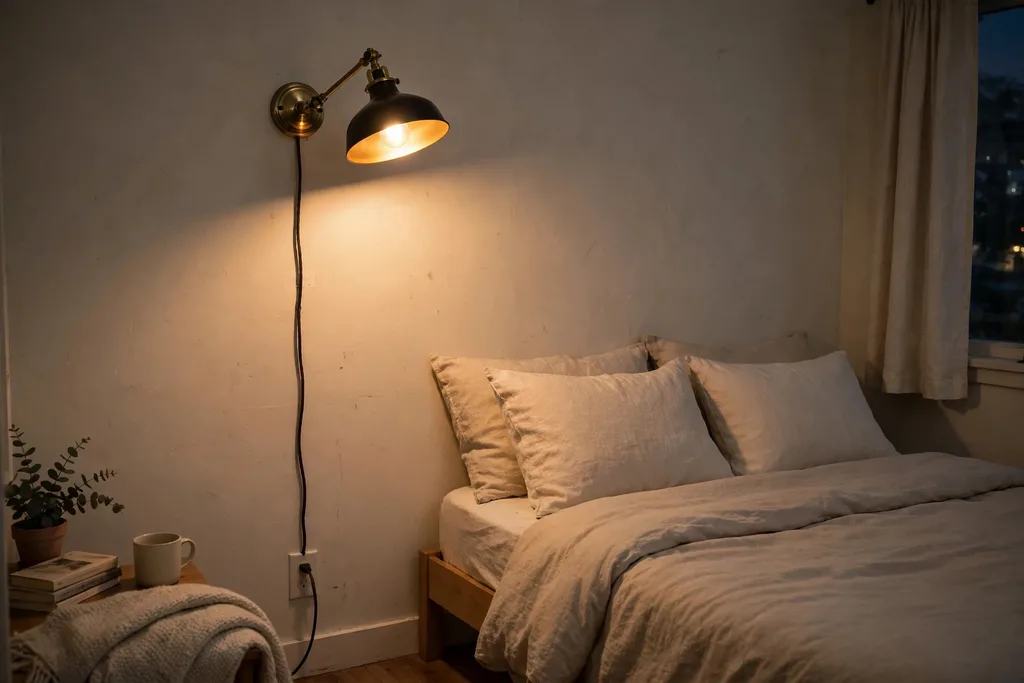
Can you light a bedroom well with no overhead light at all? Yes, and for a small bedroom it is often better than the single ceiling bulb you would have had. The plan is simple: build from the corners inward, with three sources at three heights, and nothing that needs wiring. That is why these small bedroom lighting ideas work even in a room with no ceiling fixture at all.
Start with the corner opposite the bed. That is where the ambient light lives. A torchiere floor lamp bounces light off the ceiling, which makes the ceiling read as higher, and it kills the shadow pinch that makes small rooms feel cramped. One strong corner lamp does more here than any other of these small bedroom lighting ideas.
Next, the bedside. One bedside lamp on each side for couples, or one lamp and one plug-in sconce if the nightstand is small. This is the task layer, and it is also half your ambient light when the floor lamp is off. A plug-in pendant swagged to a ceiling hook is the renter-friendly hanging light: the bottom of the shade hangs 24 to 36 inches above the nightstand.
Then the accent. A warm LED strip behind the headboard, stuck on with adhesive backing, at 2700K with a dimmer or remote. Never multicolour in a bedroom; the light is wrong for sleep. A second short strip under the bed gives the low glow that makes the room feel finished at night. Warm white copper-wire string lights with a timer work the same way above a desk or along a shelf, but keep them away from bedding.
Bedroom lighting no overhead works because the light comes from where you actually use the room, not from one point in the middle of the ceiling. Bedroom no overhead lighting fails only when people buy one bright floor lamp and call it done. One source, however bright, makes the same flat light the ceiling bulb made. It is the clearest proof that small bedroom lighting ideas do not need a ceiling fixture to succeed.
The renter ladder, from least to most permission needed: table and floor lamps need nothing. Battery or rechargeable sconces stick on with adhesive or a magnetic base and need nothing. Plug-in sconces need one or two screws, so ask first. A plug-in pendant needs a ceiling hook, so ask first. A hardwired ceiling light needs your landlord’s written permission and a licensed electrician. That is why bedroom lighting ideas no ceiling light searches keep growing: renters want real light without touching the ceiling. Start at the no-permission end of the ladder: most small bedroom lighting ideas need no landlord approval at all.
One outlet only? Run the cord along the wall, not across a walkway, and use adhesive cord clips to keep it tidy. A power strip with a switch gives you the one-switch trick, which has its own section below.
Bedside Lamps: The Right Height, the Right Bulb
Best for: reading in bed without waking your partner, and without a lamp that eats the whole nightstand.
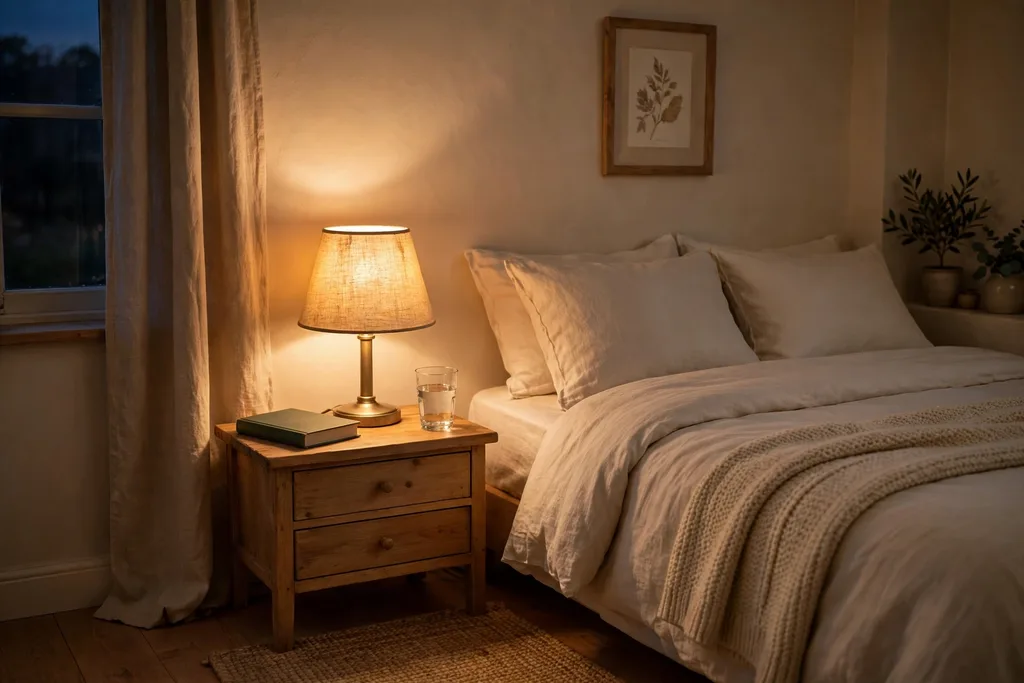
The bedside lamp is the hardest working light in the bedroom, and the most often bought wrong. Two numbers decide it: height and brightness. Get this one lamp right and the rest of these small bedroom lighting ideas get easier.
The lamp should stand 24 to 30 inches tall, about the same height as the nightstand or 2 to 3 inches taller. The bottom of the shade should sit at your seated eye level or slightly below, so the bulb is hidden when you are reading and the light falls on the page, not in your eyes. A lamp taller than 30 inches throws light over your head. A lamp shorter than 24 inches lights the nightstand and nothing else. Height matters more than style here, which is why so many small bedroom lighting ideas start at the nightstand.
Brightness is simpler than people think. A reading lamp needs about 450 to 800 lumens at 2700K to 3000K, aimed at the page. That is a 40 to 60W equivalent bulb, nothing more. Brighter bulbs bounce off the page and into your eyes, and they keep you awake longer. A dimmable 2700K bulb is the quiet workhorse of these small bedroom lighting ideas.
Couples need one lamp each side, and the reader’s side gets the brighter, adjustable one. A swing-arm lamp on the reader’s side lets one person read while the other sleeps, because the light points at one pillow and nowhere else.
The nightstand test: if the lamp base takes 8 to 10 inches of a 14 inch deep nightstand, more than half the surface is gone. That is when a wall sconce earns its place, which is the next section.
Wall Lights and Sconces: Free the Nightstand
Best for: small nightstands, couples who read, and anyone who wants the bedside clear.
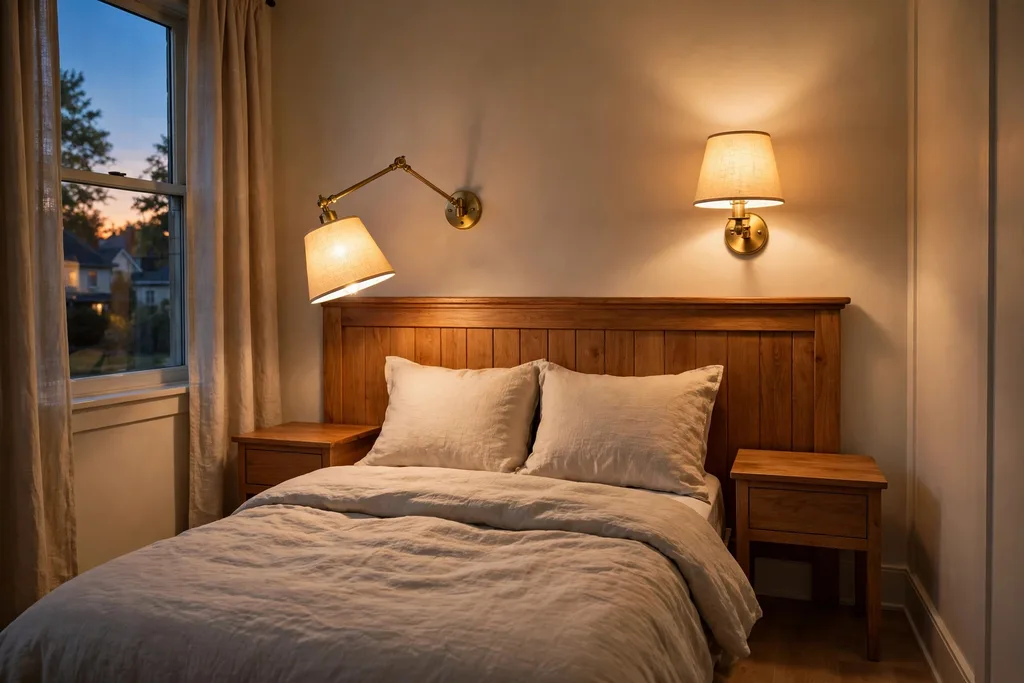
Sconces are the best small bedroom lighting idea for tight nightstands, because they give you a reading light and give you the surface back. A pair of sconces reclaims 18 to 24 inches of nightstand surface per side.
Mount them 60 to 65 inches off the floor, which is 8 to 10 inches above the top of the mattress, and 12 to 18 inches horizontally from the edge of the headboard. The fixture should project less than 8 inches from the wall. A swing-arm sconce extends 10 to 24 inches, so you can pull the light toward the page for reading and push it back flat for sleeping. Measure twice before you drill or stick anything: that is the rule behind the best small bedroom lighting ideas for sconces.
Plug-in sconces are the renter’s version. The cord runs down the wall to the outlet, held by removable adhesive clips, and the whole thing comes down in minutes at move-out with one or two small holes to fill. Battery sconces need no screws at all: magnetic base, USB rechargeable, stuck on with adhesive. They are dimmer than plug-ins, so use them for ambient and accent light, not as your only reading lamp. For renters, plug-in sconces are among the most practical small bedroom lighting ideas there are.
Place sconces in pairs for couples, one above each pillow, and give each its own switch or dimmer if you can. A single sconce above the centre of the headboard looks tidy in photos and lights nobody’s book; avoid it. Wall lights belong beside the bed or above the headboard edge, never where a sleeper could bump into them.
If your landlord is strict, the adhesive battery sconce is the zero-permission option. It will not replace a reading lamp, but paired with a good bedside lamp it completes the layer.
The Dark Corner: Floor Lamps That Replace the Ceiling Light
Best for: the corner that stays dark no matter what, and rooms where the ceiling light was never enough.
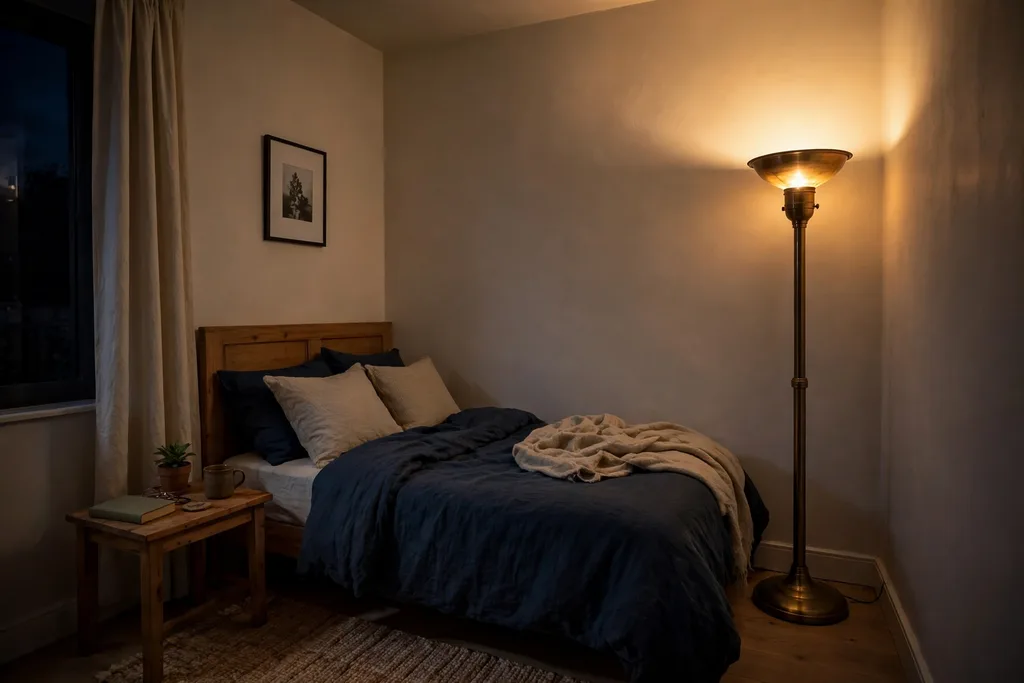
Every small bedroom has one dark corner, usually the one farthest from the door, where the ceiling light never reaches. A floor lamp fixes it.
A torchiere is the best first pick. It points up, bounces light off the ceiling, and floods the whole corner with soft, spread-out light. That upward bounce is what makes the ceiling read as higher. Pick an LED torchiere, not a halogen one. Halogen torchieres run hot enough to be a fire risk near curtains: never near curtains, never drape clothes over it, 300W maximum, never left on when you are out. An LED torchiere gives the same upward light with none of the heat. A torchiere is the single easiest win in these small bedroom lighting ideas for a dark corner.
An arc lamp is the second pick, for corners near the bed. Its arm reaches over the bed edge, so the light lands on the pillow instead of the floor. A tripod floor lamp fits a tight corner where a wide base will not.
Height for a bedside floor lamp is typically 54 to 60 inches. Shorter than that and the light pools on the floor. Taller than that and it glares over the headboard. Put the floor lamp in the corner opposite the bed. And give it a heavy base: a lamp that tips when you brush past it in the dark is worse than no lamp at all.
Ceiling Fan With Light for Small Bedrooms: The Option Nobody Talks About
Best for: rooms that already have a fan, or a ceiling fixture you are allowed to swap.
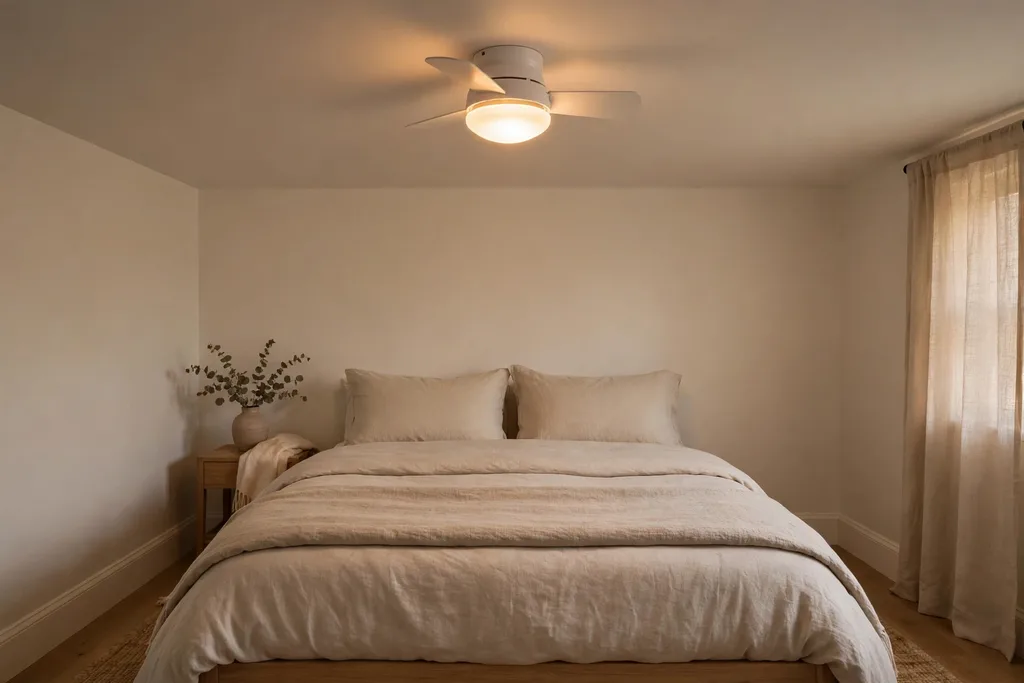
A ceiling fan with light for small bedroom use is the most overlooked option in bedroom lighting, and it solves two problems at once: air movement and ambient light. It is the only fixture that earns its ceiling space twice.
If your room already has a ceiling fan, start there before you buy anything else. Swap the bulbs for warm white LEDs at 2700K to 3000K, put the fan on a dimmer if the wiring allows it, and check the blade direction. In summer the fan should push air down. In winter it should pull air up on low speed, which pushes warm air off the ceiling and back down without a draught. A bulb swap is the cheapest of all small bedroom lighting ideas when a fan is already in place.
If you are choosing a new fan for a small bedroom, pick a hugger or low-profile model. Standard fans hang too low for 8 foot ceilings, and anything that drops the blades below 7 feet is a hazard. A hugger fan mounts almost flush to the ceiling and still moves the air. Size it small: a 36 to 44 inch blade span suits a 10 by 12 foot room.
The light kit matters as much as the fan. Pick one with a dimmable warm LED, not a bare bulb, and a frosted cover that spreads the light. A fan with a light is still only one layer, though: you still need the bedside task light and the low accent light.
One caution: swapping a ceiling fixture for a fan is not a renter’s job. It needs your landlord’s permission and, in most rentals, a licensed electrician. If you cannot swap it, the plug-in plan in the no-overhead section above does the same job without touching the ceiling. And if your room has a fan already, do not swap it for a pretty flush mount just because a photo looked nice. The fan earns its place every summer night.
Small bedroom ceiling lighting ideas usually stop at flush mounts and pendants. A fan with a light belongs on the same list, because it is the only ceiling option that also cools the room.
Closet, Mirror, and Desk: The Forgotten Zones
Best for: the three spots where bad light shows up every single morning.
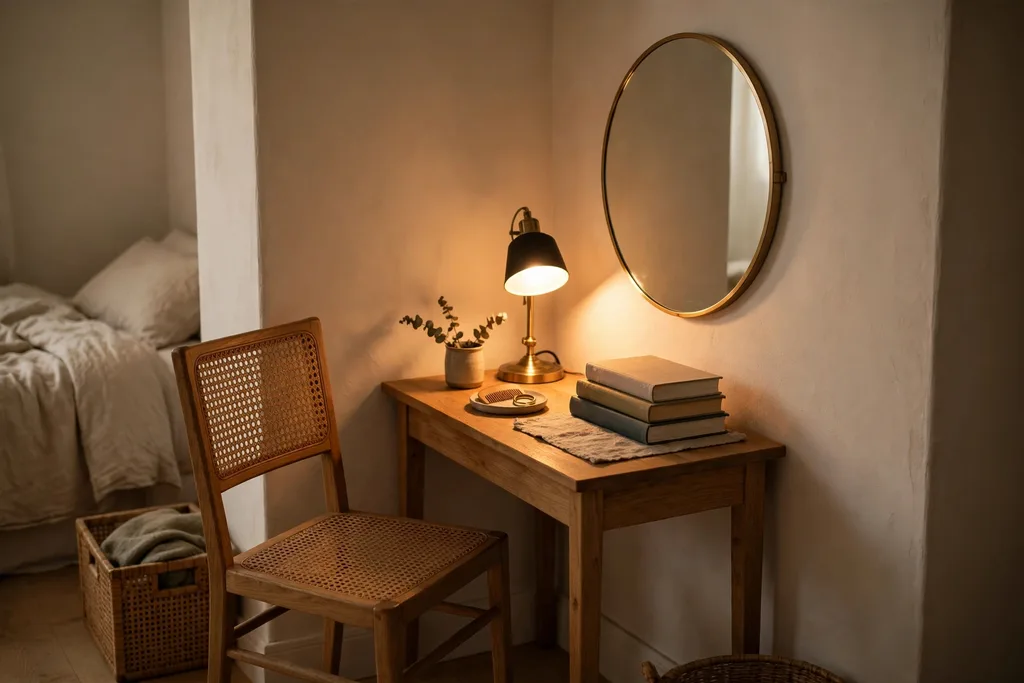
The bed gets all the attention, and three zones get none: the closet, the mirror, and the desk. Fix all three and the whole room works better.
The closet needs light you can see by, or the back half of the rod becomes a dead zone. A battery-powered motion sensor LED strip stuck under the top shelf turns on when you open the door and off when you close it. It needs no wiring and no landlord permission. Put the strip at the front edge of the top shelf, facing down, so the light falls on the clothes instead of into your eyes.
The mirror is a light multiplier, not just a reflection. A mirror opposite the main light raises perceived brightness by 30 to 50 percent, because it bounces the light back across the room. Hang it opposite the light source or at 90 degrees to it, never on the same wall as the light. A full-length mirror leaning in a corner has the biggest effect. A wall mirror goes at 4 to 6 feet off the floor. One or two mirrors maximum. A mirror opposite the main light is one of the oldest small bedroom lighting ideas, and it still works.
The desk or vanity needs its own task light, separate from the bedside lamp. A small desk lamp on the side opposite your writing hand keeps your own shadow off the page, and a pair of small wall lights flanking a desk mirror zones the work corner away from the rest corner. String lights above a desk work as accent light, but never enough alone for work or makeup. If your bedroom doubles as a home office, use 3000K at the desk and keep the bedside at 2700K for sleep.
One Switch: Turn It All On at Once
Best for: anyone who is tired of walking around the room switching on four lamps every night.
Three lamps are better than one, but only if you actually turn them on. The fix is a one-switch system. Without one switch, even the best small bedroom lighting ideas go unused on tired evenings.
The simplest version is a power strip with a switch, placed where you can reach it from the door or the bed. Plug the lamps into it, and one switch turns the whole room on. It costs nothing if you already own a strip.
The better version is smart plugs. Group the lamps in one app and one tap turns the room on, one tap turns it off. Set a schedule: on at sunset, off at a set time. Two smart plugs cover the bedside lamps, and the floor lamp goes on the strip. Smart bulbs do the same job in existing fixtures, and they add dimming to lamps that have no dimmer.
The bedroom version adds two scenes. A wind-down scene dims everything to 20 to 30 percent in the last hour before bed. A wake-up scene brings the bedside lamp up slowly in the morning instead of a harsh alarm light. Both are one tap once they are set up.
Keep the cords tidy. Run them along the wall with adhesive cord clips, never across a walkway or under a rug, and never staple a cord to the wall.
The Evening Wind-Down: Dim It Down, Sleep Better
Best for: anyone who reads in bed and then lies awake, and anyone whose bedroom light is the last bright thing before sleep.
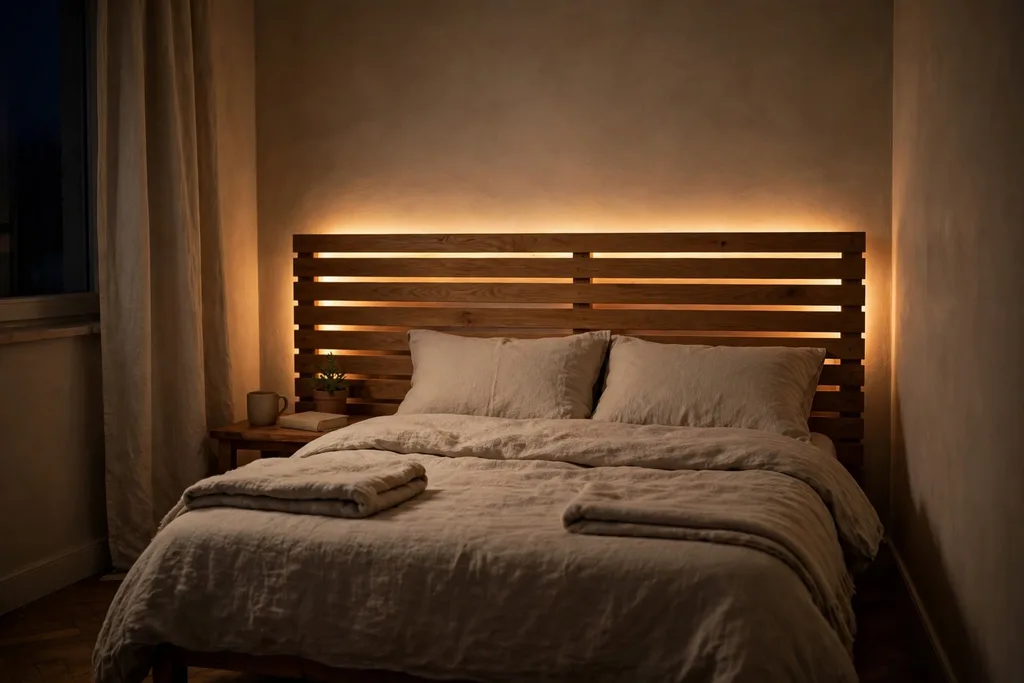
Light is the strongest signal your body gets about whether it is day or night. Room light under 200 lux has been shown to push melatonin onset later in 99.0 percent of people and shorten melatonin duration by about 90 minutes, and about two hours of evening blue light significantly suppresses melatonin. The alerting effects persist 3 to 4 hours after the lights go off. That is the science behind the routine below. That is why the evening matters so much in these small bedroom lighting ideas. The Sleep Foundation explains how light affects sleep and why dim, warm light in the evening helps.
Dim everything to 20 to 30 percent in the last hour before bed: the bedside lamp on its lowest setting, the floor lamp off, and only the LED strip or a small accent lamp on. The room should feel like candlelight, not like a lit room.
Switch the night light to amber or red. Red-toned light is the least disruptive to sleep, and a small amber night light on the way to the bathroom beats the bright hallway light every time. Keep the phone on its warmest night setting, because a phone screen at full brightness undoes the dimming you just did.
Make the last light you turn off the lowest one. The LED strip behind the headboard or the small lamp on the dresser goes off last, after you are already in bed. And keep the morning light different: open the curtains first, let daylight in, and save the bright lamps for cloudy mornings. Ending low is the finishing touch in these small bedroom lighting ideas for better sleep.
The Whole Room for Under $150
Best for: seeing the real cost before you buy. Here it is, item by item.
| Item | Price |
|---|---|
| Plug-in swing-arm wall sconces, set of 2 | $36 |
| Bedside table lamps, set of 2 | $30 |
| Warm white LED strip with dimmer, behind headboard | $14 |
| LED torchiere floor lamp | $28 |
| Warm white LED bulbs 2700K, 4-pack | $10 |
| Smart plugs, 2-pack | $12 |
| Copper-wire string lights with timer | $9 |
| Adhesive cord clips | $5 |
| Total | $144 |
The whole system costs $144, which leaves $6 of the $150 budget unspent. Every price is a typical US retail price for a standard version, not a sale price and not a premium brand. At $144 for the whole room, these small bedroom lighting ideas stay well inside a renter’s budget.
The cheapest path is $105. Skip the smart plugs and use a power strip you already own, skip the string lights, and buy one sconce instead of two. That leaves the working core of the system. Add the rest later, one piece at a time.
Do not buy the cheapest torchiere. It holds the room’s ambient light, and a lamp that wobbles or buzzes is not a bargain. Spend the $28 on one with a heavy base. Spend the savings where the light actually comes from: that is the priority in these small bedroom lighting ideas.
Buy in This Order
Best for: spreading the cost and avoiding the classic mistake of buying accent lights before the room has a reading light.
- Measure, $0. Tape measure, five numbers, one sketch. Nothing gets bought until this is done.
- Warm white bulbs, $10. Swap every bulb in the room to 2700K first. This one change fixes half the problem.
- Bedside table lamps, $30. The reading light comes next, because it is the light you use every night.
- Plug-in sconces, $36. Free the nightstand once the lamps are in place.
- LED strip, $14. The accent layer goes in after the task light, not before.
- Torchiere floor lamp, $28. The dark corner is gone.
- Smart plugs, $12. The one-switch system, once the lamps exist to switch.
- String lights and cord clips, $14. The finishing touches.
Buy one step, live with it for a night, then buy the next. One step at a time is how these small bedroom lighting ideas stay affordable instead of overwhelming.
7 Mistakes to Avoid
Best for: skipping the errors that make a small bedroom feel smaller, not bigger.
1. One bright ceiling light as the only source. A single overhead bulb flattens the room and leaves the corners dark. Three layers at three heights beat one bright light every time. One layer is never enough, and that is the first lesson of these small bedroom lighting ideas.
2. Cool white bulbs above 4000K. They feel clinical in a bedroom and fight sleep. Use 2700K to 3000K everywhere.
3. A sconce hung too high or too low. At 60 to 65 inches off the floor the light lands on the page. Higher than that it lights the ceiling; lower than that it glares in your eyes when you sit up.
4. An oversized ceiling fixture. Above 18 inches wide crowds the ceiling, below 10 inches reads undersized. Length plus width in feet equals diameter in inches; for rooms under 120 square feet, use 12 to 16 inches.
5. A lamp base that eats the nightstand. A base 8 to 10 inches wide on a 14 inch deep nightstand leaves no room for anything else. Switch to a sconce.
6. Exposed bulbs you can see from the pillow. If you can see a bare bulb from the bed, change the shade or the angle.
7. Mixing colour temperatures. A 2700K lamp next to a 4000K lamp looks wrong even when each one looks fine alone.
FAQ
Can I light a bedroom well with no overhead light at all?
Yes. Three sources at three heights do the job: a tall floor lamp in the corner for ambient light, a bedside lamp or plug-in sconce for reading, and a low accent like an LED strip behind the headboard. That layered plan lights a small bedroom better than a single ceiling bulb. Three sources at three heights is the short answer behind all of these small bedroom lighting ideas.
How to light a bedroom with no overhead lighting?
Build from the corners inward. Put a torchiere or arc floor lamp in the corner opposite the bed, add a bedside lamp or plug-in sconce for reading, and finish with a warm LED strip behind the headboard. Keep every bulb at 2700K to 3000K, and put the lamps on one switch or a smart plug.
How many lights should a bedroom have?
At least three points of light at three different heights: one bedside lamp, one taller floor or wall light, and one low accent. Larger rooms need four to five. The number matters less than the heights.
Where should bedside lamps be placed?
On the nightstand, with the bottom of the shade at your seated eye level or slightly below. The lamp should stand 24 to 30 inches tall, about the same height as the nightstand or 2 to 3 inches taller. For couples, one lamp each side.
Should bedroom lights be warm or cool?
Warm. Use 2700K to 3000K in every bedroom lamp. Warm white feels cozy and helps you wind down; cool white above 4000K feels clinical and fights sleep. The one exception is a bedroom desk used for work, where 3000K is crisper. Warm white is the default in these small bedroom lighting ideas for a reason: it helps the room wind down.
How many lumens do I need in a bedroom?
A bedroom needs 10 to 20 lumens per square foot, so a 120 square foot room needs 1,200 to 2,400 lumens in total, spread across the layers. A reading lamp needs about 450 to 800 lumens at 2700K to 3000K.
What is the best renter-friendly bedroom lighting?
Table lamps, floor lamps, battery sconces, and plug-in sconces. None of them need wiring, drilling, or an electrician. Plug-in sconces need one or two screws, so ask your landlord first. Battery sconces stick on with adhesive and need no permission at all.
What size light fixture should I use in a small bedroom?
Add the room’s length and width in feet to get the diameter in inches. A 10 by 12 foot room takes a 22 inch fixture, and for rooms under 120 square feet step down to 12 to 16 inches. Below 10 inches reads undersized, above 18 inches crowds the ceiling. On an 8 foot ceiling, pick a flush or semi-flush mount that drops 4 to 8 inches.
Do mirrors really make a small bedroom feel bigger?
Yes. A mirror opposite the main light raises perceived brightness by 30 to 50 percent, because it bounces the light back across the room. Hang it opposite the light source or at 90 degrees to it, never on the same wall. A full-length mirror leaning in a corner has the biggest effect.
How do I turn everything on at once?
Use a power strip with a switch, or group smart plugs in one app. Two smart plugs cover the bedside lamps, and the floor lamp goes on the strip. Set a schedule so the lamps come on at sunset and off at a set time.
Can I install a ceiling light in a rental, and do I need an electrician for plug-in lights?
A hardwired ceiling light needs your landlord’s written permission and a licensed electrician. Plug-in lights, battery lights, table lamps, and floor lamps need no electrician at all. A plug-in sconce needs one or two screws, and a plug-in pendant needs a ceiling hook, so ask first.
Is it safe to use floor lamps around children and pets?
Yes, if the base is heavy and stable and the lamp uses LED bulbs. LED torchieres stay cool, while halogen torchieres run hot enough to be a fire risk near curtains. Keep cords along the wall with adhesive clips, never across a walkway, and never drape clothes over a lamp.
Start Today
Your small bedroom does not need an electrician, a new ceiling, or a big budget. It needs five measurements, three layers of warm light at three heights, and one switch that turns them all on. Start with the bulbs tonight, add the bedside lamp this weekend, and build the layers one at a time. In a week, reading in bed will feel easy, and the small bedroom lighting ideas in this guide will be doing their quiet work every single evening. The room is small. The light is what makes it feel big. Start with the tape measure tonight, and let these small bedroom lighting ideas do the rest.