Your bedroom walls are blank, your lease says no paint, and every “renter-friendly” idea you have seen either costs too much or looks temporary. Peel and stick wallpaper for bedroom walls solves all three problems at once: one accent wall behind the bed changes the whole room, it costs less than $150, and when move-out day comes, it peels off without taking your paint, or your deposit, with it. This guide gives you the exact roll counts by bed size, a full itemized budget, and the renter checklist that protects your walls from the first patch test to the final slow peel.
Table of Contents
Why Peel and Stick Wallpaper Works So Well in a Small Bedroom
A small bedroom has one big problem: there is not enough room for the furniture to do the decorating. You cannot add a statement dresser, a reading chair, and a gallery wall when the bed already takes up half the floor. That is exactly why peel and stick wallpaper for bedroom works. It decorates the wall you already stare at, the wall behind the bed, without taking a single inch of floor space.
One wall is the whole trick. Papering all four walls in a 10 by 10 foot bedroom closes the room in and costs four times as much. One accent wall behind the bed gives you the color, the pattern, and the finished feeling, and it leaves the other three walls light and quiet so the room still feels open. It also keeps the project small enough to finish in one afternoon: a single bed wall takes most first-timers 3 to 5 hours, including measuring and trimming. That one-wall approach is also why peel and stick wallpaper for bedroom projects stay affordable for renters.
It is also the most forgiving way to try a bold pattern. A dark botanical print or a deep navy that would feel risky on four walls feels intentional on one. And because the paper is removable, a pattern you love at 25 can come down at 27 without a repaint, a repair bill, or a fight with your landlord. If the rest of the room still needs a plan before you commit to a wall, start with these small bedroom decorating ideas, the wallpaper works best when the bed, the bedding, and the wall are planned together.
How Much Peel and Stick Wallpaper Do You Need?
This is the question that stops most people before they start, and it has a simple answer once you know two numbers: your wall width in inches and the width of one roll. A standard peel and stick roll is about 20.5 inches wide and 16.5 feet long, which covers roughly 28 square feet. You do not buy by square feet, though, you buy by panels. Each vertical strip on your wall is one panel, and each panel is one roll-width wide. Once you know those two numbers, buying peel and stick wallpaper for bedroom walls is a simple panel count, not a guess.
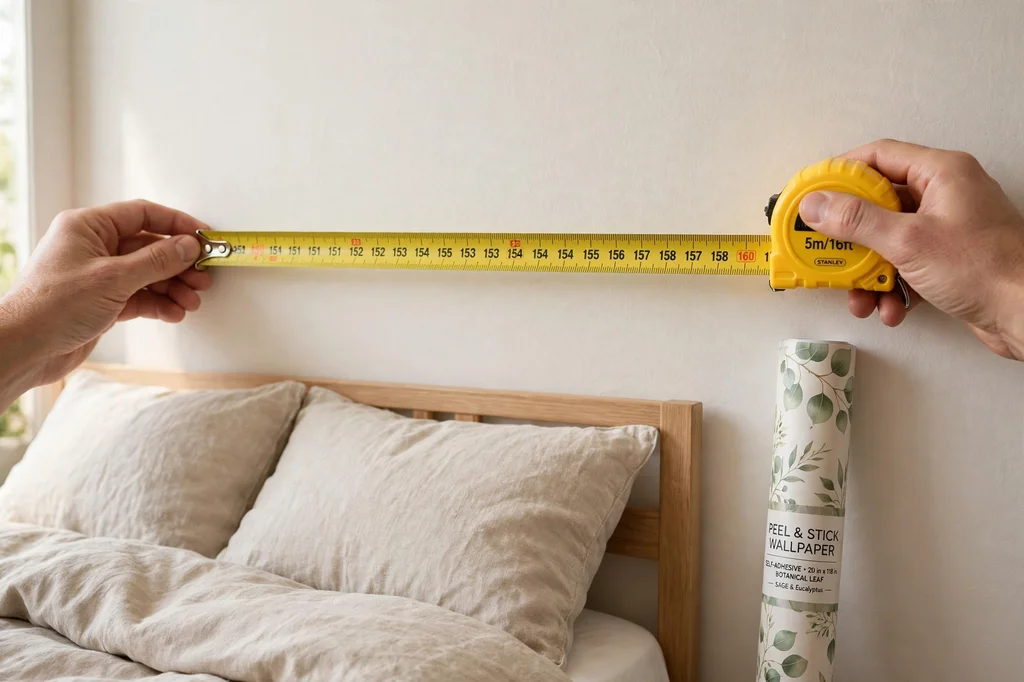
Measure the bed wall at its widest point, in inches, from corner to corner. Divide that number by 20.5 and round up. That is your panel count.
Then work out the rolls: an 8-foot-tall wall needs one 8-foot panel, and a 16.5-foot roll gives you two 8-foot panels. So divide your panel count by 2 and round up, that is the number of rolls for a solid color or a small, random print. For a patterned print with a visible repeat, add one extra roll: the repeat eats paper every time you line the pattern up, and a spare roll from the same batch is the only way to guarantee the color matches. That spare roll is the cheapest insurance in a peel and stick wallpaper for bedroom project.
Bed-Wall Sizing Table
The table below assumes a standard 8-foot ceiling and a standard 20.5-inch-wide roll. “Rolls to buy” already includes the extra roll for patterned prints.
| Bed size | Bed width | Typical bed-wall width | Panels needed | Rolls to buy | Estimated paper cost at $29/roll |
|---|---|---|---|---|---|
| Twin | 38 in | 8 ft (96 in) | 5 | 4 | $116 |
| Full | 54 in | 9 ft (108 in) | 6 | 4 | $116 |
| Queen | 60 in | 10 ft (120 in) | 6 | 4 | $116 |
| King | 76 in | 12 ft (144 in) | 8 | 5 | $145 |
A queen bed wall is the sweet spot: 6 panels, 4 rolls, and $116 of paper. A king wall jumps to 5 rolls because the wall is 2 feet wider, so if your budget is tight, look for rolls at $24 instead of $29, 5 rolls at $24 is $120, and the whole king project still lands under $150 with tools included. That $116 figure is the paper alone, before tools, in a typical peel and stick wallpaper for bedroom budget.
Two details people miss: first, measure at the widest and tallest points, not the middle. Baseboards, uneven corners, and a ceiling that dips by half an inch will eat your margin if you measured the easy spot. Second, always round panels up, never down. A panel that is half an inch short leaves a stripe of bare wall at the corner, and no amount of smoothing fixes that. Those two rules matter most on a first peel and stick wallpaper for bedroom install, when a short panel cannot be stretched.
What about a 12 by 12 foot room? The math does not change, only the wall you paper matters. A 12-foot bed wall needs 8 panels (144 inches divided by 20.5, rounded up), which is 5 rolls with the pattern spare. The other walls stay plain, so the room size never multiplies the paper. If you ever papered a whole 12 by 12 room, all four walls, you would need about 24 panels, but for a bedroom accent wall, you never do.
How Much Does a Bedroom Accent Wall Cost?
Here is the whole project, itemized, for a standard queen bed wall (10 feet wide, 8 feet tall). When you compare peel and stick bedroom wallpaper prices, remember the roll width matters more than the roll price, a cheap narrow roll that needs 6 rolls costs more than a standard roll that needs 4. No hidden extras, no “plus tools” footnote, the tools are in the table. That roll-width point is the key to comparing peel and stick wallpaper for bedroom prices fairly.
Queen Bed-Wall Budget, Under $150
| Item | Cost |
|---|---|
| 4 rolls of budget peel and stick wallpaper for bedroom (20.5 in × 16.5 ft) at $29 each | $116 |
| 1 sample swatch (order before the rolls) | $8 |
| Plastic smoothing tool | $8 |
| Utility knife + spare blades | $6 |
| Painter’s tape + pencil | $4 |
| Total | $142 |
$116 + $8 + $8 + $6 + $4 = $142. That is $8 under the $150 budget, and it includes everything, the paper, the sample, and every tool. You probably already own a step stool, a level, and a tape measure; if you do not, a basic level adds about $7, which would push the total to $149, still under $150, but with only $1 to spare, so borrow one if you can. That $142 total is the full, honest cost of a peel and stick wallpaper for bedroom accent wall, tools included.
Premium rolls change the math. At $60 to $65 a roll, 4 rolls alone cost $240 to $260, and the project is no longer a budget project. The budget rolls in the $24 to $40 range are the right choice for a first bedroom wall: they look the same from the bed, they remove the same way, and if you make a mistake on your first panel, you have only wasted $29, not $65.
The Cheapest Path: Under $80
If $142 is still more than you want to spend, paper a headboard-width panel instead of the full wall. A queen headboard is 60 inches wide, which needs 3 panels (60 divided by 20.5, rounded up). Two rolls give you 4 panels, so 2 rolls cover it with one spare panel left over.
| Item | Cost |
|---|---|
| 2 rolls of budget peel and stick wallpaper for bedroom at $29 each | $58 |
| 1 sample swatch | $8 |
| Plastic smoothing tool | $8 |
| Painter’s tape + pencil | $4 |
| Total | $78 |
$58 + $8 + $8 + $4 = $78. You save $64, you use half the paper, and you cut your removal risk in half too, because there is simply less adhesive on the wall. The panel reads like a giant headboard, and in a small bedroom it can actually look more deliberate than a full wall.
Full Wall or Headboard-Width Panel?
Both look good. They solve different problems, so choose by your room, not by what looks better in a photo.
| Full bed wall | Headboard-width panel | |
|---|---|---|
| Paper needed (queen) | 4 rolls | 2 rolls |
| Total cost | $142 | $78 |
| Install time | 3–5 hours | 1–2 hours |
| Removal risk | Higher (more adhesive, more seams) | Lower (less paper on the wall) |
| Best for | Bedrooms where the bed wall is the room’s focal point; bold or dark patterns | Tight budgets, first-timers, very small rooms, renters who want the smallest possible deposit risk |
| Pattern scale | Large prints work, the wall is wide enough to show the repeat | Small or medium prints work best, a large print gets cut off by the panel edges |
A full wall wins when the bed wall is the first thing you see from the door and you want the room to feel finished. A headboard-width panel wins when you want the look for under $80, when you have never hung wallpaper before, or when your lease makes you nervous. Either way, center the paper on the bed, not on the wall. In a small bedroom the bed is almost never centered on the wall, there is a nightstand on one side and a door on the other, and paper centered on the wall with an off-center bed looks like a mistake. Measure from the middle of the headboard outward.
7 Peel and Stick Wallpaper Ideas for a Small Bedroom
1. Soft Floral Behind the Bed
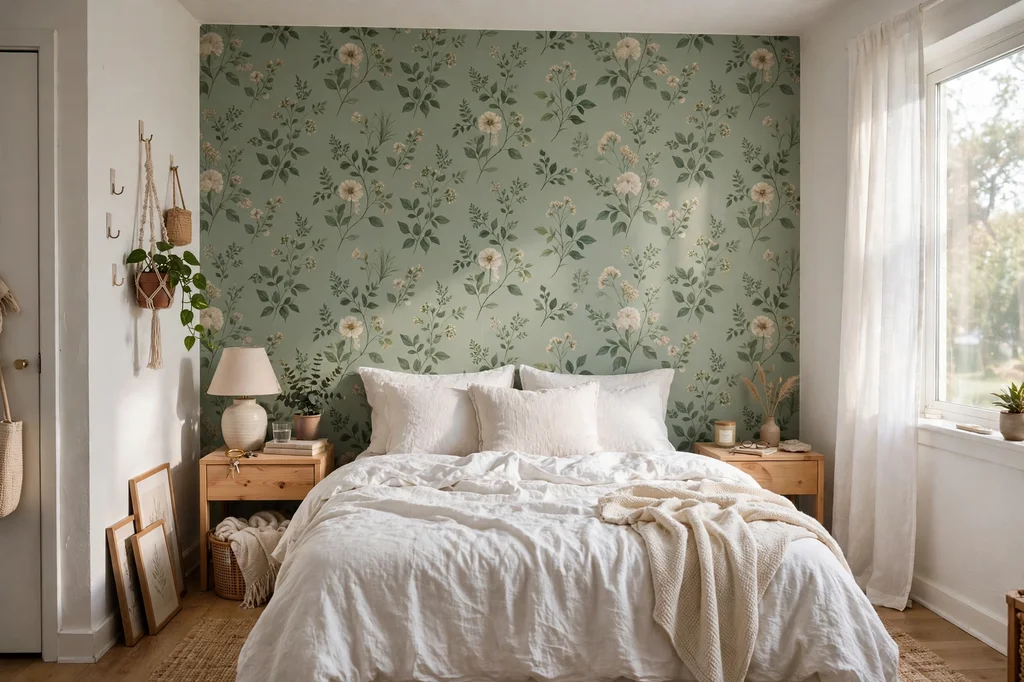
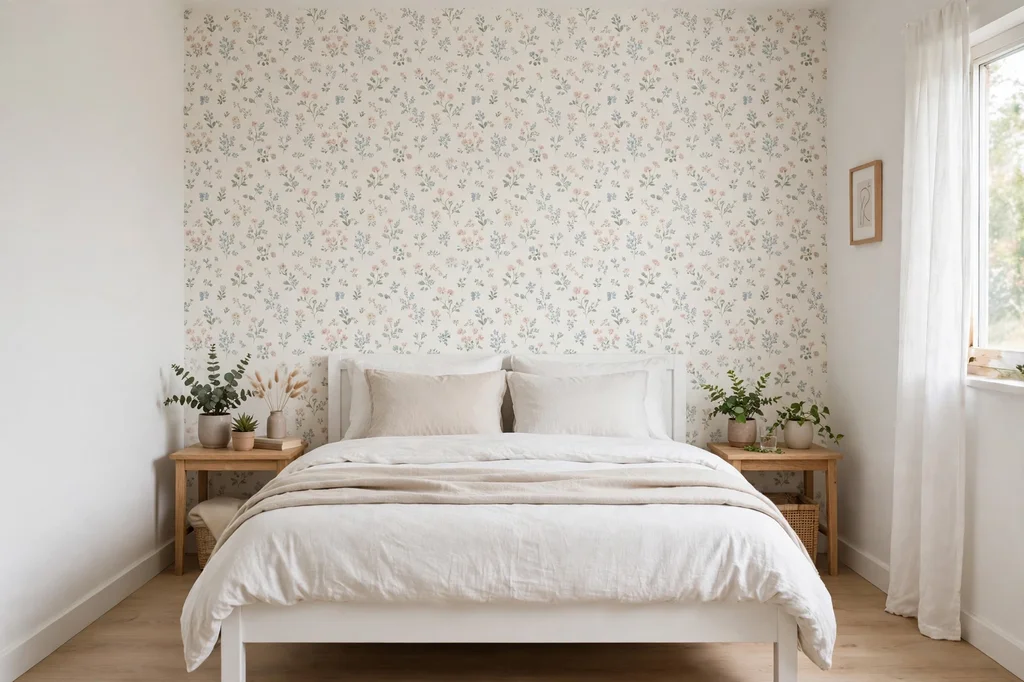
A small-scale floral in sage, cream, or dusty blue is the safest first choice for a small bedroom. The print is busy enough to hide a slightly crooked seam and calm enough to sleep next to. Keep the bedding plain, white or cream linen, and let the wall do the talking. Small florals suit a 10-foot wall; on a 12-foot king wall they can look repetitive, so step up to a medium-scale bloom. For a first project, a small-scale floral is the easiest peel and stick wallpaper for bedroom pattern to match at the seams.
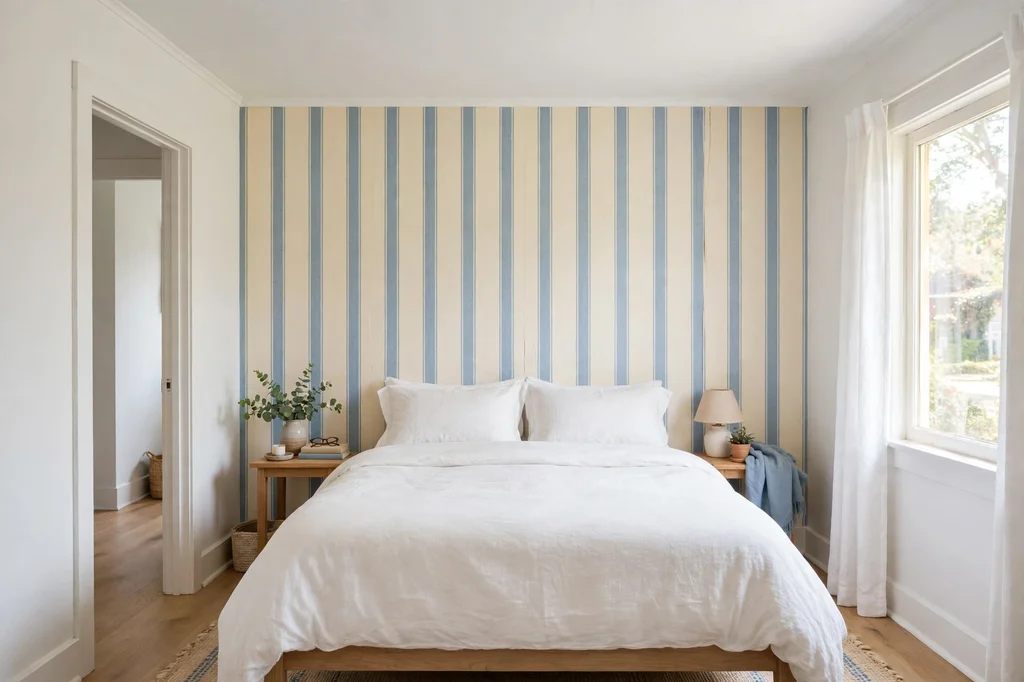
2. Vertical Stripes to Add Height
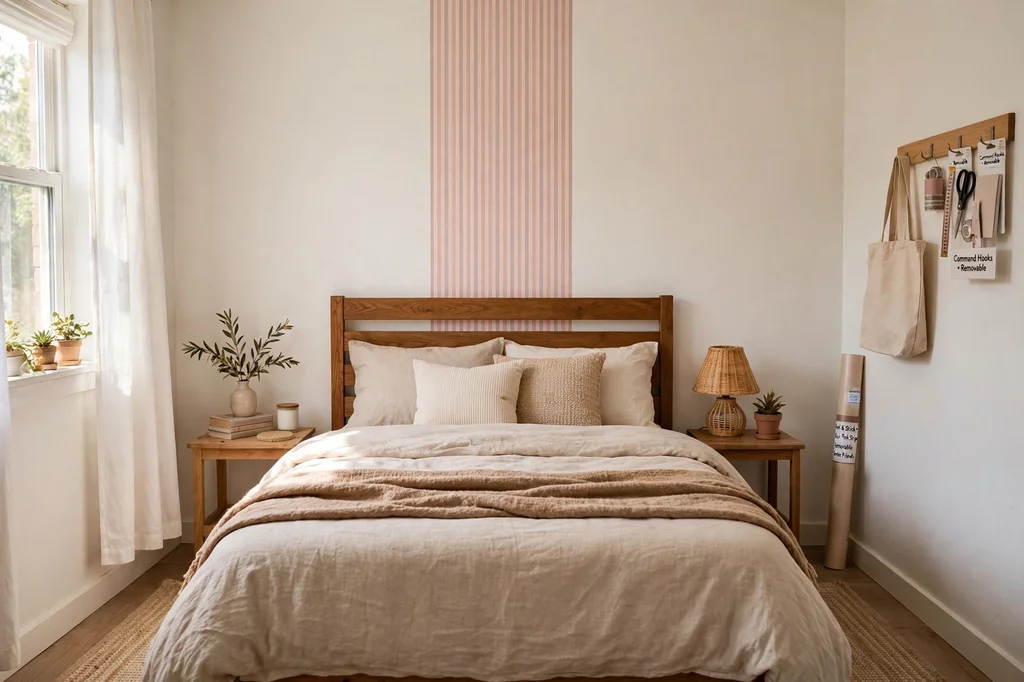
If your ceiling is 8 feet or lower, vertical stripes are the oldest trick in the book and it still works: the eye follows the lines up and the ceiling reads taller. Use soft, low-contrast stripes, cream and pale blue, or white and warm gray, so the effect is height, not a circus tent. High-contrast stripes in a small bedroom feel busy by bedtime.
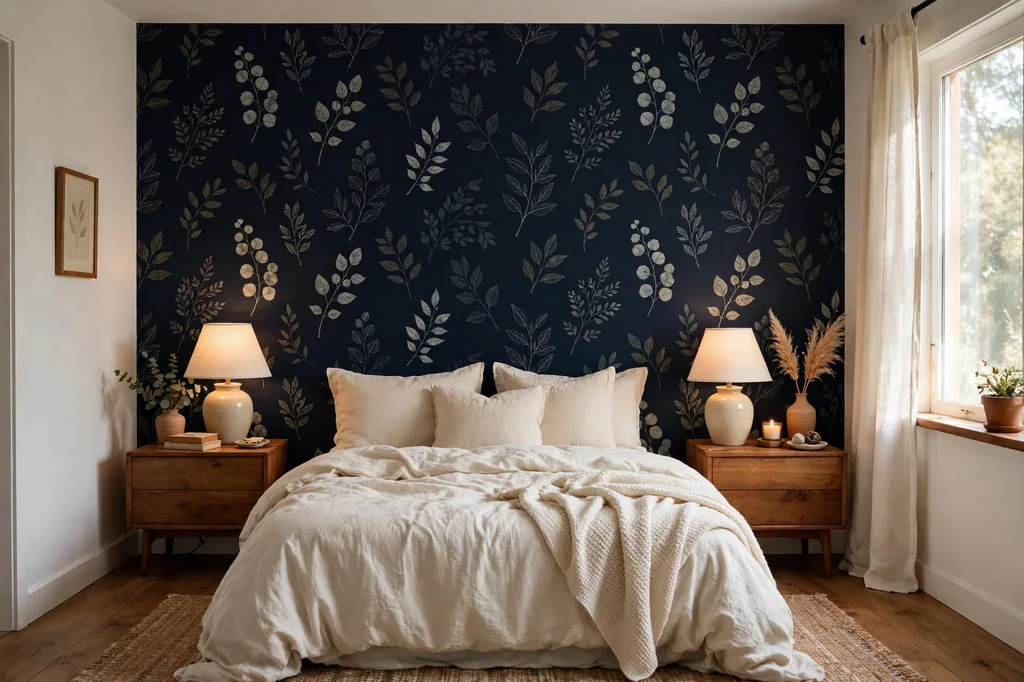
3. Dark and Moody Behind the Bed
A dark navy, charcoal, or deep green botanical print behind the bed makes the wall recede, which paradoxically makes a small bedroom feel deeper instead of smaller. The rule is one dark wall only, plus light bedding and a warm lamp on the nightstand so the room never feels like a cave. This is the best choice if your bedroom gets strong daylight, the dark wall absorbs the glare and the room feels calm by evening. A dark wall works best with light bedding, and that contrast is what makes peel and stick wallpaper for bedroom walls feel deep, not dark.
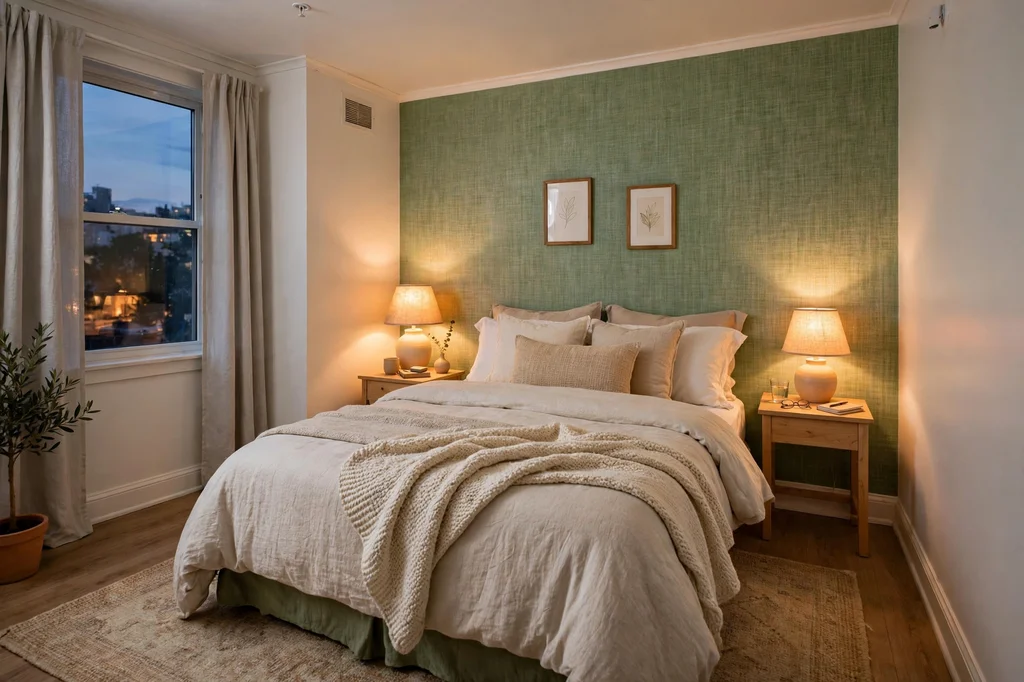
4. Textured Linen or Grasscloth Look
A textured linen or grasscloth-look print adds depth without a pattern, which is perfect if you already have patterned bedding or a busy rug. Texture makes a small room feel layered and expensive, and because there is no pattern to match, you can skip the extra roll, a solid or textured print needs no pattern-repeat allowance. Check the sample in morning, midday, and evening light before you buy: texture changes color more than flat prints do as the light moves.
5. A Calm Botanical for Better Sleep
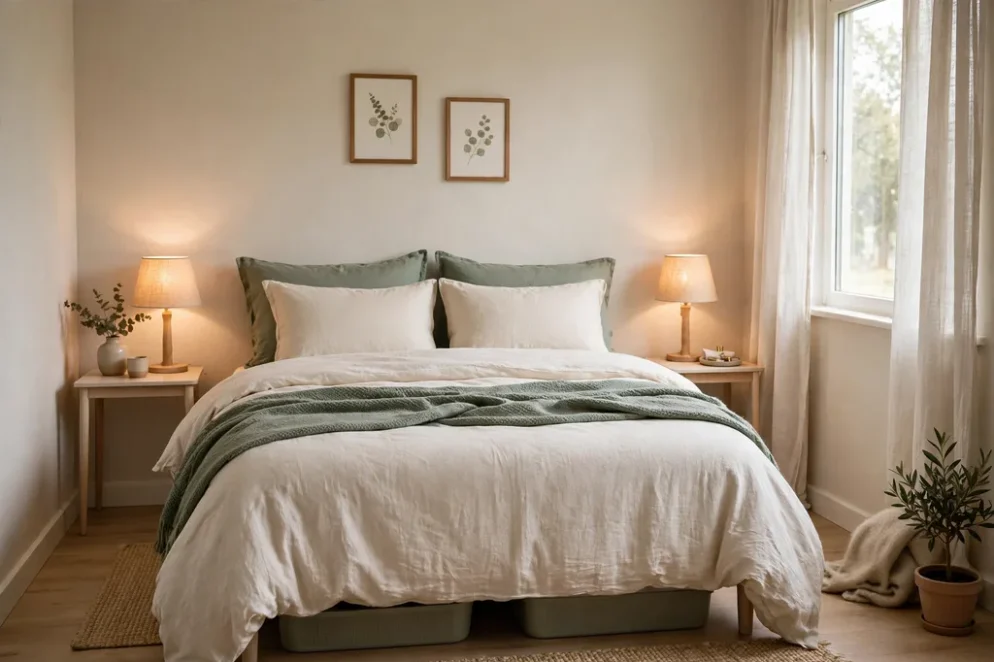
Soft green leaves, eucalyptus sprigs, or a pale botanical on a white ground is the most relaxing option on this list, and it pairs with almost any bedding you already own. It is also the easiest pattern to live with long-term, nothing in it shouts, so it will not feel dated in six months. This is the print to choose if you are papering a bedroom you actually sleep in every night rather than a guest room.
6. Horizontal Stripes to Widen a Narrow Wall
If your bed wall is narrow, a twin bed pushed against a short wall, or a bedroom that is longer than it is wide, horizontal stripes stretch the wall visually. Keep them thin and low-contrast, and stop the paper at the corners: wrapping a horizontal stripe around a corner breaks the line and looks unfinished.
7. One Bold Print, Quiet Everything Else
Pick one wallpaper with a big personality, a large-scale botanical, a bold geometric, a vintage damask, and keep everything else in the room quiet: plain bedding, plain curtains, one wood tone. The rule is one star per room. Two bold patterns (a loud wall plus a loud duvet) fight each other, and in a small bedroom there is nowhere for the eye to rest. Before you commit to a bold print, double-check the bed placement against your small bedroom layout ideas, a bold wall behind a bed that blocks the only walkway will annoy you every single day.
How to Hang Peel and Stick Wallpaper in a Bedroom
You do not need experience. You need a clean wall, a level line, and patience with the first panel, the first one sets every panel after it. Peel and stick wallpaper for bedroom projects start with the first panel, so take your time with it. For a second, photo-led walkthrough, see Bob Vila’s guide to applying peel-and-stick wallpaper.
1. Clean the wall. Wipe the bed wall with a damp cloth and a drop of mild dish soap, then let it dry completely. Dust and grease are the two things that stop peel and stick paper from bonding, and a bedroom wall collects both, especially behind the bed, where nobody ever dusts.
2. Draw your starting line. Find the center of the headboard, mark it, and use a level to draw a faint vertical pencil line. Your first panel goes on this line, not in the corner, corners in rental bedrooms are almost never straight, and starting in a corner guarantees a crooked wall.
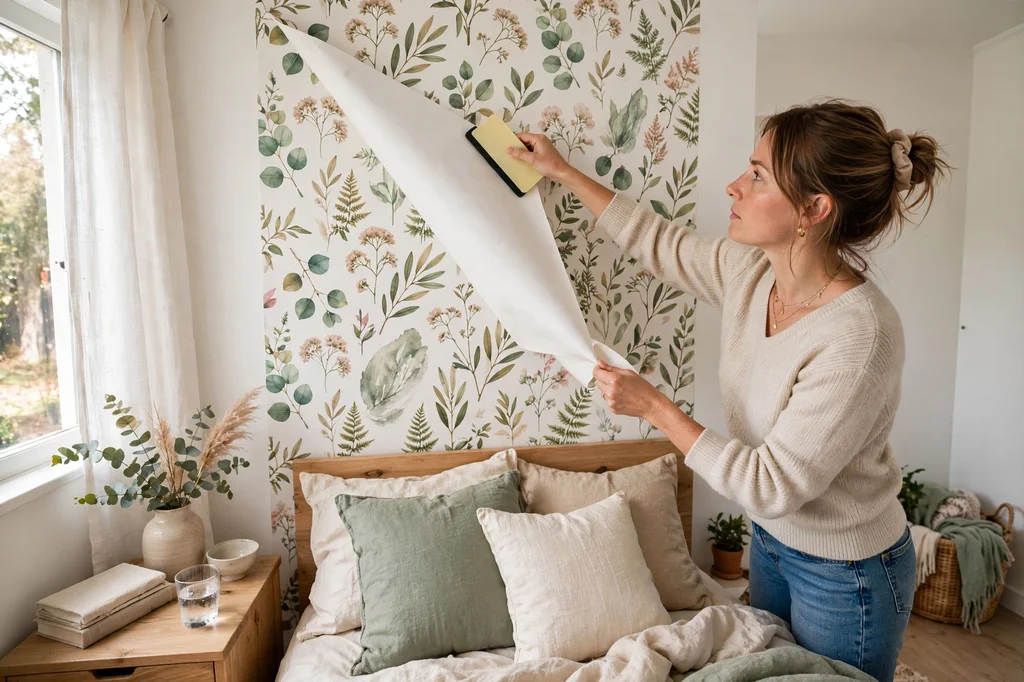
3. Peel a little, not a lot. Peel back 12 inches of backing from the top of the first panel. Stick the top edge to the wall, leaving 1 inch overlapping onto the ceiling, you will trim it later. Smooth downward with the plastic tool, center outward, peeling more backing as you go. Never peel the whole backing off at once: the panel will stick to itself and you will lose it.
4. Match the pattern at eye level. Line up the second panel so the pattern matches at eye level, where you will actually see it. Overlap the edges by about 1 inch, then smooth the seam flat. Small mismatches near the ceiling or the baseboard disappear behind the bed and the pillows, do not waste an hour fixing a seam nobody will ever see.
5. Work around outlets and switches. Turn off the power at the breaker for any outlet on the bed wall. Hang the panel over the outlet, then cut a small X over the outlet box with the utility knife and fold the four flaps back into the box before you screw the cover plate back on. Never cut around a live outlet with a metal blade.
6. Trim top and bottom. Run the utility knife along the ceiling line and the baseboard with a straight edge, using a fresh blade. A dull blade tears the paper instead of cutting it, change the blade after every two panels.
7. Roll the seams. Go over every seam once more with the smoothing tool, pressing firmly. Then step back, look at the wall from the door, and leave it alone. Freshly hung peel and stick paper settles over the first 24 hours, and the small bubbles you see at hour one are usually gone by morning.
The Renter Checklist: Patch Test, Paint Cure, Install, Removal, Deposit
This is the system no competitor puts in one place, and it is the whole reason peel and stick wallpaper for bedroom is safe for renters. Each step protects the next one. Skip the patch test and you will not know the paint is a problem until removal day. Skip the paint cure and the paper bonds to soft paint and takes it with it. Follow all five steps and your deposit stays yours.
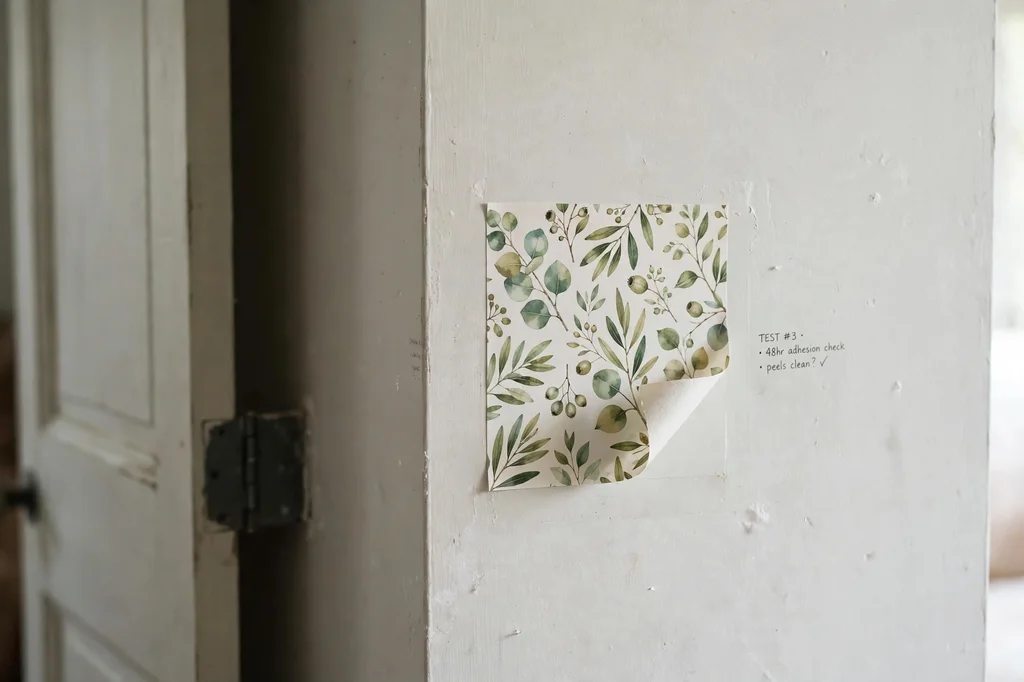
Step 1, Patch test (1 week before you buy rolls). Stick a sample square on a hidden spot, behind the door, or low on the wall behind the bed where the headboard will cover it. Leave it for a full week, not a day. After 7 days, peel it off slowly at a low angle. If the paint is intact and there is no sticky residue, your wall is safe. If paint comes off, stop: your wall has flat or chalky builder paint, and no peel and stick paper is safe on it.
Step 2, Paint cure (30 days). If the bedroom was painted recently, wait at least 30 days before hanging anything. Fresh paint feels dry in hours but keeps curing for weeks, and paper stuck to curing paint bonds to it permanently. Ask your landlord when the room was last painted, if nobody knows, do the patch test and treat a sticky result as a no.
Step 3, Install on the right surface. Peel and stick wallpaper only belongs on smooth, clean, dry, fully cured paint in eggshell, satin, or semi-gloss. It does not belong on textured walls, plaster with bumps, or flat matte builder paint. If your wall fails the patch test, do not try a different brand hoping for a different result, the problem is the paint, not the paper.
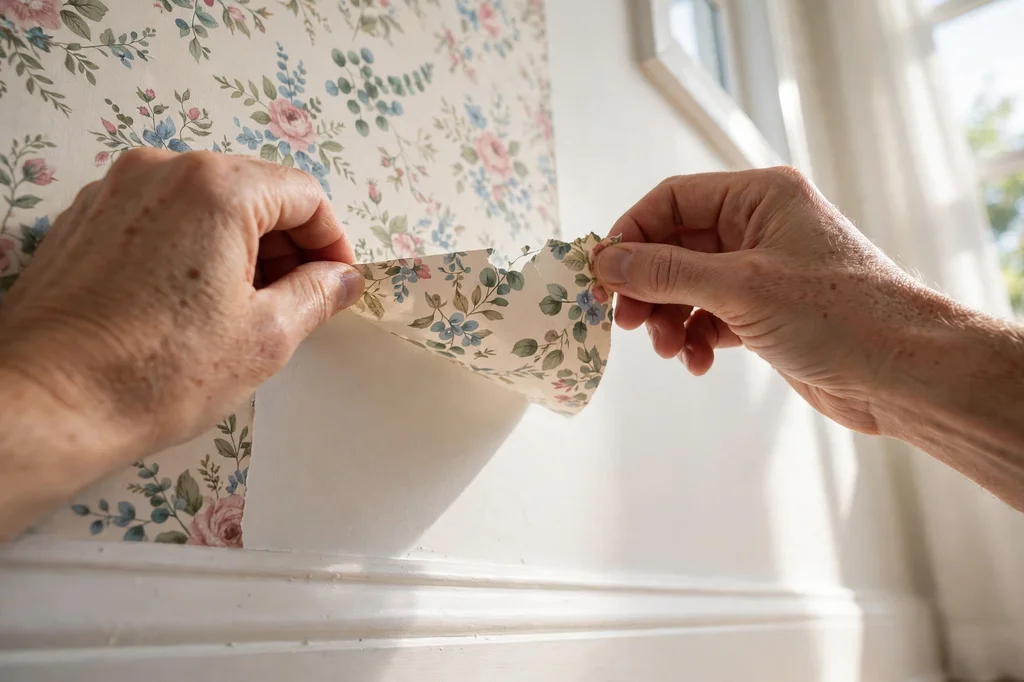
Step 4, Slow-peel removal (move-out day). Start at a top corner, warm the edge with a hairdryer on low for 30 seconds, and pull down slowly at a low angle, close to the wall. Never yank straight out, that is what pulls paint. If a spot resists, warm it again and keep going slowly. Wipe any residue with warm soapy water.
Step 5, Deposit protection. Take a dated photo of the bare wall before you hang the paper and another dated photo after removal. Keep the sample square and the receipt. If a landlord ever questions the wall, you have proof it went up clean and came down clean. Photograph the wall in daylight, not lamplight, so the paint color reads true.
How to Remove Peel and Stick Wallpaper Without Damaging Paint
Removal is where deposits are won or lost, and it is a 30-minute job if you go slowly and a $200 repair if you rush it. Go slowly, and peel and stick wallpaper for bedroom walls should release cleanly from cured paint.
Start at the top corner of one panel. Lift the edge with a plastic putty knife, never a metal scraper, which gouges paint. Warm the first 6 inches with a hairdryer on low heat for about 30 seconds; heat softens the adhesive and is the single best trick for clean removal. Then pull the panel down and toward you at a low angle, about 45 degrees, keeping your hand close to the wall. Slow and steady is the whole method: if you feel resistance, stop, warm that spot, and continue.
Work one panel at a time, top to bottom. If a small patch of adhesive stays behind, dab it with warm water and a drop of dish soap, wait a minute, and wipe it off. A mix of warm water and a little fabric softener also loosens stubborn residue. Do not use harsh solvents or scrub pads, they damage paint faster than the wallpaper ever could.
One more thing: remove the paper on a warm day if you can choose. Cold adhesive is stiff adhesive. If you are moving out in winter, run the bedroom heater for an hour before you start peeling, and keep the hairdryer handy for every panel.
7 Mistakes That Ruin a Bedroom Wallpaper Accent Wall
1. Skipping the sample. Ordering 4 rolls of a print you have only seen on a screen is how you end up with a wall that looks green in the listing and gray in your bedroom. The $8 sample is the cheapest insurance in the whole project.
2. Hanging it on fresh paint. Paint needs 30 days to cure. Paper hung on 2-week-old paint can bond to it so firmly that removal takes the paint with it, and your deposit with the paint.
3. Starting in the corner. Corners are never square in a rental. Start at the center line of the headboard and work outward, or every panel after the first will drift further off level.
4. Buying exactly enough paper. Pattern matching, trimming, and one crooked first panel eat paper. Buy the extra roll. A spare roll from the same batch costs $29; a second order from a different batch that does not match costs you the whole wall.
5. Peeling all the backing off at once. The panel sticks to itself, folds, and creases, and a creased panel is a wasted panel. Peel 12 inches at a time.
6. Papering a textured wall. Peel and stick paper needs a smooth surface. On orange-peel texture or bumpy plaster it bubbles, lifts at the edges, and peels off within weeks. If your wall is textured, the headboard-width panel on the smoothest section is still a gamble, test it first.
7. Choosing a print that is too big for the wall. A large-scale print with an 18-inch repeat gets cut off on a 10-foot wall and looks accidental. Match the print scale to the wall: small prints for 8-foot walls, medium prints for 10-foot walls, large prints only for 12-foot king walls.
Frequently Asked Questions
Will peel and stick wallpaper damage the paint in my bedroom?
It should not, if the paint is the right kind and fully cured. Peel and stick wallpaper for bedroom releases cleanly from smooth eggshell, satin, or semi-gloss paint that has cured for at least 30 days. The risk is flat or chalky builder paint, which is soft and can lift with the paper, and fresh paint under 30 days old. Do the 1-week patch test on a hidden spot before you buy rolls, it is the only way to know for sure on your wall.
How many rolls do I need for one accent wall?
For a standard 8-foot-tall bed wall, count panels first: wall width in inches divided by 20.5, rounded up. A queen bed wall (10 feet wide) needs 6 panels, which is 4 rolls including one spare for pattern matching. A twin wall (8 feet) needs 5 panels, or 4 rolls with the spare. A king wall (12 feet) needs 8 panels, or 5 rolls. Solid colors and textured prints need no spare roll for pattern matching, so you can buy one less. That panel count is the same method used throughout this guide to size peel and stick wallpaper for bedroom walls.
Can you put peel and stick wallpaper on textured walls?
No, not safely. Peel and stick wallpaper for bedroom needs a smooth, flat surface to bond evenly. On textured drywall or bumpy plaster it bubbles, the edges lift, and it usually peels off within weeks. It can also pull loose texture off the wall when you remove it. If your bedroom walls are textured, skip the wallpaper and decorate the bed wall another way.
How long does peel and stick wallpaper last in a bedroom?
In a dry bedroom with stable temperature, a quality peel and stick wallpaper for bedroom lasts 2 to 5 years. Bedrooms are actually the best room for it, no steam like a bathroom, no grease like a kitchen. The edges are the first thing to fail, usually because of dust or humidity, so keep the room ventilated and press any lifting edge down firmly as soon as you notice it.
Can you apply peel and stick wallpaper over old wallpaper?
You can, but you should not in a rental. Peel and stick wallpaper for bedroom will stick to smooth old wallpaper, but the weight of two layers can pull the old paper, and the paint under it, off the wall when you remove it. It also makes removal twice as messy. Strip the old paper first, or paper a different wall.
What is the best wallpaper for renters?
The best wallpaper for renters is a smooth, matte-finish peel and stick wallpaper for bedroom in a light-to-medium weight, bought after a 1-week patch test on your own wall. Matte finishes hide small bumps better than gloss, and a lighter paper puts less stress on the paint at removal. The brand matters less than the wall: any reputable peel and stick paper removes cleanly from cured eggshell or satin paint, and no paper removes cleanly from flat builder paint.
How much peel and stick wallpaper do I need for a 12 by 12 room?
For one accent wall in a 12 by 12 room, you need 8 panels, the 12-foot bed wall divided by the 20.5-inch roll width, rounded up, which is 5 rolls including the pattern spare. The room size does not change the math, because you are only papering the bed wall. Papering all four walls of a 12 by 12 room would take about 24 panels, but that is not a bedroom accent wall project, and it would cost far more than $150.
Start Today
Your bedroom does not need a renovation. It needs one wall, one afternoon, and one good decision made before you order: the $8 sample, stuck on a hidden spot for a week, telling you the truth about your paint. Once that patch peels off clean, the rest is just measuring, smoothing, and stepping back to look at a bedroom that finally feels finished. Peel and stick wallpaper for bedroom walls is the rare project that costs less than $150, takes less than a day, and comes down without a trace when you move, so order the sample tonight, and by next weekend your plainest wall could be the best-looking one in the room.