Bedroom ideas for couples fail in small rooms for one reason: the room was planned for one person’s stuff, and now two people live in it. Two wardrobes’ worth of clothes, two nightstands’ worth of chargers and books, two different tastes, and one small bedroom to hold all of it. The fix is not a bigger room. It is a system: size the bed to the room, split every storage spot down the middle so each person has their own side, and agree on one style rule before you buy anything. This guide gives you that system with measurements, a whole-room budget under $150, and a renter-only version that needs zero drilling.
These bedroom ideas for couples work because every choice is split, measured, and agreed on before you spend anything.
That is the system these bedroom ideas for couples use: size the bed, split the storage, and agree on the style first.
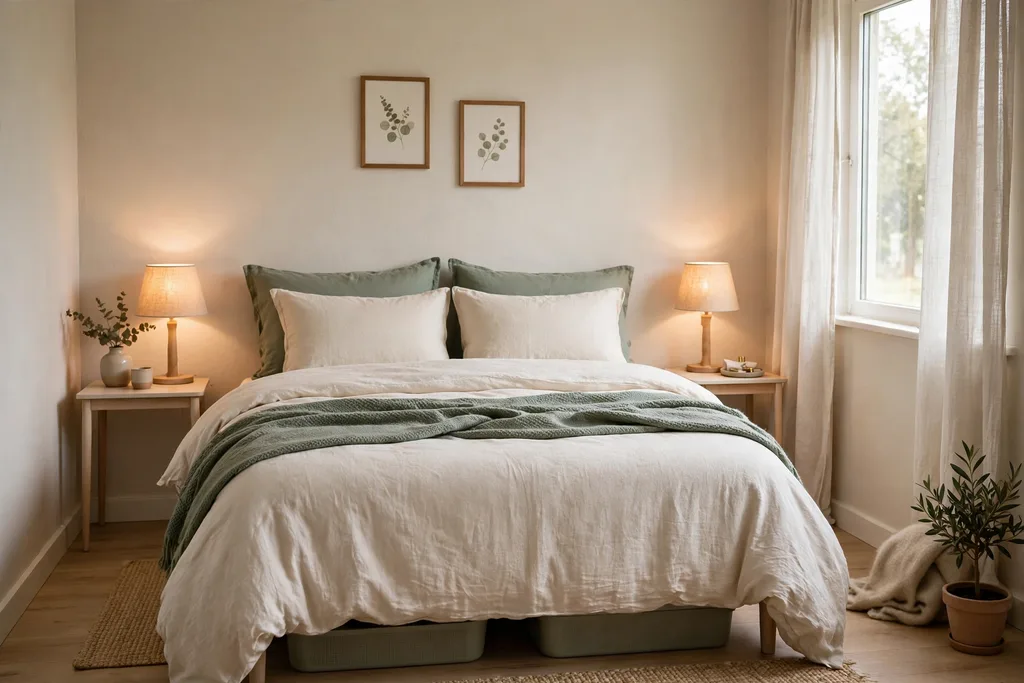
Table of Contents
The numbers first
A typical small bedroom is 10×12 feet, 120 square feet of floor. A queen bed is 60 by 80 inches, which is 33.3 square feet, and the frame brings it to about 38. That leaves roughly 80 square feet for everything else: walking, dressing, a dresser, two nightstands, and the door swing. The door alone needs 30 to 36 inches of swing space. Two people need more walking room than one, because you pass each other instead of walking alone, so the clearance numbers below are not suggestions, they are the difference between a room that works and a room you fight in every morning.
| Number | What it means |
|---|---|
| 24 inches | Minimum clearance on each side of the bed, below this, you turn sideways |
| 30 inches | Comfortable clearance on each side of the bed |
| 12–16 inches | Nightstand depth that fits a small bedroom |
| 6–12 inches | Under-bed clearance, which decides your bin height |
| 4–5 feet | A typical small-bedroom closet width, split it down the middle |
| 18–24 inches | How far a rug should extend past each side of the bed |
| $130 | The whole-room budget in this guide |
Two rules run through everything below. First, every storage spot gets split, one side per person. Shared storage in a small room becomes one person’s mess and the other person’s complaint. Second, measure before you buy. A nightstand that is 2 inches too deep blocks the closet door, and a bin that is half an inch too tall lives in the hallway.
1. Size the bed to the room, not the store display
The bed is the biggest decision in the room, and showrooms lie about it. A king bed looks reasonable in a 400-square-foot showroom and eats a 10×12 bedroom alive. Size the bed to your room, not to the store display, using this table:
| Room size | Bed that fits | Why |
|---|---|---|
| Under 100 sq ft | Full (54×75 in) | A queen leaves under 24 inches of clearance on the sides |
| 100–130 sq ft | Queen (60×80 in) | The sweet spot, 24 to 30 inches of clearance on both sides |
| 130+ sq ft | Queen or king (76×80 in) | A king works only if 24 inches of clearance remain on both sides |
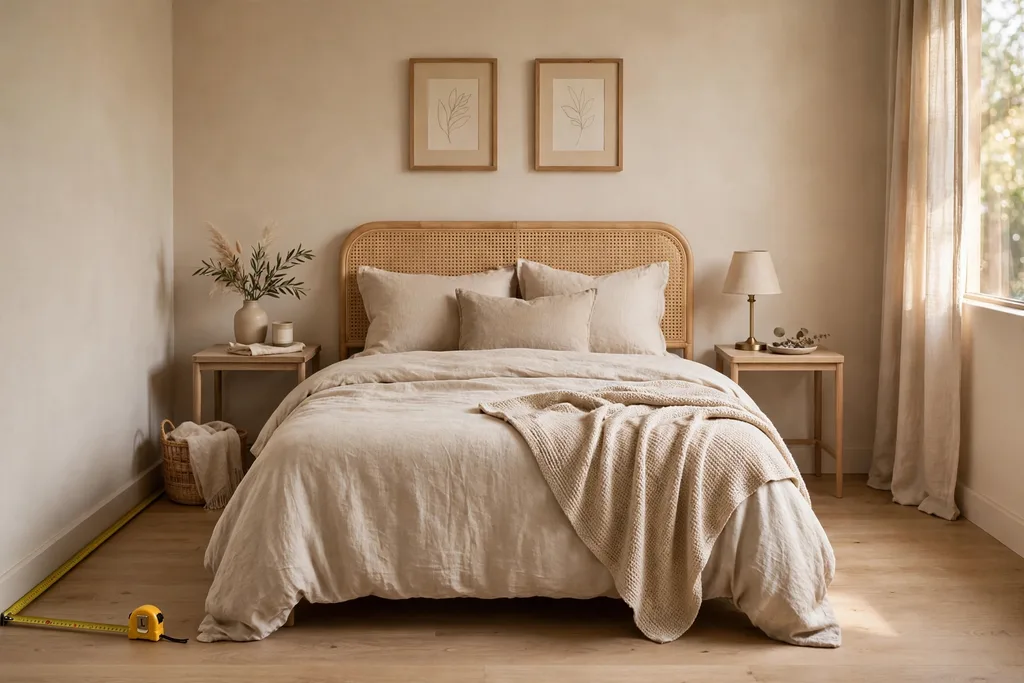
Measure it before you buy. Tape the bed’s outline on the floor with painter’s tape, 60 by 80 inches for a queen, and walk around it for a day. Open the closet door. Open the bedroom door. Sit on the edge of the taped outline and stand up. If you have to shuffle sideways anywhere, the bed is too big for the room. For the full layout numbers behind this, see our small bedroom layout ideas guide, it covers the same measurements room by room.
A king bed is almost never the right answer in a small bedroom for couples. It takes 76 inches of width, and in a 10-foot-wide room that leaves about 22 inches on each side once the frame is counted, under the 24-inch minimum, with no room for a nightstand. A queen with 30 inches of clearance on each side feels bigger than a king you have to climb over your partner to get out of.
If you already own a king and cannot replace it, push the bed against the wall and give the other side the full clearance, but know the trade: the person on the wall side climbs over every night, and the room loses its symmetry. A queen centered on the longest wall, with equal space on both sides, is the layout most couples end up happiest with.
2. Split the closet down the middle
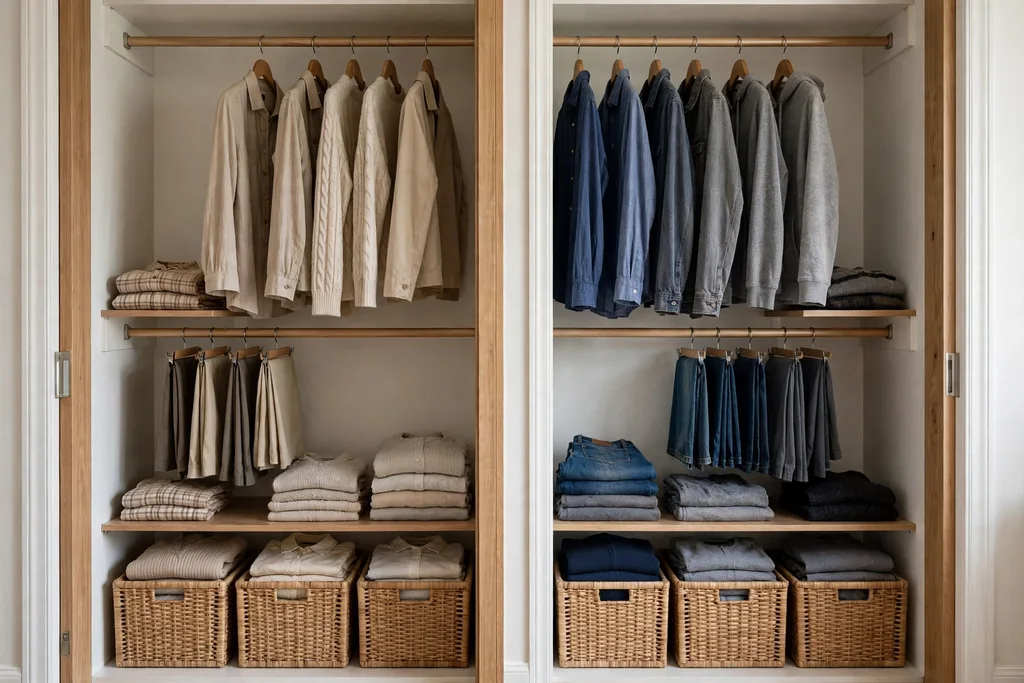
A shared closet in a small bedroom is where couples’ storage arguments start. One person’s clothes creep across the rod, the other person’s shoes pile on the floor, and nobody can find anything. The fix is a line down the middle: one side per person, and the line is not negotiable.
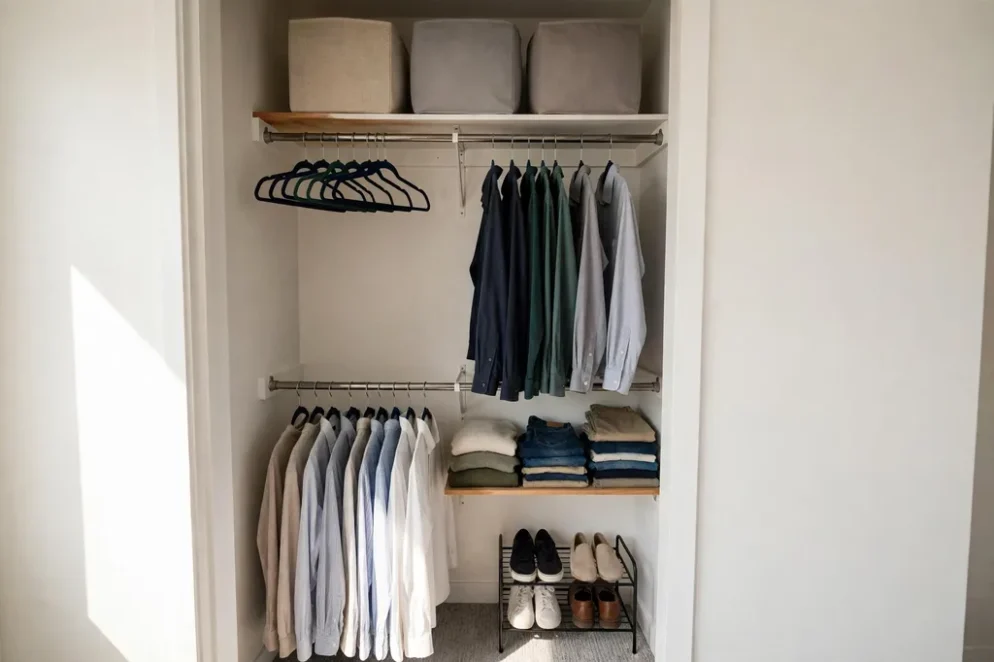
Start by emptying the closet completely. Measure its width, most small-bedroom closets are 4 to 5 feet wide. Mark the middle with a small piece of tape on the rod. Each person gets half the rod, half the shelf, and half the floor. Hanging clothes go on the rod; folded clothes go on the shelf in two matching bins, one per person.
Then double the closet with a second rod. A tension rod hung 40 inches below the main rod doubles your hanging space for about $12, and it needs no drilling, it presses between the two closet walls. Shirts and blouses go on the top rod, pants and skirts on the bottom rod. Add a small shoe shelf on the floor, split the same way: your shoes on your side, theirs on theirs.
That line is the heart of these bedroom ideas for couples: shared storage only works when it is split fairly. It is one of the cheapest bedroom ideas for couples in this guide, and it needs no drilling.
A second rod is the kind of small win bedroom ideas for couples rely on: cheap, fast, and invisible once the clothes are back on it.
The back of the closet door is the last free spot. An over-door organizer with clear pockets holds shoes, scarves, belts, and small things, and it hangs on two hooks over the door, no screws. Check the door first: a hollow-core door holds about 15 pounds on its hooks, so keep the organizer light and skip the heavy boots.
If your room has no closet at all, the same split applies to whatever you use instead. A freestanding garment rack gets one side per person. A dresser gets split drawers, top two drawers for one person, bottom two for the other, with a small label inside each drawer so the split survives laundry day. The rule is the same everywhere: one side each, always.
3. Two nightstands, one drawer each
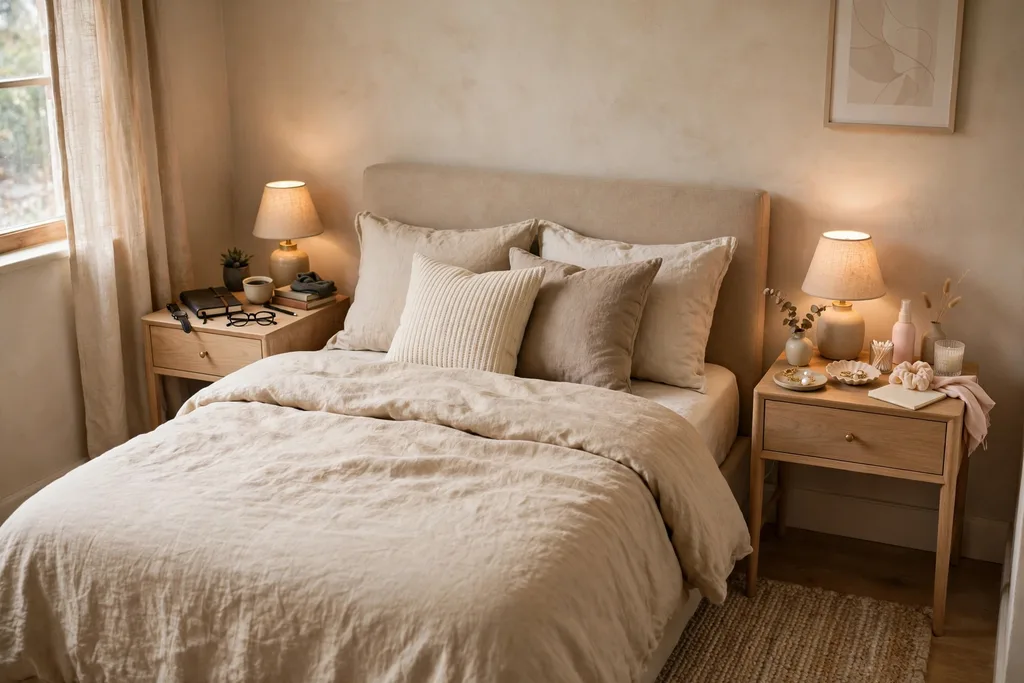
One nightstand for two people is the fastest way to make a small bedroom feel cluttered. Two nightstands, one per person, one drawer each, is the cheapest peace treaty a couple can buy. Each person gets a drawer for their own things: phone charger, book, glasses, lip balm, earplugs. Nothing of yours lives in their drawer, and nothing of theirs lives in yours.
The size matters more than the style. A nightstand 12 to 16 inches deep fits a small bedroom; anything deeper eats the walkway. In rooms under 100 square feet, wall-mounted floating nightstands work even better, they hold the same drawer and lamp but leave the floor clear, which makes the room look bigger and the floor easier to clean.
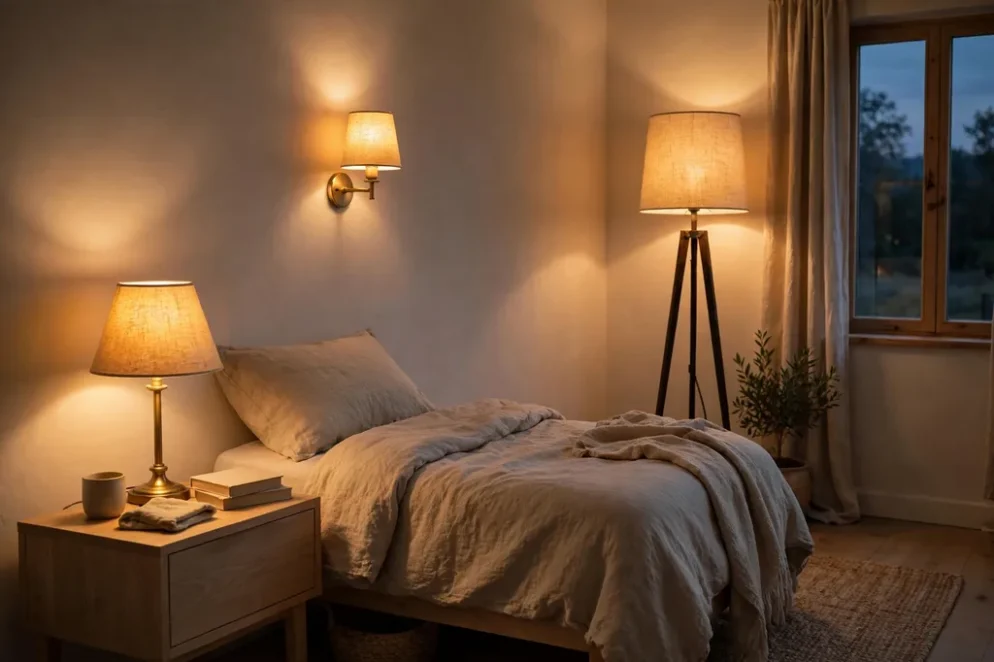
Match the lamps, not the clutter. Two matching bedside lamps, same size, same warm light, give the room its symmetry, and symmetry is what makes a shared room feel calm instead of fought-over. Each lamp should have its own switch or a small dimmer, so the early riser can read without waking the sleeper. A warm bulb (2700K) keeps the light soft; a cool white bulb in a bedroom feels like an office.
What lives on top of each nightstand is a one-item rule: lamp, plus one personal thing. A book, a small plant, a framed photo, one thing, not five. The rest goes in the drawer. If the nightstand top is collecting clutter, the drawer system is wrong, not the person.
That split-everything rule is what makes bedroom ideas for couples work even in a room with no closet at all. It is a small change, but bedroom ideas for couples keep coming back to it because it stops the daily clutter fight.
Symmetry is a quiet theme in bedroom ideas for couples: matching pairs make a shared room feel calm.
4. Under the bed: one bin per person
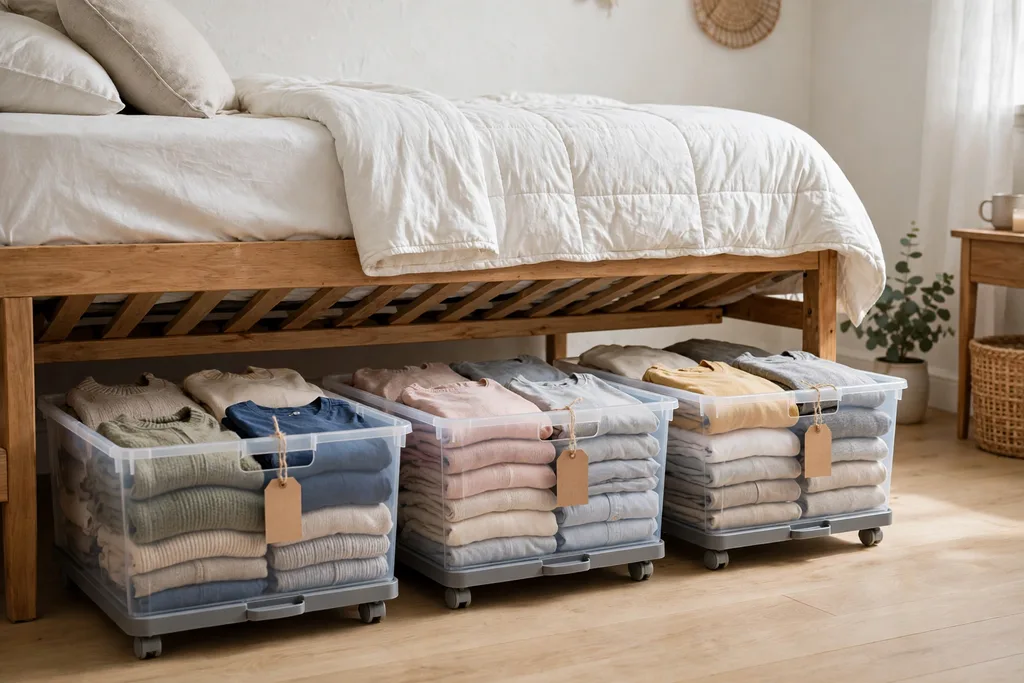
Under-bed storage is the biggest hidden zone in a small bedroom, and for couples it has one rule: one bin per person, labelled. Shared under-bed bins become a junk drawer you have to kneel for. Two labelled rolling bins, one per person, turn the space under the bed into two extra drawers.
Measure first. Get on the floor with a tape measure and measure from the floor to the underside of the bed frame, not to the mattress, to the frame. That number decides your bin height:
| Bed frame clearance | Bin height that fits | What goes in it |
|---|---|---|
| 6 to 7 inches (low platform frame) | 5 to 6 inch flat bins | Flat things only: out-of-season clothes in vacuum bags, spare sheets |
| 10 to 12 inches (standard frame) | 8 to 9 inch rolling bins | Off-season clothes, spare bedding, shoes |
| 14 inches or more (tall frame, or bed risers) | 12 inch bins or shallow drawers | Bulkier items, two stacked layers of folded clothes |
Bed risers are the cheapest way to buy under-bed space, a set of four risers lifts most frames by 5 to 8 inches for about $15, and they need no tools. Check the frame’s legs first: risers work on standard legs, not on platform frames that sit flat on the floor.
Label the bins. A strip of masking tape and a marker is enough: one name per bin. Out-of-season clothes go in first, then spare bedding, then the things you need once a month. Daily clothes stay in the closet and dresser, under the bed is for storage, not for the shirt you need tomorrow morning.
Of all bedroom ideas for couples, this one adds the most storage without taking a single inch of floor space. For renters, it is one of the easiest bedroom ideas for couples to try, because it needs no tools and leaves no marks.
Two labelled bins are the simplest bedroom ideas for couples to start with, because they cost less than $25 and need no tools.
5. The style compromise: one base, two accents
The hardest part of bedroom decorating ideas for couples is not storage, it is agreeing on a style. One person wants minimal and white, the other wants warm and boho, and the room ends up as a compromise nobody likes. The system that works is one base, two accents: one neutral base you both agree on, and one accent each.
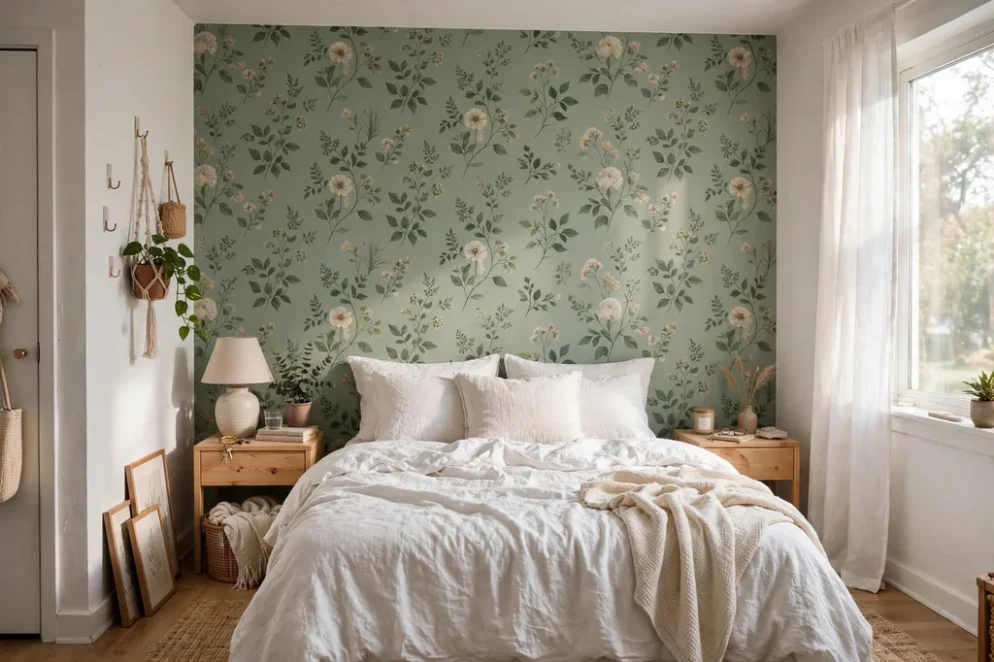
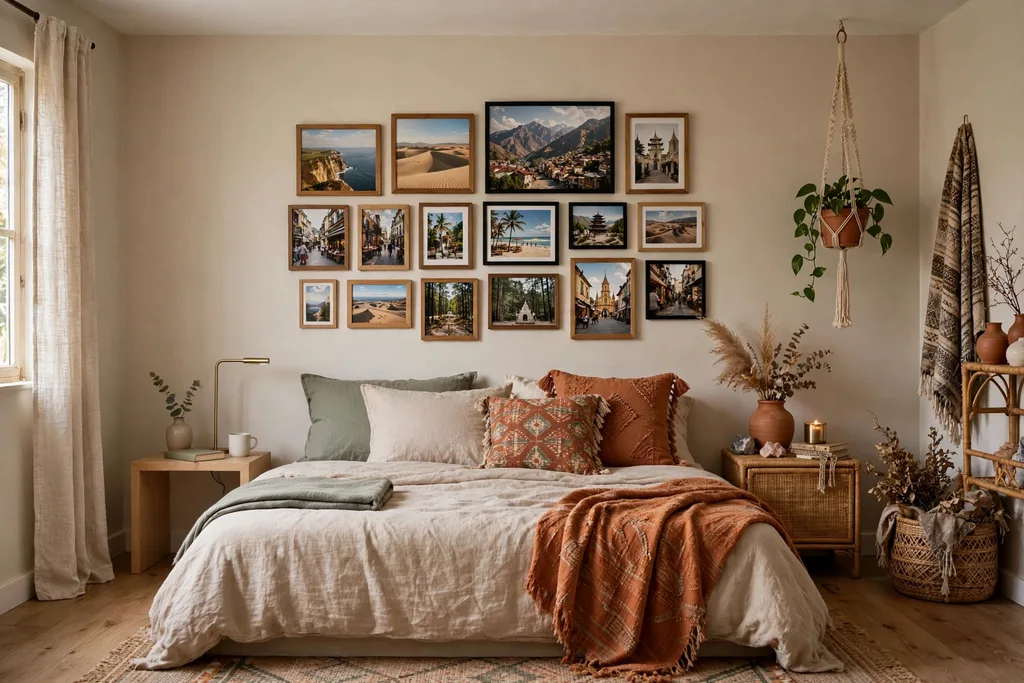
Pick the base together. Warm white walls, light wood, and plain bedding in white or cream, a base so neutral that neither person’s taste fights it. Then each person picks one accent: one color and one texture. One person might pick sage green and linen; the other might pick terracotta and woven rattan. Both accents live in the room, one on each side of the bed. Your accent is your nightstand side, your throw pillow, your side of the gallery wall. Their accent is theirs.
The veto rule keeps it fair: each person gets two vetoes for the whole room. You can veto anything, a color, a lamp, a rug, but only twice. Vetoes stop the endless “I don’t like it” loop, because a veto costs something, so people only use it on what they truly hate. Everything else, you live with, and it turns out fine.
Build a mood board before you buy anything. Not a 40-image Pinterest board, nine images, three each: three for the base, three for your accent, three for theirs. Put them side by side on your phone. If the nine images look like they belong in the same room, the plan works. If they clash, change the accents, not the base.
Symmetry does the rest. Matching lamps, matching nightstands, matching frames on the gallery wall, symmetry makes two different accents look intentional instead of accidental. The room does not need to match perfectly; it needs to look like two people chose it together, on purpose.
That shared base is what keeps bedroom ideas for couples from becoming a tug-of-war over taste. One base, two accents is the compromise bedroom ideas for couples use when two tastes share one small room.
Good bedroom ideas for couples do not need a bigger room, just a plan both people helped make. The veto rule is the part of bedroom ideas for couples that keeps the compromise fair: two vetoes each, and everything else you live with.
6. Sleep differences: schedules, snoring, and temperature
Two people rarely sleep the same way, and a small bedroom makes every difference louder. The couples who sleep well in small rooms solve three differences on purpose: schedules, snoring, and temperature.
Different schedules are the most common. One person reads until midnight, the other sleeps at ten. The fix is light control: a small warm reading lamp on the reader’s side (clip-on or a dim bedside lamp, 2700K, pointed at the book and not the room), a sleep mask for the sleeper, and a white noise machine or app on the sleeper’s nightstand. The reader stays on their side of the bed with the light low; the sleeper’s side stays dark. A curtain or a tall headboard between the bed and the door helps too, it blocks hallway light when the early riser leaves.
Snoring is the difference nobody plans for. Before separate rooms, try the cheap fixes: a white noise machine masks most snoring, earplugs handle the rest, and sleeping slightly propped up (an extra pillow) reduces it for many people. If one partner snores every night, the snorer takes the side of the bed farther from the door, so the other partner is not woken by every hallway sound on top of it. It is a small thing, and it helps more than it sounds like it should.
Temperature is the easiest to solve and the most argued about. Two blankets instead of one shared duvet, each person gets their own weight and warmth, and nobody steals the covers. One side gets a light cotton blanket, the other a heavier one. It looks slightly less tidy than one duvet, and it sleeps twice as well. A small fan on the warm sleeper’s nightstand, pointed at their side only, finishes the job.
None of this needs new furniture. A reading lamp, a sleep mask, two blankets, and a white noise app cost under $30 together, and they solve the three fights that make couples say the room is too small when the room is actually fine.
7. Small bedroom ideas for couples under $150
Everything in this guide adds up to one room, and the total stays under $150. These are real prices for budget versions of each piece, thrift stores and discount shops will beat them, and name brands will exceed them, but this is the honest middle:
| Item | Price | What it does |
|---|---|---|
| 2 rolling under-bed bins (one per person) | $24 | Under-bed storage, split by person |
| Over-door organizer | $14 | Shoes, scarves, and small things on the door |
| Tension rod (second closet rod) | $12 | Doubles the closet hanging space |
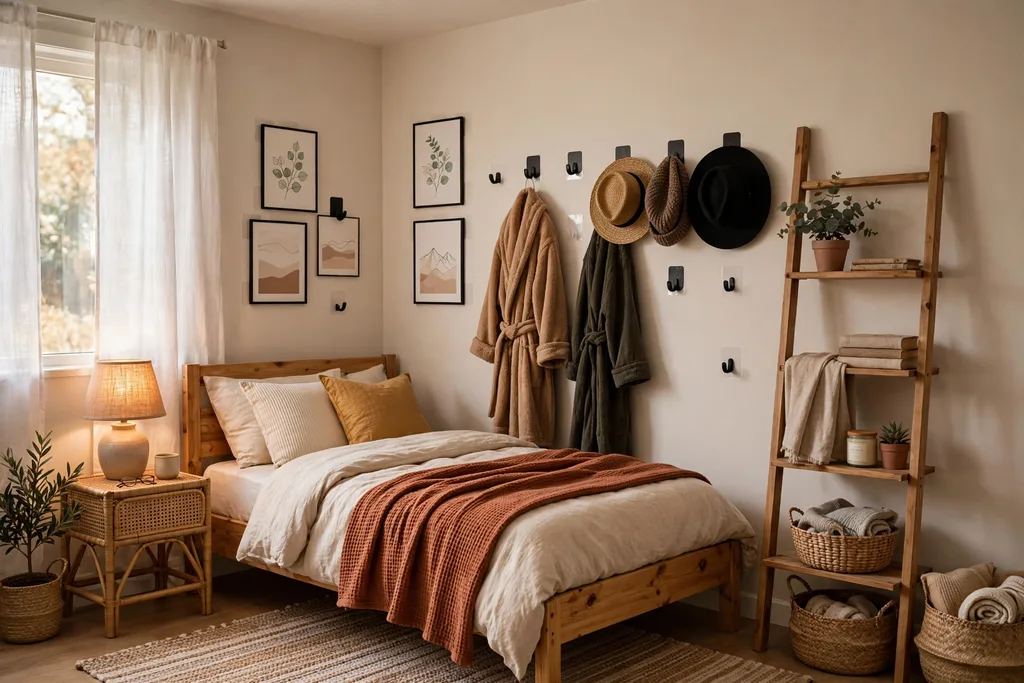
| 2 packs Command hooks | $12 | Robes, hats, and bags, no drilling |
| 2 matching bedside lamps | $22 | Symmetry + separate light control |
| Throw + 2 pillow covers (your accent + theirs) | $18 | The two accents, one per person |
| 5×7 rug | $28 | Anchors the bed zone, extends past both sides |
| Total | $130 |
The cheapest path is $62: the two bins, the over-door organizer, the tension rod, and the Command hooks. That is the whole storage system, the lamps, throw, and rug are style, and style can wait a month. Buy in this order: measure the bed clearance and closet first, then the bins and rod, then the lamps, then the rug last, because the rug size depends on where the bed finally sits.
8. The renter-only plan: zero drilling
Renters cannot drill, and a shared small bedroom makes that rule harder, two people, twice the stuff, and no holes allowed. The whole system above already avoids drilling, but here is the renter-only version in one place, with the limits that matter.
Command hooks hold robes, hats, bags, and light frames, check the weight rating on the pack and stay under it. A standard large hook holds about 3 pounds; a small one holds about 1 pound. Two hooks share a heavier bag. Peel-and-stick frames hold the gallery wall, and they come off clean if you pull the tab straight down instead of yanking it out. A leaning ladder shelf stands against the wall with no screws at all, it holds books, plants, and folded clothes, and it moves with you.
The one limit to respect is the hollow door. Most bedroom doors are hollow-core, and their hooks hold about 15 pounds total. Keep the over-door organizer light, shoes and scarves, not boots and bags. If the organizer feels heavy when you lift it, it is too heavy for the door.
Tension rods do the rest: a second closet rod, a curtain rod for a closet without a door, and a shower-style rod across an alcove if you want a dressing nook. Everything in this article comes down in under an hour on moving day, and the deposit stays safe. That is the real test of a renter-friendly bedroom: can you take it all with you, and does the landlord never know it was there?
Those no-drill fixes are the bedroom ideas for couples renters ask for most, because the deposit stays safe. That is why bedroom ideas for couples for renters lean on hooks, rods, and leaning furniture instead of screws.
Every one of these bedroom ideas for couples is renter-safe, because nothing here needs a drill.
The rest of the guide works the same way: these bedroom ideas for couples treat sleep differences as a design problem, not a relationship problem. Start with storage, and the rest of these bedroom ideas for couples can wait until the storage is sorted.
9. Mistakes to avoid
- Buying the king first. A king bed in a 10×12 room leaves under 24 inches on each side. Measure the tape outline on the floor before you buy, not after.
- One shared dresser instead of split storage. A shared dresser becomes one person’s mess. Split everything, closet, drawers, bins, hooks, one side each.
- Only one nightstand. Two people need two nightstands. One nightstand means one person’s things live on the floor.
- Buying before measuring. Bins that are half an inch too tall, nightstands that block the closet door, a rug that runs under the door, all of it is fixed by five minutes with a tape measure.
- Letting one person’s style win. A room that is entirely one person’s taste makes the other person feel like a guest. One base, two accents, two vetoes each.
- Ignoring the closet. The closet is the biggest storage in the room, and most couples use half of it. A second rod and an over-door organizer double it for under $30.
FAQ
What is the best bed size for a small bedroom shared by a couple?
A queen (60×80 inches) in a 100–130 square foot room, with 24 to 30 inches of clearance on both sides. A full works under 100 square feet. A king only works if 24 inches of clearance remain on both sides after the frame is counted, in most small bedrooms, it does not.
Do couples need two nightstands in a small bedroom?
Yes, one per person, one drawer each. It is the cheapest way to stop the clutter fight. Keep them slim, 12 to 16 inches deep, and match the lamps for symmetry.
How do I make a small shared bedroom feel bigger?
Center the bed on the longest wall, keep 30 inches of clearance on both sides, use floating nightstands to show more floor, and put a rug that extends 18 to 24 inches past each side of the bed. Light walls and one mirror opposite the window help, but the clearance numbers matter more than the color.
How can I decorate a shared small bedroom on a budget?
The whole system in this guide costs $130, and the storage half alone is $62. Start with the bins, the tension rod, and the over-door organizer, style (lamps, throw, rug) can wait a month.
Is a king bed ever a good idea in a small bedroom?
Only if the room is 130+ square feet and 24 inches of clearance remain on both sides of the bed after the frame. In a 10×12 room, a king leaves about 22 inches per side, under the minimum, and the person on the wall side climbs over every night.
How do two people with opposite styles agree on one small bedroom?
One neutral base you both agree on, one accent each, and two vetoes per person. The accents live on each person’s side of the bed. Symmetry, matching lamps, matching nightstands, matching frames, makes two different accents look intentional.
How do couples with different sleep schedules share one small bedroom?
A warm, low reading lamp on the reader’s side, a sleep mask and white noise for the sleeper, and two separate blankets so nobody steals the covers. A small fan on the warm sleeper’s side finishes it, all under $30 together.
Start today
Measure the bed clearance on both sides and the closet width. Mark the middle of the closet rod with tape, your side and theirs. Tonight, each of you picks one accent color and one texture. That is the whole system: a bed that fits, storage split down the middle, and a style you both chose. The bins and the tension rod can wait for the weekend; the tape on the floor takes five minutes.
Those two measurements are the first step in these bedroom ideas for couples, and they cost nothing. Those are the bedroom ideas for couples to start with: bins, rod, and organizer first, style second.
The best bedroom ideas for couples give both people a visible say in the room.
Measure the bed first: the bed frame sizes guide from Sleep Foundation lists every standard size, so you can tape the outline before you buy.