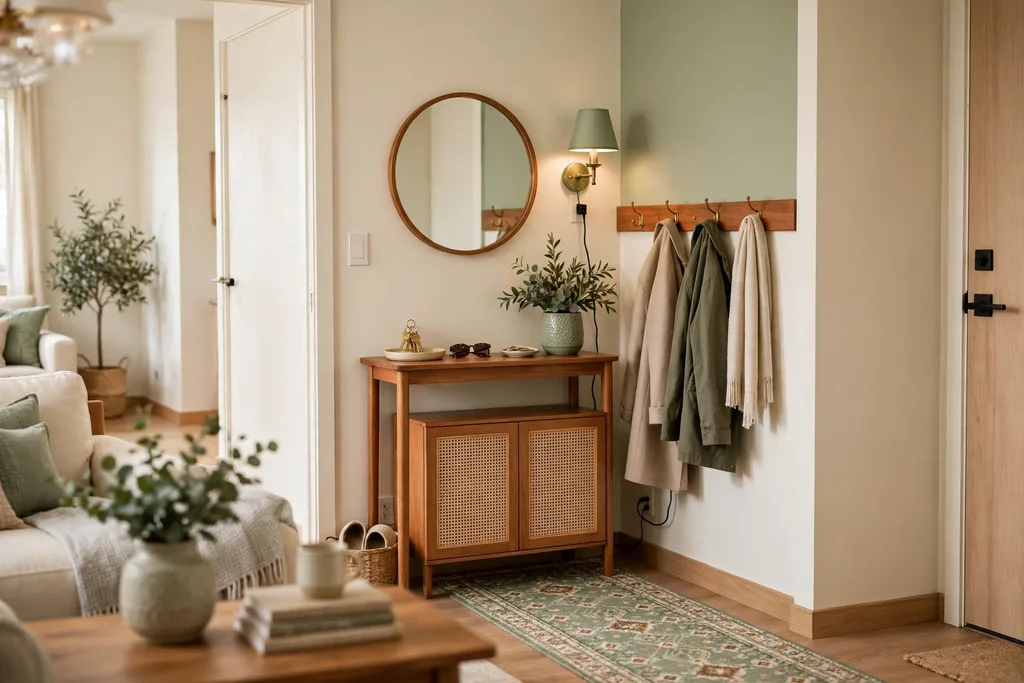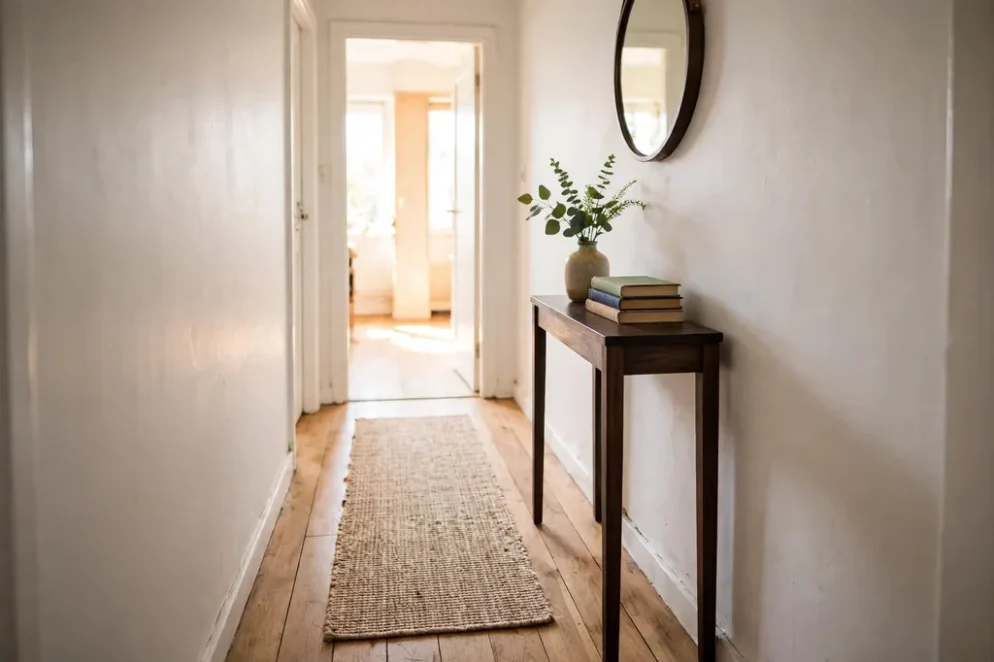
Your front door opens and you are already in the living room. No foyer, no coat closet by the door, no wall to hang a hook on, nowhere for your keys except the kitchen counter, and nowhere for your shoes except the pile by the door that everyone trips over. If that sounds like your apartment, you are not alone, and you do not need a renovation to fix it. These small apartment entryway ideas build a landing strip where none exists: a small marked zone by the door where everything you carry in has a place. It takes about 3 feet of wall, 4 feet of floor, and less than $150 in total. No drilling, no built-ins, nothing you cannot take with you when you move. An apartment entryway landing strip is not a piece of furniture. It is a system, and once you understand the system, even the smallest apartment entryway ideas start to make sense.
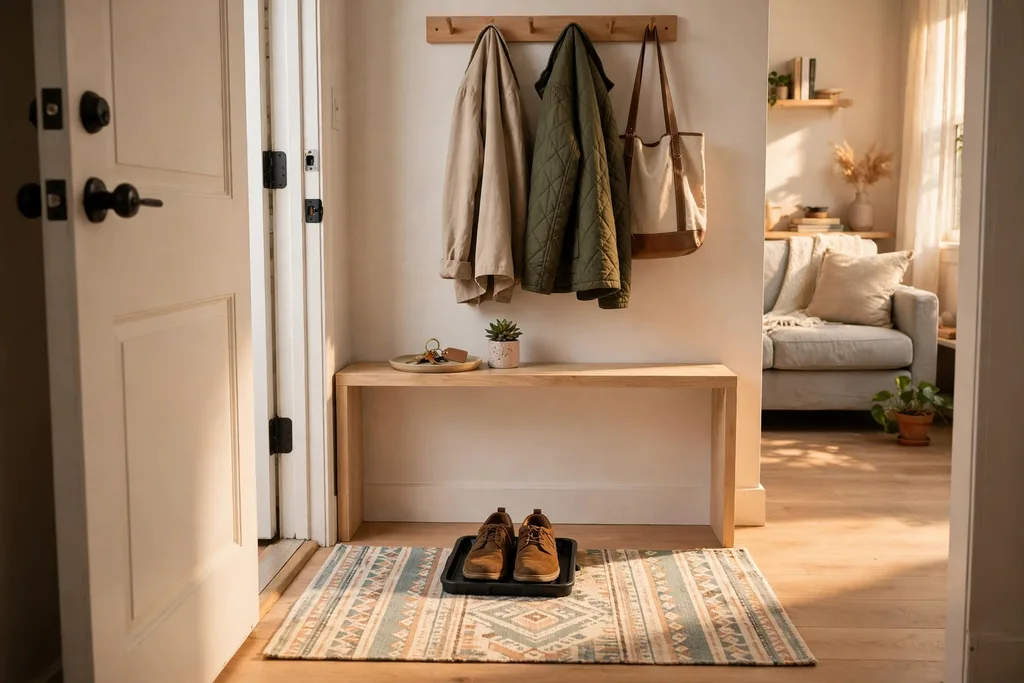
Table of Contents
- Measure first: the numbers that decide your landing strip
- The 3-by-4-foot plan: your whole landing strip on one page
- Start with the rug: the boundary that costs the least
- Hooks at the right height: the landing strip’s workhorse
- Shoes, contained: the slim cabinet and the boot tray
- A slim console as your landing surface
- No free wall? Use the sofa back as your divider
- No drilling allowed: the over-the-door and adhesive plan
- Mirror and light: the finishing layer
- The whole landing strip for $148: the budget table
- Mistakes that ruin a no-entryway apartment
- Frequently asked questions
- Start today
Measure first: the numbers that decide your landing strip
Every good entryway starts the same way, with a tape measure, not a shopping cart. Before you buy anything or move anything, measure your door and the wall beside it, and write the numbers down. It takes ten minutes, and it saves you from the most common mistake in no entryway apartment ideas, which is buying something beautiful that does not fit.
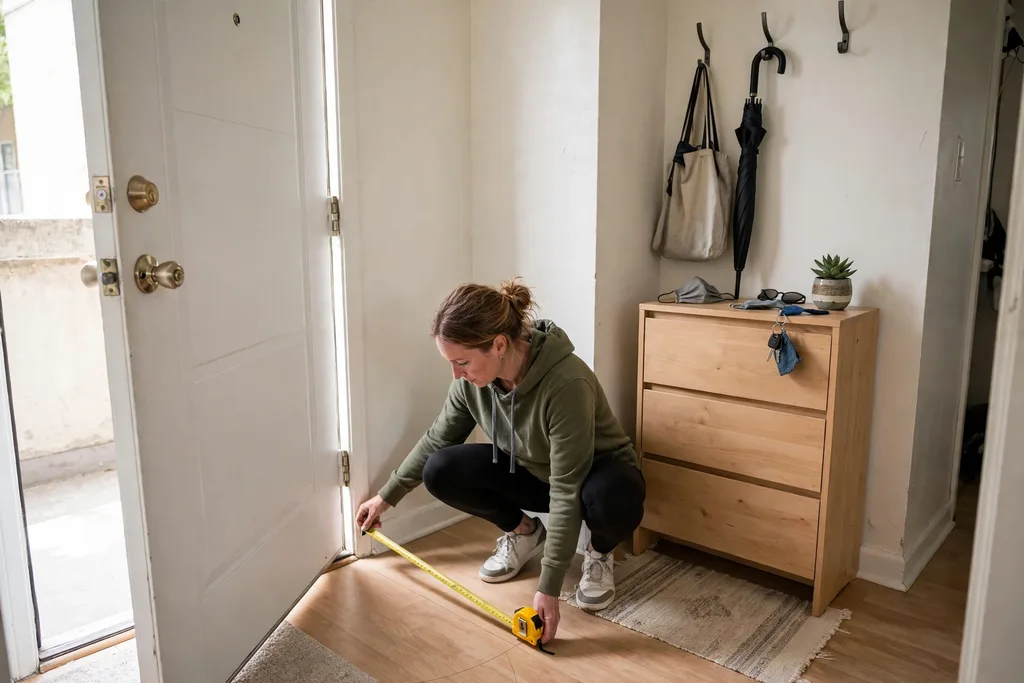
Start with the door swing. Open your front door all the way and watch the arc it sweeps across the floor. Nothing can sit on the floor inside that arc, not a shoe cabinet, not a basket, not a bench. Mark the arc with painter’s tape on the floor so you can see it. Most apartment doors swing 30 to 36 inches into the room, and that arc is your first hard boundary. Everything in your landing strip lives outside it.
Next, measure the walking path. You need a clear path of 36 inches from the door into the room, and it must stay clear. If the path narrows below 36 inches, people will bump the furniture, the rug will bunch up, and the whole zone will feel like an obstacle instead of a welcome. Walk the path yourself with a laundry basket in your arms. If you have to turn sideways, the path is too tight, and something has to move.
Now measure the wall. A working landing strip needs only 2 to 3 feet of wall and 12 to 16 inches of depth. That is it. Two to three feet of wall holds a hook rail, a small shelf, and a slim cabinet side by side. Twelve to sixteen inches of depth is the difference between a zone that works and a zone that swallows your living room. Measure the wall next to the door, the wall across from the door, and the wall beside the door, and pick the one that gives you the most uninterrupted length. Note where the light switches, the thermostat, and the outlets sit, because a hook rail cannot go over a light switch and a plug-in sconce needs an outlet within reach.
Five numbers decide everything: the door swing arc, the 36-inch clear path, the length of your free wall, the depth you can spare (12 to 16 inches), and the height of your hooks (60 to 66 inches, covered in the hooks section below). Write them on a sticky note and keep them in your pocket while you shop. Every piece you buy must pass all five numbers, or it does not come home. That is why entryway ideas for apartments with no entryway always start with the door, not with the furniture.
The 3-by-4-foot plan: your whole landing strip on one page
Here is the whole plan in one picture. Your landing strip is a rectangle 3 feet wide and 4 feet deep, sitting just outside the door swing arc, against the wall you measured. Three feet wide is enough for a hook rail, a small shelf, and a slim cabinet. Four feet deep is enough for a rug, a boot tray, and a basket, with room to stand and take your shoes off. Everything you own for the entry fits inside that rectangle, and everything outside it stays living room.
Draw it on paper before you buy anything. Sketch the door at the top, the arc it sweeps, and the 3-by-4-foot rectangle next to it. Then place the pieces inside the rectangle in this order. First, the rug goes on the floor, 2 by 3 feet, with 2 to 3 inches of bare floor showing around it so it reads as a deliberate zone. Second, the hook rail goes on the wall at 60 to 66 inches high, with hooks 6 to 8 inches apart. Third, the shoe storage goes against the wall, no deeper than 10 to 12 inches. Fourth, the landing surface, a slim console or a floating shelf, goes at 30 to 32 inches high, shallow enough that it never eats into your 36-inch path.
The 3-by-4-foot plan is the heart of these small apartment entryway ideas, and it works in almost every apartment layout because it is small enough to fit and big enough to hold the four things an entry needs: a place for coats and bags, a place for shoes, a place for keys and mail, and a place to stand while you do all three. If your door opens onto a wall, the rectangle hugs that wall. If your door opens into the living room, the rectangle floats in the open floor, and the rug is what marks its edge. If your door opens next to the kitchen, the rectangle tucks between the door and the first cabinet. And if you live in a studio where the sofa sits near the door, the rectangle sits behind the sofa, and the sofa back becomes the wall, which is covered in its own section below.
One rule holds the plan together: keep everything inside the rectangle. The moment a shoe, a bag, or a basket drifts outside it, the zone stops working and the clutter spreads. The rectangle is small on purpose. A small zone you can keep tidy beats a big zone you cannot.
Start with the rug: the boundary that costs the least
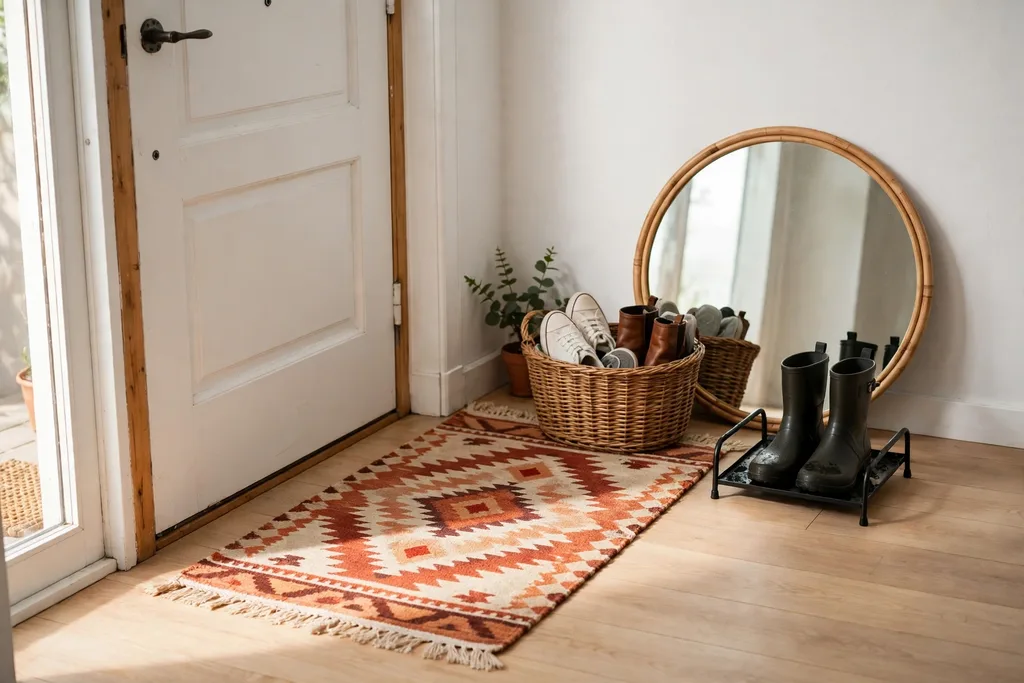
If you buy one thing first, buy the rug. The rug is the cheapest way to say “the entry starts here” in an apartment that has no entry, and it does the job before a single hook goes on the wall. A washable runner or a 2-by-3-foot rug in a pattern you like costs about $28, and it changes the room the day it arrives.
Pick a rug that is 2 by 3 feet, or a runner 2 by 5 feet if your rectangle is long and narrow. Leave 2 to 3 inches of bare floor showing on every side so the rug reads as a zone, not as wall-to-wall carpet. Choose a washable rug, because this rug will take mud, rain, and salt from shoes, and a rug you cannot wash becomes a rug you replace. A low pile, flat weave, or indoor-outdoor rug works best, because the door must clear it. Measure the gap under your door first. If the door catches the rug when it swings, the rug is too thick, and you need a thinner one. This is the most common rug mistake in small apartment entryway ideas, and it is entirely avoidable with a tape measure.
Color matters more than pattern. A rug in a mid-tone color with a pattern hides dirt between washes, while a solid white rug shows every footprint on day one. Pick a color that connects to your living room, a warm terracotta if your sofa is cream, a sage green if your cushions are sage, so the entry feels like part of the room instead of a mat someone dropped by the door. The rug is the first thing guests see and the last thing you step on before you leave, so let it set the tone.
Place the rug flat against the floor with a rug pad or rug tape under it so it never slides. A rug that slides is a tripping hazard and a daily annoyance, and it takes thirty seconds to fix. Put the boot tray on the rug, not beside it, so wet shoes drip onto the tray and the tray drips onto the rug, not onto your wood floor. And keep the rug inside your 3-by-4-foot rectangle. If the rug is bigger than the rectangle, the zone looks accidental. If it fits, the zone looks designed.
Hooks at the right height: the landing strip’s workhorse
Hooks do more work per inch than any other piece in your entry. A good hook rail holds coats, bags, dog leashes, hats, and umbrellas, costs about $16, and takes up zero floor space. But hooks only work when they are hung at the right height, and most people hang them too low.
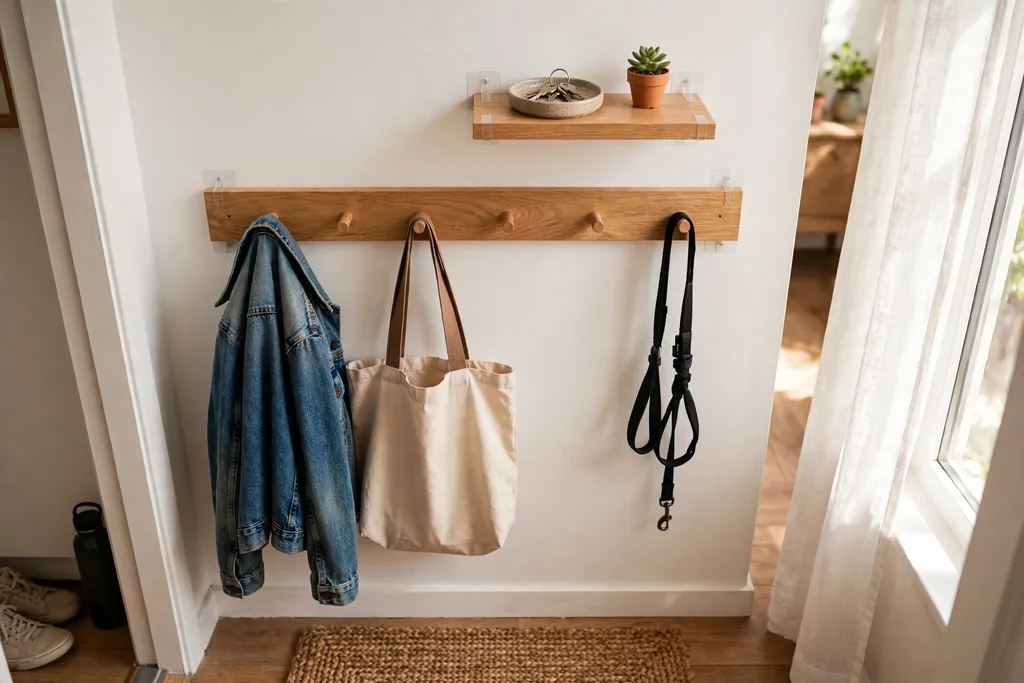
Hang your hook rail at 60 to 66 inches high, measured from the floor to the center of the rail. That is shoulder height for most adults, high enough that a coat hangs clear of the floor and low enough that you can reach it without stretching. Space the hooks 6 to 8 inches apart, and give each person in the apartment 1 to 2 hooks. A rail with 5 hooks serves two people comfortably, and a rail with 3 hooks serves one person plus a guest hook. More hooks are not better. A rail crowded with hooks becomes a wall of coats, and a wall of coats makes a small entry feel smaller.
Choose a peg rail, a wooden rail with round pegs, or a simple metal rail with hooks, whichever matches your apartment. Wood reads warmer, metal reads cleaner, and both work. What matters is the mount. If you can use screws, use two small screws and patch them when you move out, because a screwed rail holds a heavy winter coat without fail. If your lease forbids holes, use a rail designed for adhesive mounting, and check its weight rating before you trust it with a coat. A rail rated for 10 pounds per hook holds a coat and a bag. A rail rated for 3 pounds per hook holds a cap and a leash, and your coat will end up on the floor.
Hang the rail vertically, not as one long horizontal row. One long row of hooks across the wall eats the whole wall and leaves nothing for a shelf or a mirror. A short rail, 18 to 24 inches long, with 3 to 5 hooks, leaves room beside it for the key shelf and above it for nothing at all, which is fine, because the wall above the rail is the one place in a small entry that should stay empty. The rail is the workhorse. Let it work, and do not ask it to be a decoration too.
One more rule: one hook, one thing. A hook holding a coat, a bag, and a scarf at the same time is a hook that drops everything at midnight. Assign the hooks. Two for coats, one for the everyday bag, one for the dog leash or the umbrella. When the hooks are assigned, the landing strip cleans itself, because everything has one home and only one home. That is the quiet magic of good small apartment entryway ideas: the system does the tidying, not you.
Shoes, contained: the slim cabinet and the boot tray
Shoes are the reason most apartment entries look messy. They multiply, they migrate, and they pile up by the door faster than anything else in the apartment. The fix is not more willpower. The fix is a container with a limit, and the container is a slim shoe cabinet.
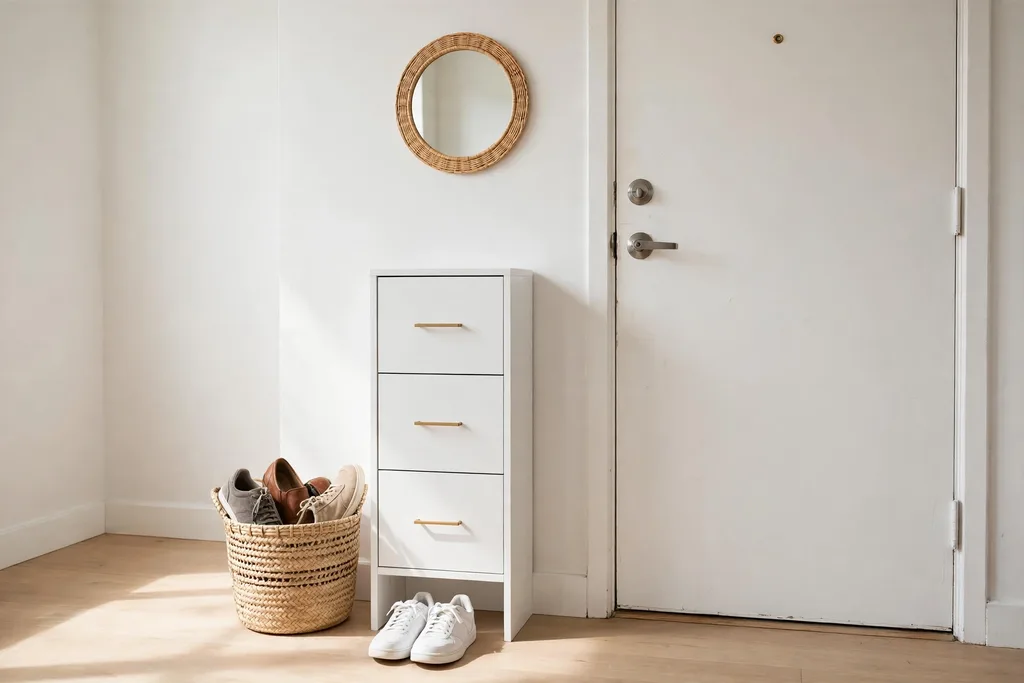
A tipping shoe cabinet, the kind where the front tilts down and the shoes stand upright inside, is the best shoe storage for a small entry because it is only 7 to 10 inches deep. Ten inches is the magic number. A cabinet 10 inches deep holds two rows of shoes and never eats into your 36-inch path. A cabinet 14 inches deep holds the same shoes and steals 4 inches from the room every single day. Measure before you buy, and do not trust the product photo, which is always taken in a room bigger than yours.
Set the limit at 2 pairs per person inside the cabinet, plus the pair you are wearing. That is the whole rule. Two pairs per person fits in a slim cabinet, and when the cabinet is full, the extra pair goes to the bedroom closet, not to the floor by the door. A limit you can keep beats a big shoe rack you cannot. That limit is what makes small apartment entryway ideas work in real apartments, where the entry is 3 feet wide and the shoe collection is not. If you live alone, a cabinet that holds 4 to 6 pairs is plenty. If two of you share the entry, a cabinet that holds 8 pairs, or two slim cabinets side by side, does the job.
Put a boot tray on the rug in front of the cabinet for the pair you wore today. A boot tray is a shallow tray with a raised edge, about $11, and it catches rain, mud, and salt before they reach the floor. One pair on the tray, the rest in the cabinet. When the tray holds three pairs, the tray has become a pile, and the pile has to go back in the cabinet. The tray is a landing pad, not a storage unit.
If a cabinet does not fit your wall, use a low woven basket instead, one basket per person, sitting under the console or beside the door. A basket holds 2 pairs, hides them from view, and costs about $9. The basket rule is the same as the cabinet rule: when it is full, the extra shoes leave the entry. Shoes are the one thing in a small entry that must have a hard limit, because shoes are the one thing that grows without anyone noticing.
For more on fitting storage into a tight entry, the deep dive on slim storage is worth a look: small entryway storage ideas.
A slim console as your landing surface
Every landing strip needs one flat surface at hand height, a place to put down what you are carrying the moment you walk in. Without it, your keys land on the kitchen counter, your mail lands on the sofa, and your sunglasses disappear into a coat pocket. With it, everything has a home, and the home is right by the door.
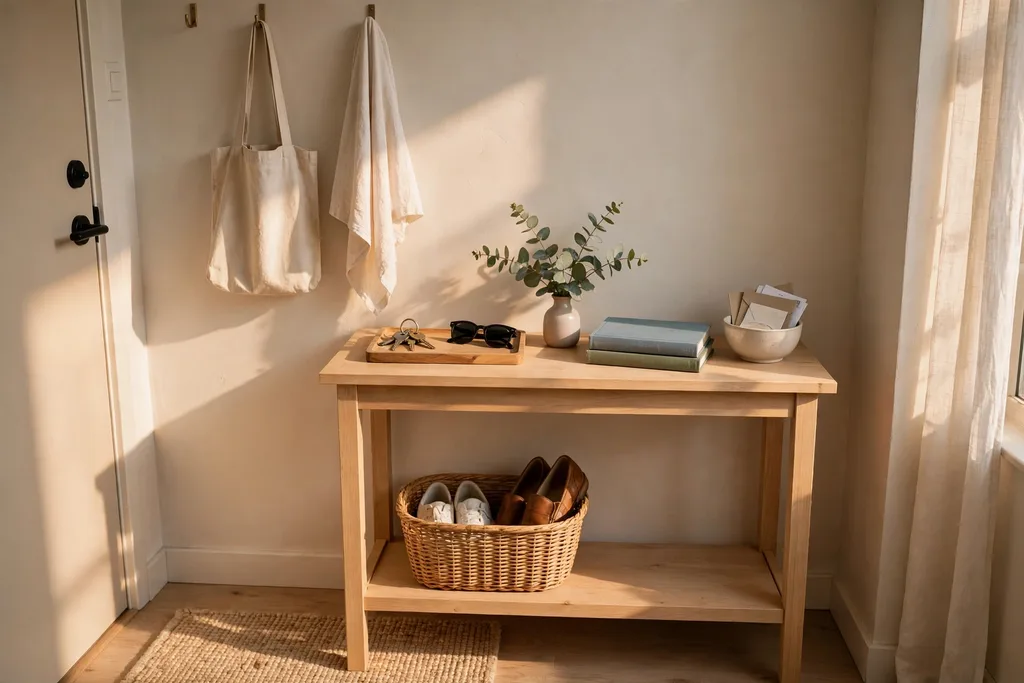
A slim console table is the classic landing surface, and the number that matters is the depth. This is where small apartment entryway ideas earn their keep, because one flat surface by the door saves you from hunting for keys every morning. A console 10 to 12 inches deep gives you a real surface for a tray, a dish, and a small plant, and it leaves your 36-inch path alone. A console 16 inches deep gives you the same surface and takes 4 inches from the room. A console 18 inches deep is a dining table pretending to be an entry table, and it will fight the door swing every day. Measure the depth before you buy, and if the console you love is too deep, keep looking. The right console exists at 12 inches deep, and it is worth the search.
Style the top with no more than three things. A small tray for keys and sunglasses, a tiny vase or plant, and a small bowl or dish for mail. Three things, not six. A console top crowded with decor is a console top with no room to put anything down, which defeats the purpose. The tray is the most important piece. Keys go in the tray, every time, and the tray is the reason you never lose your keys again. A tray 10 inches long and 6 inches wide is plenty, and it costs about $10.
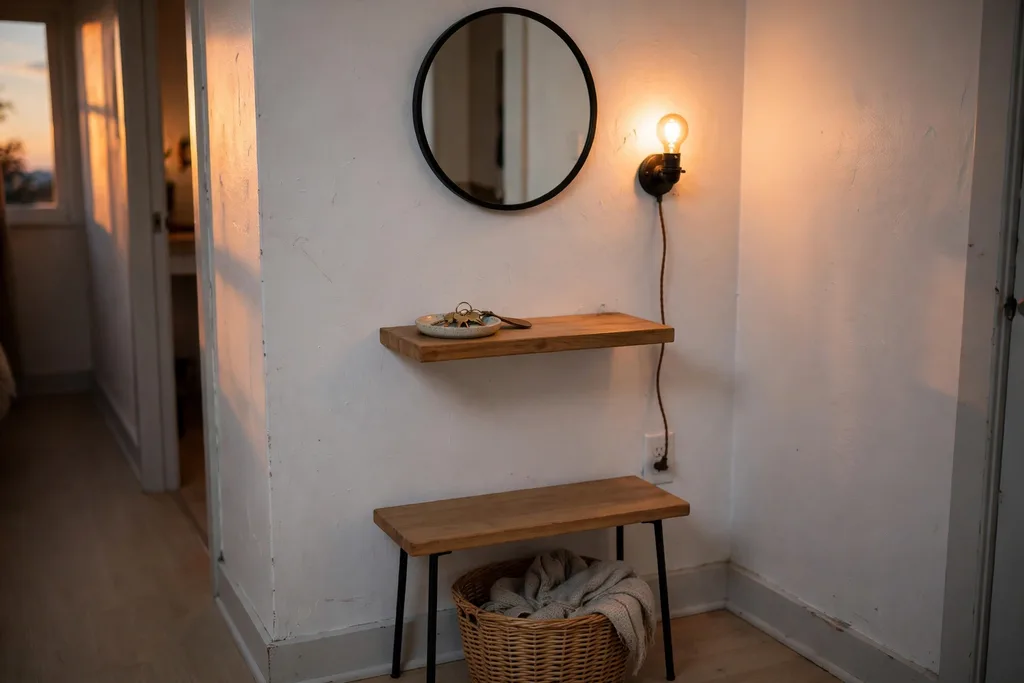
If a console does not fit, a floating shelf does the same job in less space. A floating shelf 4 to 6 inches deep, mounted at 30 to 32 inches high, holds the same tray and the same dish, and it leaves the floor completely clear. A shelf that shallow cannot hold a plant and a stack of books, and that is fine, because it does not need to. It needs to hold your keys, and it does.
If you want the full guide to picking a slim table that actually fits your entry, read small entryway console ideas. The console is one component of a landing strip, and that article covers the table piece in depth, including the exact depths that work and the ones that do not.
No free wall? Use the sofa back as your divider
Some apartments give you no free wall at all. The door opens, and the first thing it faces is the back of the sofa. That feels like a problem, but it is actually the answer. The sofa back is your wall. Use it.
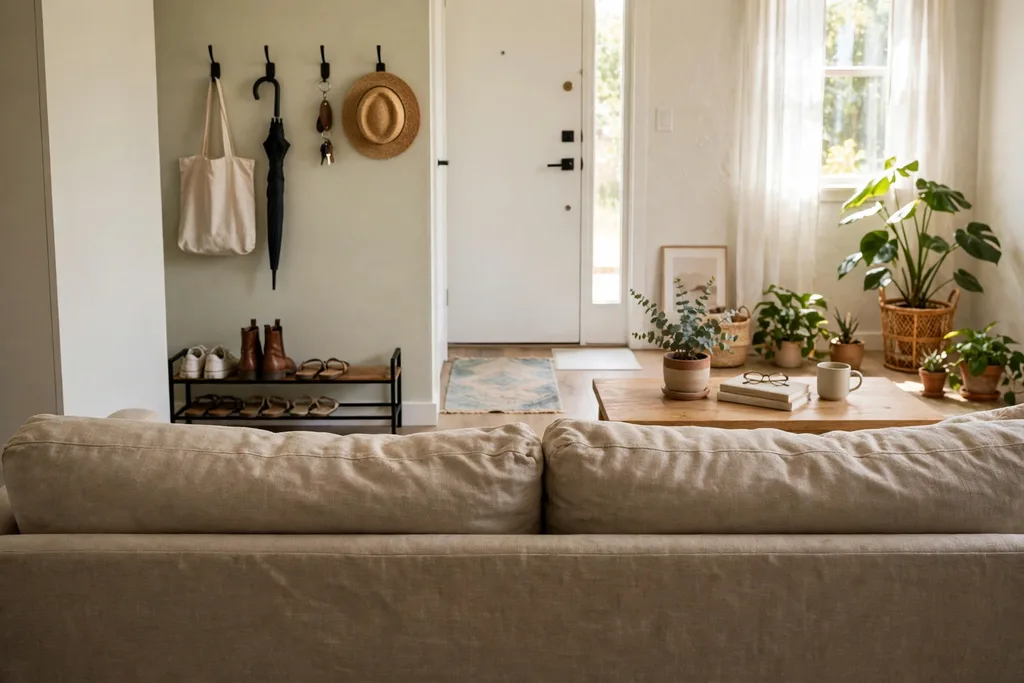
A sofa-back entry works like this. The sofa sits with its back to the door, about 36 inches from the door, so the walking path stays clear and the door swing stays free. The space between the door and the sofa back is your landing strip, and the sofa back is the boundary that says the entry ends here and the living room begins there. Put the rug in that space, put the hooks on the wall beside the door, and put a slim shoe cabinet or a basket against the sofa back, facing the door. The sofa hides the shoes from the living room, and the living room never sees the entry mess.
The measurements matter more here, not less. Keep 36 inches between the door and the sofa back for the walking path. Keep the rug 2 by 3 feet, inside that gap, not under the sofa. Keep the shoe storage no deeper than 10 inches, because the gap is only 36 inches and the rug already takes some of it. And keep the sofa back clean. A sofa back piled with coats is a closet, not a divider. Coats go on the hooks, bags go on the hooks, and the sofa back stays bare so it reads as furniture, not storage.
A narrow console behind the sofa, 10 to 12 inches deep, turns the divider into a landing surface. It holds the key tray and the mail bowl, and it faces the door, so you use it the moment you walk in. From the living room side, the console is invisible behind the sofa cushions. From the entry side, it is the most useful piece in the apartment. If the gap is too tight for a console, a floating shelf on the wall beside the door does the same job, and the sofa back still does the dividing.
This is one of the best small apartment entryway ideas for studios, because studios have the least wall and the most need for a boundary. The sofa is already there. Let it do two jobs.
No drilling allowed: the over-the-door and adhesive plan
Many leases forbid drilling, and some walls, plaster, brick, or tile, punish you for trying. That does not mean you cannot have a landing strip. It means your landing strip hangs instead of screws, and the plan below is the whole system for a no-drill entry.
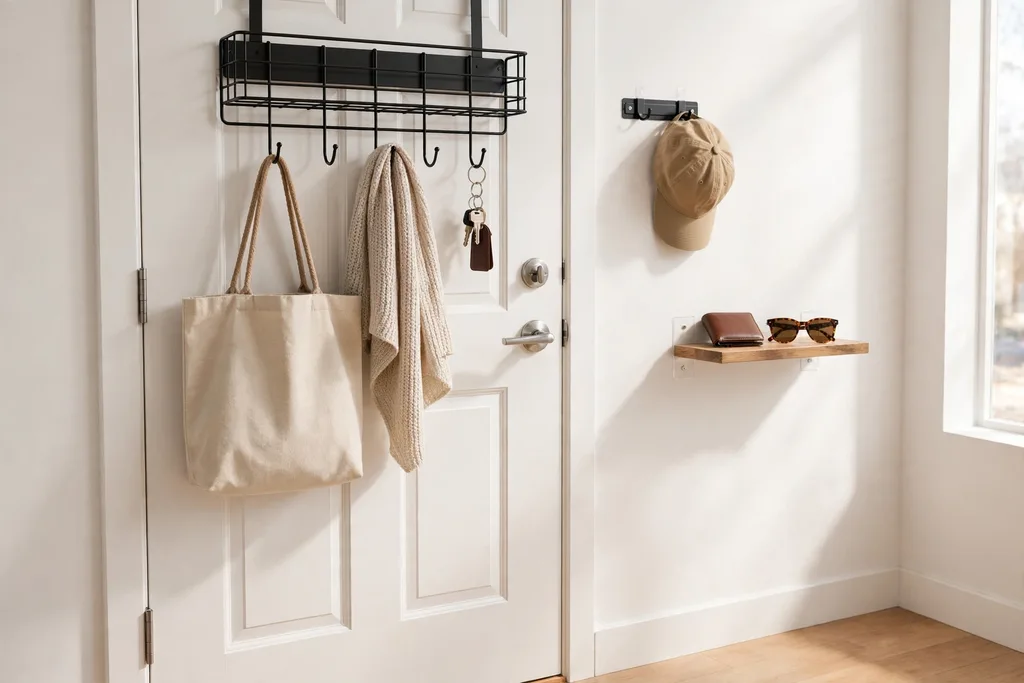
Start with the door itself. An over-the-door organizer, a rail that hooks over the top of the door, holds coats, bags, and keys, costs about $14, and leaves no mark at all. Measure the top of your door first. Most interior doors are 1 and 3/8 inches thick, and most over-the-door hooks are made for that thickness. If your door is thicker, look for an adjustable hook. Hang the organizer on the inside of the door, not the outside, so it never blocks the hallway and never announces your apartment to the neighbors.
Next, the adhesive plan. Adhesive hooks and strips hold a surprising amount when they are used correctly, and they fail when they are used wrong. The rules are simple. Clean the wall with rubbing alcohol and let it dry completely before you stick anything on it. Wait the full hour the package asks for before you hang anything heavy. Never hang a hook on fresh paint, on textured walls, or on wallpaper, because the adhesive will either fall off or take the paint with it. And check the weight rating. A strip rated for 3 pounds holds a cap and a leash. A strip rated for 7 pounds holds a light jacket. Your winter coat needs a freestanding coat stand, not a strip.
For everything else, go freestanding. A freestanding coat stand holds 4 to 6 coats and costs about $25, and it needs no wall at all. A leaning mirror needs no wall at all. A slim bench needs no wall at all. A basket needs no wall at all. When the wall is off limits, the floor does the work, and the floor is honest about what fits. If a freestanding piece fits inside your 3-by-4-foot rectangle, it belongs. If it does not fit, it does not belong, no matter how much you like it.
One last no-drill rule: keep the original hardware. If you swap a hook or a knob, save the original in a labeled bag, and put the bag in the closet, not in a drawer you will forget. When you move out, the original goes back on, and the landlord never knows anything changed. That is the whole point of a renter-friendly entry: everything you add, you can remove, and everything you remove, you can restore.
Mirror and light: the finishing layer
A landing strip works without a mirror and without extra light. But a mirror and a light are what make it feel like an entry instead of a storage corner, and they are the cheapest finishing layer in the whole plan.
Hang a round mirror, 18 to 24 inches across, on the wall beside the door, at eye level. A mirror does three jobs at once. It lets you check yourself before you leave, it bounces light into a dark entry, and it makes a small space feel bigger. A round mirror suits a small entry better than a rectangular one, because the soft shape contrasts with all the straight lines of the door, the console, and the cabinet. Hang it so the center sits at about 60 inches high, roughly eye level, and keep it clear of the hook rail. A mirror behind a coat is a mirror you cannot use.
Add one light. Most apartment entries have one ceiling light, and it is usually too dim and too far from the door. A plug-in sconce, mounted at 60 to 66 inches high beside the mirror, fills the gap, and it needs no wiring. Run the cord down the wall inside a small cord cover painted the same color as the wall, and the cord disappears. A warm bulb, 2700K, makes the entry feel welcoming at night, and it costs pennies to run. If a sconce does not fit, a small battery lamp on the console does the same job, and a lamp you can move is a lamp you can take with you.
Keep both pieces simple. Good small apartment entryway ideas end here, with one mirror and one light, because a finished entry needs nothing more. One mirror, one light, and the wall is done. A wall with a mirror, a sconce, a hook rail, and a shelf is a wall that has everything it needs. A wall with two mirrors and three pictures is a gallery, and a gallery by the front door is clutter wearing a nice frame. The entry is the smallest room in the apartment. Let it be small, and let it be finished.
The whole landing strip for $148: the budget table
Here is the whole entry, every piece, with real prices. Buy in this order, because the order matters: rug first, because it marks the zone, then hooks, then shoes, then the landing surface, then the finishing pieces. If your budget is tight, stop after the first four rows and you still have a working entry for $100.
| Piece | What to buy | Price |
|---|---|---|
| Washable runner rug, 2 by 3 ft | Low-pile washable rug in a mid-tone pattern | $28 |
| Peg rail with 5 hooks | Wooden peg rail, 18 to 24 in long, adhesive or screw mount | $16 |
| Slim tipping shoe cabinet | White cabinet, 7 to 10 in deep, holds 4 to 6 pairs | $45 |
| Boot tray | Shallow tray with a raised edge for wet shoes | $11 |
| Floating key shelf, 4 to 6 in deep | Small shelf at 30 to 32 in high for keys and mail | $14 |
| Woven basket | One basket for extra shoes or bags | $9 |
| Round mirror, 18 to 24 in | Round mirror with a small shelf underneath | $15 |
| Small key tray | Wooden or ceramic tray, 10 by 6 in, for keys and sunglasses | $10 |
| Total | $148 |
The cheapest item is the woven basket at $9, and the most expensive is the shoe cabinet at $45, because the cabinet does the hardest job. If you already own a basket, skip it and save $9. If you already own a mirror, skip it and save $15. The total is a ceiling, not a target, and every piece you already own brings it down. What matters is the system: rug, hooks, shoes, surface, mirror, light. Buy the system in order, and the entry builds itself.
Mistakes that ruin a no-entryway apartment
These are the mistakes that turn good small apartment entryway ideas into a mess, and every one of them is avoidable with the numbers in this article.
A console too deep. A console 16 or 18 inches deep eats your walking path and fights the door swing. The right depth is 10 to 12 inches. If the console you love is deeper than that, it is the wrong console for your apartment, no matter how pretty it is.
Hooks too low. Hooks hung at 48 inches, or wherever the last tenant left them, put coats on the floor and bags in the way. Hooks belong at 60 to 66 inches, with 6 to 8 inches between them. Measure, do not guess.
A rug the door catches on. A thick rug under a door that swings over it bunches up, trips people, and wears out in a month. Measure the gap under the door first, and buy a low-pile rug that clears it.
No limit on shoes. An entry with no shoe limit becomes a shoe store within a week. Two pairs per person in the cabinet, one pair on the tray, the rest in the bedroom closet. The limit is the system.
One long row of hooks. A rail that runs the whole wall leaves no room for a shelf or a mirror, and it turns the wall into a coat closet. A short rail, 18 to 24 inches, with 3 to 5 hooks, leaves the wall room to breathe.
Everything on the floor. Shoes on the floor, bags on the floor, the dog leash on the floor. The floor is for walking, and the wall and the cabinet are for storage. If it is on the floor and it is not the rug or the boot tray, it needs a hook or a home.
Forgetting the door swing. A shoe cabinet, a bench, or a basket placed inside the door swing arc gets hit every time the door opens, and it will be broken or moved within a month. Mark the arc with tape before you place anything.
Buying before measuring. The most expensive mistake is the prettiest one: a piece that does not fit, that you cannot return, that sits in the corner of the living room for a year. Measure first, buy second, every time.
Frequently asked questions
How do I make an entryway when my door opens into the living room?
Build a landing strip instead of a room. Mark a 3-by-4-foot zone by the door with a washable rug, hang a hook rail on the nearest wall at 60 to 66 inches high, add a slim shoe cabinet no deeper than 10 inches, and put a small tray on a slim console or a floating shelf for keys and mail. The rug is the boundary, the hooks are the storage, and the zone works even though no wall was built. If the sofa sits near the door, let the sofa back act as the divider, and keep the entry between the door and the sofa.
What is the minimum space for an apartment entryway?
A working entry needs only 2 to 3 feet of wall and 12 to 16 inches of depth, plus a clear walking path of 36 inches from the door into the room. A 3-by-4-foot rectangle holds everything an entry needs: a rug, a hook rail, shoe storage, and a landing surface. Anything smaller than that still works if you drop the console and use a floating shelf instead, because a shelf takes no floor space at all.
Can I put a shoe rack behind the front door?
Yes, but only if it sits outside the door swing arc and no deeper than 10 to 12 inches. A slim tipping shoe cabinet, 7 to 10 inches deep, is the safest choice, because it holds the shoes and never blocks the door. Measure the arc first with painter’s tape on the floor, and never place a rack, a basket, or a bench inside it. If the space behind the door is less than 12 inches deep, use the wall beside the door instead, or a basket under the console.
How do I hide shoes in a small entryway?
Use a slim tipping shoe cabinet with a door, which hides the shoes completely, and set a limit of 2 pairs per person inside it. The pair you wore today sits on a boot tray on the rug, and everything else lives in the cabinet or the bedroom closet. A woven basket under the console hides 2 pairs just as well if a cabinet does not fit. The trick is the limit, not the furniture. Hidden shoes stay hidden only when the container is not overfull.
What are renter-friendly entryway ideas?
The most renter-friendly entryway ideas use nothing that damages the wall: an over-the-door organizer for coats and bags, adhesive hooks rated for the weight they hold, freestanding furniture like a slim bench or a coat stand, a leaning mirror, and a washable rug. Save every original piece of hardware in a labeled bag when you swap anything, and keep everything inside a 3-by-4-foot zone so the entry is easy to remove when you move out. A move-out checklist is below in the Start Today section.
Should an apartment entry have a mirror?
Yes, if you have the wall for it. A round mirror, 18 to 24 inches across, hung at eye level beside the door, lets you check yourself before you leave, bounces light into a dark entry, and makes the space feel bigger. But a mirror is a finishing piece, not a starting piece. Buy the rug, the hooks, and the shoe storage first. Add the mirror when the system works, and skip it if the wall is needed for hooks instead.
Start today
You do not need a weekend, a renovation, or a big budget to fix an entry that does not exist. You need a tape measure, one rug, and one afternoon. Start with the rug today, because the rug marks the zone and the zone changes how the room feels the moment it arrives. Measure the door swing, tape the 3-by-4-foot rectangle on the floor, and lay the rug inside it. That is step one, and it takes twenty minutes.
Tomorrow, hang the hook rail at 60 to 66 inches, with hooks 6 to 8 inches apart. The day after, bring in the shoe cabinet and the boot tray, and set the 2-pairs-per-person rule. By the end of the week, add the small tray for keys and the round mirror, and your landing strip is done. The whole project costs $148, and every piece comes with you when you move.
And when moving day comes, here is your move-out checklist. Take the rug up and wash it. Pull the adhesive hooks off slowly, with heat from a hair dryer if they resist, and patch any small holes with filler. Put the original hardware back on, using the labeled bag you saved. Wipe the wall where the rail hung, and take the cabinet, the tray, the basket, and the mirror with you. Leave the entry exactly as you found it, and take the system to your next apartment, where it will fit, because it is measured to your habits, not to your walls.
These small apartment entryway ideas prove your front door opening into your living room is not a flaw in your apartment. It is a chance to build a landing strip that works harder than a foyer ever did, in 3 feet of wall, 4 feet of floor, and one small rectangle that finally gives everything you carry a place to land.