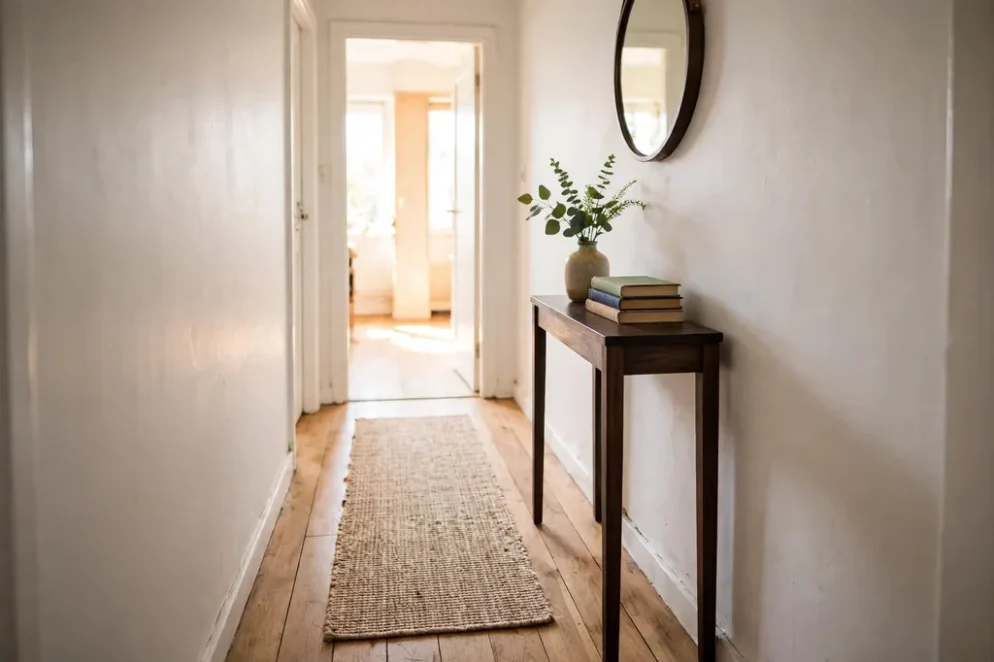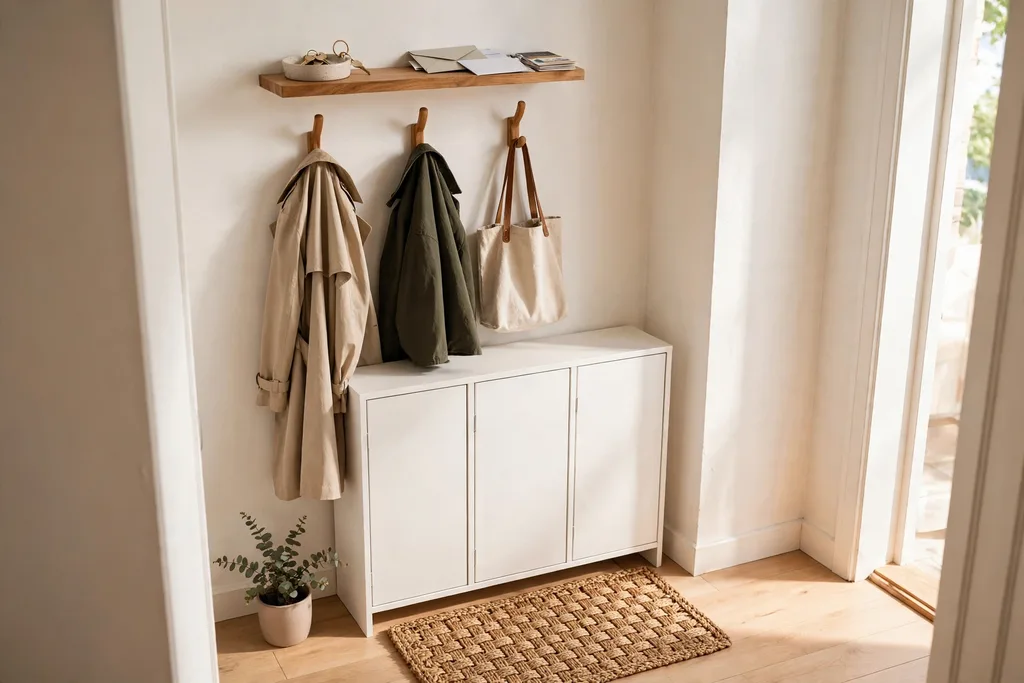
Small entryway storage ideas usually fail in the same way: they show you one pretty basket and call it a system. A real entryway has three jobs at once, shoes off, coat up, keys down, and in a small home all three have to happen on one wall, in about 3 square feet of floor, without turning the hall into an obstacle course.
This guide builds that wall. One measured wall run, 36 inches wide and no more than 12 inches deep, that holds shoes, coats, and keys for one to four people, with exact heights, depths, and a whole-entry cost under $150. Everything here works in a rental, and there is a full no-drill version in section 6. Every number below is one the best entryway guides agree on, so you can measure once and buy once. That is the point of these small entryway storage ideas: measure first, then buy only what fits the wall.
For the decorating side, colours, mirrors, and styling the wall once the storage works, see Entryway Decor Ideas for Small Spaces.
Table of Contents
The numbers first
Best for: every idea in this guide, measure the wall and the walkway before you buy anything.
Seven numbers decide whether small entryway storage ideas work in a real hall:
- Wall run: the whole system fits on 36 inches of wall, 24 inches for one person, 48 to 60 inches for a family of four.
- Depth: no floor piece deeper than 12 inches. The slim shoe cabinet is 7 to 10 inches deep; a bench is 10 to 14 inches deep. Twelve inches is the house standard here, because it is the deepest piece that still leaves a real walkway.
- Walkway: keep 30 inches clear minimum, 36 inches if two people come home at once. Walkway left equals hall width minus piece depth, do that subtraction before you buy.
- Hooks: 60 to 66 inches high for adults, 40 to 48 inches for a kids’ row. Pegs every 6 to 8 inches, one hook per person plus one guest hook.
- Key shelf: 48 to 54 inches high, 4 to 6 inches deep, with a tray about 6 by 9 inches.
- Shoe cap: 2 pairs per person at the door. Everything else lives in the closet or under the bed.
- Mat: 24 by 36 inches inside the door, low pile under 1/2 inch so the door clears it.
Measure in this order: door swing first (nothing on the floor inside the 30- to 36-inch door arc), then hall width, then wall width, then hook height. A tape measure and five minutes save the most common entryway mistake, buying a piece that fits the wall and blocks the walk. These small entryway storage ideas start with that subtraction, not with shopping.
1. The 3 sq ft plan: one wall run, measured
Best for: the whole system, this is the plan every other section hangs on.
Three square feet is not a metaphor. It is a rectangle: 36 inches of wall by 12 inches of floor. That is the footprint your entryway storage is allowed to take. Everything in this guide lives inside that rectangle and on the wall above it. The walkway is not part of the 3 square feet, it is the space you protect by keeping the storage inside it. Good small entryway storage ideas protect the walkway first and fill the wall second.
Here is the plan, top to bottom, on one 36-inch wall run:
| Zone | Height from floor | Depth from wall |
|---|---|---|
| Coat hooks | 60–66 in (adults) | 2–4 in (pegs) |
| Key shelf + tray | 48–54 in | 4–6 in |
| Mirror (optional) | centre 57–60 in | 2–5 in |
| Bench seat (if it fits) | 16–19 in | 10–14 in |
| Shoe cabinet | 0–30 in tall | 7–10 in |
| Boot tray + mat | floor | tray 30–36 in long |
Now the walkway math, the only subtraction that matters:
| Hall width | Deepest floor piece | Walkway left |
|---|---|---|
| 48 in | 12 in (bench or cabinet) | 36 in, comfortable |
| 42 in | 12 in | 30 in, the minimum, workable |
| Under 42 in | 7 in (slim cabinet only) | under 30 in, go wall-only (section 7) |
Two rules hold the plan together. First, shoes go up, not out: the cabinet is tall and thin, so pairs stack vertically inside 7 to 10 inches of depth instead of spreading across the floor. Second, one wall does all three jobs: shoes low, keys at hand height, coats high. When each thing has one fixed height, nobody has to think, hands go to the same spot every time, and the pile never starts. That fixed-height habit is what makes small entryway storage ideas work day after day.
What to watch: do not plan the wall run on the door-swing side. Stand in the doorway, swing the door open, and mark the arc on the floor with tape. Nothing, not a tray, not a mat corner, not a shoe, sits inside that arc. A door that catches a boot tray every morning will train everyone to step over the mess instead of using the system. In small entryway storage ideas, a clear door arc matters more than any single piece of furniture.
2. Shoes up, not out: the slim cabinet
Best for: the shoe pile, the one problem every small entryway actually has.
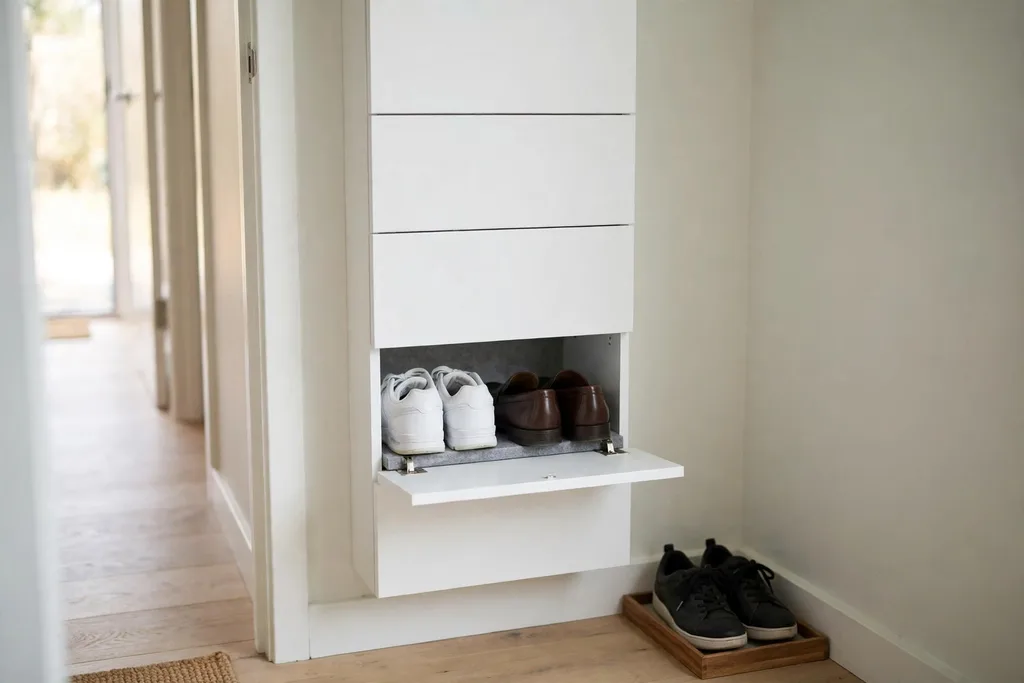
Shoes are the whole game. Coats hang, keys sit in a tray, but shoes multiply: two people, four pairs, plus the boots that never made it back to the closet. The fix is not a bigger rack. It is a thinner one. Small entryway shoe storage ideas work when shoes go up inside a slim cabinet instead of out across the floor, and the cabinet that does it best is the tipping, flip-front kind, 7 to 10 inches deep, holding 8 to 12 pairs.
- Size: measure your longest shoe first. A men’s size 12 is about 12.5 inches long, which is why the cabinet works: shoes stand tilted inside, so a 12.5-inch shoe fits in a 7- to 10-inch-deep box. Check the depth before you buy, anything over 10 inches deep eats walkway for no extra capacity. That depth limit is one of the simplest small entryway storage ideas to follow.
- Capacity: count pairs, not shelves. Two people need 4 daily pairs; a family of four needs 8. A two-tier flip-front cabinet holds 8 to 12 pairs, which covers most households with one unit. If your cabinet holds fewer than your daily pairs, shoes will live on the floor beside it, the cabinet has to be big enough or it is decoration. Small entryway storage ideas fail quietly when the cabinet is too small for the daily pairs.
- What goes where: daily pairs in the cabinet, everything else out. Seasonal boots, rarely worn shoes, and the third pair of sneakers live in the closet or under the bed. The 2-pairs-per-person cap is the rule that keeps the cabinet honest: when a new pair comes in, an old pair goes out to long-term storage.
- Open or closed: closed (flip-front doors) hides the mess and keeps dust off, which is why it wins in a small entry where the cabinet is the first thing guests see. Open cubbies work only if everyone puts shoes away neatly every time, in real life, that lasts about a week. If you do use open cubbies, one cubby per person, 5.5 inches tall each, and no more than two pairs per cubby.
Most shoe storage ideas for small entryway stop at “buy a shoe rack”. A rack holds shoes; a cabinet hides them, stacks them vertically, and keeps dust off, which is why the cabinet wins in an entry guests see first. Most small entryway storage ideas come back to that same choice: hide the shoes, keep the floor clear.
What to watch: never store damp shoes sealed inside a closed cabinet. Wet shoes need air, let them dry on the boot tray overnight first (section 9), then put them away. Shoes stored damp go smelly fast, and a closed cabinet makes it worse. A small charcoal bag or a sprinkle of baking soda in a closed bin helps, but dry-first is the rule that actually works. Wet shoes are where many small entryway storage ideas break down, so dry them before they go away.
Renter note: a freestanding slim cabinet needs no holes at all. Keep it low, under 30 inches tall, and it will not tip. Tall, narrow shoe cabinets are the one entryway piece that can tip forward when a child pulls on them, and the safety guidance is to anchor them to the wall. In a rental, the simpler answer is: do not buy the tall one. A low, wide cabinet holds the same pairs and cannot fall on anyone.
3. Coats on hooks, not on chairs
Best for: the coat pile, the chair by the door is not storage.
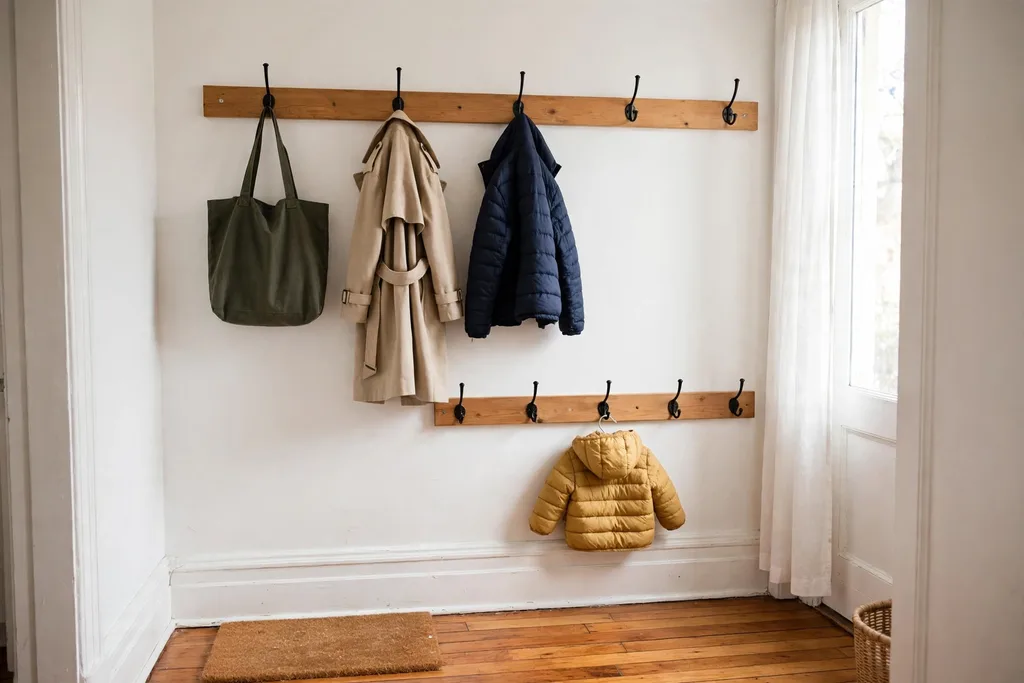
Coats fail differently from shoes. Shoes pile on the floor; coats pile on the nearest chair, the stair rail, or the back of the sofa. The fix is hooks, and the fix only works if there is exactly one hook per person and the hook is at the right height. A hook rail is the cheapest piece in this whole system and the one that changes behaviour fastest, because a coat on a hook takes two seconds, and a coat on a chair takes a “later” that never comes. That two-second habit is the heart of small entryway storage ideas for coats.
- Height: hang the rail so the hooks sit at 60 to 66 inches for adults. That is high enough that a long coat clears the floor and low enough that nobody has to reach. Add a second, lower row at 40 to 48 inches for kids, a child who cannot reach their own hook will not use it, and the coat will end up on the floor instead.
- Spacing: pegs every 6 to 8 inches apart, on a rail 24 to 36 inches long for one or two people, 48 to 60 inches for a family. A rail that is too short is worse than no rail: coats overlap, sleeves tangle, and the second coat slides off the first. Count hooks before you buy: one per person, plus one guest hook, plus one for the bag.
- What goes on a hook: current-season coats only. The heavy winter coat lives on a hook from November to March; in summer it lives in the closet. Same rule as shoes, the entry holds the daily set, not the wardrobe. A hook holding three off-season coats has no room for today’s coat, and today’s coat goes on the chair. Small entryway storage ideas keep only the current season on the rail for exactly that reason.
- Bags share the rail: one hook per person is really one hook per person’s coat and bag. A tote or backpack on its own hook stops bags from landing on the bench or the floor. For school bags, a hook at kid height plus a small basket underneath for lunch boxes and gloves is the whole system, the bag never touches the floor.
What to watch: do not hang heavy things on adhesive hooks. A winter coat with keys and a phone in the pocket is too heavy for a stick-on hook, it will come down in the night and take paint with it. Heavy coats go on screwed-in hooks or on a freestanding rack (section 6 covers the no-drill version, with weight limits). And check the wall: hooks need a stud or a proper wall anchor. A hook held by a single small screw in bare drywall will pull out the first time a wet coat goes on it. Strong fixings are not optional in small entryway storage ideas, because a failed hook drops everything at once.
4. Keys down in one tray: the landing zone
Best for: the lost-keys moment, the smallest piece in the system, and the one you will use most.
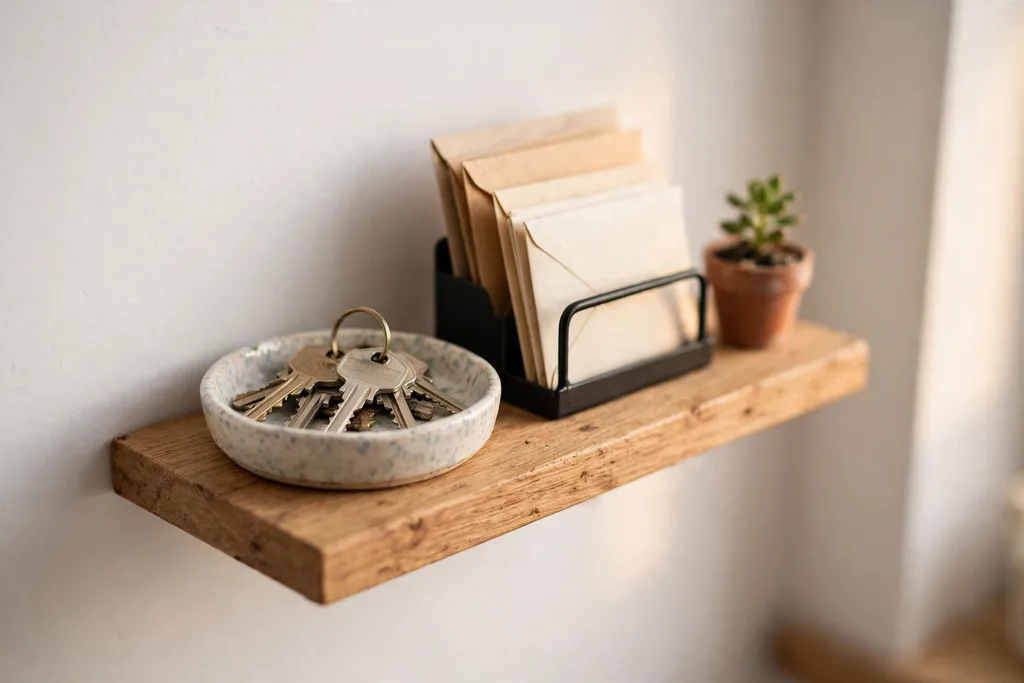
Keys are the cheapest problem in the entryway and the most annoying one. A key tray costs less than lunch, takes up 6 by 9 inches, and ends the daily “where are my keys” search forever, but only if the tray is the only place keys ever land. The landing zone works because it is one spot, at hand height, on the way out. If keys can land in three places, they will. Small entryway storage ideas give keys exactly one landing spot, and no second choice.
- Height: the shelf sits at 48 to 54 inches, eye level when you walk in, hand height when you reach out without thinking. A tray on a table works the same way; the height is what matters, not the furniture. If you already have an entryway table, the tray goes on it, not on the wall, the table is your landing zone, and the rest of this guide still applies around it.
- Size: a floating shelf 4 to 6 inches deep is enough. The tray itself is about 6 by 9 inches, big enough for two sets of keys, a wallet, and sunglasses, small enough that mail cannot pile up in it. That size limit is a feature: a tray that fits everything becomes a junk drawer on a shelf.
- Mail gets its own rule: two slots, or one small upright holder. Incoming mail goes in the holder; anything that stays longer than a week gets filed or recycled on Sunday. The landing zone is a transit point, not a filing cabinet. A five-minute weekly reset, mail cleared, tray wiped, gloves back in the basket, is what keeps the system working in month six, when the novelty has worn off. That weekly reset is part of small entryway storage ideas, not an extra chore on top of them.
- One hook for the leash and the extras: a single small hook beside the tray holds the dog leash, and a second holds the lanyard or the spare key ring. Keep it to two hooks: more hooks invite more stuff, and the landing zone drifts back into clutter.
What to watch: do not put the key tray above the shoe cabinet where shoes get tossed. Keys land where hands go when you walk in, the tray belongs on the wall you face, or on the table beside the door, not behind the coat rail where a sleeve knocks it off. And if your entry has a table instead of a wall shelf, style the tray the same way: one tray, one job, nothing else on that corner of the table. For table styling that pairs with this storage setup, see Entryway Table Decor Ideas. Small entryway storage ideas work the same way: one tray, one spot, every time.
Renter note: a floating shelf is the one piece in this system that usually needs two screws. If you cannot drill at all, skip the shelf: use a narrow console table, a small wall-mounted basket on adhesive hooks (light loads only, keys and mail, never coats), or a tray on top of the shoe cabinet. The landing zone is a habit, not a shelf, the tray can sit anywhere at hand height.
5. The bench question: when it fits and when it doesn’t
Best for: sitting to put shoes on, if your hall is wide enough to earn one.
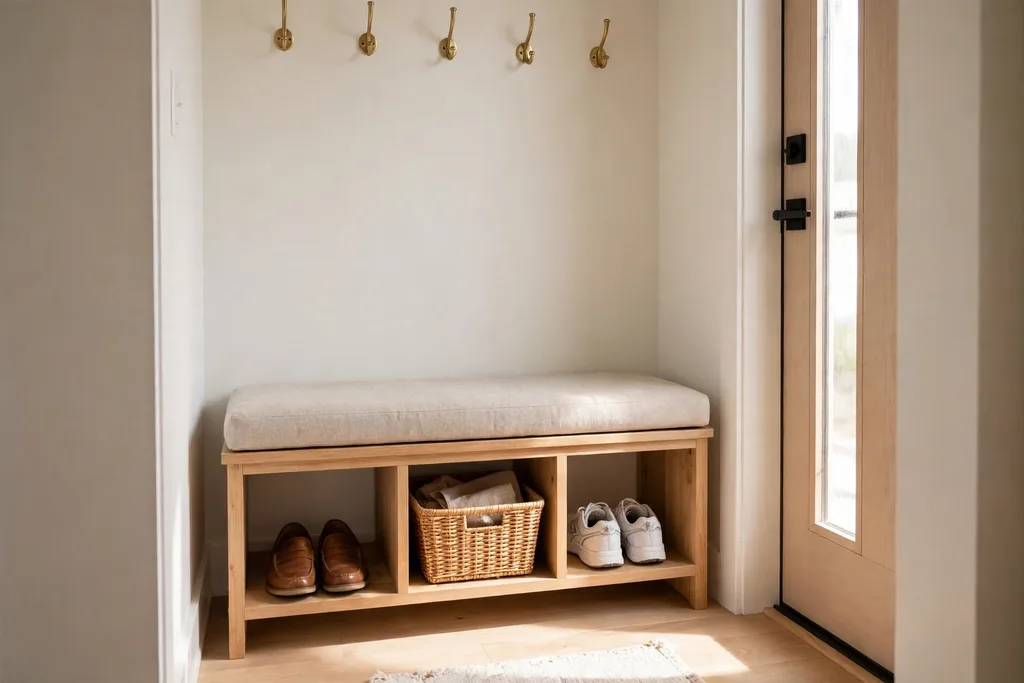
A bench is the most loved entryway piece and the most often regretted. People buy one because sitting to put shoes on is genuinely easier, then discover it eats the walkway every single day. The honest rule: a bench earns its floor space only when the hall is 48 inches wide or more. At 48 inches, a 12-inch-deep bench leaves a 36-inch walkway. At 42 inches, it leaves exactly 30, the minimum, and the bench will feel tight. Under 42 inches, skip the bench entirely and put the money into the cabinet. That trade-off is the honest version of small entryway storage ideas: buy the cabinet before the bench.
- Size: bench 10 to 14 inches deep, 24 to 30 inches wide for one or two people, 36 to 48 inches for a family. Seat height 16 to 19 inches, standard chair height, so sitting and standing are both easy. The house standard here is 12 inches deep: it fits the 3 sq ft plan, holds cubbies underneath, and still leaves a real walkway in a 48-inch hall.
- Storage underneath: the bench earns its keep when the space below it works. Open cubbies, one per person, 5.5 inches tall each, hold the daily pairs where you can see them. A bench with drawers hides the mess better and costs more; open cubbies are cheaper and faster, which is what a bench is for. Either way, the bench holds today’s shoes, the 2-pairs-per-person rule still applies, and the cabinet still holds the rest. In small entryway storage ideas, the bench is a seat first and storage second.
- The no-bench alternative: if the hall is too narrow, a wall-mounted fold-down seat or a small stool tucked beside the cabinet does the same job and folds away. A stool takes zero permanent floor space. Nobody needs a bench every minute, you need a seat for thirty seconds while shoes go on, and a stool you can move is often the smarter buy in a hall under 42 inches.
- What goes on top: nothing. A bench with a cushion, a throw, and three decorative pillows is a bench you cannot sit on. One cushion, no clutter. The bench is a seat first and storage second; the moment it becomes a display shelf, it stops doing either job.
What to watch: the most common bench mistake is buying the biggest bench that fits the wall. A 48-inch bench in a 48-inch hall leaves no room for the door swing or the cabinet, measure the wall after the cabinet and the mat, not before. The bench is the last piece you buy, not the first (see the buying order at the end), because everything else in the system is more important than sitting down. Small entryway storage ideas buy the bench last,
6. The no-drill system: renters, weight limits included
Best for: renters, the whole entryway, zero holes, with honest weight limits.
Most “renter-friendly” entryway advice is one tip, “use adhesive hooks!”, and then silence about what those hooks can actually hold. Here is the full no-drill system, with a weight limit for every fix. The principle is simple: heavy things go on freestanding furniture, light things go on the wall, and nothing heavy ever hangs from a sticker. That one rule keeps small entryway storage ideas renter-friendly without risking the deposit.
| Fix | Holds | Weight limit | Use for |
|---|---|---|---|
| Over-door hook rack (5–6 hooks) | Coats, bags | About 10–15 lb total | Coats and tote bags |
| Adhesive hooks | Keys, leash, one light bag | 1–3 lb per hook (check the pack) | Keys, dog leash, lanyard |
| Tension rod (24–36 in) | Shoes by the heel, light hanging | A few lb, shoes only | Heel rail for shoes, extra hanging |
| Freestanding shoe rack/cabinet | All shoes | No limit (it stands on the floor) | The whole shoe system |
| Freestanding bench/stool | Sitting | No limit | Sitting, shoe cubbies |
| Over-door pocket organizer | Light shoes, gloves, hats | Light items only | Overflow shoes, accessories |
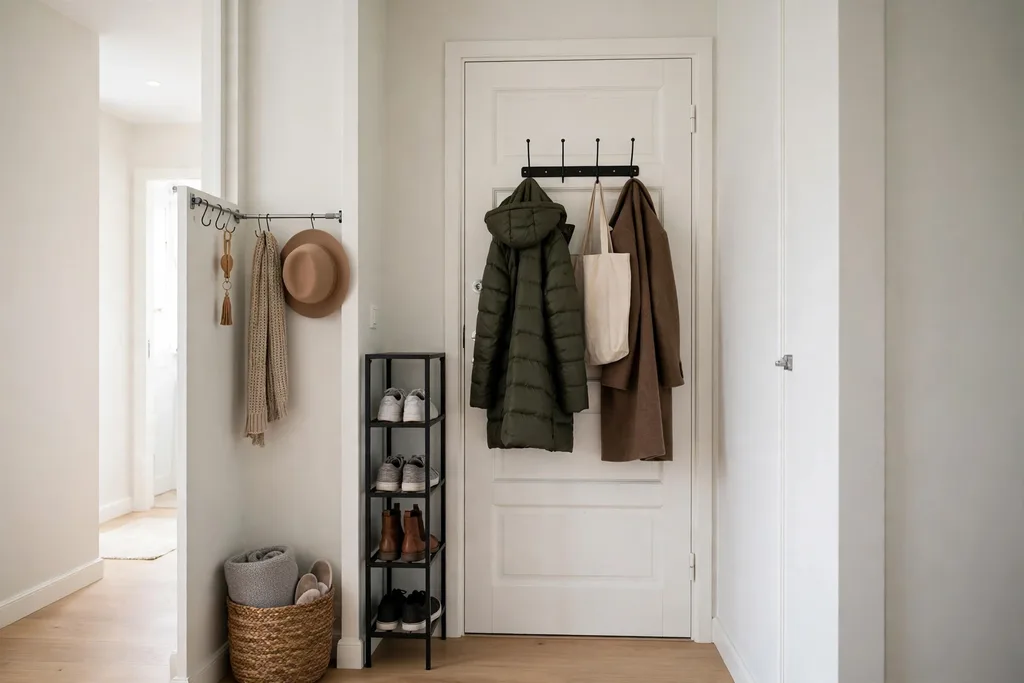
- Coats: the over-door rack is the renter’s coat closet. Five to six hooks on the back of the door hold the daily coats and a bag. Check two things: the door still closes without rubbing (keep to two or three items if it sticks), and the rack is the kind that hooks over the top of the door, not one that screws in. Heavy winter coats are fine here because the door carries the weight, not the wall. Small entryway storage ideas for renters lean on the door, not on adhesive.
- Keys: adhesive hooks are perfect for keys, a key ring weighs almost nothing. One adhesive hook beside the door at 48 to 54 inches, plus a small adhesive-mounted basket for mail, is the whole no-drill landing zone. Test the hook first: stick it, wait 24 hours, then hang the keys. A hook that fails on day one takes paint with it; a hook that holds for a day holds for months.
- Shoes: freestanding, always. A two-tier shoe rack or a slim cabinet stands on the floor and needs no fixing at all. The tension-rod heel rail is the rental-friendliest shoe trick in this guide: a rod wedged between two walls (or inside a closet opening) holds shoes by the heel, 6 to 10 pairs, with zero holes. And the over-door pocket organizer, 24 pockets, about 12 pairs of light shoes, takes the overflow that does not fit in the cabinet. Freestanding pieces are the backbone of small entryway storage ideas in a rental.
- What not to do: never hang a heavy coat on an adhesive hook, and never mount a floating shelf with adhesive strips. A shelf full of keys and mail is heavier than it looks, and it will come down, usually at 2 a.m., usually onto the shoes. If you cannot drill, the shelf becomes a tray on the cabinet or a narrow console table. The system bends; the weight limits do not.
What to watch: read your lease before you buy anything that sticks. Some leases ban adhesive hooks because removal can pull paint, and the fix is to use hooks rated for the surface, remove them slowly with heat (a hair dryer softens the adhesive), and test one hook in a hidden spot first. Felt pads under the cabinet and tray protect the floor, which is the damage landlords actually charge for.
7. Narrow halls under 30 inches: the wall-only setup
Best for: halls under 42 inches wide, where the floor is not yours to use.
If your hall is under 42 inches wide, the 3 sq ft plan changes: the floor belongs to the walkway, and storage goes on the wall. A 36-inch hall minus a 12-inch bench leaves 24 inches to walk through, which is a corridor, not an entryway. So the rule for narrow halls is simple: nothing on the floor except the mat and the boot tray, and both of those only if the door clears them. This wall-only setup is what entryway storage ideas for small spaces usually mean in practice, the storage moves up the wall because the floor is not available. That wall-only shift is what small entryway storage ideas mean in the narrowest halls.
- Shoes: a slim cabinet 7 inches deep is the deepest floor piece a narrow hall can take, and only if the hall is at least 37 inches wide, because 37 minus 7 leaves the 30-inch minimum walkway. Under 37 inches, shoes go up: an over-door pocket organizer on the bedroom side of the door, or a wall-mounted shoe rail (shoes hang by the heel on a rod), or a single shelf above the door for the off-season pairs. The daily pair lives on the boot tray by the door, one pair per person, no more.
- Coats and keys: these are wall jobs anyway, so nothing changes, hooks at 60 to 66 inches, key shelf at 48 to 54 inches, tray 6 by 9 inches. In a narrow hall, keep the rail short (24 inches) and the hooks to one per person: a rail crowded with coats sticks out further than the hooks themselves, and sleeves brushing past every time you walk through is exactly the cluttered feeling you are trying to avoid.
- Mirror: this is where a mirror earns its keep. A mirror on the wall opposite the door, centre at 57 to 60 inches, doubles the light and makes a narrow hall feel twice as wide. It takes zero floor space and does more for a small entry than any piece of furniture. Lean it if you can, a leaning mirror needs no hook at all. A mirror adds nothing to the floor, which is why it earns a place in small entryway storage ideas for narrow halls.
- Light: a dark narrow hall feels smaller than it is. A small battery sconce or a plug-in lamp on the key shelf, warm white light (2700K to 3000K), changes the whole space for the price of a bulb. Light is storage’s silent partner: a bright hall looks organised even when it is not, and a dark hall looks cluttered even when it is tidy.
What to watch: measure the door swing twice in a narrow hall. The door arc is 30 to 36 inches, and in a 36-inch hall the arc is the hall, anything on the floor inside it gets hit daily. A low-pile mat under 1/2 inch thick is the only floor piece that survives a door swinging over it, and even then, check the clearance before you buy.
8. Bags, kids, and the family math
Best for: households of two or more, the entryway is a shared system, and shared systems need numbers.
One person’s entryway is easy: one hook, two pairs of shoes, one tray. A family’s entryway fails when everyone shares one hook and one shelf, because the family has four times the stuff and the same 36 inches of wall. The fix is per-person allocation: one hook, one cubby, two pairs of shoes per person, and a wall run sized to the headcount. Small entryway storage ideas for families start with that per-person maths, not with a bigger cabinet.
| Household | Hooks (incl. 1 guest) | Shoe pairs at door | Wall run |
|---|---|---|---|
| 1 person | 2 | 2 | 24 in |
| 2 people | 3 | 4 | 36 in |
| Family of 4 | 5 | 8 | 48–60 in |
- Bags: school bags and backpacks are the forgotten entryway category, and they are the one that ends up on the floor most often. The rule is the same as coats: one hook per child, at kid height (40 to 48 inches), plus a small basket underneath for lunch boxes, gloves, and hats. A bag on its own hook never touches the floor; a bag with no hook goes wherever the child drops it, which is always the walkway. One hook per child is a small detail, and small entryway storage ideas for families live or die on details like that.
- Kids’ row: a lower hook row is not a luxury, it is the difference between a system kids use and one they walk past. Hooks at 40 to 48 inches, a low cubby they can reach, and a tray they can see into. Label the hooks if you have more than two children: a name tag on a hook ends the “that is my coat” argument and, more usefully, makes it obvious whose coat is missing when someone leaves without one.
- The weekly reset: a family entryway needs a five-minute weekly reset the way a single person’s does not. Sunday evening: mail cleared, outgrown or off-season shoes moved to long-term storage, gloves paired, the tray wiped. One person can reset an entryway in two minutes; a family needs five, and skipping it for three weeks is how a system quietly dies. Put the reset on the same day as the laundry, it is the same kind of job. In small entryway storage ideas for a household, the reset is part of the system, not a rescue.
- Guests: the guest hook is not decoration. One empty hook, always empty, is what stops a visitor’s coat from landing on the bench or the stair rail. If the guest hook is full, the system is full, that is the signal to move off-season stuff out, not to add another hook.
What to watch: do not solve a family entryway by buying a bigger unit. A bigger cabinet in the same 36 inches of wall just holds more of the wrong things. The family fix is allocation and rotation, more people means more of the system (longer rail, more cubbies, more frequent resets), not a bigger box. And keep the 2-pairs-per-person cap ruthless: a family of four with four pairs each has 16 pairs at the door, and no cabinet in a small entry holds 16 pairs.
9. The wet-season system: boots, trays, and dry shoes
Best for: rain and snow months, when the entryway works hardest and fails fastest.
Dry-season entryways are easy. Wet season is when the system earns its keep or collapses, because wet boots bring water, mud, and smell into the smallest room in the house. The wet-season system has three parts: a tray, a mat, and a rule, and the rule matters more than the other two. Wet-season small entryway storage ideas put the dry-first rule ahead of buying anything new.
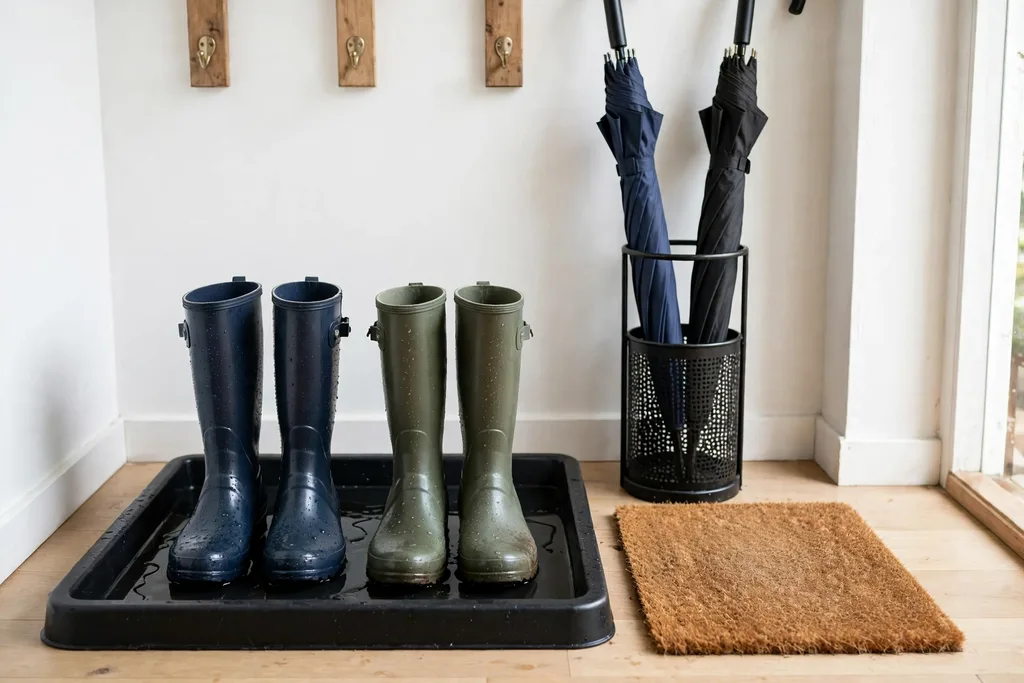
- The tray: a boot tray 30 to 36 inches long with a raised lip of 1 to 2 inches, at least 2 inches wider than the shoes on it. The lip is the whole point: it holds the water instead of letting it run onto the floor. One tray holds two pairs of adult boots; a family needs two trays side by side, or one long tray and a strict one-pair-per-person rule. Empty the tray when it fills, a tray full of water is a puddle with edges.
- The two-mat system: one scraper mat outside the door, one absorbent mat inside. Research from the University of Georgia Extension puts 30 to 40 percent of indoor dirt as coming in from outdoors on shoes, and two mats catch far more of it than one. The inside mat is the 24 by 36 inch one from the numbers section, low pile, under 1/2 inch, so the door clears it. Shake both mats weekly; wash the inside one monthly. Two mats are one of the simplest small entryway storage ideas for keeping dirt out of the house.
- The dry-first rule: wet boots sleep on the tray overnight and go into the cabinet only when dry. Never store damp shoes sealed in a closed cabinet or a box, damp plus dark plus closed equals smell, and the smell gets into every other pair. Tall boots stay upright, always; clip hangers are the best way to keep knee-high boots standing, and they cost less than a boot tray.
- Umbrellas: an umbrella bin 8 inches wide beside the door, or one hook on the rail for a folding umbrella. Wet umbrellas drip, so the bin sits on the tray or on a waterproof mat, never directly on wood floor. One bin, one place: umbrellas leaning in three corners of the hall are the wet-season version of the shoe pile.
What to watch: the seasonal swap. Twice a year, the entry changes: winter coats and boots in, summer sandals and light jackets out, a ten-minute seasonal reset for the entry itself. Off-season shoes go to under-bed bins, off-season coats to the closet. The entry holds the current season only. Skip the swap and the entry slowly fills with things nobody is wearing, which is the same failure as the shoe pile, just slower. Small entryway storage ideas change with the season, so swap the entry twice a year.
Small entryway storage ideas under $150
Best for: the whole system, one table, one total, no surprises.
No other entryway guide totals the whole system, so here it is. Six pieces, one wall run, everything in this article, and the total stays under $150 with room to spare. Prices are typical ranges for basic, non-branded pieces; secondhand and sale prices run lower. These small entryway storage ideas stay under $150 because every piece earns its place on the wall.
| Piece | What to buy | Price |
|---|---|---|
| Key tray | Ceramic or wood tray, about 6 by 9 in | $8–$12 |
| Hook rail | Wooden rail, 5 hooks, 24–36 in long | $12–$18 |
| Slim shoe cabinet | 2-tier flip-front, 7–10 in deep, 8–12 pairs | $35–$55 |
| Boot tray | Rubber tray, 30–36 in long, 1–2 in lip | $10–$15 |
| Doormat | Coir or woven mat, 24 by 36 in, low pile | $12–$18 |
| Small basket | Woven basket for gloves, dog gear, overflow | $8–$12 |
| Total | The whole entryway | $85–$130 |
The cheapest path is $38–$53: key tray ($8), adhesive hooks ($8), boot tray ($10), and doormat ($12), $38, plus a $15–$25 two-tier shoe rack if you do not already own one. That path skips the cabinet and the rail, and it still fixes the three daily problems: keys have a home, shoes have a spot, and the floor stays dry. Add the cabinet and rail later, in the order below, when the budget allows.
If you already own a mat, a tray, or a basket, subtract it from the total, the $85–$130 figure assumes you are starting from nothing. And the bench is not in this table on purpose: a bench is a $35–$50 extra that only earns its place in a hall 48 inches wide or more. Buy it last, if at all.
Buy in this order
Best for: your wallet, what to buy first, what it costs, and what the running total is.
Do not buy everything at once. Buy in this order, one piece at a time, and stop whenever the entry works, most entries work after step three. Small entryway storage ideas work best bought in this order, one piece at a time.
| Step | Buy | Cost | Running total |
|---|---|---|---|
| 1 | Key tray | $8–$12 | $8–$12 |
| 2 | Slim shoe cabinet | $35–$55 | $43–$67 |
| 3 | Hook rail (5 hooks) | $12–$18 | $55–$85 |
| 4 | Boot tray + doormat | $22–$33 | $77–$118 |
| 5 | Small basket | $8–$12 | $85–$130 |
Step 1, the key tray, is the cheapest fix in the whole guide and the one that changes daily life most. Lost keys cost time every single morning; a tray ends that on day one for eight dollars. Buy it first, even if you buy nothing else this month.
Step 2, the shoe cabinet, is the biggest single purchase and the one that clears the floor. Shoes are the visible mess, and the cabinet is what makes the hall walkable again. If the budget is tight, a $15–$25 open two-tier rack does the same job for now, upgrade to the closed cabinet later.
Step 3, the hook rail, ends the coat-on-the-chair habit. By now the floor is clear and the keys are found; the rail finishes the wall. Screw it into studs or proper anchors, this is the one piece worth two screws, because it carries the heaviest daily load.
Step 4, tray and mat, is the wet-season insurance. Buy them before the rain starts, not after the floor is already marked. Together they cost less than refinishing one scratched patch of floor.
Step 5, the basket, is optional. It holds gloves, the dog gear, and the overflow that has nowhere else to go. If the entry works without it, skip it and keep the $8–$12.
5 mistakes to avoid
Best for: everyone who has already bought the wrong thing once.
- A bench or console deeper than 12 to 14 inches. The deepest piece sets the walkway, and a 16-inch console in a 42-inch hall leaves 26 inches to walk through. Measure the hall, subtract the depth, and keep 30 inches clear, or do not buy the piece. Measuring first is the first of these small entryway storage ideas, and the one most people skip.
- Every pair of shoes at the door. The entry holds the daily set, 2 pairs per person. The rest lives in the closet or under the bed. A cabinet stuffed with off-season shoes has no room for today’s pair, and today’s pair ends up on the floor beside it.
- Hooks without studs or anchors, or adhesive hooks carrying coats. A hook in bare drywall pulls out under a wet winter coat, and an adhesive hook does the same in the night, taking paint with it. Heavy things need studs, anchors, or freestanding furniture. Light things, keys, a leash, are all adhesive hooks should ever hold.
- Skipping the mat and the boot tray. No mat means dirt walks straight in; no tray means wet boots drip onto the floor. The two cheapest pieces in the system protect the most expensive thing in the room, the floor itself.
- No landing spot for keys and mail. Keys without a tray land in five places: the kitchen counter, the coat pocket, the bag, the bench, the floor. One tray, one spot, every time, the habit only forms when there is exactly one right place.
FAQ
What is the best storage for a small entryway?
One wall run that does all three jobs: a slim shoe cabinet (7 to 10 inches deep) low, a key tray at 48 to 54 inches, and coat hooks at 60 to 66 inches. Closed storage hides the mess; open storage is faster. In a small entry, closed wins, the cabinet is the first thing guests see.
How do you store shoes in a small entryway?
Up, not out: a slim flip-front cabinet 7 to 10 inches deep holds 8 to 12 pairs inside 3 square feet of floor. Keep 2 pairs per person at the door and move the rest to the closet or under the bed. Wet shoes dry on the boot tray overnight first, never store damp shoes sealed in a closed cabinet.
How deep should entryway furniture be in a small space?
Under 14 inches, and 12 inches is the safe standard here. A shoe cabinet should be 7 to 10 inches deep, a bench 10 to 14 inches, a console 10 to 14 inches. Whatever you buy, subtract its depth from the hall width, 30 inches of walkway must be left.
How high should entryway hooks be?
60 to 66 inches for adults, with a second row at 40 to 48 inches for kids. Pegs every 6 to 8 inches, one hook per person plus one guest hook. A child who cannot reach their own hook will not use it.
How many shoes should stay in a tiny entry?
Two pairs per person. Everything else goes to the closet or under the bed. The cap is the rule that makes the cabinet work, when a new pair comes in, an old pair moves out to long-term storage.
Can renters build a mudroom corner without drilling?
Yes, the whole system has a no-drill version: an over-door hook rack for coats, adhesive hooks for keys only (1 to 3 lb per hook), a tension rod as a shoe rail, and freestanding shoe storage and bench for everything heavy. The one piece that usually needs screws is the floating key shelf; use a tray on the cabinet or a narrow console table instead.
What is the first purchase for an entry with no storage?
The key tray, $8 to $12, and it ends the lost-keys search on day one. Shoe storage comes second, the hook rail third, and the boot tray and mat fourth. The full order with running totals is in the “Buy in this order” section above.
Should entryway storage be open or closed?
Closed for shoes (a flip-front cabinet hides the mess and keeps dust off), open for coats and keys (hooks and a tray need to be fast). The 80/20 rule works well: about 80 percent closed, 20 percent open, the daily things visible, everything else behind a door.
How do I stop my entryway from becoming cluttered?
Give everything one fixed home and cap the volume: 2 pairs of shoes per person, current-season coats only, mail cleared weekly in a five-minute reset. That is small entryway organization ideas in one line: one home per thing, a cap on volume, and a weekly reset. Clutter is not a storage problem, it is a “too much stuff with no fixed spot” problem, and the fix is the cap, not a bigger cabinet. Small entryway storage ideas cap the volume first and buy storage second.
How can I add storage to a narrow hallway?
Go wall-only: hooks at 60 to 66 inches, a key shelf at 48 to 54 inches, and a mirror to widen the space. On the floor, only a low-pile mat and a boot tray, and a slim cabinet no deeper than 7 inches, only if the hall is at least 37 inches wide. Under that, shoes go on an over-door organizer or a wall rail.
What does a small entryway storage setup cost?
The whole system in this guide is $85 to $130: key tray, hook rail, slim shoe cabinet, boot tray, doormat, and a basket. The cheapest path, tray, adhesive hooks, boot tray, and mat, is $38 to $53. The bench is extra and optional.
Start today
Small entryway storage ideas work when the system is small enough to build in an afternoon and strict enough to keep. Start with the tape measure, not the shopping cart: door swing, hall width, wall width. Then buy the key tray, eight dollars, one screw-free fix, and tomorrow morning starts differently. That first tray is the smallest of these small entryway storage ideas, and the one that changes mornings fastest.
The shoes, the coats, and the keys each get one home on one wall, in 3 square feet. That is the whole system. Build the wall, keep the caps, and the entryway stops being the messiest 3 square feet in the house.