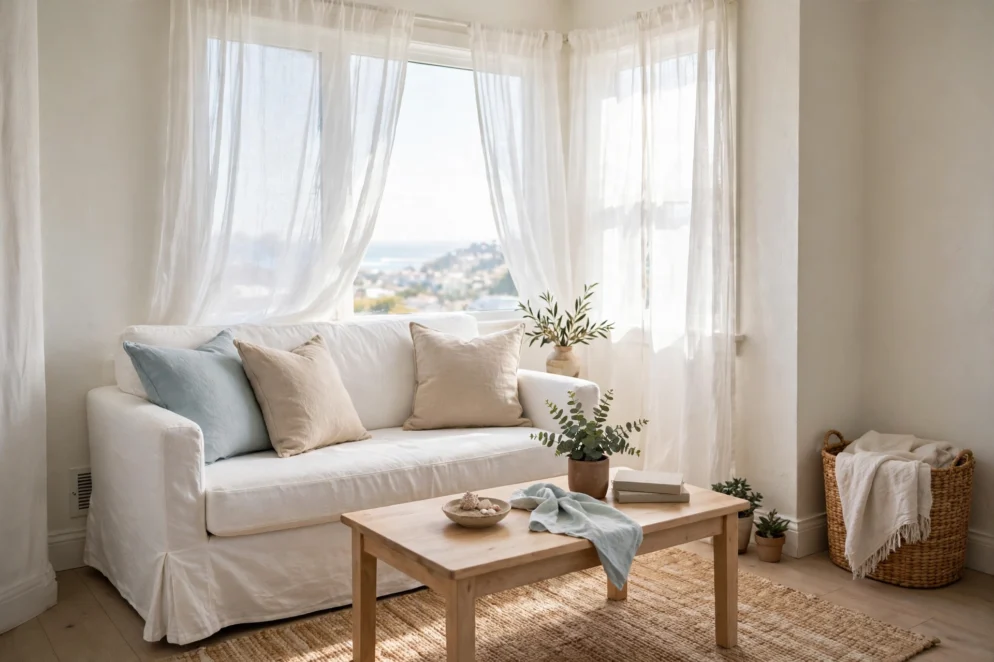
Small living room bar ideas do not start with a built-in bar. They start with a cart, a console, or a corner, one piece of furniture, a tray, and a few glasses, because a small living room has no floor space to waste on a bar that only gets used on Friday night. The best small bar earns its footprint every day: coffee in the morning, water and mocktails in the afternoon, cocktails when friends come over.
This guide gives you 8 small living room bar ideas with exact measurements: how wide the cart should be, how much wall it needs, how tall the bottles are, how much clearance the walkway needs, and what the whole setup costs. Every idea is renter-friendly, freestanding first, nothing drilled, and the whole bar comes in under $150.
Table of Contents
The numbers first
Best for: every idea in this guide, measure the wall before you buy anything. Small living room bar ideas all start here, with the wall measured before anything is bought.
Seven numbers decide whether a small living room bar works in a small room:
- Bar cart size: a standard small bar cart is 24 to 30 inches wide and 12 to 16 inches deep, and it needs a 3-foot wall section to sit against. Anything wider than 30 inches stops being a cart and starts being furniture.
- Bottle height: a liquor bottle is 11 to 13 inches tall, and some specialty spirits reach 15 inches. A wine bottle is about 12 inches tall. If the shelf above the bottles is closer than 14 inches, you cannot lift a bottle out.
- Shelf spacing: shelves for bottles need 14 to 16 inches of vertical space. Shelves for glasses only need 8 to 10 inches, most cart tiers give you only 8 to 10 inches of usable height, which is why bottles go on top and glasses go below.
- Counter vs bar height: a counter-height surface is 36 inches; a bar-height surface is 42 inches. Counter stools are 24 to 26 inches; bar stools are 30 to 32 inches. A cart is neither, it is a serving station, and it needs no stool at all.
- Walkway: leave 36 inches of clear walkway in front of a bar. In a tight standing-only nook, 18 to 24 inches is the minimum, less than that and nobody can stand at the bar and pour.
- Corner minimum: a basic corner bar needs about 2 feet by 2 feet of floor space. Smaller than that, and the corner fits a tray table, not a bar.
- Sofa arm height: sofa arms are 24 to 26 inches high. A cart parked at the end of the sofa works as a side table only if its top sits within 2 to 3 inches of the arm height, otherwise every glass is a reach up or a reach down.
Measure the wall section, the walkway, and the sofa arm before you buy anything. The best bar in a small room is the one that fits the wall it was measured for. That check is what makes small living room bar ideas fit instead of crowding the room.
What is a dry bar?
What is a dry bar? A dry bar is a bar with no sink and no plumbing, a cart, a console, or a cabinet with bottles, glasses, and tools, and nothing connected to a water line. A wet bar has a small sink, which means a plumber, a water supply, and a drain. In a rental, the answer is almost always a dry bar. That is why small living room bar ideas start with a dry bar, not with plumbing.
Is a wet bar better than a dry bar? Not in a small living room. A wet bar needs a 15 to 18 inch sink, a water connection, and a counter deep enough to hold it, and it turns a movable piece of furniture into a permanent fixture. A dry bar does everything a wet bar does except rinse a glass, and a dry bar moves with you when you leave. The only thing a dry bar needs is a small tray for drips and a habit of carrying used glasses to the kitchen. For small living room bar ideas, a wet bar is the exception, not the starting point.
Is plumbing necessary for a living room bar? No. Every idea in this guide is a dry bar. If you want running water near the bar, keep a small carafe of water on the tray, it is the oldest bar trick there is, and it costs nothing. That is the point of these small living room bar ideas: no plumber, no permit, no permanent fixture.
For the same low-cost, renter-first approach across the whole room, one clear focal point, everything under $150, see Small Living Room Decor on a Budget.
1. The bar cart
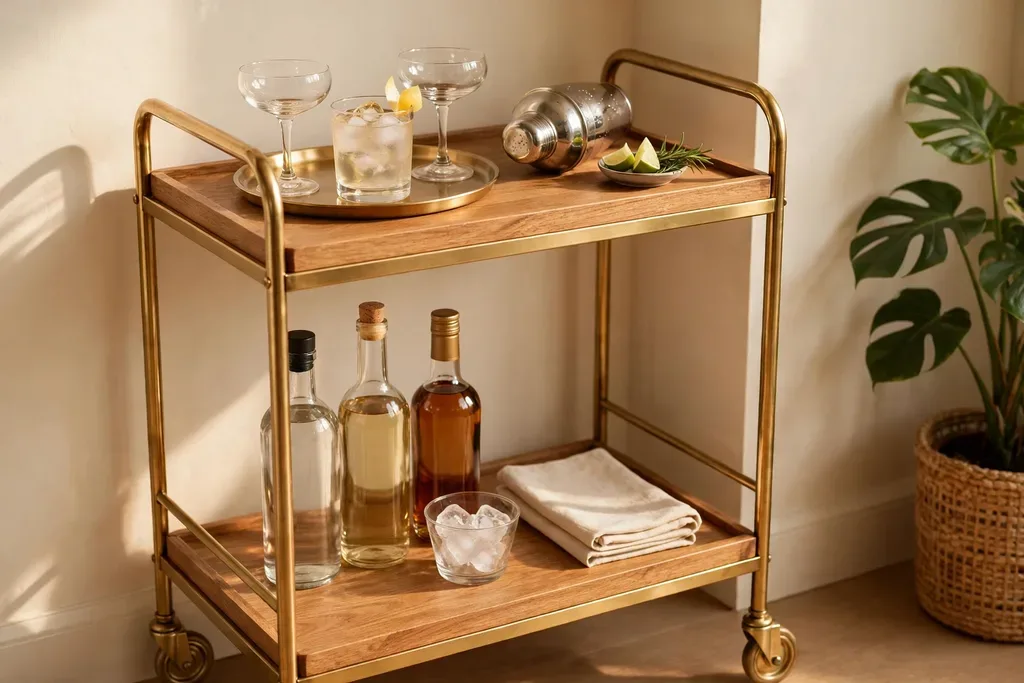
Best for: the classic small bar, one piece of furniture, zero installation, moves anywhere. That is why the cart is the classic choice in small living room bar ideas.
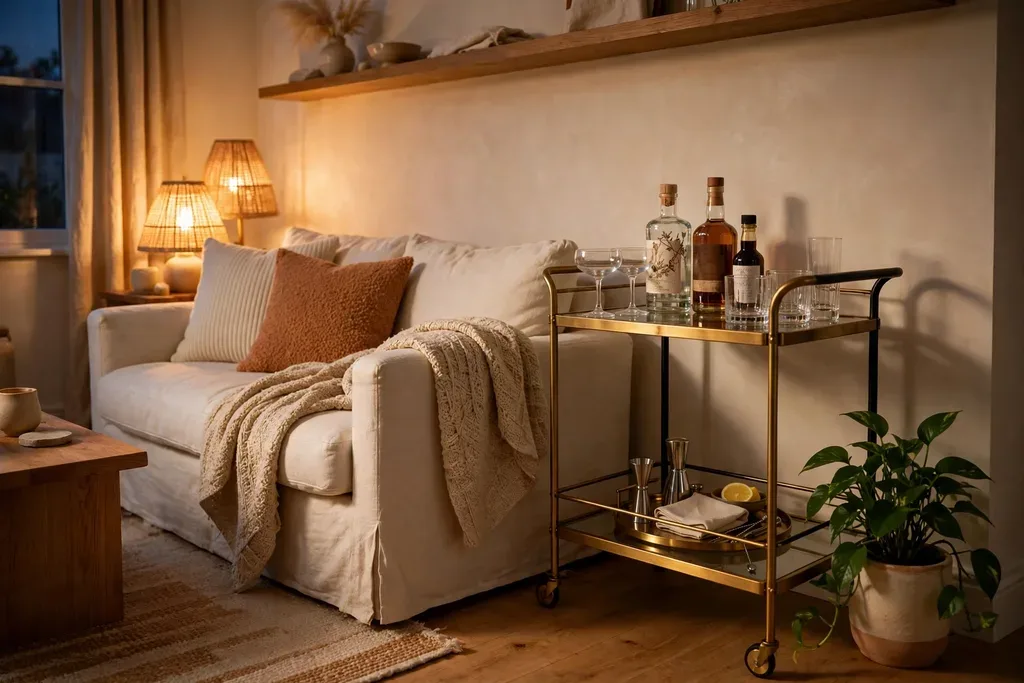
A bar cart is the easiest small living room bar there is, and it is the one most competitors recommend for a reason: it is freestanding, it rolls, and it holds everything. A two-tier cart 24 to 30 inches wide and 12 to 16 inches deep fits a 3-foot wall section, tucks into a corner, or parks at the end of the sofa, and when the party is over, it rolls back against the wall. It is the simplest of these small living room bar ideas for a first bar. For styling ideas, see Pottery Barn’s bar-cart setup guide.
- Size: buy the cart to fit the wall, not the other way around. Measure the wall section first: you need 36 inches of clear wall for a standard cart, and 36 inches of walkway in front of it. A cart wider than 30 inches in a 10-foot room eats the walkway.
- Tiers: the top tier is the work surface, bottles you reach for, the shaker, the tray. The bottom tier is storage, backup bottles, extra glasses, the ice bucket. Most cart tiers give you only 8 to 10 inches of usable height, so bottles (11 to 13 inches) go on top, never underneath. If a bottle does not fit under the top shelf, it lives on top of the cart, not squeezed below.
- Wheels: buy a cart with locking casters, and lock at least 2 wheels, or swap the casters for stationary rubber feet. A cart that rolls every time someone leans on it will spill a drink within a month, and on a hard floor it will drift across the room on its own.
- What to watch: do not overfill the cart. A cart with ten bottles, eight glasses, a plant, a candle, and a stack of books is not a bar, it is a shelf that happens to have wheels. Six bottles, four to six glasses, one tray, one tool set. Everything else lives in the kitchen cabinet.
Budget: a simple cart costs under $100 new, and $30 to $50 secondhand, thrift stores and marketplace listings are full of them, because a bar cart is the first thing people sell when they move. A cart is the whole bar: once you own it, the rest is glasses and a tray. That price is why small living room bar ideas often start with a secondhand cart.
2. Console-table bar
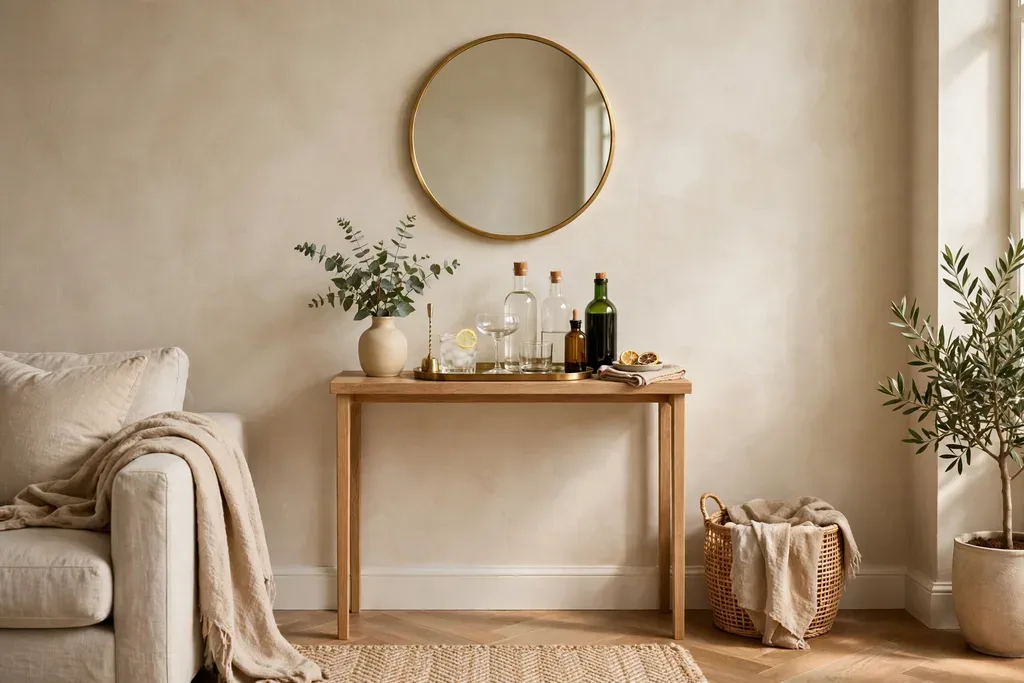
Best for: the bar that looks like furniture, not like a bar, a console against the wall, styled with a tray. That look is why the console is a quiet favourite among small living room bar ideas.
A console table is the most grown-up living room bar idea in this guide, and the most renter-friendly after the cart: it is a piece of furniture you already own, or can buy secondhand, and it needs no holes in the wall. A console at least 30 inches high and 12 inches deep holds a tray, four to six bottles, and a row of glasses, and with a mirror above it, the whole wall looks designed. Among small living room bar ideas, the console is the one that looks most like ordinary furniture.
- Size: the console should be 30 to 36 inches wide for a small wall, and no deeper than 12 inches, deeper than that and it pushes into the walkway. The top is the work surface; the shelf below holds backup bottles and the ice bucket.
- The tray: one tray does three jobs, it catches drips, it groups the bottles into one visual unit, and it makes the whole bar portable. Pick a tray 10 to 12 inches wide, about one-third of the console’s length. A tray that covers the whole console looks like a placemat; a tray that is too small looks lost.
- The mirror: a round mirror 20 to 24 inches wide above the console doubles the light and tells the eye this wall is finished. Lean it, leaning needs no hook and no hole, or hang it from one removable hook rated for twice its weight.
- What to watch: do not put the console where the walkway is. A console bar belongs on a wall nobody walks past, behind the sofa, on the short wall, or beside the fireplace. On a traffic wall, every guest will brush past the bottles.
Budget: a secondhand console costs $30 to $60. A tray costs $8 to $12. A round mirror costs $20 to $30 secondhand. The console bar is the cheapest bar that looks expensive, because the furniture does the work, not the bottles. That is why small living room bar ideas like the console stay cheap and look expensive.
3. Corner bar
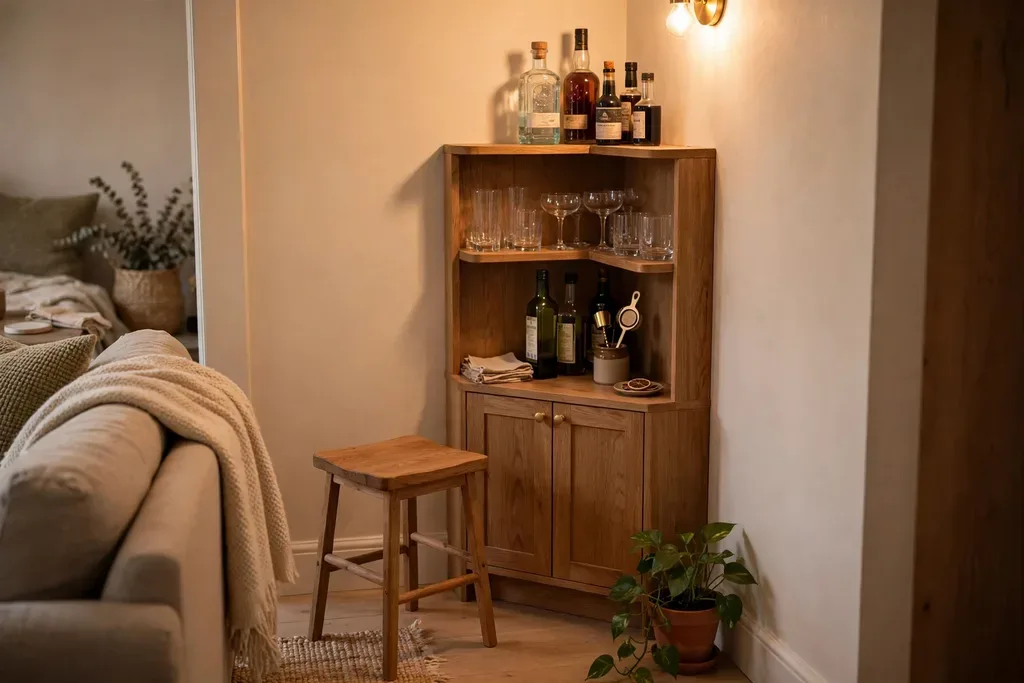
Best for: the dead corner, the 2-by-2-foot spot that holds nothing else.
Every small living room has a dead corner: the spot beside the sofa, behind the door swing, or next to the fireplace where nothing fits. A corner bar is the answer to that corner, and it is the smallest real bar in this guide, a basic corner bar needs only about 2 feet by 2 feet of floor space. That dead corner is where small living room bar ideas earn their floor space.
- Size: the corner takes a small corner cabinet, a two-tier corner shelf, or a cart turned at 45 degrees. A corner cabinet 24 inches wide on each wall fits the 2-by-2-foot minimum; a cart turned diagonally needs the same footprint plus 18 to 24 inches of standing room in front of it.
- Shelves: a corner shelf unit with 14 to 16 inches between shelves holds bottles upright; glasses go on the lower shelf, where the 8 to 10 inch tier height is enough. If the corner is dark, add a battery puck light under the top shelf, rechargeable, no wiring, and it makes the bottles glow.
- Stool: one stool, not two. A corner bar seats one person at a time, a stool 24 to 26 inches high for a counter-height corner, or a small backless stool that tucks under the cabinet when nobody is sitting. Two stools in a 2-foot corner means nobody can get in or out.
- What to watch: do not put the corner bar in the corner behind the door. A bar behind a door swing gets hit every time someone walks in, and a bottle on a shelf behind a door is a spill waiting to happen. The corner beside the sofa or beside the fireplace is the right corner; the corner behind the door is not a bar, it is a hazard.
Budget: a small corner cabinet costs $40 to $70 secondhand. A two-tier corner shelf costs $20 to $35. A puck light costs $8 to $12 for a set. The corner bar is the cheapest square footage in the room, because the floor space was already wasted. Small living room bar ideas like this one cost little because the floor space was already wasted.
4. Bookshelf and cabinet bar
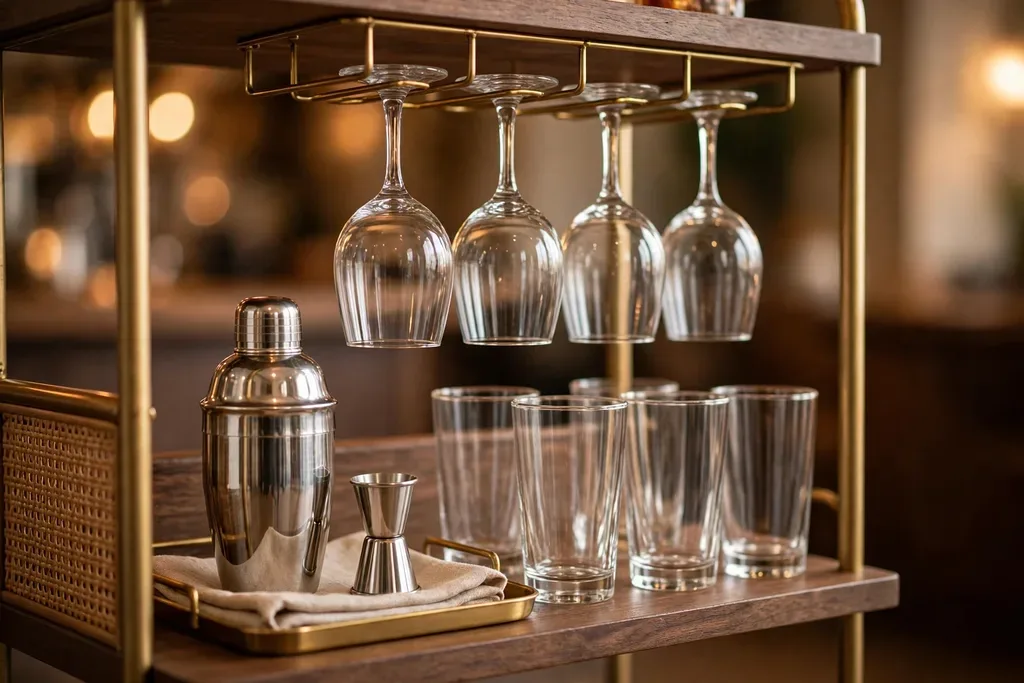
Best for: the hidden bar, everything behind a door, nothing on display until you open it.
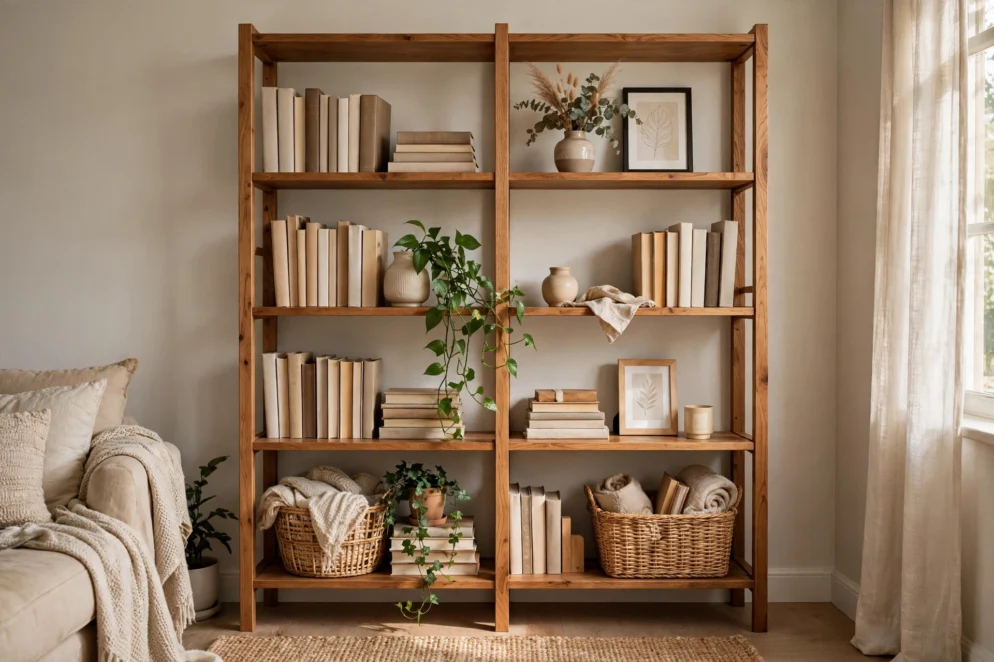
A bookshelf or a cabinet with doors is the bar for people who do not want a bar on display. Close the doors and it is a bookshelf; open them and it is a bar. A bookcase 24 to 30 inches wide with shelves 14 to 16 inches apart holds bottles upright on one shelf and glasses on the next, and the doors keep dust off everything. For hidden storage, small living room bar ideas like a bookshelf bar keep everything out of sight.
- Size: a standard bookcase shelf is 10 to 12 inches deep, deep enough for a bottle (3 to 4 inches in diameter) with room in front for a row of glasses. A cabinet 12 to 15 inches deep works the same way. If the shelves are fixed, check the spacing before you buy: bottles need 14 inches of clearance, and most bookcases give you 10 to 12 inches between fixed shelves.
- Glassware: organize glasses by height, tallest at the back. Wine glasses hang upside down from an under-shelf rack if the shelf above has 8 to 10 inches of clearance; tumblers stand in a row below. One shelf of glasses is enough, four wine glasses and four tumblers cover every drink this bar makes.
- The door trick: if the cabinet has doors, hang a small rail or a row of hooks inside the door for the bottle opener, the jigger, and the stirrers. The tools live inside the door, the bottles live on the shelves, and nothing is on the counter.
- What to watch: do not overload a bookshelf bar. Liquor is heavy, one litre weighs more than 2 pounds, and ten bottles plus glassware easily pass 30 pounds. A bookcase shelf rated for books can hold it, but a thin particle-board shelf will sag within a year. Put the bottles on the lowest shelf, where the weight sits closest to the floor, and keep the top shelf for glasses only.
Budget: a secondhand bookcase costs $25 to $50. An under-shelf glass rack costs $8 to $12. A cabinet with doors costs $40 to $80 secondhand. The bookshelf bar is the bar for small rooms that already own a bookshelf, because the furniture is already there. Small living room bar ideas that reuse furniture you already own are the cheapest of all.
5. Coffee bar by day, cocktail bar by night
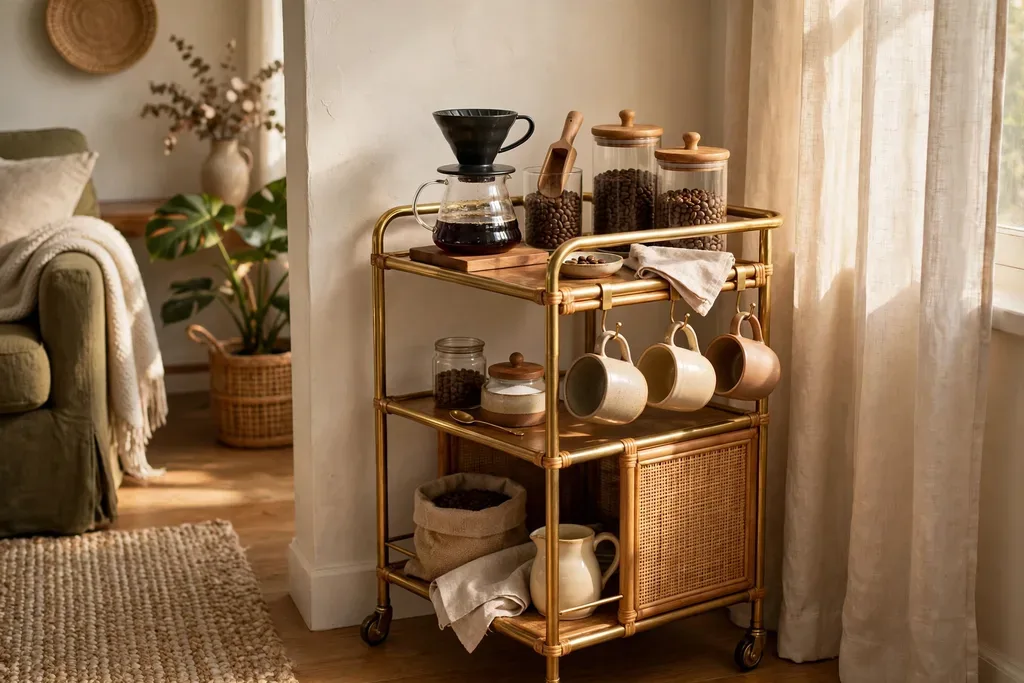
Best for: the bar that earns its footprint twice a day, coffee in the morning, cocktails at night.
This is the idea no competitor covers, and it is the reason a small bar belongs in a living room instead of a kitchen: the same cart that holds bottles at night holds the coffee maker in the morning. A cart 24 to 30 inches wide and 12 to 16 inches deep is exactly the right size for a coffee station, start with 18 inches of counter, which is enough for one machine, a canister, and a mug. Small living room bar ideas that work twice a day, like this coffee bar, earn their footprint.
- The swap: morning setup is the coffee maker, two mugs, a canister of beans, and a small milk jug. Evening setup is the same cart with the coffee maker pushed to the back, the mugs swapped for glasses, and the bottles brought forward. The swap takes two minutes, and the cart never moves.
- Size: a coffee cart needs a 30 to 32 inch high surface, standard cart height, and a depth of 16 inches or less, so the machine sits close to the wall and the mugs sit within reach. A slim coffee cart 11 to 12 inches wide fits a gap as narrow as a foot; a narrow shelf stack fits 18 inches of wall space.
- Shelves above: one or two small shelves above the machine hold mugs on hooks and canisters in a row. The shelves need 14 to 16 inches of vertical spacing, enough for a mug (4 to 5 inches tall) plus room to lift it off the hook, and they should be 8 to 10 inches deep, no deeper, or they shadow the machine.
- What to watch: steam. A coffee maker needs 6 to 8 inches of clearance above it for steam, or the shelf above will warp and the paint will peel. And keep the coffee setup away from the liquor bottles, coffee grounds in a cocktail glass are a mistake nobody makes twice.
Budget: a coffee maker you already own costs nothing to move. Two ceramic mugs cost $8 to $12. A glass canister costs $5 to $10. The coffee bar is free if the cart is already there, it is the same furniture, used twice. That makes it one of the cheapest small living room bar ideas in this guide.
6. Sideboard and credenza bar
Best for: the bar with storage, bottles, glasses, and the board games, all in one piece.
A sideboard or credenza is the biggest bar in this guide, and the only one with real storage: a sideboard 48 to 60 inches wide and 15 to 18 inches deep holds a full bar on top and a full cabinet below. In a small living room it works only on the longest wall, and only if the room can spare the 36 inches of walkway in front of it. That size is what makes small living room bar ideas like a sideboard need the longest wall.
- Size: the top is the bar, a tray, six to eight bottles, and a row of glasses. The cabinet below holds backup bottles, extra glassware, and the things that do not belong on display. A sideboard deeper than 18 inches pushes into the walkway; a sideboard shorter than 48 inches does not hold enough to justify the floor space.
- The top rule: one tray, one row of bottles, one row of glasses, and nothing else. A sideboard top is wide enough to collect clutter, and clutter is what turns a bar into a dumping ground. If it does not pour, measure, or hold a drink, it does not live on the sideboard.
- What to watch: a sideboard bar fails when it is too tall to reach over or too deep to reach across. The top should sit at 30 to 36 inches, counter height, so you can pour standing up without leaning. Higher than that, and every pour is a stretch; deeper than 18 inches, and the back row of bottles is out of reach.
Budget: a secondhand sideboard costs $50 to $100, the most expensive piece in this guide, and the only one that replaces another piece of furniture. If the room already needs storage, the sideboard bar is two purchases in one; if it does not, the cart is the better buy. Small living room bar ideas at this price still beat a built-in bar by thousands.
7. Tray-table mini bar
Best for: the smallest bar possible, one tray, one table, no furniture bought at all.
A tray-table mini bar is the bar for a room with no wall space left: a folding tray table 18 to 20 inches wide and 14 to 15 inches deep, a tray on top, two bottles, two glasses, and the bottle opener. It sets up in a minute, folds away after, and lives in a closet between uses. Small living room bar ideas do not get smaller than a tray table and a tray.
- Size: the tray table should be 24 to 26 inches high, side-table height, so it sits beside the sofa at arm level. A table taller than that is a podium; a table shorter than that is a footstool with bottles on it.
- The tray: the tray is the bar. One tray 12 to 14 inches wide holds two bottles, two glasses, and the opener, and it keeps drips off the table and the rug. When the evening is over, the tray carries everything back to the kitchen in one trip.
- What to watch: a tray table is light, and a light table with bottles on it tips. Put the heaviest bottle at the back, against the wall side, and never put the tray table where someone walks past it in the dark. A tray-table bar belongs beside the sofa, not in the walkway.
Budget: a folding tray table costs $15 to $25 secondhand, or nothing if you already own one. A tray costs $8 to $12. The tray-table bar is the cheapest bar in this guide, and the honest answer for a room that has no space for furniture at all. For a room with no wall space, small living room bar ideas like this one are the cheapest way in.
8. The non-alcoholic bar
Best for: the bar everyone can use, mocktails, sodas, and sparkling water, no liquor at all.
A non-alcoholic bar is not a smaller version of a cocktail bar. It is a different bar, and in a small living room it is often the better one: no expensive bottles, nothing that spoils in the sun, and every guest can drink from it. A mocktail bar needs the same cart, the same tray, and the same glasses, and half the budget, because the bottles cost $5 to $10 each instead of $25 to $40. Small living room bar ideas are not only for cocktails; this one is for everyone.
- What goes on it: sparkling water, tonic, ginger beer, two or three syrups, fresh citrus, and a jar of mint. Four glasses, a shaker, and a jigger, the same tools as a cocktail bar, because a mocktail is a cocktail without the alcohol, not a glass of juice.
- Size: the same cart, 24 to 30 inches wide, holds a non-alcoholic bar easily, the bottles are smaller and lighter, so the top tier holds more of them. A non-alcoholic bar also skips the weight problem: a litre of syrup weighs less than a litre of spirits, and the shelf never sags.
- What to watch: do not call it a “kids’ bar” or a “temporary bar.” A non-alcoholic bar is a bar. Style it the same way, one tray, one row of bottles, one row of glasses, and guests will use it the same way.
Budget: four syrups and mixers cost $20 to $30. Four glasses cost $10 to $15. The tray and the cart are the same as any other bar. The non-alcoholic bar is the cheapest bar to stock and the easiest bar to keep stocked, because nothing in it goes stale in a month. Small living room bar ideas like this one are also the cheapest to stock, with syrups instead of liquor.
Small living room layout: the bar wall
Best for: the whole room, where the bar sits in a 10 by 12 foot living room.
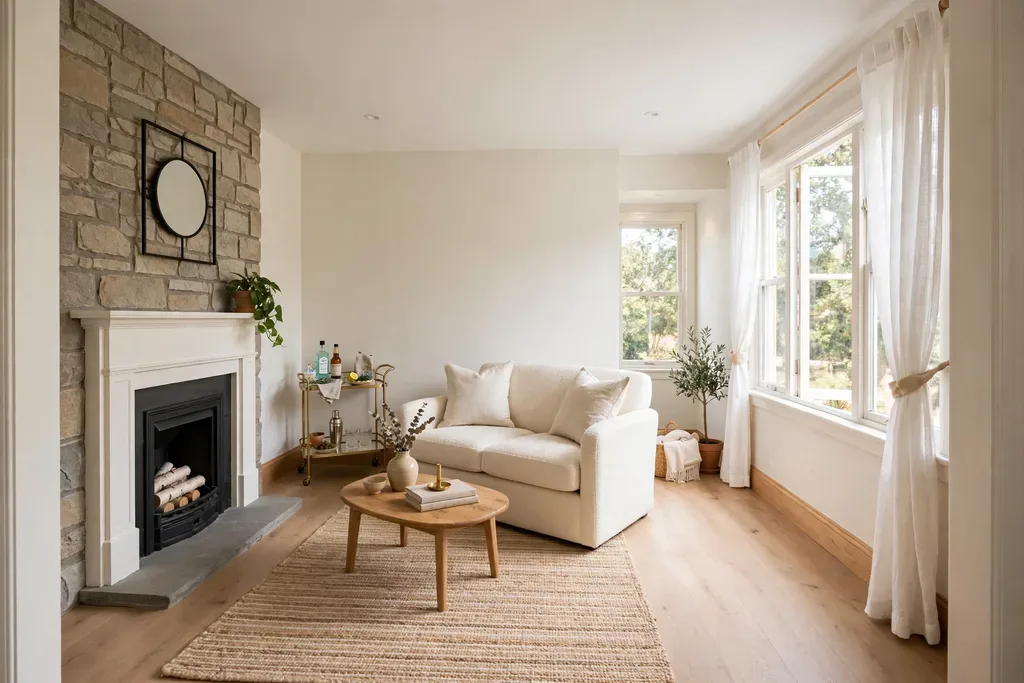
A bar in a small living room competes with the sofa, the TV, and the walking route, and the layout has to solve that conflict before anything is bought. The room is 10 by 12 feet: the sofa goes on the long wall, the TV goes opposite it, and the bar goes where neither of them is. Small living room bar ideas work best when the layout gives the bar one clear wall.
- Sofa: a loveseat 52 to 58 inches wide on the 12-foot wall, 8 to 10 feet from the TV wall. A full three-seater crowds a 10-foot room and leaves no wall for the bar.
- Bar: the cart goes in the dead corner beside the sofa, or on the short wall opposite the door, never on the wall the TV is on, and never in the walkway between the door and the sofa. The cart needs its 3-foot wall section and 36 inches of walkway in front of it; in a 10-by-12 room, that means the corner, not the middle of a wall.
- Coffee table: a coffee table 36 to 42 inches long sits 14 to 18 inches from the sofa, with 30 inches of walking space around it. The bar cart is not a coffee table, it sits against the wall, and the coffee table sits in the middle.
- The fireplace wall: if the room has a fireplace, the mantel wall is the focal wall, and the bar does not fight it. The cart goes on the wall beside the fireplace, not in front of it, and the mantel keeps its mirror and its three heights. For how that wall is styled, see Fireplace Mantel Decor Ideas for a Small Living Room.
- What to watch: a small living room fails when the bar wall tries to do everything. One wall, one job: the bar wall holds the bar. The TV, the bookshelf, and the gallery wall belong on other walls, or the room has three focal points and none of them works.
How to decorate a small living room space with a bar in it comes down to this: one focal wall, one bar wall, and empty floor between them. The bar is a piece of furniture, not a room, it should read as one corner of the room, not as the room itself. Small living room bar ideas fail when the bar wall tries to do everything, so keep one wall, one job.
Renter-friendly rules
Most small living room bar ideas are renter-friendly by nature, a bar is furniture, not a fixture. The rules are simple, and they are all about what you do NOT do.
- Freestanding first: a cart, a console, a cabinet, a sideboard, every idea in this guide stands on the floor. Nothing in this guide needs a hole in the wall, and a freestanding bar moves with you when you leave. If a bar idea needs drilling, it is the wrong idea for a rental.
- Adhesive strips have a weight limit, respect it: removable strips are rated at 16 pounds per pair. Two pairs hold 32 pounds, enough for a small frame, a puck light, or a mug rail with two or three mugs. They are not enough for a shelf of liquor: one litre weighs more than 2 pounds, and ten bottles plus glassware easily pass 30 pounds. Bottles live on furniture, never on a strip-hung shelf.
- Strips only on smooth, cured paint: adhesive strips hold only on smooth walls with fully cured paint, at least 30 days after painting. They fail on textured walls, and they fail on fresh paint. Test one strip first, and give it 24 to 48 hours to cure before you hang anything on it. To remove, pull the tab straight down, slowly, and warm the strip with a hairdryer for 20 to 30 seconds first.
- No floating shelves with bottles: one competitor tells readers to anchor floating shelves into wall studs and never to trust drywall anchors. In a rental, that is the landlord’s wall, not yours, and a stud-anchored shelf is a permanent install. Our rule is simpler: if the shelf needs a stud, the bottles do not go on it. Bottles go on the cart, the console, or the cabinet, furniture that holds weight without asking the wall to.
- Plug-in, don’t hardwire: a plug-in lamp or a rechargeable puck light gives the bar its glow without an electrician. Hardwired sconces above a bar are a permanent install, they are the landlord’s decision, not yours.
- Removable wallpaper for the built-in look: if you want the bar wall to look built-in, put removable wallpaper on the wall behind the cart and add battery sconces that stick to the wall. The wallpaper comes down cleanly, the sconces come down cleanly, and the wall underneath is untouched.
- Lock the wheels: a cart with unlocked casters rolls every time someone leans on it. Lock at least 2 wheels, or swap the casters for stationary rubber feet. A rolling cart on a hard floor will drift across the room on its own, and a drifting cart with bottles on it is a spill waiting to happen.
Small living room bar under $150
Best for: the whole bar, every idea in this guide, added up.
| Item | Cost |
|---|---|
| Bar cart, two-tier (secondhand) | $30–$50 |
| Tray, 10–12 in | $8–$12 |
| 4 tumblers | $10–$15 |
| 2 wine glasses | $8–$12 |
| Shaker + jigger set | $10–$15 |
| Bottle opener | $3–$5 |
| Small plant | $8–$12 |
| Rechargeable puck lights (set) | $8–$12 |
| Total | $85–$133 |
That total covers the whole setup, cart, tray, glasses, tools, light, and a plant. Bottles are not in the table, and that is honest: bottles are consumables, not furniture, and they are stocked over time. A first bottle costs $10 to $15; a starter set of three costs $25 to $40, bought one at a time across three months. Nobody needs a full liquor cabinet on day one, a bar with three bottles and the right glasses pours better than a bar with fifteen bottles and no tray. Small living room bar ideas under $150 start with this list, not with a full liquor cabinet.
The free ideas: moving a cart you already own into the corner, using glasses you already own, and taking three things off the cart cost nothing, and they change the bar more than any purchase. A small bar starts with taking things away, not adding them. Small living room bar ideas can start free, by moving a cart you already own into the corner.
5 mistakes to avoid
1. Buying the cart before measuring. A cart that is too wide for its wall section blocks the walkway, and a cart that is too deep pushes into the room. Measure the wall first: you need 36 inches of clear wall and 36 inches of walkway in front of it. The most common small-bar mistake is a cart bought for the picture, not for the wall. Measuring first is the rule that keeps small living room bar ideas from blocking the walkway.
2. Overfilling the cart. Ten bottles, eight glasses, a plant, a candle, and a stack of books is not a bar, it is a shelf with wheels. Six bottles, four to six glasses, one tray, one tool set. Everything else lives in the kitchen cabinet, and the cart stays usable. Small living room bar ideas stay tidy only when the cart is not overfilled.
3. Heavy bottles on a weak shelf. Liquor is heavy, one litre weighs more than 2 pounds, and ten bottles plus glassware easily pass 30 pounds. A strip-hung shelf, a thin particle-board shelf, or a floating shelf with no stud behind it will sag or fall. Bottles go on furniture, on the lowest shelf, where the weight sits closest to the floor.
4. The wrong height against the sofa. A cart parked at the end of the sofa works as a side table only if its top sits within 2 to 3 inches of the sofa arm height (24 to 26 inches). A cart top six inches above the arm means every glass is a reach up; six inches below means every glass is a reach down. Measure the arm before you park the cart beside it.
5. Sun on the bottles. Direct sunlight spoils liquor, it fades the color, flattens the flavor, and heats the bottle. Never put the bar in the sunniest corner of the room, and never put it against a radiator or a heat vent. The shadiest corner is the best corner for a bar, and it is usually the corner nobody wanted for anything else.
FAQ
Can you put a bar in the living room?
Yes. A bar cart, a console, or a cabinet fits any living room with a 3-foot wall section to spare, and a dry bar needs no plumbing at all. The bar belongs on a wall nobody walks past, beside the sofa, on the short wall, or in a dead corner.
Where should a bar be placed in the living room?
In the dead corner beside the sofa, on the short wall opposite the door, or behind the sofa on the long wall. Never on the TV wall, never in the walkway between the door and the sofa, and never in the corner behind the door swing.
What is a good size for a living room bar?
A bar cart 24 to 30 inches wide and 12 to 16 inches deep is the standard small bar, and it needs a 3-foot wall section. A basic corner bar needs about 2 feet by 2 feet of floor space. Anything smaller than that fits a tray table, not a bar.
How do I create a home bar in a small space?
Start with one piece of furniture, a cart or a console, then add one tray, four to six glasses, and a basic tool set. Measure the wall first, keep the walkway 36 inches clear, and stock three bottles to start. A small bar is built in one afternoon, not one shopping trip.
What should I put in a basic home bar?
A sturdy surface, four to six glasses, a tray, a bottle opener, a shaker and a jigger, and three starter bottles. That is the whole list. Everything else, extra glassware, garnish tools, a second tray, is a second-round purchase, not a first-round one.
Is a wet bar better than a dry bar?
Not in a small living room, and not in a rental. A wet bar needs a sink, a water connection, and a plumber, and it turns movable furniture into a permanent fixture. A dry bar does everything except rinse a glass, and a small carafe of water on the tray covers that.
How much does a small living room bar cost?
A complete setup, cart, tray, glasses, tools, light, and a plant, costs $85 to $133 if the cart is secondhand. A simple cart alone costs under $100 new, and custom built-in bars run to $5,000 and beyond, which is exactly why a small bar should be furniture, not construction.
Can I have a home bar if I rent?
Absolutely. Use a freestanding bar cart or a console table, nothing drilled, nothing wired. For a built-in look, use removable wallpaper on the wall behind the cart and battery sconces that stick to the wall. Bottles live on the furniture, never on a strip-hung shelf, because ten bottles plus glassware easily pass 30 pounds.
How do I set up a coffee bar in a small apartment?
Choose one of three setups: a defined zone on your existing kitchen counter, a narrow bar cart in the living room, or a bare wall with one or two small shelves above a console. All three work without permanent changes, a freestanding cart, a narrow table, and removable adhesive strips for a mug rail are the renter-friendly options. Start with 18 inches of counter: enough for one machine, a canister, and a mug.
Start today
Small living room bar ideas do not need a shopping trip, they need a measurement and an edit. Measure one wall section, move a cart or a console into the corner, and put a tray with two glasses on it. That is the whole first round, and it takes an afternoon.
Start with the wall. The room will tell you what the bar needs next.