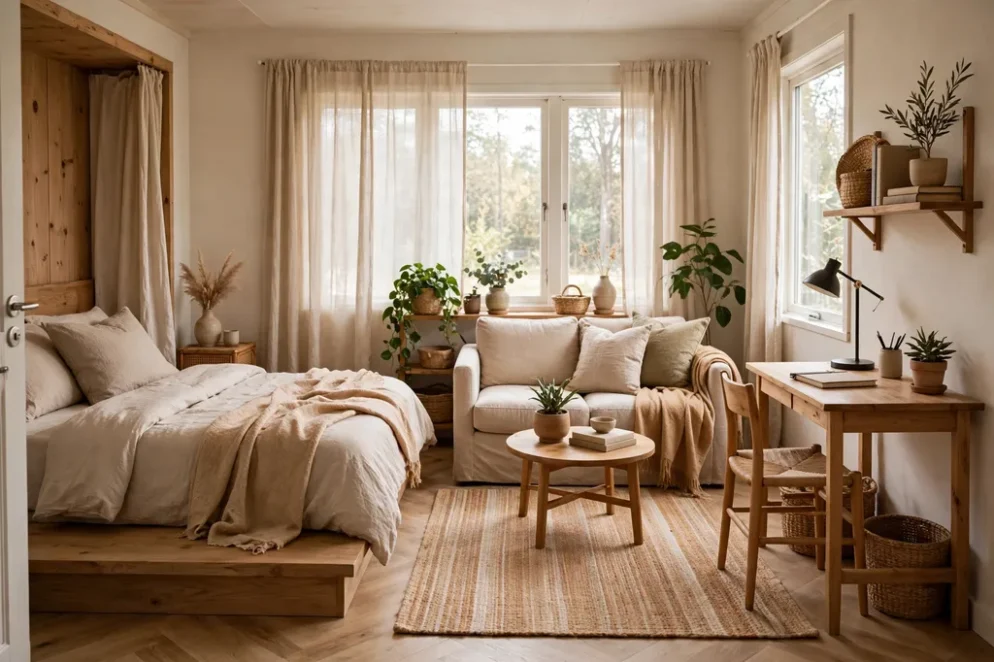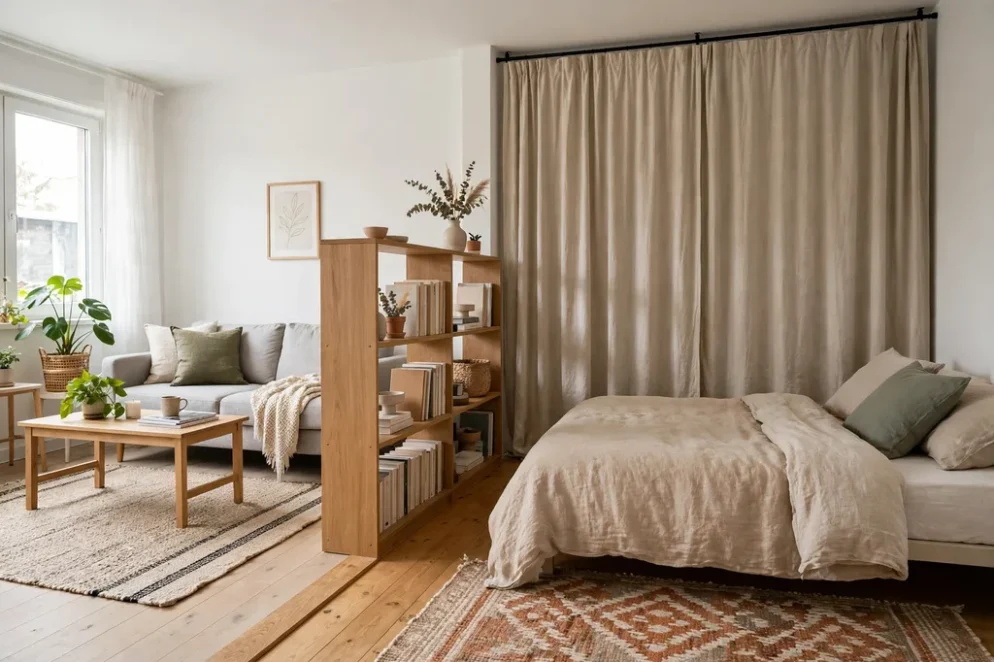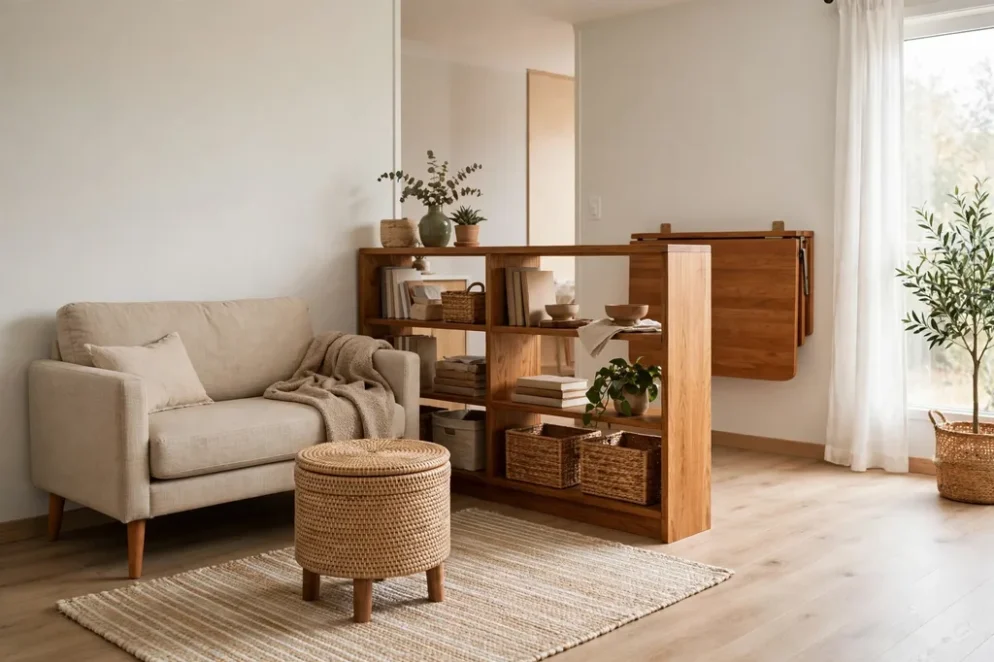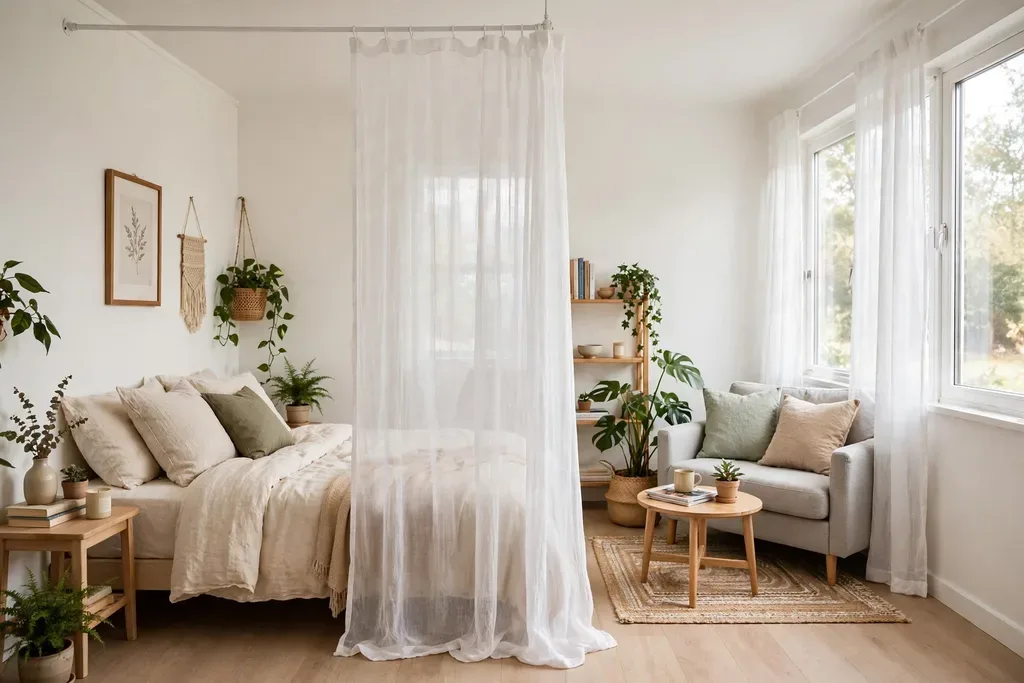
A studio apartment is one room doing three jobs, bedroom, living room, and often a workspace, and without a wall between them, the whole place can feel like one big bedroom. The right room divider ideas for studio apartments fix that without a renovation: a curtain on a tension rod, a low bookshelf, a folding screen, or a piece of furniture turned sideways. No drilling, no landlord permission, and the whole setup comes in under $150.
This guide gives you 7 studio apartment room divider ideas with exact measurements: how wide the divider should be, how tall, how much walkway to leave, and what it all costs. Every idea is renter-friendly, and every one of them comes apart on moving day. Every one of these room divider ideas for studio apartments includes the exact width, height, and walkway to leave, so you can measure once and buy once.
For the full room plan, where the bed goes first, how the zones sit together, see Studio Apartment Decorating Ideas.
Table of Contents
The numbers first
Best for: every idea in this guide, measure the room before you buy anything.
Six numbers decide whether a studio apartment divider works or just gets in the way: These six numbers are the first filter for any room divider ideas for studio apartments, because a divider that is too tall or too wide will fight the room every day.
- Walkway: leave 36 inches of clear walking space as the main path through the room. 30 inches is the minimum, below that, you will bump the divider every day.
- Divider height: a divider should stop 12 to 24 inches short of the ceiling. In an 8-foot (96-inch) ceiling, that means a divider 72 to 84 inches tall. Floor-to-ceiling solid dividers block light and air, that is the single most common divider mistake.
- Divider width: the divider should span the room minus the walkway. In a 12-foot-wide room (144 inches), a 108-inch divider leaves a 36-inch walkway at one end.
- Bed-zone depth: give the sleeping zone 7 to 8 feet of depth, enough for a queen bed (60 by 80 inches) plus a 24-inch lane beside it and a 20-inch nightstand.
- Shelf depth: a bookshelf divider should be 10 to 15 inches deep. Deeper than 15 inches eats floor space; shallower than 10 inches tips easily.
- Curtain drop: curtain fabric should stop about 1/2 inch above the floor, long enough to feel like a wall, short enough not to drag and trip you.
Measure the width, the ceiling height in three spots, and the walking route before you buy anything. The best divider in a small studio is the one you stop noticing after a week. That three-minute check is what makes room divider ideas for studio apartments work in a real room instead of only in a photo.
What is a room divider in a studio?
What is a room divider in a studio apartment? It is anything that marks where one zone ends and another begins, a physical screen, a curtain, a shelf, a sofa back, or even a rug and a light. It does not need to be a wall. In a studio, a divider has three jobs: give the bed privacy, mark the living zone, and keep the room feeling like one home instead of two cramped halves. Wikipedia’s overview of room dividers lists the main types — screens, curtains, shelves, plants, and rails — and the room divider ideas for studio apartments in this guide use all five.
Do I need a physical divider, or just visual separation? It depends on what bothers you. If you can see the bed from the sofa and it stops you relaxing, you need a physical divider, a curtain, a screen, or a shelf. If the room only feels undefined, visual separation is enough: a 5 by 8 foot rug under the living zone, a different light over the bed, a change of wall color behind the sofa. Most small studios need a bit of both.
The 7 ideas below start with the most private and end with the lightest. Pick the one that matches the problem you actually have.
1. Tension-rod curtain divider
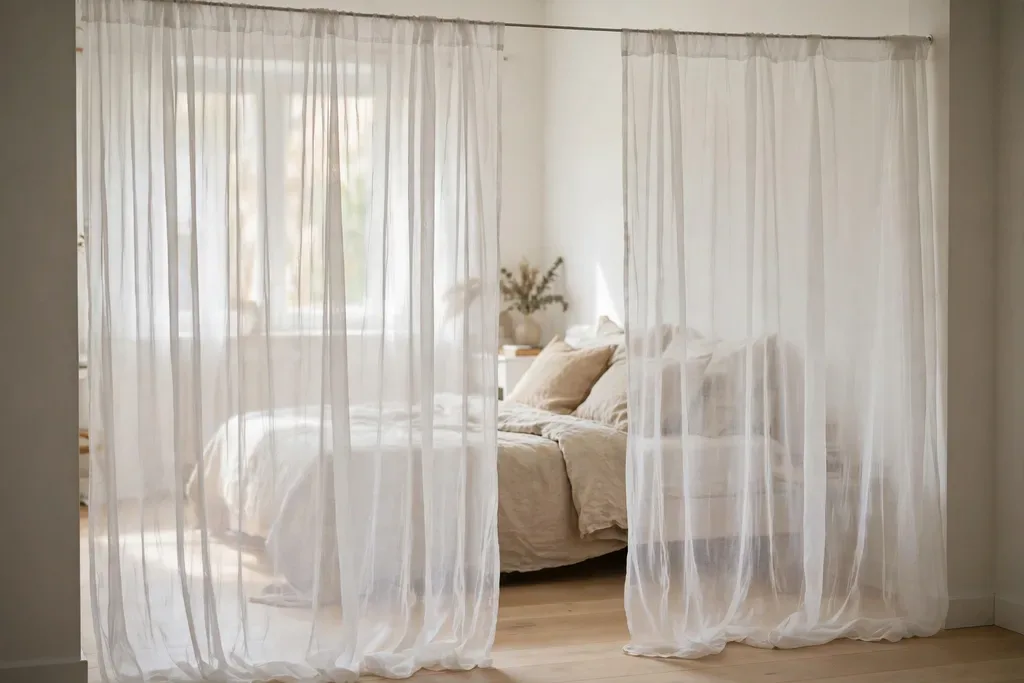
Best for: the most privacy for the least money, a curtain is the only divider that hides the bed completely and costs less than a dinner out. For privacy per dollar, few room divider ideas for studio apartments beat a curtain.
A tension rod wedged between two walls, with a pair of curtains on it, is the classic studio apartment room divider, and the most renter-friendly one there is. No holes, no hooks, no permission. The rod holds itself up by pressure, and the curtains come down in two minutes on moving day. It is also the easiest of the room divider ideas for studio apartments to remove when you move out.
- Rod: use a heavy-duty tension rod rated for up to 45 pounds. Check the rating on the pack, a rod rated for 8 feet of span used across a 10-foot gap can crack paint or peel drywall paper. Match the rod to your span.
- Height: mount the rod 84 inches high in an 8-foot ceiling, so the curtain stops 12 inches short of the ceiling and light and air still move over the top.
- Curtain size: for a 9-foot (108-inch) span, buy curtains at least 84 inches long and wide enough to cover the span with a little gather, two panels of 52 inches each is the usual fit. Fabric should stop about 1/2 inch above the floor.
- Fabric: semi-sheer fabric (3 to 5% openness) lets light through and still hides the bed shape. Blackout fabric (about 1% openness) gives full privacy but blocks light, use it only on the bed side, and keep the top gap open.
- What to watch: weigh the curtains before you hang them. A sheer pair weighs 1 to 2 pounds; a blackout pair weighs 4 to 6 pounds. Both are well under a 45-pound rod rating, but a heavy velvet pair is not. And measure the ceiling height in three spots: old buildings slope, and a rod that fits at one end can slip at the other.
Budget: a heavy-duty tension rod costs $20 to $30. A curtain pair costs $25 to $40. The whole divider is $45 to $70, the cheapest real privacy in this guide.
2. Low open bookshelf divider
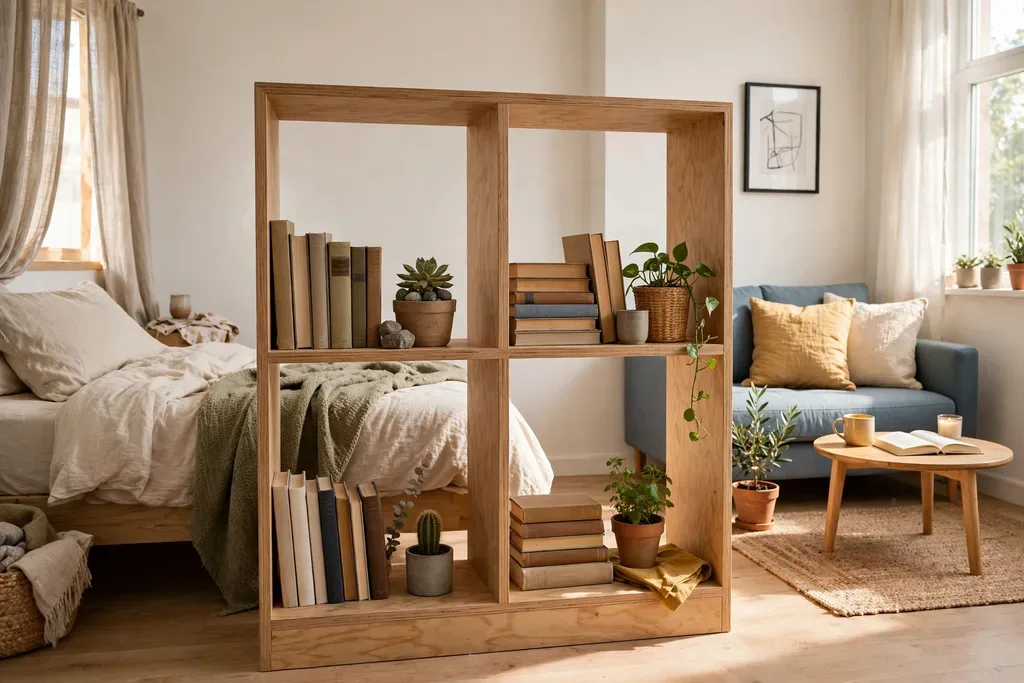
Best for: storage and separation in one piece, a shelf divides the room and holds your books at the same time. Among room divider ideas for studio apartments, a low shelf is the only one that also solves storage.
An open-back cube shelf set perpendicular to the wall is the most recommended room divider for a studio apartment in almost every guide, and for good reason. It marks the bed zone, it stores things on both sides, and because it is open-backed, light still passes through it. That double duty is why room divider ideas for studio apartments so often start with a shelf.
- Height: keep it low, 30 to 36 inches high. A low shelf is stable without any wall attachment. A tall 60-inch shelf is top-heavy and needs anchoring, which means drilling, not renter-friendly.
- Depth: 10 to 15 inches deep. A 4-cube unit is usually about 30 inches wide, 30 inches high, and 12 inches deep. Two of them side by side make a 60-inch divider.
- Weight: load the heaviest books in the bottom two rows. A bottom-weighted shelf is far harder to tip than a top-heavy one, this is the single most important stability rule in this guide.
- What to watch: the famous IKEA Kallax 4 by 2 (57 inches tall, 30 inches wide, 16 inches deep) is the most-cited divider shelf in other guides, but it costs $150 to $200 on its own, over this guide’s whole budget. A thrifted cube shelf or a budget 4-cube unit at $30 to $50 does the same job for a third of the price, and at 30 inches high it needs no wall anchors.
Budget: a budget 4-cube shelf costs $30 to $50 secondhand or new. Two units side by side cost $60 to $100 and give you a 60-inch divider with eight cubes of storage.
3. Folding screen divider
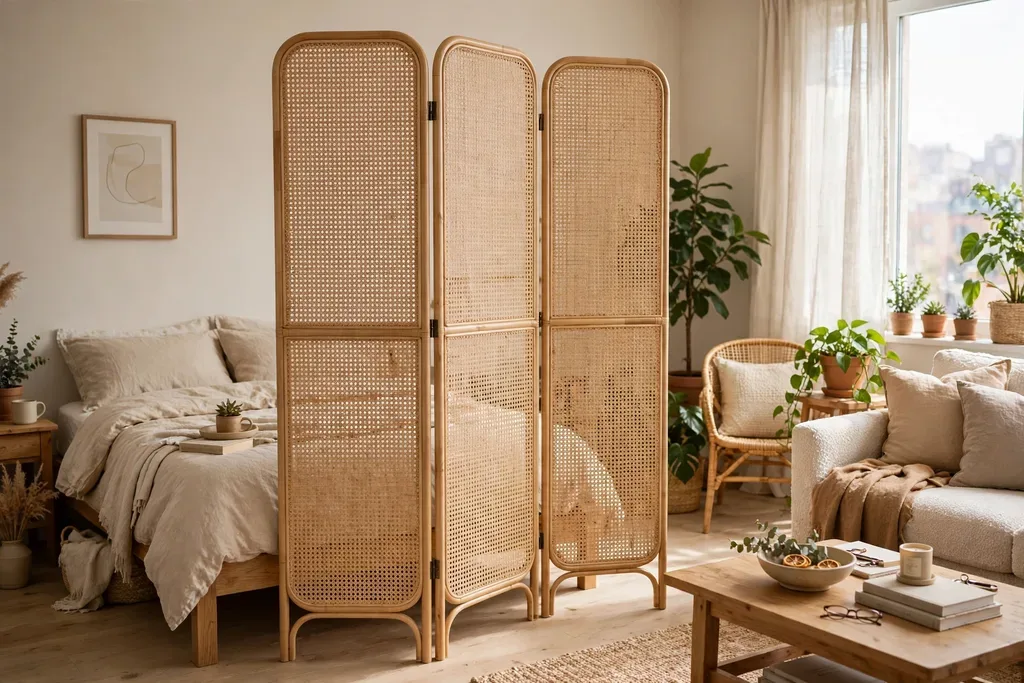
Best for: instant privacy with zero installation, unfold it, angle it, done. If you rent, this is one of the simplest room divider ideas for studio apartments to try first.
A folding screen is the fastest studio divider there is: it arrives folded, opens in ten seconds, and needs no rod, no screws, and no measuring. Cane, rattan, and woven screens let light through; solid wood or fabric panels give more privacy. No measuring, no drilling, and no waiting — which is why room divider ideas for studio apartments often include a folding screen.
- Height: 60 to 72 inches tall, tall enough to hide the top of the mattress, short enough to leave the 12 to 24 inch ceiling gap.
- Width: a 3-panel screen is usually a little over 4 feet wide (about 50 inches). A 4-panel screen covers about 5 to 6 feet.
- Stability: set the panels in a slight zigzag, not a straight line. A zigzag screen stands on its own; a straight-line screen falls over if you brush it. The angled panels are the whole stability system.
- What to watch: do not buy a screen taller than 72 inches for an 8-foot ceiling, it blocks the light gap and makes the bed zone feel like a closet. And keep the screen at least 18 inches from the side of the bed on the quiet side, 24 inches where you walk past it every day.
Budget: a 3-panel cane screen costs $80 to $160 new, $40 to $80 secondhand. It is the priciest idea in this guide, but it is also the only one that moves to the next apartment folded flat under one arm.
4. Furniture as the divider
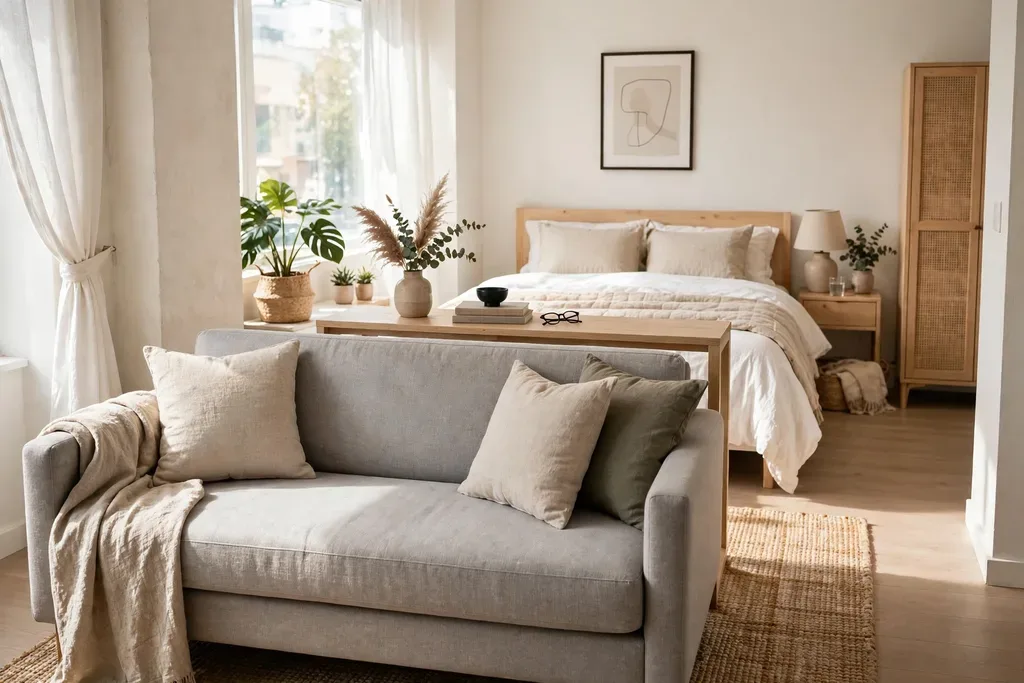
Best for: no new purchase at all, the furniture you already own marks the zones. It is the cheapest of all room divider ideas for studio apartments, because it costs nothing new.
The cheapest divider is the sofa you already have. Turn the sofa back to the bed, put a slim console behind it, and the living zone is marked without buying a single divider. This is how to divide a studio apartment when the budget is zero and the room is small. That zero-cost start is the reason room divider ideas for studio apartments often begin with the sofa you already own.
- Sofa back: a sofa back is 30 to 34 inches high, the same height as a half-height divider, and it reads as a wall from the bed side.
- Console: a slim console 10 to 12 inches deep behind the sofa gives you a surface for a lamp, keys, and a plant, and it stops the sofa sliding backward.
- Rug: a 5 by 8 foot rug under the living zone does the rest of the work. The rug edge is the boundary, step off the rug and you are in the bedroom.
- What to watch: do not push everything against the walls. A sofa floating 36 inches off the wall, with a walkway behind it, divides a room better than a sofa shoved into a corner. Keep a 30-inch clear path between the sofa and the coffee table.
Budget: free, if you already own the sofa and the rug. A slim console costs $40 to $80 secondhand. A 5 by 8 rug costs $30 to $45 on a budget.
5. DIY tension slat wall
Best for: the divider that looks built-in but comes apart, vertical wood slats with light between them. Of all the room divider ideas for studio apartments, a slat wall looks the most built-in.
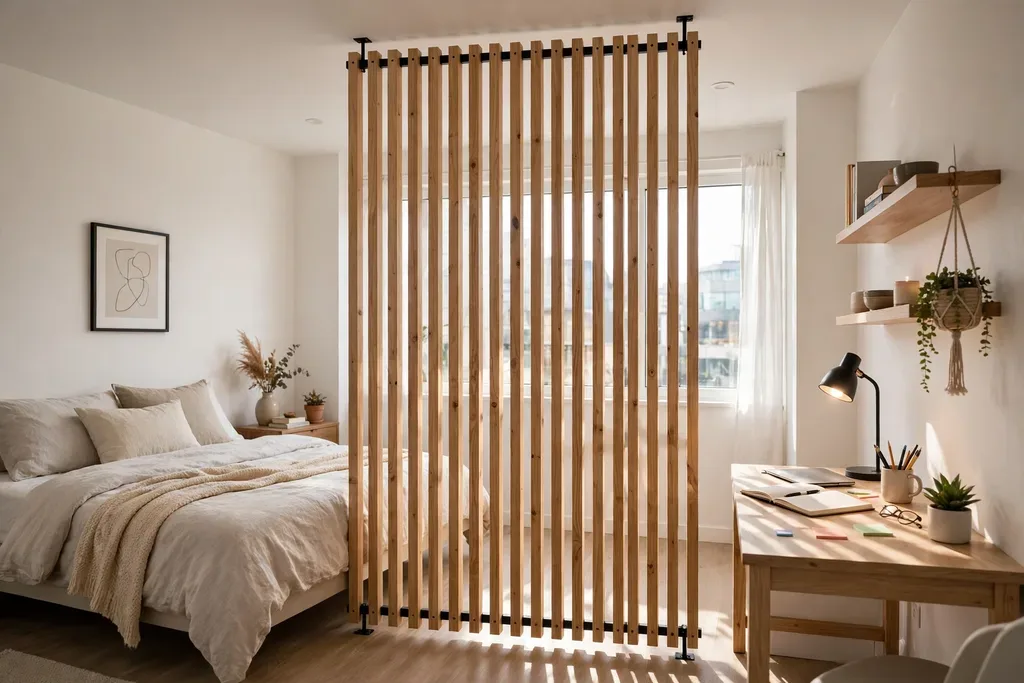
A slat wall is the most designed-looking divider for a studio apartment in this guide, and it is a weekend build. Vertical wood slats, spaced 1 to 2 inches apart, let light through while still hiding the bed. It tension-mounts between floor and ceiling, so there is no drilling, and it comes apart into flat boards on moving day. The gaps keep the room bright, which is the point of most room divider ideas for studio apartments.
The cut list (for a 48-inch-wide, 72-inch-tall panel):
| Piece | Size | Qty |
|---|---|---|
| Vertical slats, 1 by 3 pine | 72 in long | 8 |
| Top and bottom rails, 1 by 3 pine | 48 in long | 2 |
| Feet, 2 by 4 pine | 18 in long | 2 |
| Wood screws, 1 1/4 in | , | 1 box |
| Wood glue + sandpaper + stain | , | , |
How it goes together: screw the 8 slats to the two rails, spaced 1 to 2 inches apart, that gap is what lets the light through. Screw the two feet perpendicular to the bottom rail, one at each end, so the panel stands on its own. Sand, stain, and stand it up. The panel is 48 inches wide and 72 inches tall, so it stops 24 inches short of an 8-foot ceiling.
Cost:
| Item | Cost |
|---|---|
| 8 slats, 1 by 3 pine, 72 in | $28–$36 |
| 2 rails, 1 by 3 pine, 48 in | $5–$8 |
| 2 feet, 2 by 4 pine, 18 in | $6–$10 |
| Screws, glue, sandpaper, stain | $15–$20 |
| Total | $54–$74 |
What to watch: the feet are the stability system, 18 inches deep, one at each end, screwed tight. Without feet, a 72-inch panel falls over. With them, it stands on its own, and you can slide it aside whenever you want the room open. Do not build it taller than 72 inches: above that, it needs a ceiling fixing, and a ceiling fixing needs drilling.
6. Tall plants as a living divider
Best for: the softest divider, green, alive, and it moves with you. Plants are the softest of the room divider ideas for studio apartments, and the only living one.
A row of tall plants is a divider that breathes. Plants 6 feet tall block sightlines the way a screen does, but they let light and air through, and they make the room feel bigger instead of smaller. That breathing quality is what sets these room divider ideas for studio apartments apart from screens and shelves.
- Height: aim for plants 5 to 6 feet tall, a fiddle-leaf fig, a snake plant, or a tall monstera in a floor pot. Shorter plants mark a zone; they do not divide one.
- Arrangement: cluster three plants in a row, 12 to 18 inches apart, in pots 12 to 14 inches wide. A plant stand lifts the shorter ones to the right height.
- What to watch: plants need light, so do not put the plant divider between the bed and the only window, the plants will block the light they need. Put the divider beside the window’s path, not across it. And a plant divider gives privacy, not sound blocking.
Budget: three tall plants in pots cost $45 to $90, or free, if you split plants you already own into three pots.
7. Half-height console divider
Best for: the grown-up divider, a low cabinet that marks the zone and hides the clutter. A low cabinet is one of the most practical room divider ideas for studio apartments for hiding clutter.
A half-height cabinet, 36 to 42 inches high, is the most solid-feeling divider that still needs no wall fixing. It reads as furniture, not as a partition, and it gives you a surface and storage at the same time. It reads as furniture, which is why room divider ideas for studio apartments often end with a console or sideboard.
- Height: 36 to 42 inches, high enough to hide a mattress from the sofa side, low enough to see over and keep the light moving.
- Depth: 10 to 15 inches, the same as a bookshelf divider. Deeper than 15 inches eats the walkway.
- What to watch: keep the top clear except for one lamp and one plant. A half-height cabinet with ten things on it is a shelf, not a divider, and it blocks the sightline that makes the room feel open.
Budget: a low console or sideboard costs $50 to $100 secondhand. It is the most expensive single piece in this guide, which is why the curtain and the shelf come first for most people.
The measured plan: one 12 by 20 foot studio
Best for: seeing the whole room at once, every number in one place.
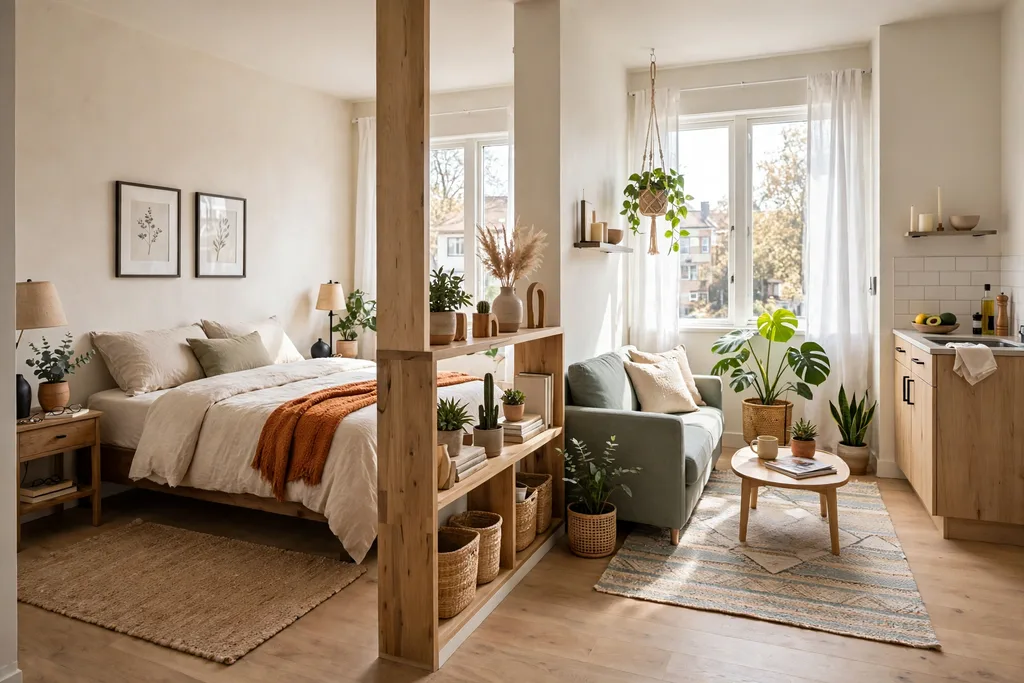
Here is the plan for a 12 by 20 foot studio (240 square feet) with 8-foot ceilings, the most common small-studio size. Everything in this guide fits into it. This layout is the test case for the room divider ideas for studio apartments in this guide.
- Room: 12 feet wide (144 inches) by 20 feet long (240 inches), ceiling 96 inches.
- Bed zone: 8 feet deep (96 inches) at the far end, away from the front door. A queen bed (60 by 80 inches) sits against the far wall, with a 24-inch lane beside it and a 20-inch nightstand on the other side.
- Divider: a 108-inch-wide curtain divider (or a 60-inch shelf plus a screen), placed 8 feet from the far wall, running across the room. The rod sits at 84 inches high, the fabric stops 1/2 inch above the floor, and the divider stops 12 inches short of the ceiling.
- Walkway: a 36-inch opening at one end of the divider, the main path from the door to the bed. Never less than 30 inches.
- Living zone: the remaining 12 feet (144 inches) holds the sofa (72 to 84 inches), a coffee table, and a 5 by 8 foot rug, with a 30-inch clear path between the sofa and the table.
- Light: the divider sits 2 to 3 feet off the window wall, never across it, so daylight travels the full depth of the room.
If your studio is smaller, 200 to 250 square feet, shrink the bed zone to 7 feet deep and use the curtain divider instead of the shelf: a curtain takes zero floor space, and in a small studio, floor space is the scarcest thing you own. In a smaller room, room divider ideas for studio apartments work best when the divider takes no floor space at all.
For the bed itself, where it goes, which wall, and how the layout works around it, see Small Bedroom Layout Ideas.
The no-drill system: one checklist
No single product makes a divider renter-friendly. The system does, four checks, in order, before you buy anything: Run them in order, because room divider ideas for studio apartments only stay renter-friendly if the system holds.
- Rod rating: a heavy-duty tension rod is rated for up to 45 pounds. Add up the curtain weight first, a sheer pair is 1 to 2 pounds, a blackout pair is 4 to 6 pounds, and keep the total well under the rating. Never use a rod across a span longer than its rating: a 10-foot span on an 8-foot-rated rod can crack paint or peel drywall paper.
- Curtain weight: weigh the curtains on a kitchen scale before hanging them. If the pair weighs more than a third of the rod’s rating, buy a lighter fabric or a stronger rod.
- Ceiling and floor surface: a tension rod needs flat, solid surfaces to grip. Measure the ceiling height in three spots, old buildings slope. Textured or popcorn ceilings reduce grip, and a rod will slip on them; use a freestanding screen or shelf instead. Freestanding dividers need a level floor, check with a phone level app before you buy.
- Lease clause: read the clause before you install. Most leases fall into four kinds: no holes at all (use tension rods and freestanding pieces only); small nails tolerated (adhesive hooks are still the safer choice); adhesive permitted (Command strips and hooks are fine); modifications negotiable (ask in writing first). Tension rods and freestanding dividers need no permission in almost every lease. Ceiling tracks and joist anchors need drilling, so they need written landlord permission first.
Run the four checks in order and the divider stays up, the deposit stays safe, and moving day takes an afternoon.
Renter-safe stability: keeping it upright
A divider that falls over is worse than no divider. Four rules keep any divider upright without a single hole in the wall: These four rules apply to every one of the room divider ideas for studio apartments above.
- Keep it low: a 30 to 36 inch shelf is stable on its own. A 60-inch shelf is top-heavy and wants a wall anchor. When in doubt, choose the low unit.
- Weight the bottom: load the heaviest books and objects in the bottom two rows of any shelf divider. A bottom-weighted unit is far harder to tip than a top-heavy one.
- Build a furniture-L: set the divider perpendicular to the wall, then put a second piece, a console, a nightstand, a plant stand, at a right angle to it. The L shape braces the divider from the side.
- Rubber wedges and pads: stick rubber furniture pads under the feet of any freestanding divider. They stop sliding on wood floors and level out a slightly uneven floor. For screens, the zigzag angle is the stability system, never set a folding screen in a straight line.
What not to do: do not anchor a tall shelf to a ceiling joist or a wall stud with anti-tip hardware, that is drilling, and it is the landlord’s decision, not yours. The four rules above are the renter-safe replacement, and they work for every divider in this guide.
Room divider ideas under $150
Best for: one complete setup, every item, added up.
This is the tension-rod curtain setup from idea 1, plus the rug that marks the living zone. No guide in the top 10 prices a complete setup, this one does. This setup is the budget pick among room divider ideas for studio apartments, and it still leaves room to spare.
| Item | Cost |
|---|---|
| Heavy-duty tension rod, rated 45 lbs | $20–$30 |
| Curtain pair, sheer or blackout, 84 in | $25–$40 |
| 5 by 8 ft rug for the living zone | $30–$45 |
| Small plant in a pot | $10–$15 |
| Total | $85–$130 |
That is the whole divider, under $150, with room to spare. (The Kallax shelf other guides cite costs $150 to $200 on its own, see idea 2 for the cheaper alternative.) That total is the proof that room divider ideas for studio apartments do not have to cost $150 to work.
The free version: move the sofa, unroll a rug you already own, and put a plant between the bed and the sofa. That costs nothing, and it changes the room more than any purchase, because zoning starts with moving furniture, not buying dividers.
5 mistakes to avoid
1. A floor-to-ceiling solid divider. A solid divider that touches the ceiling blocks light and air, and the bed zone turns into a closet. Stop the divider 12 to 24 inches short of the ceiling, the gap is what keeps the room feeling like one home. A solid divider is the most common way room divider ideas for studio apartments go wrong.
2. Blocking the only window. A divider across the window wall kills the daylight for half the room. Keep the divider 2 to 3 feet off the window wall, or place it beside the window’s path, never across it.
3. A tall, narrow divider with no stability plan. A 60-inch shelf with nothing in the bottom rows tips. Keep dividers low, weight the bottom, build the furniture-L, and use rubber pads. If a divider needs a wall anchor to stay up, it is the wrong divider for a rental.
4. A walkway under 30 inches. A 24-inch gap between the divider and the wall is a squeeze, not a path. Leave 36 inches for the main route and 30 inches minimum everywhere else, or you will bump the divider every single day.
5. Dividing a tiny studio unnecessarily. In a studio under 250 square feet, a full divider can make the room feel smaller, not bigger. If the room is that small, start with visual separation, a rug, a light, a sofa turned sideways, and add a physical divider only if the bed still bothers you. And never layer three divider types at once: one curtain plus one screen plus one shelf is visual chaos, not zoning.
Sound and light: what a divider really does
The honest numbers:
- Sound: a bookshelf full of books cuts about 5 to 10 decibels. Heavy curtains cut 10 to 15 decibels. Fabric screens cut 10 to 15 decibels. Normal speech is about 60 decibels and a whisper is about 30, so a divider takes the edge off a conversation, but it does not make a bedroom quiet. If you need real quiet, add a white-noise machine.
- Light: semi-sheer fabric (3 to 5% openness) lets most daylight through. Blackout fabric (about 1% openness) blocks nearly all of it. Slats spaced 1 to 2 inches apart and cane screens let light through in stripes. The 12 to 24 inch ceiling gap matters more than the fabric: light travels over the top of the divider even when the fabric is blackout.
- Heat and cooling: a divider makes heating and cooling slightly worse on the bed side, because air moves less freely behind it. The ceiling gap fixes most of it, and a small fan on the bed side fixes the rest. If your studio has one vent, never block it with a divider.
FAQ
How do I divide a studio apartment?
Start with the bed zone: give it 7 to 8 feet of depth at the far end of the room, then mark it with one divider, a tension-rod curtain is the cheapest, a low bookshelf adds storage, a folding screen needs no installation at all. Leave a 36-inch walkway at one end and stop the divider 12 to 24 inches short of the ceiling so light and air still move. That bed-first order is the starting point for room divider ideas for studio apartments.
How do I split a studio apartment into a bedroom and living room?
Place the bed first, against the far wall and away from the front door. Put the divider 7 to 8 feet from that wall, across the room. The remaining space is the living room, mark it with a 5 by 8 foot rug and a sofa with its back to the bed. That is the whole split: bed zone, divider, living zone.
Will a tension rod damage the ceiling over time?
It can, if the rod is wrong for the span. A rod rated for 8 feet used across a 10-foot gap presses too hard and can crack paint or peel drywall paper. Match the rod to your span, keep the curtain weight well under the 45-pound rating, and check the rod ends every few months.
How do I keep a bookshelf divider from tipping without wall anchors?
Four things: keep the shelf low (30 to 36 inches), load the heaviest books in the bottom two rows, set the shelf perpendicular to the wall with a second piece at a right angle (the furniture-L), and put rubber pads under the feet. A low, bottom-weighted shelf with an L brace does not need a wall anchor.
Should a studio bedroom divider go floor to ceiling?
No. Stop it 12 to 24 inches short of the ceiling. A floor-to-ceiling divider blocks light and air, makes the bed zone feel like a closet, and makes heating and cooling worse. The gap is the whole point, it is what keeps one room feeling like one home.
How much do studio apartment room dividers cost?
A complete tension-rod curtain setup costs $85 to $130, including the rug. A DIY slat wall costs $54 to $74. A folding screen costs $40 to $80 secondhand. The most-cited shelf in other guides costs $150 to $200 on its own, over budget before you buy anything else, so a thrifted cube shelf at $30 to $50 is the better buy.
Do room dividers block sound?
A little. A bookshelf cuts about 5 to 10 decibels, heavy curtains and fabric screens about 10 to 15. That takes the edge off a conversation, but it does not make a bedroom quiet, normal speech is about 60 decibels. For real quiet, add a white-noise machine.
Start today
Room divider ideas for studio apartments do not need a shopping trip, they need a measuring tape and one moved sofa. Measure the room, mark the bed zone 7 to 8 feet deep, turn the sofa so its back faces the bed, and unroll a rug. That is the whole first round, and it takes an afternoon.
Then, when you know what the room actually needs, add the one divider that fits: a curtain on a tension rod for privacy, a low shelf for storage, a screen for speed. Start by moving furniture. The room will tell you what it needs next.