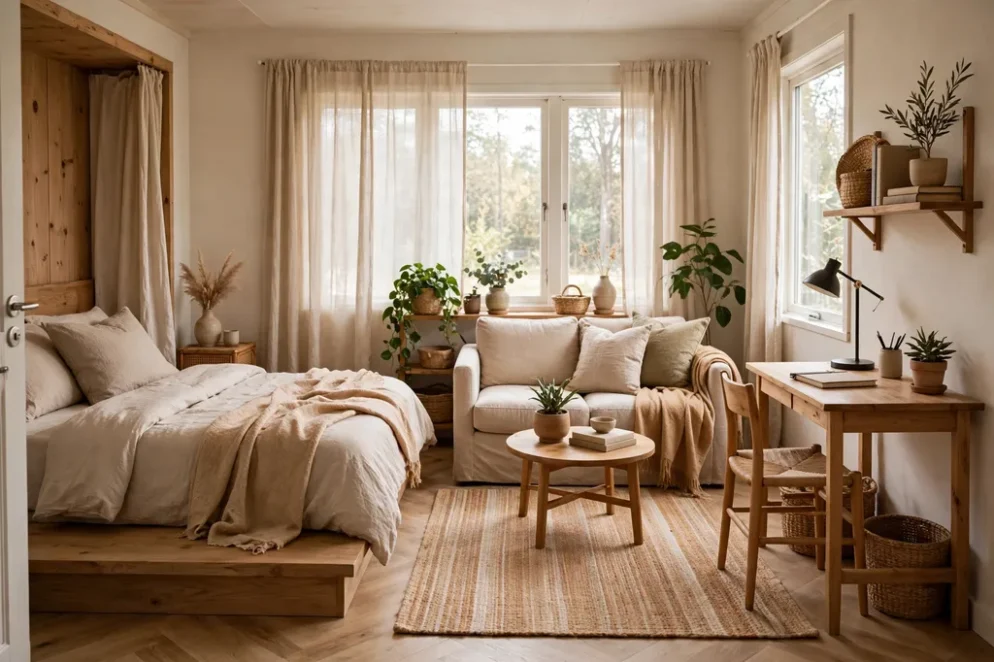
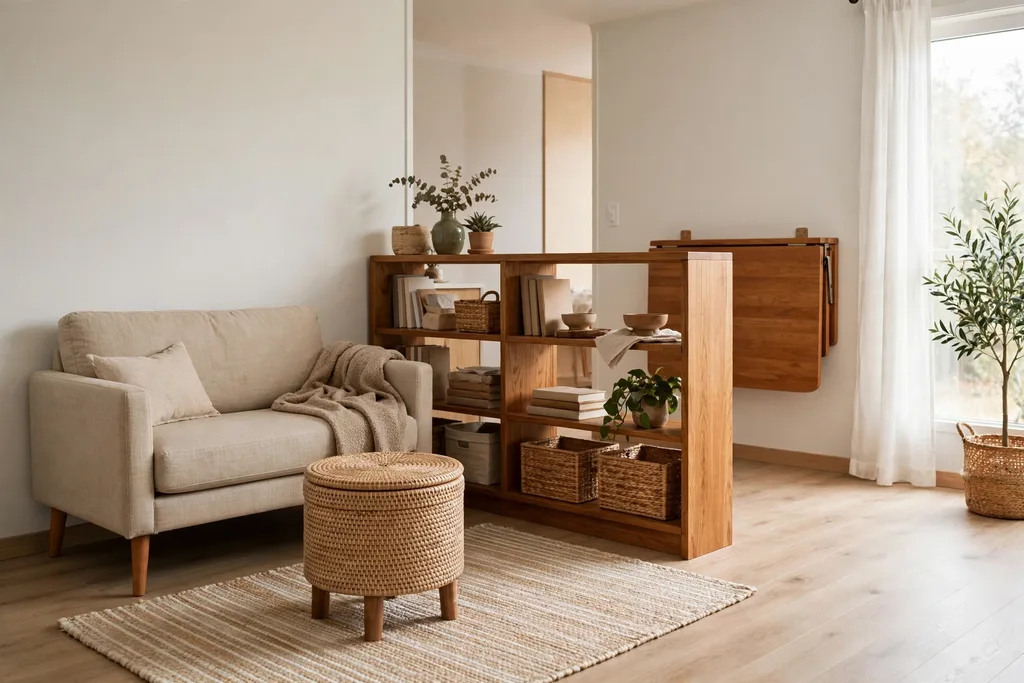
Studio apartment furniture ideas fail for one reason: the furniture is sized for a normal apartment, and a studio is not a normal apartment. One room does the work of four, bedroom, living room, dining room, office, so every piece has to earn its floor space twice. A sofa that only seats people is a waste. A bed that only sleeps is a waste. A table that only seats four, in a room where two people eat, is a waste.
This guide gives you 8 studio apartment furniture ideas with exact measurements in inches: how wide the sofa should be, how much room a sofa bed needs to open, what size drop-leaf table seats two or four, and what the whole room costs. Every piece is renter-friendly, freestanding, no drilling, and the whole room comes in under $150 if you buy secondhand.
For the room around the furniture, how the zones sit together in one room, see Studio Apartment Decorating Ideas.
Table of Contents
The numbers first
Best for: every piece in this guide, measure the room, the doorway, and the hallway before you buy anything. That measuring habit is what makes these studio apartment furniture ideas work in a real room, not just on paper.
Six numbers decide whether studio apartment furniture fits:
- Walkways: main paths need 30 to 36 inches clear. Secondary paths can be tighter, but never below 24 inches, and never on the route to the door. Keep those paths clear and the studio apartment furniture ideas below will not fight the room.
- Sofa width: a loveseat is 52 to 58 inches wide. A full three-seater is 72 to 84 inches, too wide for most studios, and it eats the walkway. That width is the first filter for the studio apartment furniture ideas in this guide.
- Sofa-bed pull-out: a sofa bed needs 7 to 8 feet (84 to 96 inches) of clear floor in front of it to open. Measure the open size, not just the closed size, the closed size is the lie.
- Dining clearance: a chair needs 24 inches behind the table to pull out, and each person needs 24 inches of elbow room along the table edge.
- Drawer clearance: a storage-bed drawer needs 24 inches of pull-out space in front of it. A drawer you cannot open is not storage.
- Doorway: most interior doors are 30 to 32 inches wide and hallways are 36 inches. If the sofa is 38 inches deep, it does not fit through the door, measure the doorway before the room.
Measure the doorway first, the room second, and the furniture last. The best studio furniture is the furniture that actually arrives in the room. It is the simplest of all the studio apartment furniture ideas, and the one people skip most often.
What makes furniture work in a studio?
What furniture works best in a studio apartment? Furniture that does two jobs, stands on visible legs, and folds or opens when you need it. One room, four jobs, every piece has to pull double duty. Keep that test in mind and the studio apartment furniture ideas in this guide will read as a shortlist, not a wish list.
- Two jobs or it stays in the shop: a storage ottoman is a seat, a footrest, and a blanket box. A sofa bed is a sofa and a guest bed. A drop-leaf table is a desk by day and a dining table at night. A lift-top coffee table is a table and a laptop desk. If a piece does one job, a two-job piece should take its place.
- Legs, not blocks: furniture on visible legs, 4 to 6 inches of leg showing, lets you see floor underneath it, and the room reads bigger. A sofa that sits flat on the floor looks like a wall. The same sofa on legs looks like furniture.
- Fewer, larger pieces: five small single-purpose pieces fill a studio faster than three bigger two-job pieces. One loveseat, one storage ottoman, one drop-leaf table beats a sofa, an armchair, a coffee table, a side table, and a dining table. That swap is one of the easiest studio apartment furniture ideas to apply on a tight budget.
- Measure closed AND open: a sofa bed is 36 to 38 inches deep closed and 84 inches long open. A drop-leaf table is 24 inches deep folded and 48 inches open. A Murphy bed is 16 to 18 inches deep folded and 80 inches open. Buy for the open size, the closed size is what the shop shows you, and the open size is what you live with.
1. The bed decision first
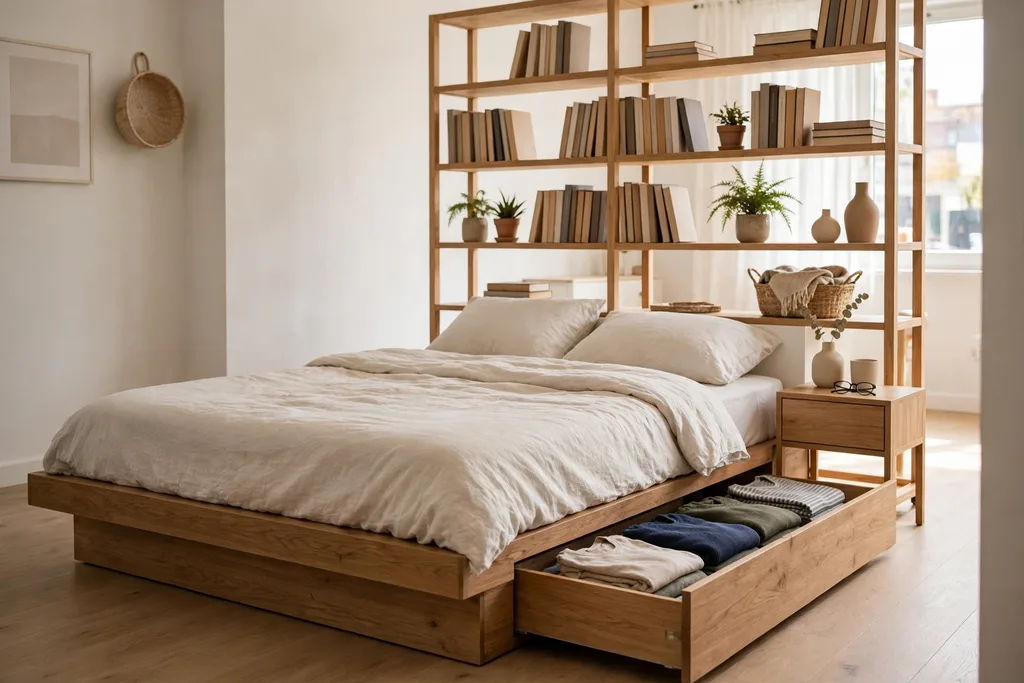
Best for: the biggest decision in the room, the bed is the largest piece, so it gets decided first and everything else fits around it.
The bed is where most studio furnishing goes wrong, because there are four good answers and they solve different problems. Here they are, head to head: That is why the bed leads this list of studio apartment furniture ideas, before the sofa or the table.
| Bed | Floor space freed | Cost | Install needs | Best for |
|---|---|---|---|---|
| Murphy bed (queen) | ~33 sq ft when folded up | $500–$1,500+ | Bolts into wall studs, not renter-friendly | Owners, not renters |
| Sofa bed | 0 sq ft, it IS the sofa | $300–$900 new, $100–$250 secondhand | None, freestanding | Renters who host rarely |
| Loft bed (twin) | ~28 sq ft underneath | $300–$800 | Freestanding frame, needs 8 ft+ ceilings | Tall studios |
| Storage bed (full/queen) | 0 sq ft, but replaces a dresser (~8 sq ft saved) | $200–$600 new, $80–$150 secondhand | None, freestanding | Most renters |
- Murphy bed: a queen Murphy bed folds up to 16 to 18 inches deep against the wall and frees about 33 square feet, the whole sleeping zone becomes living space by day. But it bolts into wall studs, it costs $500 to $1,500+, and in a rental it is the landlord’s decision, not yours. If you own the studio, it is the best answer. If you rent, skip it.
- Sofa bed: the classic studio answer. Closed it is a 72 to 84 inch sofa; open it is a bed about 84 inches long. The catch is the pull-out: it needs 7 to 8 feet of clear floor in front of it, and a sofa bed you sleep on every night is a bad mattress. It is a guest bed, not a daily bed, if you sleep on it nightly, buy a real bed instead.
- Loft bed: a twin loft bed (38 by 75 inches) frees the whole footprint underneath, about 28 square feet for a desk or a dresser. But it needs ceilings 8 feet or higher, and at least 30 inches of sitting clearance above the mattress, or you cannot sit up in bed. In a studio with 8-foot ceilings and a thin mattress, that is 30 inches of air, it works, but only just.
- Storage bed: the honest pick for most renters. A full storage bed (54 by 75 inches) or a queen (60 by 80 inches) with drawers underneath replaces the dresser entirely, that is 8 square feet of dresser you do not need to buy or fit. The drawers need 24 inches of pull-out clearance in front of the bed, and under-bed bins need only 6 inches of height. No drilling, no landlord, no installation.
My pick for most studios: a storage bed. It is the only option that is freestanding, cheap secondhand ($80 to $150), and removes a whole piece of furniture from the room. Best bed for a studio apartment is not the cleverest bed, it is the bed that deletes the dresser. Among all the studio apartment furniture ideas here, this is the one that saves the most floor space per dollar.
2. The sofa: loveseat, not a three-seater
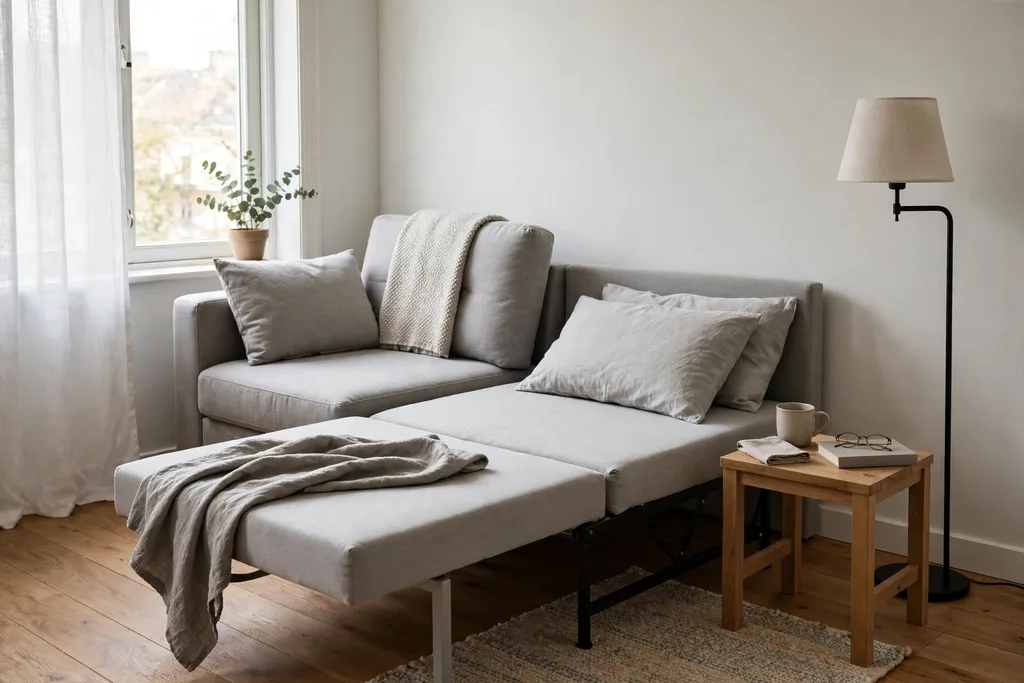
Best for: the living zone, the sofa is the second-largest piece, and the one most people buy too big.
A three-seater sofa is 72 to 84 inches wide. In a studio with a 10 by 12 foot living zone, that sofa plus a 30-inch walkway leaves nothing, no side table, no lamp, no way past. A loveseat is 52 to 58 inches wide, seats two properly, and leaves room for the rest of the room. Choosing the loveseat is the single easiest of these studio apartment furniture ideas to get right.
- Size: a loveseat 52 to 58 inches wide and 36 to 38 inches deep. Seat height 17 to 19 inches. Anything wider blocks the walkway; anything deeper blocks the doorway on moving day.
- Sofa bed or plain loveseat: if guests sleep over more than once a month, a loveseat-size sofa bed (52 to 58 inches wide, opening to about 72 inches long) is worth it. If guests are rare, a plain loveseat plus a folding guest mattress stored under the bed is cheaper and more comfortable.
- The open-size rule: measure the sofa bed open, not closed. Closed it is 36 to 38 inches deep; open it is 84 inches long and needs 7 to 8 feet of clear floor. If the coffee table sits 16 to 18 inches from the sofa, it has to move every time the bed opens, buy a lift-top or nesting table that moves in one lift, not a heavy coffee table.
- What to watch: do not buy a deep sectional. A sectional’s chaise is 60 inches long and it blocks the door-to-kitchen path, the single most common studio sofa mistake. One loveseat, facing the room, with its back to the sleeping zone, does the dividing job a sectional promises and leaves the path clear.
Budget: a loveseat secondhand costs $80 to $150. A loveseat sofa bed secondhand costs $100 to $250. New, both cost roughly double, and in a studio, secondhand is the honest buy, because the first sofa teaches you what the room actually needs. At that price, the loveseat is one of the most budget-friendly studio apartment furniture ideas in this guide.
3. The dining table: drop-leaf sizing
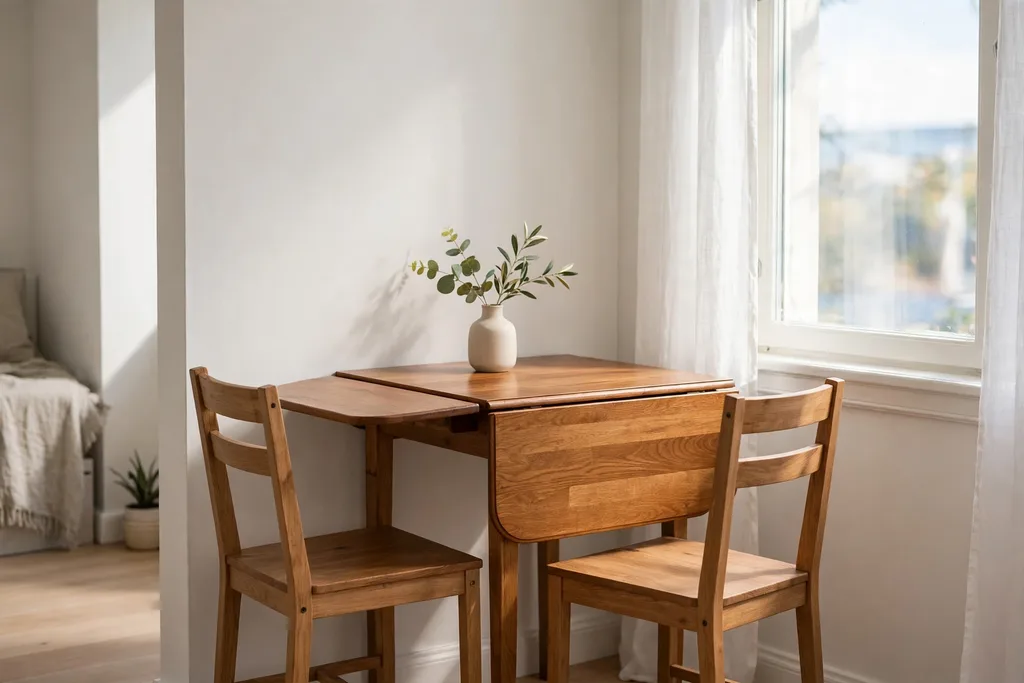
Best for: eating, working, and everything in between, the table is the piece that changes size most often.
A fixed dining table in a studio is usually a mistake. It seats four people who never come, and it eats 12 square feet every day of the year. A drop-leaf table folds to the size you use daily and opens to the size you need on the rare night you host. Of all the studio apartment furniture ideas in this guide, the drop-leaf table saves the most square feet per day.
- Two people, daily: a table 30 by 36 inches with both leaves down seats two, one on each long side. Folded depth is 24 inches against the wall, so it takes about 5 square feet.
- Four people, hosting: the same table open to 30 by 48 inches seats four, two on each long side, 24 inches of elbow room per person. Open it needs 24 inches of chair pull-out behind each side, so the open footprint is about 48 by 72 inches.
- Six people: a table 30 by 60 inches seats six, but it needs a 10 by 12 foot clear zone when open, most studios do not have it. If six people eat at your place regularly, you do not have a studio problem, you have a different apartment problem.
- Height: dining height is 29 to 30 inches. A table at 36 inches is counter height, it needs stools, and stools need 24 inches of leg room underneath. For a studio, 29 to 30 inches with real chairs is the right answer.
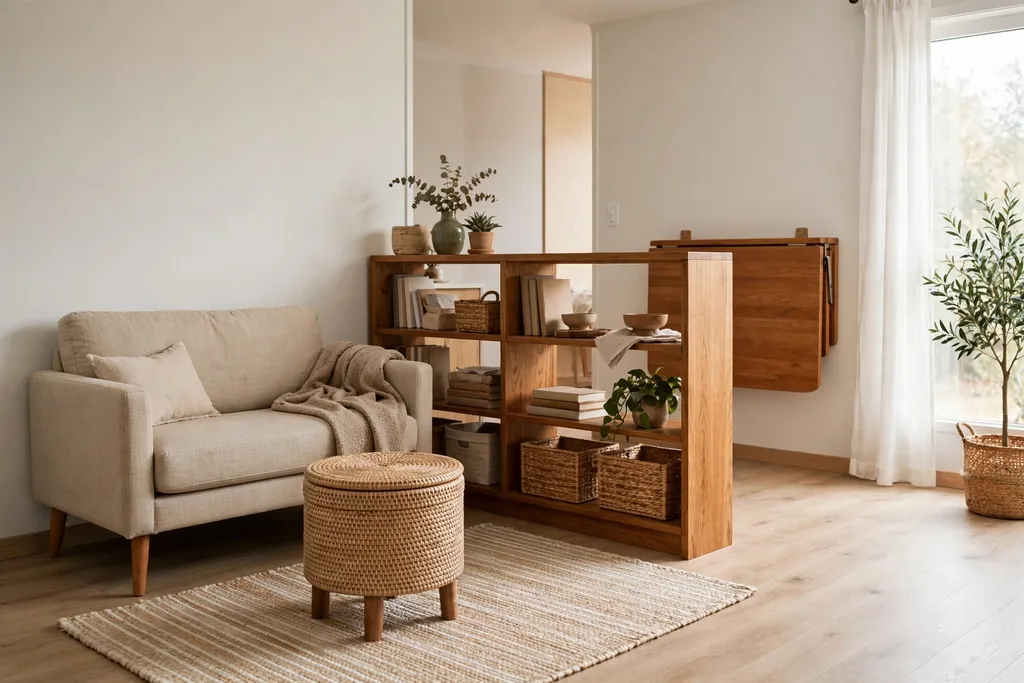
- What to watch: a wall-mounted fold-down table sounds perfect for a studio, but it screws into the wall, and in a rental, that is a hole in the landlord’s wall. A freestanding drop-leaf table does the same job, folds to 24 inches deep, and moves with you. Buy the freestanding one.
Budget: a drop-leaf table secondhand costs $25 to $40. New, $80 to $150. Two folding chairs cost $15 to $25 secondhand. The table is the cheapest two-job piece in this guide. That low cost makes the drop-leaf table one of the cheapest studio apartment furniture ideas to try first.
4. Storage ottoman and nesting tables
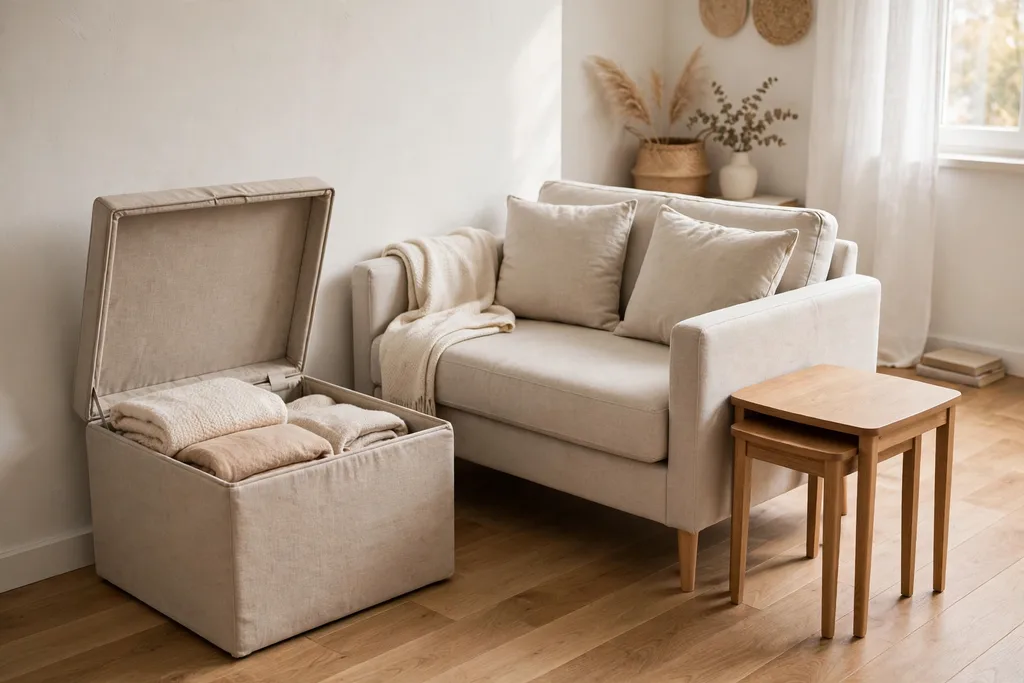
Best for: the small pieces, the ottoman and the nesting tables are the cheapest square feet in the room.
Small pieces are where studios fill up fastest. Five small single-purpose tables fill a floor quicker than one big two-job piece. The fix is two pieces that each do three jobs. That is why small pieces earn their own section in these studio apartment furniture ideas.
- Storage ottoman: a square ottoman 30 to 36 inches across, or a bench ottoman 15 by 30 inches, holds blankets, off-season clothes, or board games inside, and works as a seat, a footrest, and a coffee table with a tray on top. One ottoman replaces a coffee table, a blanket basket, and a spare seat, three pieces in 6 square feet.
- Nesting tables: a set of two or three tables, the largest 16 to 18 inches across, nesting with at least a 5-inch height gap between each so they actually slide under each other. Pulled apart they are side tables for two seats; nested they take 2 square feet. They are the side table that disappears.
- Lift-top coffee table: if you work from the sofa, a lift-top coffee table (36 to 42 inches long, 18 inches high, top lifting to 24 to 28 inches) is a laptop desk that looks like a coffee table. It costs more than nesting tables, so it is a second-round buy, not a first-round one.
- What to watch: do not buy a coffee table and an ottoman. One or the other. And do not buy nesting tables with less than a 5-inch height gap, they will not nest, and you will own three side tables instead of one.
Budget: a storage ottoman secondhand costs $20 to $30. Nesting tables secondhand cost $15 to $25. Together they are the cheapest storage in this guide. They are also two of the simplest studio apartment furniture ideas to buy secondhand.
5. The desk corner
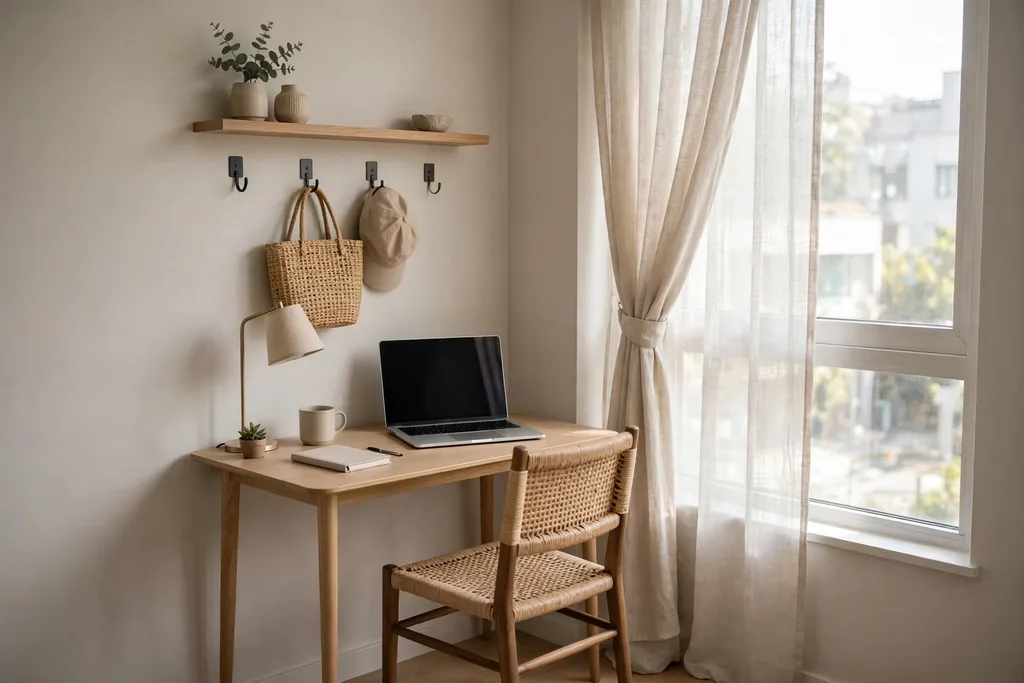
Best for: working from home, the desk is the piece most studios squeeze in last, and it shows.
A desk in a studio is a corner, not a room. The rules are small numbers, and the biggest mistake is buying a desk built for an office. Get the corner right and the rest of these studio apartment furniture ideas fall into place around it.
- Size: a desk 36 to 42 inches wide and 20 to 24 inches deep. That fits a laptop, a lamp, and a notebook, and nothing else, which is the point. A desk 48 inches wide or deeper than 24 inches eats the walkway.
- Chair clearance: the chair needs 30 inches behind the desk to pull out and sit down. If the desk faces the wall, that 30 inches comes out of the room, so the desk goes in the corner where the chair’s 30 inches is dead space anyway, not in the middle of a walkway.
- No wall-mounting: a wall-mounted folding desk screws into the wall, and one competitor guide even tells readers to mount it into a stud. In a rental, that is a hole, and a folding desk you cannot fold because the landlord said no is just a shelf. A freestanding slim desk does the same job and moves with you.
- The drop-leaf double-up: if the budget is tight, the drop-leaf dining table from idea 3 IS the desk by day. One table, two jobs, zero extra floor space. That is the under-$150 answer.
For desk sizes, chair clearance, and small-desk layouts in detail, see Small Desks for Small Spaces. Those layouts pair with the studio apartment furniture ideas above, so the desk never blocks the walkway.
6. The bookcase divider
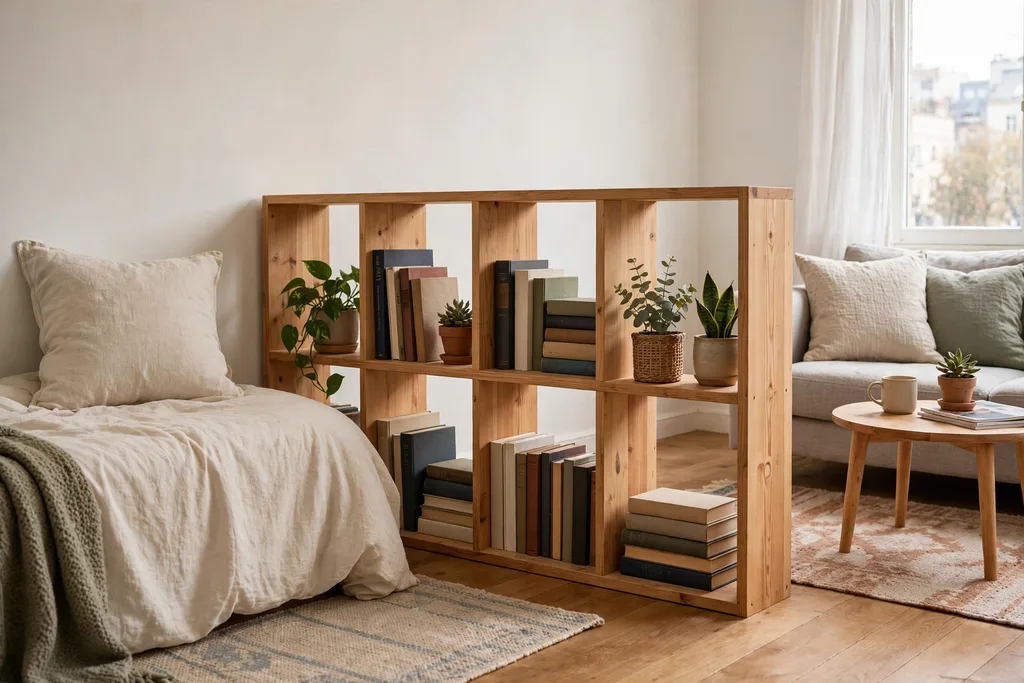
Best for: dividing the room without building a wall, the bookcase is the divider that also stores things.
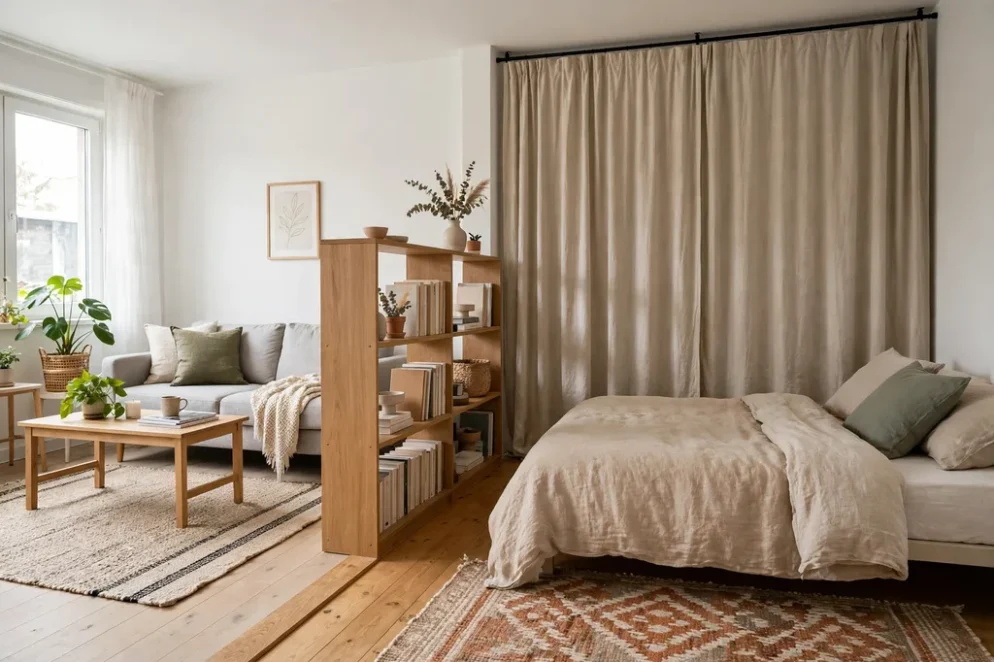
A studio needs the bed to feel separate from the living area, and a bookcase does it without a single screw. Keep it brief, the layout guide covers zoning in depth, but the furniture numbers are these: A low bookcase is one of the gentlest studio apartment furniture ideas for dividing a room without walls.
- Height: a divider bookcase should be 48 to 60 inches tall, high enough to block the sightline from the sofa to the bed, low enough to let light over the top. A bookcase taller than 60 inches in a studio darkens the sleeping zone and needs wall anchoring to be safe.
- Depth: 10 to 12 inches deep. Deeper than 12 inches and it becomes a wall, not a divider, it eats floor space and blocks the walkway.
- Placement: the bookcase goes at the foot or the side of the bed, never across a walkway. Leave 36 inches of walking space on at least one side of it. The sofa’s back can do the same job for free, a loveseat with its back to the bed divides the room with zero extra furniture.
- What to watch: a tall, narrow bookcase is a tipping risk, and the fix is not a wall anchor in a rental, the fix is a low, wide bookcase. Low and wide does not tip. Tall and narrow does. Buy low and wide.
7. Guest seating: folding chairs
Best for: the people who visit, guest seating that lives in a closet, not on the floor.
A studio cannot keep four dining chairs out all year for guests who come four times a year. Folding chairs live in a closet and come out for dinner. That is the whole point of these studio apartment furniture ideas for guests: seating that disappears when the visit ends.
- Size: a folding chair is 16 to 18 inches wide and folds to 4 to 6 inches deep. Four of them hang on over-door hooks or lean in a closet, 2 square feet of storage for four seats.
- The daybed double-up: a daybed (38 by 75 inches, about 18 inches high) is a sofa by day and a single bed by night, and it doubles as a dining bench, slide it to the table and it seats two. If you host overnight guests often, a daybed beats a sofa bed: it is a real mattress, and it needs no 7-foot pull-out clearance.
- What to watch: do not buy a guest armchair. An armchair is 30 inches wide, it never folds, and it sits empty 360 days a year. Four folding chairs cost less than one armchair and seat four people.
Budget: two folding chairs secondhand cost $15 to $25. Four cost $25 to $40. A daybed secondhand costs $80 to $150, a second-round buy. At that price, guest seating is one of the cheapest studio apartment furniture ideas in this guide.
8. Storage that moves with you
Best for: the clutter, storage that rolls, hangs, or stacks, and leaves with you when you move.
A studio’s storage problem is not a lack of shelves. It is a lack of shelves you can take with you. The pieces that work are the ones with no screws. The studio apartment furniture ideas in this section all pass that test: they roll, hang, or stack, and they leave with you.
- Rolling cart: a slim rolling cart 12 to 15 inches wide and 18 inches deep rolls between the kitchen and the desk, holds office supplies or pantry overflow, and parks in a 2-square-foot gap when you are done. It is the cheapest flexible storage in this guide.
- Over-door hooks and organisers: an over-door hook rail holds 5 hooks and coats, bags, and hats, no drilling, no holes, and it comes off in ten seconds on moving day. An over-door shoe organiser holds shoes, cleaning supplies, or pantry jars. The door is free wall space.
- Under-bed bins: bins 6 inches high slide under any bed frame and hold off-season clothes. If the bed is a storage bed, the drawers already do this job, do not buy both.
- Vertical, freestanding: a tall freestanding shelf is fine if it is wide and low-risk, but a tall narrow shelf in a rental is a tipping risk you cannot fix with a wall anchor. Go wide, go low, and stack up only with pieces that are stable on their own.
- What to watch: floating shelves look perfect in studio photos, and they are the worst rental buy in this guide. They screw into the wall, they hold almost nothing, and they leave holes. A freestanding shelf holds more, costs less, and moves with you.
Budget: a rolling cart costs $12 to $18 secondhand. Over-door hooks cost $8 to $12. Under-bed bins cost $10 to $15 for a set of two. All three are small, cheap studio apartment furniture ideas that you can buy in one trip.
Buy in this order
Best for: the budget, buying in the wrong order is how a studio ends up with a dining table and no bed.
Nobody furnishes a studio in one shopping trip. The order matters more than the pieces, because the first piece decides what fits after it. Follow the order below and the studio apartment furniture ideas above will arrive in the sequence you actually need them.
- Bed and seating first. The storage bed and the loveseat are the two largest pieces and the two you use every day. Buy them first, place them, and live with them for a week before buying anything else. Together secondhand they cost $160 to $300, the biggest spend, and the only one that cannot wait.
- The table second. The drop-leaf table and two folding chairs, once you know where the bed and sofa actually sit. The table is $40 to $65 secondhand with chairs, and it is the piece most people buy too big when they buy it first.
- Storage last. The ottoman, the nesting tables, the rolling cart, and the over-door hooks, after you know what is actually left to store. Storage bought first fills up with things you do not need; storage bought last holds the things you actually own. Together they cost $55 to $85 secondhand.
First piece to buy: the bed. It is the largest, the most-used, and the one that deletes the dresser. Everything else fits around it. That order is the backbone of the studio apartment furniture ideas in this guide.
Renter-friendly rules
Most studio apartment furniture is renter-friendly by nature, the best studio pieces are freestanding, and freestanding needs no permission. The rules are simple, and they are all about what you do NOT do. In fact, the studio apartment furniture ideas in this guide were chosen with renters in mind first.
- Freestanding, don’t wall-mount: the desk stands on the floor, the table stands on the floor, the bookcase stands on the floor. Wall-mounted folding tables and desks screw into the wall, and one competitor guide tells readers to anchor tall units into studs. In a rental, that is holes in the landlord’s wall and a deposit risk. If a piece needs a wall to work, it is the wrong piece for a rental.
- Lean, don’t drill: mirrors lean, art leans, frames lean. A leaning mirror needs no hook and no hole. If you must hang something light, use a removable adhesive hook rated for at least twice the piece’s weight, and only on smooth, fully cured paint.
- Adhesive weight ratings: small hooks hold 1 to 3 lb, medium hooks hold 3 to 5 lb, large hooks hold 5 to 7 lb. A loaded tote bag is 5 to 8 lb, it needs a large hook, not a medium one. Adhesives need 24 to 48 hours to cure before you hang anything on them, and they do not stick to textured walls or fresh paint, paint needs 30 days to cure first. Always check the pack: ratings are the manufacturer’s numbers, not a promise.
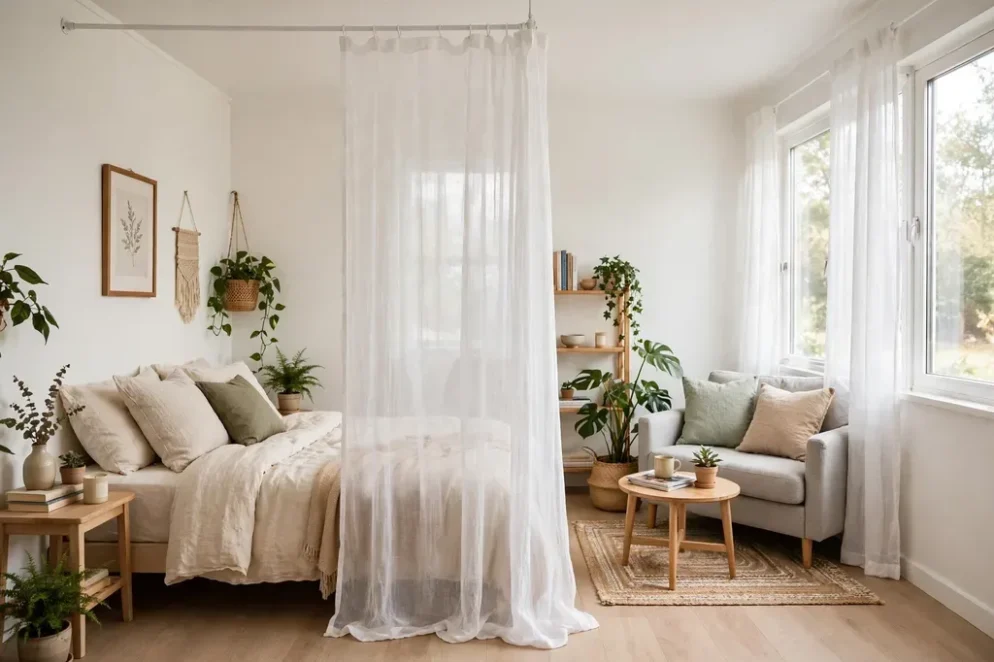
- Tension, not screws: a tension rod between two walls holds a curtain divider with no holes at all. A tension-rod curtain is the renter’s room divider, and it comes down in ten seconds.
- No floating shelves: floating shelves screw into the wall and hold almost nothing. A freestanding shelf holds more, costs less, and moves with you. If a guide tells you to mount it into a stud, it is not a renter’s guide.
- Felt pads and rug pads: felt pads under every leg protect the floor and let heavy pieces slide instead of scratch. A rug pad keeps the rug from sliding without adhesive, and adhesive on a rental floor is a deposit risk.
- Everything moves with you: the test for every piece in this guide is one question, can it leave with you in a normal move? The loveseat, the drop-leaf table, the ottoman, the cart, the hooks: all yes. The Murphy bed, the wall-mounted desk, the floating shelf: all no.
Studio apartment furniture under $150
Best for: the whole room, every piece in this guide, added up, secondhand.
| Item | Cost |
|---|---|
| Drop-leaf dining table (secondhand) | $25–$40 |
| Storage ottoman (secondhand) | $20–$30 |
| Nesting tables, set of 2 (secondhand) | $15–$25 |
| Two folding chairs (secondhand) | $15–$25 |
| Rolling cart (secondhand) | $12–$18 |
| Over-door hooks | $8–$12 |
| Total | $95–$150 |
That total is the honest version, and it is honest because the bed and the sofa are not in it. A storage bed secondhand costs $80 to $150 and a loveseat secondhand costs $80 to $150, and no under-$150 table in the world includes both. The guides that claim a full studio for under $150 are hiding the two biggest pieces. That honesty is what separates useful studio apartment furniture ideas from roundups that only count the cheap pieces.
Here is the real plan. Round one, $95 to $150: the table, the ottoman, the nesting tables, the chairs, the cart, and the hooks, everything in the table above. Round two, $160 to $300: the storage bed and the loveseat, bought secondhand once you know the room. Two rounds, and the room is furnished, because the second round is the one where you know what the room actually needs. Two rounds, in that order, turn these studio apartment furniture ideas into a furnished room instead of a pile of purchases.
The free ideas: moving the sofa so its back divides the room, taking three small single-purpose pieces off the floor, and measuring the doorway before you buy anything cost nothing, and they change the room more than any purchase. Furnishing a studio starts with taking things away, not adding them. Those free moves are studio apartment furniture ideas too, they just cost a tape measure instead of money.
5 mistakes to avoid
- Buying a full three-seater sofa first. A three-seater is 72 to 84 inches wide, and in a studio it eats the walkway and leaves no room for the table. Buy the loveseat (52 to 58 inches) first, the sofa is the piece most people buy too big, and the hardest to return.
- Buying single-purpose furniture. A coffee table that only holds coffee, a side table that only holds a lamp, a dining table that only seats four, five single-purpose pieces fill a studio faster than three two-job pieces. Every piece needs a second job, or it stays in the shop. Every piece in these studio apartment furniture ideas has to earn its floor space twice, or it stays in the shop.
- A fixed dining table you never use. A fixed table seats four people who never come and eats 12 square feet every day. A drop-leaf table folds to 24 inches deep and opens when you host. If the table is fixed, it should be the desk too, or it should not be there.
- Pushing everything against the walls. A studio with every piece against the wall has a hole in the middle and no zones at all. Float the loveseat with its back to the bed, let the bookcase divide the room, and leave the middle open. The wall is not the only place furniture goes.
- Measuring the room but not the doorway. A sofa 38 inches deep does not fit through a 30-inch door, and a bed frame does not fit down a 36-inch hallway. Measure the doorway, the hallway, and the lift or stairwell before you buy, and measure every moving part’s clearance: the sofa bed needs 7 to 8 feet to open, the drawer needs 24 inches to pull out, the chair needs 24 inches behind the table.
FAQ
What is the best furniture for a studio apartment?
Furniture that does two jobs: a storage ottoman (seat, footrest, blanket box), a sofa bed (sofa and guest bed), a drop-leaf table (desk by day, dining table at night), and a storage bed (bed and dresser in one). One room, four jobs, every piece has to earn its floor space twice. That two-job rule is the short version of all the studio apartment furniture ideas in this guide.
What should be the first piece of furniture I buy for a studio apartment?
The bed. It is the largest piece, the most-used piece, and a storage bed deletes the dresser, a whole piece of furniture you do not need to buy or fit. Buy the bed and the loveseat first, live with them for a week, then buy the table, then the storage.
How do I divide a studio apartment without building walls?
With furniture, not construction: a low open bookcase 48 to 60 inches tall between the bed and the living area, the loveseat with its back to the bed, a rug under the living zone, or a tension-rod curtain. All freestanding, all renter-friendly, all removable in minutes.
Is a sofa bed or a Murphy bed better for a small apartment?
For renters, a sofa bed: it is freestanding, costs $100 to $250 secondhand, and needs no installation. A Murphy bed frees more floor space (about 33 square feet), but it bolts into wall studs and costs $500 to $1,500+, in a rental, that is the landlord’s decision. If you own the studio, the Murphy bed wins; if you rent, the sofa bed does.
How do I stop my studio apartment furniture from making the room feel cluttered?
Buy fewer, larger pieces, three two-job pieces beat five small single-purpose ones. Choose furniture on visible legs (4 to 6 inches showing) so you can see floor underneath it, keep one clear 30 to 36 inch walkway through the room, and give everything a home inside a closed piece (ottoman, drawer, bin) instead of on top of a surface. That is how the studio apartment furniture ideas above keep a small room feeling open instead of crowded.
How do I furnish a studio apartment on a budget?
Buy secondhand, in this order: bed and loveseat first ($160 to $300 together), then the drop-leaf table and chairs ($40 to $65), then storage ($55 to $85). The table, ottoman, nesting tables, chairs, cart, and hooks together cost $95 to $150 secondhand, the bed and sofa are a separate round, and any guide that hides them is not honest about the total. Spend in that order and these studio apartment furniture ideas will fit both the room and the budget.
What type of dining table works best in a studio apartment?
A freestanding drop-leaf table: 30 by 36 inches with the leaves down for two people daily, opening to 30 by 48 inches for four when you host. Dining height is 29 to 30 inches, each person needs 24 inches of elbow room, and each chair needs 24 inches behind it to pull out. Skip the wall-mounted fold-down table in a rental, it screws into the wall.
Where should a desk go in a studio apartment?
In a corner near a window, with 30 inches behind it for the chair to pull out. A slim desk 36 to 42 inches wide and 20 to 24 inches deep fits a laptop and a lamp and nothing else, which is the point. Or skip the desk entirely and use the drop-leaf dining table as the desk by day.
Start today
Studio apartment furniture ideas do not need a shopping trip, they need a tape measure. Measure the doorway, measure the walkway, and move the sofa so its back faces the bed. That is the whole first round, and it takes an afternoon. Before you buy, compare these studio apartment furniture ideas with real-room examples in IKEA’s room ideas.
Start by measuring. The room will tell you what fits next. Then work through the studio apartment furniture ideas above in order, starting with the bed.