A coastal living room does not need an ocean view, a beach house, or a landlord who lets you paint. It needs light, pale color, natural texture, and furniture that fits the room you actually have. That is good news for renters, because the whole look is built from things you can carry out the door: a slipcover, a rug, sheer curtains, one big piece of art, and a few woven baskets. This guide is for one room only, your small living room, and every idea below is renter-friendly, with exact measurements and a total makeover budget under $150.
Table of Contents
The Measurements That Make a Small Coastal Living Room Work
Write these numbers down before you buy anything. In a small room, one wrong size, a rug that is too small, a sofa that is too wide, undoes every pretty thing you add.
| What you are measuring | The number for a small room |
|---|---|
| Sofa width | Two-thirds to three-quarters of the wall it sits against; a 72–81 inch two-seater suits most small rooms |
| Rug for a 10 × 12 ft room | 5 × 8 ft minimum |
| Rug for an 11 × 13 ft room | 8 × 10 ft |
| Rug placement | Front legs of the sofa and chairs on the rug, with 8–12 inches of rug showing past each side of the sofa |
| Sofa to coffee table gap | 14–18 inches |
| Coffee table length | About two-thirds of the sofa length, about 48 inches for a 72-inch sofa, or a round table 30–36 inches across |
| Coffee table height | Within 1–2 inches of the sofa seat height (seat height 17–19 inches) |
| Walkways | 30–36 inches clear |
| Art above the sofa | Center 57–60 inches from the floor, 6–8 inches above the sofa back, about two-thirds of the sofa width |
| Curtain rod height | 4–6 inches above the window frame, 8–12 inches past each side |
| Gap behind the sofa | 3–4 inches from the wall, not pushed hard against it |
Tape the rug and coffee table outlines on the floor with painter’s tape and live with them for a day before you spend anything. The tape costs nothing and it catches the mistakes, a walkway that is really 24 inches, a rug that floats, before they cost you money.
1. Start With a Washable Slipcover, Not a New Sofa
Cost: $25–$40 for a washable slipcover, $0 if your sofa is already pale. No-drill version: nothing is fixed to the wall or the sofa frame.
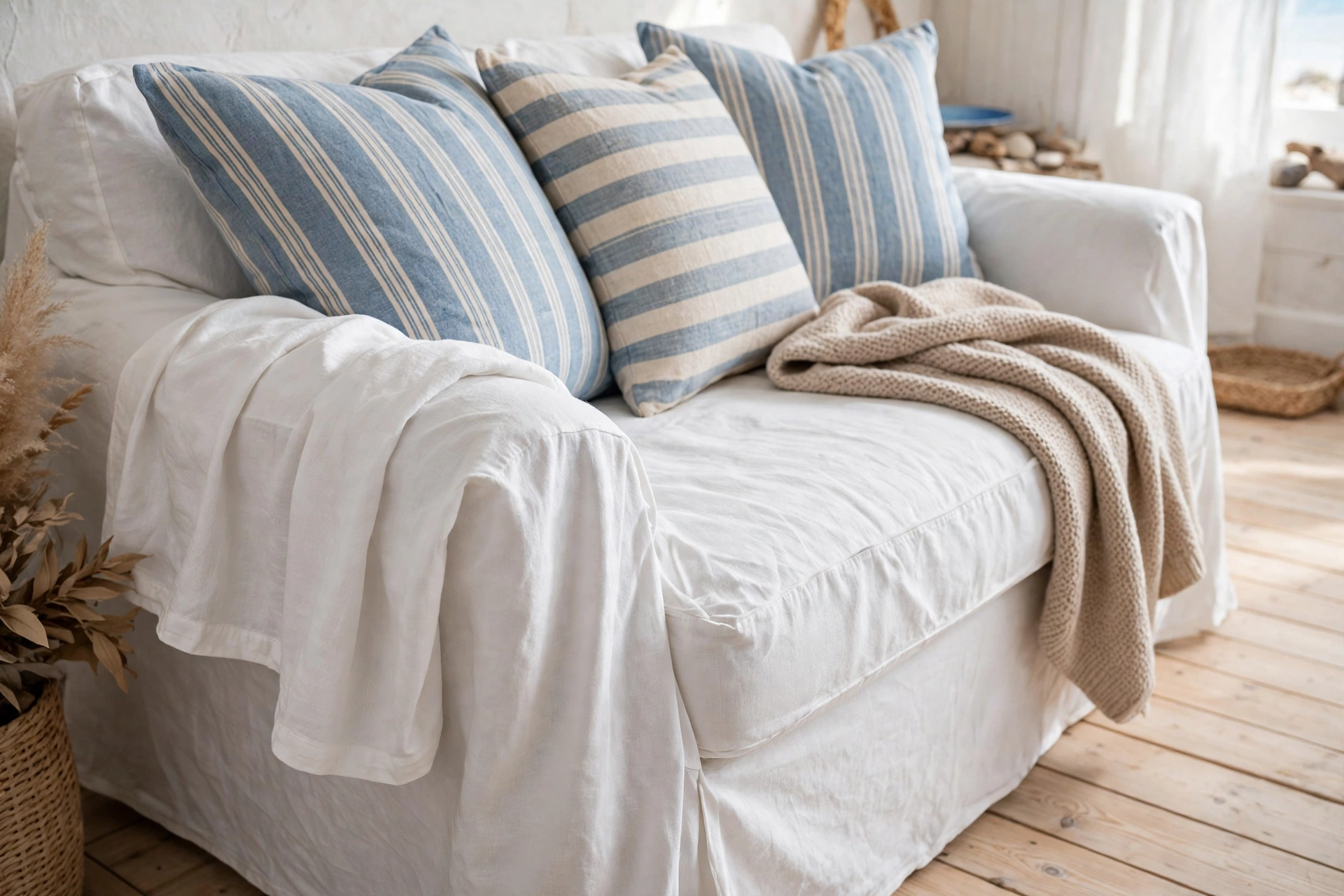
The sofa is the biggest thing in your living room, so it decides the style before anything else does. A dark, heavy sofa fights a coastal look all day; a pale one does half the work for you. As a renter, you do not need a new sofa. You need a slipcover.
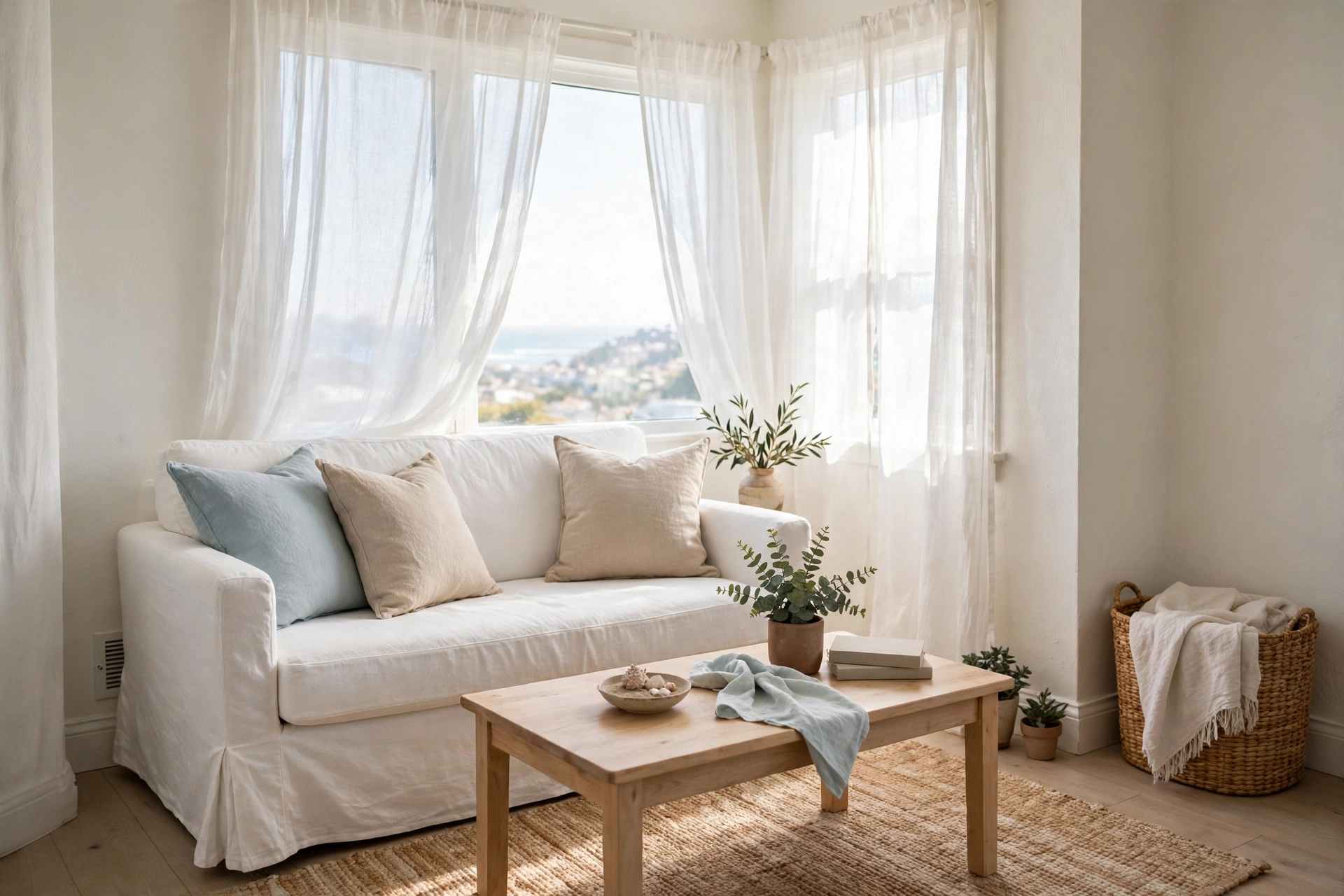
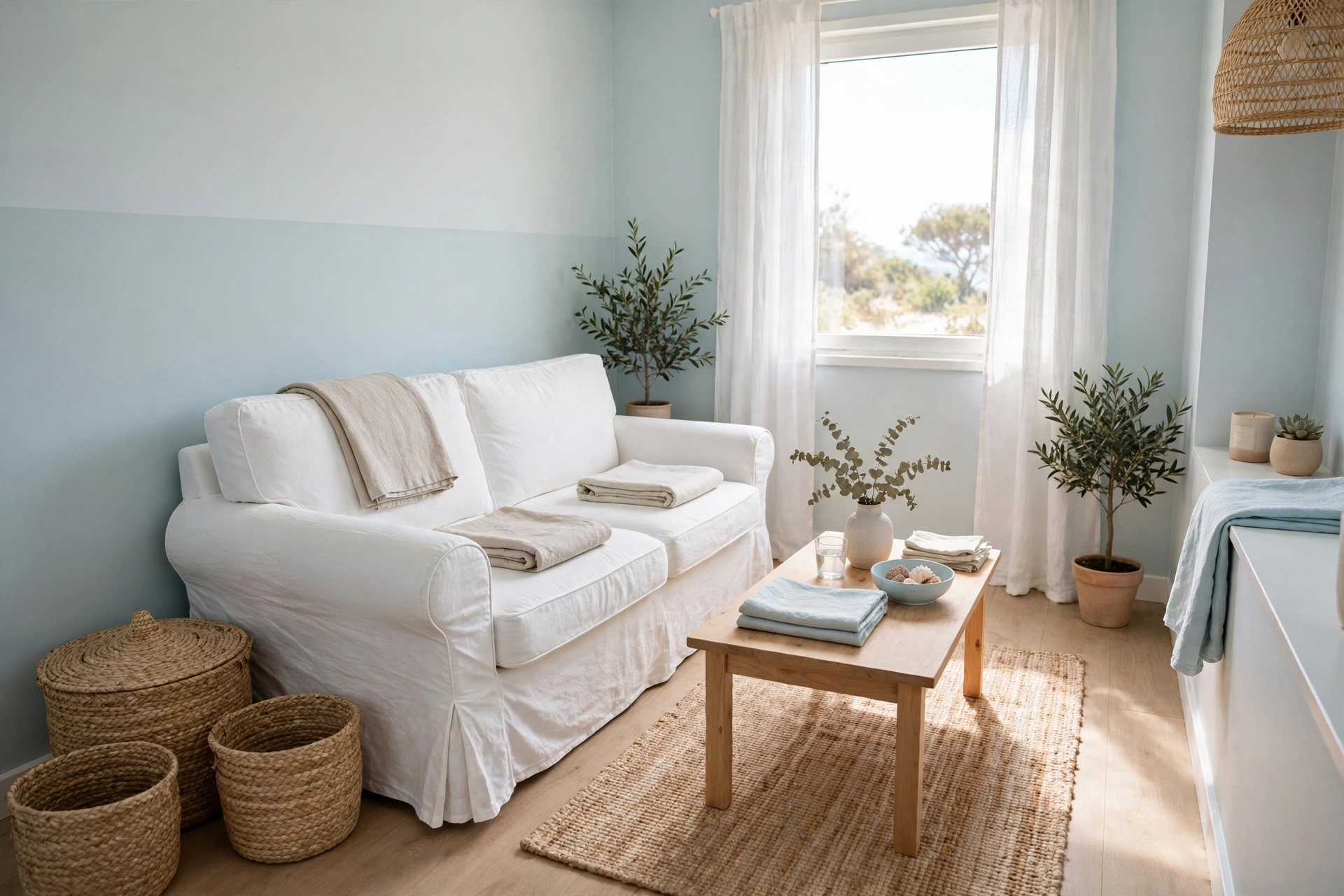
Choose a washable slipcover in soft white, cream, or pale linen. Linen-look cotton is the sweet spot: it reads coastal, it washes in the machine, and it does not shine the way cheap polyester does. Measure first, a slipcover made for a 72-inch two-seater will bag and wrinkle on a 60-inch loveseat, and one made for a sectional will never sit right on a straight sofa. Tuck the extra fabric deep into the seat creases and smooth it once a week; a slipcover that is tucked looks tailored, and one that is left loose looks like a sheet.
If your sofa is already pale gray, oatmeal, or beige, skip the slipcover and spend the money on cushions instead. A gray sofa with white and pale blue linen cushions reads coastal at once. If your sofa is dark brown or black leather, a slipcover is not optional, it is the whole idea. No cushion can lighten a black leather sofa enough to make the room feel breezy.
This is also the most practical coastal living room decor decision you will make. Sand, sunscreen, coffee, and pets are real life, and a washable cover means you can actually live with light colors instead of guarding them, and it moves with you to the next apartment.
2. Size the Rug Like the Room Depends on It (It Does)
Cost: $30–$45 for a flatweave or jute-look rug on sale or secondhand, $0 if you layer rugs you already own. No-drill version: a rug needs no fixings, use a non-slip pad underneath, never tape on the floor.
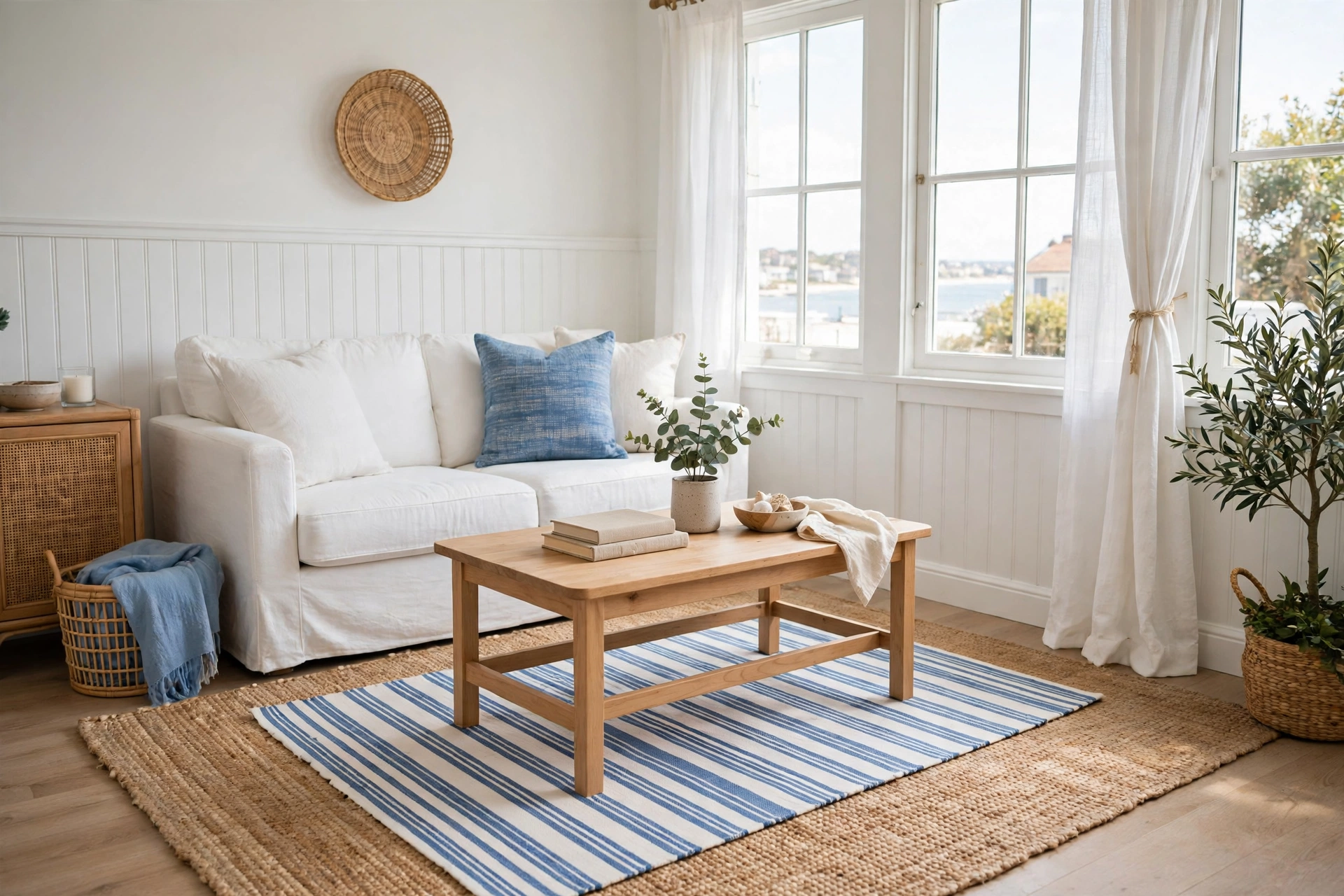
The most common mistake in small coastal living rooms is a rug that is too small. A 4 × 6 ft rug under a 72-inch sofa leaves the sofa legs off the rug, the seating unanchored, and the whole room looking smaller than it is. Go bigger, not smaller: 5 × 8 ft for a 10 × 12 ft room, 8 × 10 ft for an 11 × 13 ft room, with the front legs of the sofa and any chair sitting on the rug.
For coastal decor living room style, the base rug should be plain and natural, a flatweave jute or jute-look rug in sand, or a low-pile cotton rug in warm white. Flatweave matters in a rental: it sits low enough that doors still swing over it, it is easy to vacuum, and a coffee table sits level on it. A thick plush rug in a small room eats visual space and traps sand and crumbs.
Then layer, if you want pattern. This is the trick most competitors mention but few size properly: put a smaller patterned rug, blue and white stripes, or a soft block print, on top of the plain base. The top rug should be about one-half to two-thirds of the base: a 3 × 5 ft top over a 5 × 8 base, or a 4 × 6 over a 6 × 9, centered under the coffee table with at least 8–12 inches of base showing all the way around. The coffee table legs pin the top rug so it does not wander.
For the full sizing formulas, see our guide to rug layering ideas, the same rules work here, and layering is the cheapest way to rescue a too-small rug you already own.
One rental warning: never use double-sided tape directly on hardwood, laminate, or vinyl to hold a rug, it can lift the finish and your deposit. A thin non-slip rug pad cut 1–2 inches smaller than the rug costs $12–$20 and does the job safely.
3. Build a Small Neutral Coastal Living Room Palette
Cost: $15–$20 for two cushion covers and a throw. No-drill version: change color with textiles and removable pieces only, no paint.
Coastal living rooms fail when the palette is too wide. Pick three colors and stop: a warm white or soft white for the big surfaces, a warm sand or pale greige for the sofa and wood tones, and one blue, pale sky blue, soft sea-glass green, or a muted denim, for cushions, art, and one or two small accents. Use the 60-30-10 rule: 60% main color (walls, rug, curtains), 30% second color (sofa, wood, larger textiles), 10% accent (cushions, throw, art).
That discipline is what separates a calm coastal living room from a beach souvenir shop. Repeat each color at least three times around the room: the blue in a cushion, in the art, and in a ceramic vase; the sand in the rug, the throw, and the basket. If the room feels flat, add texture in the same colors before you add a new color, a nubby linen cushion, a woven throw, a chunky knit in cream.
Most coastal decor ideas living room guides start with paint, this one starts with textiles. What about the walls you cannot paint? Work with them. Most rentals have warm white, cream, or builder beige walls, and all three are already coastal, they are the 60% of your palette, for free. If your walls are a cold gray or a yellowed cream you dislike, do not fight them with paint you are not allowed to use. Fight them with scale: a large pale rug, sheer white curtains, and a big light art print pull the eye away from the wall color entirely.
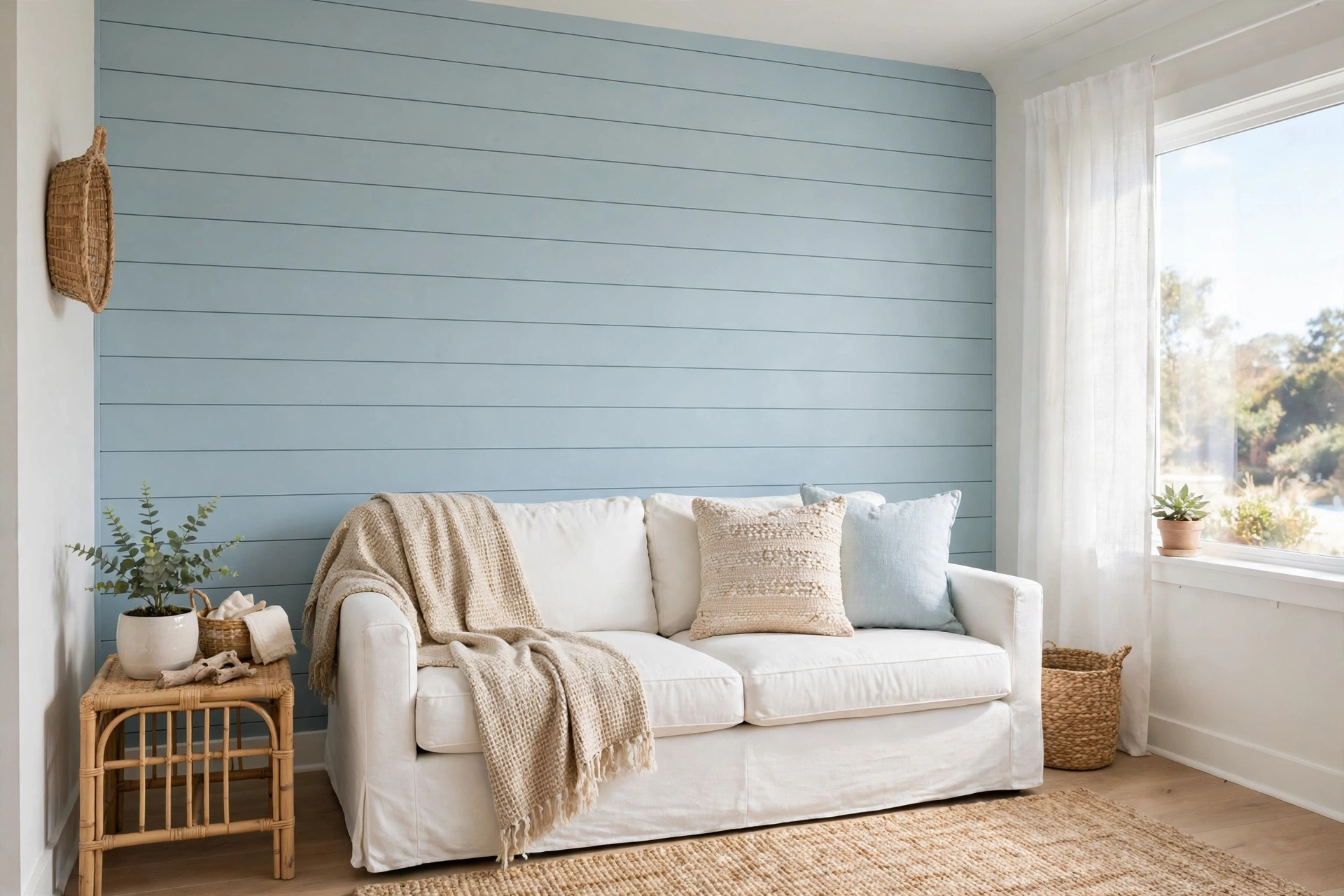
One renter-safe exception is worth knowing: removable peel-and-stick panels. A single strip of shiplap-look or pale blue panels behind the sofa, about 8 feet wide and 3 feet tall, gives you a feature wall you can peel off on moving day. Test one panel in a hidden spot first, and never apply peel-and-stick to freshly painted, textured, or damaged walls. If your lease bans even that, skip it: the textiles alone carry the look.
4. Let the Light In: Sheer Curtains and One Mirror
Cost: $10–$15 for sheer panels and a tension rod, $0 for the mirror if you move one you own. No-drill version: tension rod inside the frame, or removable adhesive rod holders, never drill a curtain rod without permission.
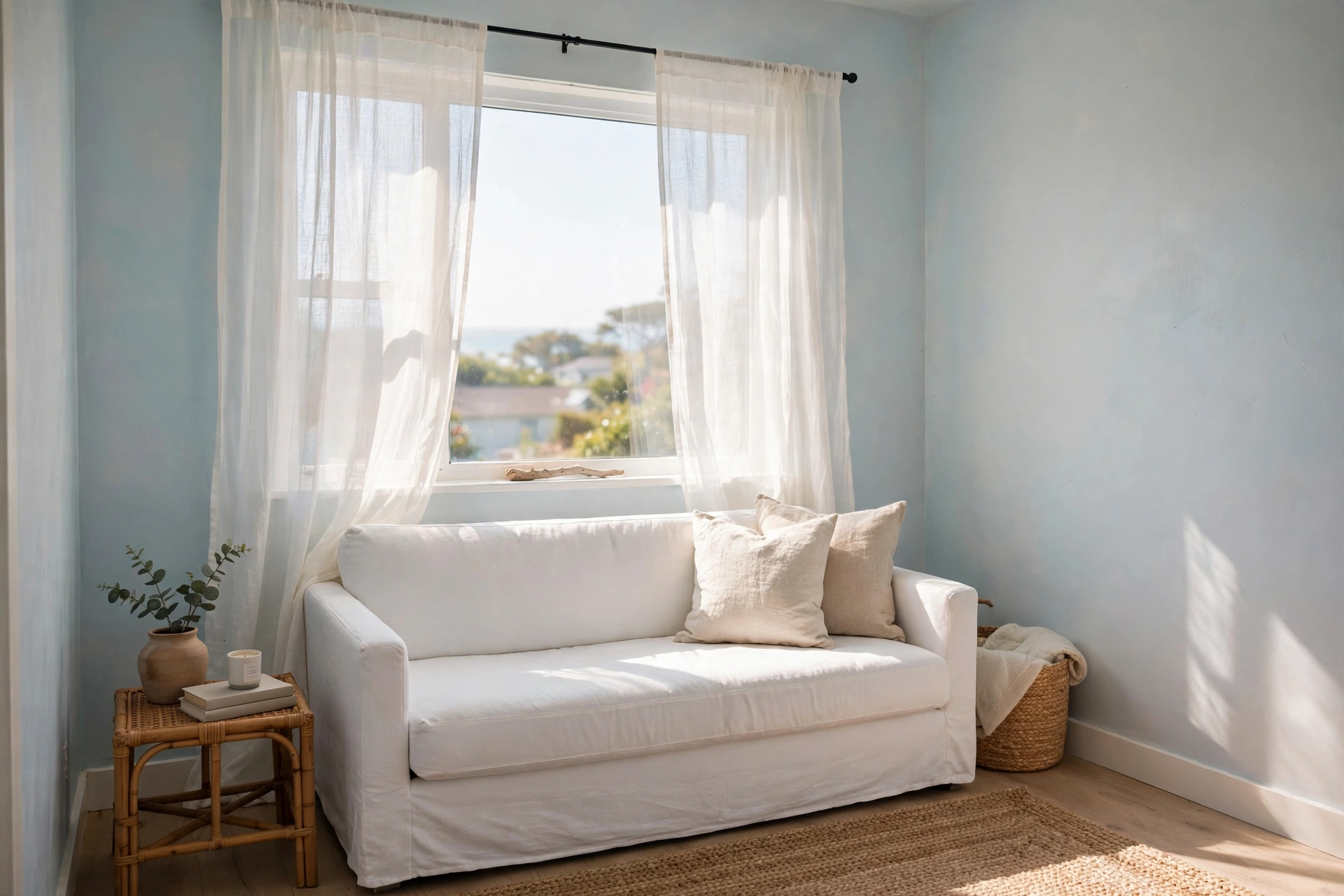
Coastal style is light before it is anything else. Heavy, lined curtains in a dark color will kill the look faster than any wrong cushion. Swap them for sheer white or sheer linen panels that filter daylight instead of blocking it. Hang the rod 4–6 inches above the window frame and 8–12 inches past each side, so the curtains frame the window and the window looks taller. In a rental, a tension rod inside the window frame does the job with no holes at all; if the window is wide, removable adhesive rod holders rated for the curtain weight are the next best thing.
Then add one mirror, one, not three, opposite the window. A leaning mirror, 48–60 inches tall, propped against the wall bounces daylight across the room and makes a small coastal living room feel twice as wide. It needs no fixings, which is exactly the point in a rental. Keep the frame pale wood, white, or thin rattan.
Clean the windows, too. It sounds too simple to matter, and it matters more than a new cushion. Coastal rooms live on daylight, and a dirty window in a small room cuts the light by more than any curtain ever will. Wash the glass inside and out, open the blinds fully during the day, and let the sheer panels do the softening.
If your coastal living room faces north or gets little direct sun, do not try to fake it with cool white bulbs. Use warm white bulbs (2700K) in the evening and keep the daytime palette pale, the room will feel calm rather than cold. Three light sources in the evening, a floor lamp beside the sofa, a table lamp, and the ceiling light, are covered in Idea 10 and in the evening image at the end of this guide.
5. Coastal Wall Decor Living Room Style, Without a Single Nail
Cost: $15–$25 for one large print, $0 if you lean art you already own. No-drill version: lean it, or hang it from removable adhesive hooks rated for its weight, never nails without written permission.
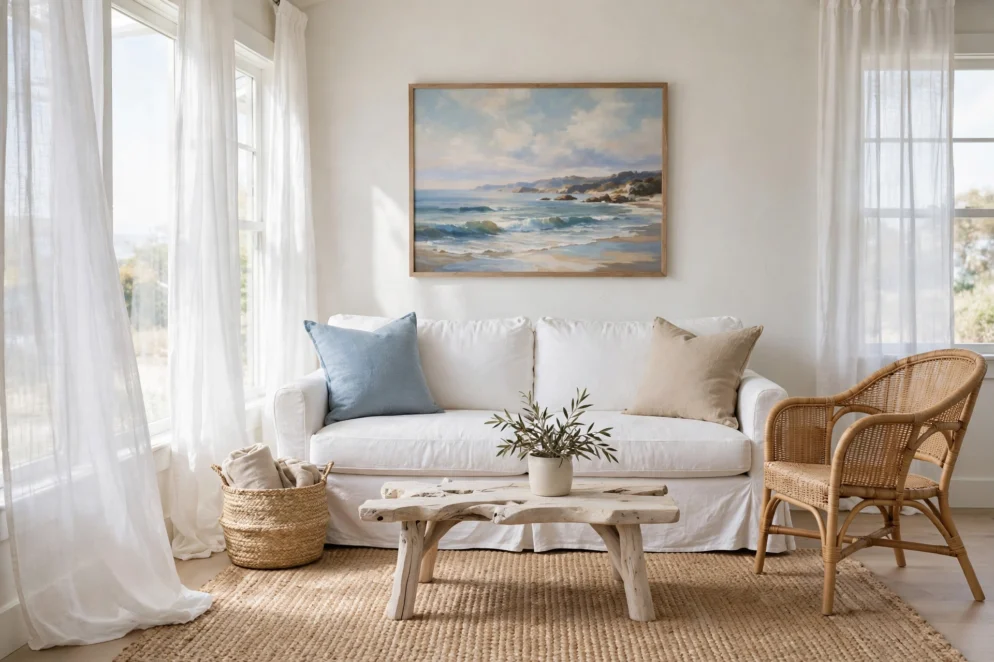
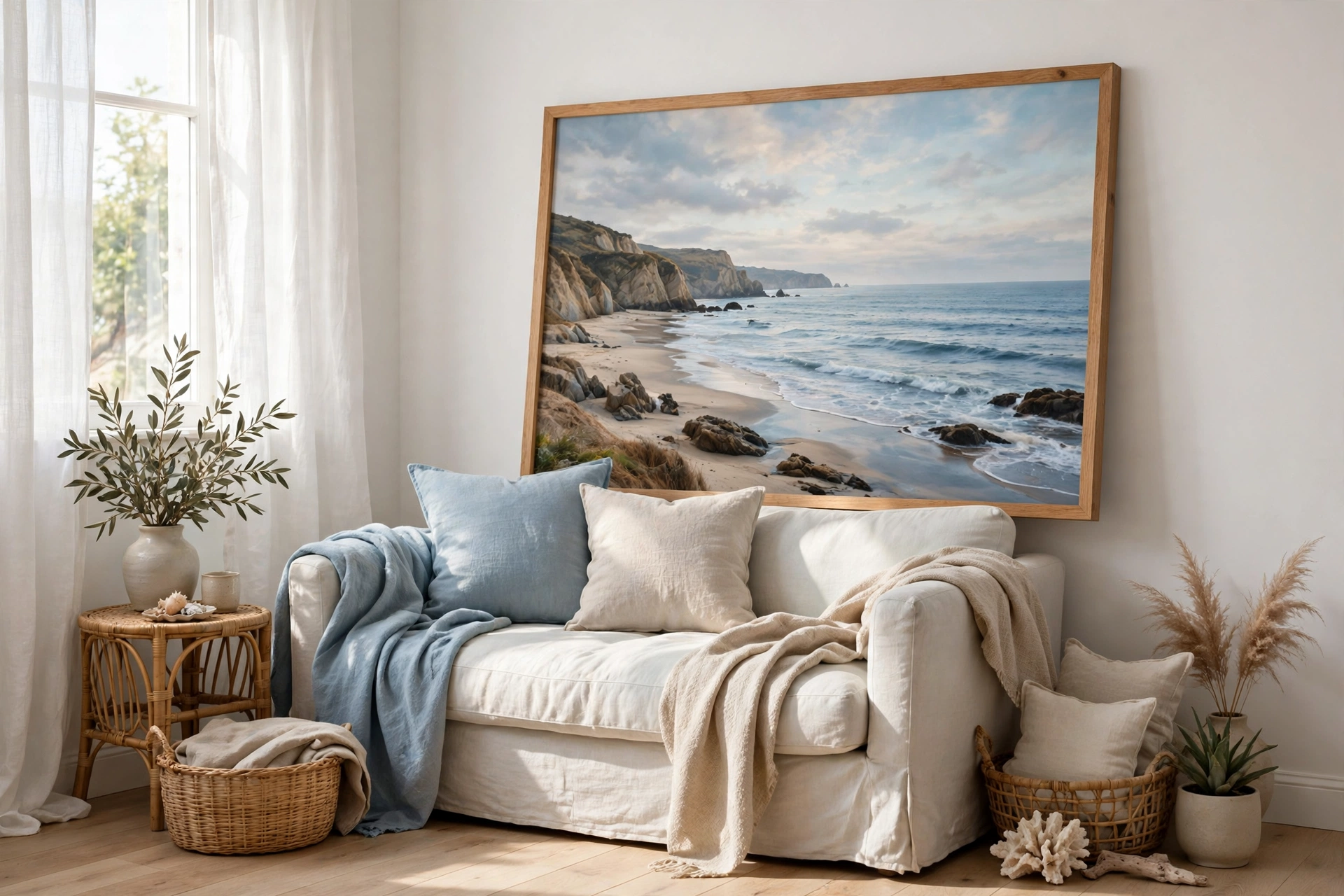
One big piece of coastal wall decor beats five small frames in a small room, and it is far kinder to a rental wall. Choose one large ocean print, a soft watercolor coastline, a misty horizon, a black-and-white surf photo, about two-thirds of your sofa width. For a 72-inch sofa, that is a 48-inch-wide print. Hang or lean it so its center sits 57–60 inches from the floor and its bottom edge sits 6–8 inches above the sofa back. That spacing is what makes it look deliberate instead of random.
Leaning is the renter’s best method and it suits coastal style perfectly: the relaxed, slightly informal lean reads beach-house, not unfinished. Rest the frame on the sofa back or on a low console behind the sofa, and use a small removable adhesive strip at the top corners if the frame wobbles, the strip touches the frame, not a nail hole in the wall.
If you do hang, use removable adhesive hooks or strips rated for the frame’s actual weight, on a clean, dry, smooth wall. Wipe the spot with rubbing alcohol first, let it dry completely, and wait the hour the instructions ask for before hanging. Skip adhesive on textured plaster, brick, or freshly painted walls, it can lift the finish, and the repair costs more than the art.
What should the art show? Calm water, a distant shoreline, soft dunes, or an abstract wash of blue and sand. Skip the literal: no anchors, no ship wheels, no “Life’s a Beach” signs, no plastic starfish. One honest image of the sea does more than a shelf of beach souvenirs, and it is the difference between coastal living room wall decor and a theme park. If you already own driftwood wall art or a woven wall hanging, that counts too, one textured piece, at the same height rules, is enough. For more on sizing art above a sofa in a small room, the measurements in our minimalist small living room guide use the same 57–60 inch center rule.
6. Add One Rattan Chair and Storage That Hides the Clutter
Cost: $0–$30, a secondhand rattan chair, or baskets you already own. No-drill version: freestanding furniture only.
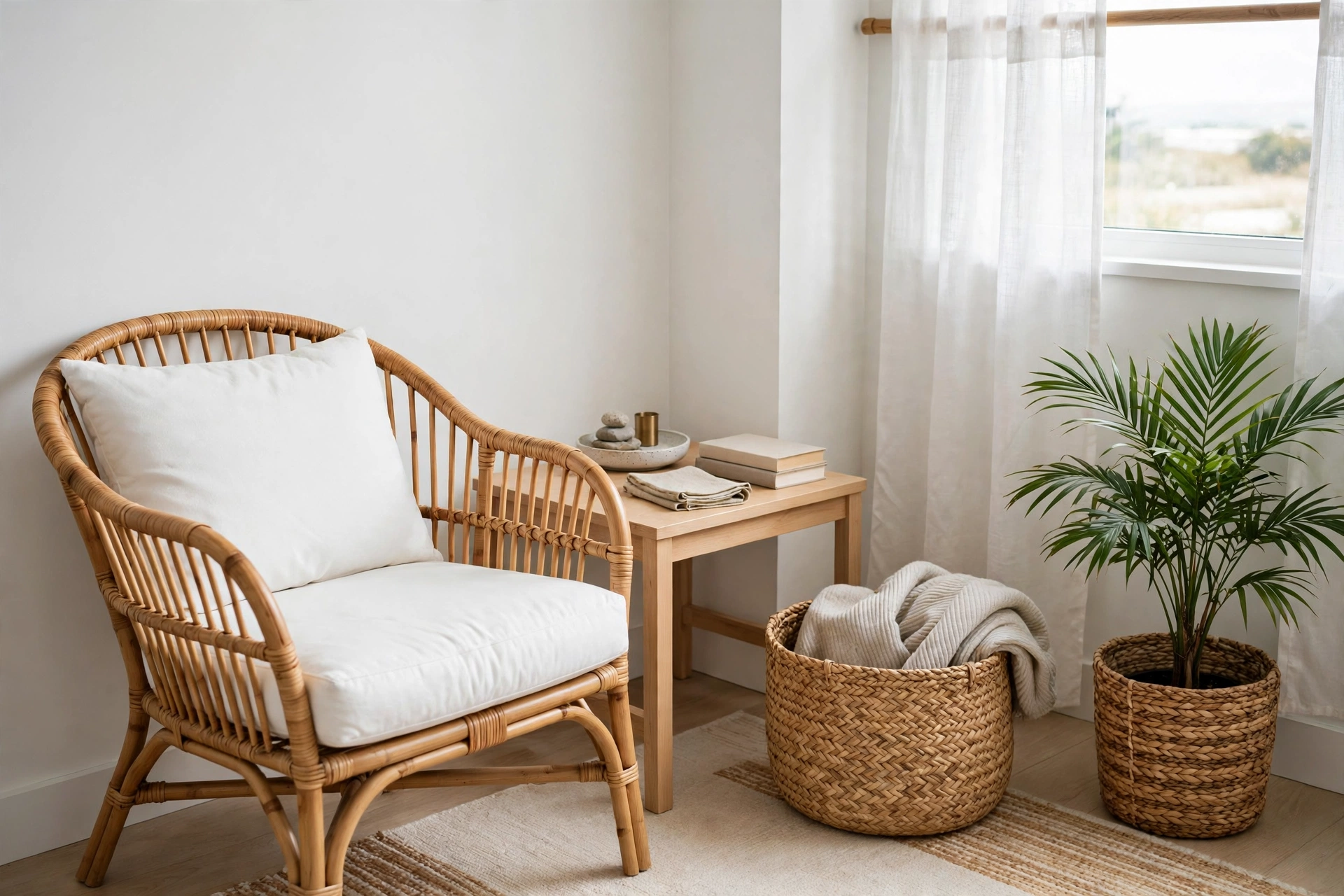
A small coastal living room needs a second seat, but a second sofa will eat the room. One rattan or wicker accent chair does the job: it adds the woven texture coastal rooms need, it is light enough to move for guests, and its open weave lets light and sightlines pass through instead of blocking them. Place it at a slight angle to the sofa, not squared against the wall, with 30 inches of walkway behind it. Add a cushion in off-white or soft blue, never a busy pattern on both the chair and the cushions.
Then hide everything else. Coastal calm dies the moment clutter takes over, and small rooms have nowhere to hide it. That is where woven storage earns its place: two or three seagrass or rope-handled baskets in varied sizes, tucked beside the sofa, under the side table, or under the coffee table. One holds throws, one holds magazines and remotes, one holds the things that used to live on the coffee table.
A basket with a lid, or a storage ottoman in a natural weave, doubles as a side table and a footrest. This is coastal farmhouse decor living room thinking at its most practical, natural materials doing a real job, not sitting on a shelf looking beachy.
Keep the count tight: one chair, two or three baskets, and nothing else on the floor that does not have a job. If a basket is empty, it is decoration; fill it or remove it. A room with three full baskets and clear surfaces reads calm. A room with six half-empty baskets reads like a storage unit.
7. Style a Small, Light Coffee Table
Cost: $0–$25 secondhand or on sale. No-drill version: a freestanding table needs no wall fixings.
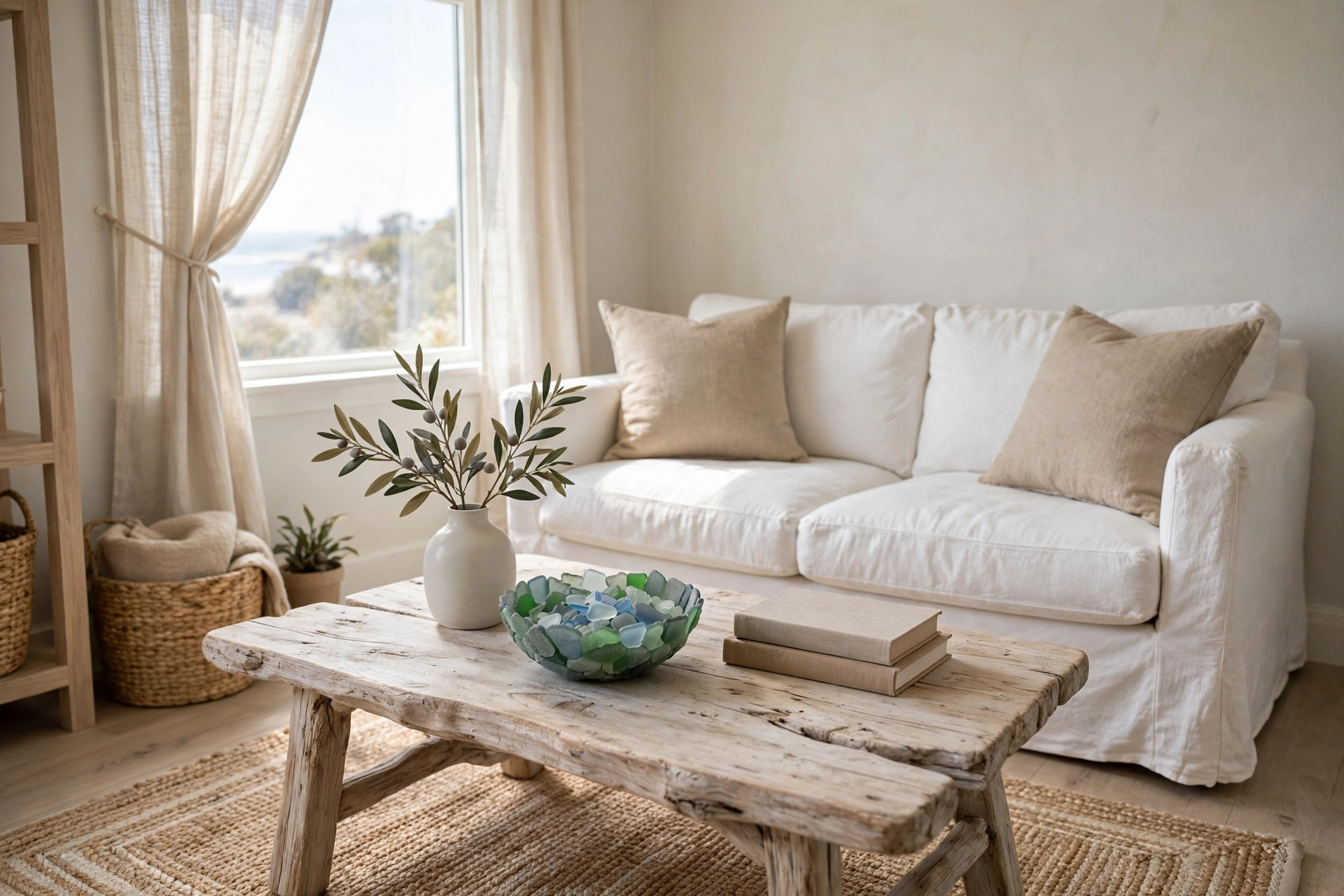
The coffee table in a small coastal living room should be light in every sense: light wood, light color, and visually light. A driftwood-finish or whitewashed wood table, or a glass-top table with pale wood legs, keeps sightlines open. Size it by the sofa, about two-thirds of the sofa length, so about 48 inches for a 72-inch sofa, or a round table 30–36 inches across if the room is tight. A round table has no corners to catch your hip in a 30-inch walkway, which matters more than it sounds in a 10 × 12 ft room. Keep the gap to the sofa at 14–18 inches and the height within 1–2 inches of the sofa seat height.
Good coastal decor for living room tables stays light and low. Style it with three things, maximum: one low stack of two books, one small ceramic bowl or sea-glass vase, and one small plant, or just one of those, with the rest empty. A tray underneath the arrangement gives it a stage and stops small things sliding around. What does not belong: a shell collection spread across the whole table, five candles, and a stack of magazines. Every object you remove makes the ones you kept look intentional.
If you already own a dark wood coffee table, do not replace it yet. A pale linen-look runner, a light tray, and pale objects on top will lift it a long way for $0–$10, and the money you save goes to the rug, which matters more. If the table is too big, longer than two-thirds of the sofa, or so wide the walkway drops below 30 inches, swap it for a smaller one before you buy anything else. Size beats style here.
8. Modern Coastal Living Room, Coastal Farmhouse, or Coastal Chic, Pick One
Cost: $0. This idea is a decision, not a purchase.
Coastal living room ideas split into three looks, and mixing all three is how small rooms turn messy. Pick one and let it decide the details.
A modern coastal living room decor style is the cleanest: crisp white, pale wood, one blue, almost no pattern, and texture doing the talking, linen, jute, rattan, matte ceramic. Furniture has slim arms and visible legs. Nothing is distressed, nothing is themed. If you like the minimalist end of coastal, this is yours.
Coastal farmhouse decor living room style is warmer and a little more layered: whitewashed wood, a slipcovered sofa, woven baskets doing real storage work, and one or two vintage-look pieces. It shares coastal’s natural materials and casual comfort, but keep the farmhouse to the materials, not to word signs and faux-distressed everything.
Coastal chic decor living room style is the dressed-up version: the same pale palette, but with cleaner lines and a little more polish, a glass coffee table, one elegant ceramic lamp, and no visible clutter at all. It suits a small room well, but it needs the storage from Idea 6 to work.
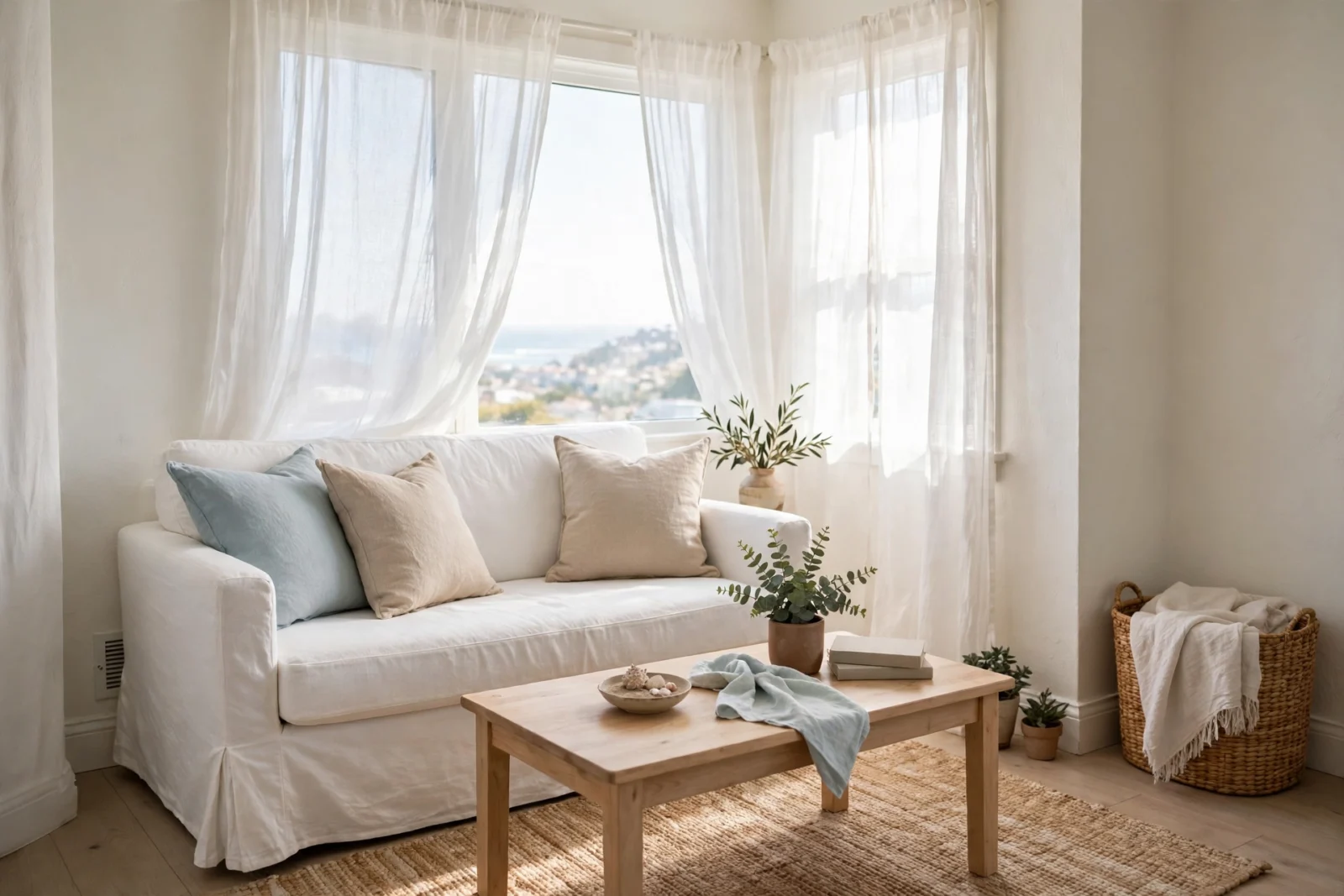
Whichever you pick, the test is the same: stand at the door and count the styles you can see. If you can see two, edit. The room in the photo below is modern coastal, pale, uncluttered, one blue, and it works because nothing in it is arguing with anything else. Small coastal living room ideas work best when the room has one voice.
For more visual inspiration, browse HGTV’s coastal living room ideas to see how designers use pale palettes, natural textures, and one strong blue in real rooms.
9. Add One Plant, Not Five
Cost: $10–$20 for one hardy plant in a woven basket planter. No-drill version: a floor plant needs no fixings.
One medium plant beats five small ones in a small coastal living room, competitors say this, and they are right. Five small pots on every surface read as clutter; one tall plant in the corner reads as life. Choose a hardy one that forgives a renter’s schedule: a snake plant, a palm, or a monstera. Put it in a woven basket planter near the window, not in a bright plastic pot, and let it be the one green note in the room. A palm in a woven basket is the classic living room coastal decor move, height, texture, and green, in one object that takes up one square foot of floor.
Keep it off the coffee table and off the windowsill if the sill is narrow. A plant that blocks light or crowds the table is working against the room. Water it on a schedule, wipe the leaves monthly, and replace it if it dies, a dead plant in a coastal room is worse than no plant at all. If you have no natural light at all in the corner, skip the real plant and use one good faux palm in the same woven basket; a convincing faux plant beats a dying real one, and nobody checks.
10. The Measured Layout for a 10 × 12 ft Room
Cost: $0. This is a rearrangement, not a purchase.
Put these coastal living room decor ideas together in a typical small living room, 10 feet wide and 12 feet long, with one door and one window. Put the sofa on the long 12-foot wall, centered, with its back 3–4 inches from the wall. A 72-inch two-seater leaves about 36 inches of wall on each side, enough for a floor lamp on one side and the tall plant on the other. Put the 5 × 8 ft rug in front of the sofa, with the front legs on the rug and about 12 inches showing on each side. Put the coffee table on the rug, 14–18 inches from the sofa, centered on it. That leaves a 30–36 inch walkway behind the table.
Put the rattan chair at an angle near the window, facing into the seating zone, with the side table and baskets beside it. Hang or lean the one large art print above the sofa, center 57–60 inches from the floor. Put the closed storage or media unit on the short 10-foot wall opposite the sofa, a 48-inch unit fits with room to spare. Leave the window wall mostly clear, with sheer curtains on a tension rod and the leaning mirror opposite the window.
In the evening, the room changes character with light, not with new decor: one floor lamp beside the sofa (58–64 inches tall), one table lamp on the storage unit, and the ceiling light if you have one, all with warm white 2700K bulbs. That is the coastal chic evening version of the same room, same furniture, same palette, warmer light.
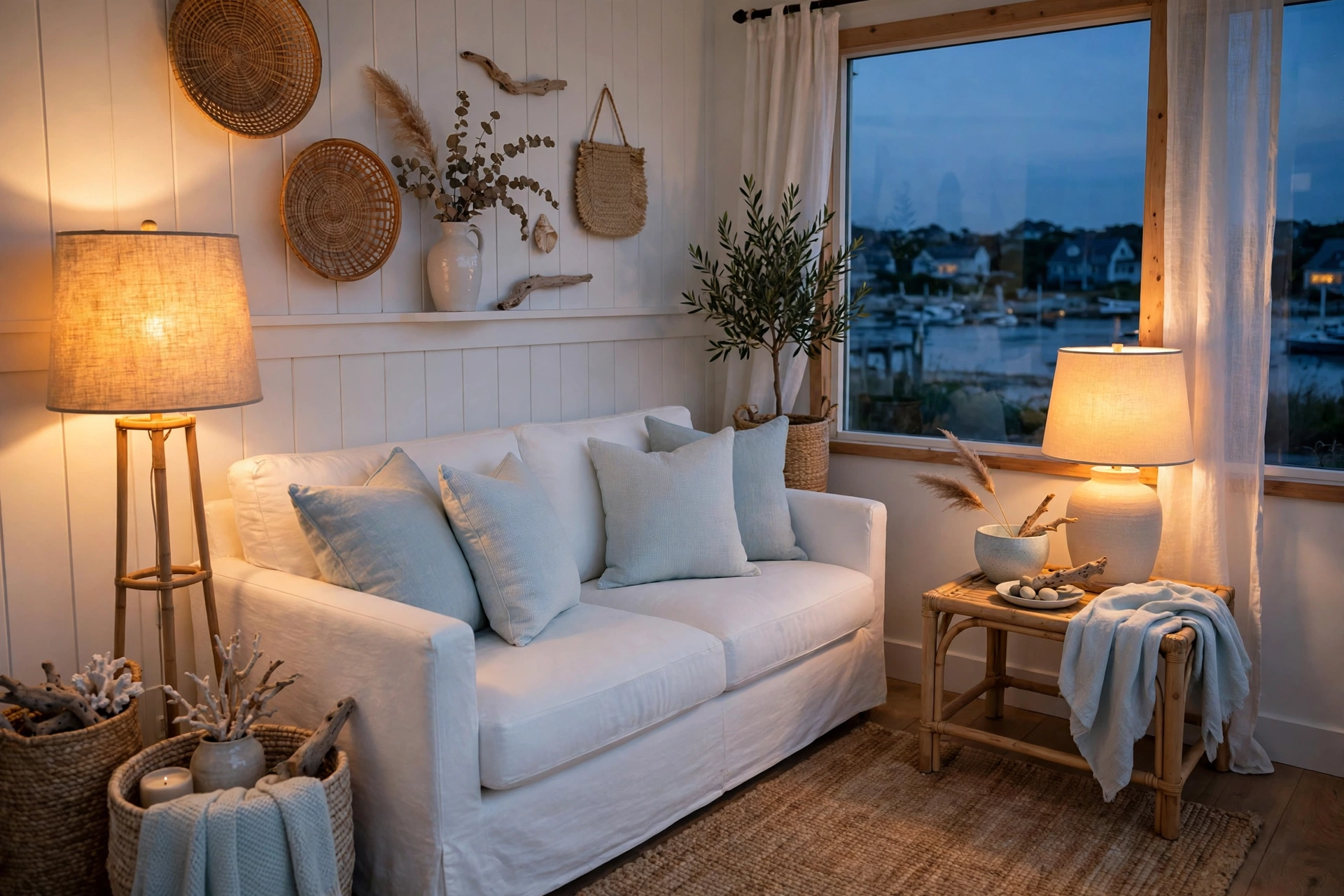
Your Under-$150 Coastal Makeover Budget
Every coastal living room idea above was priced as you read it. Here is the whole room, added up, using the top of each range only where you buy new, and $0 where you reuse what you own.
| What you buy | Cost |
|---|---|
| Washable slipcover (or $0 if your sofa is already pale) | $25–$40 |
| Flatweave or jute-look rug, 5 × 8 ft, on sale or secondhand | $30–$45 |
| Two cushion covers + one throw | $15–$20 |
| Sheer curtain panels + tension rod | $10–$15 |
| One large coastal art print | $15–$25 |
| One hardy plant in a woven basket | $10–$20 |
| Non-slip rug pad | $12–$20 |
| Total if you buy everything | $117–$185 |
That top number is over $150, so here is the honest version. Buy the slipcover only if your sofa needs it, buy the rug secondhand or layer rugs you already own, and lean art you already own instead of buying a print. The realistic renter total, buying the rug, cushions, curtains, plant, and rug pad while reusing a pale sofa and existing art, is $77–$115; buying everything new at the low end of each range is $117. Either way, the makeover stays under $150 when you reuse even one big piece, and most renters already own at least one. Start with the rug and the slipcover, because those two change the room most.
7 Common Mistakes to Avoid
1. Buying a rug that is too small. A 4 × 6 ft rug under a 72-inch sofa leaves the legs off the rug and the seating unanchored. Measure the room, buy the size from the table at the top, and put the front legs on the rug.
2. Going full nautical theme. An anchor and lighthouse pillows and a ship’s wheel and boat prints is a theme park, not a coastal living room. One or two sea references, maximum. The room should feel like the beach, not like a gift shop at the beach.
3. Using navy as a wall color or a sofa color. One navy accent chair is great. Navy walls swallow light in a small room and make it feel smaller and darker. Keep navy to cushions, a throw, or one chair.
4. Filling every surface with shells and small decor. Competitors warn about this in almost every guide, because almost everyone does it. One shell bowl on the coffee table is enough. Five small beach objects on one shelf are clutter, and clutter is the opposite of coastal calm.
5. Choosing plastic wicker, plastic shells, or glossy beach signs. Fake wicker looks shiny and cheap up close, and plastic shells look like toys. Use real rattan, real jute, real linen, and real wood, or skip the piece entirely. Authentic materials in their natural form are what make coastal decor living room style feel grown-up.
6. Pushing all the furniture against the walls. A sofa hard against the wall and chairs in every corner leaves no conversation zone and no flow. Pull the sofa 3–4 inches off the wall, angle the chair in, and leave 30–36 inch walkways clear.
7. Drilling without permission, or taping rugs to the floor. Both risk your deposit. Lean art, use removable hooks rated for the weight, use a tension rod for curtains, and use a non-slip pad, never tape, under rugs. If your lease bans even removable hooks, lean everything and let the furniture do the work.
Frequently Asked Questions
How much does it cost to create a coastal living room?
Competitor guides put a basic refresh at $100–$200, but this guide’s whole makeover stays under $150 when you reuse even one big piece, and the rug-and-cushions-first version costs $77–$115. A moderate makeover runs $500–$1,000, and a full transformation with new furniture can run $2,000–$5,000+, but you do not need any of that. Coastal style works at any budget because it is built on light and natural materials, not expensive furniture.
Can I do coastal style if I don’t live near the beach?
Absolutely. Coastal design is about evoking a feeling, not your actual location. Focus on light, airy spaces with natural textures and a calming color palette. Some of the best coastal rooms are hundreds of miles from the ocean. The key is creating that vacation-home atmosphere wherever you are, and a small rental living room is actually a good place to start, because there is less space to fill.
What’s the difference between coastal and nautical style?
Nautical is a subset of coastal that is more literal: anchors, ship wheels, navy and white stripes, and sailing motifs. Coastal is broader and more subtle, emphasizing natural materials, soft colors, and beachy elements without being themed. Coastal can incorporate some nautical touches, but it is generally more sophisticated and less literal. In a small room, stay coastal, one stripe, not a whole sailing kit.
How do I make coastal style work in a small apartment?
Small spaces actually benefit from coastal living room design. Use white or very light colors, keep furniture minimal and low-profile, stick to 2–3 main colors, and use mirrors to reflect light. Avoid large statement pieces. Instead, focus on small textural elements like pillows, a jute rug, and sheer curtains. One medium-sized plant is better than several small ones. The measurements at the top of this guide, rug size, sofa width, walkways, are what make the small version work.
Can coastal style work with my existing furniture?
Yes. You do not need to replace everything. Start by working with what you have: add white or cream slipcovers to darken furniture, swap out pillows and throws, change your wall art, and add coastal accents. Most furniture styles can be made coastal with the right accessories. Even a traditional leather sofa works with light linen pillows and a jute rug, though a dark sofa will need a slipcover before anything else helps.
What if I’m renting and can’t paint the walls?
No problem. Focus on large textiles to set the tone: a cream or white area rug, light curtains, white or neutral slipcovers, and plenty of pillows. Add a large piece of coastal art to anchor the space. Use removable peel-and-stick panels if your lease allows them and the wall surface suits them. Coastal style relies heavily on accessories rather than permanent changes, which is exactly why it suits renters.
How do I create a coastal look without painting?
Rely on texture and textiles: a jute rug, linen cushions, sheer curtains, pale timber, and woven storage. These carry the scheme without touching the walls. Repeat your three colors in textiles and art, and let the biggest textile, the rug, do the work the paint would have done.
What colors work best for a renter-friendly coastal space?
Light blues, warm whites, sandy neutrals, and soft greens create a calm coastal palette that works with most rental finishes. Keep it to three colors with the 60-30-10 rule, and avoid heavy dark colors as large elements, dark brown, burgundy, deep purple, or black walls and large furniture pieces feel too heavy in a small room.
Can I add coastal style without buying new furniture?
Yes. Add pillows, throws, baskets, and a coastal rug. These small pieces can shift the mood of the room quickly. A slipcover, a rug, and sheer curtains are the three swaps that change a room most without replacing a single piece of furniture.
What is the easiest coastal upgrade for renters?
Add breezy curtains or add a large beach print. Both changes make the room feel brighter and more relaxed, and both come down on moving day with no repair needed; either change lifts a coastal living room in an afternoon.
How do I prevent my coastal room from looking like a beach souvenir shop?
The key is restraint. Choose one or two statement pieces rather than covering every surface with shells and starfish. Avoid decorative signs with beach puns. Stick to authentic materials like real driftwood, genuine shells, and natural rope rather than plastic versions. If you would not find it in an actual beach house, do not put it in your room.
Start Today
Your coastal living room is one weekend and under $150 away, and the first step costs nothing at all. Measure your sofa wall and your rug space tonight, tape the rug outline on the floor, and move the sofa 3–4 inches off the wall. Tomorrow, swap in sheer curtains and lean one big ocean print above the sofa. By Sunday, with a washable slipcover, a right-sized jute rug, and two pale blue cushions, the room will feel like a beach house, no paint, no drilling, no deposit at risk, and every single piece ready to move with you to the next place you call home.