Coastal decor is the fastest way to make a small home feel bigger, calmer, and easier to live in, and you do not need a beach house, a big budget, or your landlord’s permission to get it. This guide is the full coastal decor system: the colors, the textures, the materials, and room-by-room ideas for your living room, bedroom, bathroom, kitchen, and entryway, all sized for small spaces and all renter-friendly. No paint, no drilling, and most rooms refreshed for under $150.
Table of Contents
What Coastal Decor Actually Is (and What It Is Not)
Coastal decor is a feeling before it is a shopping list. The best coastal rooms feel like the first morning of a beach vacation: bright, unhurried, a little sun-bleached, and easy to live in. That feeling comes from three things, light, natural materials, and breathing room, not from a cart full of seashells. Living Spaces’ five coastal decor ideas show the same idea in real rooms: light colors, natural textures, and almost no themed clutter.
That distinction matters, because most coastal rooms fail the same way. They buy the theme instead of building the feeling. A rope lamp, a sign that says BEACH, a bowl of shells, and a sailboat print do not make a coastal room. They make a gift shop full of beach themed decor. The designers quoted by The Spruce put it plainly: incorporating natural elements through color, texture, and plants is the first step to avoiding the cliche seashells and blue tones that overdo a coastal aesthetic.
Coastal style is also not the same as nautical style. Nautical is a subset of coastal, and it is far more literal: anchors, ship wheels, navy and white stripes, sailing motifs. Coastal is broader and more subtle. It borrows the colors of sand and sea and the textures of driftwood and linen, and it stops there. You can use one nautical touch, a thin stripe, a rope detail, a weathered lantern, but the moment you use three, the room stops being coastal and starts being a costume.
And coastal decor is not one look. There are three main flavors: classic coastal (white walls, soft blues, natural wood, relaxed cottage feel, the safest choice for a small rental), modern coastal decor (the same palette with cleaner lines, fewer patterns, and more negative space, the version that dates slowest), and coastal grandmother (softer, more layered, linen and wicker and blue-and-white ceramics, warm, but it needs more space, so keep it to one room if your home is small). Pick one flavor for the whole home and stick to it. One flavor, repeated room to room, is what makes a small home feel bigger: the eye travels without stopping.
The Coastal Color System: The 60-30-10 Rule
Every room in this coastal design style follows the same ratio, whether the designer planned it or not: 60 percent light neutral, 30 percent natural fiber tone, 10 percent ocean color. Get the ratio right and the room feels coastal even before you add a single beach object. Get it wrong, too much blue, and the room feels cold, dark, and smaller than it is. That ratio is the backbone of coastal decor in every room, from the living room to the bathroom.
The 60 percent: warm white and sand. Your walls, your sofa, your largest rug, and your bedding should live here. Use a warm white, not a stark blue-white: warm whites bounce daylight around without turning clinical under a lamp at night. Sandy beige, soft cream, and pale driftwood gray all count. If your rental walls are already a warm white or light beige, that is your 60 percent, free.
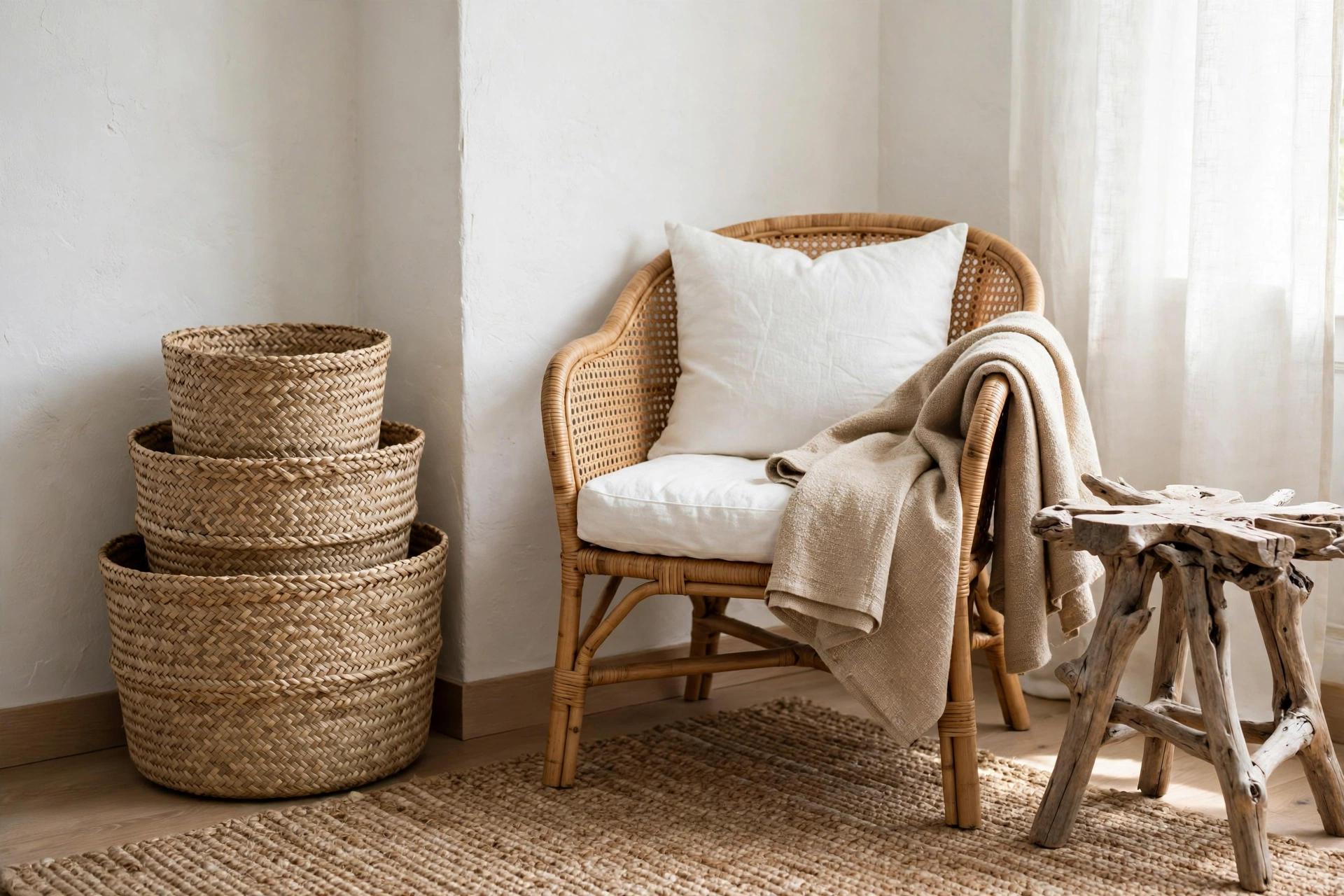
The 30 percent: natural fiber tones. This is the color of jute, rattan, seagrass, light oak, and unbleached linen. It is what keeps a white room from feeling sterile. A jute rug, a rattan chair, a woven basket, and a pale wood coffee table will usually fill this 30 percent on their own.
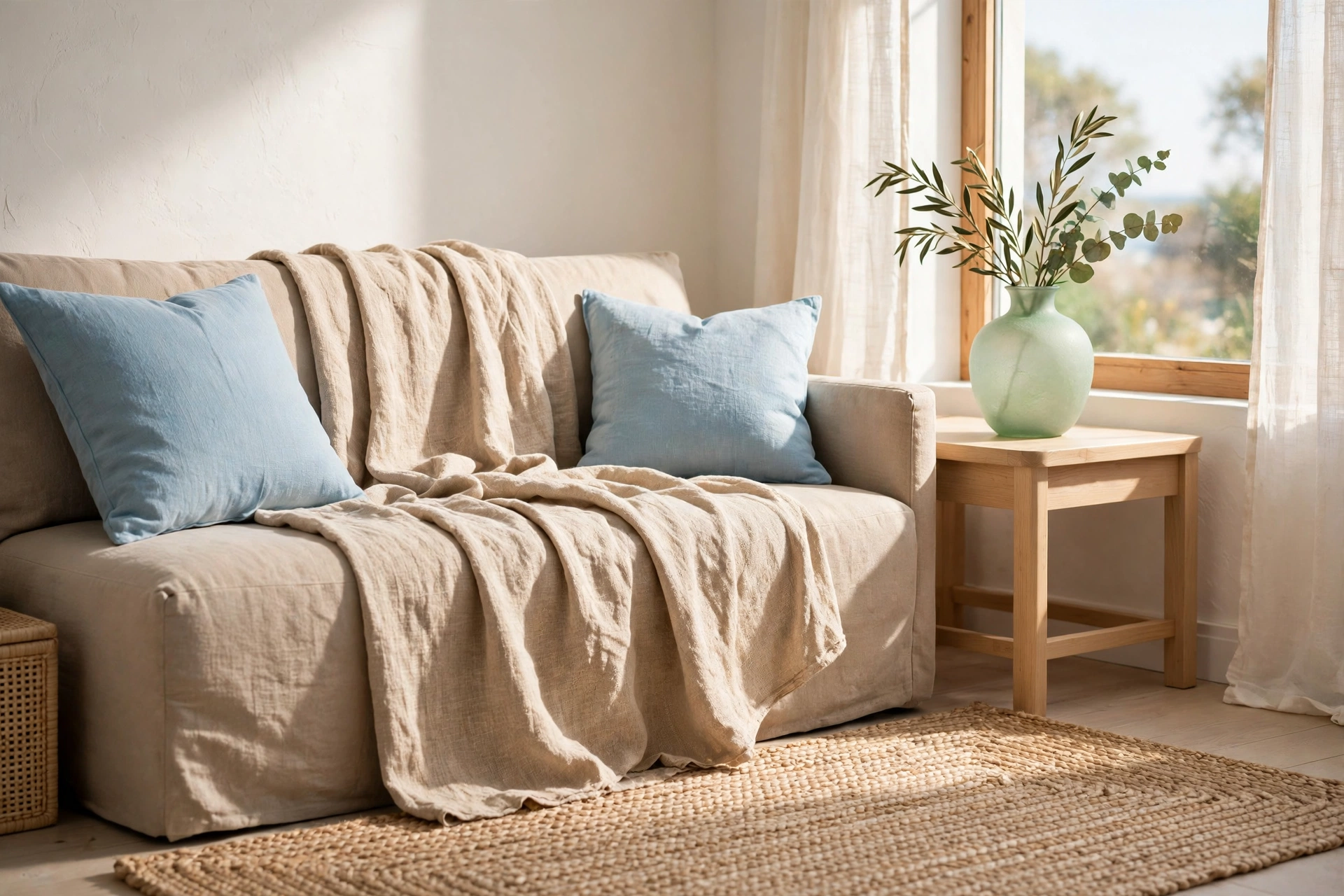
The 10 percent: one blue. Pick one blue and repeat it, and only it. Pale sky blue, soft sea-glass green, or a muted dusty blue all work. What does not work is five blues fighting each other in one room. Two or three blue pillows, one blue throw, and one piece of blue-and-white art are enough for a whole living room.
The 5 Materials That Make a Room Coastal
If color is the first thing people notice, texture is the thing that makes them stay. Modern coastal interior design takes almost all of its interest from surface, not pattern: a loose linen weave against a jute pile against a cane door against painted wood. Here are the five materials that make coastal chic decor work. Those surfaces are what make coastal decor feel relaxed instead of decorated.
1. Linen and cotton. Slipcovers, curtains, bedding, and pillows. Linen is the coastal fabric because it wrinkles, softens, and washes, it looks lived in, not showroom stiff. A washable linen or cotton slipcover is the single best coastal purchase for a renter: it turns a dark or dated sofa coastal for $50 to $120, and you take it with you when you move. Keep slipcovers light, white, cream, or sandy beige, and let the pillows carry the color.
2. Jute, sisal, and seagrass. Rugs, baskets, and storage. A jute or sisal rug is the fastest coastal change you can make to a floor, and it stands up to sandy feet and pets. In a small living room, the base rug should be at least 5 by 8 feet, with the front legs of the sofa and chairs sitting on it and 12 to 18 inches of bare floor between the rug edge and the walls. Layer a smaller patterned rug on top, 3 by 5 feet over a 5 by 8 base, or 4 by 6 over a 6 by 9, for the depth that makes a room feel styled instead of bare. I
3. Rattan and wicker. Chairs, pendants, baskets, and mirrors. Rattan is lightweight, which matters in a small room: its open weave lets light through instead of blocking it. One rattan piece per room is the right amount. Two is fine if one is small, like a basket. Three large rattan pieces in one small room start to feel like a furniture showroom.
4. Light and weathered wood. Coffee tables, shelves, frames, and driftwood accents. Choose whitewashed, bleached, or pale oak finishes, dark, polished wood adds visual weight and pulls a room away from coastal toward traditional. Driftwood is the most coastal wood there is, and the cheapest: a branch 24 to 40 inches long and 1 to 2 inches thick is the right size for a wall piece, and a craft-store branch costs $10 to $30.
5. Glass, ceramic, and stone. Vases, bowls, and lamps. Clear glass, matte white ceramics, and pale stone add the reflective surfaces that bounce light around a small room. Keep glass and ceramic to two or three pieces per room, more than that, and the surfaces start to look like a shop shelf.
Combine at least three natural textures in every room, and limit yourself to two or three material types per room. Three textures are enough for coastal decor to feel layered without looking busy.
The Renter Rules: Coastal Without Paint or Drilling
Almost every coastal guide online assumes you can paint. Renters cannot, and that is where most guides stop being useful. The good news is that coastal style relies more on accessories than on permanent changes. These are the rules that keep your deposit safe. That is why coastal decor suits renters so well: the look lives in portable pieces, not in the walls.
No paint? Use textiles as your walls. A cream or white area rug, light curtains, a white or neutral slipcover, and plenty of pillows set the palette without touching a wall. If your rental walls are a color you dislike, hang one large piece of coastal art, 24 by 36 inches or larger, and let it anchor the wall. The eye goes to the art, not the wall behind it.
No drilling? Use strips, hooks, and leaning. Picture hanging strips are rated up to 16 pounds per pair on a clean, smooth surface. A light frame needs one pair; a 16 by 20 inch canvas needs two pairs; a 20 by 24 to 24 by 36 inch piece needs four pairs. Wait 1 hour after pressing a strip on before hanging anything, and 24 hours before trusting it fully. Test any adhesive in a hidden spot for 48 hours first, and never use adhesives on walls painted less than 30 days ago. Anything over 16 pounds should lean, not hang. Leaned art is a quiet coastal decor win, too: it looks intentional and leaves no holes at all.
Light is free, so use all of it. Remove heavy drapes and replace them with sheer linen or cotton panels. Clean the windows. Hang a mirror opposite the window, a round mirror 24 to 36 inches wide doubles the light in a small room. Keep windowsills clear: a cluttered sill blocks light and breaks the whole coastal effect.
Coastal Living Room Ideas
The living room is where coastal decor earns its keep, because it is the room you live in most. The goal is a coastal living room that feels breezy without feeling empty, and styled without feeling staged.
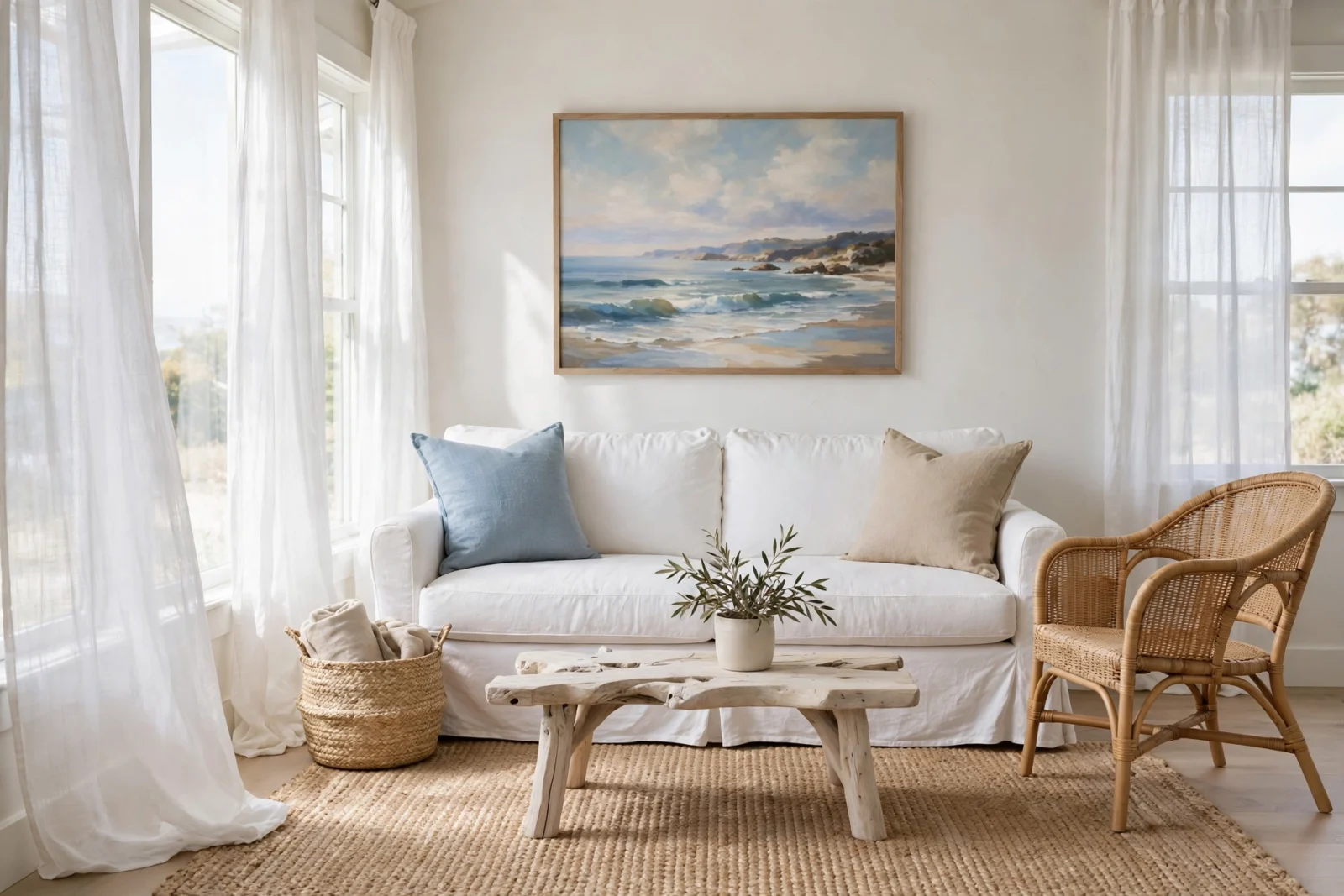
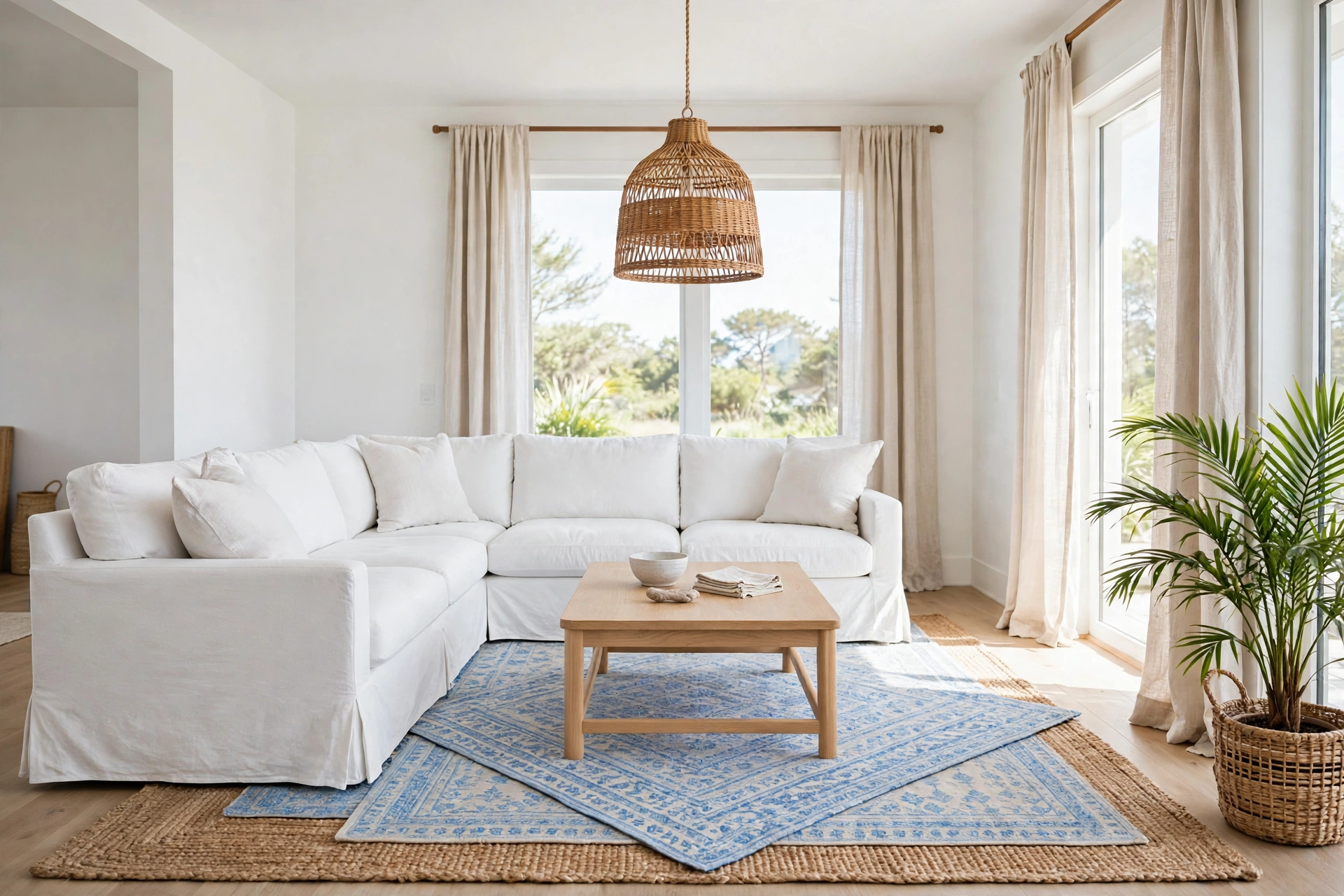
Start with the sofa, not the shells. A white or cream slipcovered sofa is the anchor of a modern coastal living room. Choose a sofa with exposed legs rather than a skirted base: visible floor under the furniture is the single most reliable way to make a room read as airy. A slipcovered sofa is the single biggest coastal decor decision in the room, so choose it before the accessories.
Size the rug before you buy anything else. The base rug should be at least 5 by 8 feet in a small living room, 6 by 9 or 8 by 10 if the room allows, with the front legs of the sofa and chairs on the rug.
Layer a smaller rug on top, a 3 by 5 foot patterned rug over a 5 by 8 base, or a 4 by 6 over a 6 by 9, centered under the coffee table, with at least 8 to 12 inches of base showing on every side. The visible frame of base rug is what makes it read as layering instead of stacking. For the full size formula, pattern pairings, and the grip rules that keep two rugs from sliding, see our guide to rug layering in the living room.
Hang sheer curtains high and wide. Hang the curtain rod 4 to 6 inches above the window frame and 6 to 12 inches wider than the window on each side, so the panels hang beside the glass instead of covering it. Sheer linen or cotton panels, floor-length, in white or cream, filter harsh sun into a soft glow while keeping the view. Heavy drapes collapse the whole coastal effect, no matter what else you did right. Two panels cost $25 to $60 each.
Keep the coffee table light. A whitewashed or pale wood coffee table, 36 to 48 inches long, leaves 14 to 18 inches between the table and the sofa. Round tables work better than rectangular ones in tight rooms, because there are no corners to catch your hip. Style it with three things only: a stack of two books, a small vase, and one coastal object.
Coastal Bedroom Ideas
Good coastal bedroom decor feels like the best beach house decor: cool sheets, pale light, and nothing you have to think about before coffee. The bed takes up most of the visual field, so bedding deserves the largest share of the budget. In a small bedroom, coastal decor works best when the bed does most of the talking.
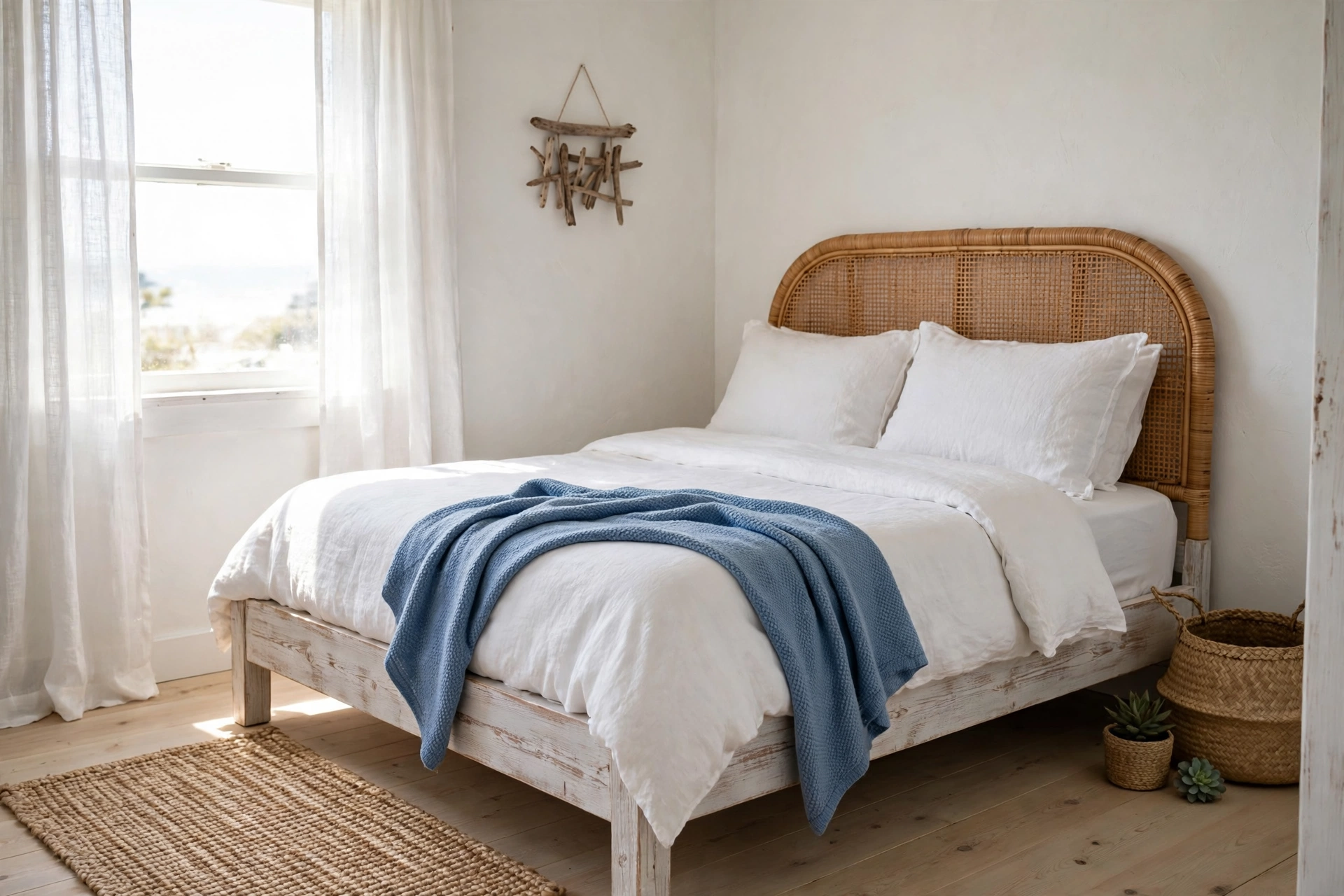
Put the bed against the longest uninterrupted wall and leave the window wall open. That preserves daylight and makes the room read larger than its footprint. Leave at least 24 inches of walkway on each side of the bed, and 30 inches at the foot if you can. In a room under 140 square feet, a low bed frame matters more than style: a tall frame cuts the room in half visually, while a low platform or slim cane frame in bleached white, with no footboard, lets your eye travel to the wall.
Dress the bed in one calm tone. White or warm-white linen or cotton bedding, with one blue or sea-glass accent: two blue pillows, or a soft blue throw folded across the foot. A wide nautical stripe on bedding is fine as long as it is the only bold pattern in the space. Skip busy patterns and sea-creature motifs on bedding; they shrink a small room.
One natural texture, not three. In a small coastal bedroom, choose one: a jute rug beside the bed, or a rattan headboard, not both if the room is very tight. A lidded seagrass trunk at the foot of the bed holds extra linens and doubles as a bench, storage that earns its floor space.
Hang one large piece of art, not a gallery. One larger piece of wall art above the bed, about two-thirds of the bed’s width and hung with its center 57 to 60 inches from the floor, anchors the space and keeps the wall calm. A gallery of six small beach prints above a bed in a small room reads as clutter; one calm seascape reads as a window.
Light it in three layers. Overhead lighting alone flattens a room, so add one bedside lamp and one lower accent light. A small woven basket beside the bed corrals books and a lamp cable, and a bud vase with a single stem on the nightstand is enough.
Coastal Bathroom Decor Ideas
The bathroom is the easiest room to take coastal, because it is small and it needs almost nothing. Coastal bathroom decor ideas work best when they stay practical: everything in a bathroom gets wet or steamy, so choose materials that dry out instead of rotting. Keep every piece washable, and coastal decor stays easy to live with, even in a steamy room.
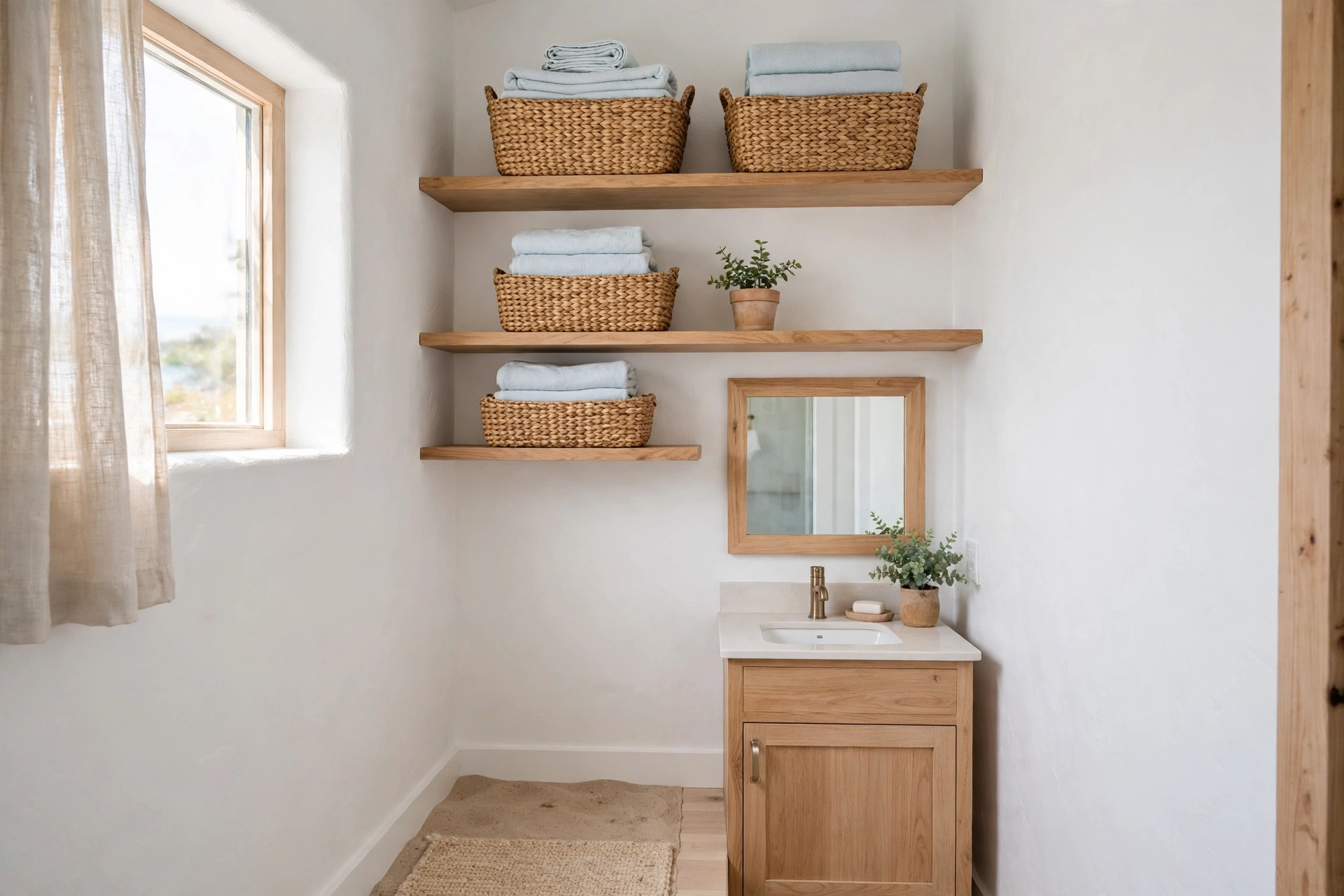
Start with towels, not tile. Store them rolled in a woven seagrass basket on an open shelf or beside the vanity, storage and decoration at the same time.
Add a mirror that bounces light. A round mirror 24 to 30 inches wide, in a light wood or rope frame, hung with its center 57 to 60 inches from the floor, doubles the light in a small bathroom. Never hang a mirror where it reflects clutter, face it toward the window or the cleanest wall.
Use a shower curtain as your accent wall. In a rental bathroom, the shower curtain is the biggest piece of fabric in the room, and the cheapest way to set the palette. Choose a white or pale blue curtain in linen-look fabric, or a subtle stripe, and keep everything else plain. A busy beach print on the curtain plus patterned towels plus shell soap dishes is three patterns too many.
Swap the small things, not the fixtures. A woven soap dish, a glass jar for cotton balls, a pale wood tray on the vanity, and a sandy beige bath mat cost $25 to $50 together and do more than any fixture change. Skip the shell-shaped soap dispensers and the starfish toothbrush holders, one coastal object per surface is the limit. And run the fan during every shower and for 20 minutes after: no material survives a bathroom with no airflow.
Coastal Kitchen Touches
You do not need a coastal kitchen remodel. In a small rental kitchen, beach room decor works as touches, open shelving, ceramics, and textiles, because the cabinets and counters are not yours to change. A few well-chosen touches are all coastal decor needs in a kitchen.
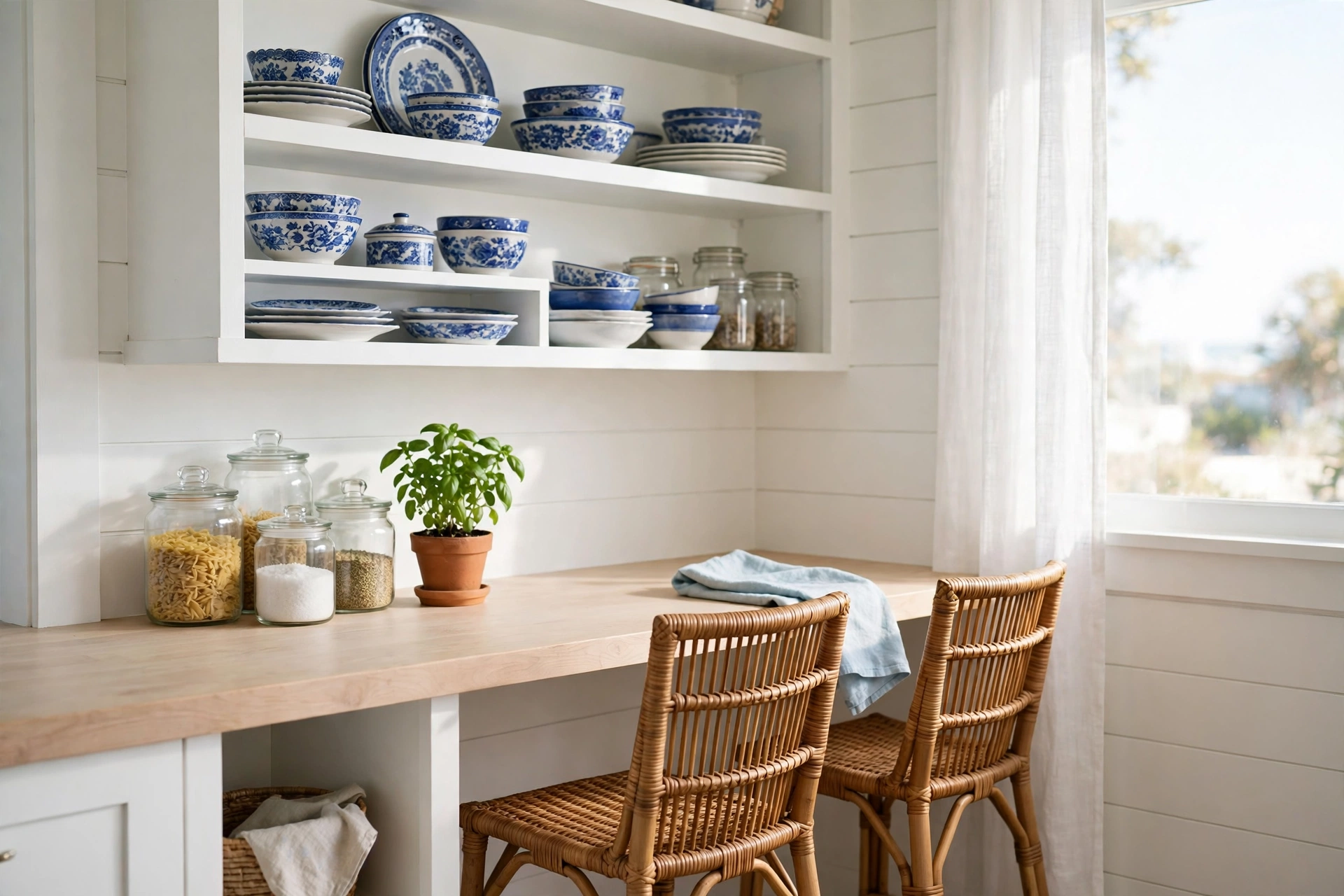
Open one shelf. Style one shelf with blue-and-white ceramics: three plates, two bowls, and a stack of glasses, with 2 to 3 inches of breathing room between groups. Open shelving looks breezy only when it is half empty; a shelf packed edge to edge looks like a storage unit.
Use the textiles you already touch every day. A pale blue linen dish towel, a sandy beige oven mitt, and a woven placemat set the palette for $15 to $30, and you see them every time you cook. Keep the dish towels to one color family, white plus one blue.
Style the counter with three things. A glass jar of wooden spoons, a small potted herb plant, and one ceramic bowl of lemons or limes is a complete coastal kitchen counter. Lemons are the warm accent that keeps a white-and-blue kitchen from feeling cold, and they cost less than any decor object. Clear everything else off the counter every night, a clear counter is the cheapest coastal upgrade there is. Skip the beach theme here entirely, and if you want one coastal moment, make it a framed seascape print on the one empty wall.
Entryways and Small Corners
Small corners are where coastal home decor is most forgiving, because a corner needs only three things to feel finished: something on the wall, something to hold things, and something alive. A corner needs very little for coastal decor to read clearly: one light wood piece and one woven texture.
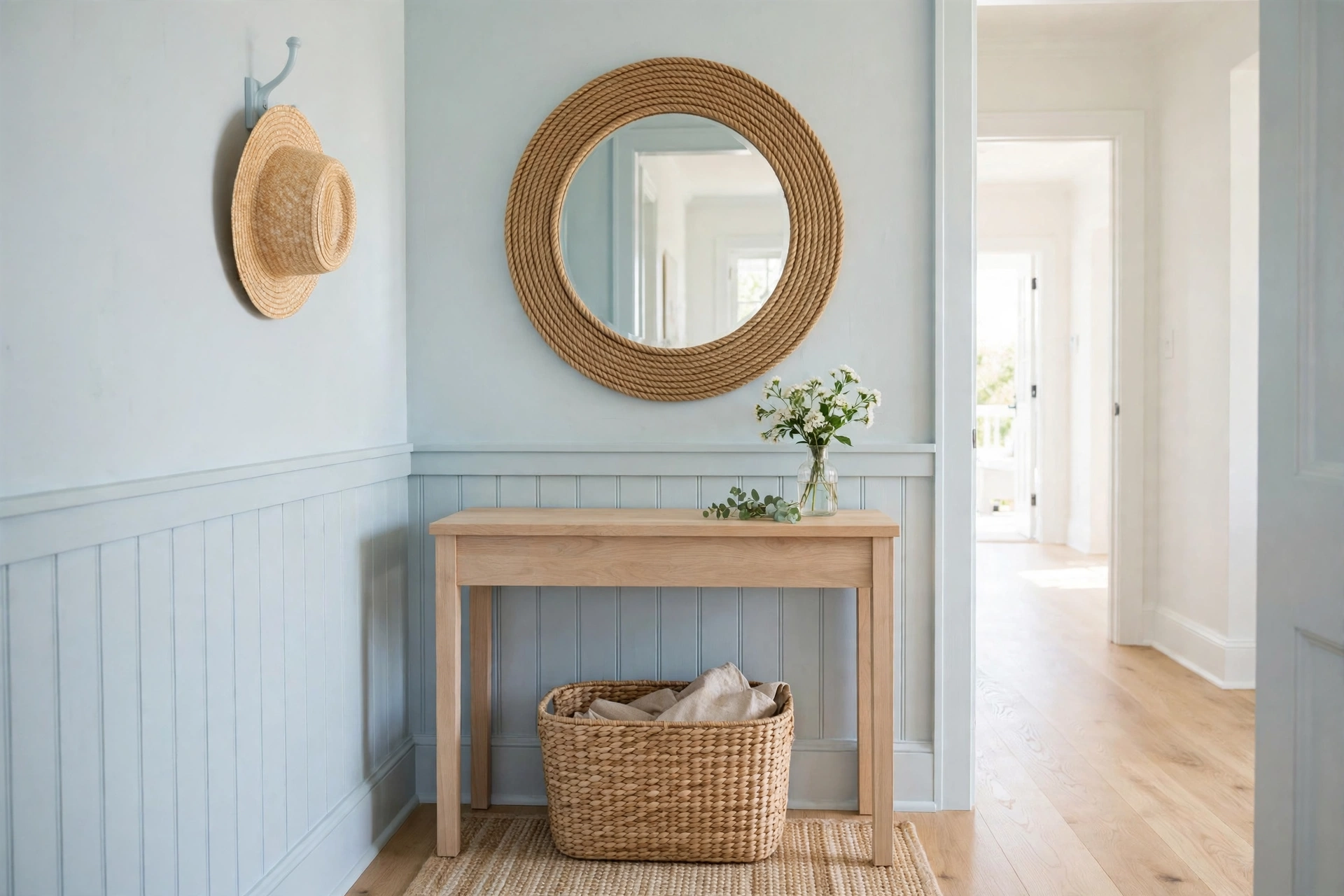
The entryway formula. A light wood console table 30 to 36 inches wide and 12 to 14 inches deep fits a narrow entryway without blocking the door swing. Above it, hang a round rope-framed mirror 24 to 30 inches wide, with its center 57 to 60 inches from the floor. Underneath, slide one woven basket for shoes or bags. That is the whole entryway: mirror, basket, vase, bowl. A driftwood branch with three or four hooks, hung at 60 inches from the floor, can replace the console entirely in a very tight entry, it is a coat rail, a key rail, and a piece of wall art at the same time.
The empty wall. Every small home has one wall that is blank because nothing fits there. Hang a single piece of beach wall decor, a framed seascape, a driftwood branch 24 to 36 inches long, or a woven wall hanging 18 to 24 inches wide, with its center at eye level, 57 to 60 inches from the floor. One piece on a blank wall looks intentional. Three small pieces scattered on the same wall look like leftovers.
Beach Wall Decor: Sizes and Heights That Work
Coastal wall decor ideas are where most coastal rooms go wrong, because wall art is the easiest thing to buy and the easiest thing to hang badly. The right size matters more in coastal decor than the subject of the art.
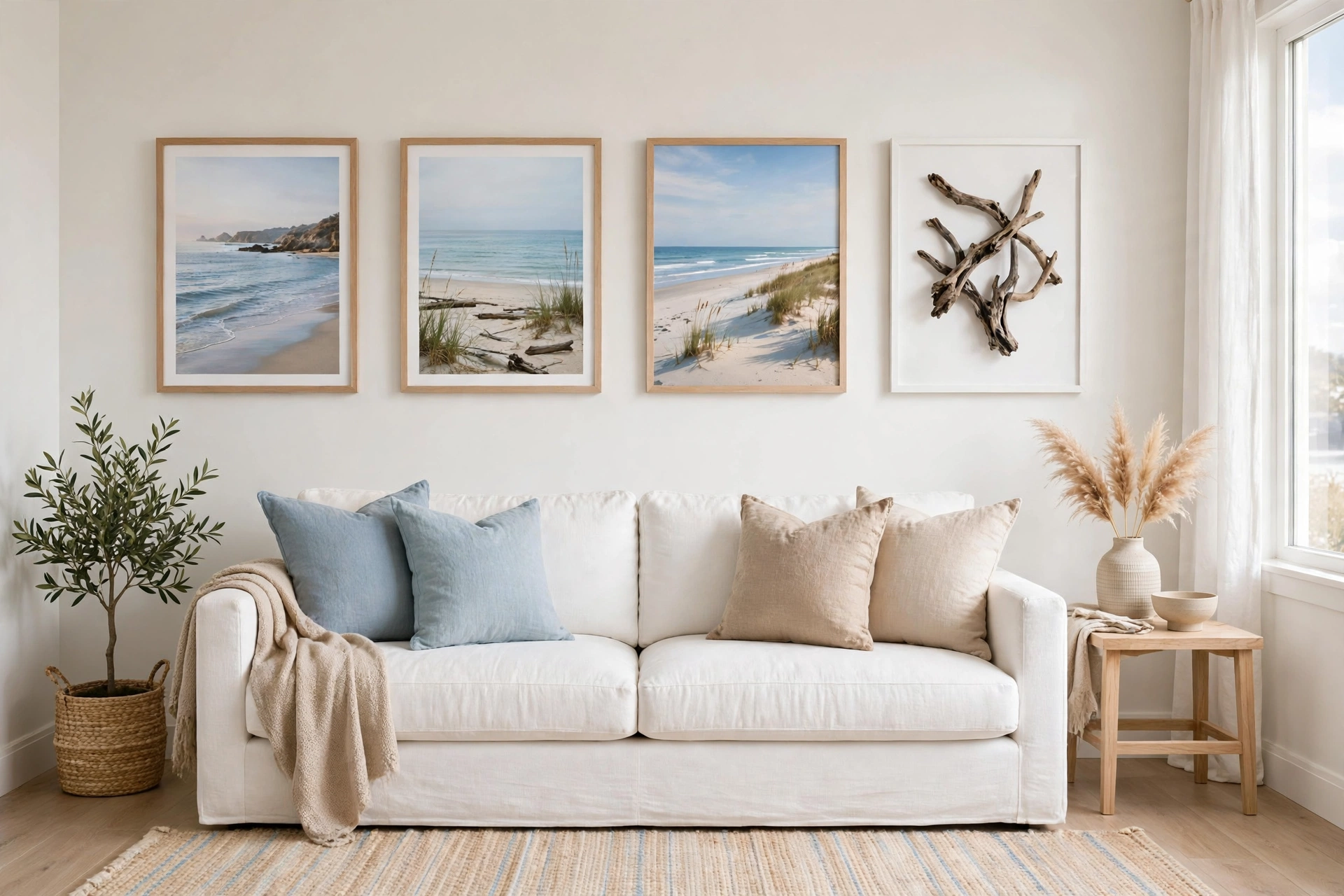
The two-thirds rule. Art above a sofa or a bed should be about two-thirds of the furniture’s width. Above a loveseat 52 to 58 inches wide, that is a piece about 35 to 40 inches wide. Above a full sofa 72 to 84 inches wide, that is 48 to 56 inches, either one large piece or two pieces hung together with 2 to 3 inches between them. A piece narrower than half the sofa looks lost; a piece wider than the sofa looks like it is falling.
The 57 to 60 inch rule. Hang the center of the piece 57 to 60 inches from the floor, eye level for most people. Above a sofa, keep the bottom of the piece 6 to 8 inches above the sofa back. Art hung too high is the most common mistake in small rooms, and it makes the furniture look short and the wall look empty at the same time.
One large piece beats six small ones. In a small room, one piece 24 by 36 inches or larger anchors the space and keeps the wall calm. A gallery wall can work, but it needs a system: frames in the same two finishes, 2 to 3 inches of even spacing, and the whole arrangement treated as one piece, two-thirds of the sofa width, center at 57 to 60 inches. A gallery of random frames at random heights is not a gallery; it is clutter with nails.
What to hang. Framed coastal photography, watercolor seascapes, a large vintage-style map, or a single piece of driftwood art all work as beach decor, because they look like the sea instead of labeling it. What does not work: word art with beach puns, mass-produced “distressed” signs, and plastic shells glued to a frame. If you would not find it in an actual beach house, do not put it on your wall. Choose art that looks like the sea, and coastal decor stays calm instead of literal.
Driftwood is the cheapest natural art there is: a branch 24 to 40 inches long, hung horizontally above the sofa with two picture hanging strips, costs $20 to $48 all in. For seven driftwood ideas with exact measurements, weights, and strip ratings, see our guide to driftwood wall decor ideas for a small room. One real branch does more for coastal decor than a whole shelf of souvenir shells.
Coastal Christmas Decor Ideas
Coastal Christmas decor is the seasonal test of everything in this guide: if your coastal style is built on color and texture instead of theme, the Christmas version is easy. Swap the textiles and the small accents, keep the bones. If the base palette is right, coastal decor carries the season with only a few swapped accents.
Keep the palette, change the accents. Your white, sand, and one-blue palette already works for winter, it is the color of snow, sand, and a cold sea. Add warmth instead of red and green: a chunky knit throw in cream, warm fairy lights, and one warm accent, like a coral ornament or a gold star. A coastal Christmas tree in white, soft blue, and sand ornaments, with a driftwood star on top, looks intentional. A tree covered in plastic starfish and anchor ornaments looks like a joke that ran too long.
Swap, do not add. The rule for coastal Christmas decor ideas is the same as for the rest of the year: swap the seasonal pieces, do not pile them on top of the everyday ones. Put the summer shells away, bring out the knit throws and the fairy lights, and keep the total number of coastal accents in the room at 3 to 5. Store the off-season pieces in one labeled bin, so the swap takes 15 minutes twice a year. In a small living room, a tree 4 to 5 feet tall in a woven basket planter fits the corner without eating the room.

The Under-$150 Room-by-Room Budget
Coastal decor is naturally budget-friendly, because it relies on restraint rather than spending. Here is what these coastal decorating ideas actually cost, room by room, when you buy the portable pieces first and skip the themed objects entirely.
Living room: $100 to $150. Two linen pillow covers ($20 to $30 for a set of two), sheer curtains ($25 to $60 for two panels), a seagrass basket ($15 to $25), and one piece of coastal art or a driftwood branch ($20 to $48). If you need a jute rug, a 5 by 8 foot rug costs $60 to $120, buy the rug first and the pillows second, because the rug is the piece you live on.
Bedroom: $75 to $130. White linen or cotton bedding set ($40 to $70), two blue pillow covers ($15 to $25), a 2 by 3 foot jute rug beside the bed ($15 to $25), and a small woven basket ($10 to $15). The bed is the room, so the bedding is the budget.
Bathroom: $25 to $50. Two sets of towels ($20 to $40), a woven basket ($10 to $15), and a small plant ($5 to $10). That is the entire bathroom refresh, and it takes twenty minutes.
Kitchen: $15 to $30. A linen dish towel set ($10 to $15), a woven placemat set ($10 to $15), and a small herb plant ($5).
Entryway: $30 to $60. A round mirror ($20 to $40), a woven basket ($10 to $15), and a small vase ($5 to $10).
The whole-home version: $150 total, one room at a time. Start with the room you use most, usually the living room, and let the coast come in gradually. Buy one room’s worth of pieces, live with them for two weeks, and only then buy the next room. Spend on the things you touch every day, the rug, the slipcover, the bedding, and save on the things you only look at. Spend in that order and coastal decor stays under budget without feeling cheap.
Common Mistakes to Avoid
Here are the seven mistakes that break a coastal room fastest, and the fix for each.
1. Too much blue. The most common mistake, and the one that makes a room feel cold and small. Blue should be 10 percent of the room, not 60 percent. Fix: remove blue until only two or three blue objects are left.
2. The souvenir shop. Shells on every surface, starfish on the pillows, anchors on the wall, a sign that says BEACH. Fix: choose one or two statement pieces, a rope mirror, a driftwood branch, one seascape, and remove everything else beach-themed.
3. Dark, heavy furniture. A dark brown sofa, a black coffee table, or dark wood shelves absorb the light that coastal style depends on. Fix: a washable white slipcover over the sofa ($50 to $120) and a pale wood or whitewashed coffee table. You do not need to replace the furniture; you need to lighten the largest surfaces.
4. Heavy curtains. Thick drapes that block or filter light collapse the effect, regardless of everything else done right. Fix: sheer linen or cotton panels, hung high and wide, so the panels frame the window instead of covering it.
5. Plastic wicker and fake driftwood. Plastic “wicker” looks shiny and cheap up close, and fake driftwood looks like what it is. Fix: buy one real rattan piece instead of three plastic ones, and one real driftwood branch instead of a resin copy.
6. Filling every corner. Overcrowding eliminates the breathing room that coastal style is built on, and replaces the calm feeling with visual noise. Fix: leave gaps. Clear floors, bare walls, and open surfaces are not empty, they are the design.
7. Mixing coastal flavors. Modern coastal furniture next to coastal grandmother curtains next to tropical coastal art. Fix: pick one flavor for the whole home, classic, modern, or grandmother, and buy everything inside it. One flavor, repeated room to room, is what makes a small home feel like one home.
FAQ
How much does it cost to create a coastal living room?
You can start with as little as $100 to $150 for a basic refresh, pillows, curtains, and small decor. A moderate makeover runs $500 to $1,000, while a complete transformation with furniture might be $2,000 to $5,000 or more. Most of that budget goes to textiles, which is where coastal decor gets its softness.
Can I do coastal style if I don’t live near the beach?
Absolutely. Coastal design is about evoking a feeling, not your actual location. Focus on light, airy spaces with natural textures and a calming color palette. Some of the best coastal rooms are hundreds of miles from the ocean. The key is creating that vacation-home atmosphere wherever you are. Distance from the sea does not matter when coastal decor is built on light and texture, not location.
What’s the difference between coastal and nautical style?
Nautical is a subset of coastal that is more literal. Think anchors, ship wheels, navy and white stripes, and sailing motifs. Coastal is broader and more subtle, emphasizing natural materials, soft colors, and beachy elements without being “themed.” Coastal can incorporate some nautical touches, but it is generally more sophisticated and less literal.
Is coastal style going out of fashion?
The coastal aesthetic has evolved but remains timeless, because it is based on natural materials and calming colors that never truly go out of style. Modern coastal design has moved away from the heavy nautical themes of the 2000s toward a more refined, organic look. That is why coastal decor keeps coming back: it is a feeling, not a trend.
How do I make coastal style work in a small apartment?
Small spaces actually benefit from coastal design. Use white or very light colors, keep furniture minimal and low-profile, stick to 2 to 3 main colors, and use mirrors to reflect light. Focus on small textural elements like pillows, a jute rug, and sheer curtains. Those limits are exactly why coastal decor suits small apartments so well.
What if I’m renting and can’t paint the walls?
No problem. Focus on large textiles to set the tone: a cream or white area rug, light curtains, white or neutral slipcovers, and plenty of pillows. Add a large piece of coastal art to anchor the space. Use removable wallpaper or wall decals if you want a bigger impact. The good news is that coastal style relies heavily on accessories rather than permanent changes.
How do I prevent my coastal room from looking like a beach souvenir shop?
The key is restraint. Choose one or two statement pieces rather than covering every surface with shells and starfish. Avoid decorative signs with beach puns. Stick to authentic materials like real driftwood, genuine shells, and natural rope rather than plastic versions. If you would not find it in an actual beach house, do not put it in yours. Across a whole living room, 3 to 5 coastal accents is the right number.
Can coastal style work with my existing furniture?
Yes. You do not need to replace everything. Start by working with what you have: add white or cream slipcovers to darken furniture, swap out pillows and throws, change your wall art, and add coastal accents. Most furniture styles can be “coastalized” with the right accessories. Even a traditional leather sofa works with light linen pillows and a jute rug. Add the palette first and coastal decor will follow, even with furniture you already own.
What colors should I avoid in a coastal living room?
Avoid heavy, dark colors as large elements, dark brown, burgundy, deep purple, or black walls and large furniture pieces can feel too heavy. Also steer clear of overly warm oranges and reds, unless used very sparingly as coral accents. Jewel tones can work as small accents but avoid them as dominant colors.
How do I keep a coastal room from feeling cold or sterile?
Layer in warm neutrals like sandy beige, warm taupe, and cream alongside the cool blues and whites. Add plenty of texture through natural materials like chunky knit throws, nubby linen, and rough jute. Include warm wood tones in small doses, and lived-in touches like books and throws casually draped. Warm neutrals are the difference between coastal decor that feels calm and a room that feels clinical.
Can coastal living room ideas work in a small space?
Yes, coastal principles actually favor small rooms. Light walls, open layouts, and minimal decor make compact spaces feel larger. Avoid oversized furniture and dark tones.
What flooring works best for a coastal living room?
Light oak, whitewashed wood, or pale limestone-effect tile all work well. The goal is a floor tone that reflects light and stays visually recessive. Avoid dark hardwood or busy tile patterns, both pull attention downward and add visual weight that works against the airy coastal feel. A pale floor is the quiet base that lets coastal decor sit lightly in the room.
How much does it cost to decorate a coastal living room on a budget?
Coastal style is naturally budget-friendly because it relies on restraint rather than spending. Cushions, sheer curtains, and a few organic accents can complete the look for well under $500, and the room-by-room refresh in this guide brings most rooms in under $150.
Start Today
You do not need a beach house to live with coastal decor, you need a palette, three textures, and one free afternoon. Pick your one blue, swap two pillow covers, hang sheer curtains high and wide, and put a jute rug under your feet. That is the whole system, and it works in every room, in a rental you do not own and a small space you thought was too small for style. Start with the room you use most, change one thing today, and let the coast come in one room at a time. Your small home has been missing the sea, now it does not have to.