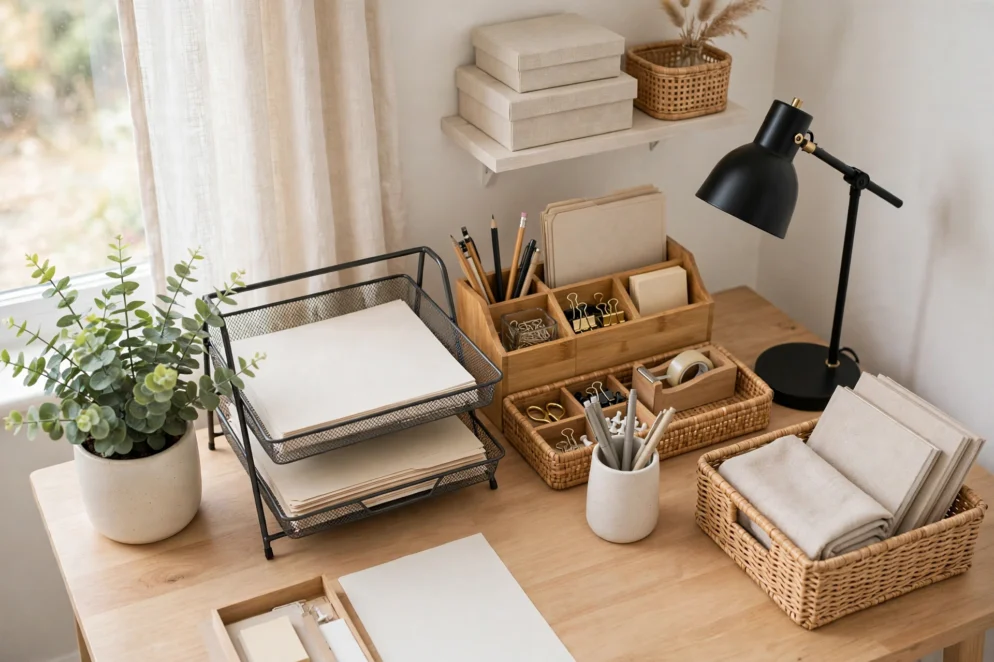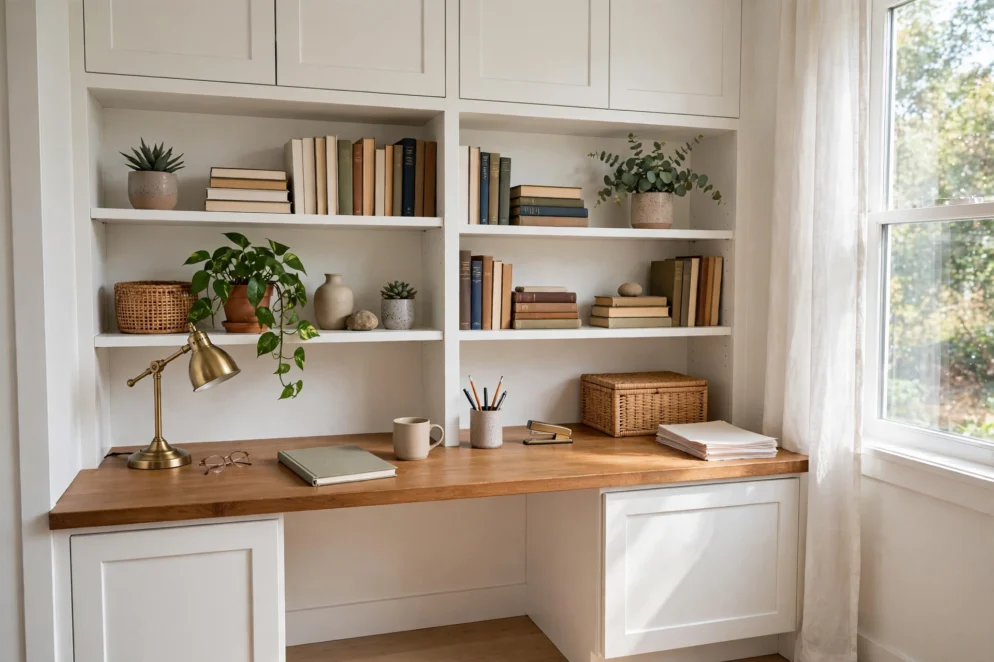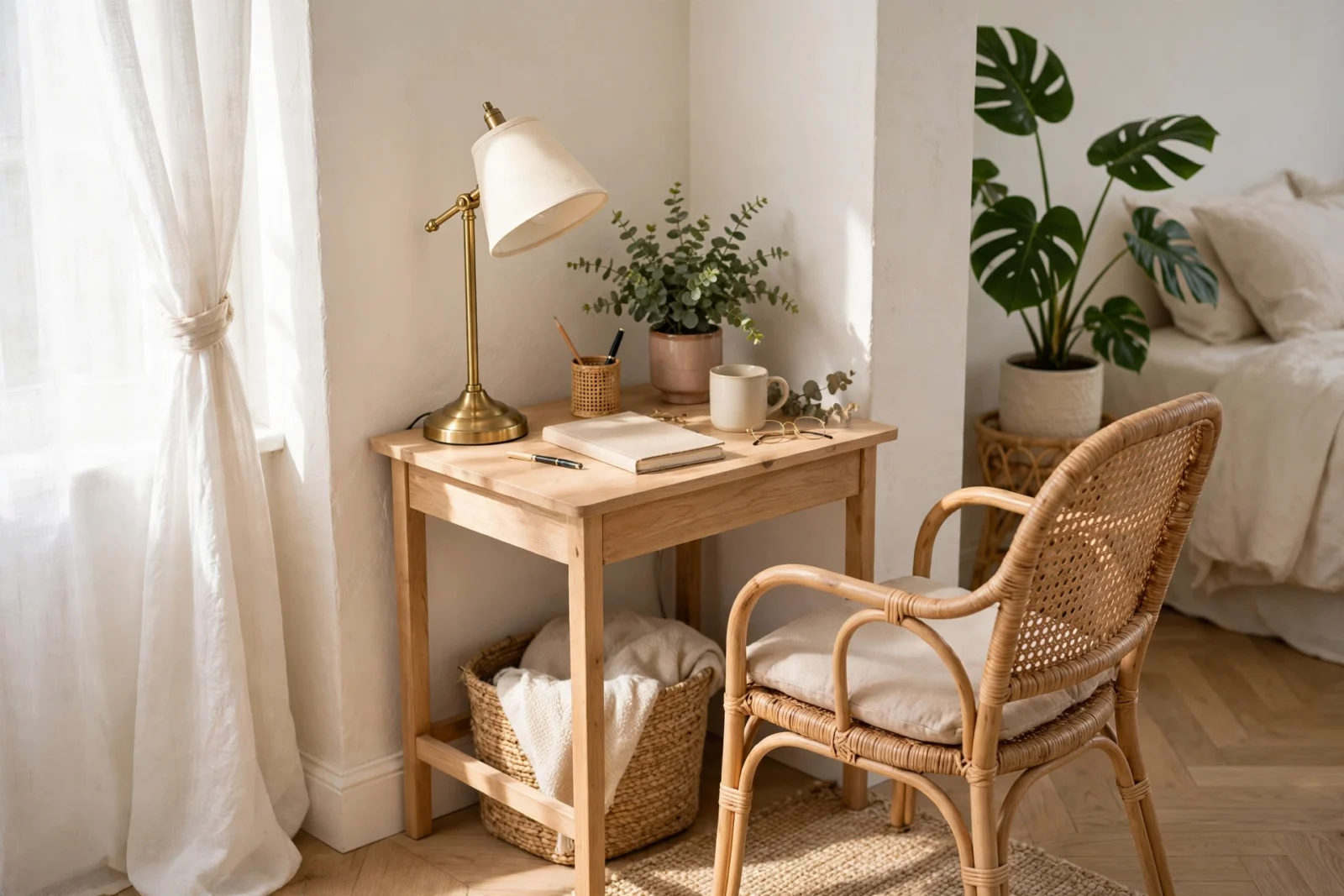
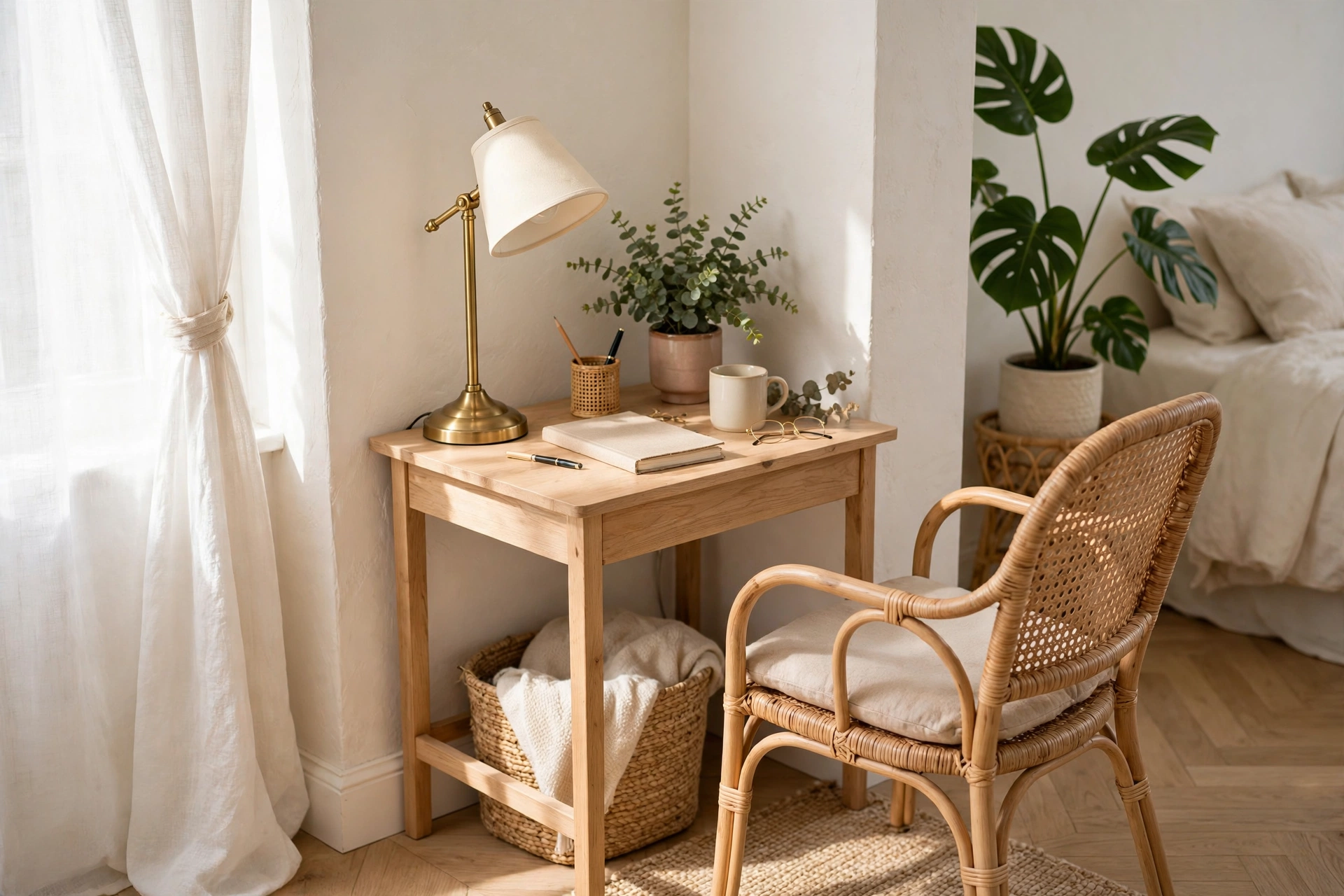
A small desk for bedroom is the hardest desk to place well. The bed takes the biggest wall, the wardrobe takes the second, and the desk gets whatever is left, usually a dark corner with no socket and no light. This guide fixes that: 6 placements that work, 5 layouts with exact measurements, and the decorating and storage that make a bedroom desk feel like part of the bedroom, not an office that moved in.
Every placement in this guide uses the same numbers: the right desk size for the job, 30 inches behind the chair, a 24 inch clear walkway, and a lamp, because a bedroom desk without a lamp is unusable after dark. Each one is sized for a small desk for bedroom, not a full home office.
Table of Contents
Before you place it: the numbers
Best for: every placement in this guide, get these numbers right and any spot works. These numbers are the starting point for any small desk for bedroom, whatever its shape.
- Desk size: a laptop-only desk can be 36 to 42 inches wide and 20 to 24 inches deep. A monitor-and-keyboard setup needs 48 inches wide and 24 to 30 inches deep. Do not buy the desk before you know which setup you have.
- Chair clearance: leave 30 inches behind the desk for the chair, enough to push back and stand up without hitting the bed or the wall.
- Walkway: keep the main path from the door to the bed at least 24 inches clear (30 inches if two people share the room). A desk that blocks the walkway will be moved within a week.
- Socket: the desk needs a socket within 3 feet. An extension lead across the floor is a trip hazard and looks terrible, if the only socket is far away, pick a different wall.
- Light: the desk needs daylight from the side and a lamp for the evening. A bedroom desk without a lamp is unusable after dark, and a bedroom has no office lighting to fall back on.
Measure the room, mark the bed, the wardrobe, and the door on paper, and the desk spot will show itself. The best spot is rarely the emptiest wall, it is the wall with light, a socket, and 30 inches behind it. Mark where a small desk for bedroom will go before you buy anything.
1. Beside the window
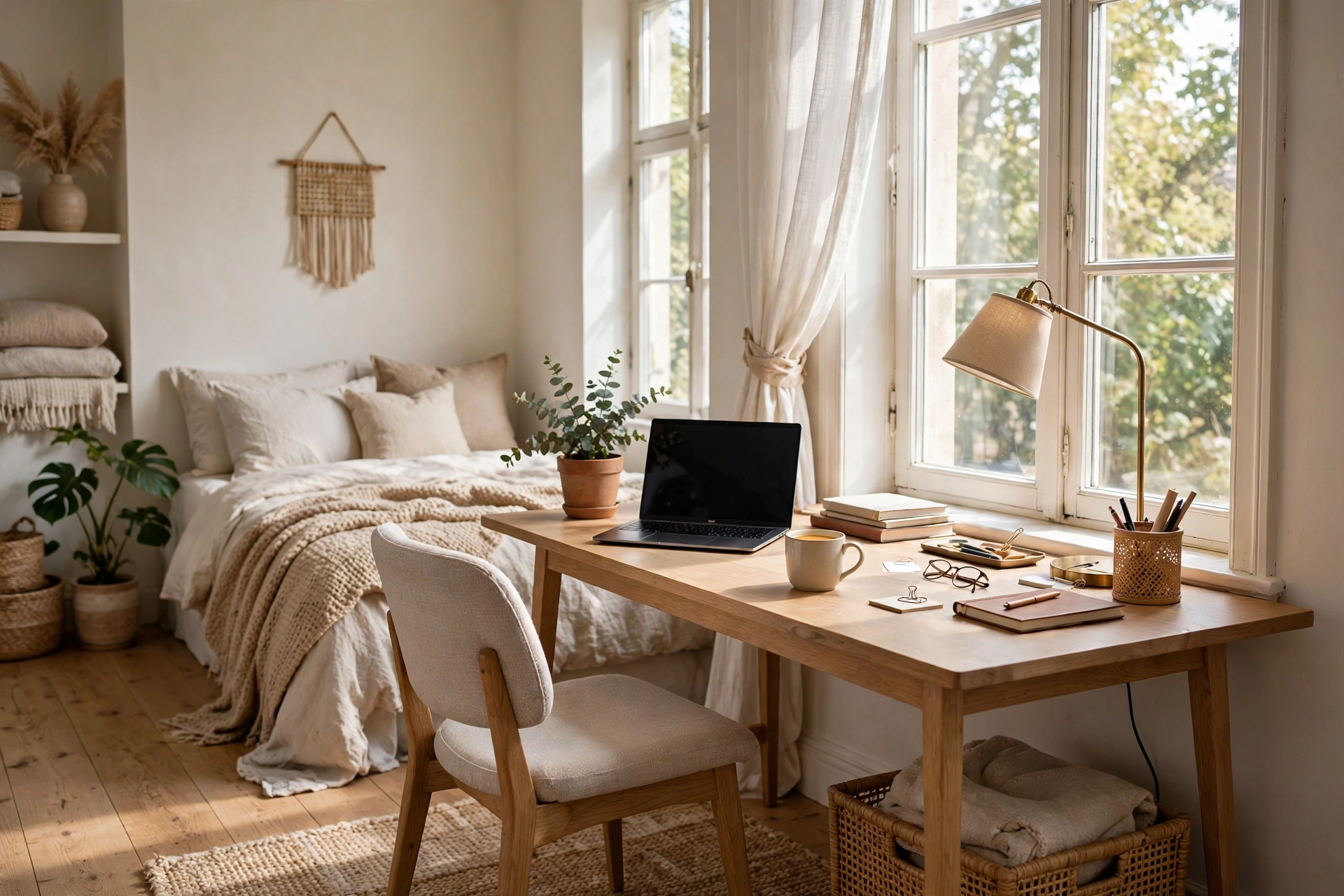
Best for: the best placement in most bedrooms, side daylight, no glare, and the bed out of your eyeline. It is the first spot to try for a small desk for bedroom.
Put the desk on the wall next to the window, so daylight comes from the side. Light from the side lights your work without shining into your eyes or onto your screen, and your face is lit for video calls. If you can manage it, sit facing away from the bed, facing the bed makes it harder to feel like you are at work, and harder to stop thinking about work when you are in bed. Side light is the main reason a small desk for bedroom works so well here.
- Size: a desk 36 to 48 inches wide fits on most window walls. Measure the wall from the window frame to the corner and use the smaller number.
- Light: daylight from the side is the goal. If the sun hits the screen in the afternoon, add a sheer curtain or a light-filtering blind, do not move the desk, fix the light.
- Socket: window walls usually have a socket nearby. If not, run the cable along the skirting board with adhesive clips, never across the floor.
- What to watch: curtains. A desk tight against the window wall can block the curtain from closing. Leave 4 to 6 inches between the desk and the curtain.
This is the placement to choose first. If the window wall is free, the search is over.
2. Under the window
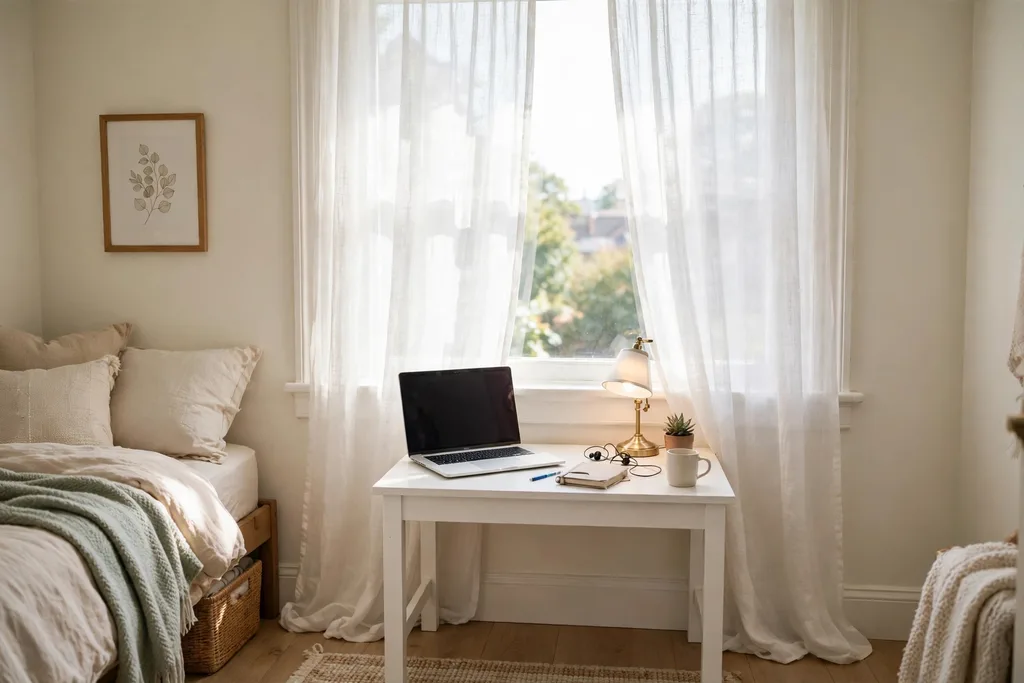
Best for: a wall that is hard to use for anything else, the desk under the window uses dead space and gets the best light in the room. A small desk for bedroom under the window uses a wall nothing else needs.
A desk under the window sits in the brightest spot in the bedroom and leaves the rest of the walls free for the bed and the wardrobe. It makes the room feel open, because the desk is low and the window is above it.
- Size: a desk 36 to 42 inches wide and 20 to 24 inches deep fits under most windows. Measure the window sill height, the desk top must sit 2 to 4 inches below the sill, or the desk blocks the window.
- Light: the best daylight in the room, but the most glare. Facing the window gives you a view and daylight, but the screen glares and your face is dark on video calls. Fix it with a sheer curtain, or turn the desk 90 degrees so the window is to your side.
- What to watch: radiators under the window (a desk over a radiator blocks the heat and dries out the wood), and blinds (you need to reach them, leave 6 inches between the desk and the blinds).
- Storage: no wall above the desk for shelves, so use a drawer unit beside the desk or a small shelf on the side wall.
Under the window is the best placement for studying and reading. For video calls, beside the window is better.
3. In the corner
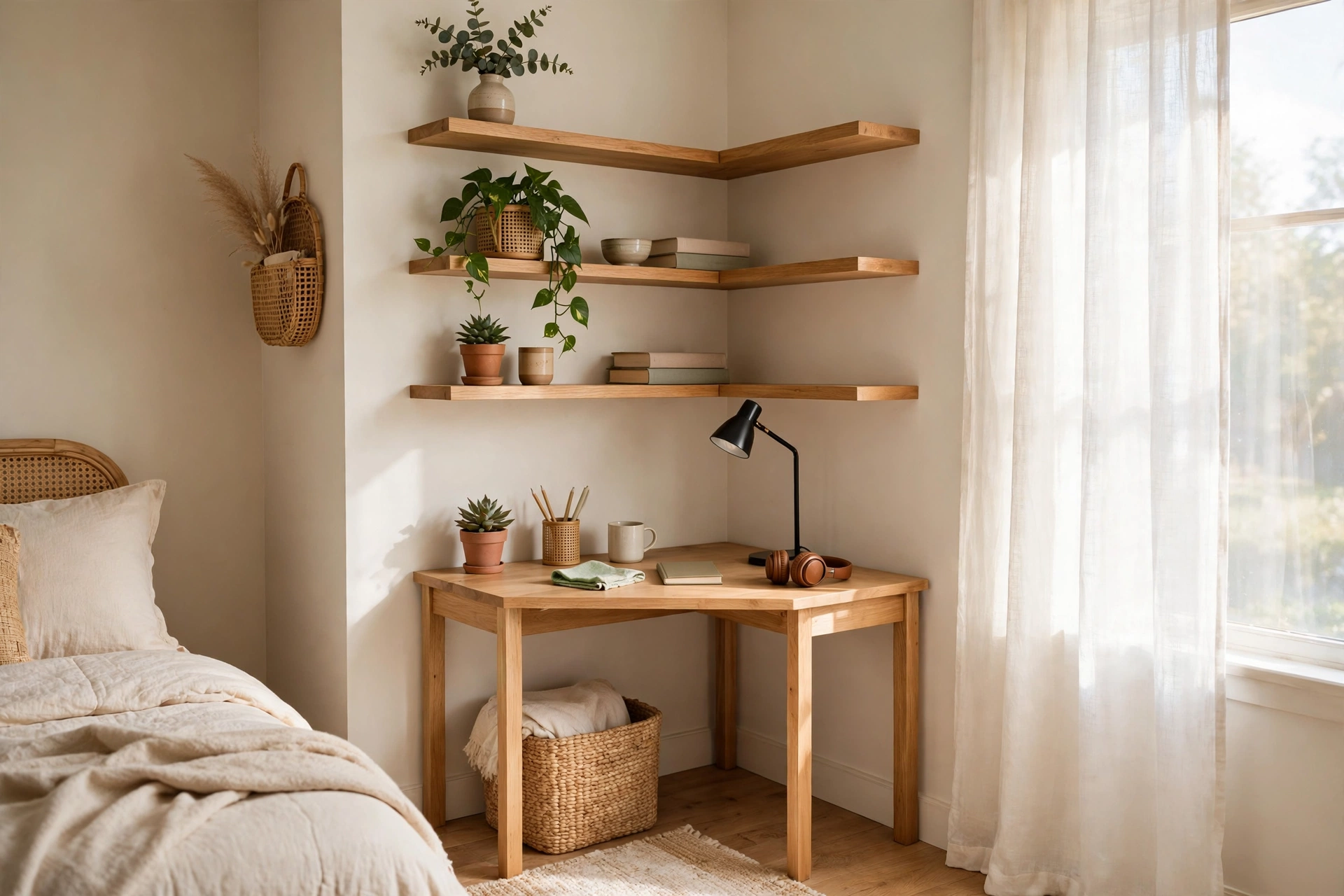
Best for: the most wasted space in a bedroom, a corner desk tucks away, frees the middle of the room, and gives you two walls for shelves.
Corners are the most wasted space in most bedrooms. A corner desk fills one, keeps the middle of the room clear, and gives you two walls, one for the desk, one for shelves. That is why a small desk for bedroom in a corner feels bigger than it is.
- Size: each arm 40 to 48 inches long, 20 to 24 inches deep. The corner itself is the deepest part, about 30 inches from the corner to the front edge, which is where the monitor goes.
- Shelves: shelves above one arm only, not both. Shelves on both arms make the corner feel closed in. Put the shelves above the arm you use for paper, and leave the monitor arm clear.
- Light: corners are often the darkest part of the room. Add a lamp on the desk and, if you can, a small shelf light above it. A corner desk without a lamp is unusable after dark.
- What to watch: a corner desk can feel boxed in. Face the desk out into the room, not into the corner, if you can, the chair faces the room, the desk is behind you, and the corner holds the monitor and the shelves.
If you want the full corner desk guide, 12 layouts with exact measurements, see our corner desk setup guide.
4. At the end of the bed
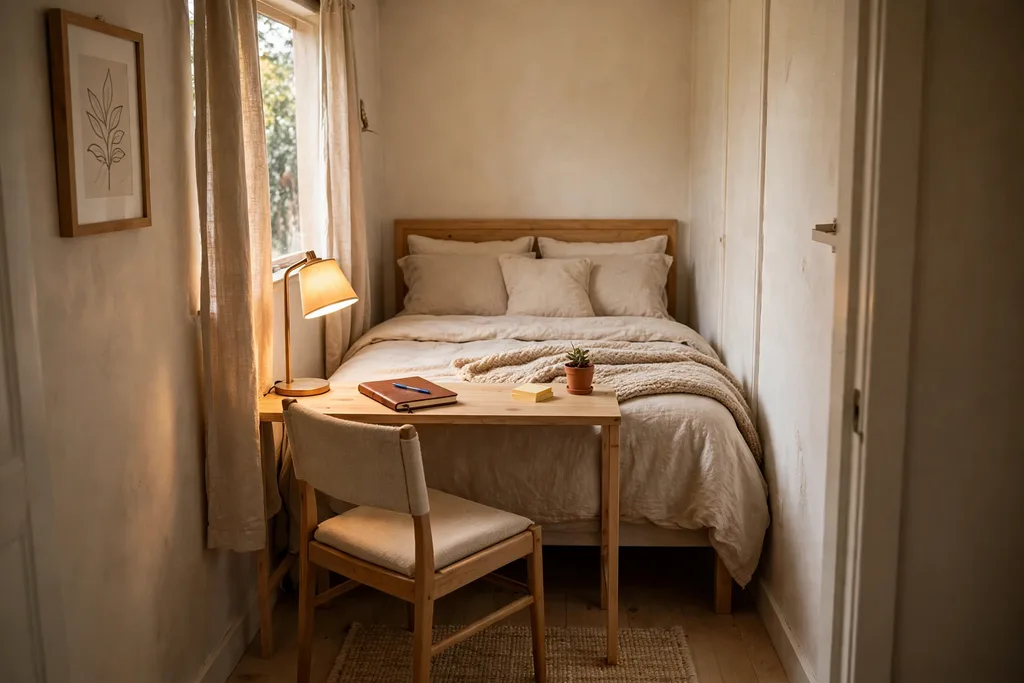
Best for: a narrow bedroom where the bed takes one whole side, a slim desk at the foot of the bed uses the walkway zone. A slim small desk for bedroom fits here without blocking the bed.
In a narrow room where the bed takes up one side, the foot of the bed is often the only free wall. A slim desk there uses the walkway zone without blocking it, if you leave enough room for the chair.
- Size: a slim desk 36 to 40 inches wide and 18 to 20 inches deep fits at the foot of most beds. Deeper than 20 inches and the desk eats the walkway.
- Chair space: you need 30 inches behind the desk for the chair, measured from the desk to the bed. If the gap between the bed and the desk is less than 30 inches, the chair will not fit, use a stool that slides under the desk instead.
- What to watch: the desk faces the bed, so you see the bed while you work. If that bothers you, put a low bookcase or a folding screen between the desk and the bed, a thin boundary is enough.
- Storage: no wall above the desk for shelves (the bed is behind you), so use a drawer unit beside the desk or a small rolling cart that slides under it.
This is the placement to choose when the window wall and the corner are both taken. It is the least private spot, but it works.
5. Inside the closet
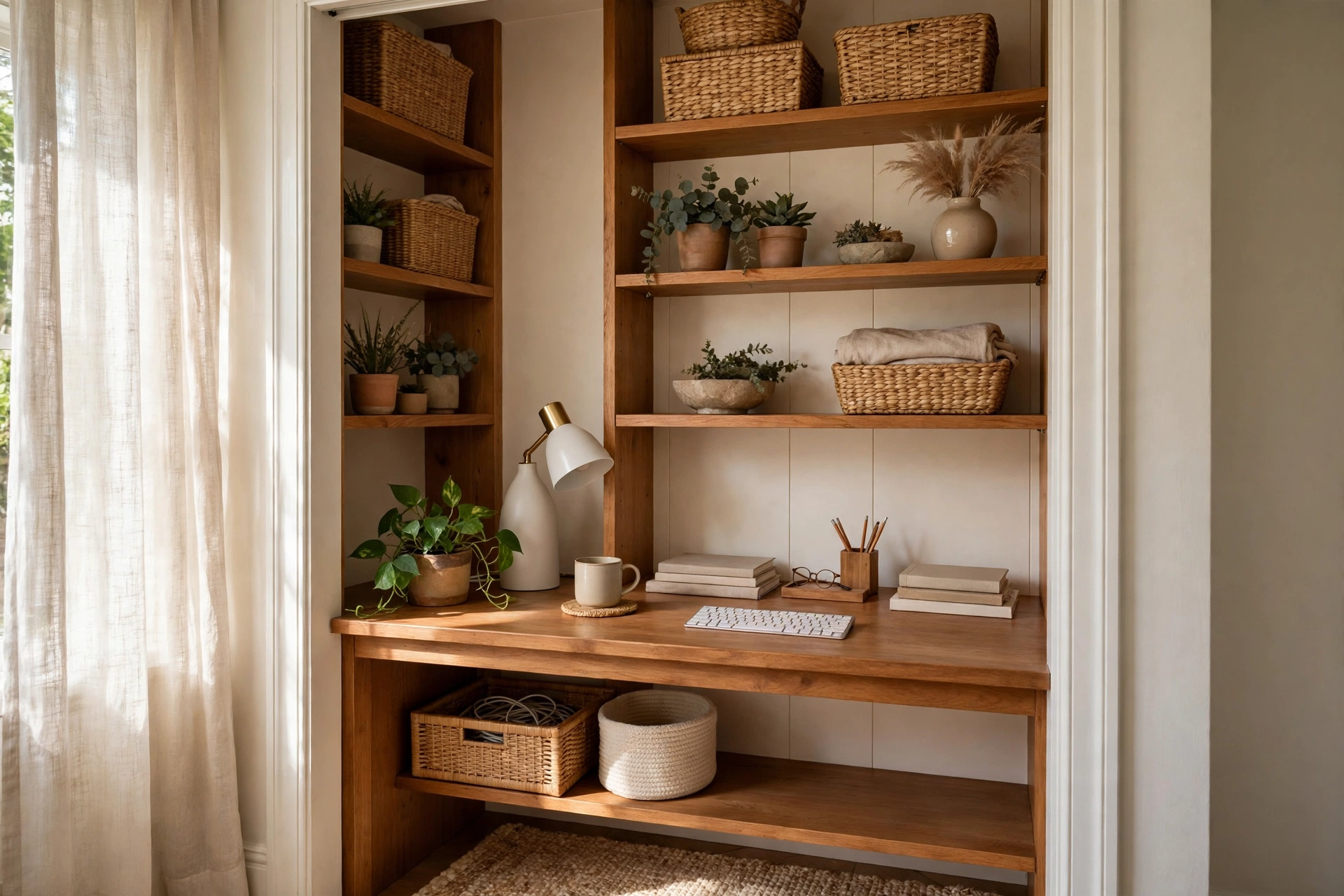
Best for: the smallest bedrooms, a closet desk hides the office completely when you close the doors.
A standard reach-in closet is about 24 inches deep, exactly deep enough for a laptop and a small monitor. Remove the doors (or take them off their hinges and store them), fit a desk board across the closet at 28 to 30 inches high, and you have a complete office that disappears at the end of the day. At 24 inches deep, a closet is exactly deep enough for a small desk for bedroom.
- Size: closet desks are usually 36 to 48 inches wide (the width of a standard reach-in closet) and 20 to 24 inches deep.
- Shelves: one or two shelves above the desk inside the closet, 10 to 12 inches deep, first shelf 18 to 20 inches above the desk. The closet walls hold the shelves, so no brackets into the room walls are needed.
- Light: a closet has no window, so add a small lamp or a stick-on LED light under the shelf. Warm white (2700 to 3000K) keeps the nook from feeling like a cupboard.
- Ventilation: a closet desk gets warm. Leave the doors open while you work, or remove them entirely. If the closet has no doors, hang a curtain on a tension rod, it hides the desk and costs $10 to $15.
- Cost: a desk board ($30 to $50), two shelf boards ($20 to $30), brackets and screws ($15 to $25), about $65 to $105 total. The cheapest desk in this guide.
A closet desk is the best desk for a bedroom where sleep matters more than office space, because at night, the office is gone.
6. Against the wall, bed and desk on one wall
Best for: a long wall, bed and desk lined up end to end, with the rest of the room left open. This arrangement suits a small desk for bedroom in a long, narrow room.
If the bedroom has one long wall, put the bed and the desk on it, end to end. The bed takes one half, the desk takes the other, and the rest of the room stays open. It is the simplest layout in this guide and the easiest to live with. Lining them up keeps a small desk for bedroom out of the walkway.
- Size: the desk 36 to 48 inches wide on the same wall as the bed, with at least 12 inches of gap between the bed and the desk so the bedding does not fall onto the work surface.
- Boundary: mark the boundary between bed and desk with a rug under the desk, a different paint colour on the desk half of the wall, or a low bookcase between them. A thin boundary is enough, a full divider chops up a small room.
- Light: the desk gets the same light as the bed. If the bed is near the window, the desk is near the window too, which is good. Add a lamp on the desk for the evening.
- What to watch: the desk is beside the bed, so you see the bed while you work and the desk while you sleep. If that bothers you, face the desk toward the wall and put a low bookcase between the desk and the bed.
This layout works best in a rectangular bedroom with one long, clear wall. If the room is square, the corner or the window wall is usually better.
5 bedroom layouts with a small desk for bedroom
Best for: seeing the whole room at once, pick the layout that matches your room shape. Each layout fits a small desk for bedroom in a different room shape.
- Layout 1, Bed in the corner, desk on the opposite wall. Push the bed into a corner, lengthwise against a wall. This frees the most floor and leaves a full wall for the desk. The go-to layout in very small rooms.
- Layout 2, Desk under the window, bed facing it. The desk sits under the window and the bed faces it or runs along another wall. Best daylight, but watch the screen glare.
- Layout 3, Corner desk, bed on the opposite wall. The desk fills the corner, the bed takes the opposite wall, and the middle of the room stays clear. Best for square rooms.
- Layout 4, Desk at the foot of the bed. The bed goes against the top wall, the desk faces the opposite wall at the foot of the bed. Best for narrow rooms.
- Layout 5, Desk next to the bed, as a nightstand. A desk beside the bed replaces the nightstand and saves space, but you see the bed while you work and the desk while you sleep. Best for a laptop-only desk that is used for an hour a day, not eight.
In every layout, keep 30 inches behind the chair and 24 inches clear on the path from the door to the bed. If a layout breaks either number, pick a different layout. Those clearances matter most around a small desk for bedroom, where space is tight.
Decorating your small desk for bedroom area
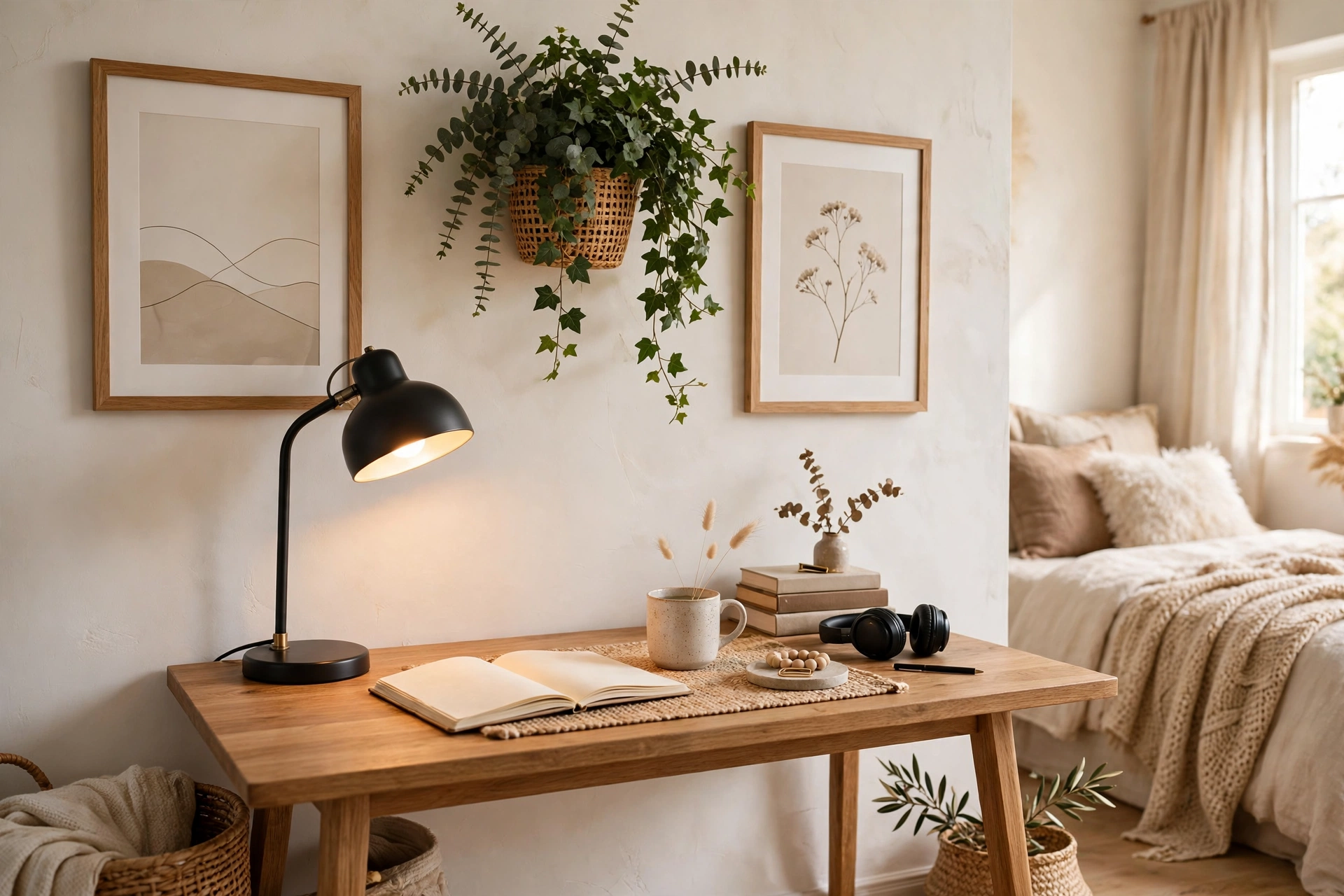
Best for: making the desk look like part of the bedroom, not an office that moved in. That is the goal for a small desk for bedroom.
A bedroom desk should match the bedroom, not fight it. Use the bedroom’s colours, the bedroom’s textures, and one or two decor pieces, not a full office setup. Choose finishes that match the room, and a small desk for bedroom will look built in, not added on.
- Art: one piece of art above the desk, about two-thirds as wide as the desk, hung 6 to 8 inches above the surface. Match the bedroom’s art, not the office’s, a landscape print, not a motivational poster.
- Plant: one small plant in a 4 to 6 inch pot on the desk or on the shelf above it. A trailing plant softens the desk edge; a snake plant stands upright and takes no horizontal space.
- Lamp: one lamp opposite your writing hand, warm white (2700 to 3000K). The lamp is the tallest thing on the desk, so it sets the style, choose one that matches the bedroom lamp, not an office lamp.
- Colour: use the bedroom’s accent colour on the desk, a notebook, a plant pot, a frame. One colour, three touches, and the desk belongs to the room.
- The video call view: the wall behind you is what everyone on a call sees. Decorate that wall first, one frame and one plant behind you is enough.
For the full decorating guide, see our office decor ideas guide.
Storage for a small desk for bedroom
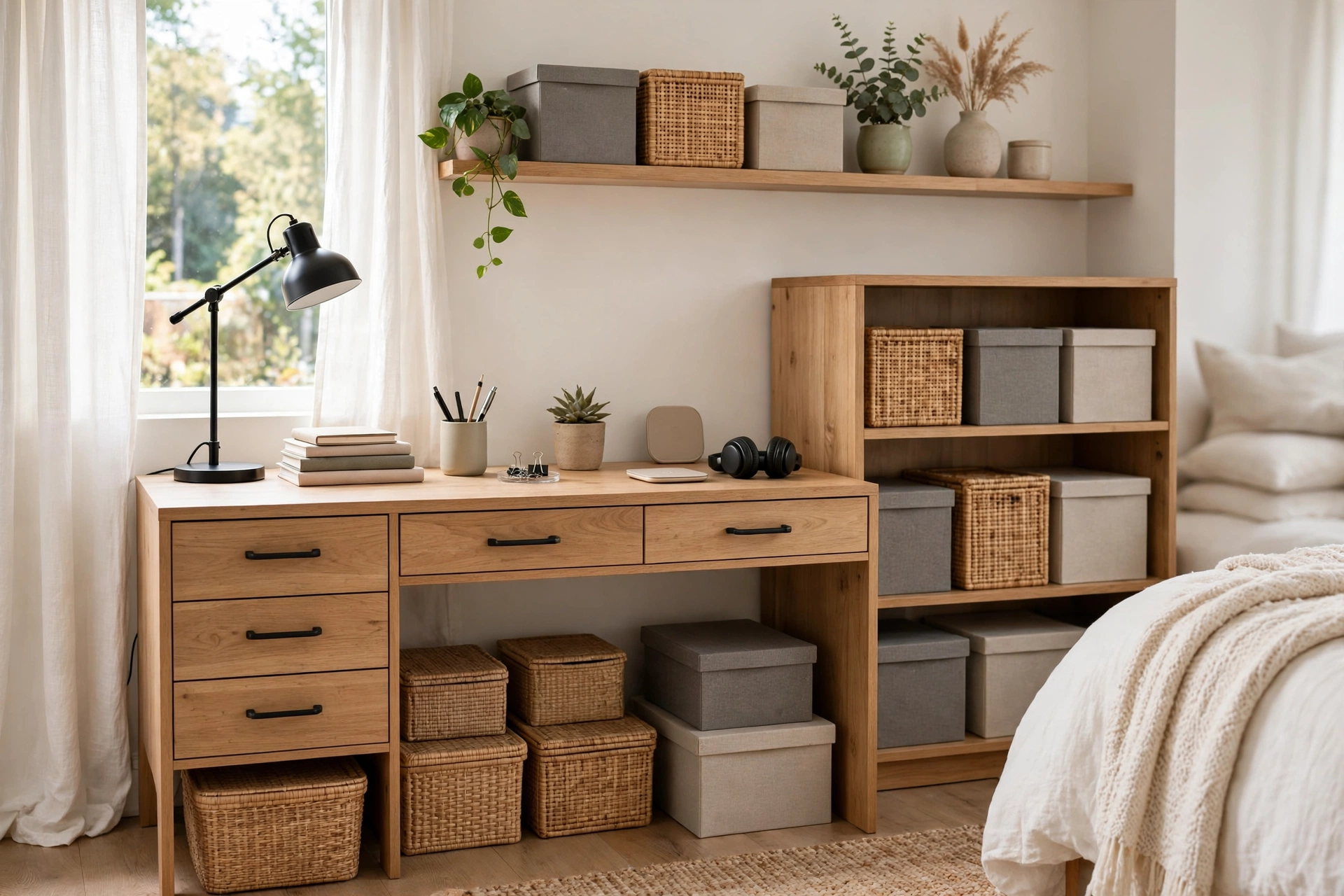
Best for: the eternal bedroom problem, where the desk stuff goes when the desk is small.
A bedroom has no office storage, so the desk has to hold its own supplies. The rule is one closed storage spot and one open one. One closed drawer unit is usually enough for a small desk for bedroom.
- Closed storage: one drawer unit beside the desk, 15 to 18 inches wide, for files, cables, and supplies you do not want to see. A closed cabinet hides office clutter better than open shelves, and in a bedroom, hiding the office matters.
- Open storage: one shelf above the desk, 10 to 12 inches deep, 18 to 20 inches above the surface, for books and the things you use daily. Start the shelf run 18 inches above the desktop and use a 12 to 15 inch deep cabinet if you want to hide more.
- Under the bed: the space under the bed holds a flat box for spare supplies, cables, and paper. A box 24 by 16 inches and 6 inches tall slides under most beds.
- The wardrobe: if the desk is near the wardrobe, one shelf inside the wardrobe holds office supplies. The desk stays clear because the supplies live in the wardrobe, not on the desk.
- Cost: a drawer unit costs $40 to $80; a shelf with brackets costs $20 to $30; an under-bed box costs $10 to $15.
If the desk has no storage at all, add the drawer unit first. A desk with nowhere to put things becomes a pile within a week.
Keeping sleep separate from work
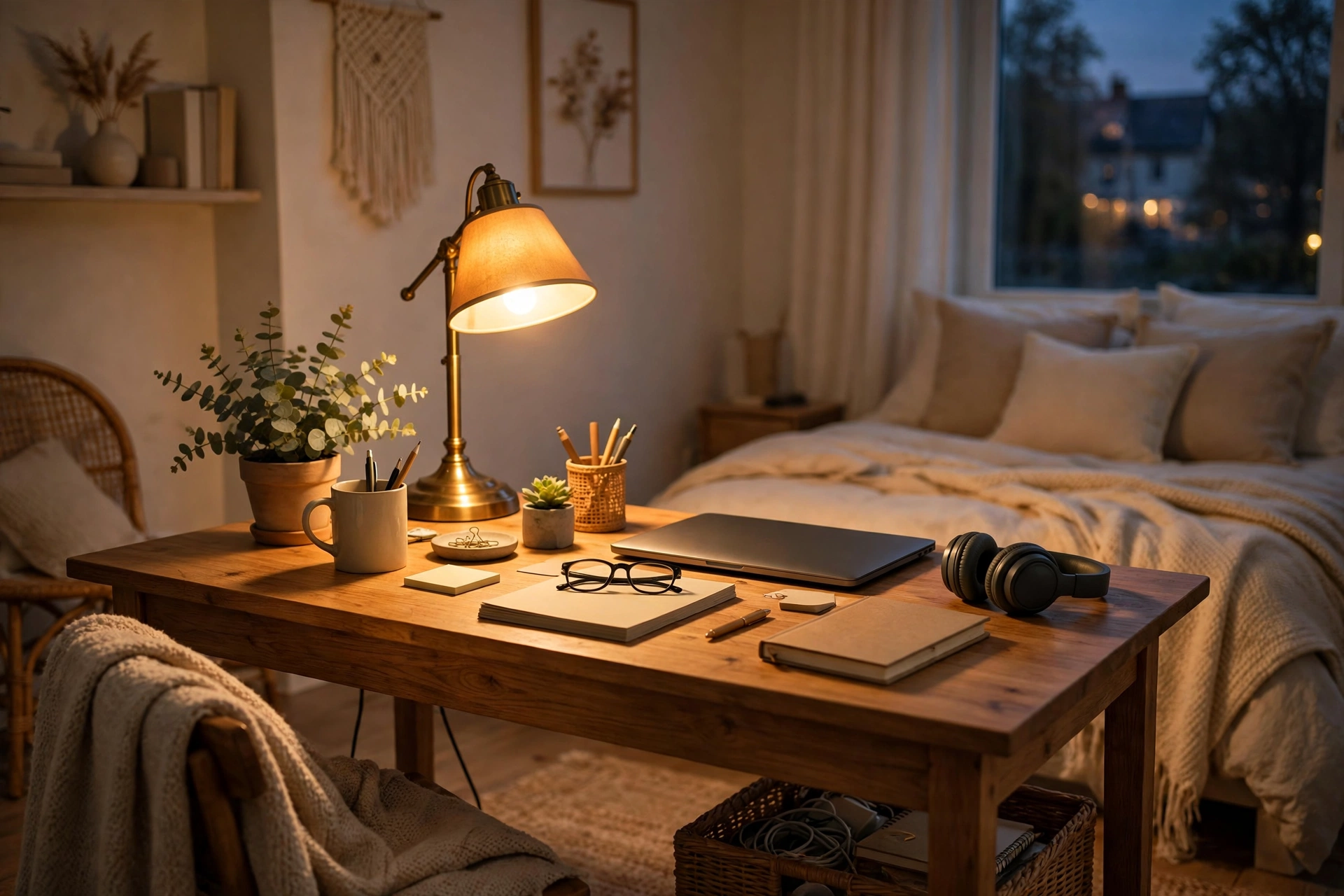
Best for: the reason a bedroom desk fails, when work follows you to bed.
A desk in a bedroom works only if you can stop seeing it at night. Four things make the separation: If you can close it off at night, a small desk for bedroom stops feeling like work.
- Face away from the bed. Sit facing away from the bed if you can. Facing the bed makes it harder to feel like you are at work, and harder to stop thinking about work when you are in bed.
- Hide the screen. Keep the screen out of the first sightline from the pillow. A desk facing the bed makes the mattress stare at your inbox all night. A desk along the bed wall, beside the window, or backed by a low bookcase reduces that pressure.
- A thin boundary. A rug under the desk (4 by 6 feet, low-pile so the chair rolls on it), a paint panel 6 to 12 inches wider than the desk on each side, a curtain on a tension rod, or a low bookcase between the desk and the bed. A full divider chops up a small room; no divider lets the desk bleed into the bed. A thin boundary is enough.
- Different light by zone: about 3000K at the desk for clear task light, and warmer 2700K near the bed to signal wind-down. Two bulb temperatures tell your brain which zone you are in.
- Close it at night: if the desk is in a closet, close the doors. If it is a fold-down desk, fold it up. If it is a regular desk, close the laptop and put the notebook away. The ritual matters more than the furniture, when the desk is closed, work is over.
If you cannot separate the desk from the bed at all, the closet desk (idea 5) is the answer, because at night, the office is gone.
Small desk for bedroom setup under $150: the budget breakdown
A bedroom desk does not need to be expensive. Here is the whole setup for under $150: This small desk for bedroom setup keeps every item under budget.
- Small desk (36 to 42 inches, laptop-only): $60
- Chair (simple, with back support): $35
- Desk lamp (warm white, 2700 to 3000K): $25
- Rug (4 by 6 feet, low-pile): $25
- Total: $145
Buy the desk and the lamp first, they make the biggest difference. Buy the chair second (a bad chair ruins a good desk). Buy the rug last, after you know the layout works. Spend on the chair next: a small desk for bedroom is only comfortable if the chair fits it.
If you have not set up your small desk for bedroom yet
A bedroom desk is only as good as its setup. Once the desk is placed, set the chair, monitor, keyboard, and cables in their right places before you decorate it, see our desk setup guide. And if you want a gaming desk in the bedroom, see our gaming corner desk guide for the best place, layout, and measurements. For choosing the desk itself, see our desks for small spaces guide. For monitor height and sitting posture for your small desk for bedroom, see OSHA’s computer workstation guide.
5 small desk for bedroom mistakes to avoid
1. Desk facing the bed. You see the bed while you work and the desk while you sleep. Face away from the bed, or put a low bookcase between the desk and the bed.
2. Blocking the door or the drawers. A desk that blocks the door, the wardrobe, or the dresser drawers will be moved within a week. Keep 24 inches clear on the path from the door to the bed.
3. No lamp. A bedroom desk without a lamp is unusable after dark, and a bedroom has no office lighting to fall back on. One lamp, warm white, opposite your writing hand.
4. Screen glare. A desk facing the window gives you a view and daylight, but the screen glares and your face is dark on video calls. Put the desk beside the window, not facing it, or add a sheer curtain.
5. No boundary between work and sleep. A desk with no boundary bleeds into the bed. A rug, a paint panel, a curtain, or a low bookcase marks where work ends and sleep begins.
FAQ
Where should I put a desk in a small bedroom?
On the wall beside the window, so daylight comes from the side and the bed stays out of your eyeline. If that wall is taken, try a corner, the end of the bed, under the window, or inside the closet. Avoid spots that block the door, the drawers, or your path to the bed. That side light is the main advantage of a small desk for bedroom in that spot.
Where to place a desk in a bedroom?
Beside the window is best for light and video calls. Under the window is best for studying. In a corner is best for saving space. Inside a closet is best for hiding the office at night. Wherever it goes, leave 30 inches behind the chair and keep a clear path from the door.
How do I separate my desk from my bed?
Face the desk away from the bed, keep the screen out of the sightline from the pillow, and add a thin boundary, a 4 by 6 foot rug under the desk, a paint panel 6 to 12 inches wider than the desk on each side, a curtain on a tension rod, or a low bookcase between the desk and the bed. Use 3000K light at the desk and warmer 2700K light near the bed.
What size desk fits in a small bedroom?
A laptop-only desk can be 36 to 42 inches wide and 20 to 24 inches deep. A monitor-and-keyboard setup needs 48 inches wide and 24 to 30 inches deep. A slim desk at the foot of the bed should be 36 to 40 inches wide and 18 to 20 inches deep. Those sizes suit a small desk for bedroom for one person and one laptop.
How do I decorate a bedroom desk area?
Match the bedroom, not an office: one piece of art above the desk (two-thirds as wide as the desk, hung 6 to 8 inches above the surface), one small plant in a 4 to 6 inch pot, one lamp in warm white, and the bedroom’s accent colour in three touches, a notebook, a plant pot, a frame.
Start today
The best small desk for bedroom is not the biggest one. It is the one in the right spot, beside the window, with 30 inches behind the chair, a lamp on it, and a boundary between it and the bed. Walk around your bedroom today, find the wall with light and a socket, and measure it. The desk will fit, because you measured the room before you bought the desk.