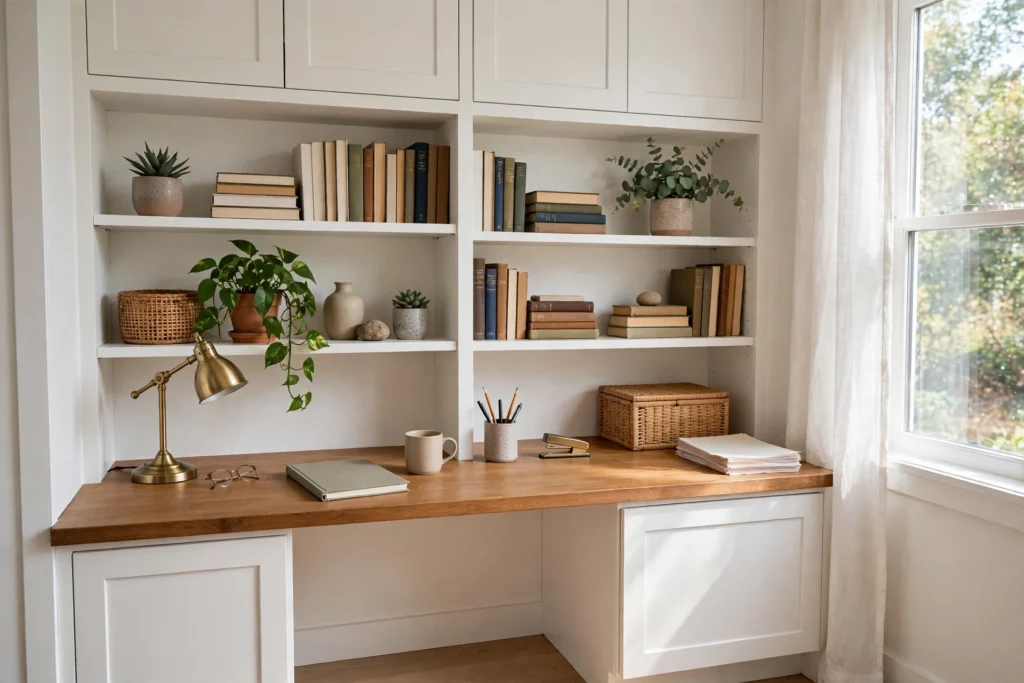
A built in desk fits where a bought desk cannot. It follows the exact width of your wall, uses the space above and below the surface, and turns a dead corner, a closet, or a hallway nook into a real workspace. For a small home office, that is the whole point: no wasted inches, no gaps, no furniture that almost fits.
This guide shows you 8 built in desk ideas for small spaces, with the exact measurements for each one: how deep the desk should be, how high the shelves go, how much knee space you need, and what it costs. Most of these can be built for under $150 with the one-unit versions in ideas 2 and 8, as specified, three of the eight are under $150, and there is a renter-friendly version of the look at the end, for anyone who cannot drill into the walls.
Table of Contents
Measure first: the numbers that matter
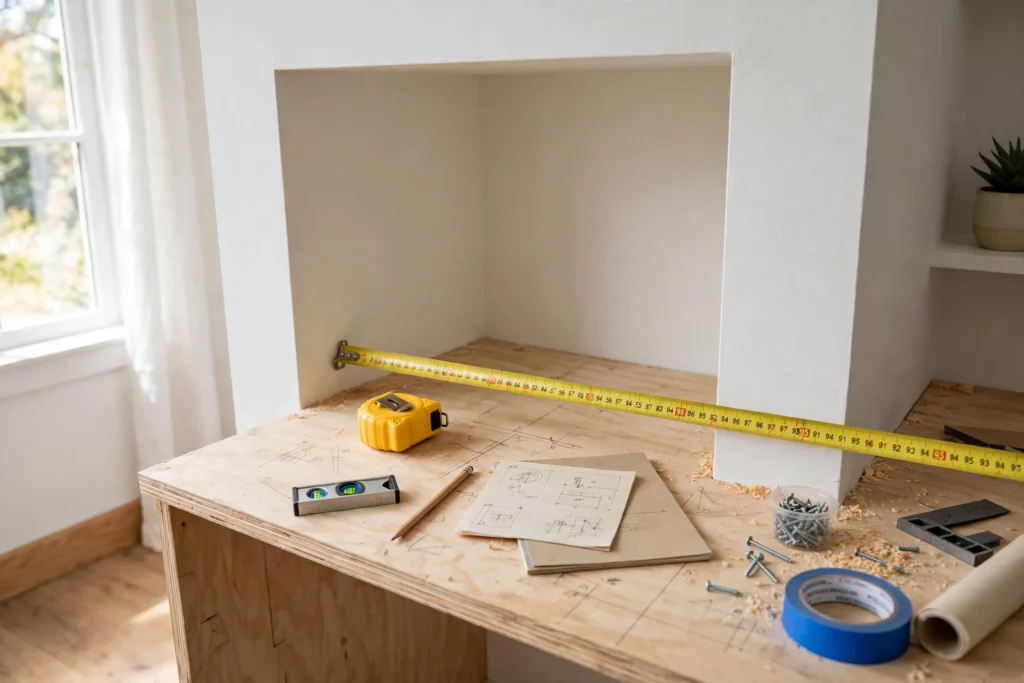
Best for: every built-in desk, measure twice, build once.
A built-in desk is custom, so the measurements are the project. Get these five numbers right before you buy or cut anything. Every built in desk in this guide is sized from these five numbers, so write them down before you buy a single board. Before you drill, read Family Handyman’s guide to wall studs so every bracket lands in solid wood.
- Width: measure the wall at three heights, floor, desk height, and shelf height. Walls are rarely straight; use the smallest of the three measurements, minus 1/4 inch for fitting.
- Depth: 20 to 24 inches for a laptop setup, 24 to 30 inches for an external monitor. Deeper than 30 inches and you cannot reach the back of the desk from your chair.
- Height: 28 to 30 inches from the floor to the top of the desk surface. This is the standard desk height, and it works with most chairs.
- Knee space: at least 24 inches wide and 27 inches high clear under the desk, so your legs and chair fit. A drawer unit under the desk must leave this space open.
- Shelf height: the bottom of the first shelf 18 to 20 inches above the desk surface, shelves 10 to 12 inches deep. Lower than 18 inches and the shelf hits your head; higher than 20 inches and you cannot reach it sitting down.
Write these five numbers on a card and take it to the store. Every idea below uses them.
1. Desk with open shelves above
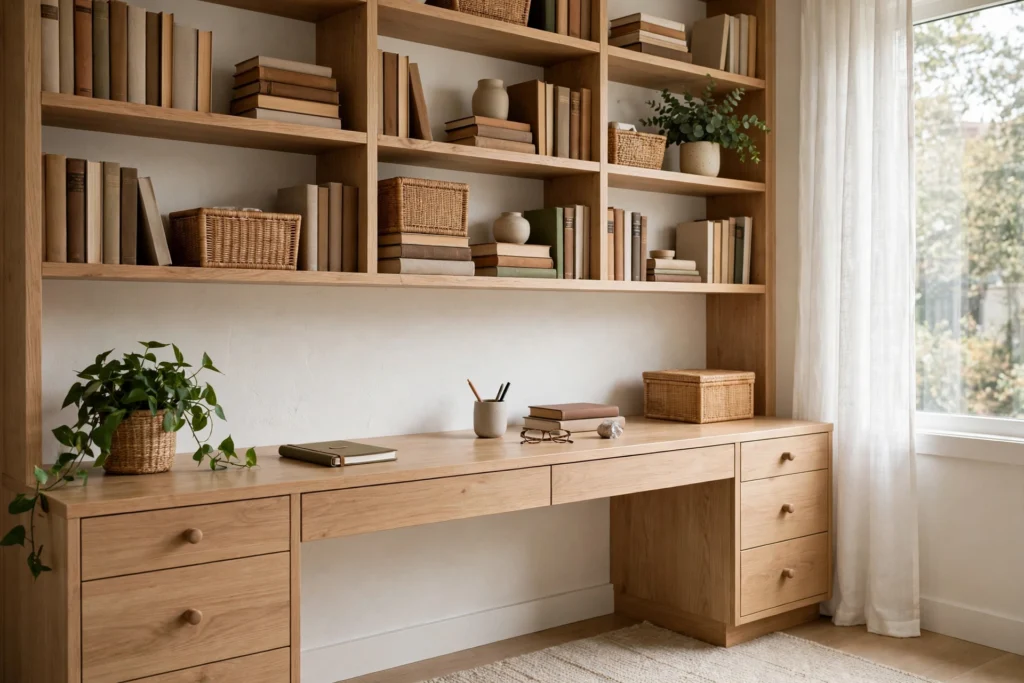
Best for: the classic built in desk and shelves, the most popular built-in, and the easiest to build.
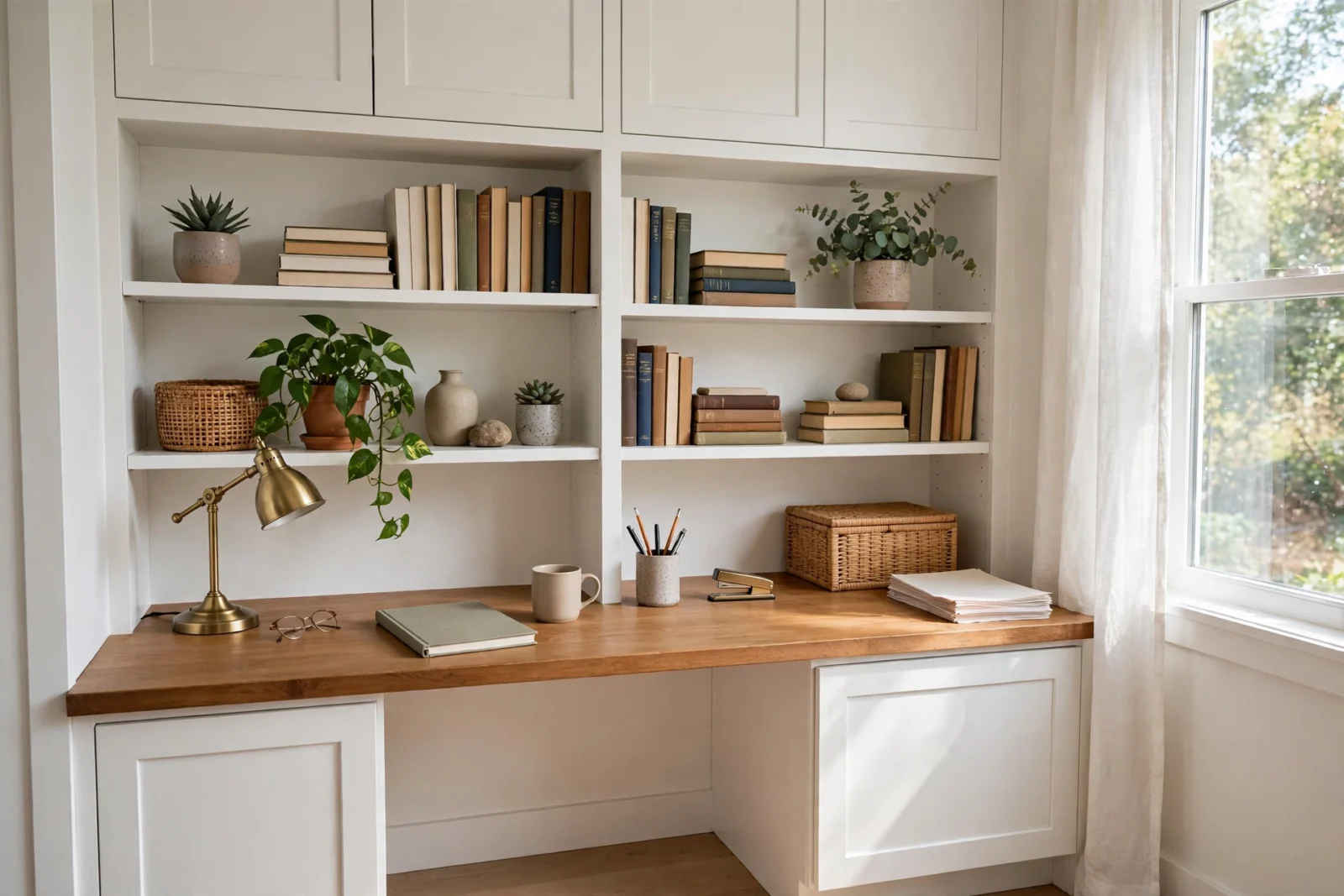
A desk surface with open shelves above it is the built-in most people picture, and it works in the smallest spaces because the storage goes up the wall instead of out into the room. It is the simplest built in desk to build, and the easiest to change later.
- Size: desk 36 to 48 inches wide, 20 to 24 inches deep. Shelves 24 to 36 inches wide, 10 to 12 inches deep, first shelf 18 to 20 inches above the desk.
- How many shelves: two shelves above the desk is enough. The lower shelf holds books and binders you use daily; the upper shelf holds decor and things you use weekly.
- What goes where: books standing upright on one side of the lower shelf, one plant, one framed photo. Leave 4 to 6 inches of empty shelf on each side, empty space is what makes shelves look styled instead of stuffed.
- Build it: a wood board for the desk surface, two shelf boards, and brackets screwed into wall studs. A 3/4 inch plywood or butcher block top is strong enough for a monitor and a laptop.
- Cost: about $80 to $120 for boards, brackets, and screws if you build it yourself.
This is the built-in to choose if you want the look with the least work. One weekend, three boards, and the wall does the rest.
2. Desk with a bookcase
Best for: readers and anyone with more books than desk space, a built in desk and bookshelves in one unit.
A desk with a bookcase built in turns one wall into a whole office: work surface in the middle, books above and beside it, and no separate bookcase taking up floor space. For a reader, a built in desk with a bookcase keeps everything within arm’s reach.
- Size: the bookcase section 12 to 16 inches deep, 72 to 84 inches tall (floor to top shelf). The desk surface sits at 28 to 30 inches high, 20 to 24 inches deep, and as wide as the wall allows.
- Layout: bookcase on one side of the desk, shelves above the desk, or both. A bookcase on the left and open shelves above the desk is the most useful layout for a small room.
- Shelf spacing: shelves 10 to 12 inches apart for paperbacks, 12 to 14 inches for binders and large books. Adjustable shelf pins let you change the spacing later.
- Build it: two stock bookcases (one on each side of the desk, or one tall bookcase beside it) with a wood top spanning between them. This is the built-in look without building anything from scratch.
- Cost: two stock bookcases ($60 to $100 each) plus a wood top ($40 to $60), about $160 to $260 total, or under $150 if you use one bookcase and a shorter top.
The bookcase version is the best built-in for a bedroom office, because the books make the desk look like furniture instead of an office.
3. Desk with cabinets and drawers
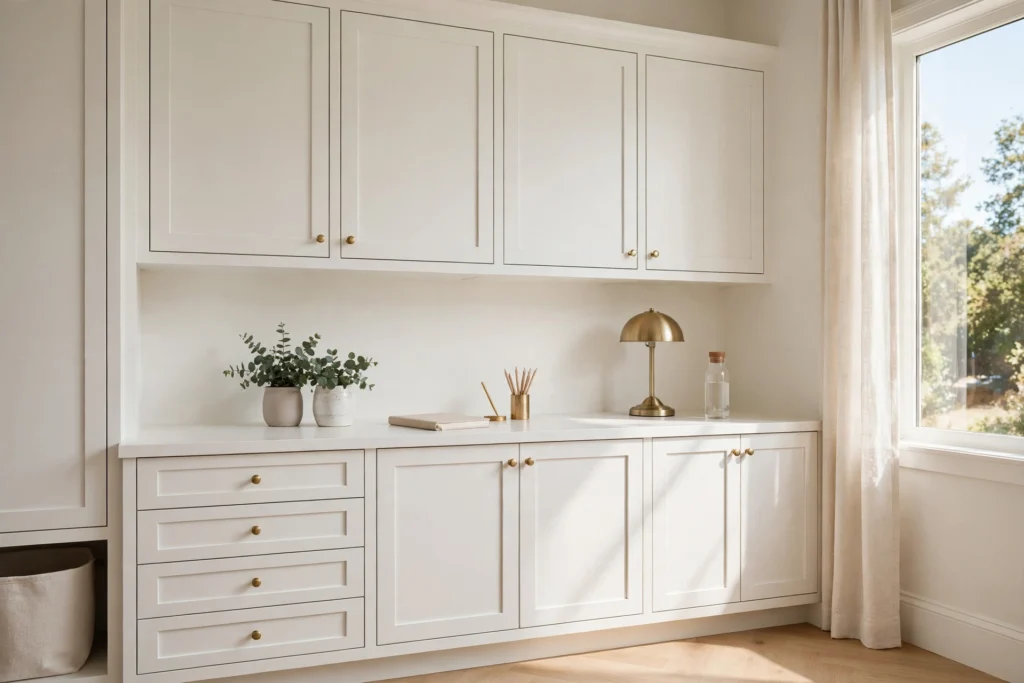
Best for: hiding everything, a built in desk cabinet setup for people who hate visible clutter.
Open shelves show everything. Cabinets and drawers hide everything. If your desk holds files, chargers, cables, and supplies you do not want to look at, this is the built-in to build. If clutter is the problem, a built in desk with drawers solves it better than open shelves.
- Size: a drawer unit 15 to 18 inches wide and 20 to 24 inches deep on one or both sides of the desk, with the desk top spanning between them. Keep the 24 inch knee space clear in the middle.
- What goes where: top drawer for pens, chargers, and small supplies; middle drawer for files and paper; bottom drawer or cabinet for a printer, cables, or a bag. A file drawer needs 12 inches of depth for hanging folders.
- Doors or drawers: drawers are easier to use every day; doors hide bigger things (a printer, a shredder, a stack of boxes). One drawer unit and one door cabinet is the most useful mix.
- Build it: two stock drawer units or kitchen base cabinets with a wood top across them. Kitchen base cabinets are 24 inches deep and 34.5 inches high, cut the top to 28 to 30 inches by adding a thicker wood top or trimming the cabinet legs.
- Cost: two stock drawer units ($80 to $120 each) plus a wood top ($40 to $60), about $200 to $300 total.
This is the most expensive built-in in this guide, and the most useful if your desk is also your storage. If you only need one drawer, build idea 1 and add a single drawer unit under one side.
4. Wall-to-wall desk
Best for: a whole wall of workspace, the built in wall desk that turns an entire wall into a desk.
A wall-to-wall desk spans the full width of a wall, with no gaps at the sides and no legs in the middle. It looks custom because it is custom, and it gives you the most desk surface per square foot of any idea in this guide. That is the appeal of a built in desk that spans the whole wall: no gaps, no wasted inches.
- Size: as wide as the wall (measure at three heights, use the smallest minus 1/4 inch), 20 to 24 inches deep, 28 to 30 inches high.
- Support: a desk longer than 48 inches needs a middle support, a leg, a drawer unit, or a bracket into a stud every 36 to 48 inches. A wood top longer than 48 inches sags in the middle without support.
- Storage: add shelves above the full width, or cabinets at one end. A wall-to-wall desk with shelves above it is a whole office on one wall.
- Build it: a single long wood top (butcher block or plywood, 3/4 inch thick minimum), brackets into studs, and one drawer unit or leg for support in the middle.
- Cost: a 72 inch butcher block top ($100 to $150), brackets ($20 to $30), and a drawer unit ($80 to $120), about $200 to $300 total.
This is the built-in to choose for two people sharing one wall, or for one person who wants a desk and a craft table in the same place.
5. Closet desk and desk nook
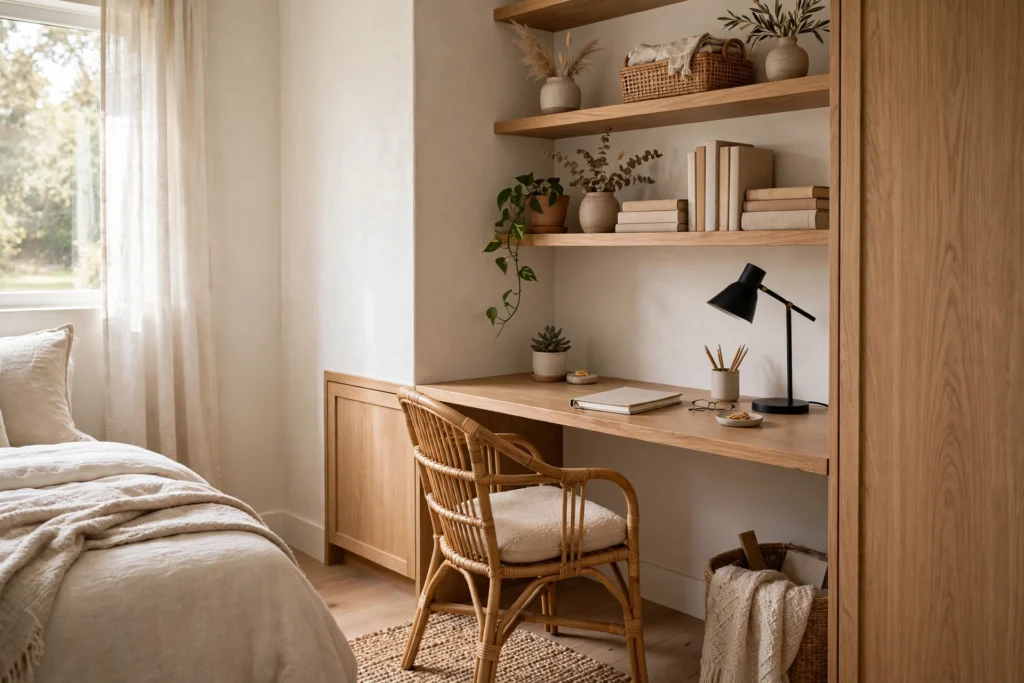
Best for: the smallest spaces, a built in desk nook in a closet, an alcove, or a bedroom corner.
A closet is about 24 inches deep, exactly deep enough for a laptop and a small monitor. Remove the doors (or take them off their hinges and store them), fit a desk board across the closet at 28 to 30 inches high, and you have a complete office that closes away at the end of the day.
- Size: closet desks are usually 36 to 48 inches wide (the width of a standard reach-in closet) and 20 to 24 inches deep. An alcove nook can be any width, measure the alcove at three heights and use the smallest.
- Shelves: one or two shelves above the desk inside the closet, 10 to 12 inches deep, first shelf 18 to 20 inches above the desk. The closet walls hold the shelves, so no brackets into the room walls are needed.
- Light: a closet has no window, so add a small lamp or a stick-on LED light under the shelf. Warm white (2700 to 3000K) keeps the nook from feeling like a cupboard.
- Doors: keep the closet doors if you want to hide the office at night; remove them if you want the nook open all day. Sliding doors hide the mess and cost nothing to keep.
- Cost: a desk board ($30 to $50), two shelf boards ($20 to $30), brackets and screws ($15 to $25), about $65 to $105 total. The cheapest built-in in this guide.
A closet desk is also the best bedroom built in desk, because it uses space the bedroom already has and does not take a single inch of floor.
6. Floating built-in desk
Best for: a desk with no legs at all, a wall-mounted desk that keeps the floor completely clear.
A floating desk is a wood board screwed into the wall studs with heavy-duty brackets, with no legs underneath. The floor stays open, the room feels bigger, and you can slide a chair or a storage box underneath without moving anything. A floating built in desk keeps the floor clear, which matters most in a hallway or on a landing.
- Size: 36 to 48 inches wide, 20 to 24 inches deep, mounted at 28 to 30 inches high. Wider than 48 inches needs a middle bracket into a stud.
- Support: anchor into wall studs with heavy-duty brackets rated for at least 50 pounds more than the desk will hold. Drywall anchors alone are not enough for a desk with a monitor on it.
- Weight limit: a floating desk holds a laptop, a monitor, books, and a lamp, about 30 to 50 pounds of gear. Do not sit on it, and do not store heavy boxes on it.
- Shelves: pair it with one or two floating shelves above, 10 to 12 inches deep, first shelf 18 to 20 inches above the desk. The desk and the shelves use the same brackets and the same studs.
- Cost: a wood board ($30 to $50), two heavy-duty brackets ($20 to $40), screws ($5 to $10), about $55 to $100 total.
This is the built-in to choose for a hallway, a landing, or any spot where floor space matters more than storage.
7. Corner built-in desk
Best for: a dead corner, an L-shaped built-in that uses two walls at once.
A corner built-in turns the two walls of a corner into one L-shaped work surface. One arm holds the monitor and keyboard, the other holds paper, a notebook, or a second screen. Each arm 40 to 48 inches long gives enough room for both without pushing the desk into the middle of the room. A corner built in desk turns dead space into the most-used spot in the room.
- Size: each arm 40 to 48 inches long, 20 to 24 inches deep, 28 to 30 inches high. The corner itself is the deepest part of the desk, about 30 inches from the corner to the front edge, which is where the monitor goes.
- Shelves: shelves above one arm only, not both. Shelves on both arms make the corner feel closed in. Put the shelves above the arm you use for paper, and leave the monitor arm clear.
- Build it: two wood boards joined at the corner with a bracket underneath, or one L-shaped board cut to fit. A corner desk needs a support leg or a drawer unit at the end of each arm.
- Cost: two wood boards ($60 to $100), brackets ($20 to $30), one drawer unit ($80 to $120), about $160 to $250 total.
If you want the full corner desk guide, 12 layouts with exact measurements, see our corner desk setup guide.
8. The built-in look on a budget
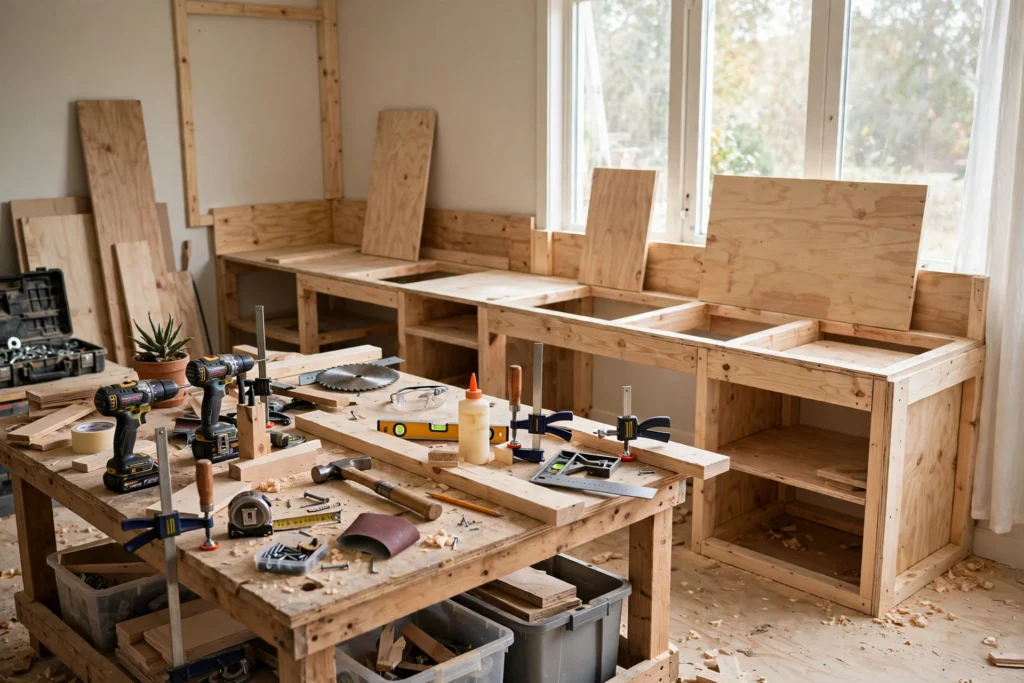
Best for: the diy built in desk, the built-in look for under $150, with no carpentry skills needed.
You do not need to build a desk from scratch to get a built-in. The cheapest way is to combine stock furniture into a unit that looks built in: two drawer units or bookcases, one wood top across them, and a shelf above. It looks custom because it fits the wall exactly; it costs little because every piece is stock.
- The formula: two stock drawer units ($40 to $60 each) + one butcher block or plywood top ($40 to $60) + one shelf board and brackets ($20 to $30) = $140 to $210 total. Use one drawer unit and a shorter top to stay under $150.
- Make it look built in: paint the drawer units and the wall the same colour, so the unit reads as one piece. Add a strip of wood trim along the top edge of the desk to hide the join. Push the unit tight to the wall, no gap at the sides.
- The top: butcher block looks best and costs $40 to $60 for a 48 inch piece. Plywood costs less ($25 to $40) and looks fine painted. Sand the edges smooth and seal the top with a clear coat so coffee rings do not stain it.
- The shelves: one shelf board above the desk, 10 to 12 inches deep, 18 to 20 inches above the desk, on two brackets screwed into studs. If you cannot screw into the wall, use a leaning ladder shelf beside the desk instead (see the renter section below).
- Time: about 4 hours, one hour to assemble the drawer units, one hour to cut and seal the top, one hour to mount the shelf, one hour to paint and tidy up.
This is the built-in most people should build first. If you outgrow it, the drawer units and the top come apart and move with you.
Renter-friendly alternatives
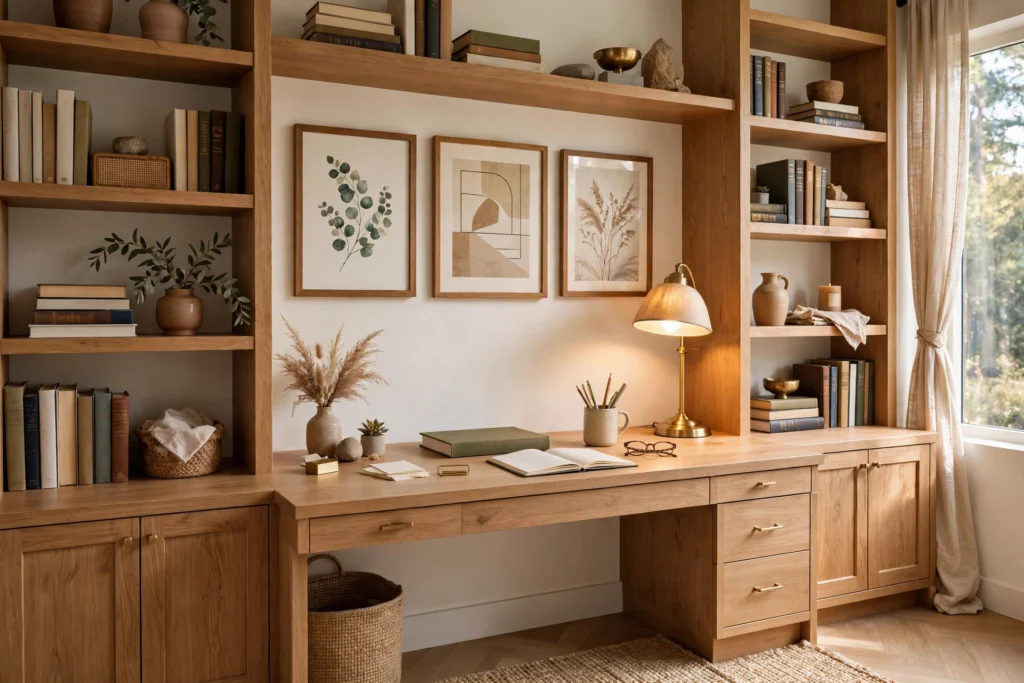
Best for: renters, the built-in look with no holes in the wall.
A true built-in desk is screwed into the wall, so it is not renter-friendly. But the look is, with three no-drill swaps:
- Instead of a screwed-in desk top: use two stock drawer units with a wood top resting on them. The weight of the top and the units holds it in place, no screws into the wall needed. Add a strip of non-slip matting under the top so it does not slide.
- Instead of screwed-in shelves: use a leaning ladder shelf beside the desk, or a tall bookcase pushed tight against the wall. A bookcase 12 inches deep and 72 inches tall holds as much as two wall shelves and needs no holes at all.
- Instead of a wall-mounted floating desk: use a folding desk or a console table pushed against the wall. A console table 36 to 40 inches wide and 18 to 20 inches deep fits behind a sofa or along a hallway wall and moves with you.
- The trim trick: paint the drawer units the same colour as the wall, and the unit reads as built in even though nothing is attached. When you move out, the units come apart and the wall is untouched.
If your landlord allows two small screw holes, one shelf on two brackets is the single best upgrade, but check your lease first, and use adhesive hooks and leaning furniture for everything else.
How much does a built-in desk cost?
The honest answer: it depends on who builds it.
- Custom built-in (a carpenter builds it): $1,000 to $3,000 or more, depending on the size, the wood, and the cabinets. This is the most expensive option and the best-looking one, but it is permanent, and it stays with the house when you move.
- Semi-custom (stock cabinets + wood top): $200 to $600, depending on how many cabinets and shelves you add. This is the sweet spot for most people: it looks built in, it costs a fraction of custom, and it comes apart if you move.
- DIY (boards + brackets): $55 to $300, depending on the size. The open-shelf desk (idea 1) and the closet desk (idea 5) are the cheapest; the cabinet desk (idea 3) is the most expensive DIY option.
- Built-in bookshelves: a stock bookcase costs $60 to $100; a custom built-in bookshelf costs $500 to $1,500 per section. A single shelf board with brackets costs $20 to $30, which is why the open-shelf desk is the cheapest built-in of all.
Start with the DIY version. If you love the built-in after six months, spend more on the semi-custom version. Do not start with custom.
If you have not set up the desk yet
A built-in desk is only as good as its setup. Once the desk is built, set the chair, monitor, keyboard, and cables in their right places before you decorate it, see our desk setup guide. And if you have not chosen a desk type yet, see our desks for small spaces guide for the eight desk types that fit small rooms.
5 mistakes to avoid
1. Measuring once. Walls are rarely straight. Measure the width at three heights and use the smallest number minus 1/4 inch. A desk cut to the widest measurement will not fit.
2. Forgetting knee space. A desk with drawers on both sides and no gap in the middle leaves nowhere for your legs. Keep at least 24 inches wide and 27 inches high clear under the desk.
3. Shelves too high or too low. Shelves lower than 18 inches above the desk hit your head; higher than 20 inches and you cannot reach them sitting down. Measure from the desk surface, not from the floor.
4. No middle support on a long desk. A wood top longer than 48 inches sags in the middle without a leg, a drawer unit, or a bracket into a stud every 36 to 48 inches. Support it before you load it with books.
5. Building before you know the setup. A built-in is hard to move. Set up the chair, monitor, and keyboard positions first, on a folding table if you have to, and build the desk around the setup, not the other way round.
FAQ
How do I build a built in desk?
Measure the wall at three heights and use the smallest measurement minus 1/4 inch. For the simplest version, mount a wood board 20 to 24 inches deep at 28 to 30 inches high on brackets screwed into wall studs, then add one or two shelves 10 to 12 inches deep, 18 to 20 inches above the desk. A board, two brackets, and screws cost about $55 to $100.
How much does a built in desk cost?
A DIY built-in costs $55 to $300. A semi-custom built-in (stock cabinets + wood top) costs $200 to $600. A custom built-in from a carpenter costs $1,000 to $3,000 or more. Start with the DIY version and upgrade later if you love it.
How much are built in bookshelves?
A stock bookcase costs $60 to $100. A custom built-in bookshelf costs $500 to $1,500 per section. A single shelf board with brackets costs $20 to $30, which is why the open-shelf desk is the cheapest built-in of all.
Can I put a built in desk in a small bedroom?
Yes, a closet desk is the best option. A standard reach-in closet is about 24 inches deep, exactly deep enough for a laptop and a small monitor. Fit a desk board across the closet at 28 to 30 inches high, add one or two shelves above it, and the office closes away behind the closet doors.
How deep should a built in desk be?
20 to 24 inches for a laptop setup, 24 to 30 inches for an external monitor. Deeper than 30 inches and you cannot reach the back of the desk from your chair. A closet desk works at 20 to 24 inches deep, which is the depth of a standard closet.
Start today
The best built in desk is not the most expensive one. It is the one that fits your wall exactly, one wood board at the right height, one shelf at the right height, and enough knee space to sit comfortably. Measure your wall today, write down the five numbers, and build the open-shelf desk this weekend. The wall will do the rest.