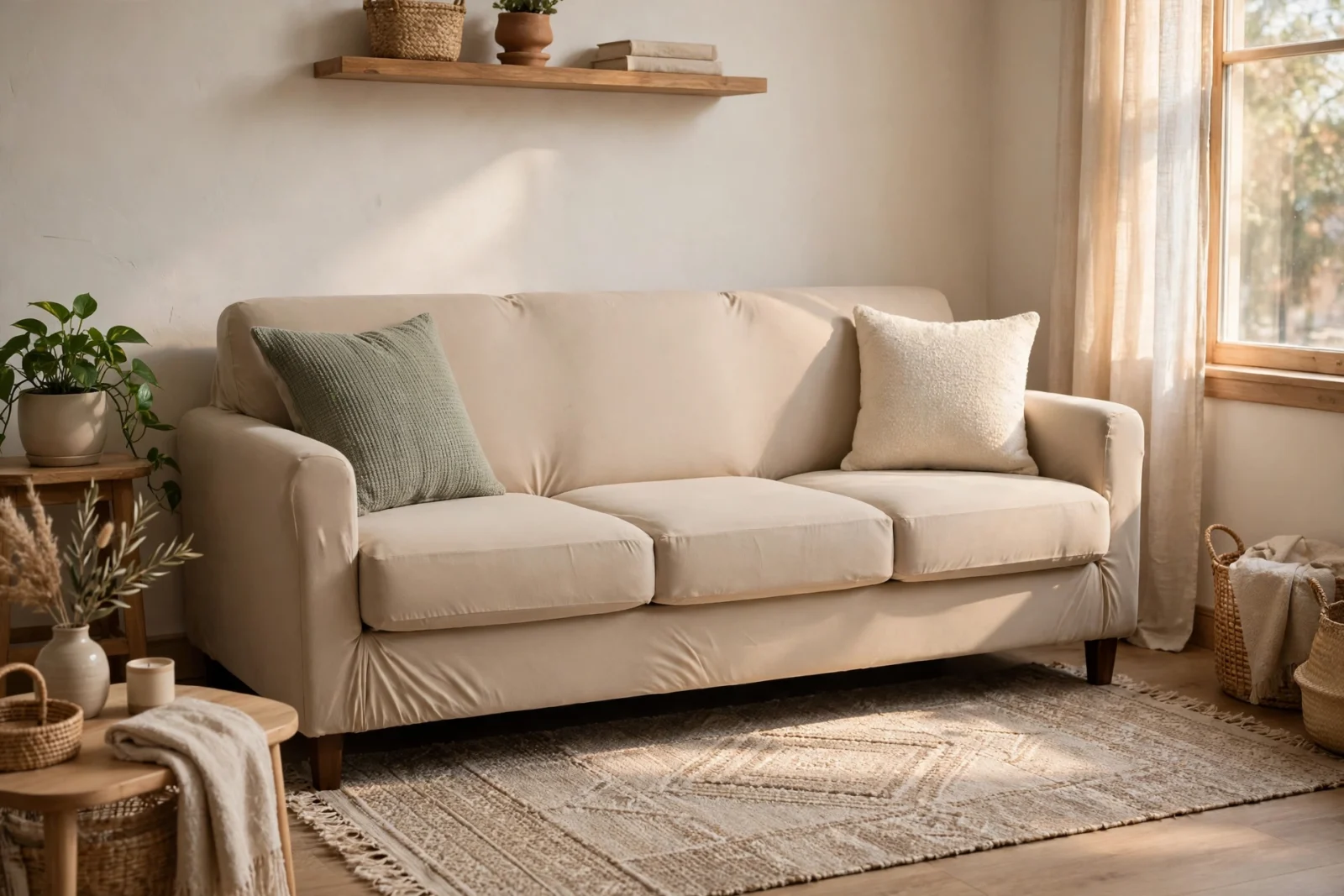
Couch covers are the fastest, cheapest way to fix a small living room, and the one upgrade a renter can do without asking the landlord, drilling a single hole, or buying a new sofa. If your couch is stained, faded, the wrong color, or simply the landlord’s old floral sofa you never chose, a good cover hides all of it in one afternoon, protects the upholstery underneath so your deposit stays safe, and comes off for washing whenever life happens. This guide shows you how to measure your sofa, pick the right cover type, fit it without wrinkles, wash it without shrinking it, and finish the whole refresh for under $150.
Table of Contents
The numbers first
Best for: every idea in this guide, measure the sofa before you buy anything.
Six numbers decide whether couch covers work or end up folded in a closet:
- Overall width: outside arm to outside arm. A standard three-seat sofa is 72 to 84 inches wide; a loveseat is 52 to 58 inches.
- Seat width: inside arm to inside arm, usually 60 to 72 inches on a three-seater. Separate couch cushion covers live or die by this number.
- Seat depth: front edge to back cushions, 20 to 22 inches on most apartment sofas; deep seats run 23 to 25 inches and need more fabric.
- Back height: floor to top of the backrest, usually 30 to 36 inches. A cover cut for a short back leaves the top exposed.
- Arm width: slim track arms are 3 to 4 inches wide; rolled or pillow-top arms run 6 to 10 inches and eat far more fabric.
- Walkway: keep 30 to 36 inches of clear walking space in front of the sofa. A cover does not change your floor plan, if the sofa already crowds the room, the cover will not fix that.
What is a couch cover, really?
A couch cover, also sold as a sofa cover, a couch slipcover, or a slipcover couch cover, is a removable fabric case that pulls over your existing sofa to protect it or change how it looks. The best ones fit snuglyupholstery that guests will not notice. The worst ones bunch up, slide around, and look like a bedsheet thrown over the furniture. In short, couch covers are the renter-friendly version of reupholstery.
Three things people confuse, and the confusion causes the returns:
- A throw is draped fabric: cheap and easy to wash, but it shifts when someone sits, leaves the sides and back exposed, and protects nothing underneath.
- A slipcover is a fitted case pulled over the whole sofa, full coverage, but most ready-made sofa covers are sized for standard shapes and sit loosely on sectionals.
- A built-in removable cover is part of the sofa’s construction. You cannot buy one for a sofa that does not already have it, which is exactly why a good fitted couch cover is the renter’s version of the same idea.
A cover is a cosmetic and protective layer. It is not furniture repair, and pretending otherwise wastes money, more on that in the mistakes section. Treat couch covers as a replaceable layer, not a repair.
1. The 4 types of couch covers, honestly compared
Every cover on the market is a variation of four ideas. Most couch covers fall into one of these four, so name your type before you shop.
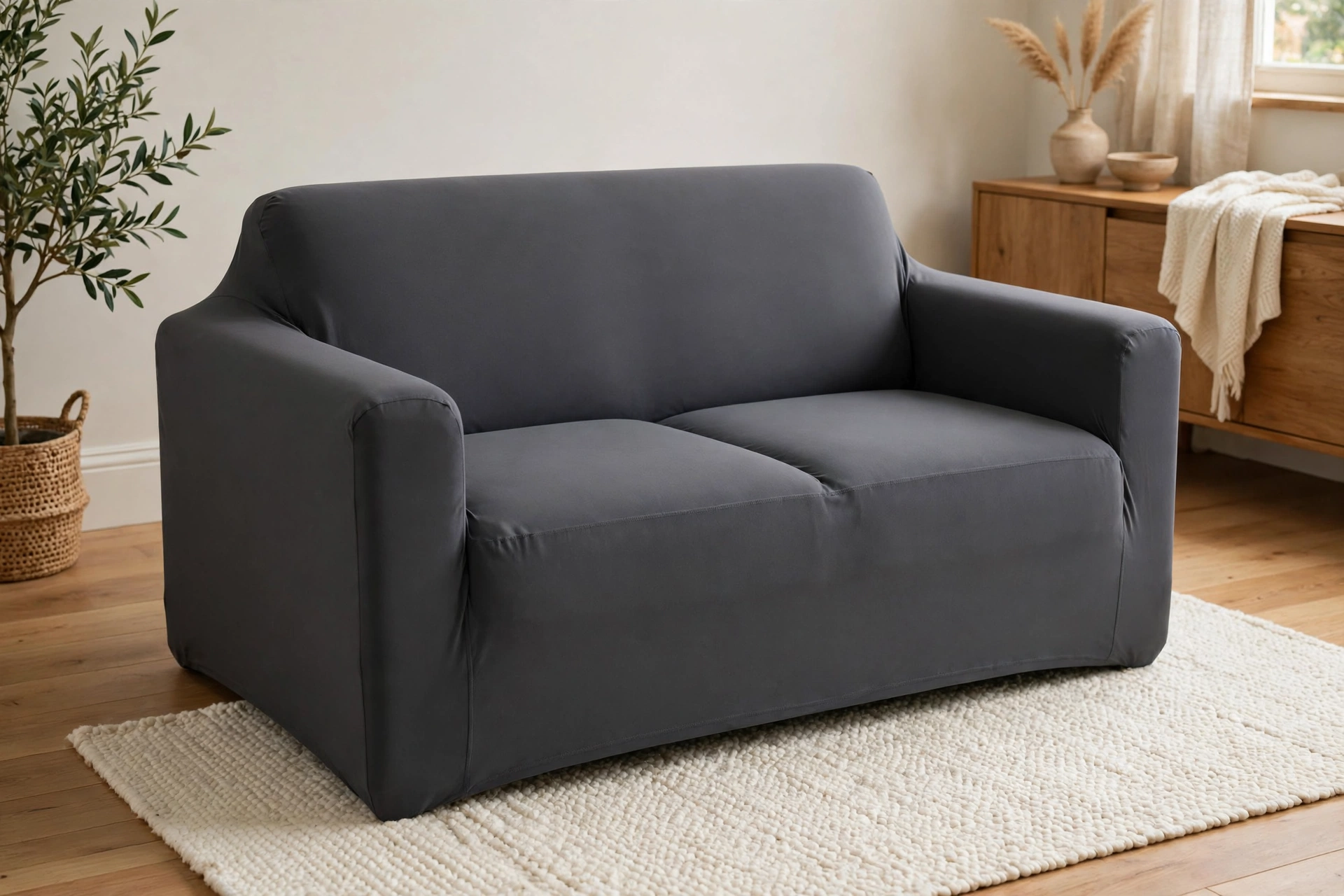
One-piece stretch covers
These are knit fabrics, most commonly polyester blended with spandex, that pull over the whole sofa like a fitted sheet. Their strength is forgiveness: if your sofa is an inch or two outside the stated range, the stretch usually absorbs it, and installation takes minutes. Their weakness is shape: one piece of fabric covering base and cushions together shifts and wrinkles when people sit down and stand up. They look best in relaxed, casual rooms and rentals where easy washing matters more than a tailored silhouette. Typical price range: $25 to $60 for a standard three-seater.
Separate-cushion (multi-piece) covers
These sets include a cover for the sofa body plus individual sofa cushion covers for each seat cushion, and sometimes for the back cushions too. This is the design that most convincingly mimics real upholstery, because the cushion covers stay put independently when someone sits. The trade-off is sizing strictness: you need to match not just the overall width but the seat width, because each cushion cover for couch seats is cut for a specific cushion size. For the main living-room sofa that guests actually see, this is usually the type worth the extra effort. Typical price range: $40 to $90.
Quilted furniture protectors
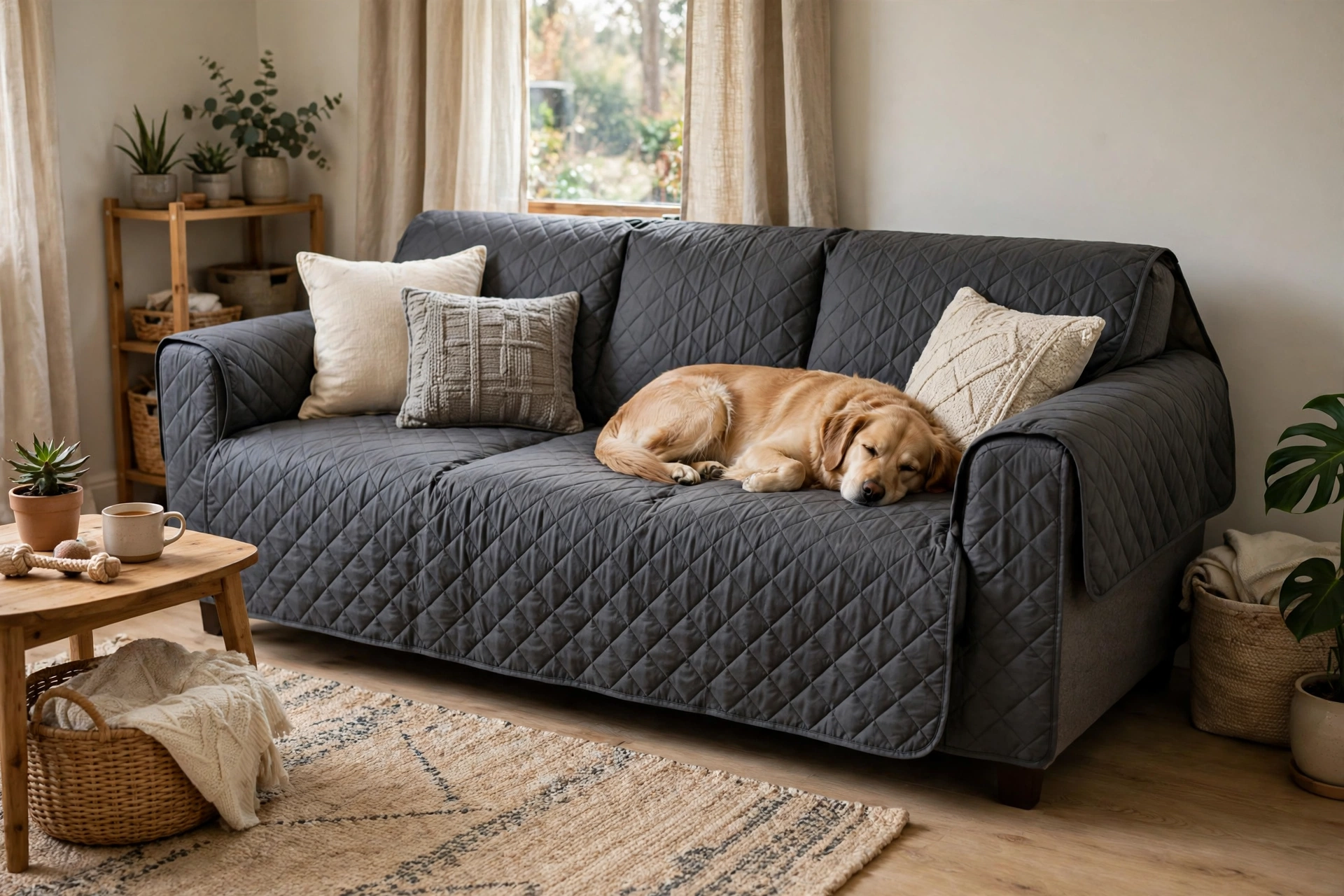
Quilted couch protector covers are padded, often reversible, and built for protection first and looks second. They drape over the sofa rather than hugging it, and they are the type most often sold for homes with dogs and kids. The padding absorbs impact, the quilting hides wrinkles, and the fabric is chosen for frequent machine washing. What they do not do is make a sofa look reupholstered, they read as a protective layer. In a family room where the dog sleeps on the couch every night, that trade is usually the right one. Typical price range: $30 to $70.
Custom couch covers
Custom couch covers are made to order for a specific sofa model or for measurements you supply. They are the only option that reliably fits antiques, unusual arm shapes, curved backs, or oversized frames, and they can use heavier upholstery fabrics like cotton duck or twill. They cost several times more than ready-made covers, typically $150 to $400+, and take weeks.
Go custom when your sofa is genuinely outside standard dimensions or when the sofa itself is worth protecting. For an ordinary standard sofa, a well-measured ready-made cover gets you most of the way there for a small fraction of the cost. Note that custom covers alone break the under-$150 budget in this guide, so they are the exception, not the plan.
The one-sentence version: stretch for ease, separate-cushion for looks, quilted for protection, custom for odd shapes.
| Cover type | Best for | Fit | Price range |
|---|---|---|---|
| One-piece stretch sofa cover | Any standard sofa, easiest install | Forgiving, softer silhouette | $25–$60 |
| Separate-cushion set | Main sofa, tailored look | Strict, needs seat and cushion widths | $40–$90 |
| Quilted couch protector | Dogs, kids, heavy washing | Draped, relaxed | $30–$70 |
| Custom couch covers | Odd shapes, antiques, quality frames | Exact | $150–$400+ |
| Throw-style cover | Quick seasonal change, layering | Loose, shifts | $15–$40 |
2. How to measure your sofa for a couch cover
Do this before you look at colors. You need a soft tape measure, a pen, and five minutes. Measure over the sofa as it is, cushions on, arms bare, and write every number down. These six numbers are what make couch covers fit instead of bunching.
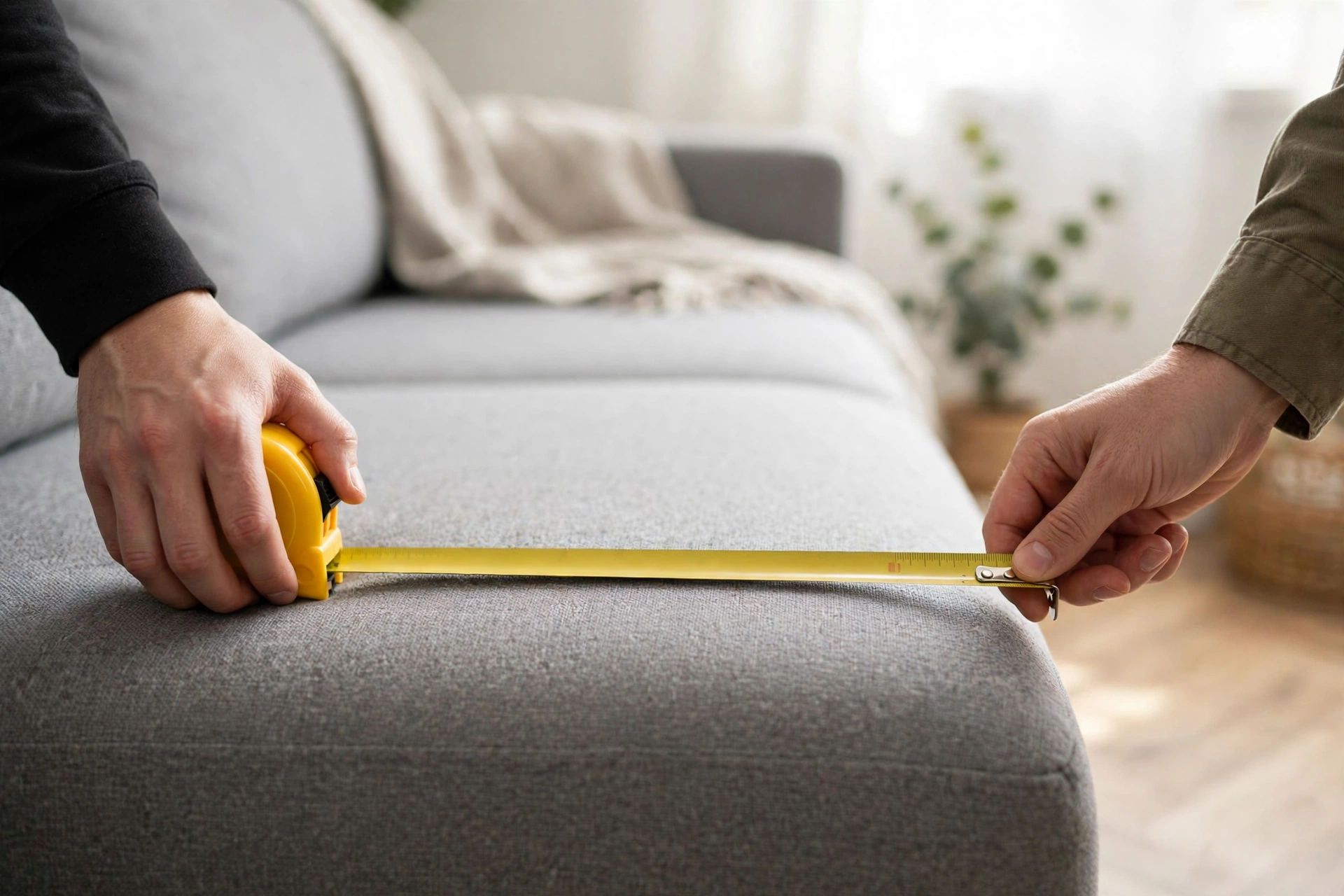
- Overall width: from the outside of one arm to the outside of the other arm. This is the number most people measure first, and on its own it is not enough.
- Seat width: the width of the sitting area, inside arm to inside arm. Separate-cushion sets live or die by this number, several listings flag a seat-width limit (for example, up to 66 inches) that has nothing to do with the overall width.
- Seat depth: from the front edge of the seat to the back cushions. Deep seats need more fabric; a cover cut for a shallow seat will pull and ride up.
- Back height: from the floor to the top of the backrest. Tall backs need taller covers; short covers leave the top of the back exposed.
- Arm width and arm height: wide, rolled, or pillow-top arms need more fabric than slim track arms. Measure each arm at its widest point.
- Individual cushion widths: for multi-piece sets, measure each seat cushion separately. Two-cushion and three-cushion sofas are not interchangeable, and a set cut for three cushions will not fit a two-cushion sofa properly. Standard seat cushions run 20 to 24 inches wide each.
Then compare all of your numbers to the listing’s size chart, not just one. If any single measurement is outside the stated range, that cover does not fit your sofa, even if the overall width matches. When you are between sizes, the smaller size usually looks better than a baggy larger one, because stretch fabric can give a little but cannot take fabric away. Keep the packaging until you have fitted the cover and sat on it for an evening, because a return without packaging is often refused. That comparison is the step most couch covers buyers skip.
Measuring a sofa you cannot see yet: if you are ordering before move-in day, ask your landlord or property manager for the sofa’s approximate dimensions or the furniture brand and model, most are happy to share them. Then lean on the forgiving nature of stretch covers: as long as you know whether you are dealing with a loveseat (52 to 58 inches), a standard sofa (72 to 84 inches), or a sectional, a stretch cover gives you room for error. Measure again the day you get the keys.
Skirted bases and removable legs: measure with the legs on if you plan to keep them on, since removing legs changes the back height and the way the cover’s bottom edge sits. A skirt under a cover creates bulk at the bottom that shows as an uneven hem, note it in your measurements rather than assuming the cover will hide it.
3. Sectional couch covers: the L-shape rules
Sectionals are where most slipcover purchases go wrong. A standard one-piece cover cannot cover an L-shape, because the sofa runs in two directions and one piece of fabric cannot turn a corner and stay taut. What works is a two-piece sectional couch covers kit: one piece for the main sofa run, one for the chaise run, each measured separately.

For a sectional you need, for each side: the backrest width, the chaise length (from the back to the front of the extended seat, usually 60 to 72 inches), and the chaise width (usually 28 to 36 inches). Listings commonly size sectional kits by backrest width, so that number matters more than the total length of the sectional. You also need to know your orientation: stand facing the sofa and note whether the chaise sticks out on your left or your right. Many kits are reversible and fit either side, but some are not, and a left-facing kit on a right-facing chaise is a return, not a workaround.
Three warnings: recliners generally cannot be slipcovered, the moving mechanism needs clearance the cover blocks. Sleeper sofas: the fold-out bed makes a fitted couch cover impractical; a loose throw-style protector is the realistic option. Attached chaise with no gap: if the chaise is fully attached with no seam, a two-piece kit may not sit cleanly, because the pieces are designed to tuck into that gap.
Covers are cut per seat count: a three-seat cover on a two-seat loveseat leaves fabric pooling at the sides. Buy the loveseat size, even if the sofa size is on sale. Sectional sofa covers and couch covers for sectionals are sold as kits for a reason, one standard cover cannot do the job of two.
For more on sizing seating to a small room before you cover it, see Small Apartment Living Room Ideas.
4. Fabric guide: what the blends actually mean
Listings throw blend percentages at you as if they were quality scores. They are not, but they do tell you something useful if you know how to read them. Percentages alone do not tell you how couch covers will feel after washing.
| Fabric | What it feels like | Best for | Watch out for |
|---|---|---|---|
| Polyester-spandex stretch knit | Soft, stretchy, wrinkle-resistant, holds color | Everyday family sofas, rentals, easy installs | Thin versions can look shiny; heavy use relaxes the knit |
| Velvet / plush stretch | Rich texture, dressier look, soft hand-feel | Formal living rooms, a luxe refresh | Grabs pet fur; check the care label for gentler washing |
| Quilted microfiber | Padded, matte, durable, forgiving of wrinkles | Pet homes, family rooms, frequent washing | Reads as a protector, not as reupholstery |
| Cotton or cotton duck | Natural feel, breathable, structured drape | Tailored custom covers, natural-fiber preference | Less stretch, so sizing must be exact; can wrinkle |
| Linen or linen blend | Airy, relaxed, gets softer with washing | Summer refreshes, light bright rooms | Wrinkles; pure linen needs gentler care |
| Waterproof barrier layers | A hidden layer that blocks liquid | Accident-prone households, heavy spill risk | Can feel crinkly or warm; confirm it is the cover itself, not a separate pad |
Two things the blend percentage does not tell you: fabric weight and construction quality. A heavier knit generally drapes better and resists shifting than a feather-light one, but listings rarely state weight clearly, owner photos and review mentions of “thin” versus “thick” are often more informative than the percentage. That is why two couch covers in the same blend can feel completely different.
Sunlight deserves its own warning. A sofa in direct sun through a south- or west-facing window will fade any cover over time, and unevenly, the back cushions facing the window lighten while the seat stays darker. If your sofa lives in strong sun, favor medium tones over very dark ones and accept that a sun-exposed cover is a consumable with a shorter life. A subtle pattern breaks up fading so the eye does not catch it as quickly as it catches a fading solid color.
Leather sofas need a special note. Leather is slippery, so a standard fabric cover slides more on leather than on fabric, the grip layer matters twice as much. Look for covers with non-slip backing or foam grips, and avoid cheap vinyl or plastic protectors, which can stick to leather or cause surface peeling. A breathable woven cover protects leather safely; a plastic one can damage it.
5. How to fit a couch cover without wrinkles
Fitting is a 20-minute job done once, plus a 2-minute tuck every few days. Here is the order that works:
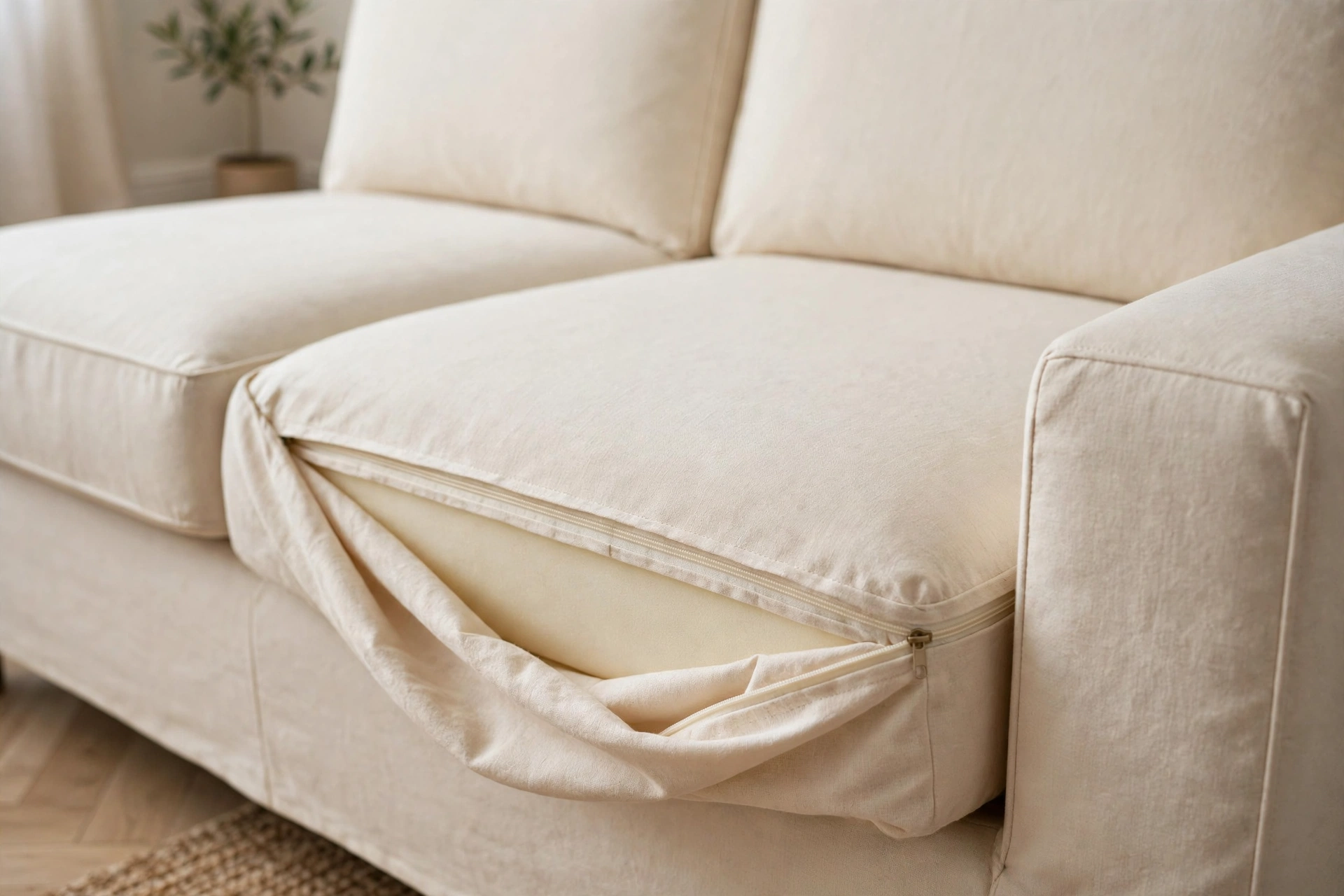
- Wash the cover first. New fabric carries a factory smell that dogs investigate obsessively. Wash cold, gentle cycle, mild detergent, then fit it while it is still very slightly damp, so it stretches into place and dries to the shape of your sofa.
- Remove the cushions. Fit the body cover first with the cushions off, then fit each couch cushion cover separately and put the cushions back. Trying to fit everything at once is how wrinkles happen.
- Start at the back. Drape the cover over the backrest, center it so the seams line up with the sofa’s edges, then pull it down over the arms one side at a time.
- Tuck deep. Push excess fabric into the creases between the seat and the back, and between the seat and the arms, a wooden spatula or a foam tuck stick does this cleanly. Foam tuck sticks (also sold as foam pipes) are 12 to 18 inches long and cost $5 to $10 for a set; they are the oldest reliable fix for a sliding cover.
- Smooth from the center out. Work from the middle of each cushion toward the edges, pushing air and bunches outward instead of pulling the fabric tighter at one corner.
- Sit on it. Sit in every seat for a few minutes, then re-tuck. The sit test is part of the fitting.
How to stop a cover sliding: use a cover with non-slip backing or built-in straps, tuck excess fabric into the cushion gaps, and add foam rollers or grip strips underneath on leather or smooth-fabric sofas. For leather sofas especially, couch covers need that grip layer to stay in place.
6. Pets, kids, and waterproof sofa covers
Let us be blunt, because pet owners are the buyers most often oversold: no ordinary slipcover is claw-proof. A determined dog digging to nest, or a cat kneading with claws out, will eventually snag any knit or quilted fabric. What a good cover does is change the damage from “ruined sofa” to “replaceable cover,” and that is still a very good deal, replacing a cover costs far less than reupholstering or replacing a sofa.
Within that honest limit, some choices hold up better. Thicker quilted microfiber resists snagging better than thin single-knit stretch, tighter weaves snag less than loose, open knits, and darker colors and subtle patterns hide fur between washes far better than white or cream. Fit matters for pets too: a loose, sliding cover becomes a toy, while a snug cover stays put and gets ignored.
Fur is a separate problem from claws. Smooth, tightly woven fabrics release fur in the wash more easily than velvety or fleece-like textures, which grab fur and hold it, favor smooth microfiber over plush velvet if fur is your main battle, and wash the cover on its own.
Water-resistant is not waterproof. Read the exact wording on the listing, they are different claims. “Water-resistant” means the fabric slows a liquid down and gives you time to blot it up; “waterproof” means a barrier layer blocks it. A water-resistant stretch cover will not save a sofa from a full accident. If accidents are regular, use a waterproof sofa cover or a waterproof protector underneath a washable cover, two layers, each doing its own job.
Kids create a different wear pattern than pets: less claw damage, more stains, juice, chocolate, markers, mystery stickiness. Stain treatment speed matters more than stain-proof fabric, and no cover is proof against a marker left overnight. What works is a cover you can strip off in two minutes, throw in the wash, and have back on the sofa the same day. Machine-washable is non-negotiable in a house with small children, and medium tones and small patterns hide the stains you miss far better than solid white.
7. How to wash a couch cover (and keep the fit)
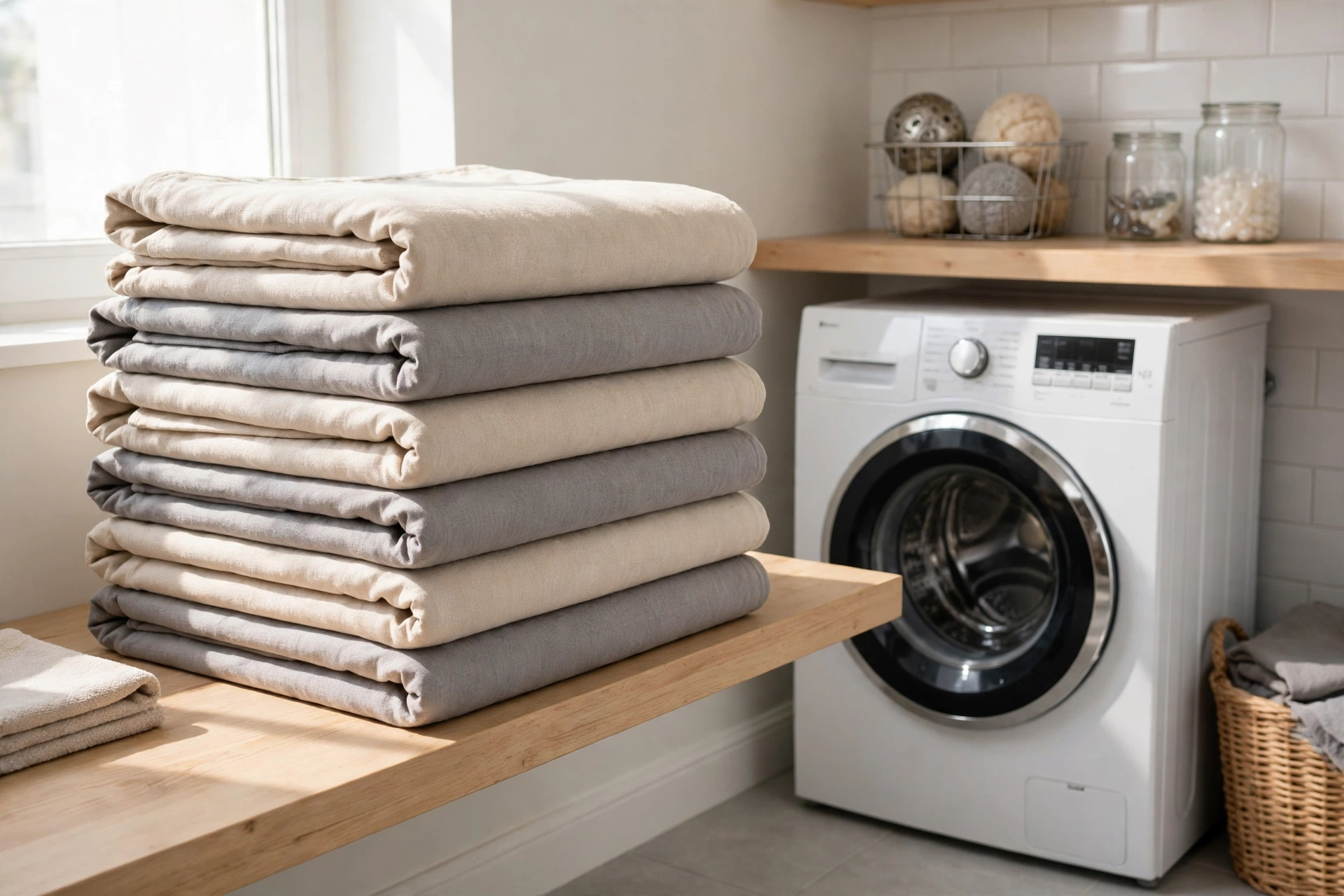
A slipcover’s second life starts in the laundry, and most fit problems after the first wash are laundry problems, not manufacturing problems. The rules on nearly every care label are consistent: machine wash cold on a gentle cycle, mild detergent, no bleach, and tumble dry low, or line dry if you can. High heat is the enemy: it shrinks cotton and relaxes spandex, and a cover that fit perfectly can come out of a hot dryer a size smaller. Wash-day habits decide whether couch covers keep their shape or shrink.
Three habits protect the fit:
- Close any zippers before washing so they do not snag the fabric.
- Wash the cover alone or with similar soft items, washing it with jeans or towels causes pilling and lint transfer.
- Put the cover back on while it is still very slightly damp. The fabric stretches into place more easily and dries to the shape of your sofa, which is exactly how you want it to set. If the cover has foam tuck sticks, remove them before washing and reinsert them after, they are not laundry items.
How often should I wash my sofa cover? Every two to four weeks for most households. More frequently if you have pets or young children, weekly washing of the most-used sofa’s cover is normal in a pet or kid household. That is why a second cover in rotation is so useful: one is always on the sofa while the other is in the laundry, so the bare sofa is never exposed. For food and drink stains, blot first, never rub, rubbing pushes the stain deeper into the fibers. Cold water for most stains; hot water sets protein stains like milk.
8. Color and style: making a small room look bigger
Once fit, fabric, slip resistance, and washability are sorted, then think about color, and in a small living room, color is not decoration, it is space. Color is the last choice, not the first, when choosing couch covers.
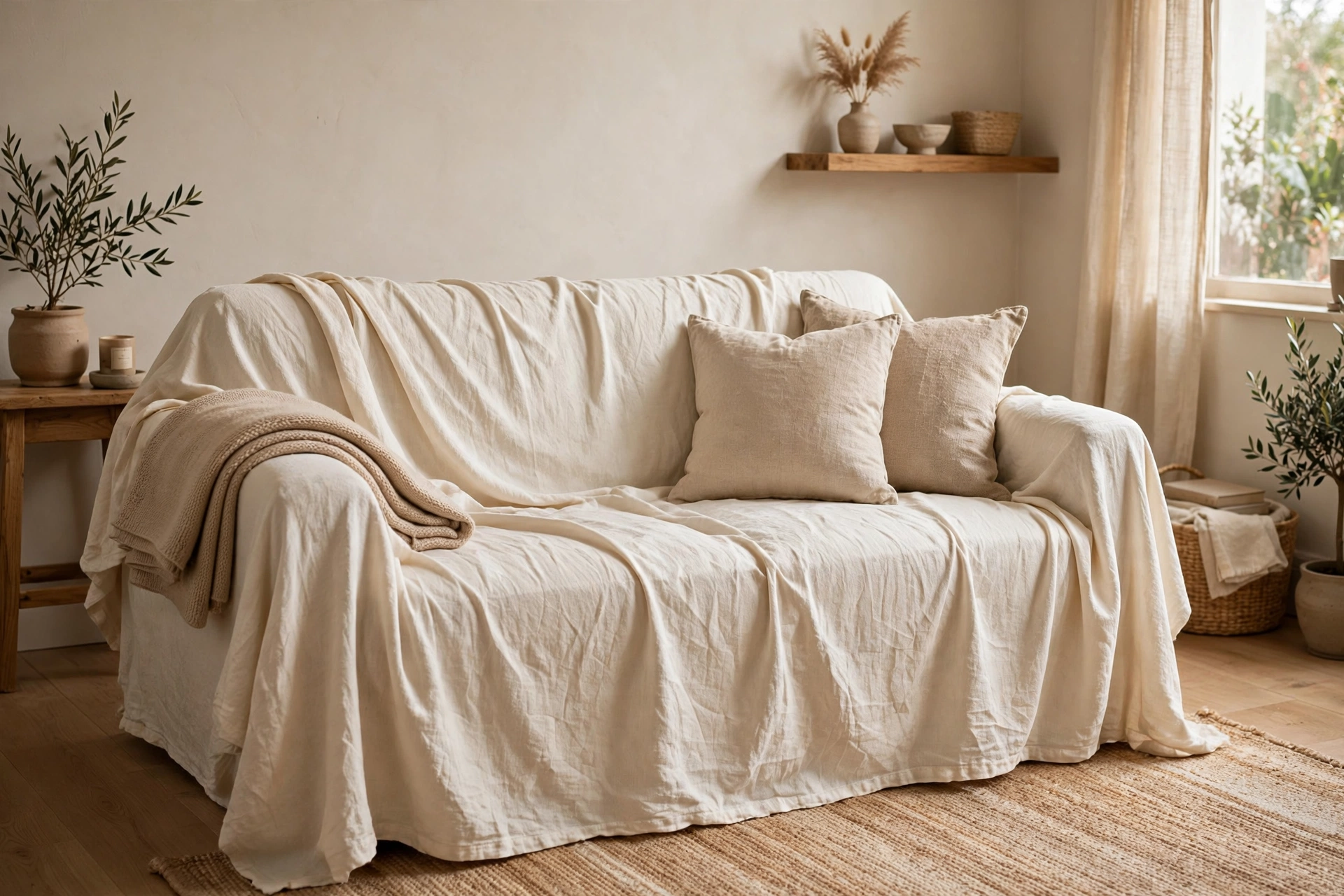
- Light neutrals open the room. A cream, warm beige, or light gray sofa cover reflects light and makes a small room feel larger. If your landlord’s sofa is dark or loudly patterned, a light solid cover is the single biggest visual change you can make for the money.
- Dark colors hide stains but show pet hair. Darker colors hide stains better but show pet hair more; lighter colors brighten a room but show marks faster. Medium tones, warm greige, mid-gray, sage, are the compromise that works in real households.
- Solid covers hide the old pattern; patterns hide real life. A solid, rich tone masks an underlying pattern bleeding through. But a subtle pattern disguises pet hair, everyday marks, and sun fading far better than a plain solid. If the sofa underneath is loud, go solid. If the household is messy, go subtle pattern.
- Texture reads as upholstery. Textured fabrics like waffle knit or jacquard look more like intentional upholstery than flat stretch fabrics. If you want the cover to look as close to an actual sofa as possible, texture helps.
- One accent color, three times. The cover stays neutral; the color comes from the pillows and throw (see the next section).
A couch slipcover in a light neutral also solves the rental-beige problem: most rental walls are warm beige or off-white, and a cream or light gray cover sits calmly against them instead of fighting them. Save the bold color for the two pillows and the throw, those are the pieces you can swap in ten minutes when the season changes.
9. Throw pillow combinations: the one finishing section
Once the cover is on, the pillows do the styling. This is the only section this guide gives to pillows, because throw pillow combinations are a finishing touch, not the project itself, get the cover right first, then spend ten minutes here.
The rule that works on a covered sofa: two pillows, two sizes, one repeated color. One 20-inch square at the back and one 18-inch square in front of it, slightly overlapping. The 2-inch difference is what makes the pair look styled instead of matched. Three pillows on a loveseat is one too many; the third one ends up on the floor.
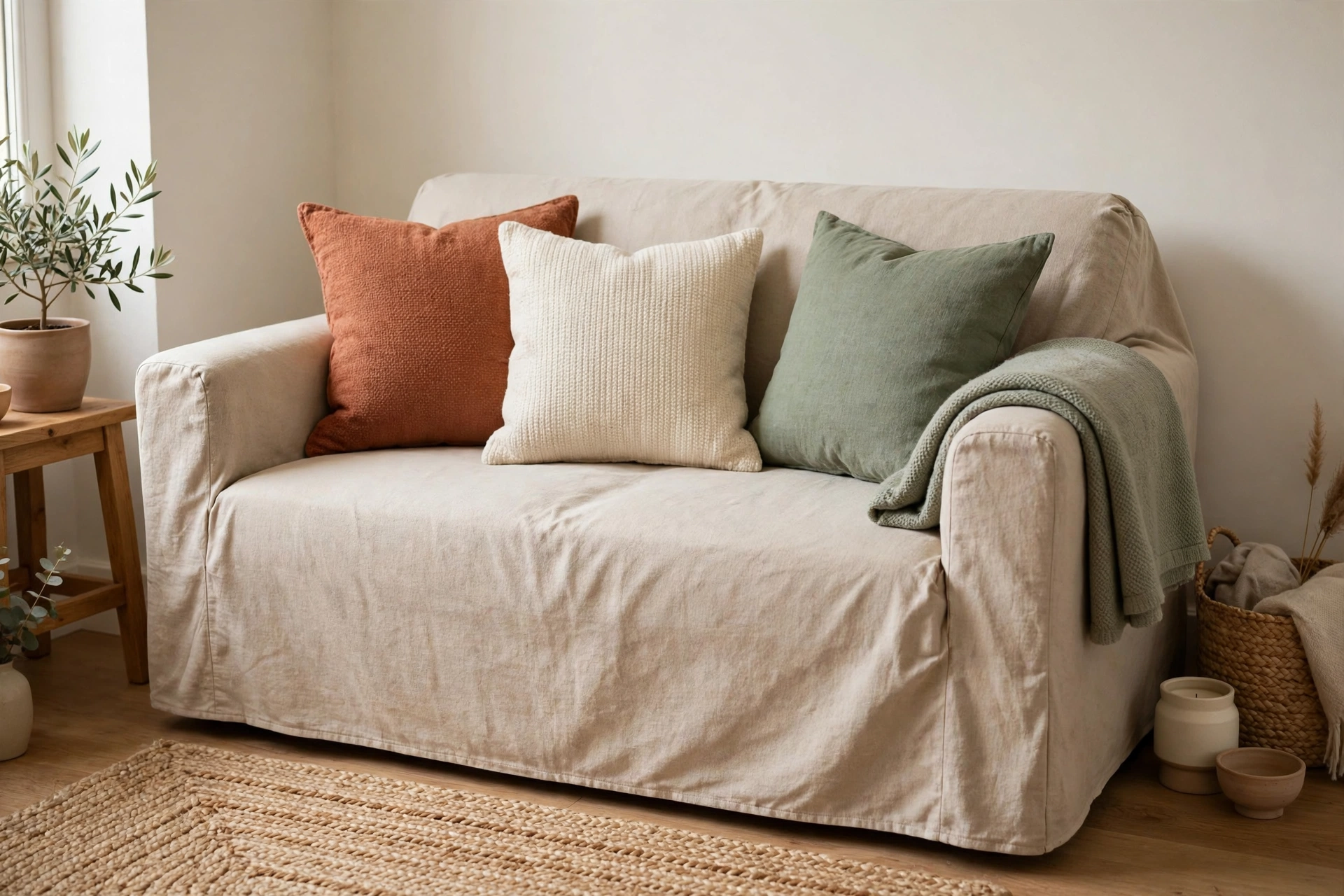
Throw pillow combinations for sofa styling that work with a neutral cover: warm and calm (one terracotta 20-inch pillow, one cream 18-inch pillow, a folded throw with a terracotta stripe); cool and fresh (one sage 20-inch, one soft white 18-inch, a light gray throw over one arm); or pattern plus solid (one small-pattern 20-inch pillow, one solid 18-inch pillow in a color pulled from the pattern). Never two loud patterns together on a small sofa.
Throw pillow color combinations to avoid: matching the pillows exactly to the cover (the sofa disappears into one flat block), and using more than three colors in the seating area (the eye has nowhere to rest). One repeated color is enough, a terracotta pillow, a cream throw, and a rug with a terracotta thread.
For pet households, sofa cushion covers for pets and washable pillow covers belong together: if the pillows are not washable, they become the one thing on the sofa that cannot be cleaned, and the dog will choose them every time. Washable cushion covers for sofa seats and washable pillow covers mean the whole seating area can go through one wash.
For the full room built around the covered sofa, rug size, lamp heights, and the under-$150 budget, see Cozy Small Living Room Decor Ideas That Actually Work.
10. The under-$150 renter refresh plan
The whole point of a cover is that it costs a fraction of a new sofa. Here is the full refresh, with honest ranges:
| What | Size / detail | Price range |
|---|---|---|
| One-piece stretch couch cover (or quilted protector) | Standard 3-seater, 72–84 inches | $25–$60 |
| Foam tuck sticks / grip set | 12–18 inches each, set of 4–6 | $5–$10 |
| Two washable pillow covers | 20-inch + 18-inch | $8–$12 |
| Folded throw, 50 by 60 inches | One arm, not the whole back | $12–$18 |
| Total | $50–$100 |
That leaves $50 to $100 spare, enough for a second cover in rotation ($25 to $60) if you have pets or kids. What the budget does not include: a custom couch cover ($150 to $400+). If your sofa frame is broken or the cushions have completely lost their shape, put the cover money toward the replacement fund instead, a cover hides the symptom for a week and then sags exactly where the sofa sags.
Couch covers and your security deposit
This is the part competitors mention and then move past, but for a renter it is the whole reason to buy a cover. If you are renting a furnished apartment, any damage to the landlord’s couch, a red wine spill, a coffee stain, pet wear, will likely be deducted directly from your security deposit. A single stain can cost hundreds of dollars at move-out. A full-coverage, machine-washable stretch sofa cover shields the original upholstery from spills, pet hair, dirt, and UV fading while remaining completely removable. For renters, couch covers are the cheapest deposit insurance you can buy.
Will a sofa cover damage the couch underneath? No, a quality cover will not harm the sofa underneath. Breathable, soft-knit fabrics allow air circulation, preventing moisture or stale odors from getting trapped inside the cushioning, unlike cheap vinyl or plastic protectors that can stick to leather or cause surface peeling. A full-coverage layer also shields the original material from direct sunlight. When it comes time to move out, strip off the cover, and the couch underneath looks as it did the day you moved in.
Clean or deodorize the sofa before covering it, a cover traps odor underneath it rather than removing it, and on a warm day you will smell it. Take a dated photo of the sofa the day the cover goes on, too.
Common mistakes to avoid
Competitor guides agree on these, because they are the mistakes that cause the returns:
- Buying without measuring. Even covers labelled “universal fit” have size limits. Measure all six numbers first.
- Measuring only the overall width. Seat width, backrest width, and cushion widths decide fit for multi-piece sets. Measure all of them.
- Ordering a sofa cover for a loveseat (or the reverse). Seat count is a size, not a suggestion.
- Ignoring the arm style. Rolled, T-cushion, high-arm, and low-arm sofas all fit differently, and not every cover works with every arm type.
- Ignoring chaise orientation. Left-facing and right-facing sectional covers are not interchangeable unless the listing says reversible.
- Believing “water-resistant” means “waterproof.” They are different claims; read the exact wording.
- Expecting claw-proof fabric. No ordinary cover is. The win is a replaceable cover, not an indestructible one.
- Buying white for a pet or kid household. It looks beautiful for a week. Medium tones and patterns are the practical choice.
- Skipping the slip resistance check on leather or smooth fabric sofas. Grip backing, straps, or foam rollers are not optional there.
- Buying a cover that cannot be machine washed. The whole point of a cover is to take the abuse your sofa would otherwise absorb.
- Covering a sofa you fundamentally dislike. If the shape, height, or seat depth is wrong for your body, a new fabric will not fix the ergonomics. A cover refreshes a sofa you like; it does not rescue one you do not.
- Covering a broken sofa. Sagging seats, broken springs, or a collapsed cushion need repair or replacement first, new foam inserts plus a cover is a genuinely effective combination, and far cheaper than a new sofa.
FAQ
Are couch covers worth it?
Yes, couch covers are worth it for most households because they protect your furniture, extend the life of your sofa, and refresh your space without replacing the entire couch. A quality cover costs a fraction of a new sofa or reupholstery. The exception is a sofa with a broken frame or collapsed cushions, a cover cannot restore structural integrity.
Do couch covers actually stay in place?
Good ones do. Look for covers with non-slip backing, straps, or tucking systems, and avoid cheap covers with no grip mechanism. Tuck excess fabric into the cushion gaps, and on leather sofas add foam rollers or grip strips underneath. A snug, correctly sized cover with foam tuck sticks stays put; a loose, oversized one will slide no matter what it is made of. In practice, couch covers with straps and deep tucks move least.
How do I know what size sofa cover to buy?
Measure overall width (outside arm to outside arm), seat width (inside arm to inside arm), seat depth, back height, arm width, and each cushion width, and check every number against the size guide, not just the overall width.
Do sofa covers work on sectionals?
Standard sofa covers are not designed for sectionals. Look for covers specifically made for sectional configurations, two-piece couch covers for sectionals kits, one piece per side, or use multiple covers to cover each section separately. Measure each side separately and confirm the chaise orientation (left or right) before ordering.
How often should I wash my sofa cover?
Every two to four weeks for most households. More frequently if you have pets or young children, weekly washing of the most-used sofa’s cover is normal in a pet or kid household. Regular washing prevents buildup of pet hair, dust, and odors and keeps the cover looking fresh. Keep a second cover in rotation so the sofa is never bare while one is drying.
Can you put a sofa cover on a furnished apartment couch?
Absolutely. Putting a slipcover over a furnished apartment’s couch protects the owner’s property from accidental spills and wear, so you will not lose your security deposit over sofa damage. It also provides a clean, hygienic barrier so you do not have to sit directly on pre-owned furniture fabric.
What’s the best way to cover an ugly couch?
The best way to cover an ugly couch is to install a high-stretch, solid-colored slipcover that completely hides the original pattern and color. Choose a modern neutral shade like gray, stone, or beige, and tuck foam grips into the cushion crevices for a tailored look. Finish the styling with two contrasting accent pillows and a soft throw blanket.
Are sofa covers a good idea for apartments?
Yes, sofa covers are ideal for apartment living: an affordable, non-permanent way to update your decor without violating a lease or buying new furniture. Machine-washable covers make keeping a small space clean simple, and the cover moves with you to the next place, measure again, because the next sofa is rarely exactly the same size.
Start today
The best couch covers do not ask you to wait for a new sofa, a new apartment, or a landlord’s permission, they ask for a tape measure, five minutes, and one honest look at how you actually live on your couch. Measure the six numbers, pick the cover type that matches your household, and fit it this weekend. By Sunday evening the stained, faded, or landlord-chosen sofa will be gone from sight, the upholstery underneath will be safe, and the room will look like a room you chose, all for under $150, with nothing drilled, nothing painted, and nothing you cannot take with you when you move. Before you buy, compare lab-tested picks in Good Housekeeping’s roundup of the best couch covers.