Driftwood wall decor is the cheapest natural art there is, a branch from a beach, a piece of wood from a craft store, and one hook on the wall. In a small living room it does two jobs at once: it fills a blank wall with something warm and organic, and it costs almost nothing. The trick is hanging it without drilling, and knowing how heavy it actually is before you trust a strip with it.
This guide gives you 7 driftwood wall decor ideas with exact measurements: how wide the piece should be, how high it hangs, which strip holds which weight, and what it all costs. Every idea is renter-friendly, no drilling, no damage, nothing permanent, and the whole wall comes in under $150.
Table of Contents
The numbers first
Best for: every idea in this guide, weigh the piece and measure the wall before you hang anything.
Five numbers decide whether driftwood wall decor stays on the wall:
- Piece width: a driftwood piece above a sofa should be about two-thirds of the sofa’s width. Above a loveseat 52 to 58 inches wide, that is a piece about 35 to 40 inches wide. A piece narrower than half the sofa looks lost; a piece wider than the sofa looks like it is falling.
- Hanging height: hang the center of the piece at about 57 to 60 inches from the floor, eye level for most people. Above a sofa, keep the bottom of the piece 6 to 8 inches above the sofa back.
- Weight matching: match the method to the weight. Picture hanging strips are rated up to 16 pounds per pair. A poster or a light frame needs one pair; a canvas 16 by 20 inches needs two pairs; a piece 20 by 24 to 24 by 36 inches needs four pairs. A large mirror needs four pairs and holds up to 15 to 16 pounds on a clean, smooth surface. Anything heavier than that should lean, not hang.
- Cure time: after you press a strip on, wait 1 hour before hanging anything on it, and 24 hours before you trust it fully. Do not hang the piece the same minute you stick the strip on.
- Test patch: test any adhesive in a hidden spot for 48 hours before committing to the full piece. If it lifts, bubbles, or pulls paint on the small test, a full piece will do the same thing at a much bigger scale. And do not use adhesives on walls painted less than 30 days ago, fresh paint has not cured, and the strip will take it off.
Weigh the driftwood wall decor on a kitchen scale before you choose the method. A branch that looks light can weigh 5 to 10 pounds once it is dry and thick, and a strip rated for 3 pounds will not hold it.
Where to get driftwood (and how to clean it)
Best for: the first step, driftwood wall decor starts with the wood, not the hook.
Driftwood comes from three places, and the price goes up as the work goes down:
- Beachcombing (free): pick up a branch on a beach, but check the local rules first. Some beaches and parks do not allow collecting, and some places limit how much you can take. A branch 24 to 40 inches long and 1 to 2 inches thick is the right size for a wall piece. Anything 3 to 7 feet long and 2 to 4 inches thick is far too heavy for any adhesive, lean it, or leave it.
- Craft store ($5 to $50 a piece): craft-store driftwood is already clean, dry, and light, and it costs $5 to $50 a piece on Etsy and in craft shops. It is the honest choice if you do not live near a beach.
- Cleaning found wood: found driftwood needs cleaning before it goes on a wall. Soak it in salt water, scrub off the sand and the salt, let it dry completely (a week in the sun), and seal it with a clear matte sealer so it does not stain the wall. Untreated wood can stain paint, and it can carry salt and bugs into the room. Never hang a branch you found yesterday. Clean it, dry it, seal it, then hang it.
For the same natural-materials look with woven texture instead of wood, see Boho Style Living Room Ideas for a Small Room.
1. Driftwood branch wall art
Best for: the main piece of driftwood wall decor, one branch, hung well, is the whole wall.
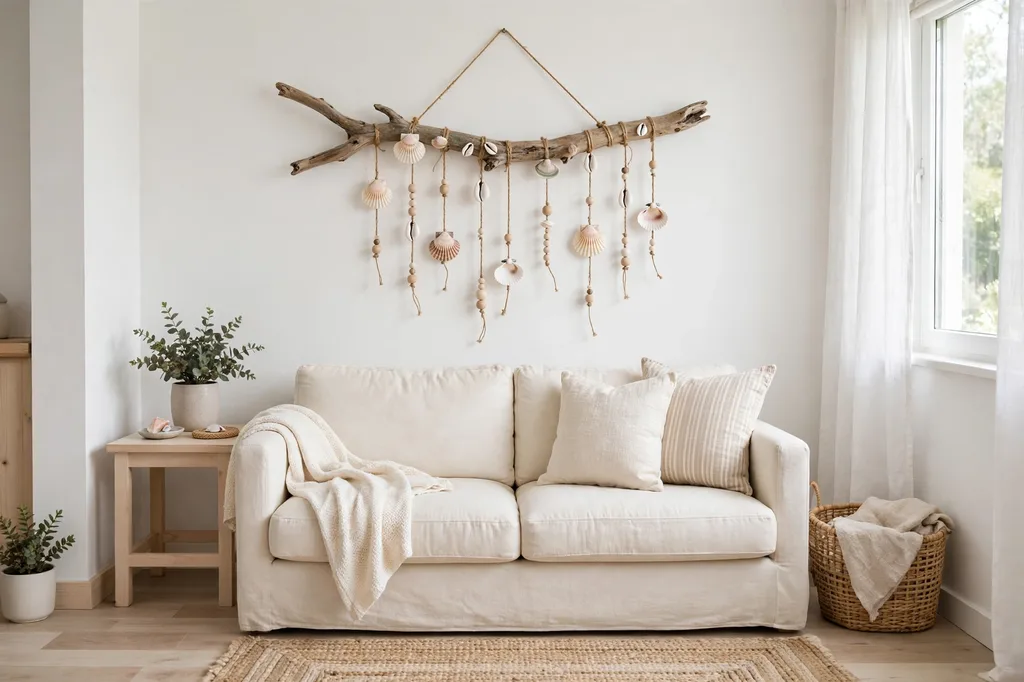
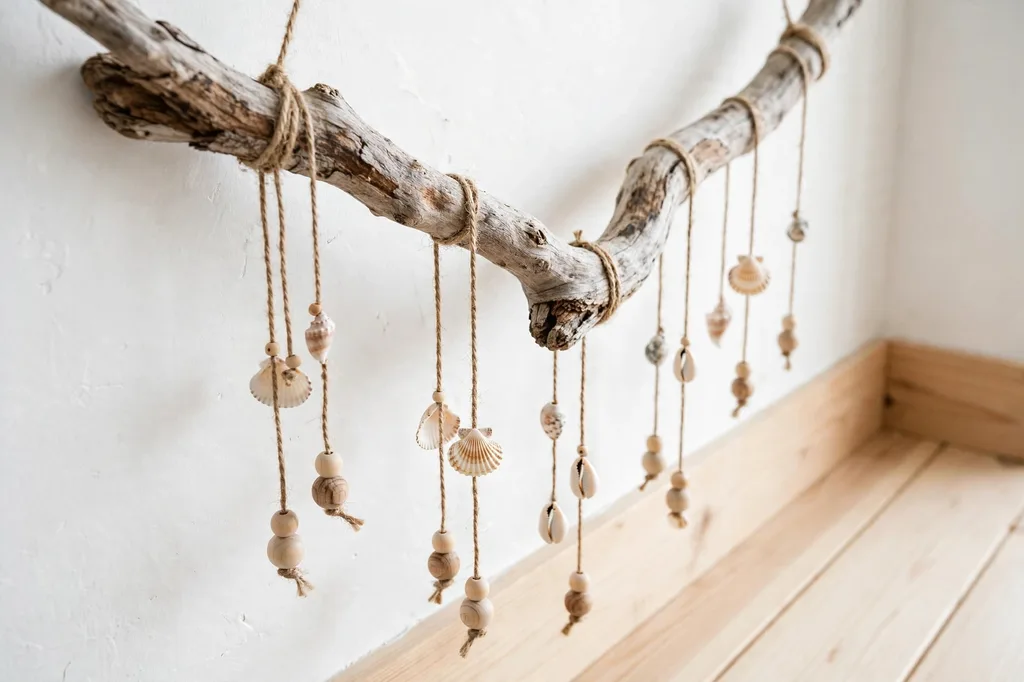
A single driftwood branch, hung horizontally above the sofa, is the simplest driftwood wall decor there is. Hang shells, beads, or small wooden shapes from it on jute twine, and the branch becomes a piece of art instead of a stick. The branch should be 24 to 40 inches long and 1 to 2 inches thick, light enough for strips, long enough to read as art.
- How to hang it: two picture hanging strips, one near each end, rated for at least twice the piece’s weight. Weigh the branch first, a 36-inch branch with shells weighs about 3 to 5 pounds, so two pairs of strips (rated to 16 pounds) hold it with room to spare.
- What to hang from it: shells, beads, small wooden shapes, or dried flowers on jute twine, 6 to 12 inches long. Three to five hangings, in odd numbers, spaced 4 to 6 inches apart. One hanging looks lonely; seven look like a wind chime.
- What to watch: do not drill holes in the branch to thread the rope, drilling is a permanent make, and it splits thin driftwood. Tie the twine around the branch instead. And do not hang the branch where it will be knocked, above the sofa, not beside the door.
Budget: a craft-store branch costs $10 to $30. Shells and beads cost $5 to $10. Two pairs of strips cost $5 to $8. One branch wall costs $20 to $48, the cheapest art in this guide.
2. Driftwood hook rail
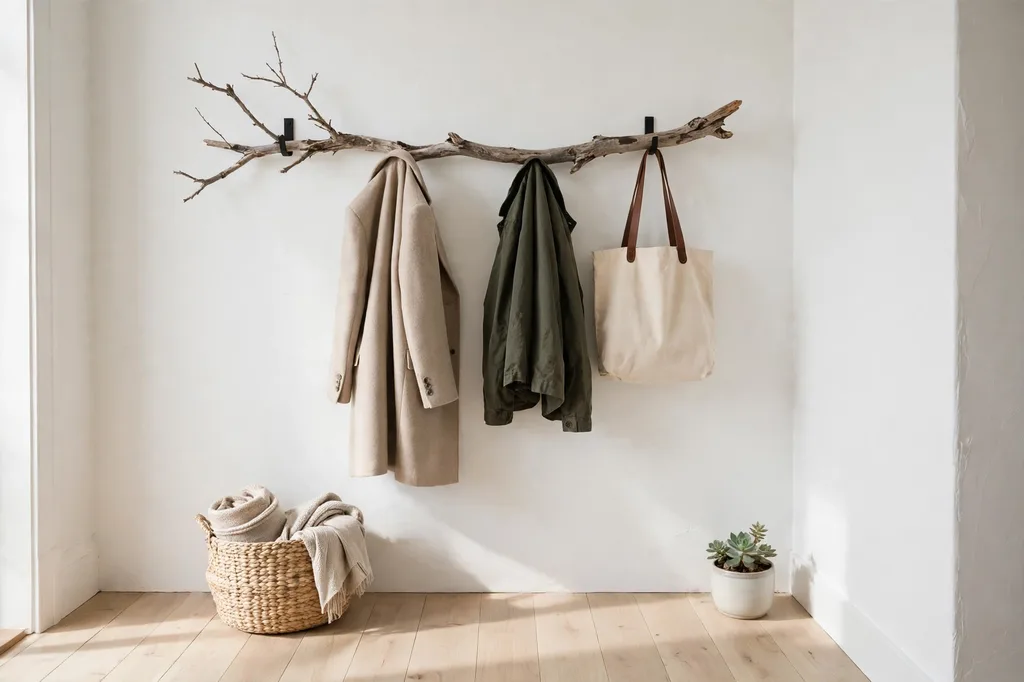
Best for: the entryway, a driftwood wall decor branch with hooks is art that also holds things.
A driftwood branch with three or four hooks on it is a coat rail, a key rail, and a piece of wall art at the same time. Hang it in the entryway or beside the door, at 60 inches from the floor, high enough for coats, low enough to reach.
- How to make it: a branch 24 to 36 inches long, three hooks screwed or tied on, spaced 8 to 10 inches apart. Use small adhesive hooks on the wall behind the branch, or lean the branch on two small shelf brackets, no drilling into the wall either way.
- What it holds: coats, bags, keys, a hat. One hook per thing, a rail with four hooks holds four things, and the fifth thing goes on the floor. Do not overload it: a rail rated for 10 pounds holds two coats, not five.
- What to watch: a hook rail is the one driftwood piece that takes real weight, every day. Weigh it loaded, coats are heavy, and use a method rated for twice the loaded weight. If the branch is thick and heavy, lean it on brackets instead of hanging it from strips.
Budget: a branch costs $10 to $25. Three adhesive hooks cost $5 to $10. A hook rail costs $15 to $35, and it replaces a coat rack that would cost three times as much.
3. Driftwood-framed mirror
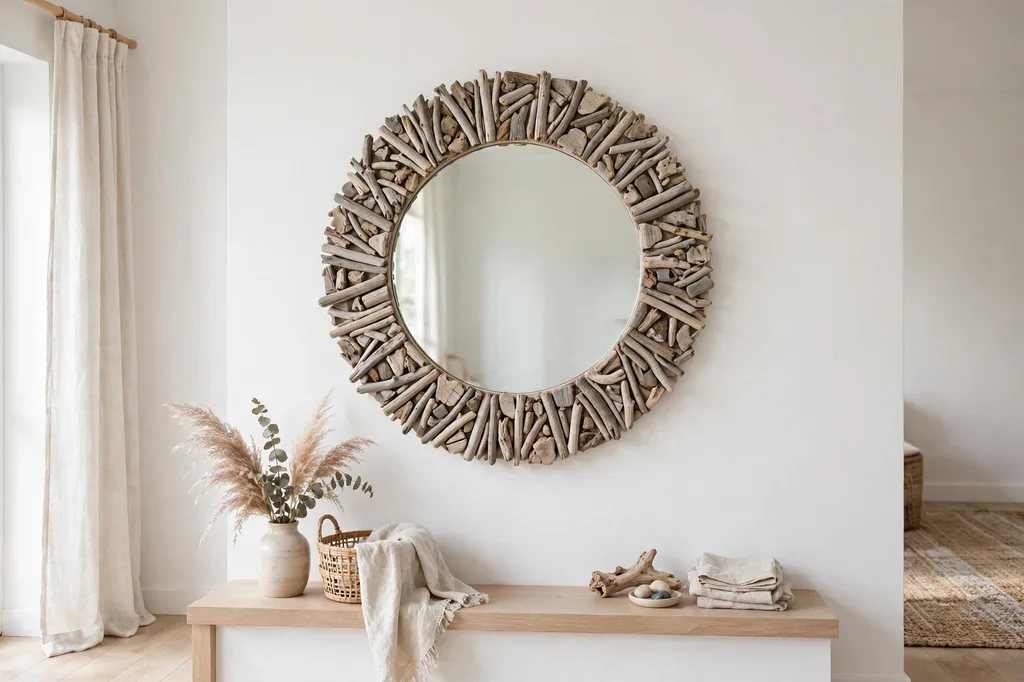
Best for: the light of the room, a driftwood wall decor mirror reflects light and adds texture at the same time.
A round mirror framed with small driftwood pieces is the driftwood version of the leaning mirror: it bounces daylight into the room and it looks handmade. A mirror 24 to 36 inches wide, framed with driftwood pieces 6 to 12 inches long, glued around the edge, is the right size for a small living room wall.
- How to make it: glue small driftwood pieces around a round mirror frame with wood glue, let it dry for 24 hours, then lean the mirror against the wall. Leaning needs no hook at all, and a leaning mirror looks intentionally casual.
- How to hang it (if you must): a mirror with a driftwood frame weighs 8 to 15 pounds. Four pairs of large picture hanging strips hold up to 15 to 16 pounds on a clean, smooth surface. Weigh the finished mirror first, if it is over 16 pounds, lean it. Do not trust strips with a mirror you cannot afford to drop.
- What to watch: do not hang a driftwood mirror where it reflects clutter. A mirror facing a window doubles the light; a mirror facing a messy side table doubles the mess. Choose the window.
Budget: a round driftwood wall decor mirror costs $20 to $40. Driftwood pieces cost $5 to $15. Wood glue costs $5. A driftwood mirror costs $30 to $60, and it is the one piece in this guide that also makes the room brighter.
4. Driftwood mobile and wind chime

Best for: the window, a driftwood wall decor mobile moves, and movement is the one thing a flat wall cannot give you.
A driftwood wall decor mobile, a branch hung from the ceiling or a high hook, with shells, beads, and small wooden shapes hanging from it on twine, is the lightest driftwood piece there is, and the only one that moves. Hang it by a window, where the light catches the shells and the air moves it.
- How to hang it: one adhesive hook on the ceiling or high on the wall, rated for twice the mobile’s weight. A mobile weighs 1 to 3 pounds, one hook holds it easily. Hang the branch 12 to 18 inches below the hook, and the hangings 6 to 12 inches below the branch.
- What to hang from it: shells, beads, small bells, or dried flowers. Three to five hangings, at different lengths, the different lengths are what make it move instead of swing as one lump.
- What to watch: do not hang a mobile in the walkway. It will be walked into, knocked, and broken within a week. Hang it by the window, in a corner, or above a side table, somewhere it can move without being touched.
Budget: a branch costs $5 to $15. Shells and twine cost $5 to $10. One hook costs $3 to $5. A mobile costs $13 to $30, the lightest and cheapest piece in this guide.
5. Driftwood shelf (leaning or strips)
Best for: the display, a driftwood wall decor shelf holds the small things that do not belong on the mantel.
A flat driftwood plank, 24 to 36 inches long and 4 to 6 inches deep, makes a floating shelf without any drilling, if you lean it on brackets or hold it with heavy-duty strips. It holds three or four small things: a bud vase, a small frame, a candle, a tiny plant.
- How to hold it: two small shelf brackets leaned against the wall (no drilling), or four pairs of heavy-duty strips rated to 16 pounds, but only if the plank plus its contents weigh under 10 pounds. Weigh everything, plank included, before you trust the strips.
- What to put on it: three things, in odd numbers, a bud vase (6 to 8 inches tall), a small frame (5 by 7 inches), and a short candle. Three things is the maximum. Four things on a 24-inch shelf is clutter.
- What to watch: do not put anything heavy on a strip-held shelf. Books, a heavy vase, a full plant pot, all of them are too heavy for strips. A strip-held shelf holds light things only. If you want books on it, lean the shelf on brackets instead.
Budget: a driftwood wall decor plank costs $10 to $25. Two brackets cost $8 to $15. A shelf costs $18 to $40, and it is the only driftwood piece that also gives you storage.
6. Driftwood + macrame, one wall
Best for: the combination, driftwood wall decor and macrame are both lightweight, one-hook pieces, and they belong together.
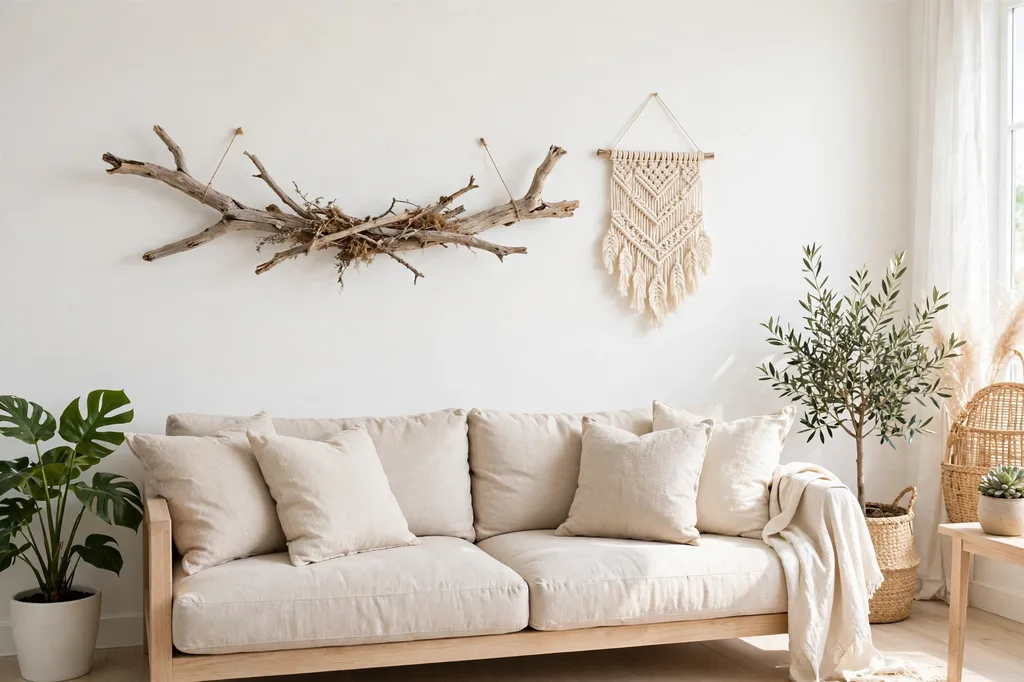
Driftwood wall decor and macrame are the same idea in two materials: natural, lightweight, and hung from one hook. A driftwood branch with a small macrame hanging beside it, or a macrame piece hung from a driftwood branch instead of a dowel, makes one wall instead of two competing ones. No competitor pairs them, and they are the easiest two pieces to combine.
- How to combine them: one wall, two pieces, one system. The driftwood branch (24 to 36 inches) goes on the left, the macrame hanging (18 to 24 inches wide) goes on the right, with 6 to 8 inches between them. Both hang from adhesive hooks rated for twice their weight. Both are light, together they weigh under 5 pounds.
- Or hang the macrame FROM the driftwood: tie the macrame’s cords around a driftwood branch instead of a wooden dowel. The branch is the rod, the macrame is the art, and the whole piece hangs from one hook. It costs nothing extra and it looks handmade.
- What to watch: do not put driftwood and macrame on the same wall with a framed gallery as well. One wall, one system: driftwood + macrame is the system. A gallery wall is a different system, and two systems on one wall fight each other.
Budget: the branch costs $10 to $25. A small macrame hanging costs $20 to $35 (or $15 to $25 as a DIY kit). Together they cost $30 to $60, two pieces, one wall, one hook each.
7. Driftwood sunburst and wreath
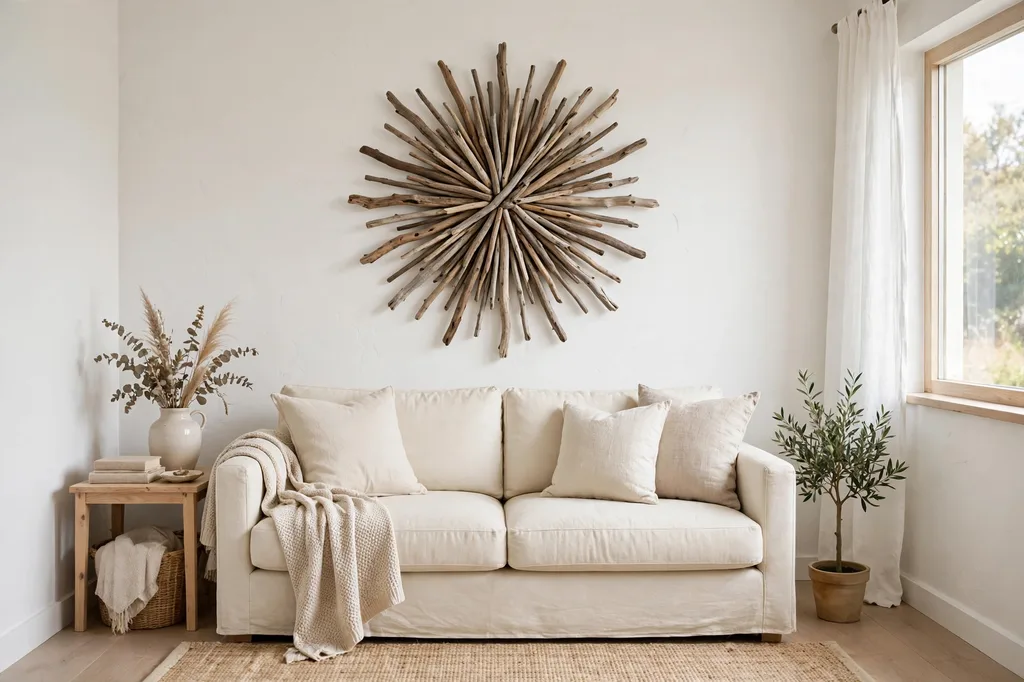
Best for: the statement, a sunburst or a wreath is the one driftwood wall decor piece that fills a whole wall by itself.
A driftwood wall decor sunburst, small pieces radiating from a center, 36 to 47 inches across, or a driftwood wreath, a circle 18 to 24 inches across, is the biggest driftwood piece in this guide, and the only one that needs no other art beside it. One sunburst above the sofa is the whole wall.
- How to hang it: a sunburst is the heaviest driftwood piece here, a 47-inch sunburst can weigh 10 to 15 pounds. Four pairs of large strips hold up to 15 to 16 pounds, but only on a clean, smooth surface. Weigh it first. If it is over 16 pounds, lean it on the floor against the wall, or hang it from a picture rail, do not trust strips with it.
- How to make a wreath: a wire wreath frame (18 to 24 inches), small driftwood pieces tied on with jute twine, shells or dried flowers tucked in. A wreath weighs 2 to 4 pounds, two pairs of strips hold it easily.
- What to watch: do not buy a sunburst that is too big for the wall. A 47-inch sunburst above a 52-inch loveseat is almost as wide as the sofa, it will dominate the room. The sunburst should be about two-thirds of the sofa’s width, like every other piece above a sofa.
Budget: a driftwood wreath costs $20 to $40 (or $10 to $20 as a DIY). A sunburst costs $45 to $75 secondhand, and the $1,000-plus sculptural ones are luxury, not renter DIY. One statement piece is enough.
Small living room layout: the driftwood wall
Best for: the whole room, where the driftwood wall goes in a 10 by 12 foot living room.
Driftwood wall decor works best on the wall opposite the window, where the daylight hits it and the wood glows. Here is the plan for a 10 by 12 foot room:
- Driftwood wall (12 foot wall): the main piece, a branch or a sunburst, centered above the loveseat (52 to 58 inches wide), its center at 57 to 60 inches from the floor, its bottom 6 to 8 inches above the sofa back. One piece, not two, the wall has one focal point.
- Side wall: the hook rail in the entryway, at 60 inches from the floor, or the small mobile by the window. The side pieces are small and low, they do not compete with the main piece.
- What to watch: a small living room fails when every wall has art on it. One wall is the driftwood wall. The other walls are for the mirror, the lamp, and the empty space. Driftwood is a beach material, too much of it turns a living room into a beach house. One wall, one system, and the rest of the room stays calm.
Renter-friendly rules
Driftwood wall decor is renter-friendly only if you respect the weight. Every rule in this section is about the same thing: match the method to the weight, and test before you trust.
- Match the method to the weight: under 3 pounds, one pair of strips. 3 to 8 pounds, two pairs. 8 to 15 pounds, four pairs of large strips, or lean it. Over 15 pounds, lean it, or do not hang it. Never guess the weight, weigh the piece on a kitchen scale.
- Clean the wall first: wipe the wall with 70% isopropyl alcohol, let it dry, press the strip for 30 seconds, wait 1 hour before hanging, and 24 hours before trusting it. A dirty wall is the most common reason strips fail.
- Test in a hidden spot for 48 hours: before you commit to the full piece, test one strip in a hidden spot for 48 hours. If it lifts, bubbles, or pulls paint, the wall is not suitable, use a leaning piece instead.
- Textured walls: adhesives struggle on textured walls because they cannot make full contact. On orange-peel or knockdown texture, test one piece for 24 to 48 hours, and if it fails, use over-the-door hooks, tension rods, or freestanding pieces instead. On popcorn texture, do not use adhesives at all.
- Removal: pull the tab straight down, slowly, keeping the strip close to the wall. Do not yank outward, yanking is what lifts paint. If it resists, warm it with a hairdryer for 20 to 30 seconds on low heat, then pull again. And never reuse a strip, once separated, the bond is broken for good.
- What NOT to use: foam tape and double-sided tape rip drywall paper on removal. Thin-pin hangers leave pinhole marks, they are not truly damage-free. Peel-and-stick tile pulls paint on removal. Use removable strips, not tape.
Driftwood wall under $150
Best for: the whole wall, every idea in this guide, added up.
| Item | Cost |
|---|---|
| Driftwood branch, 36 in (craft store) | $10–$30 |
| Shells, beads + jute twine | $5–$10 |
| Driftwood-framed mirror, 24 in | $30–$60 |
| Three adhesive hooks + strips | $8–$15 |
| Small macrame hanging (for the combo) | $20–$35 |
| Total | $73–$150 |
The whole wall fits under $150, and the cheapest version, one branch with shells and two hooks, costs $20 to $48. If the budget is tight, start with the branch alone, live with it for a month, and add the mirror next month. A driftwood wall built in two rounds looks better than one built in one rushed round, because the second round is the one where you know what the wall actually needs.
The free ideas: a branch from a beach, shells you already own, and hooks you already have cost nothing, and they change the wall more than any purchase. Driftwood styling starts with finding the wood, not buying it.
5 mistakes to avoid
1. Hanging a piece that is too heavy for its strips. A branch that looks light can weigh 5 to 10 pounds. Weigh it on a kitchen scale, match the strips to the weight, and use a method rated for twice the piece’s weight. A fallen piece breaks the art and the wall.
2. Over-theming into a beach cliché. Driftwood wall decor on every wall, shells on every surface, and a lighthouse on the shelf turns a living room into a beach house. One wall, one system, and the rest of the room stays calm.
3. Hanging untreated wood. Found driftwood wall decor that was never cleaned or sealed can stain the wall with salt and tannin, and it can carry bugs into the room. Clean it, dry it for a week, seal it with clear matte sealer, then hang it.
4. Foam tape and double-sided tape on drywall. They rip drywall paper on removal, and the repair costs more than the art. Use removable picture hanging strips, not tape.
5. Drilling into the driftwood. Drilling holes in a branch to thread rope splits thin driftwood and turns a renter project into a permanent make. Tie the twine around the branch instead, it holds just as well and the branch stays whole.
FAQ
Will Command strips damage my rental walls?
Not if you use the right size for the weight of your item, apply them to a clean surface, and remove them slowly at a downward angle. Yanking them straight off is what causes paint to lift.
How do I hang something heavy, like a large mirror, without drilling?
Lean it instead of hanging it. If you do want it flush against the wall, a full set of large picture hanging strips (four pairs) can support up to 15 to 16 pounds on a clean, smooth surface.
How do I hang driftwood without drilling?
Weigh the piece first, then match the method to the weight: under 3 pounds, one pair of strips; 3 to 8 pounds, two pairs; 8 to 15 pounds, four pairs of large strips. Over 15 pounds, lean it. Clean the wall, press for 30 seconds, wait 1 hour before hanging and 24 hours before trusting it.
Where can I get driftwood?
From a beach (check local collecting rules first), or from a craft store for $5 to $50 a piece. Found wood needs cleaning, soak it, scrub it, dry it for a week, and seal it with clear matte sealer before it goes on the wall.
Can you hang things on textured walls without nails?
Adhesives struggle on textured walls because they cannot make full contact. Test one piece for 24 to 48 hours. If it fails, use over-the-door hooks, tension rods, or freestanding pieces instead.
Will peel-and-stick wallpaper damage my walls?
High-quality peel-and-stick wallpaper removes cleanly from standard painted drywall, but test a small sample in a hidden spot for 48 hours first. The main risk is walls painted with low-quality paint, or walls painted very recently.
How do I decorate walls in a rental without losing my deposit?
Stick to products marketed as removable or damage-free, follow their removal instructions to the letter, and test everything in a hidden spot first. If you do make a small nail hole, a tiny amount of spackling compound fills it before move-out.
Start today
Driftwood wall decor does not need a shopping trip, it needs a branch and a scale. Weigh the branch, pick the strips to match, and hang one piece above the sofa. That is the whole first round, and it takes an afternoon.
Start with one branch. The wall will tell you what it needs next.