Macrame wall hanging is the softest art a small living room can have, cotton cord, a wooden dowel, and nothing else. It fills a blank wall without adding weight, it warms a white room without adding color, and it costs less than a framed print. The trick is size: a macrame wall hanging that is too small above a sofa looks like a mistake, and a piece hung too high looks like it is floating away.
This guide gives you 7 macrame wall hanging ideas with exact measurements: how wide the piece should be, how high it hangs, how much cord a DIY piece needs, and what it all costs. Every idea is renter-friendly, one adhesive hook, no drilling, and the whole wall comes in under $150.
Table of Contents
The numbers first
Best for: every idea in this guide, measure the sofa and the wall before you buy anything.
Five numbers decide whether a macrame wall hanging works on a small wall:
- Width rule: art should span about two-thirds of the furniture beneath it. Above a loveseat 52 to 58 inches wide, that is a hanging about 35 to 40 inches wide. Above a three-seater sofa around 84 inches wide, that is about 56 inches of art. A single 12-inch hanging above a sofa will not carry the wall alone, hang two or three together instead.
- Hanging height: hang the center of the piece at 57 to 60 inches from the floor, eye level for most people. Above furniture, the bottom edge of the hanging (including the fringe) should clear the top of the furniture by 6 to 10 inches. Closer looks crowded; further and the two stop reading as a pair.
- Dowel size: a macrame dowel is 18 to 36 inches long for most wall pieces. A large statement piece uses a dowel up to 48 inches, and a large piece 120 by 140 cm loops over a rod, a branch, or a dowel of your choice.
- Cord: macrame cord is 3 to 5 mm thick for wall hangings. A small piece needs about 100 feet of cord; a medium piece needs 200 to 300 feet; a large piece needs 400 to 600 feet. Cord is the cost of a DIY piece, buy it by the roll, not by the foot.
- Fringe: the fringe doubles the visual height of a piece. A hanging with a 12-inch knotted section and a 12-inch fringe reads as 24 inches tall on the wall. Measure the whole piece, fringe included, when you check the height.
Measure the sofa, the wall, and the fringe before you buy anything. The best macrame wall hanging in a small room is the one where the piece fits the furniture, not the other way round.
What is a macrame wall hanging?
What is a macrame wall hanging? It is textile wall art made by knotting cotton cord around a wooden dowel or a branch, no weaving, no frame, just knots. A macrame wall hanging is soft, handmade, and light: most pieces weigh under 2 pounds, which is why one adhesive hook holds them. It is different from a framed picture and from a tapestry, it has texture you can see from across the room, and it moves slightly when the air moves. The craft behind every macrame wall hanging is centuries old — see the history of macramé for how the square knot and hitching developed.
For the same natural-materials look in wood instead of cord, see Driftwood Wall Decor Ideas for a Small Living Room, the two pieces hang from the same kind of hook, and they pair well on one wall.
For the boho room that macrame belongs to, see Boho Style Living Room Ideas for a Small Room.
1. One large statement hanging
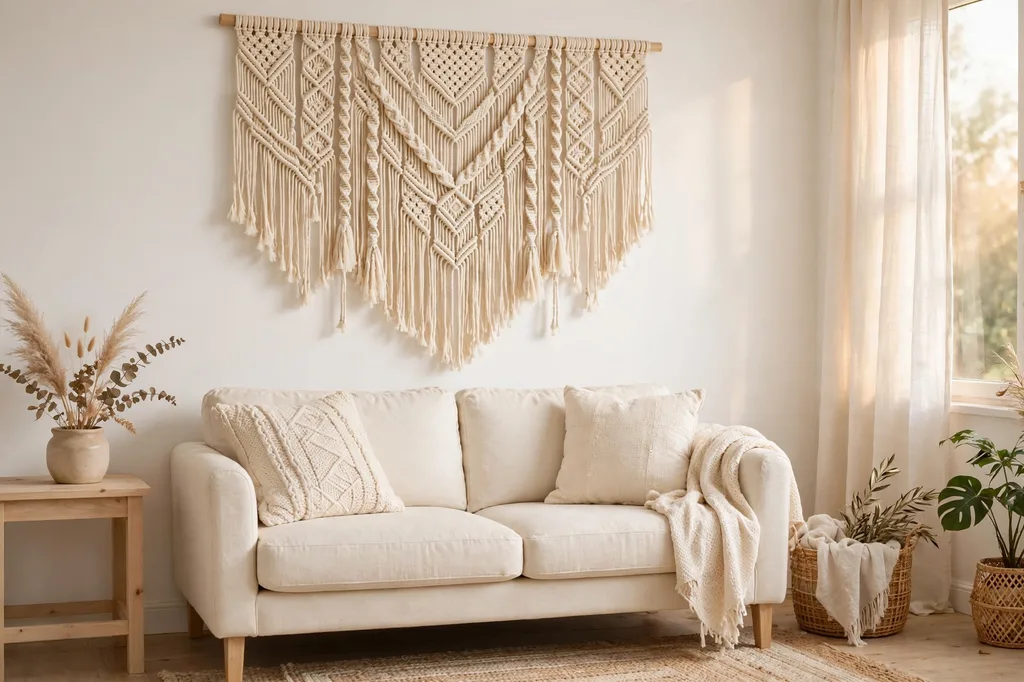
Best for: the focal point, one large piece does the work of a whole gallery wall.
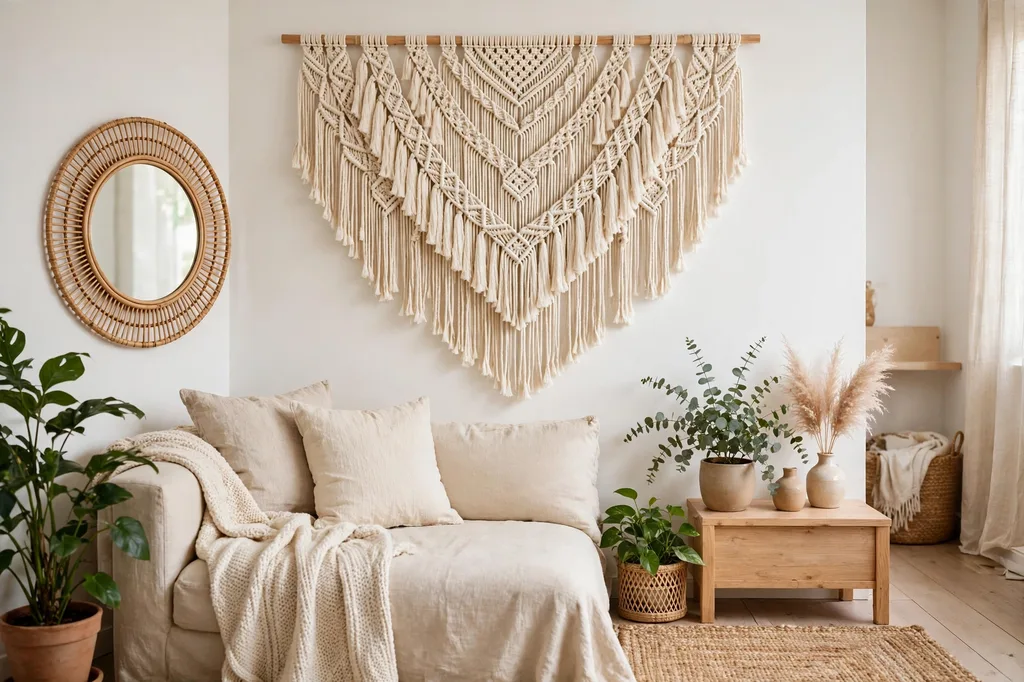
A large macrame wall hanging, 3 to 4 feet wide, with a long fringe, above the sofa is the single best macrame move in a small living room. It fills the wall, it softens the room, and it needs only one hook. A large piece 120 by 140 cm is the statement size; a medium piece 24 to 36 inches wide is the safe size for a loveseat.
- Size: the hanging should be about two-thirds of the sofa’s width. Above a loveseat 52 to 58 inches wide, that is 35 to 40 inches of macrame. Above a three-seater, 56 inches. Measure the sofa first, every size rule in this guide starts there.
- Height: the center of the piece at 57 to 60 inches from the floor, the bottom of the fringe 6 to 10 inches above the sofa back. The fringe is part of the height, measure it, do not guess it.
- What to watch: do not buy a large piece for a small wall and then hang it high to fit. A large piece hung too high looks like it is escaping. If the wall is short, buy a medium piece and hang it at eye level. Scale matters more than size.
Budget: a large macrame wall hanging costs $45 to $120 ready-made, $25 to $45 as a DIY kit. One statement piece is the biggest single purchase in this guide, and the only one the wall needs.
2. Small hangings in a row
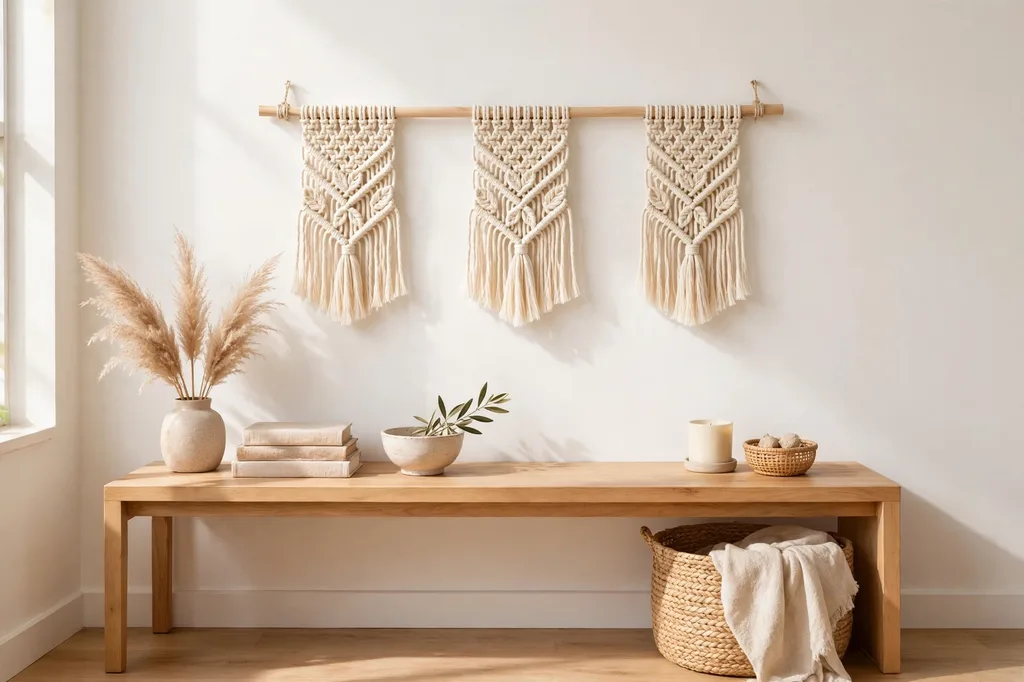
Best for: the small wall, three small pieces together carry a wall that one small piece cannot.
A single 12-inch macrame wall hanging above a sofa looks undersized on its own. Three of them, hung together in a row, look like a set, and they cost less than one large piece. Small pieces suit the spots larger art cannot fill: above a doorway, in a narrow alcove, beside a window, or above a console table.
- How to arrange them: three pieces, each 12 to 18 inches wide, hung in a row with 3 to 5 inches between them. Treat the row as one unit: its total width should be about two-thirds of the furniture beneath it, and its center should sit at 57 to 60 inches from the floor.
- Where they work: above a console or a desk (40 to 60 cm wide is the right piece for a console), in a narrow alcove, beside a window, or as part of a gallery wall. Where a 12-inch piece struggles is on a broad empty wall or above a sofa, alone, in those spots, hang two or three together rather than one.
- What to watch: do not hang three pieces at three different heights. A row is a row, the dowels should be level, and the fringes should end at roughly the same line. Different heights look like a mistake, not a design.
Budget: three small macrame wall hangings cost $15 to $25 each ready-made, $25 for a DIY kit that makes all three. A row of three costs $25 to $60, less than one large piece, and it fits walls a large piece cannot.
3. Macrame + gallery wall, one wall
Best for: the combination, macrame and framed art on one wall, done right.
Macrame and a gallery wall on the same wall can work, but only if one of them leads. The macrame wall hanging is the anchor (the biggest piece, in the center), and the frames are the support (smaller, around it, with 2 to 3 inches between them). The frames should share one thing with the macrame, the same wood tone, the same warm color, or the same natural material, so the wall reads as one composition, not two.
- How to arrange it: the macrame hanging in the center, 24 to 36 inches wide, its center at 57 to 60 inches. Two or three small frames (8 by 10 inches or 5 by 7 inches) on one side, 2 to 3 inches apart, their centers aligned with the macrame’s center. One side only, frames on both sides split the wall in half.
- What to watch: do not put a gallery wall and a macrame piece on the same wall with nothing connecting them. If the frames are black metal and the macrame is cream cotton, they are two different walls. Connect them: wood frames with cotton macrame, or cream frames with a cream hanging. One shared material is the minimum.
Budget: the macrame costs $25 to $60. Two small frames with prints cost $15 to $25. A combined wall costs $40 to $85, and it is the only wall in this guide that mixes two kinds of art.
4. Macrame plant hanger beside the wall
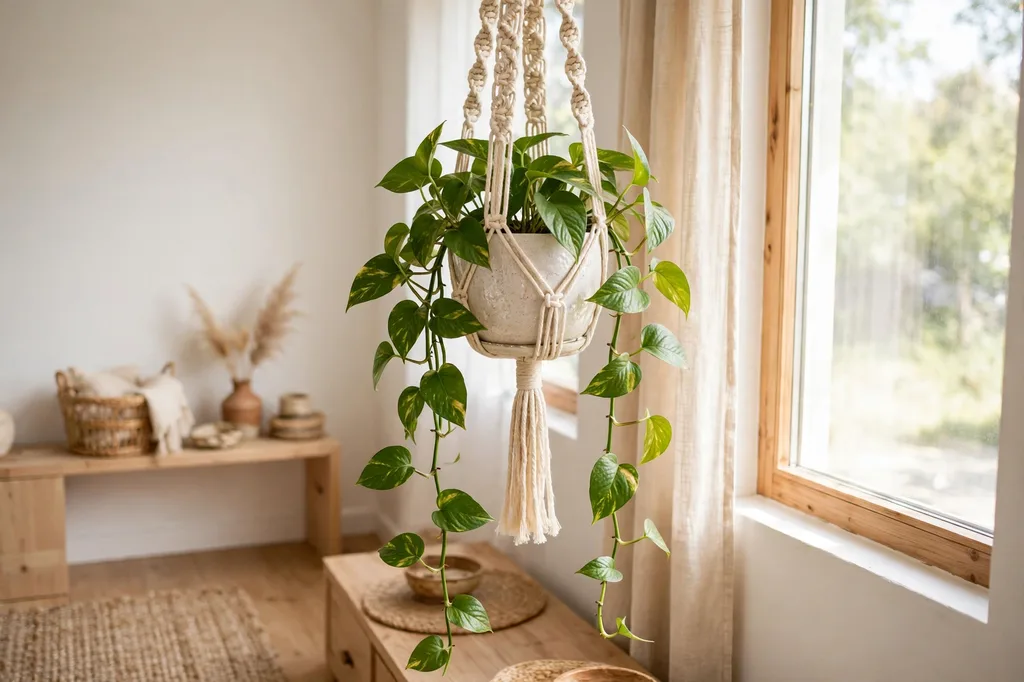
Best for: the corner, a macrame plant hanger adds green without taking floor space.
A macrame plant hanger, a small pot held in a knotted net, hung from one hook, is the macrame piece that does not need a wall at all. Hang it beside the macrame wall, in a corner, or by the window, and it adds a plant without taking a single inch of floor. A trailing pothos in a macrame hanger is the classic combination.
- How to hang it: one adhesive hook on the wall or the ceiling, rated for twice the loaded weight. A small pot with a plant weighs 2 to 4 pounds, one hook holds it, but check the rating. Hang it 12 to 18 inches below the hook, where you can reach it to water it.
- What to watch: do not hang a plant hanger where it will be knocked, not in the walkway, not above the sofa where someone leans back into it. Hang it in a corner or by the window, where it can hang undisturbed. And do not hang it in a bathroom, cotton and wool suffer in constant steam, and the plant will rot the cord.
Budget: a macrame plant hanger costs $10 to $20 ready-made, $10 as a DIY kit. A small pothos costs $8 to $15. A hanging plant costs $18 to $35, and it is the only art in this guide that grows.
5. DIY macrame: cord, dowel, knots
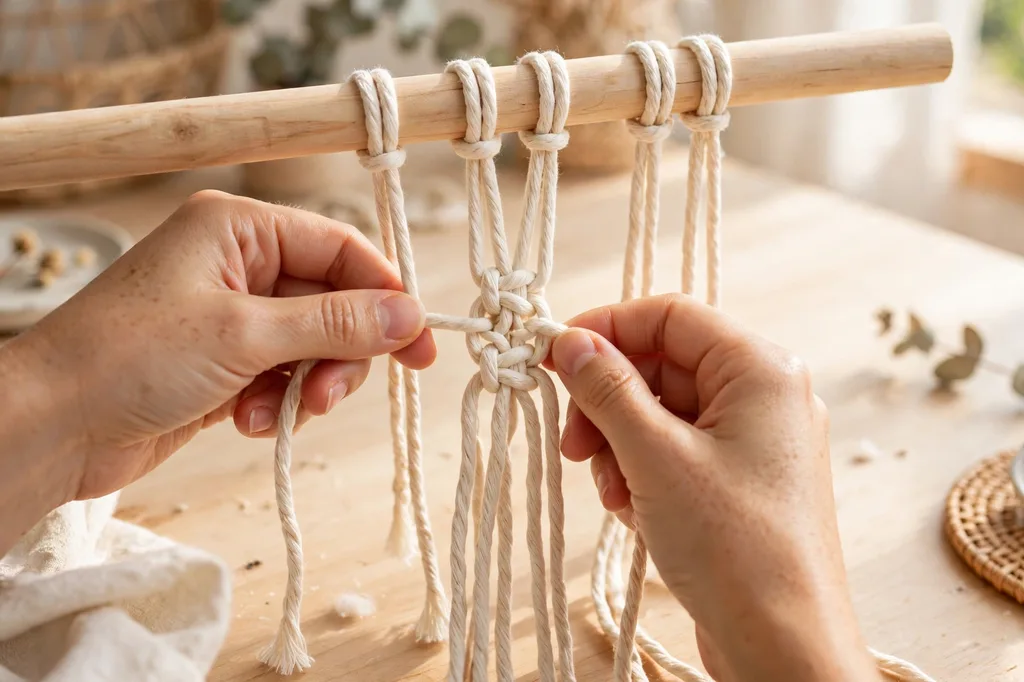
Best for: the budget, a DIY macrame piece costs a third of a ready-made one, and the knots are easier than they look.
A DIY macrame wall hanging needs three things: a dowel, cord, and two knots. The dowel is 18 to 36 inches long. The cord is 3 to 5 mm cotton. The knots are the square knot and the lark’s head knot, two knots every macrame wall hanging needs, learned in an afternoon, and every pattern in this guide uses them.
- How much cord: a small piece (12 to 18 inches wide) needs about 100 feet of cord. A medium piece (24 to 36 inches) needs 200 to 300 feet. A large piece (36 to 48 inches) needs 400 to 600 feet. Buy cord by the roll, a 300-foot roll costs $10 to $20, and it makes a medium piece with cord to spare.
- How to start: fold the cords in half over the dowel with a lark’s head knot, then tie square knots in rows. A beginner piece, three rows of square knots and a straight fringe, takes about 2 hours and looks finished. A layered piece with a half-mandala or a chevron takes a weekend.
- What to watch: do not buy cord that is too thin. Cord under 3 mm is for jewelry, not wall art, it looks stringy on a wall. And do not cut the fringe until the piece is hung, the fringe is the last thing you trim, and you trim it level with the piece hanging, not flat on a table.
Budget: a DIY kit costs $25. Cord, dowel, and a pair of scissors bought separately cost $15 to $25. A DIY piece costs a third of a ready-made one, and it is the only art in this guide you can say you made.
6. Small walls: above the desk, the bed, the console
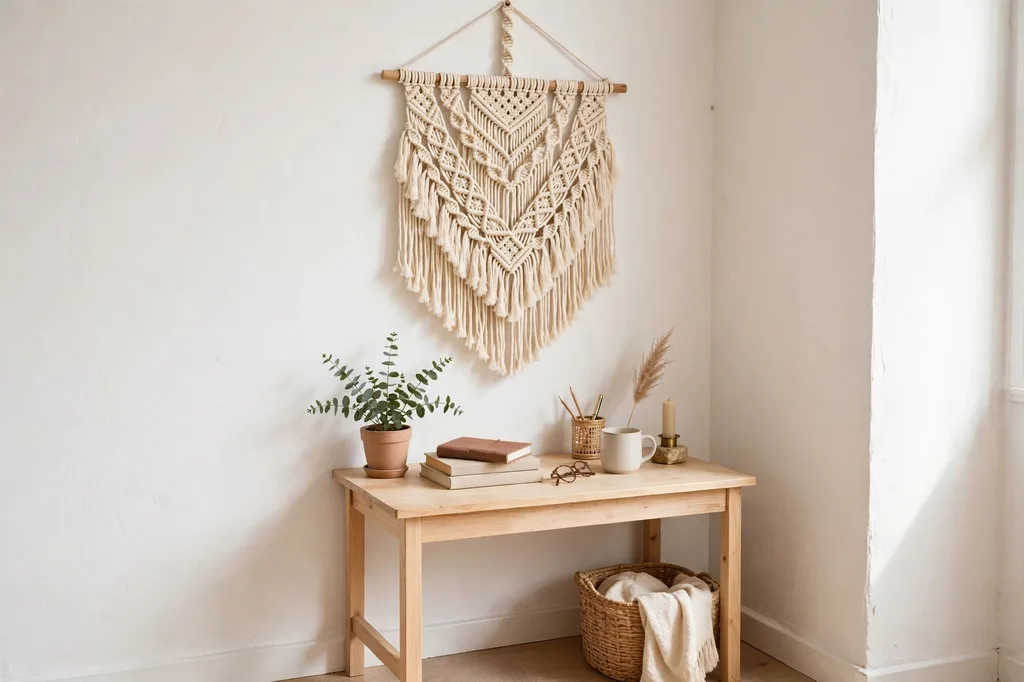
Best for: the walls a large piece cannot fill, a medium macrame piece is the right art for a small wall.
A macrame wall hanging does not have to go above the sofa. It works above a desk, above a bed, above a console table, anywhere a small wall needs soft art. Above a console, a dresser, or a desk, a medium piece 40 to 60 cm wide usually looks right. Above a bed, a piece two-thirds of the bed’s width, the same rule as the sofa, applied to the bed.
- Above the desk: a medium piece 18 to 24 inches wide, its center at 57 to 60 inches, its fringe 6 to 10 inches above the desk. It softens the work wall without taking desk space.
- Above the bed: a piece two-thirds of the bed’s width, its fringe 8 to 12 inches above the pillows. The fringe must clear the pillows, a fringe that brushes the pillows will be slept on within a week.
- Above the console: a medium piece 40 to 60 cm wide, centered, its fringe 6 to 10 inches above the console. One piece, not two, a console wall is a small wall, and one piece is the whole composition.
- What to watch: do not hang macrame above a stove, a radiator, or a heater. Cotton cord near heat is a fire risk, and steam from cooking will rot it. Macrame belongs in dry rooms only, living room, bedroom, office. Never the bathroom, never the kitchen.
Budget: a medium piece costs $25 to $60 ready-made, $25 as a DIY kit. Small walls need small pieces, and small pieces cost less.
7. Layered wall: macrame + mirror + baskets
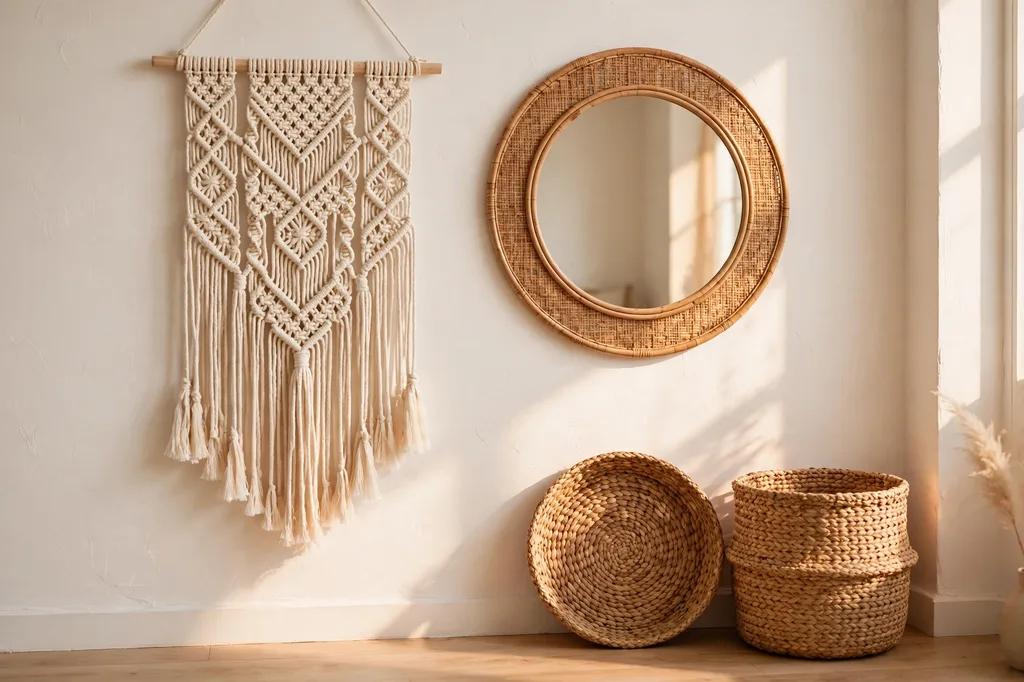
Best for: the whole wall, macrame, a mirror, and baskets together make a wall that no single piece can.
A layered wall, a macrame wall hanging, a round mirror, and two or three woven baskets, is the boho wall in full. The macrame is the soft anchor, the mirror is the light, and the baskets are the texture. Together they fill a wall without a single frame, and they all hang from adhesive hooks.
- How to arrange it: the macrame in the center (24 to 36 inches wide), the round mirror (18 to 24 inches) on one side, two baskets (12 to 18 inches each) on the other side, all with 2 to 3 inches between them. Odd numbers, three baskets, not two, and one shared material: natural fiber, wood, and cotton, all warm, all matte.
- What to watch: do not mix more than three textures on one wall. Macrame, mirror glass, and woven baskets are three textures, that is the maximum. Add a fourth (metal, ceramic, plastic) and the wall looks like a shop. And keep the palette warm: cream, wood, and rattan. One cool color breaks it.
Budget: the macrame costs $25 to $60. A round mirror costs $20 to $40. Two baskets cost $15 to $30. A layered wall costs $60 to $130, and it is the fullest wall in this guide for under $150.
Small living room layout: the macrame wall
Best for: the whole room, where the macrame wall goes in a 10 by 12 foot living room.
A macrame wall hanging works best on the wall opposite the window, where the daylight hits the cotton and the texture shows. Here is the plan for a 10 by 12 foot room:
- Macrame wall (12 foot wall): the large hanging centered above the loveseat (52 to 58 inches wide), its center at 57 to 60 inches from the floor, its fringe 6 to 10 inches above the sofa back. One piece, not two, the wall has one focal point.
- Side wall: the plant hanger in the corner by the window, and the small row of three hangings above the console. The side pieces are small and low, they do not compete with the main piece.
- What to watch: a small living room fails when every wall has art on it. One wall is the macrame wall. The other walls are for the mirror, the lamp, and the empty space. Macrame is a soft material, too much of it turns a living room into a craft room. One wall, one system, and the rest of the room stays calm.
Renter-friendly rules
Macrame wall hanging is the most renter-friendly art there is, most pieces weigh under 2 pounds, and one adhesive hook holds them. The rules are short, and they are all about the hook.
- One hook, rated for twice the weight: for light macrame pieces, an adhesive hook rated for at least twice the piece’s weight works well. A piece that weighs 1 pound needs a hook rated for 2 pounds. A large piece that weighs 3 to 4 pounds needs a hook rated for 6 to 8 pounds, or two hooks, one at each end of the dowel.
- Large pieces need two hooks: a large hanging 120 by 140 cm is too heavy and too wide for one hook. Use two hooks, one near each end of the dowel, and check both ratings. A large piece on one hook will tilt, and a tilted piece will fall.
- Test one piece first: clean the wall, press the hook for 30 seconds, wait 1 hour before hanging, and 24 hours before trusting it. On lightly textured walls, test a single piece for 24 to 48 hours. In humid rooms, allow longer cure time, and keep macrame away from steam and splashes.
- What NOT to do: do not hang macrame in a bathroom, cotton and wool suffer in constant steam. Do not hang a heavy piece from a hook rated for a light one. And do not use foam tape, it rips drywall paper on removal. Use removable adhesive hooks, not tape.
- Cleaning: dust a macrame hanging gently with a dry cloth or a low vacuum brush, and keep it out of direct sunlight to avoid fading. Do not wash it unless the maker says it is safe to do so.
Macrame wall under $150
Best for: the whole wall, every idea in this guide, added up.
| Item | Cost |
|---|---|
| Large macrame hanging, 36 in | $45–$120 |
| Three small hangings (row) | $25–$60 |
| Macrame plant hanger + pothos | $18–$35 |
| Adhesive hooks (set of 4) | $8–$12 |
| Total | $96–$227 |
That is over $150 at the top end, so here is the honest version. If the budget is strictly under $150, buy the large hanging and the hooks first ($53–$132), and make the small row yourself from a $25 DIY kit instead of buying it ready-made. A macrame wall hanging built in two rounds looks better than one built in one rushed round, because the second round is the one where you know what the wall actually needs.
The free ideas: a DIY piece from cord you already own, a plant you already have, and hooks you already own cost nothing, and they change the wall more than any purchase. Macrame styling starts with one knot, not one purchase.
5 mistakes to avoid
1. A piece that is too small above the sofa. A single 12-inch macrame wall hanging above a sofa looks undersized on its own. Art should span about two-thirds of the furniture beneath it, hang two or three small pieces together, or buy one piece that fits.
2. Hanging it too high. The center of the piece belongs at 57 to 60 inches from the floor, the fringe 6 to 10 inches above the furniture. Higher and the piece floats away from the sofa; lower and the fringe brushes the cushions.
3. Fringe brushing the furniture. A fringe that touches the sofa back or the pillows will be sat on, slept on, and tangled within a week. Measure the fringe, not just the knotted section, the fringe doubles the visual height.
4. Macrame in the bathroom. Bathrooms stay humid, and cotton and wool suffer in constant steam. Keep textile hangings in dry rooms only, living room, bedroom, office. Never the bathroom.
5. One hook for a large piece. A large hanging 120 by 140 cm on one hook will tilt and fall. Large pieces need two hooks, one near each end of the dowel, each rated for at least twice the piece’s weight.
FAQ
How big should a macrame wall hanging be?
Above a sofa, console, or bed, choose a piece about two-thirds of the furniture width below it. Above a loveseat 52 to 58 inches wide, that is a hanging about 35 to 40 inches wide. Hang its center at eye level, 57 to 60 inches from the floor.
How high should I hang a macrame wall hanging?
On an open wall, place the center of the piece at about eye level, roughly 57 to 60 inches from the floor. Above furniture, leave about 6 to 10 inches between the top of the sofa and the lowest point of the fringe, so the two read as one composition.
How do I hang a macrame wall hanging?
Most lighter pieces hang from a single adhesive hook rated for at least twice the piece’s weight. The large 120 by 140 cm hanging needs two hooks, one near each end of the dowel. Clean the wall first, press for 30 seconds, and wait 1 hour before hanging.
Can I hang wall decor without drilling?
Yes, for light macrame pieces, adhesive hooks rated for at least twice the piece weight work well, especially for renters. Heavy pieces need two hooks, and anything over 15 pounds should lean instead of hanging.
What size wall art is best for a small living room?
Follow the two-thirds rule: art should span about two-thirds of the furniture beneath it, with a 6- to 8-inch gap above the furniture. One large piece simplifies the room’s focus; three small pieces in a row do the same job for less money.
Can large art pieces work in a small space?
Definitely. One large canvas or one large macrame hanging simplifies and clarifies the room’s focus. Just ensure the scale fits the ceiling height and wall dimensions, and that the center sits at eye level.
How do I clean a macrame wall hanging?
Dust it gently with a dry cloth or a low vacuum brush, and keep it out of direct sunlight to avoid fading. Do not wash it unless the maker says it is safe to do so.
Can I put a macrame hanging in a bathroom?
No. Bathrooms stay humid, and cotton and wool suffer in constant steam. Keep textile hangings in dry rooms only.
Start today
Macrame wall hanging does not need a shopping trip, it needs a measurement. Measure the sofa, pick a piece two-thirds its width, and hang it with one hook at eye level. That is the whole first round, and it takes an afternoon.
Start with one piece. The wall will tell you what it needs next.