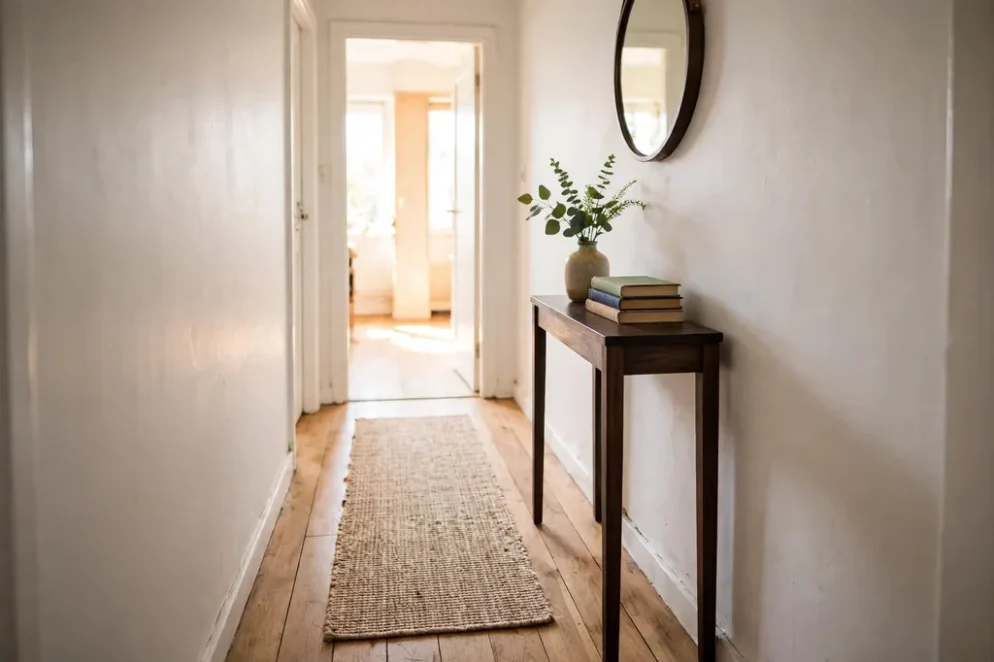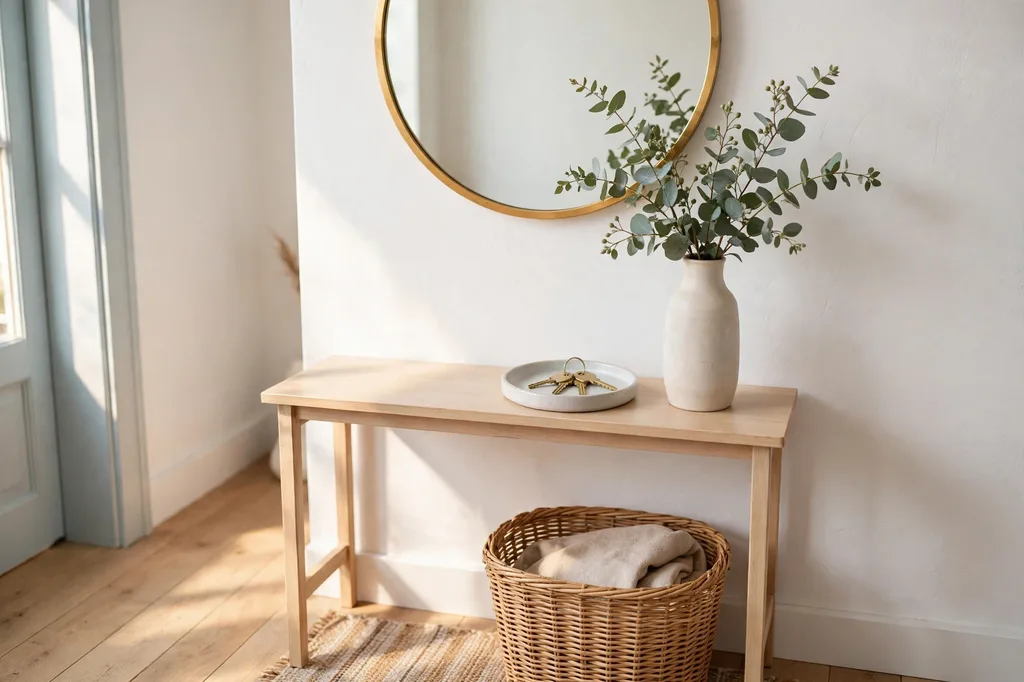
Entryway table decor is the first thing guests see when they walk in, and the last thing you touch when you walk out. In a small entryway it has two jobs at once: look styled, and hold your keys, wallet, and mail without turning into a junk pile.
This guide gives you 8 entryway table decor ideas with exact measurements, mirror width, lamp height, table depth, and cost. Every idea is renter-friendly, and the whole table comes in under $150.
Table of Contents
The numbers first
Best for: every idea in this guide, measure the wall and the walkway before you buy anything.
Six numbers decide whether entryway table decor works in a small hall:
- Table height: a console table should be 30 to 34 inches high. Under 28 inches feels cramped; over 34 inches and the tabletop sits above your natural reach when you walk in with bags.
- Table depth: most entryway tables are 12 to 16 inches deep. For an apartment or a narrow hall, go slim, under 14 inches deep. If the walkway is under 40 inches wide, use a 10-inch-deep table. If the entry is under 3 feet wide, a wall-mounted console 10 inches deep at most is the honest option.
- Table length: match the table to the wall. For an entry up to 36 inches wide, a 24- to 30-inch table; 36 to 48 inches wide, a 30- to 42-inch table; 48 to 60 inches wide, a 42- to 54-inch table. As a rule, the table should be about 30 to 40 percent of the wall length.
- Walkway clearance: leave 36 inches of walking space in front of the table, 30 inches minimum.
- Mirror width: the mirror or art above the table should be about two-thirds to three-quarters of the table’s width. On a 48-inch table, that is a mirror about 32 to 36 inches wide. On a table under 35 inches wide, use a 20- to 24-inch mirror.
- Mirror height: hang or lean the mirror so its bottom edge sits 6 to 8 inches above the tabletop, with the mirror’s center about 57 to 60 inches from the floor.
Two more numbers run the whole tabletop: the lamp should be 22 to 28 inches tall, the vase 10 to 14 inches tall, the tray 10 to 12 inches long (about one-third of the table length), and a book stack 4 to 8 inches high. And the surface rule: keep about one-third of the tabletop empty, with 7 to 9 items at most. Those numbers are the backbone of entryway table decor.
1. One anchor mirror
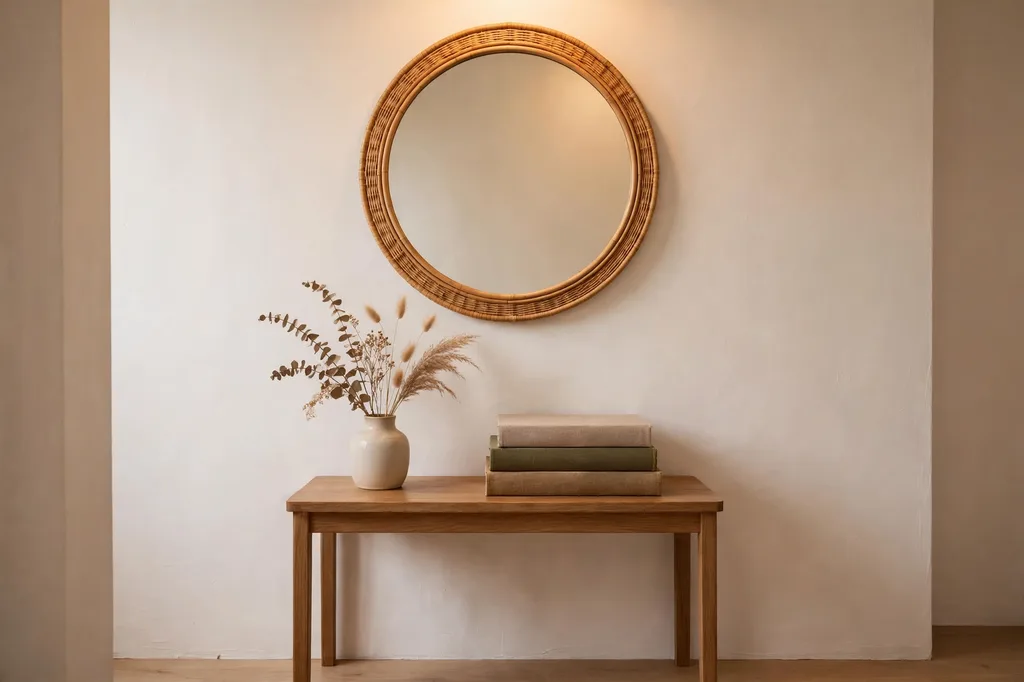
Best for: the focal point, one mirror does the work of five small things.
A mirror is the single best anchor for an entryway table. It fills the vertical space above the table, it throws light into a dark hall, and it makes a narrow entryway feel twice as wide. A round mirror 24 to 30 inches across is the classic small-entry move, and a round mirror has no corners to catch a shoulder in a tight hall. It is the anchor that makes entryway table decor feel finished, not just furnished.
- Size: the mirror should be about two-thirds of the table’s width. On a 48-inch table, that is 32 to 36 inches wide. On a table under 35 inches wide, a 20- to 24-inch mirror. A mirror smaller than two-thirds looks stranded above the table.
- Position: lean it slightly off-center, or hang it dead-center, either works, but the bottom edge must sit 6 to 8 inches above the tabletop, with the center at 57 to 60 inches from the floor. That height puts the mirror at eye level for most people, which is the whole point of a mirror by the door.
- What to watch: do not hang a mirror where it reflects clutter, and do not pair a big mirror with a second big thing. One anchor, then small things. Two anchors fight each other.
Renter note: a leaning mirror needs no hook, no hole, and no permission. A 24-inch round mirror costs $20 to $35 secondhand, $40 to $70 new, and it moves with you.
2. The drop zone: tray first
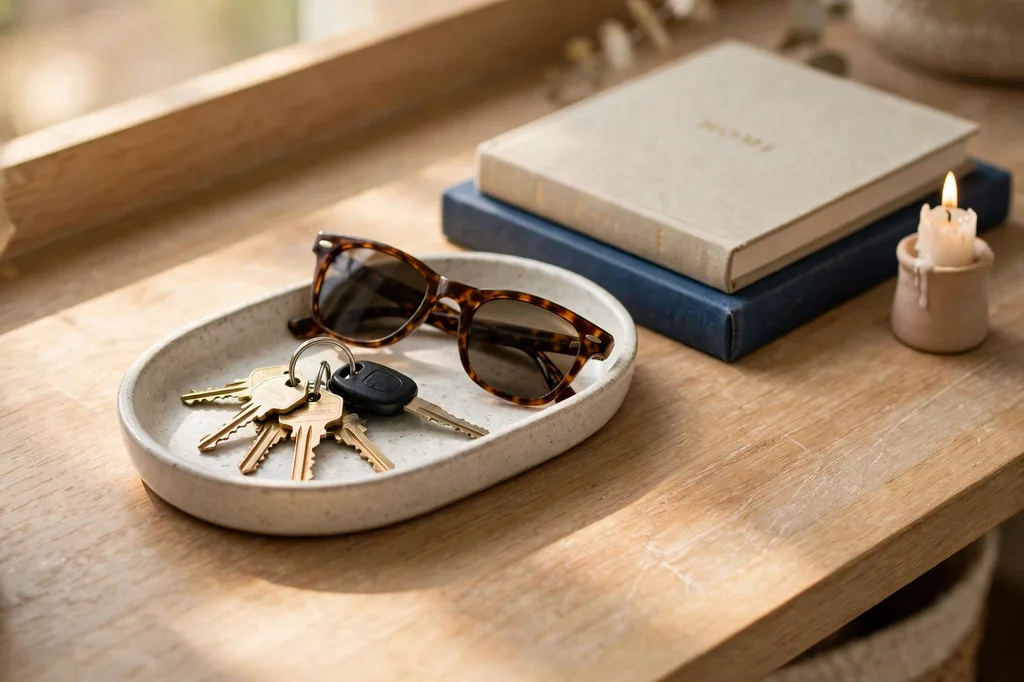
Best for: the function, the tray is what makes an entryway table a drop zone instead of a display shelf.
Before the mirror, before the vase, before anything decorative: put the tray down. The tray is the first thing in the styling order because it is the only thing that solves the daily problem, where do the keys go when you walk in? A table without a tray becomes a junk pile within a week, no matter how pretty it starts.
- Size: the tray should be 10 to 12 inches long, about one-third of the table’s length. On a 36-inch table, a 12-inch tray is right. Longer than a third and the tray becomes the table; shorter than 10 inches and the keys spill off it.
- Position: the tray goes closest to the door, the first thing your hand reaches when you walk in. If the tray is on the far end of the table, you will drop your keys on the near end anyway.
- What goes in it: keys, sunglasses, wallet, the three things you carry every day. Mail does not go in the tray. Mail goes in a separate slot, a wall pocket, or a basket under the table, or it buries the keys within two days.
- Console table with storage: if the table has a drawer, the drawer beats the tray for hiding clutter, keys in the drawer, tray on top for sunglasses and today’s mail. A console table with storage for entryway use (a drawer plus a shelf underneath) holds the same daily mess and looks cleaner doing it. If the table has no drawer, the tray is not optional, it is the whole system.
- What to watch: the tray is for what you carry daily, and only that. Empty it every Sunday, thirty seconds, once a week.
Budget: a ceramic catchall tray costs $8 to $15. A small brass tray costs $12 to $20. A tray you already own costs nothing, and it is the cheapest function in this guide. That makes a tray the cheapest start in entryway table decor.
3. Three heights: the triangle
Best for: the shape of the tabletop, three heights make a table look styled instead of lined up.
A table where everything is the same height looks like a shop shelf. A table with three heights, tall, medium, low, looks like a designer styled it. Build a visual triangle: one tall piece at the peak (18 to 24 inches high), step down to side pieces at 8 to 12 inches, and finish with one low piece (under 6 inches tall) at the front. Keep that triangle in mind and entryway table decor falls into place.
- Tall: one tall thing, the lamp (22 to 28 inches), a tall vase with stems (18 to 24 inches including the stems), or a tall candlestick. One tall thing, not two, two tall things split the table in half.
- Medium: a medium vase (10 to 12 inches), a small stack of books (4 to 8 inches high), or a ceramic bowl. The medium piece sits in the middle of the triangle and connects the tall and the low.
- Low: a low bowl, a small tray, or a short candle cluster at the front edge. The low piece keeps the tabletop grounded, without it, everything floats.
- What to watch: do not put the tall piece in the center, the center belongs to the anchor mirror. The tall piece goes to one end, the low cluster to the other. And do not put everything at the back of the table: one low piece at the front edge pulls the whole arrangement toward the room.
Budget: three heights cost less than one big statement piece, a tall vase $10 to $20, a medium bowl $8 to $15, a low candle $5 to $10.
4. A lamp that fits
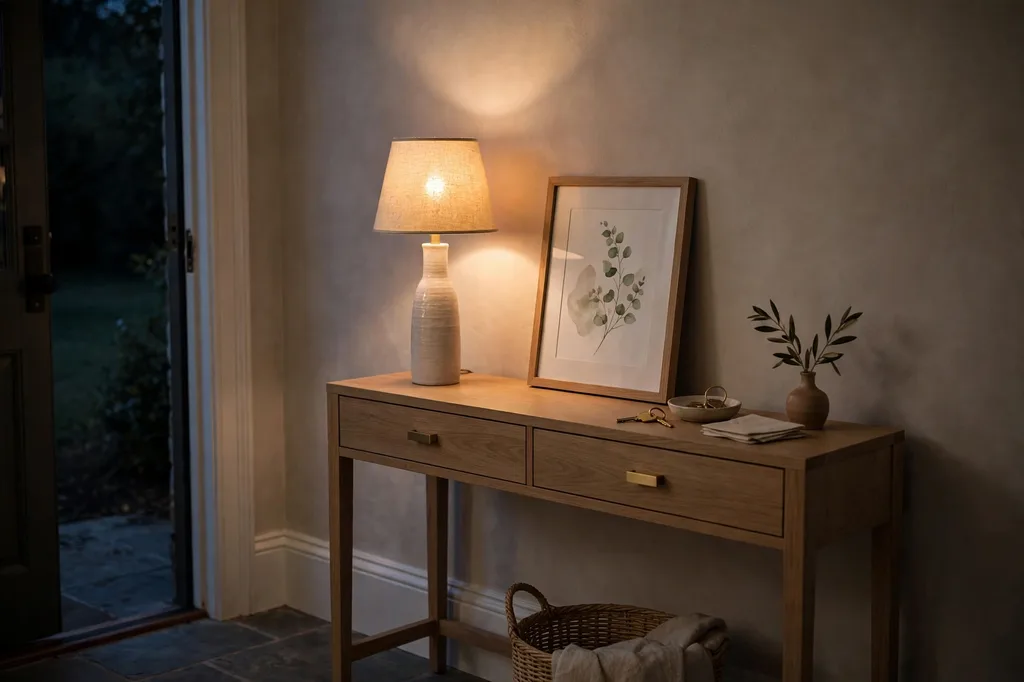
Best for: the light of the hall, most entryways have no window, and a lamp is what makes the table visible at night. Without it, entryway table decor disappears after dark.
An entryway lamp is not decoration first. It is the light you switch on when you come home after dark, and the warm glow that makes the whole hall feel welcoming. In a small entryway, the lamp also does a second job: it is the tall piece in the triangle, so it has to be the right height and the right depth.
- Size: the lamp should be 22 to 28 inches tall, and the shade must be no deeper than the table. On a 12-inch-deep table, a shade deeper than 12 inches hangs over the walkway and gets knocked.
- Light: warm light (2700K) is the rule, cool white light in a hallway makes the whole entry look grey. A warm bulb in the lamp and a warm bulb in the hall ceiling, or the lamp glows and the hall does not.
- No outlet? Use a rechargeable lamp, or a plug-in sconce on the wall beside the table. A rechargeable lamp costs $15 to $30, needs no wiring, and moves with you. Run the cord along the back of the table with adhesive cord clips so it never dangles into the walkway.
- What to watch: the lamp goes at the end of the table farthest from the door swing, never at the near end where a bag catches it. And do not put the lamp in front of the mirror, it blocks the reflection and throws glare.
Budget: a slim table lamp costs $12 to $25 secondhand, $25 to $50 new. A rechargeable lamp costs $15 to $30.
5. Greenery: one tall vase
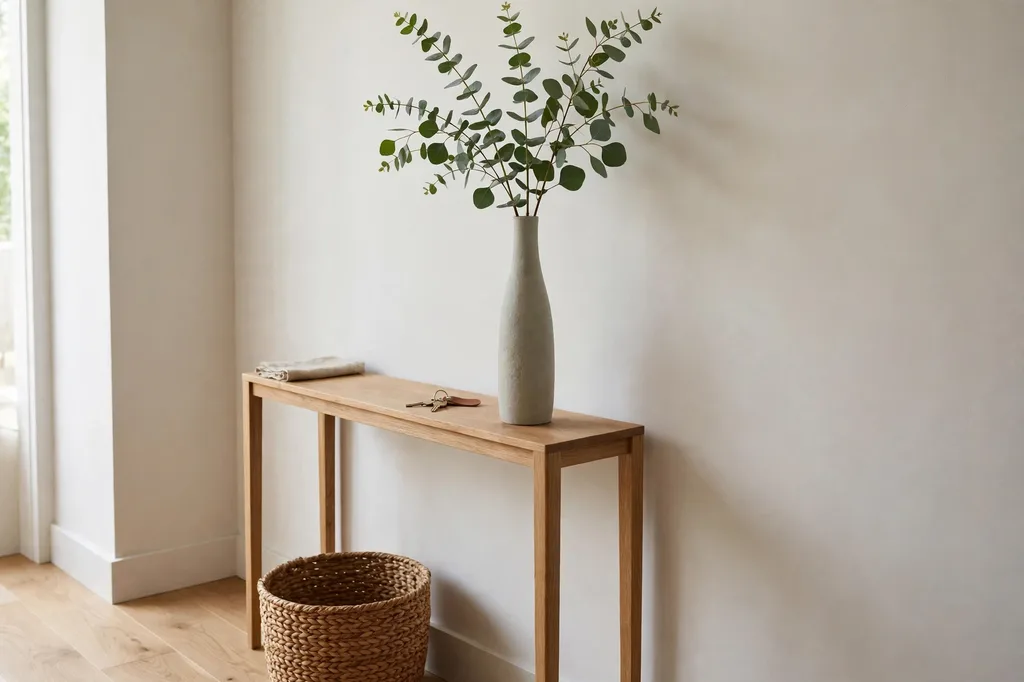
Best for: the life of the tabletop, greenery is the only soft thing on a hard console.
A table without greenery is a shelf of hard objects. One branch of eucalyptus, one tall vase with dried stems, or one small potted plant softens every edge and adds the green that balances all the wood and ceramic. The rule is one variety, not five: one kind of greenery, used once, looks intentional. Five kinds look like a garden center. One branch is enough to soften entryway table decor.
- Vase: a tall slim vase 10 to 14 inches high, with stems 1.5 to 2 times the vase height, a 12-inch vase takes stems 18 to 24 inches tall.
- Eucalyptus: a bunch of dried eucalyptus in a slim vase lasts for months with no water at all. It costs $8 to $15 and it never dies, the honest choice for a hall with no window.
- Position: the vase goes at the back half of the table, at one end, never at the front edge, and never at the near end by the door. Tall stems near the door get knocked by every bag and coat that comes through it.
- What to watch: do not use a trailing plant on an entryway table, it drapes over the front edge, catches on bags, and drops leaves on the floor. Trailing plants belong on a shelf, not on a table you brush past twenty times a day.
Budget: a tall vase costs $10 to $20. Dried eucalyptus costs $8 to $15. A small potted plant costs $10 to $20, but only if the hall gets light.
6. Books as risers
Best for: the height problem, books lift small things to the right height for free.
Books are the entryway table’s secret tool. A stack of two or three books (4 to 8 inches tall when stacked) lifts a small vase, a candle, or a bowl to the height it needs to be, and it adds color and texture at the same time. Books you already own, books in your accent color, books with the spine turned in, all of them work, and all of them are free if you already own them.
- How to stack: two or three books, largest at the bottom, smallest on top. The stack should be 4 to 8 inches tall, tall enough to lift the object, short enough not to dominate the table.
- What to put on top: one small thing, a bud vase, a short candle, a tiny ceramic. One thing per stack. Two things on one stack look crowded.
- What to watch: do not use books as a filler. A stack of books with nothing on it is a pile, not a riser. And do not use books that matter to you under a vase, water rings damage paper.
Budget: free, if you shop your own shelves. A secondhand stack costs $5 to $10 at a thrift store. Books are the only free height in this guide. Shop your own shelves first and entryway table decor costs nothing here.
7. Storage underneath: baskets and a bench
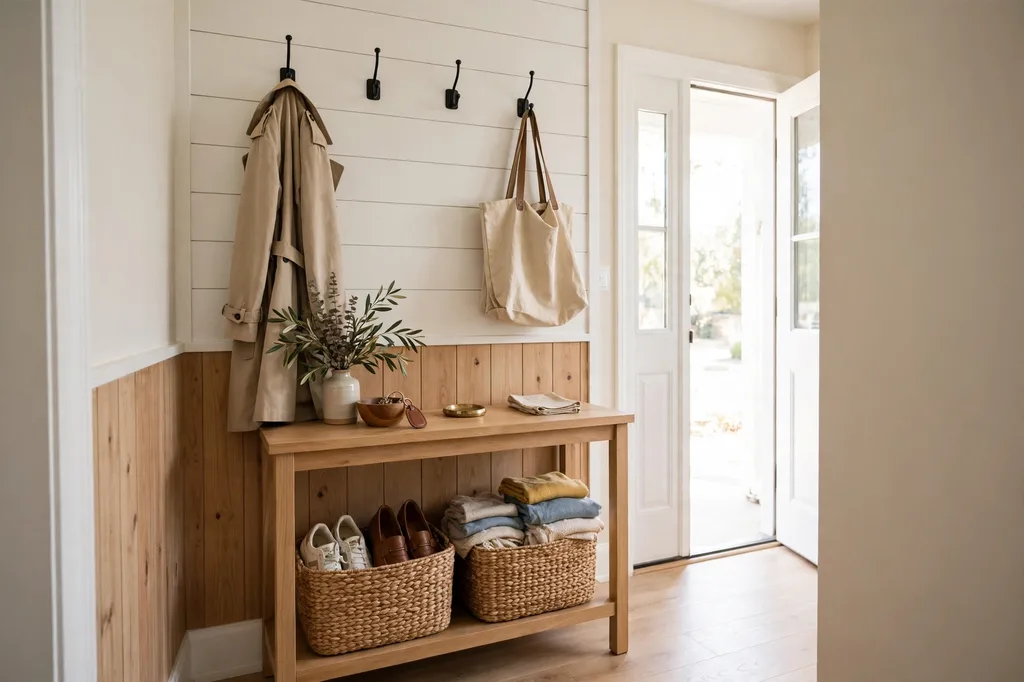
Best for: the clutter the table can’t hold, shoes, scarves, the dog leash, and the mail that isn’t today’s.
The space under an entryway table is the most useful space in the hall, and the most wasted. A table with nothing underneath it is a table with a dead zone below it. Two baskets, or one bench, turn that dead zone into the storage the whole entryway needs.
- Baskets: two woven baskets about 14 inches wide each fit under a 36-inch table. Leave 2 to 3 inches of air above each basket and 1 to 2 inches from the table legs, or the baskets jam and scrape. Shoes in one basket, scarves and dog gear in the other, one basket per category, or they become junk bins.
- Bench vs baskets: a bench is for sitting to put shoes on, seat height 17 to 19 inches, depth 10 to 12 inches. It wins in a hall wider than 48 inches. In a hall under 36 inches wide, baskets win, a bench eats the walkway. Entryway bench decor is simple either way: one cushion on the bench, one basket under it, nothing else.
- Console table with storage: a table with a drawer and a shelf underneath holds the same daily mess as baskets and looks cleaner doing it, keys and mail in the drawer, baskets on the shelf below. If you are buying a table, a drawer is worth more than a prettier top.
- What to watch: do not put anything under the table that sticks out past the table’s front edge. Anything past the edge is a trip hazard in the dark. And do not store shoes loose under the table, loose shoes migrate across the hall within a day. A basket is not decoration; it is the boundary that keeps the shoes in one place.
Budget: two woven baskets cost $12 to $20. A small bench costs $30 to $60 secondhand.
8. Minimalist and modern: two measured setups
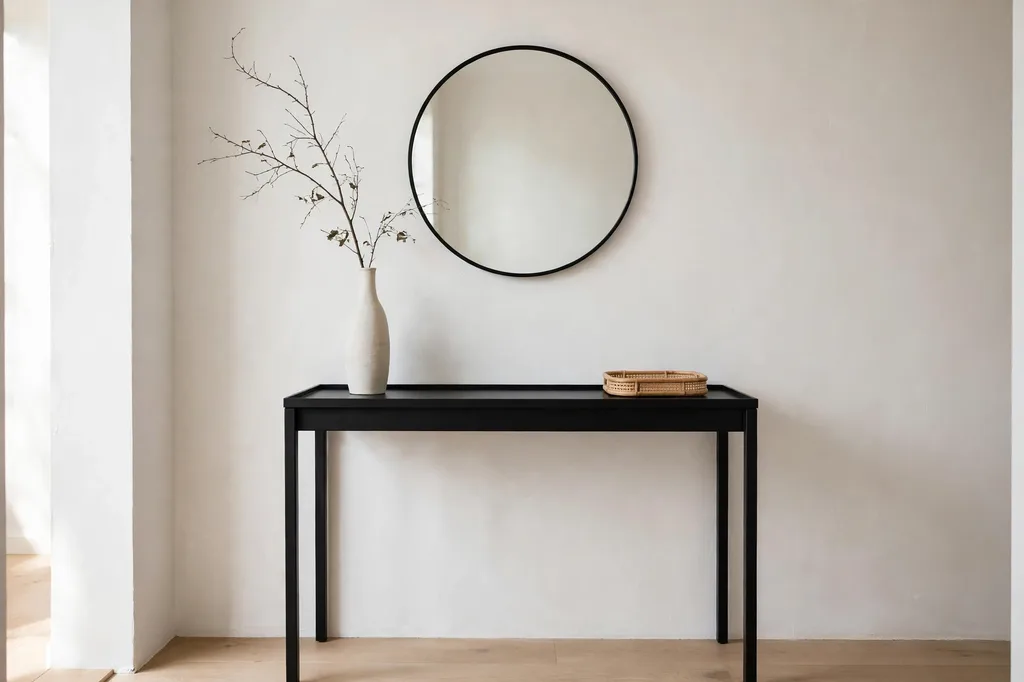
Best for: the two styles people actually search for, measured, not vague. Minimalist entryway table decor and modern entryway table decor are the two supporting styles for this article, and both fail when the pieces are the wrong sizes. Here they are, with numbers.
The minimalist setup, three pieces on a 36-inch table. A 24-inch round mirror, hung or leaned with its bottom edge 6 to 8 inches above the tabletop. One tall vase, 12 to 14 inches, with a single branch, at the far end of the table. One tray, 10 to 12 inches, closest to the door. That is the whole table. Two-thirds of the surface stays empty, that empty space is the minimalist look. If it feels bare, the answer is not a fourth thing. The answer is a bigger mirror. That empty space is part of entryway table decor, not a gap to fill.
The modern setup, a black console. A slim black console, 36 inches long, 12 inches deep, 30 inches high. A round black-frame mirror, 24 inches, above it. One matte black vase, 12 to 14 inches, with dried stems, at one end. One brass tray, 10 to 12 inches, at the other end. Warm bulb (2700K) in the lamp or the hall light, so the black doesn’t go cold and grey. That is modern entryway table decor at its simplest.
What to watch: minimalism fails when the three pieces are the wrong sizes, a 16-inch mirror above a 36-inch table looks lost. Measure the mirror first, then buy the vase, then the tray. And modern fails when everything is black, one brass or wood piece breaks it, or the whole table reads as one dark block.
Small entryway layout: the 36-inch hall
Best for: the whole hall, where the table sits in a narrow entry, with hooks, a runner, and a basket, all measured.
A table is one piece of an entryway. The hall also needs hooks for coats, a runner for the floor, and a basket for shoes, and in a small hall, those four things have to share 36 to 48 inches of width without blocking the door. Here is the full plan, with numbers.
The 48-inch hall (the comfortable case). A 12-inch-deep table on the long wall leaves 36 inches of walkway. The table is 30 to 42 inches long, the mirror above it 24 to 30 inches round, 6 to 8 inches above the tabletop. Hooks go on the opposite wall or above the table at about 65 inches high, spaced 8 inches apart, 4 to 6 hooks. The runner is 2 to 2.5 feet wide and about 6 feet long. One basket, about 14 inches wide, sits under the table, and the catchall tray sits closest to the door.
The 36-inch hall (the tight case). A 10-inch-deep table leaves 26 inches of walkway, below the comfortable 30-inch minimum. It works for shoes-only traffic, but a bag will catch the table’s corner every day. The better answer is a wall-mounted console 10 inches deep at most with three items only, or a 24- by 6-inch shelf at about 42 inches high with hooks at 65 inches above it. A table that blocks the walkway is worse than no table at all.
The door swing. Measure it before you place anything, the table must not block the door, and the tray must sit where your hand reaches it the moment you step in. For the whole entryway, hooks, bench, runner and the table together, see Entryway Decor Ideas for Small Spaces. Measure first and entryway table decor will never block the door.
Renter-friendly rules
Most entryway table decor is renter-friendly by nature, a table is styled with movable objects, not fixtures. The rules are about what you do NOT do.
- Lean, don’t drill: the mirror leans, the art leans, the frames lean. A leaning mirror needs no hook and no hole. If you must hang something light, use adhesive strips rated for at least twice the piece’s weight, and only on smooth, fully cured paint.
- Strip weight ratings: adhesive strips are rated up to 16 lbs per pair. A 24-inch round mirror weighs about 8 to 10 lbs, so use 2 pairs (32 lbs rated), twice the weight, always. A small frame under 5 lbs needs one pair. Never hang a mirror on a single pair of strips, and never trust a strip on textured walls. Check the rating first: entryway table decor should never rely on a strip that is too weak.
- Test first: stick one test strip and leave it for 48 hours before you hang anything on it. Do not stick anything to paint less than 30 days old, the paint hasn’t cured and the strip will pull it off. To remove a strip, pull the tab straight down, slowly, never out toward you, and warm it with a hairdryer for 20 to 30 seconds first if it resists.
- Hooks for keys: adhesive hooks beside the table hold keys and a tote bag, use hooks rated 3 to 5 lbs each for keys, one hook per set of keys. Foam tape is not the same as removable strips, it rips drywall paper. Don’t use it.
- Plug-in, don’t hardwire: a plug-in or rechargeable lamp gives you the glow without the electrician. Hardwired sconces are a permanent install, they are the landlord’s decision, not yours. Run cords along the back of the table with adhesive cord clips.
- Don’t drill for floating shelves: a floating shelf needs screws in the wall. In a rental, that is the landlord’s decision. A leaning mirror and a console table give you the same look with zero holes. For more no-drill wall ideas above the table, hooks, frames and art that leave no holes, see Rental Friendly Wall Decor Ideas.
Entryway table decor under $150
Best for: the whole setup, every idea in this guide, added up.
| Item | Cost |
|---|---|
| Slim console table, 36 in × 12 in (thrifted) | $30–$50 |
| Round mirror, 24 in (secondhand) | $20–$30 |
| Ceramic catchall tray | $8–$12 |
| Tall vase + dried eucalyptus | $10–$18 |
| Small LED lamp | $12–$18 |
| Two woven baskets | $12–$20 |
| Total | $92–$148 |
That is under $150 at the top end, and the decor itself (mirror, tray, vase, lamp, baskets) is only $62 to $98. The table is the expensive part, which is why the table is thrifted. If the table is bought new at $120, the same setup totals about $290, the only competitor that totals a whole entryway lands at roughly $290 too. So thrift the table or use one you already own, buy the mirror and the tray first ($28 to $42), and add the lamp and the baskets next month. That total is why entryway table decor under $150 is realistic, not a fantasy.
The free ideas: taking three things off the table, leaning a mirror you already own, and stacking books you already own cost nothing, and they change the table more than any purchase. Start with those and entryway table decor improves before you spend anything.
5 mistakes to avoid
1. A table too deep for the hall. A 16-inch-deep table in a 36-inch hall leaves 20 inches of walkway, nobody can pass it with a bag. You need 36 inches of clearance, 30 inches minimum. In a hall under 40 inches wide, use a 10-inch-deep table, or a wall-mounted shelf.
2. A mirror too small or hung too high. A mirror narrower than two-thirds of the table’s width looks stranded. A mirror hung more than 8 inches above the tabletop floats away from it.
3. Everything the same height. A table where the lamp, the vase, and the books are all the same height looks like a shop shelf. Build the triangle, tall 18 to 24 inches, medium 8 to 12 inches, low under 6 inches.
4. No drop zone. A table with no tray is a table where keys, mail, and sunglasses land wherever they fall, usually the kitchen counter. The tray goes down first, closest to the door, before anything decorative. No tray, no system.
5. Overcrowding the surface. More than 7 to 9 items, or less than a third of the surface empty, reads as clutter, and in an entryway, clutter is the first thing guests see. If it feels crowded, remove three things. An edited table reads as intentional; a full one reads as a junk pile. In entryway table decor, empty space is part of the design.
FAQ
What do you put on an entryway table?
A tray or bowl for keys, a lamp, a mirror or art above it, a tall vase with greenery, two or three books, a candle or small sculpture, and baskets underneath for shoes and scarves. That is the whole entryway table decor kit in one list.
How do I decorate an entry table?
Start with the tray, it goes down first, closest to the door. Then the anchor mirror above the table, then three heights in a triangle (tall, medium, low), then edit down to 7 to 9 items with about a third of the surface empty.
How high should I hang a mirror above an entryway table?
The bottom edge of the mirror should sit 6 to 8 inches above the tabletop, with the mirror’s center about 57 to 60 inches from the floor.
How tall should an entryway table lamp be?
22 to 28 inches tall, with a shade no deeper than the table. Use a warm bulb (2700K), cool white light in a hallway makes the whole entry look grey.
How big should the mirror or art above a console table be?
About two-thirds to three-quarters of the table’s width. On a 48-inch table, that is a mirror 32 to 36 inches wide. On a table under 35 inches wide, use a 20- to 24-inch mirror.
How do I style a narrow entryway table?
Use a 10- to 12-inch-deep table, a 20- to 24-inch mirror, and only three things on top: one tall vase, one tray, and one low bowl, with baskets underneath. If the entry is under 3 feet wide, use a wall-mounted console 10 inches deep at most. Keep it to three pieces and entryway table decor stays calm in a narrow hall.
How many things should be on a console table?
7 to 9 items at most, with about a third of the surface left empty. Fewer is better, three well-sized pieces beat nine small ones every time.
What should I put under an entryway table?
Baskets for shoes and scarves (about 14 inches wide each, with 2 to 3 inches of air above them), or a bench if the hall is wide enough, seat height 17 to 19 inches, depth 10 to 12 inches. Nothing under the table should stick out past its front edge.
Start today
Entryway table decor does not need a shopping trip, it needs a tape measure and an edit. Measure the wall and the walkway, put the tray down closest to the door, lean a mirror against the wall, and take three things off the table. That is the whole first round, and it takes an afternoon.
Start by taking away. The table will tell you what it needs next. For more small-hallway inspiration, see IKEA’s hallway ideas.