Mantel decor in a small living room is not about filling the shelf, it is about giving the room one clear focal point and then stopping. A small mantel crowded with ten things looks smaller than an empty one. One mirror, three heights, and a little breathing room make the whole wall look designed, and the whole room feel bigger.
This guide gives you 8 fireplace mantel decor ideas with exact measurements: how wide the anchor piece should be, how high the mirror goes, how far everything sits from the firebox, and what it all costs. Every idea is renter-friendly, lean, don’t drill, and the whole mantel comes in at $113–$210.
Table of Contents
The numbers first
Best for: every idea in this guide, measure the mantel before you buy anything.
Five numbers decide whether mantel decor works on a small shelf:
- Mantel width: most mantels are 42 to 60 inches wide. A narrow mantel (under 48 inches) needs asymmetrical groupings, one tall piece on one side, a low cluster on the other, not a mirror-image pair.
- Anchor width: the anchor piece (mirror or art) should be about two-thirds of the mantel’s width. On a 48-inch mantel, that is a mirror about 32 inches wide. Narrower looks stranded; wider looks top-heavy.
- Mirror height: hang or lean the mirror so its bottom sits 4 to 6 inches above the mantel shelf. Closer and it crowds the shelf; higher and it floats away from it.
- Firebox clearance: keep flammable items at least 12 inches from the firebox opening. Never hang stockings above a lit fire. Use glass hurricanes around real candles, or flameless candles instead.
- Object height: on a shallow ledge (under 5 to 6 inches deep), no object should be taller than 16 inches, and leaning art only needs about 1.5 inches of depth. Anything deeper or taller will fall.
Measure the width, the depth, and the distance to the firebox before you buy anything. The best mantel in a small room is the one with empty space left on it. Those three measurements keep any mantel decor plan honest.
What is the rule of three?
What is the “rule of three” in mantel styling? It is the practice of grouping decor in odd numbers, typically a tall, a medium, and a low item, arranged to form a visual triangle. Odd-numbered groupings read as more balanced to the eye than even ones. One tall candlestick, one medium vase, one low bowl: that is the rule of three, and it is the whole styling method in one sentence. That odd-number grouping is the backbone of good mantel decor.
Is symmetry always best? No. Symmetry gives a formal look, but asymmetrical styling, the anchor on one side, layers on the other, gives a relaxed, modern feel, and it works better on a narrow mantel where a matched pair will not fit. On a mantel under 48 inches wide, asymmetry is not a compromise, it is the right answer.
For the same calm, edited look across the whole room, fewer things, one clear focal point, see Scandinavian Interior Decor Ideas for a Small Living Room.
1. One anchor mirror
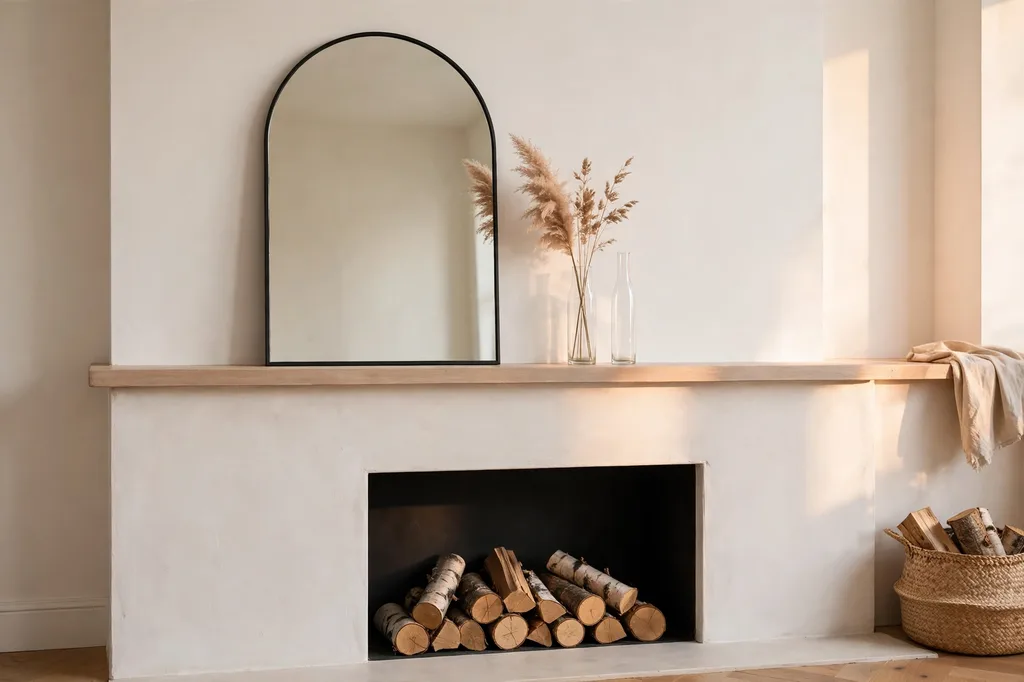
Best for: the focal point, one mirror does the work of five small things.
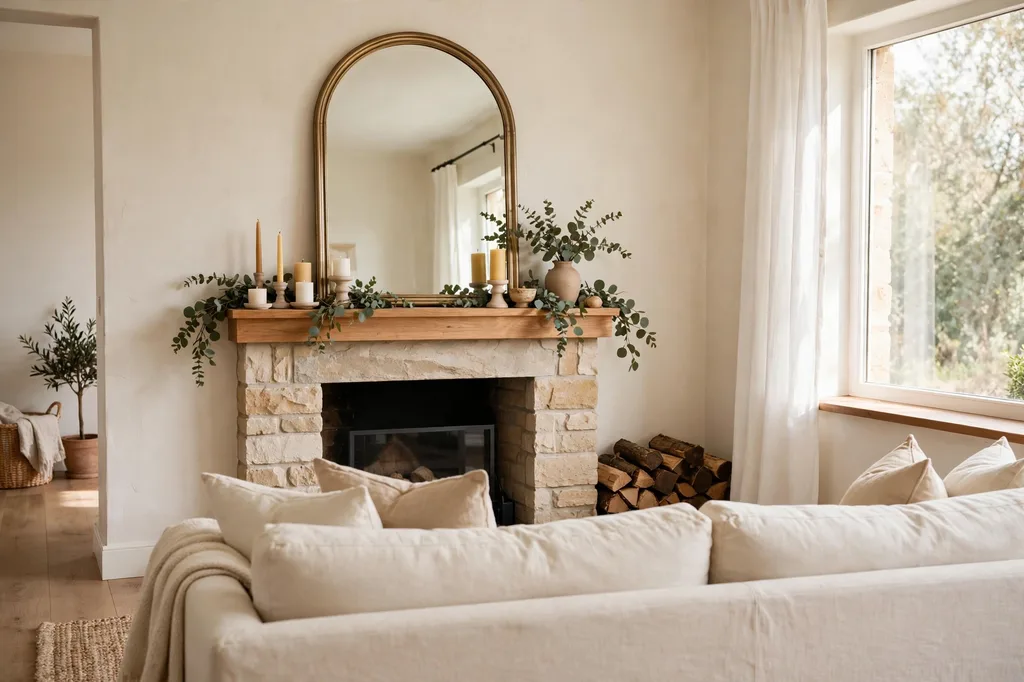
A large mirror is the single best anchor for a small mantel. It fills the vertical space above the shelf, it throws light into the room, and it makes the wall feel twice as wide. An arched mirror 30 to 40 inches tall, leaned against the wall, is the classic small-mantel move, and leaning needs no drilling at all. That single move does more for mantel decor than five small objects ever could.
- Size: the mirror should be about two-thirds of the mantel’s width and 30 to 40 inches tall. A mirror smaller than that looks lost above the shelf; a mirror that covers the whole wall looks like a shop window.
- Position: lean it slightly off-center, an off-center mirror looks designed, a dead-center mirror looks like a hotel. Leave its bottom 4 to 6 inches above the shelf.
- What to watch: do not hang a mirror where it reflects clutter. A mirror above a mantel reflects the ceiling and the window light, that is the point. And do not pair a big mirror with a second big thing. One anchor, then small things. Two anchors fight each other.
Renter note: a leaning mirror is the most renter-friendly anchor there is. It needs no hook, no hole, and no permission. A 30-inch arched mirror costs $40 to $80 secondhand, $80 to $130 new, and it moves with you.
2. Three heights: the triangle
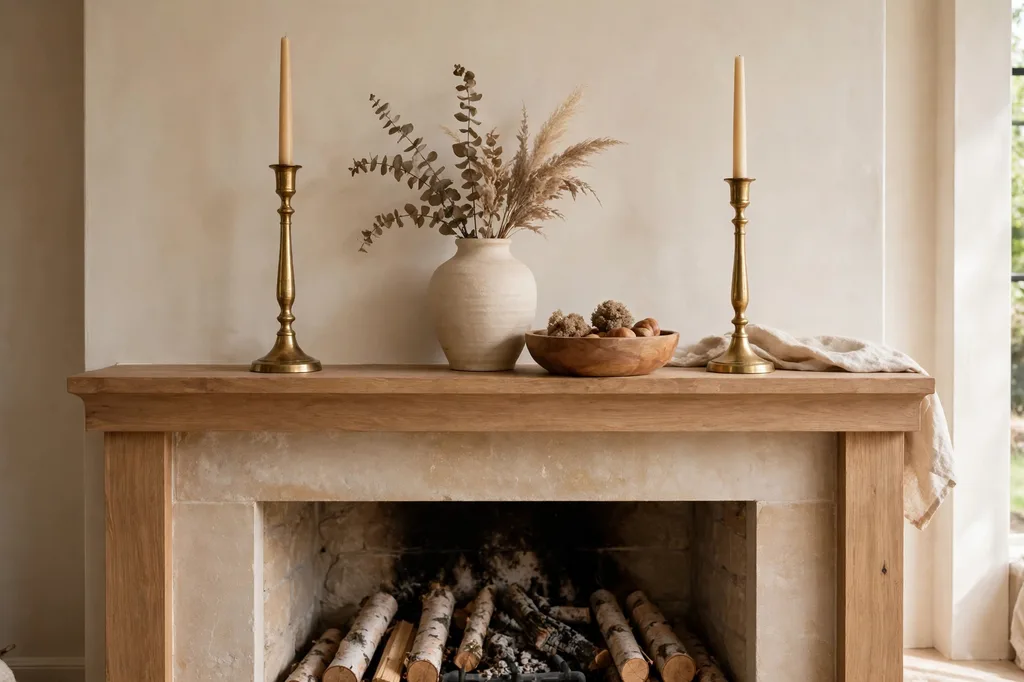
Best for: the shape of the shelf, three heights make a mantel look styled instead of lined up.
A mantel where everything is the same height looks like a shop shelf. A mantel with three heights, tall, medium, low, looks like a designer styled it. Build a visual triangle: one tall piece at the peak (30 to 36 inches high), step down to side pieces at 12 to 18 inches, and finish with one low piece (6 to 8 inches tall) at the front. That triangle is what makes mantel decor look styled instead of stacked.
- Tall: one tall candlestick set (candlesticks 6, 8, and 10 inches), a tall vase with branches, or a slim floor lantern on the hearth. One tall thing, not two, two tall things split the shelf in half.
- Medium: a medium vase (10 to 12 inches), a small stack of books, or a ceramic bowl. The medium piece sits in the middle of the triangle and connects the tall and the low.
- Low: a low bowl, a small tray, or a short candle cluster at the front edge. The low piece keeps the shelf grounded, without it, everything floats.
- What to watch: do not put the tall piece in the center. The center belongs to the anchor mirror. The tall piece goes to one side, the low cluster to the other, and the triangle leans, that is what makes it look relaxed instead of formal.
Budget: a set of three candlesticks costs $15 to $30. A medium vase costs $15 to $25. A low bowl costs $10 to $20. Three heights cost less than one big statement piece, and they look better.
3. Candles and warm light
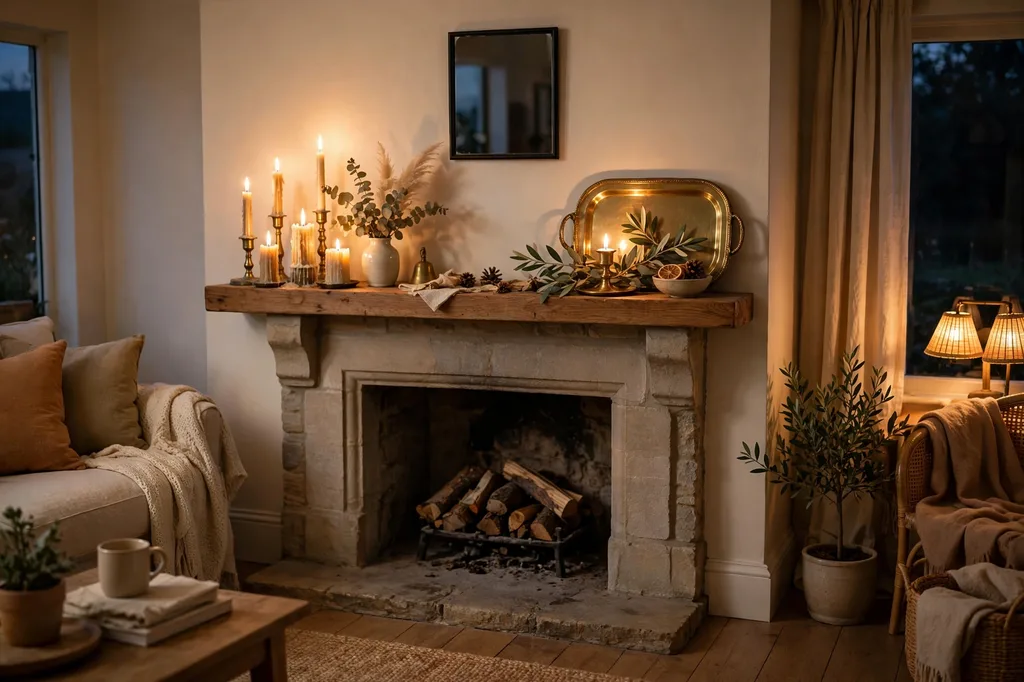
Best for: the mood of the room, candlelight is what makes a mantel feel like a fireplace, even when the fire is off.
Candles are the cheapest warmth on a mantel, and the most forgiving. A cluster of three candles in a row (6 to 8 inches tall) is the hygge signature, and a brass or wooden tray underneath them keeps wax off the shelf. Warm light (2700K) is the rule, cool white light on a mantel makes the whole wall look grey. A little glow goes a long way in mantel decor, especially in a small room.
- Real or flameless: real candles need glass hurricanes and the 12-inch firebox clearance. Flameless LED candles need nothing, they are safe with children and pets, and they cost $10 to $15 for a set of three. In a rental with a working fire, flameless is the honest choice.
- Picture light: a plug-in or rechargeable picture light above the mirror ($45 to $120) makes the mantel glow in the evening. Rechargeable versions are great in rentals, no wiring, no drilling, and they move with you.
- What to watch: do not put candles directly on a wood mantel without a tray or a hurricane, wax stains, and heat marks the wood. And do not mix warm and cool bulbs in one room. One cool bulb undoes three warm ones.
Budget: three LED candles cost $10 to $15. A brass tray costs $15 to $25. A rechargeable picture light costs $45 to $80. Candlelight is the cheapest evening in this guide.
4. Greenery: eucalyptus and trailing plants
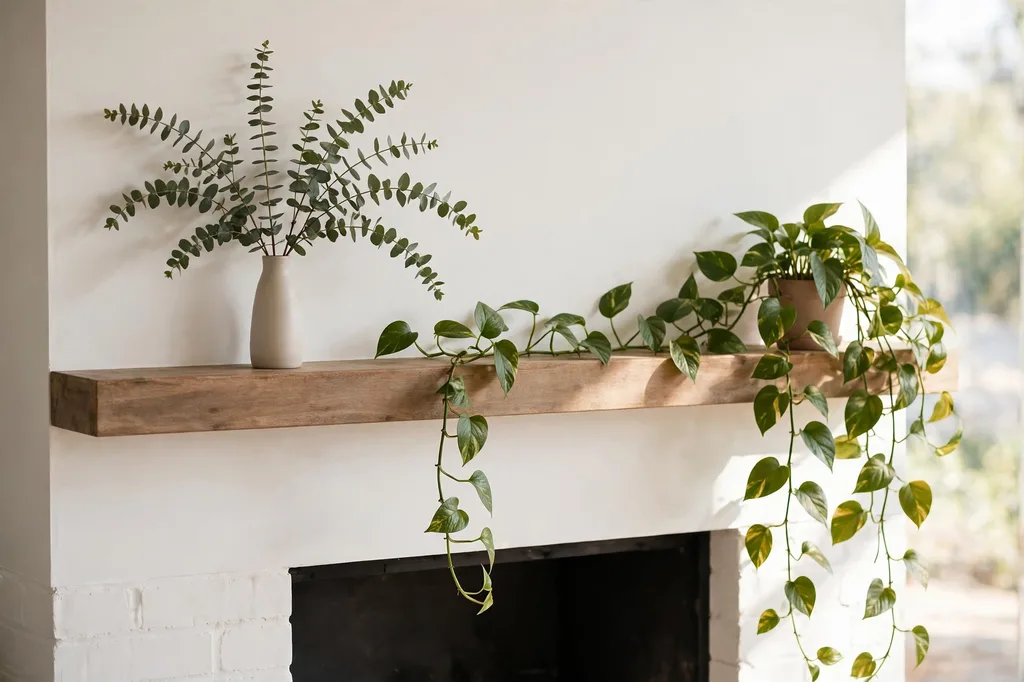
Best for: the life of the shelf, greenery is the only soft thing on a hard mantel.
A mantel without greenery is a shelf of hard objects. One branch of eucalyptus, one trailing plant, or one small potted plant softens every edge and adds the green that balances all the wood and brass. The rule is one variety, not five: one kind of greenery, used twice, looks intentional. Five kinds look like a garden center. One soft branch keeps mantel decor from feeling stiff or staged.
- Eucalyptus: a bunch of dried eucalyptus in a slim vase (12 to 18 inches tall) lasts for months with no water at all. It costs $8 to $15 and it never dies.
- Trailing plant: a pothos or ivy in a small pot on one end of the mantel, trailing down 12 to 18 inches. It softens the hard edge of the shelf and pulls the eye down to the firebox. Keep it at least 12 inches from the firebox opening.
- Garland: a spare garland along the front edge of the shelf, one strand, not three. Choose a garland a foot or two longer than the mantel so the ends drape past the corners. A fuller look comes from layering two strands of the same green, not from adding decorations.
- What to watch: do not use dried foliage near a working fire. Dried eucalyptus, dried garland, and dried branches are flammable, keep them 12 inches from the firebox, or use them only when the fire is off. And do not let a trailing plant cover the mirror. Greenery frames the anchor; it does not hide it.
Budget: eucalyptus costs $8 to $15. A trailing pothos costs $10 to $20. A spare garland costs $15 to $30. Greenery is the cheapest life in this guide.
5. Layered art: lean, don’t hang
Best for: the depth of the shelf, layered art makes a flat mantel look three-dimensional.
Layering is the difference between a mantel that looks decorated and a mantel that looks flat. Put a smaller frame in front of a larger one, a slim vase in front of the mirror, a small print leaning against a big one. Each layer adds depth, and the whole shelf reads as curated instead of lined up. Layering is also the fastest way to give mantel decor real depth.
- How to layer: the big piece (mirror or large art) goes at the back, against the wall. A medium frame (8 by 10 inches) leans in front of it, slightly off-center. A small object, a bud vase, a tiny frame (5 by 7 inches), sits in front of that. Three layers is the maximum. Four layers is clutter.
- Lean, don’t hang: leaning art on a mantel needs no nail, no hook, and no permission. A leaning frame only needs about 1.5 inches of shelf depth. On a shallow ledge (under 5 inches deep), leaning is the only option that works.
- What to watch: do not layer two pieces of the same size. Layering works when each piece is clearly bigger or smaller than the one behind it. Two same-size frames side by side are not layering, they are a pair, and a pair needs symmetry to work.
Budget: a 5 by 7 frame costs $5 to $10. An 8 by 10 frame costs $8 to $15. A printable art print costs $5 to $10. Layered art is the cheapest depth in this guide, and most of it you already own.
6. Books as risers
Best for: the height problem, books lift small things to the right height for free.
Books are the mantel’s secret tool. A stack of two or three books (6 to 8 inches tall when stacked) lifts a small vase, a candle, or a bowl to the height it needs to be, and it adds color and texture at the same time. Vintage books, books with the spine turned in, books in your accent color, all of them work, and all of them are free if you already own them. A book stack is the cheapest riser in all of mantel decor.
- How to stack: two or three books, largest at the bottom, smallest on top. The stack should be 6 to 8 inches tall, tall enough to lift the object, short enough not to dominate the shelf.
- What to put on top: one small thing, a bud vase, a short candle, a tiny ceramic. One thing per stack. Two things on one stack look crowded.
- What to watch: do not use books as a filler. A stack of books with nothing on it is a pile, not a riser. And do not use books that matter to you near a working fire, heat and soot damage paper. Use books you can replace.
Budget: free, if you shop your own shelves. A secondhand stack costs $5 to $10 at a thrift store. Books are the only free height in this guide.
7. One base, four seasons
Best for: the whole year, one permanent structure, four cheap seasonal swaps.
A mantel does not need a full redesign four times a year. It needs one permanent base, the mirror, the candlesticks, the books, and one seasonal swap: pumpkins in fall, greenery at Christmas, fresh branches in spring, a bowl of shells in summer. Small changes in color and texture work better than a complete redesign each time. Keeping that base fixed is what makes seasonal mantel decor affordable.
- The base (never changes): the anchor mirror, the tall candlestick set, the book stack. These stay all year.
- The swap (changes each season): one seasonal object and one seasonal color. Fall: amber bottles and dried leaves. Winter: pinecones and evergreen. Spring: fresh branches and pale ceramics. Summer: a bowl of shells and light linen.
- What to watch: do not buy a full seasonal set. One seasonal object, swapped four times a year, costs $10 to $20 per season. A full set costs $50 to $100 per season and fills a closet. The base is the investment; the season is the accent.
Budget: one seasonal swap costs $10 to $20. Four swaps a year cost $40 to $80, less than one full redesign, and the mantel never looks tired.
8. The firebox and the hearth
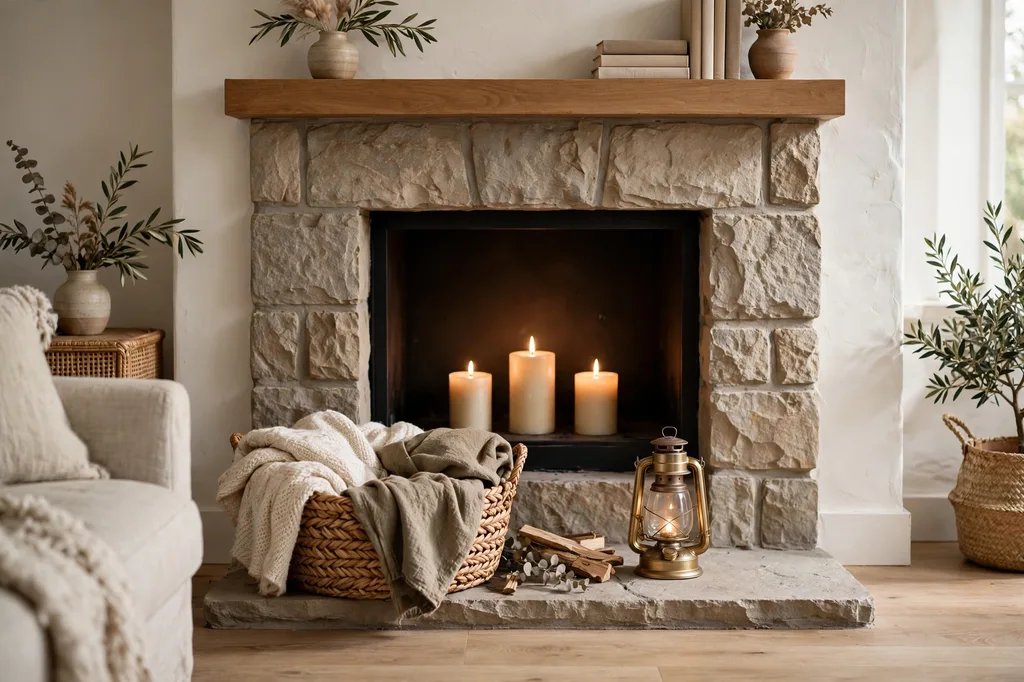
Best for: the space below the mantel, the firebox and hearth are part of the mantel, not separate from it.
A mantel does not end at the shelf. The firebox and the hearth below it are part of the same wall, and in a small room they eat floor space if they are styled badly. If you never light the fire, the firebox is free display space: pillar candles, a stack of birch logs, or a lantern inside it. If you do light it, keep it clear and keep everything flammable 12 inches away. The shelf and the hearth belong to the same mantel decor story — see the NFPA’s home fire safety guidance.
- Unused firebox: three pillar candles of different heights (6, 8, and 10 inches) inside the firebox, or a stack of birch logs, or one lantern with a flameless candle. Without heat or soot, fabric and paper are safe inside it.
- Hearth: one low thing on the hearth, a floor basket with throws, a lantern (20 to 28 inches tall), or a small stool. One thing, not three. The hearth is floor space, and floor space is the scarcest thing in a small living room.
- What to watch: do not put anything in a working firebox. No candles, no logs for display, no fabric. A working firebox is for fire only. And do not put a tall object on the hearth in the walkway, it will be knocked over within a month.
Budget: three pillar candles cost $10 to $20. A floor basket costs $15 to $25. A lantern costs $15 to $30. The firebox is free space, use it.
Small living room layout: the fireplace wall
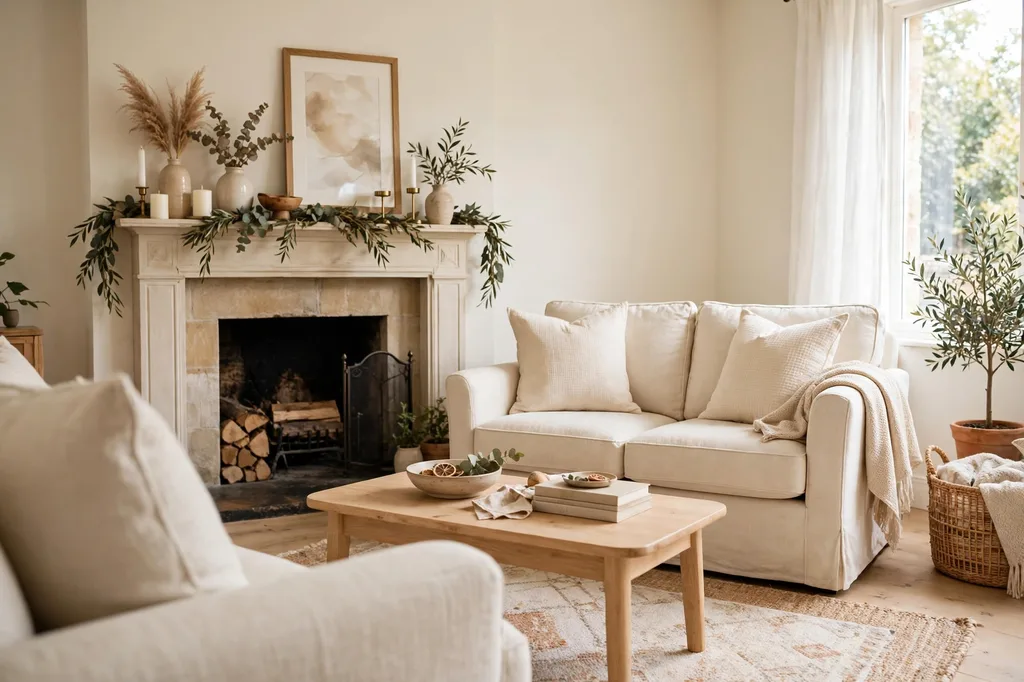
Best for: the whole room, where the mantel sits in a 10 by 12 foot living room.
A mantel is often the only fireplace wall in a small rental, so it competes with the TV, the sofa sightline, and the walking route. That conflict is the whole problem, and the layout has to solve it. In a room this small, mantel decor has to share the wall, not fight it.
- Sofa: the sofa goes opposite the fireplace wall, 8 to 10 feet from the firebox, far enough to see the mantel, close enough to feel the heat. A loveseat 52 to 58 inches wide fits a 10-foot wall; a full three-seater crowds it.
- TV: if the TV goes above the mantel, keep the decor low and asymmetrical, one tall item on one side, a short cluster on the other, and keep everything at least 2 inches clear of the TV’s remote sensor. If the TV goes on another wall, the mantel gets the mirror and the full three heights.
- Walkway: leave 30 inches of walking space between the sofa and the coffee table, and keep the hearth clear. The hearth is not a shelf, anything on it must be low and out of the traffic line.
- What to watch: a small living room fails when the mantel wall tries to do everything. One wall, one job: the fireplace wall is the focal wall. The TV, the bookshelf, and the gallery wall belong on other walls, or the room has three focal points and none of them works.
Renter-friendly rules for mantel decor
Most mantel decor is renter-friendly by nature, a mantel is styled with movable objects, not with fixtures. The rules are simple, and they are all about what you do NOT do.
- Lean, don’t drill: the mirror leans, the art leans, the frames lean. A leaning mirror needs no hook and no hole. If you must hang something light, use a command strip rated for at least twice the piece’s weight, and only on smooth, fully cured paint.
- Plug-in, don’t hardwire: a plug-in or rechargeable picture light gives you the glow without the electrician. Hardwired sconces are a permanent install, they are the landlord’s decision, not yours.
- Don’t paint the mantel: painting the mantel or the surround is a permanent change. If you want color, use removable wallpaper behind the mantel, or a leaning print in your accent color. The paint is the landlord’s, not yours.
- Removable hooks for garlands and stockings: a garland or a stocking hung from a removable hook comes down cleanly. A nail leaves a hole. Use the hook, and test one first, adhesives struggle on textured walls, and they need 24 to 48 hours to cure before you hang anything heavy on them.
- No fireplace? No problem: if your rental has no fireplace, style a console table, a sideboard, or a wall shelf the same way, mirror, three heights, candles, under a mirror or a print. The mantel is a shelf with a focal point; any shelf can be one.
Mantel decor under $150
Best for: the whole mantel, every idea in this guide, added up.
| Item | Cost |
|---|---|
| Arched mirror, 30 in (secondhand) | $40–$80 |
| Three LED candles + brass tray | $25–$40 |
| Eucalyptus bunch + slim vase | $15–$25 |
| Two frames (5×7 + 8×10) + prints | $18–$35 |
| Three candlesticks | $15–$30 |
| Total | $113–$210 |
That is over $150 at the top end, so here is the honest version. If the budget is strictly under $150, buy the mirror and the candles first ($65–$120), use books and frames you already own for the rest, and add the eucalyptus and the candlesticks next month. A mantel styled in two rounds looks better than one styled in one rushed round, because the second round is the one where you know what the shelf actually needs. Trimming the list is how mantel decor stays under $150 without looking cheap.
The free ideas: taking three things off the mantel, leaning a mirror you already own, and stacking books you already own cost nothing, and they change the shelf more than any purchase. Mantel styling starts with taking things away, not adding them.
5 mistakes to avoid
1. Overcrowding the shelf. A small mantel with ten things on it looks smaller than an empty one. If it feels cluttered, remove a few items, go for intentional groupings and leave breathing space. One anchor, three heights, and empty space is the whole recipe.
2. An anchor that is too small. A mirror narrower than two-thirds of the mantel’s width looks stranded. Measure first: the anchor should be about two-thirds of the mantel’s width. A small mirror above a wide mantel is the single most common mantel mistake.
3. Cool white light. Cool white bulbs (4000K and up) make a white wall look grey and the wood look cold. Warm light (2700K) everywhere, or the mantel glows and the room does not.
4. Flammable things near the firebox. Dried foliage, garlands, and stockings within 12 inches of a working firebox are a fire risk. Use flameless candles, keep the clearance, and never hang stockings above a lit fire.
5. Painting or drilling without permission. Painting the mantel, mounting sconces, or drilling for floating shelves are permanent changes. In a rental, they are the landlord’s decision. Lean, plug in, and use removable hooks, everything in this guide moves with you.
FAQ
What is the “rule of three” in mantel styling?
It is the practice of grouping decor in odd numbers, typically a tall, a medium, and a low item, arranged to form a visual triangle. Odd-numbered groupings read as more balanced to the eye than even ones.
How wide should my anchor piece be?
Roughly two-thirds of the mantel’s width. Narrower pieces tend to look stranded, while the two-thirds proportion keeps the display from looking top-heavy or sparse.
How do I decorate a mantel with a mounted TV?
Use an asymmetrical arrangement, a taller item on one side and a shorter cluster on the other, keep decor low-profile near the screen, and keep everything at least 2 inches clear of the TV’s remote sensor.
Is a mantel mirror required?
Not necessary. Art, a wreath, or even a grouping of smaller frames works. Mirrors just add light and reflection, which is why they are the most common anchor in a small room.
Am I over-styling my mantel?
If it feels cluttered, remove a few items, go for intentional groupings and leave breathing space. An edited mantel reads as intentional; a full one reads as a shelf.
Can I leave my mantel up year-round?
Absolutely. Keep one permanent base, the mirror, the candlesticks, the books, and swap only the seasonal accents, like pumpkins in fall or greenery at Christmas, to keep it fresh all year. That is the whole trick of low-effort mantel decor.
Is mantel styling a good idea for a rental?
Yes, especially if you rely on movable pieces instead of built-ins. Lean the mirror, use plug-in or rechargeable picture lights, and hang garlands from removable hooks. Everything in this guide moves with you when you leave.
Start today
Mantel decor does not need a shopping trip, it needs an edit. Take three things off the mantel, lean a mirror against the wall, and put three candles in a row. That is the whole first round, and it takes an afternoon.
Start by taking away. The shelf will tell you what it needs next.