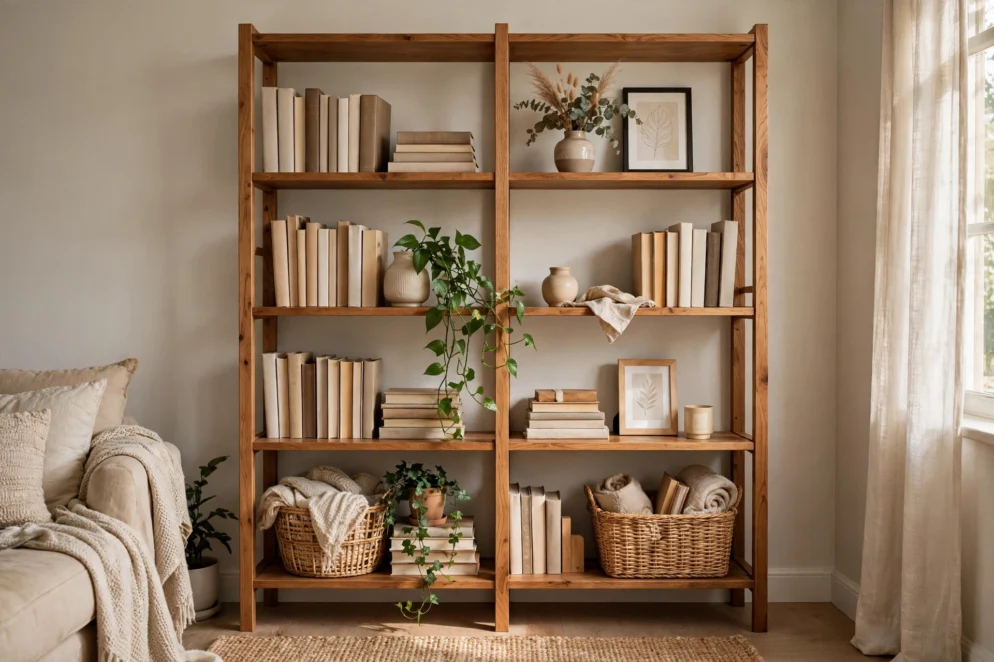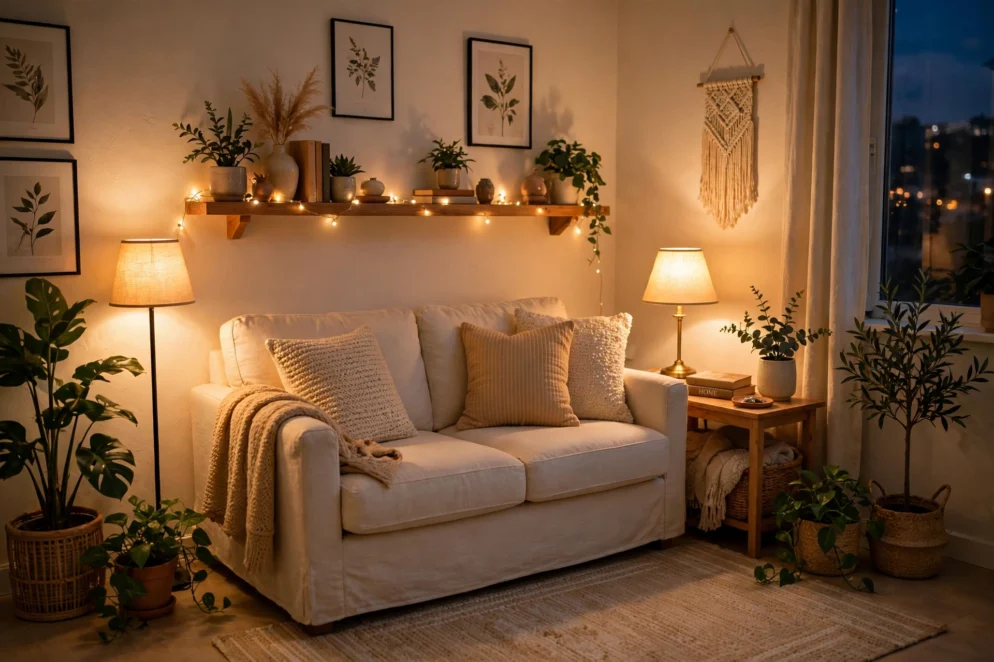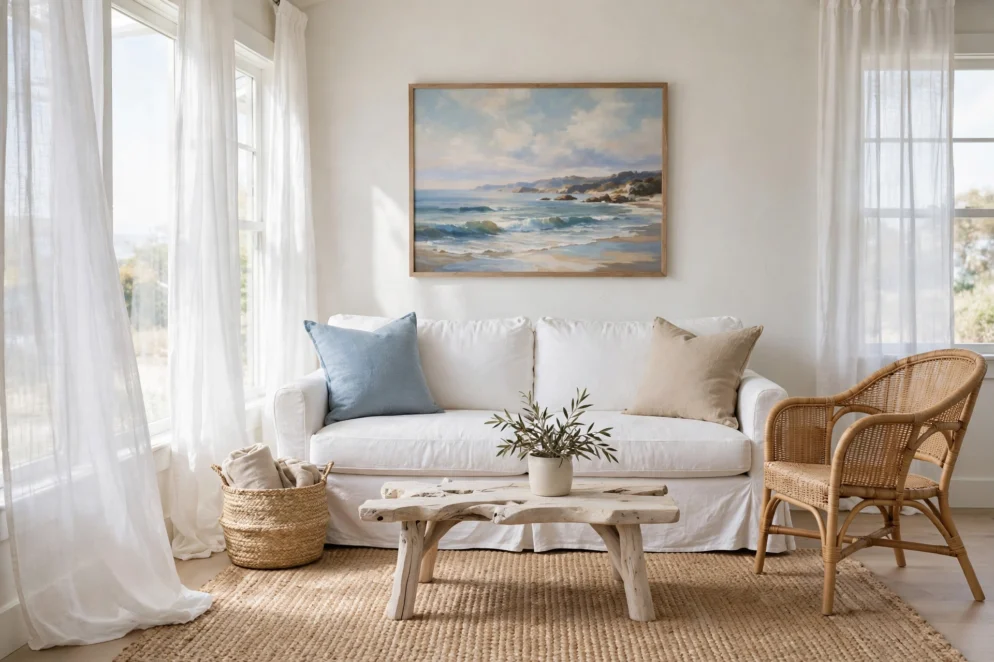
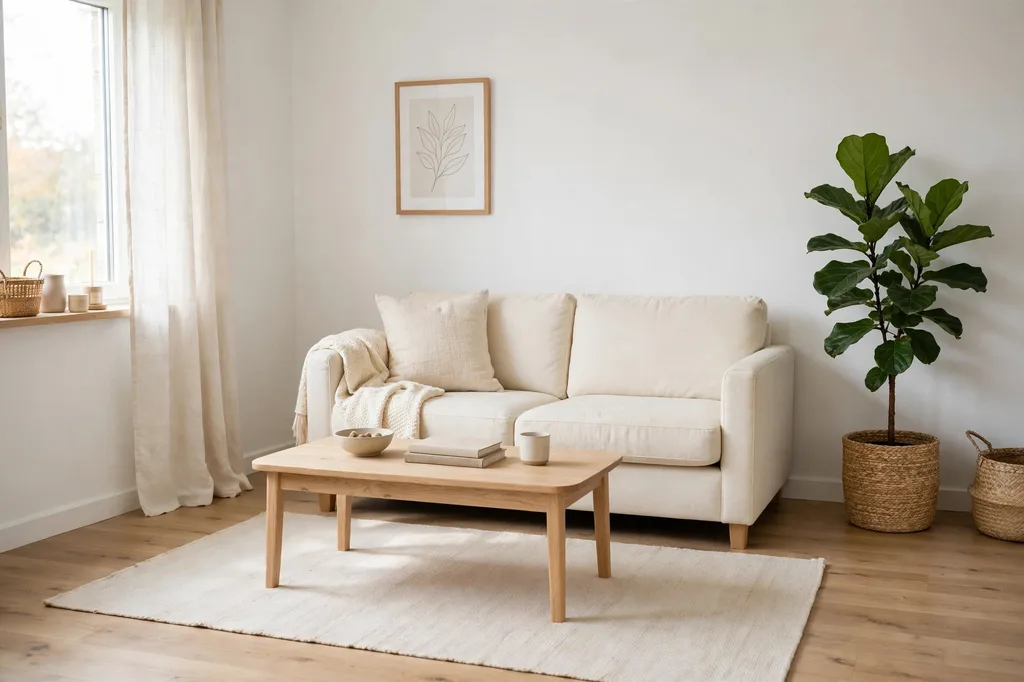
Scandinavian interior decor works best in a small living room when it starts with light, not with shopping. A small room does not need more things, it needs white walls, light wood, one soft rug, and warm light. That is the whole secret: Scandinavian style is not a look you buy, it is a room you edit until only the useful and the beautiful are left.
This guide gives you 8 scandinavian living room ideas with exact measurements for each one: how big the rug should be, how high the art goes, how far the sofa sits from the coffee table, and what it all costs. Every idea is renter-friendly, no drilling, no paint, nothing permanent, and the whole room comes in at $148–$262. Every idea below follows the same Scandinavian interior decor rules: light, wood, and warmth.
Table of Contents
The numbers first
Best for: every idea in this guide, measure before you buy anything.
Four numbers decide whether a scandinavian interior decor plan works in a small room:
- Walkway: leave at least 30 inches of walking space between the sofa and the coffee table zone and the TV wall. 36 inches feels comfortable if the room allows it. The main path from the door to the sofa must stay clear.
- Sofa size: the sofa should be about two-thirds of the wall it sits against. On an 8 to 10 foot wall, that means a loveseat 52 to 58 inches wide, not a full three-seater. A sofa deeper than 35 inches eats the walkway in a small room; 32 to 35 inches deep is the honest size.
- Coffee table: 16 to 18 inches high, sitting 14 to 18 inches from the sofa. Closer than 14 inches and you cannot sit down; further than 18 inches and you cannot reach your cup.
- Rug: the rug should be 8 by 10 feet for most small living rooms, with the front legs of the sofa and chairs on it and 12 to 18 inches of bare floor between the rug edge and the walls.
Measure the wall, the walkway, and the door swing before you buy anything. The best wall for the sofa is usually the longest one without a door or a window. In Scandinavian interior decor, measuring first saves the most money.
What is Scandinavian interior decor?
What is scandinavian interior design? It is the design of Denmark, Norway, Sweden, and Finland: white walls, light wood, clean lines, natural materials, and as much daylight as the room can hold, built for long dark winters, which is why warmth matters as much as light. Scandinavian interior decor is the same idea at home scale: simple, functional, and cozy, with nothing in the room that does not earn its place. For background, see Scandinavian design.
Scandinavian vs Nordic, what is the difference? Almost nothing in practice. Nordic is the geography (the five Nordic countries, including Iceland), Scandinavian is the design language of Denmark, Norway, and Sweden. People use the two words for the same style, and Google treats them the same way. In practice, Scandinavian interior decor and Nordic decor mean the same look at home.
Hygge (pronounced “hoo-gah”) is the Danish idea at the heart of the style: cozy comfort, candles, wool throws, warm light, and time spent well at home. Lagom is the Swedish cousin: not too much, not too little, just right. Together they explain the whole style: a room that is calm, warm, and used, not a room that is decorated. Together, hygge and lagom are why Scandinavian interior decor feels calm, not bare.
For the edited version of the same small room, even fewer things, even calmer palette, see Minimalist Living Room Ideas for a Small Room (That Still Feels Warm).
1. Colors: white walls, warm neutrals
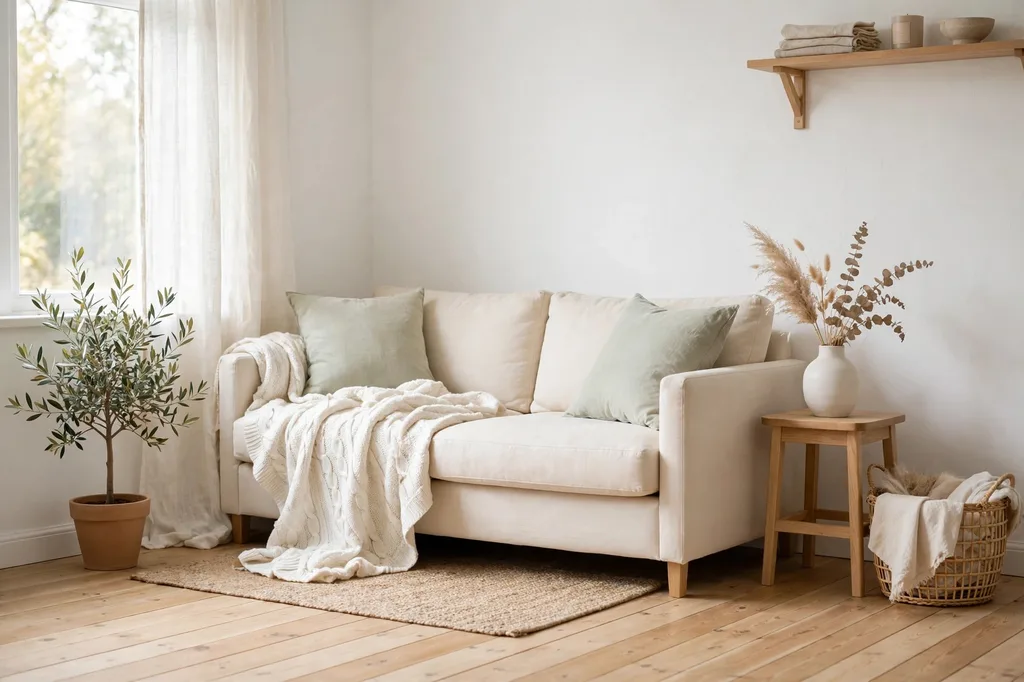
Best for: the first scandinavian living room decision, color sets the room’s light and size.
Scandinavian color is white first, warm neutrals second, and one soft accent last. White walls bounce the daylight around the room; warm neutrals (cream, pale greige, soft sage, light oak) keep the white from feeling cold. The palette rule is 70-20-10: 70% white and pale neutrals, 20% light wood, 10% one soft accent (sage, dusty blue, or pale terracotta). That 70-20-10 balance is the simplest Scandinavian interior decor rule to remember.
- Walls: white or warm white. If you rent and cannot paint, the walls stay as they are, and the lightness comes from the sofa, the rug, and the curtains instead. A white slipcover on a dark sofa does more than any paint color.
- Sofa: a white, cream, or light grey sofa is the Scandinavian base. It reflects light into the room and lets the wood and the textiles do the talking. A dark sofa makes a small Scandinavian room feel heavy and small.
- Accent color: pick one soft accent and use it three times, a cushion, a throw, and one small thing (a plant pot, a book, a candle). One accent used three times looks intentional. Three accents used once each looks like a sale.
- What to watch: do not use more than one accent color in a small Scandinavian living room. White, light wood, and one soft accent is the whole palette. A second strong color breaks the calm, and calm is the one thing Scandinavian style must not lose in a small room.
Renter note: color without paint is easy in a Scandinavian room, a cream slipcover, a pale rug, and white linen curtains are all lightness, and all of them move with you. A white throw alone can change the room’s whole mood, even against plain beige walls. That is Scandinavian interior decor without paint: light surfaces doing the work.
2. Light wood: floors and furniture
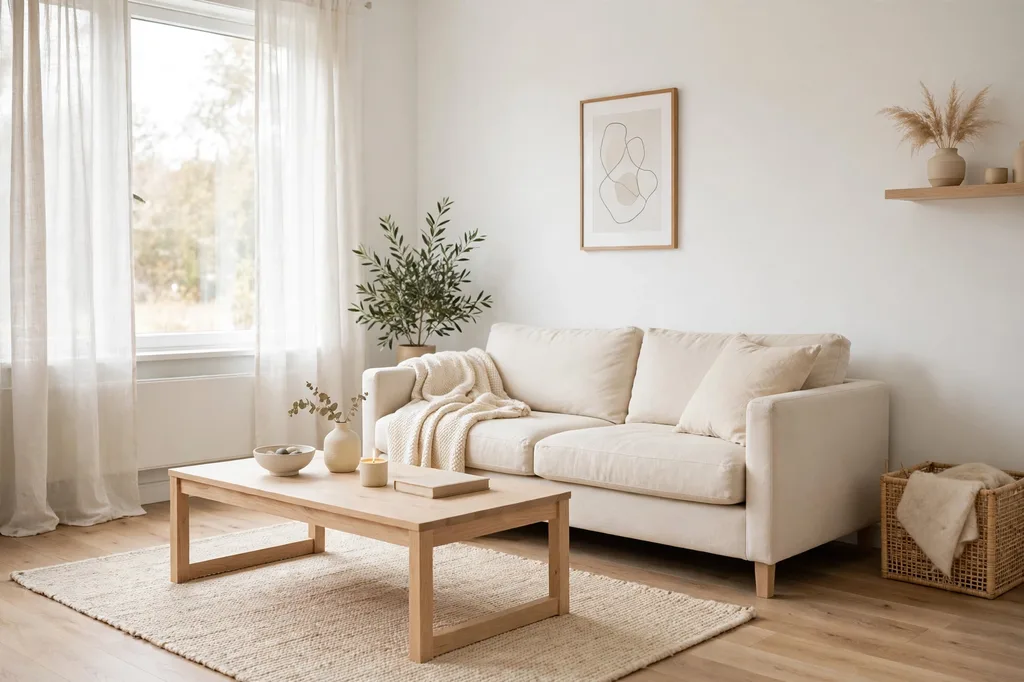
Best for: the warmth of the room, light wood is what keeps a white room from feeling cold.
A Scandinavian room without light wood is just a white room. Oak, birch, pine, and ash, pale, matte, and natural, bring the warmth that white walls cannot. The rule: wood should look like wood, not like plastic. Matte finish, visible grain, no dark stain. Without it, Scandinavian interior decor loses its warmth and looks unfinished.
- Floors: light wood floors are the Scandinavian foundation. If your floor is dark wood or carpet you cannot change, cover it: a pale flatweave rug 8 by 10 feet does the job of a light floor for the price of a rug.
- Coffee table: a light oak or birch coffee table, 16 to 18 inches high, round or rectangular with clean lines. A round table 30 to 36 inches across has no corners to bruise shins on in a small room.
- Side table and shelves: one light wood side table (18 inches wide) and one open shelf in pale wood. Open shelving shows the wood and keeps the wall light, a closed cabinet in a small room is a wall of furniture.
- What to watch: do not mix more than two wood tones in one room. Light oak plus pale birch works; light oak plus dark walnut plus grey wash does not. One wood family, used three times (floor, table, shelf), is the Scandinavian way.
Budget: a light wood-look coffee table costs $40 to $80 secondhand, $80 to $150 new. A pale flatweave rug 8 by 10 feet costs $40 to $80. Light wood is the biggest single visual change in this guide, it warms the whole room at once. In Scandinavian interior decor, light wood does more than paint ever could.
3. Cozy textiles: wool, linen, sheepskin
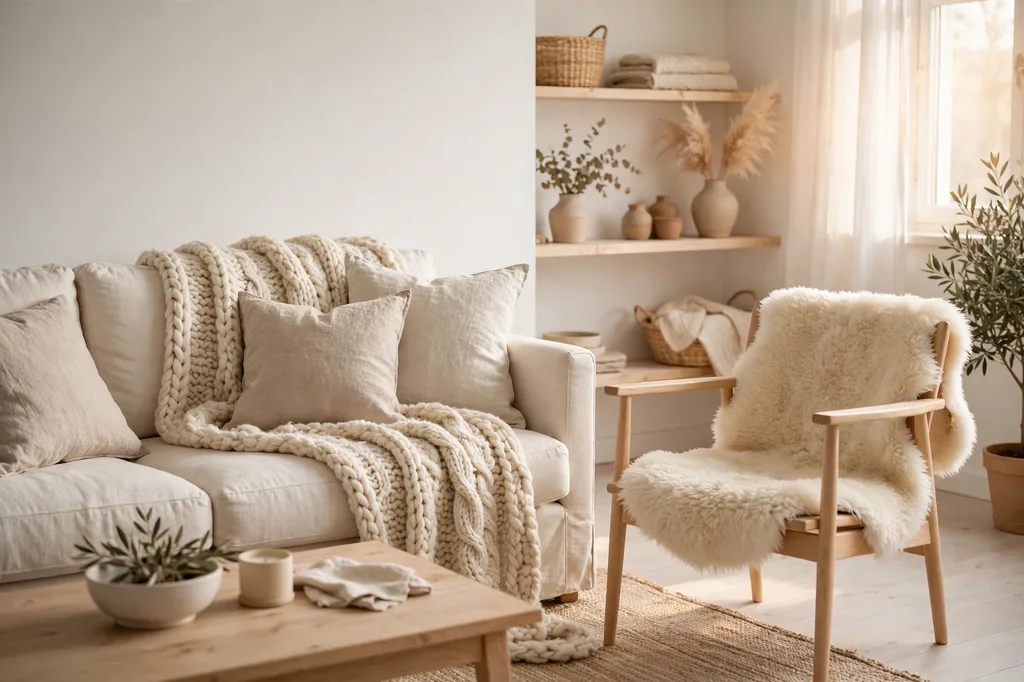
Best for: the comfort of the room, textiles are where Scandinavian warmth lives.
Scandinavian rooms are white and wood, which can feel cold. Textiles fix that: a wool throw, linen cushions, and a sheepskin on the chair make the room feel warm to the touch, not just warm to the eye. The rule is layers, not piles: three textures, not ten. That is why Scandinavian interior decor always layers wool, linen, and sheepskin.
- Throw: one wool or wool-look throw, 50 by 60 inches, folded over the arm of the sofa or across the foot of a chair. A throw is the cheapest warmth in the room, it changes how the sofa feels the moment you sit down.
- Cushions: two linen cushions, 18 by 18 inches each, in your accent color (sage, dusty blue, or pale terracotta). Two is enough. Four cushions on a small sofa crowd it.
- Sheepskin: one sheepskin (or faux sheepskin) draped over the armchair or the reading chair, 2 by 3 feet. It is the single most Scandinavian object there is, soft, warm, and visibly natural. A faux sheepskin costs $15 to $30 and looks the same from across the room.
- What to watch: do not cover every surface with textiles. One throw, two cushions, one sheepskin, that is the whole recipe. More than that and the room looks like a bedding shop, not a living room.
Budget: a wool-look throw costs $20 to $35. Two linen cushions cost $15 to $25. A faux sheepskin costs $15 to $30. Textiles are the best money in this guide, they are the warmth, and they cost less than a side table. For the money, textiles are the best value in Scandinavian interior decor.
4. Layered lighting: warm light, candles
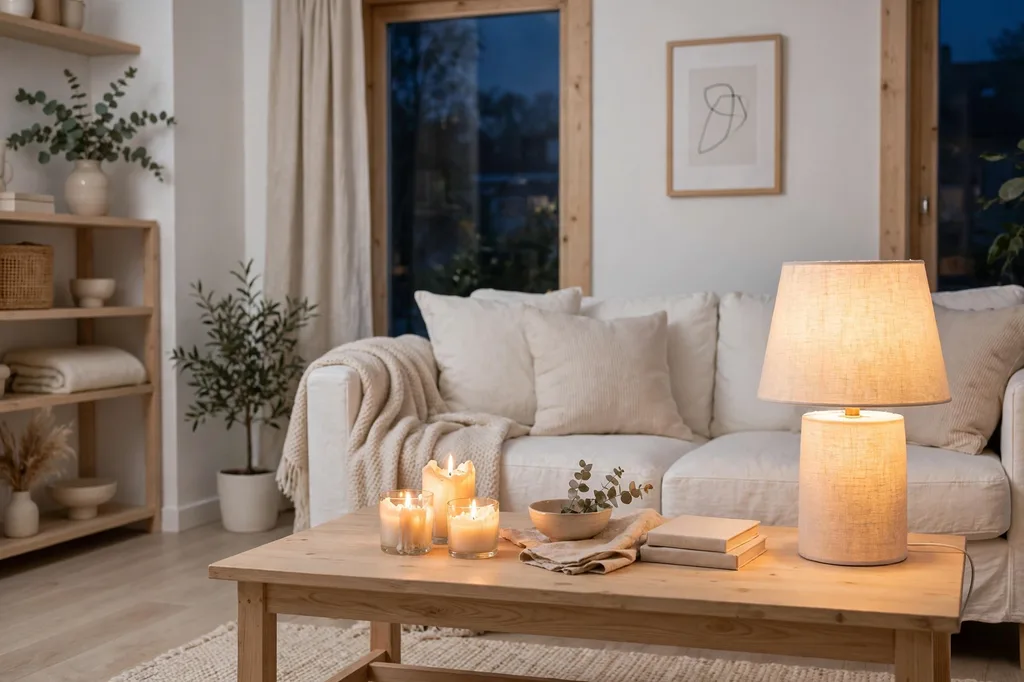
Best for: the mood of the room, light at three heights makes a small Scandinavian living room feel warm, not flat.
Scandinavian design was built for dark winters, so lighting is not an afterthought, it is the style. A small living room with one ceiling light feels flat and cold. A Scandinavian room with light at three heights feels warm and finished, even on the darkest evening. The three heights: In Scandinavian interior decor, lighting is part of the design, not decoration.
- Low: candles, real or flameless LED, on the coffee table and the windowsill. Three candles in a row (6 to 8 inches tall) are the hygge signature, and they cost almost nothing. A set of three LED candles costs $10 to $15 and is safe with children and pets.
- Table: a lamp on the side table, warm light (2700K to 3000K), with a white linen or paper shade 10 to 12 inches tall. The lamp should be 24 to 27 inches tall in total, tall enough to read by, short enough not to dominate the table.
- High: the ceiling light or a paper pendant. Warm light (2700K to 3000K), not cool white. Cool white light (4000K and up) makes a white room feel like a hospital, it kills every warm tone in the room.
The rule: warm light in a Scandinavian living room, always. 2700K to 3000K is the range, it is the color of candlelight, and it makes white walls glow instead of glare. Warm light is the rule in Scandinavian interior decor, always.
What to watch: do not use a bare bulb. A bare bulb in a small white room throws hard shadows and makes the room feel unfinished. A shade, a paper cover, or a frosted bulb is the minimum. And do not mix warm and cool bulbs in one room, one cool bulb undoes three warm ones.
5. Rugs: wool and flatweave
Best for: the floor, a rug is what makes a white Scandinavian room feel like a room instead of a gallery.
A Scandinavian rug is pale, flat, and natural: a wool rug, a cotton flatweave, or a jute-look base. It warms the floor, defines the seating zone, and softens every footstep. The rule is the same as any small room: the rug must fit the sofa, not the other way round. A pale rug grounds Scandinavian interior decor in a small room.
- Size: the rug should be 8 by 10 feet for most small living rooms, with the front legs of the sofa and chairs on it and 12 to 18 inches of bare floor between the rug edge and the walls. A rug that only sticks out 6 inches past the sofa looks like a mistake.
- Color: cream, pale greige, or natural wool white. A pale rug in a Scandinavian room does two jobs: it warms the floor and it bounces light up into the room. A dark rug makes the floor feel heavy and the room feel smaller.
- Texture: flatweave or low-pile wool. High-pile shag in a Scandinavian room looks wrong, the style is flat, clean, and calm. A flatweave rug is also the easiest to clean, which matters in a room with white everywhere.
- What to watch: a rug that is too small is worse than no rug at all. If the budget only covers a small rug, buy a runner for one side of the sofa instead, a runner 24 inches wide and 60 inches long beside the sofa is better than a small rug floating in the middle of the room.
Budget: a pale flatweave rug 8 by 10 feet costs $40 to $80. A wool-look rug the same size costs $60 to $120. A rug is the biggest single purchase in this guide, and the one that most changes how the room feels underfoot.
6. Plants: fiddle leaf, snake plant, eucalyptus
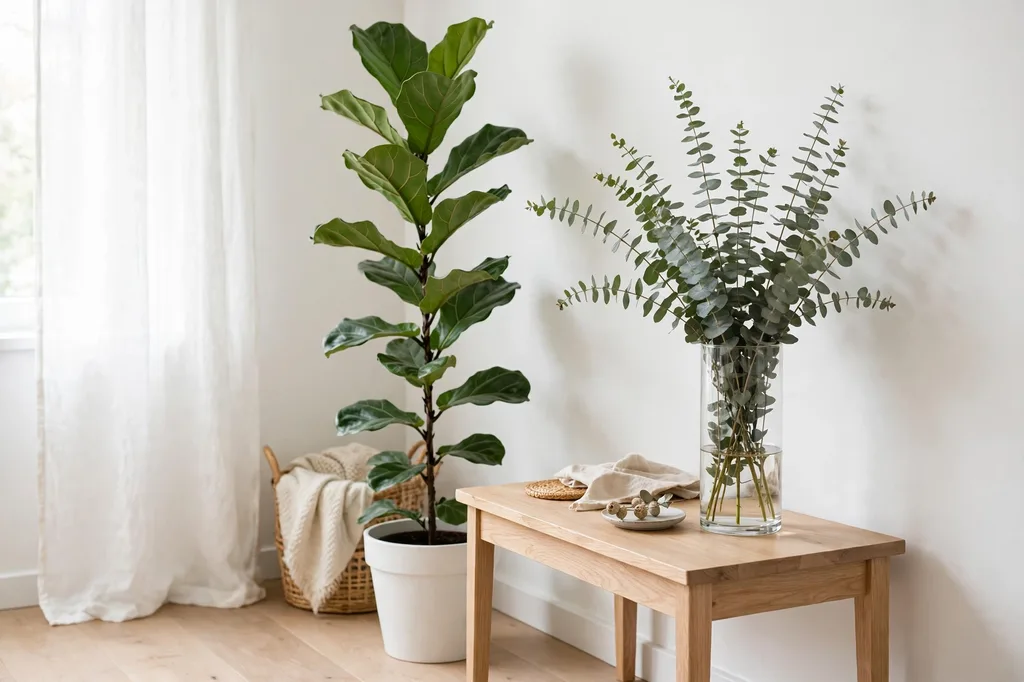
Best for: the life of the room, plants are the only strong green in a white room, and they carry the whole color story.
A Scandinavian room without plants is a white box. Plants bring the green that balances all the white and wood, and they cost almost nothing. The Scandinavian plant rule is simple: one tall plant, one small plant, and eucalyptus in a vase. Without them, Scandinavian interior decor feels flat and unfinished.
- One tall plant: a fiddle leaf fig or a snake plant in a pot 10 to 12 inches wide, in the corner by the sofa or beside the TV wall. A snake plant is the easiest tall plant, it needs almost no light and almost no water.
- One small plant: a small eucalyptus or a baby monstera on the coffee table or the side table, in a pot 4 to 6 inches wide. It adds green at eye level, where you actually see it. Dried eucalyptus in a tall vase (12 to 18 inches tall) lasts for months with no water at all.
- What to watch: do not put a plant where it blocks the window light, and do not buy a plant that needs daily care. A living room plant should survive a week without you. And keep plants out of the walkway, a tall plant in a traffic lane gets knocked over within a month.
Budget: two plants with pots plus a eucalyptus bunch cost $20 to $35 in total. For the life they add to the room, plants are the cheapest decor in this guide.
7. Mirrors and natural light
Best for: the light of the room, a mirror doubles the daylight a small Scandinavian room gets.
Scandinavian design treats light as a building material, and a mirror is the cheapest way to make more of it. One mirror, placed right, throws daylight into the darkest corner of the room and makes the room feel twice as big. In a white room, a mirror does double duty: it reflects light and it reflects white. A mirror is the cheapest light in Scandinavian interior decor.
- Size: a mirror 24 to 36 inches wide, leaning against the wall or hung on a side wall. A mirror smaller than 24 inches wide does not reflect enough to matter.
- Placement: opposite the window, or on the wall beside the window, where it catches the light and throws it back into the room. A mirror facing the sofa reflects the sofa, not the light, and that is a waste.
- Renter-friendly: a large floor mirror leaned against the wall needs no drilling at all. It looks intentionally casual, and it moves with you.
- Curtains: sheer white or pale linen curtains, floor length, on a rod hung 4 to 6 inches above the window frame. Sheer curtains soften the light without blocking it, heavy curtains in a Scandinavian room are a contradiction. A pair costs $20 to $30, a tension rod $8 to $12, no drilling needed.
- What to watch: do not hang a mirror where it reflects clutter. A mirror facing a messy side table doubles the mess. A mirror facing a window doubles the light. Choose the window.
Budget: a leaning floor mirror costs $30 to $50. A small wall mirror costs $15 to $25. For the effect, a room that feels twice as bright, it is the best money in this guide.
8. Hygge corner: a reading nook
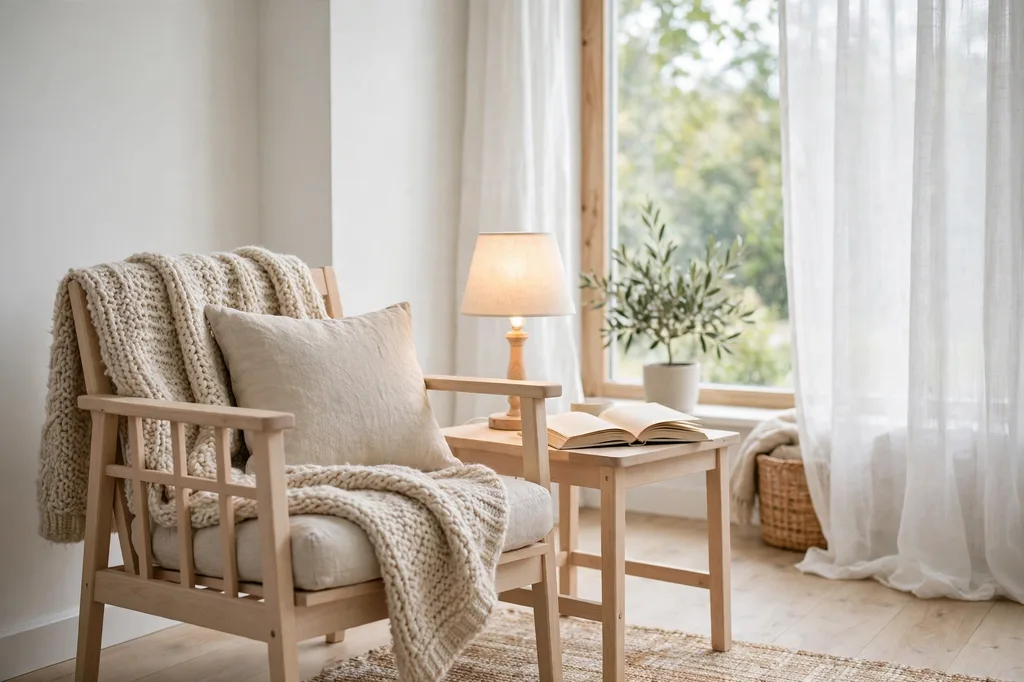
Best for: the soul of the room, a hygge corner is where Scandinavian style stops being a look and starts being a life.
Every Scandinavian living room needs one corner that is for nothing but comfort: a chair, a throw, a lamp, and a book. It is the smallest room in the room, and it is the one people remember. A hygge corner needs no money, it needs a chair and a decision. One quiet corner is enough for Scandinavian interior decor to feel complete.
- Chair: one comfortable armchair, light wood frame, cream or pale grey upholstery, in the corner by the window or beside the bookshelf. It should face into the room, not into the wall.
- Throw and cushion: the wool throw (50 by 60 inches) folded over the chair arm, one linen cushion (18 by 18 inches) in your accent color. The throw is the invitation; without it, the chair is just furniture.
- Lamp: a small warm lamp (2700K) on a side table (18 inches wide) beside the chair, 24 to 27 inches tall. Reading light is the whole point of the corner, without it, the chair is for looking at, not sitting in.
- What to watch: do not put the reading nook in the walkway or in front of the TV. It needs a quiet corner with daylight in the day and lamplight in the evening. And do not fill it with things, a chair, a throw, a lamp, and a book. A nook with five things in it is a storage corner.
Budget: a secondhand armchair costs $30 to $60. A side table costs $15 to $25. The throw and the cushion you already own from Idea 3. A hygge corner is the cheapest idea in this guide, it costs a chair and an afternoon.
Small Scandinavian living room layout: the 10 by 12 plan
Best for: the whole room, where everything goes in a 10 by 12 foot living room.
A small Scandinavian living room needs one rule: the sofa goes on the long wall, the light comes from the window wall, and the middle stays open. Here is the plan for a 10 by 12 foot room: That one rule keeps Scandinavian interior decor calm in a 10 by 12 room.
- Sofa wall (12 foot wall): a loveseat 52 to 58 inches wide, centered, with a 30 to 36 inch walkway on each side. One side table (18 inches wide) on the open side, one floor basket on the other.
- Coffee table: rectangular or round, 30 to 36 inches across, 14 to 18 inches from the sofa. The rug goes under it, 8 by 10 feet, front legs of the sofa on it.
- Window wall: sheer linen curtains, floor length, rod 4 to 6 inches above the frame. The mirror goes on the opposite wall, catching the window light. The reading nook goes in the corner by the window.
- Plants: the tall plant in the corner by the sofa, the small plant on the coffee table, the eucalyptus on the side table.
- What to watch: a small Scandinavian living room fails when the middle fills up. The middle of the room is the walkway and the rug, not a storage zone. If something does not have a wall or a corner, it does not belong in the room. Scandinavian style is the art of the empty space: the empty floor is part of the design.
Renter-friendly rules
Most scandinavian interior decor ideas work for renters without any drilling, Scandinavian style is mostly about things you buy and move, not things you fix to the wall.
- No paint, no problem: lightness comes from the sofa cover, the rug, and the curtains. A white slipcover alone can change the room’s whole mood.
- Command strips: hold a light frame, a small shelf, or a mirror up to 16 pounds with zero damage. Use them for lightweight things only, anything heavy needs a real fixing, and a real fixing is the landlord’s permission, not a strip.
- Tension rods: hold curtains with no drilling. A tension rod inside the window frame needs no holes at all.
- Peel-and-stick wallpaper: one accent wall behind the sofa in pale wood-look or white shiplap-look, $30 to $55 for enough to cover it. It takes about two hours to apply, comes off cleanly when you leave, and the landlord never knows it was there.
- Leaning, not hanging: a leaning mirror, a leaning ladder shelf, and a leaning frame all need no wall at all. They lean, they look intentional, and they move with you.
- Furniture, not fixtures: anything you buy and take with you is renter-friendly. Anything you screw into the wall is not. Choose furniture.
Scandinavian living room under $150
Best for: the whole room, every idea in this guide, added up. It is the cheapest complete Scandinavian interior decor plan in this guide.
| Item | Cost |
|---|---|
| Pale flatweave rug 8×10 ft | $40–$80 |
| Wool-look throw + two linen cushions | $35–$60 |
| Faux sheepskin | $15–$30 |
| Sheer linen curtains + tension rod | $28–$42 |
| Two plants + eucalyptus bunch | $20–$35 |
| Three LED candles | $10–$15 |
| Total | $148–$262 |
That is over $150 at the top end, so here is the honest version. If the budget is strictly under $150, skip the sheepskin and the candles for the first round, and the total is $123–$217, or buy the rug and the throw first ($75–$140), live with it for a month, and add the curtains and the plants next month. A small Scandinavian living room decorated in two rounds looks better than one decorated in one rushed round, because the second round is the one where you know what the room actually needs. Buy the rug and the throw first, and the rest of the Scandinavian interior decor can wait a month.
The free ideas: opening the curtains, taking three things off the coffee table, and moving the sofa to the longest wall cost nothing, and they change the room more than any purchase. Scandinavian style starts with taking things away, not adding them. The free ideas are Scandinavian interior decor at its simplest: light, space, and less.
5 mistakes to avoid
1. Too much stuff. Scandinavian style is the art of the empty space. If every surface has something on it, the room has no place for the eye to rest. Take three things off every surface and the room will look more Scandinavian in one afternoon than any purchase can make it. Empty space is the first rule of Scandinavian interior decor.
2. Cool white light. Cool white bulbs (4000K and up) make a white room feel like a hospital. Warm light (2700K to 3000K) everywhere, or the white walls glare and the wood looks grey.
3. A rug that is too small. A rug that only sticks out 6 inches past the sofa looks like a mistake. A rug should be 8 by 10 feet, with the front legs of the sofa on it, or buy a runner for one side instead.
4. Dark, heavy furniture. A dark wood coffee table or a black sofa in a small Scandinavian room breaks the whole style. Light wood, white, and pale neutrals, dark furniture belongs in another style.
5. Buying everything at once. A small Scandinavian living room decorated in one shopping trip has three things that do not go together. Decorate in order, color, wood, textiles, light, rug, plants, and buy one round at a time.
FAQ
What is Scandinavian design?
Scandinavian design is the design of Denmark, Norway, Sweden, and Finland: white walls, light wood, clean lines, natural materials, and as much daylight as the room can hold. It is simple, functional, and cozy, built for long dark winters, which is why warm light and wool throws matter as much as the white walls.
What colors are best for Scandinavian interiors?
White first, warm neutrals second, one soft accent last, the 70-20-10 rule: 70% white and pale neutrals, 20% light wood, 10% one soft accent like sage, dusty blue, or pale terracotta. More than one strong accent breaks the calm.
What is hygge?
Hygge (pronounced “hoo-gah”) is the Danish idea of cozy comfort, candles, wool throws, warm light, and time spent well at home. In a living room it means a reading corner with a chair, a throw, and a warm lamp: a place built for sitting, not for showing.
Is Scandinavian design good for small apartments?
Yes, it is one of the best styles for a small apartment, because it is built on light colors, mirrors, slim furniture, and empty space. White walls and a mirror opposite the window make a small room feel twice as big, and multi-functional furniture (a pouf, a storage ottoman, a foldable table) does two jobs in the footprint of one. Scandinavian interior decor is built for small apartments, because it is built on light.
Does Scandinavian decor work in a rental where the walls cannot be repainted?
Yes. Lightness comes from the sofa cover, the rug, and the curtains, not from paint. Use command strips for light frames, tension rods for curtains, a leaning mirror instead of a hung one, and peel-and-stick wallpaper for one accent wall. Everything in this guide moves with you when you leave.
How do I make my living room look Scandinavian?
Start with the light: open the curtains, add a mirror opposite the window, and switch every bulb to warm light (2700K to 3000K). Then add the three materials, light wood, wool, and linen, and take three things off every surface. The room will look Scandinavian before you buy anything new.
Start today
Scandinavian interior decor does not need a shopping trip, it needs an edit. Open the curtains, take three things off the coffee table, and put a white throw on the sofa. That is the whole first round, and it takes an afternoon.
Start by taking away. The room will tell you what it needs next.