Modern entryway decor ideas are not about buying a whole new hallway, they are about giving the first three feet inside your door one clear job and then stopping. A small entryway crowded with ten things feels smaller than an empty one. One slim console, one big mirror, and a little breathing room make the whole entrance look designed, and the whole home feel bigger the moment you walk in.
This guide gives you 8 modern entryway ideas with exact measurements: how deep the console should be, how high the mirror goes, where the hooks sit, and what it all costs. Every idea is renter-friendly, lean, stick, and plug in, don’t drill, and the whole entryway comes in under $150. Each of these modern entryway decor ideas is sized for a real small entry, not a showroom.
Table of Contents
The numbers first
Best for: every idea in this guide, measure the entryway before you buy anything.
Six numbers decide whether modern entryway decor ideas work in a small space:
- Walkway clearance: leave at least 36 inches of clear walking space after the furniture is in. 42 inches feels generous. If the console leaves less than 36 inches, the console is too deep, not the hallway too narrow.
- Console depth: a console for a small entryway should be 10 to 12 inches deep, and never more than 14 inches. A standard 16-inch-deep console eats the walkway and turns the entrance into a squeeze.
- Console height: 30 to 36 inches tall is the working range. At 30 inches the surface is a comfortable drop height for keys and mail; above 36 inches it starts to feel like a bar, not a table.
- Console width: 24 to 36 inches wide fits most small entries. Leave at least 6 inches of wall clear on each side so the console reads as one piece, not as a wall of furniture.
- Mirror height: the center of the mirror should sit at 57 to 60 inches from the floor, eye level for most adults. A mirror hung higher than that reflects the ceiling, not the room.
- Hook heights: one row at 50 inches for adults, a second row at 36 inches for kids, or for bags and dog leashes, if there are no kids in the house.
Measure the wall, the depth you can spare, and the door swing before you buy anything. Those three measurements decide which modern entryway decor ideas will actually fit your entry.
For the full picture of what an entryway can do, the pillar this article builds on, see Entryway Decor Ideas for Small Spaces.
What is a modern entryway?
What is a modern entryway? It is an entryway built on clean lines, a limited palette, and furniture that does a job, not on ornament. Think flat surfaces, matte black or warm wood, two or three colors at most, and nothing that exists only to fill space. Modern is not the same as cold: the warmth comes from wood, woven texture, and warm light, not from more objects. That restraint is what makes modern entryway decor ideas feel calm instead of bare.
Modern vs. traditional: a traditional entryway layers moldings, ornate frames, and matched sets. A modern entryway does the opposite, one console, one mirror, one bench, each with a straight silhouette, and the wall mostly empty. People search for this look a dozen ways, modern entryway ideas, entryway ideas modern, entryway decor ideas modern, but the intent is the same: a clean, functional entrance that fits a small space. For a hallway under 42 inches wide, the same search becomes small entryway ideas modern or small modern entryway ideas, same plan, smaller furniture. The contrast is the quickest way to judge modern entryway decor ideas: fewer pieces, each one earning its place.
The modern palette: white or warm-white walls, black metal, light or medium wood, and one accent, sage, terracotta, or navy. Two or three colors in total. A fourth color is where a small entryway starts to look busy, and a busy entryway is the opposite of modern. That restraint is what makes entryway decor modern rather than merely decorated.
The materials: matte black metal, light oak or walnut, woven seagrass or jute, ceramic, and glass. Mixed materials are the modern signature, black metal with warm wood, a woven basket under a lacquered console, but one finish per job: black for the hooks, wood for the bench, ceramic for the tray. Those materials are the backbone of most modern entryway decor ideas, because they stay quiet and let the shape do the work.
Style notes, mid-century modern and modern farmhouse: a mid century modern entryway is one version of this look, not a different project: tapered legs on the bench, a walnut console, a sunburst or round mirror, and warm wood against white walls. A modern farmhouse entryway is the same plan with softer edges, a reclaimed-wood bench, black metal hooks, and woven baskets instead of lacquer, and farmhouse entryway decor ideas fit the same numbers in this guide, just with softer finishes. Both use the same numbers in this guide; only the finishes change. The same calm, edited approach works across the whole home, for the modern, minimalist angle in the living room, see Minimalist Living Room Ideas for a Small Room.
What modern is not: maximalism, bold pattern on every surface, or a gallery wall of twelve frames in a three-foot hallway. Those looks need space. A small entryway needs editing. Knowing what to leave out is half of getting modern entryway decor ideas right.
1. One slim console, not a deep one
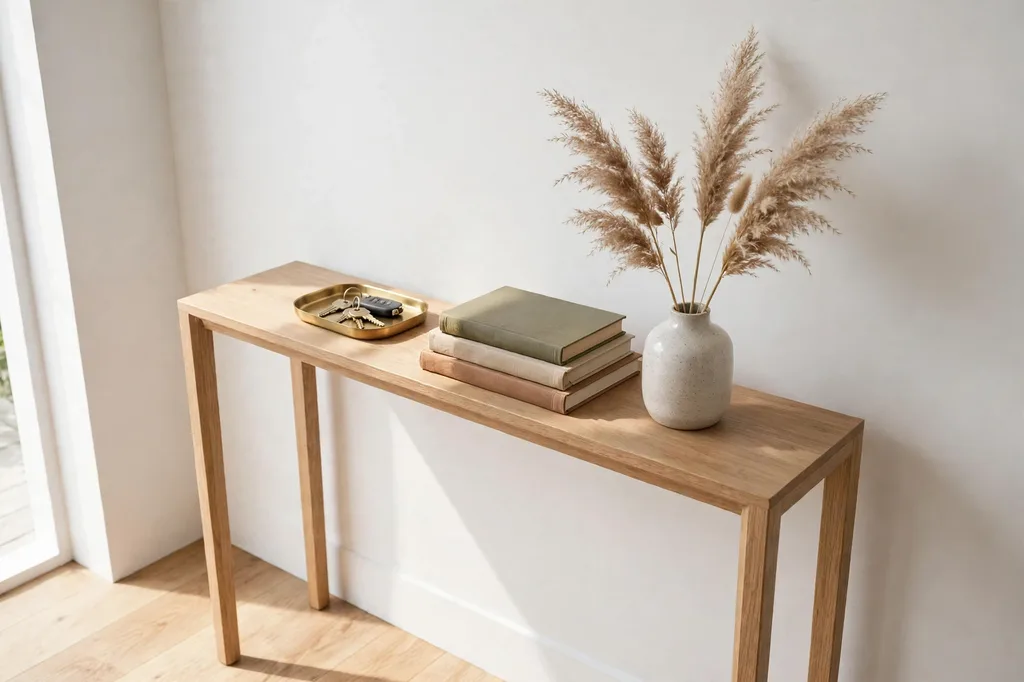
Best for: the anchor of the entryway, one console does the work of five small pieces of furniture.
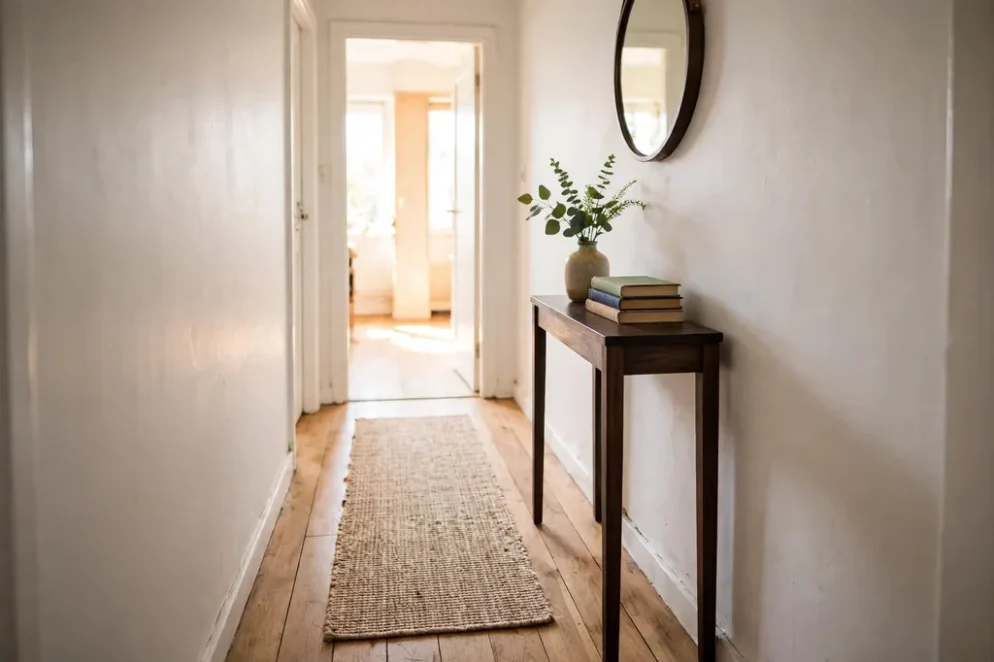
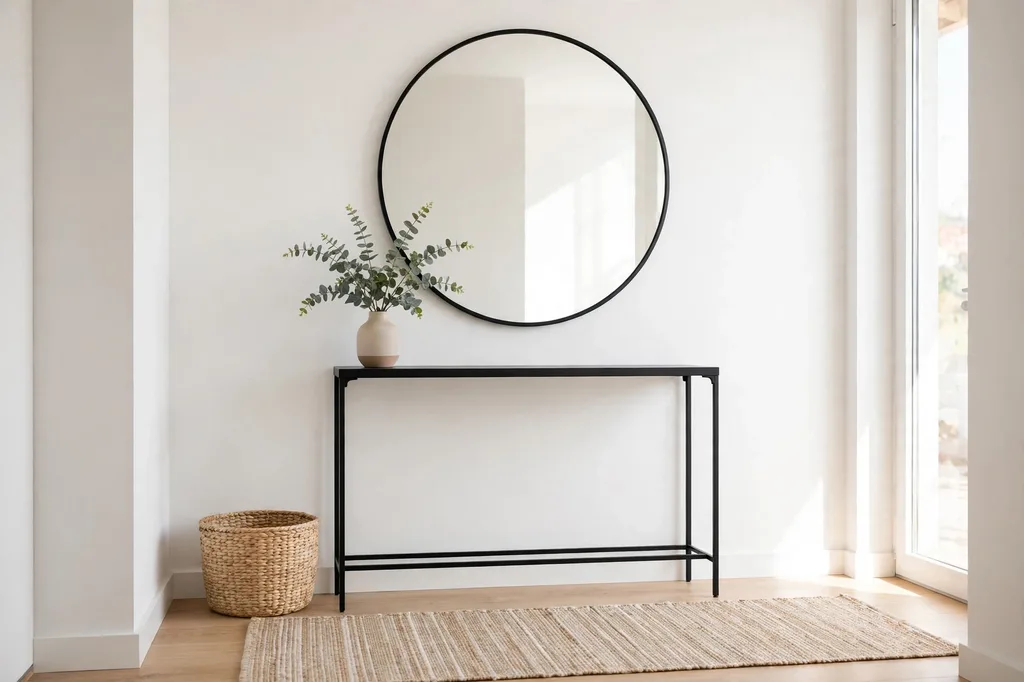
The console is the single most important piece in a modern entryway. If you are shopping modern entryway furniture ideas, start with the console, it is the landing strip for keys, mail, and sunglasses, the base for the mirror, and the thing that tells guests the entryway is a room, not a corridor. The rule is slim: a console 10 to 12 inches deep, 30 to 36 inches tall, and 24 to 36 inches wide. That is why so many modern entryway decor ideas start at the console and build outward from it.
- Size: on a wall 4 feet wide, a 30-inch console leaves breathing room on both sides. On a wall under 3 feet wide, skip the console entirely and use a floating shelf 24 to 36 inches wide instead, a shelf holds the same tray and vase and takes zero floor space.
- What goes on it: three things, not ten. A tray for keys (10 to 12 inches wide), one vase with branches (12 to 18 inches tall), and one small object, a candle, a lidded box, or a short stack of two books. Three things on a console look curated. Seven things look like a shop counter. That is the whole method behind modern entryway console table decor ideas.
- What goes under it: one thing, a woven basket (14 to 18 inches wide) for shoes, or a pair of shoes lined up neatly. Under-console storage is the whole point of a console in a small entryway; an empty gap under the console is wasted space, and a pile of shoes is clutter.
- What to watch: do not buy a console deeper than 14 inches, a 16-inch console in a 36-inch hallway leaves 20 inches to walk through. Measure the walkway after the console is in, not before.
Budget: a slim console costs $35–$55 secondhand or flat-pack, $80–$150 new. A floating shelf costs $15–$30. The console is the biggest single spend in this guide, and the one worth spending on, because everything else hangs off it. Spending here first is the smartest move in these modern entryway decor ideas, because the console sets the scale for everything above and below it. For more console styling inspiration, see HGTV’s 20 decorative entryway table ideas.
2. One big mirror
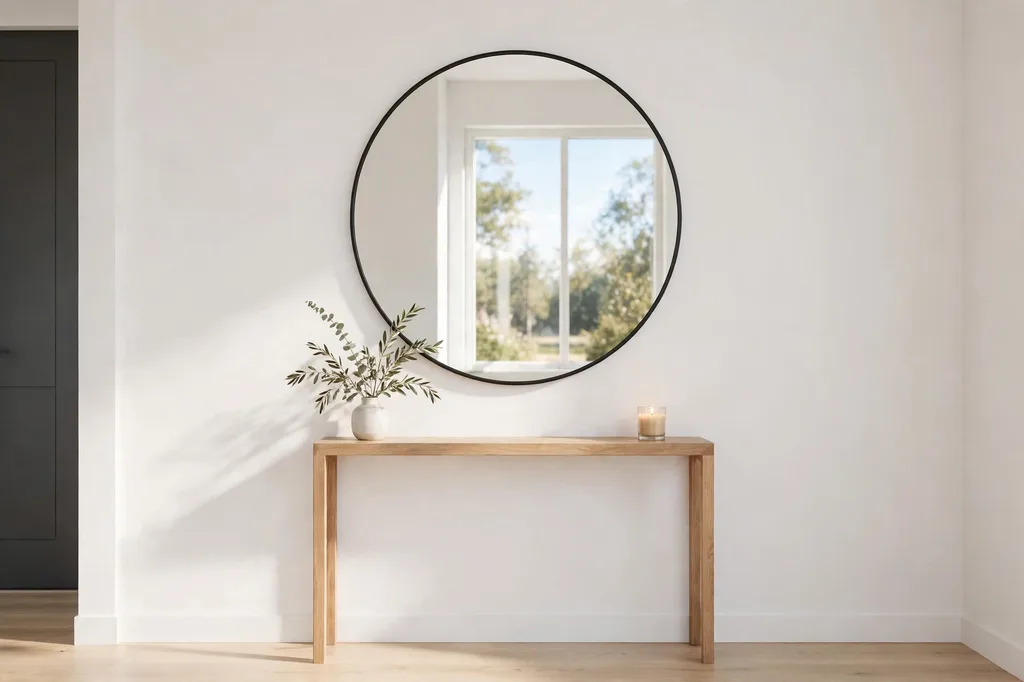
Best for: the light of the entryway, one big mirror does the work of a window.
A big mirror is the single best move in a small, dark entryway. It throws daylight from the door or the nearest window across the hall, it makes a three-foot wall feel six feet wide, and it gives you the last look before you leave. A round mirror 24 to 30 inches in diameter, in a thin black frame, is the classic modern choice, and round is the shape that softens all the straight lines of the console and the bench. A mirror this size is the single biggest visual payoff among modern entryway decor ideas for a dark entry.
- Size: the mirror should be about two-thirds of the console’s width. On a 36-inch console, that is a mirror about 24 inches wide. A mirror narrower than that looks stranded above the console; a mirror wider than the console looks top-heavy.
- Position: center it at 57 to 60 inches from the floor. Leave 4 to 6 inches between the bottom of the mirror and the top of the console, close enough to read as one composition, far enough to set a vase in between.
- Shape: round for a soft, modern look; arched for a taller, more sculptural feel; rectangular only if the wall is wide and the console is long. In a narrow entryway, round wins.
- What to watch: do not hang a mirror where it reflects clutter. A mirror opposite the front door reflects the coat hooks, that is fine. A mirror reflecting a pile of shoes is not. And do not pair a big mirror with a second big thing. One mirror, then small things. Two focal points split the wall in half.
Renter note: a leaning mirror is the most renter-friendly anchor there is, a 24-inch round mirror leaned against the wall behind the console needs no hook, no hole, and no permission. If you must hang it, use a picture-hanging strip rated for at least twice the mirror’s weight, and only on smooth, fully cured paint. Leaning the mirror keeps these modern entryway decor ideas fully renter-friendly, with no holes to patch later.
3. Hooks at two heights
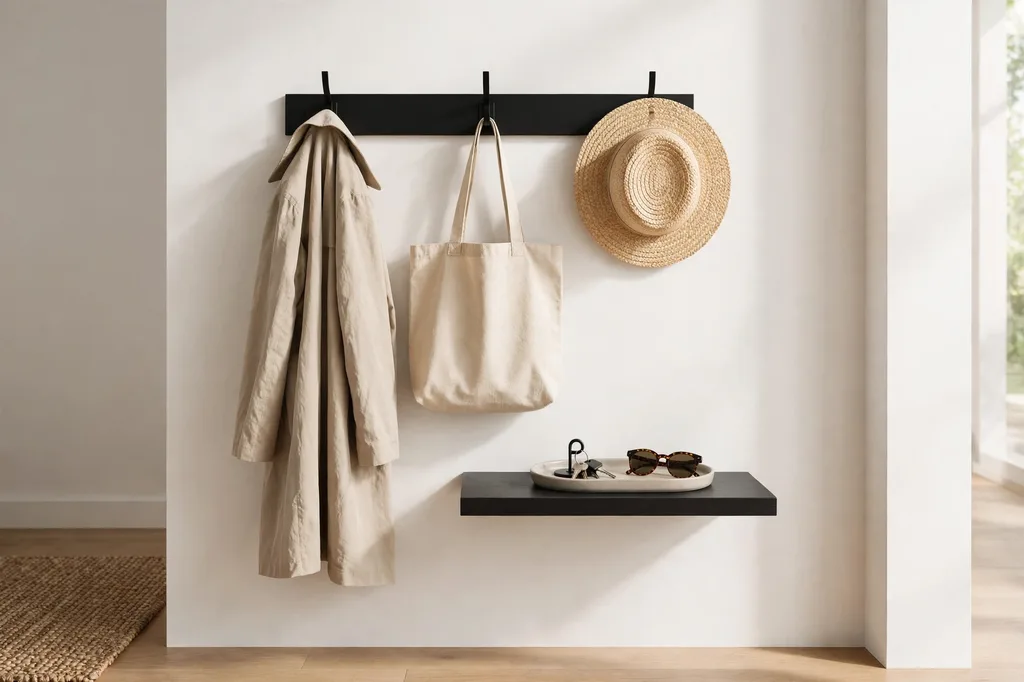
Best for: the coats, hooks are the most-used thing in the entryway, so they deserve a plan, not an afterthought.
An entryway without hooks is a pile of coats on the console. A hook rail 24 inches wide with three or four hooks holds a household’s daily coats, and it costs less than any other piece in this guide. The trick is the heights: one row for adults, one row for everything else. Hooks this simple are the hardest-working of all modern entryway decor ideas, because they get used every single day.
- Heights: the adult row sits at 50 inches from the floor; the lower row at 36 inches. The lower row is for kids’ coats, or, in a house without kids, for bags, dog leashes, and the tote you grab every morning. Two rows hold twice as much as one, and the lower row keeps the daily bag off the console.
- Spacing: hooks 6 to 8 inches apart, so a coat on one hook does not swallow the next. Four hooks on a 24-inch rail is the maximum; five hooks on a short rail is a pile, not a row.
- How many: one hook per person, plus one spare. A household of two needs three hooks. A household of four needs five, which means a 36-inch rail, not a 24-inch one. Count the people before you count the hooks.
- What to watch: do not hang the rail behind the front door’s swing, open the door fully and mark where it stops. One hook per coat, or the coats slide off each other in a heap.
Renter note: removable adhesive hooks are made for this job. A hook rated for 5 pounds holds a coat; a hook rated for 7 to 8 pounds holds a coat and a bag. Use one hook per item, test one patch for 48 hours before loading the rail, and pull the tab straight down to remove, never sideways. On textured walls, adhesive hooks struggle; use an over-the-door hook rail instead, which needs no wall at all. Tested adhesive hooks keep modern entryway decor ideas damage-free in a rental.
4. A bench with hidden storage
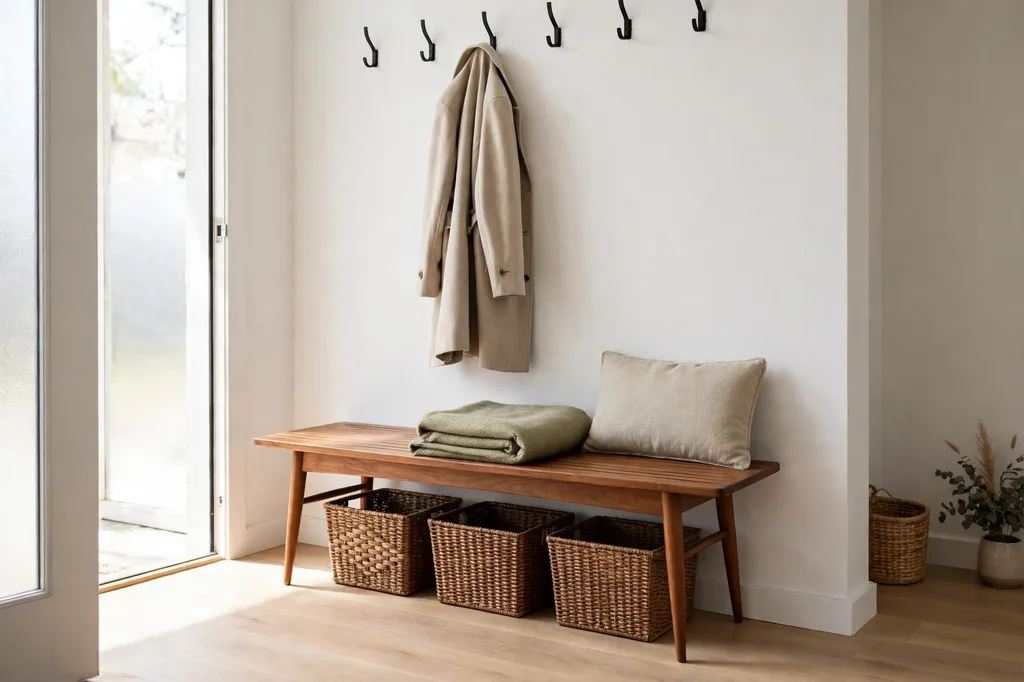
Best for: the sit-down, a bench is where shoes go on, bags get set down, and the entryway earns its keep.
A bench turns an entryway from a corridor into a room. It is the seat for putting on shoes, the landing spot for a bag, and the hiding place for the shoes themselves. A mid century modern entryway bench, tapered legs, warm walnut, a woven basket or two underneath, is the modern default, and it fits a small entryway because it is narrow and open underneath. A bench is the piece that turns modern entryway decor ideas from a hallway into a room you actually use.
- Size: the bench should be 17 to 19 inches high (seat height), 12 to 14 inches deep, and 30 to 36 inches wide. Deeper than 14 inches and it eats the walkway; wider than 36 inches and it crowds the console wall. A bench 30 inches wide fits two baskets underneath, each 12 to 14 inches wide.
- Storage: one basket per person, 12 to 14 inches wide and 10 to 12 inches tall, slid under the bench. Shoes go in the basket, not on the floor, a basket of shoes reads as storage, a row of shoes reads as clutter. A bench with a lift-up seat hides even more, but a lift-up seat costs twice as much and the hinge is the first thing to break.
- What goes on top: one thing, a folded throw, a single cushion (16 by 16 inches), or nothing at all. A bench piled with cushions is a bench nobody can sit on.
- What to watch: do not put the bench on the same wall as the console if the walkway is under 42 inches wide, console on one wall, bench on the other. And do not buy a bench taller than 19 inches.
Budget: a simple wooden bench costs $40–$70 secondhand, $80–$150 new. Two woven baskets cost $15–$25. A bench is the second-biggest spend in this guide, and the one that makes the entryway feel like a room. For the money, a bench is one of the best-value modern entryway decor ideas in this guide.
5. A runner, sized right
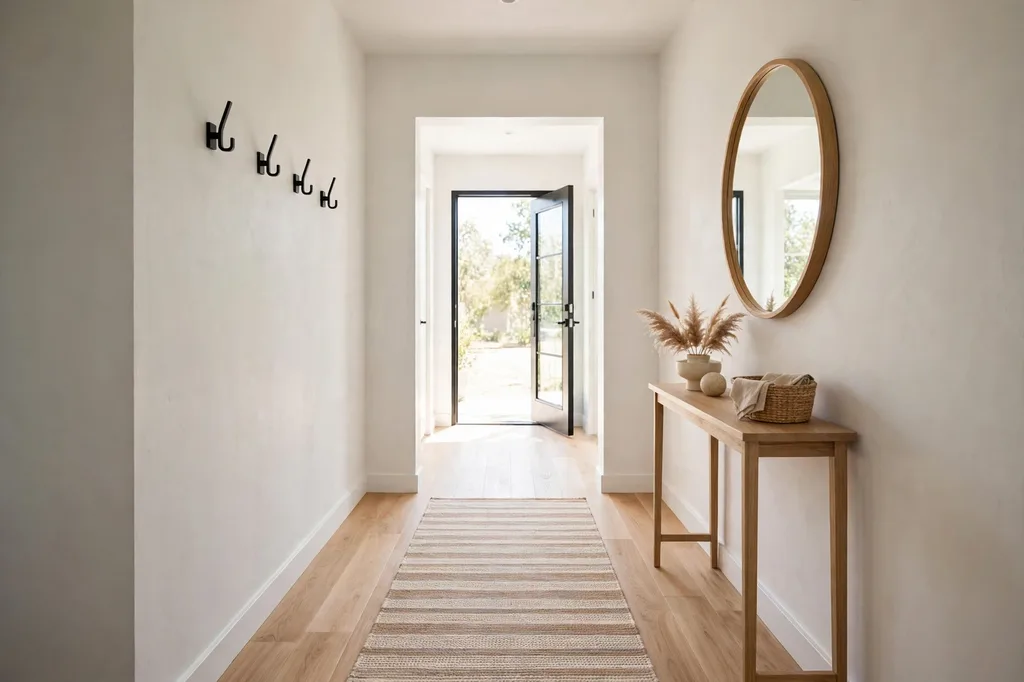
Best for: the floor, a runner is the cheapest way to make a hallway look finished, and the easiest thing to get wrong.
A runner rug does three jobs in a modern entryway: it protects the floor where shoes land, it pulls the eye from the door into the home, and it adds the one soft texture in a hallway full of hard surfaces. The rule is simple, the runner should be narrower than the hallway, and shorter than the wall. A runner is the cheapest of these modern entryway decor ideas, and the fastest way to make a hallway look finished.
- Size: in a hallway 36 inches wide, the runner should be 24 inches wide, leaving 6 inches of floor visible on each side. In a hallway 42 inches wide, a 30-inch runner leaves the same 6-inch border. A runner that touches both walls looks like wall-to-wall carpet; a runner with a border looks like a rug.
- Length: the runner should run 12 to 18 inches short of the hallway at each end. A runner that stops exactly at the door looks cut off; a runner that runs under the console looks like a mistake. Measure the hallway, subtract 24 to 36 inches, and buy that length, a standard 2 by 6 foot runner fits most small entries.
- Pattern: stripes, a simple border, or a solid color with texture. A busy pattern in a narrow hallway fights the console and the mirror for attention. A neutral runner, warm grey, natural jute, or a faded stripe, lets the furniture do the talking.
- What to watch: do not skip the rug pad, a runner without one slides, bunches at the door, and becomes a trip hazard. A thin pad (1/8 inch) costs $10–$15.
Budget: a 2 by 6 foot runner costs $15–$25; a rug pad costs $10–$15. A runner is the cheapest finished look in this guide. At this price, a runner belongs in almost every version of modern entryway decor ideas for a small home.
6. Layered light
Best for: the mood of the entryway, light is what makes a small hallway feel like a room instead of a tunnel.
Most entryways have one ceiling light and nothing else, and one ceiling light makes a hallway look like a tunnel. Layered light, one overhead, one low, one warm, makes the same hallway feel like an entrance. Warm light (2700K) is the rule; cool white light on white walls makes the whole entryway look grey. Warm light is the detail that makes modern entryway decor ideas feel welcoming after dark, not just tidy by day.
- Overhead: one flush-mount or small pendant, centered over the walkway. A pendant 10 to 12 inches in diameter suits a small entryway; a chandelier 30 to 36 inches wide belongs in a two-story foyer, not a three-foot hall. If the ceiling is under 8 feet, use a flush-mount, a pendant that hangs below 7 feet is a head-height hazard.
- Low light: a small lamp on the console (12 to 16 inches tall) or a plug-in wall sconce beside the mirror. The low light is the one you actually see in the evening, it warms the mirror, the wood, and the wall, and it is the light that makes guests feel welcome. A rechargeable lamp needs no outlet and no drilling, and it moves with you.
- What to watch: do not mix warm and cool bulbs in one entryway, one cool bulb (4000K and up) undoes three warm ones. Check the bulb box: 2700K everywhere. Keep the lamp to one side of the console so it never blocks the mirror.
Budget: a small console lamp costs $15–$25; a rechargeable lamp costs $20–$35. Light is the cheapest warmth in this guide, and the one competitors skip most often. Light is the most-skipped of the modern entryway decor ideas here, and the one guests notice first.
7. A tray and a drop zone
Best for: the daily mess, a drop zone is the difference between an entryway that works and an entryway that eats your keys.
Every entryway needs a drop zone: one fixed place where the keys, the mail, the sunglasses, and the dog leash live. Without one, those four things live on the console, on the bench, on the floor, and in your pocket, and you lose one of them every morning. With one, the entryway runs itself. A fixed drop zone is the habit that keeps modern entryway decor ideas working long after the styling is done.
- The tray: one tray, 10 to 12 inches wide, on the console, near the door side. Keys in the tray, mail beside it, sunglasses on top. One tray, not two, two trays divide the console into two piles, and two piles are clutter.
- The mail rule: mail gets sorted at the tray, not stored in it. A small wall-mounted mail holder (12 inches wide, 3 pockets) beside the console holds the week’s mail; the tray holds today’s. A tray full of last month’s mail is not a drop zone, it is a filing cabinet.
- The leash hook: one hook at 36 inches, the lower row from section 3, holds the dog leash and the reusable bag. The leash lives on the hook, not on the console, because a leash on the console slides off and takes the keys with it.
- What to watch: do not let the drop zone grow, a tray holding keys, mail, sunglasses, a wallet, a watch, and three pens is a junk drawer without a drawer. Empty it once a week and put back only what belongs there.
Budget: a ceramic or wooden tray costs $5–$10; a three-pocket mail holder costs $10–$15. The drop zone is the cheapest system in this guide, and the one that saves the most time. For under $25, the drop zone is the best-value system in these modern entryway decor ideas.
8. Wall art: lean, don’t hang
Best for: the personality of the entryway, one piece of art makes a hallway feel like your home, not a hotel.
A modern entryway needs one piece of wall art, not a gallery wall, not twelve frames, one piece. One print, one photograph, or one woven hanging, sized to the wall and leaned, not hung. Modern entryway wall art works when it is big enough to read from the door and simple enough to ignore after a week. The same rule covers all modern entryway wall decor: one piece, sized to the wall, beats a gallery. One strong piece is all it takes: that restraint is what separates modern entryway decor ideas from a gallery wall.
- Size: one piece 16 by 20 inches or 18 by 24 inches on a wall beside the console. Smaller than 16 by 20 and it reads as a Post-it; larger than 24 by 30 and it competes with the mirror. One piece, one wall, the art goes on the wall opposite the console, or on the console wall beside the mirror, never above the mirror.
- Lean, don’t hang: a framed print leaned on the console, against the wall, needs no nail, no hook, and no permission. A leaning frame only needs about 1.5 inches of console depth. On a console 10 to 12 inches deep, a leaning frame fits easily, and it moves with you.
- What to hang if you must: if the art must go on the wall, use a picture-hanging strip rated for at least twice the frame’s weight, and only on smooth, fully cured paint. Test one strip for 48 hours before trusting it with a framed print. On textured walls, strips fail, lean the frame instead.
- What to watch: do not build a gallery wall in a small entryway, it needs 8 to 10 feet of width to breathe, and in a three-foot hallway every frame competes with the mirror. One piece beats twelve. Keep art clear of the door swing.
Budget: a frame 16 by 20 inches costs $8–$15; a printable art print costs $5–$10. Wall art is the cheapest personality in this guide, and most of it you already own. A print you already own is often the best finishing touch in modern entryway decor ideas for a small entry.
Small entryway layout: the 36-inch walkway plan
Best for: the whole entryway, where the console, the bench, and the runner sit in a small hall.
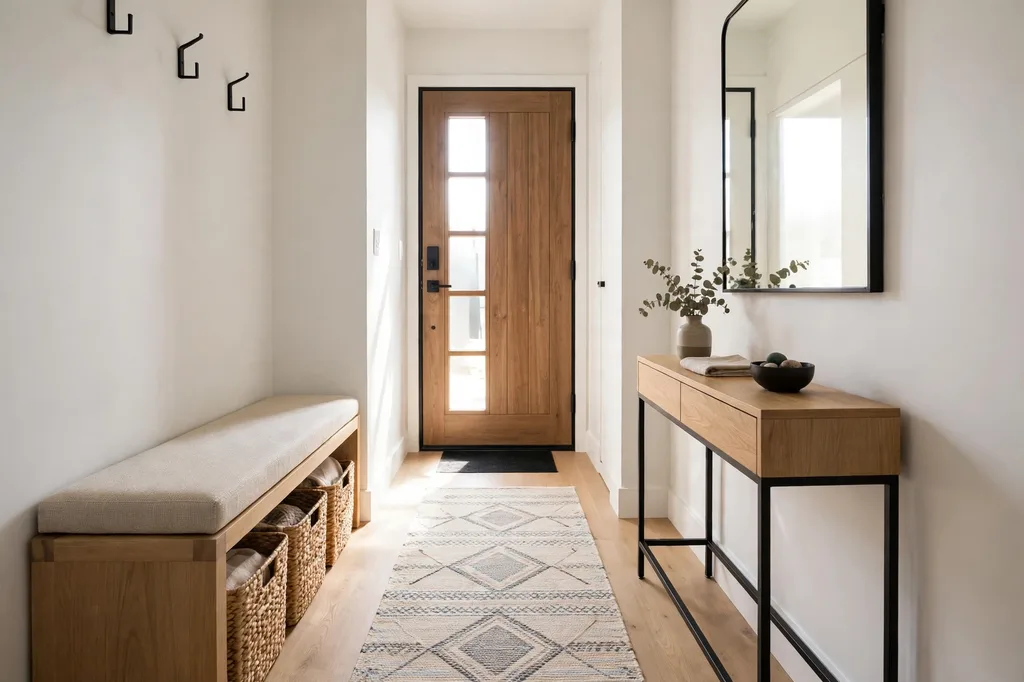
A small entryway is often the only hallway in a small rental, so it competes with the front door swing, the coat hooks, and the walking route to the living room. That conflict is the whole problem, and the layout has to solve it. This one-wall-one-job plan is how modern entryway decor ideas fit a console, a bench, and a runner into a single small hall.
- Console wall: the console goes on the longest uninterrupted wall, 10 to 12 inches deep, with the mirror centered above it. The tray sits on the door side of the console, so keys land the moment you walk in.
- Bench wall: the bench goes on the opposite wall, 12 to 14 inches deep, with the hook rail above it at 50 inches. Console on one wall, bench on the other, walkway between them, that is the layout.
- Walkway: 36 inches of clear walking space between the console and the bench, 42 inches if the hall allows it. Measure it after the furniture is in, not before, the walkway is the number that decides whether the entryway works.
- Runner: down the middle of the walkway, 24 inches wide in a 36-inch hall, 12 to 18 inches short of the hallway at each end. The runner marks the walking line, and the furniture stays off it.
- Door swing: open the front door fully and mark where it stops. Nothing, no bench, no basket, no shoe, goes inside the swing. A bench in the door swing gets hit every day, and a basket in the swing gets kicked every morning.
- What to watch: a small entryway fails when one wall tries to do everything. One wall, one job: the console wall is the landing wall, the bench wall is the sitting wall, and the walkway is the walking wall.
Renter-friendly rules
Most modern entryway decor ideas are renter-friendly by nature, an entryway is styled with movable furniture, not with fixtures. The rules are simple, and they are all about what you do NOT do.
- Lean, don’t drill: the mirror leans, the art leans, the frames lean. A leaning mirror needs no hook and no hole. If you must hang something light, use a picture-hanging strip rated for at least twice the piece’s weight, and only on smooth, fully cured paint.
- Removable hooks, tested first: adhesive hooks hold a coat if they are rated for it, 5 pounds for a coat, 7 to 8 pounds for a coat and a bag. Test one patch for 48 hours before loading the rail, and pull the tab straight down to remove, never sideways. On textured walls, adhesive hooks struggle; use an over-the-door hook rail instead, which needs no wall at all. And never stick a strip on paint less than 30 days old, it will take the paint with it.
- Peel-and-stick, not paint: if you want an accent wall behind the console, use peel-and-stick wallpaper. It goes up in an afternoon and comes down cleanly. Painting the entryway is a permanent change, it is the landlord’s decision, not yours.
- Plug-in, don’t hardwire: a plug-in or rechargeable lamp gives you the low light without the electrician. Hardwired sconces are a permanent install, they are the landlord’s decision, not yours.
- No floating shelves with screws: a floating shelf needs screws in the wall, and screws are holes. In a rental, use a narrow console or a leaning shelf instead, a leaning ladder shelf stands on the floor, holds baskets and books, and leaves no mark at all.
- Everything moves with you: the console, the bench, the mirror, the hooks, the runner, the tray, every piece in this guide is movable, and it all leaves with you.
Modern entryway under $150
Best for: the whole entryway, every idea in this guide, added up.
| Item | Cost |
|---|---|
| Slim console table, 36 in (secondhand) | $35–$55 |
| Round mirror, 24 in | $20–$35 |
| Hook rail, 24 in, 3 hooks | $8–$12 |
| Runner rug, 2 × 6 ft | $15–$25 |
| Tray / catchall | $5–$10 |
| Small faux plant | $8–$12 |
| Total | $91–$149 |
That is under $150 even at the top end, and the honest version is cheaper still. If the budget is tight, buy the mirror, the hooks, and the tray first ($33–$57), use a bench and books you already own for the rest, and add the console and the runner next month. That total is proof that modern entryway decor ideas do not need a big budget, just a short list and a tape measure.
The free ideas: taking three things off the console, leaning a mirror you already own, and moving the bench to the opposite wall cost nothing, and they change the entryway more than any purchase. Modern styling starts with taking things away, not adding them. These free moves are the fastest modern entryway decor ideas to try today, before spending anything.
5 mistakes to avoid
1. A console that’s too deep. A 16-inch console in a 36-inch hallway leaves 20 inches to walk through. Measure the walkway after the console is in, not before. Measuring first is the rule that saves most modern entryway decor ideas from a console that is too deep.
2. Too many small objects on the console. Seven small things on a console look like a shop counter. Three things, a tray, a vase, one small object, look curated. If the console feels cluttered, remove a few items and leave breathing space. An edited console reads as intentional; a full one reads as a shelf.
3. A mirror that’s too small or hung too high. A mirror narrower than two-thirds of the console’s width looks stranded, and a mirror centered above 60 inches reflects the ceiling. Size it to the console, center it at 57 to 60 inches, and leave 4 to 6 inches between the mirror and the console.
4. Blocking the walkway or the door swing. Open the door fully, mark where it stops, and keep 36 inches of walking space clear. The walkway is not storage.
5. Drilling or painting without permission. Floating shelves, hardwired sconces, and a painted accent wall are permanent changes. In a rental, they are the landlord’s decision. Lean the mirror, plug in the lamp, use removable hooks, and use peel-and-stick wallpaper, everything in this guide moves with you.
FAQ
How do I design a functional entryway?
Give it three jobs and three places: a console wall for landing (keys, mail, sunglasses), a bench wall for sitting and storage, and a clear walkway between them. One hook per person, one tray for keys, one basket per person for shoes, and 36 inches of walking space after the furniture is in. Three jobs, three places: that is the whole framework behind these modern entryway decor ideas.
How do I decorate an entryway table?
Three things, not ten: a tray for keys (10 to 12 inches wide), one vase with branches (12 to 18 inches tall), and one small object, a candle, a lidded box, or a short stack of two books. Keep the tallest thing to one side and the tray on the door side, so keys land the moment you walk in.
How do I decorate a small entryway without making it feel crowded?
Scale up the focal point and scale down the object count: one slim console (10 to 12 inches deep), one oversized mirror, and a narrow runner. Go vertical, hooks and a floating shelf instead of floor furniture, and keep the palette to two or three colors. Fewer, bigger pieces are the core of modern entryway decor ideas that keep a small entry feeling open.
How do I decorate a narrow entryway?
Use slim furniture and vertical storage: a console 10 to 12 inches deep or a floating shelf 24 to 36 inches wide, hooks at two heights, and a runner 6 inches narrower than the hallway on each side. Skip the bench if the walkway drops below 36 inches.
What size mirror should I use in the entryway?
About two-thirds of the console’s width, on a 36-inch console, a mirror about 24 inches wide. Round is the best shape for a small entryway because it softens the straight lines of the console and the bench. Center it at 57 to 60 inches from the floor.
How many accessories should I put on an entryway console?
Three: a tray, one vase, and one small object. A console styled with three intentional pieces looks curated; a console with seven small things looks like a shop counter. The basket underneath counts as storage, not as an accessory.
What should every entryway have?
A place to hang coats, a place to put keys, a place to sit, a mirror, and light. That is the whole list: hooks, a tray, a bench, a mirror, and one warm lamp. Everything else, the runner, the art, the plant, is decoration.
How can I make my entryway more welcoming on a budget?
A runner rug, a mirror, and warm light will transform most entries for under $150, the table in this guide totals $91 to $149 for the whole entryway. Start with the mirror and the hooks ($33 to $57), add the runner next, and use books and frames you already own. Start with the mirror and the hooks, and the rest of these modern entryway decor ideas can follow month by month.
Start today
Modern entryway decor ideas do not need a shopping trip, they need an edit. Take three things off the console, lean a mirror against the wall, and put one tray by the door. That is the whole first round, and it takes an afternoon. Pick the console first, then the mirror, those two modern entryway ideas change the hallway more than anything else you could buy.
Start by taking away. The hallway will tell you what it needs next.