Small bedroom storage ideas work when you stop looking for floor space and start using the space you already have. A small bedroom hides three storage zones most people never use properly: the space under the bed, the back of the door, and the wall above your head. Together, those three zones hold more than a whole dresser, and they cost nothing in floor space, which is the one thing a small bedroom cannot spare. If you searched for “small storage ideas bedroom” or “storage ideas for small spaces bedroom,” the question behind both searches is the same: where does everything go in a room this size?
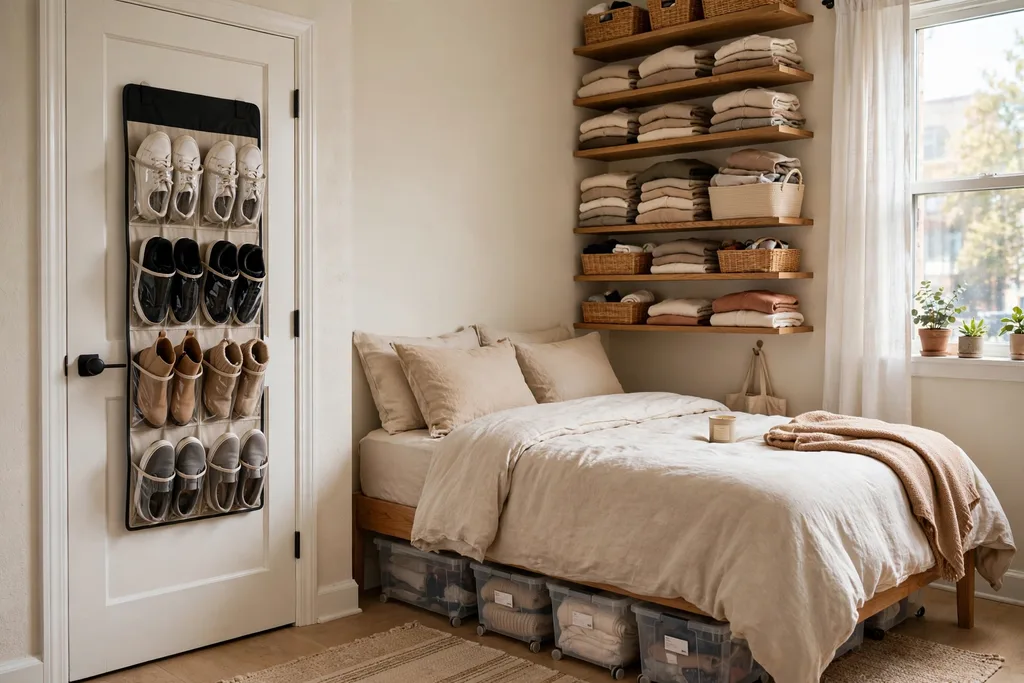
Table of Contents
The numbers first
A typical small bedroom is 10×12 feet, 120 square feet of floor. A queen bed is 60 by 80 inches, which is 33.3 square feet, and the frame brings it to about 38. That leaves roughly 80 square feet for everything else: walking, dressing, a dresser, a nightstand, and the door swing. The door alone needs 30 to 36 inches of swing space. Walkways need 24 inches at a minimum, and 30 inches beside the bed is the comfortable number, below 24 inches, you are turning sideways to get past your own bed. That is why small bedroom storage ideas start with cubic feet, not square feet.
The room is bigger than its floor. A 10×12 room with an 8-foot ceiling holds about 960 cubic feet of volume, and most of it sits empty above your waist. The three hidden zones in this guide add up to real capacity without taking a single square foot of floor: Most small bedroom storage ideas fail when they only count floor space.
| Hidden zone | Space it uses | What it holds |
|---|---|---|
| Under the bed (12-inch clearance) | 0 sq ft of floor | About 33 cubic feet, two rolling bins, spare bedding, off-season clothes |
| Upper wall band (6 to 8 feet high, 12 inches deep, one 10-foot wall) | 0 sq ft of floor | About 20 cubic feet, seasonal clothes, spare blankets, luggage |
| Shelf above the door (36 inches wide, 12 inches deep) | 0 sq ft of floor | About 4 cubic feet, light, rarely used things |
| Total | 0 sq ft of floor | About 57 cubic feet |
For comparison, a 60-inch-wide dresser holds about 20 cubic feet and eats 7.5 square feet of floor. The hidden zones give you nearly three dressers’ worth of storage and cost you nothing in walking space. That is the whole idea: go under, go behind the door, and go up, in that order, before you buy one more piece of furniture. It is the clearest proof that small bedroom storage ideas beat buying another dresser.
Two rules run through everything below. First, measure before you buy. A bin that is half an inch too tall is a bin that lives in the hallway. Second, daily things live at reach height and seasonal things live everywhere else. If you have to kneel or climb a step stool for something you use every morning, the system is wrong, not you. Both rules show up in every one of these small bedroom storage ideas.
What counts as storage in a small bedroom?
Storage in a small bedroom is not a piece of furniture. It is any place where something has a home and you can reach it without moving three other things. That definition matters, because it stops you from buying a pretty basket that holds nothing and starts you looking at the gaps your room already has. That definition is what makes small bedroom storage ideas work in any room, not just a big one.
The gaps are always the same five. Under the bed. Behind the door. Above your head. Inside the closet, which is almost never used well. And the furniture you already own, which is usually doing one job when it could do two. A nightstand with a drawer is storage. A bed frame with clearance underneath is storage. A door with hooks on the back is storage. Every one of these small bedroom storage ideas uses at least one of those five gaps.
Before you add anything, do the quick version of small bedroom organization ideas: take everything out of one drawer or one shelf, keep only what you have used in the last three months, and give every kept item one home. Most small bedrooms do not have a storage problem as much as they have a “things without a home” problem. No bin system fixes a room holding two seasons of clothes and a box of cables nobody can identify. It is the fastest way to see which small bedroom storage ideas your room actually needs.
The plan follows one order on purpose. Under the bed first, because it is the biggest hidden zone and costs nothing to open. Over the door second, because the organizer costs less than lunch. Vertical third, because height is free once you know the zones. The closet fourth, because a second rod doubles a closet for the price of a tension rod. Clothes without a closet fifth, for rooms with no closet at all. Then the whole room together, the budget, the renter version, and the mistakes. That order is what makes these small bedroom storage ideas work in a real room, not just on paper.
1. Under the bed: measure the clearance first
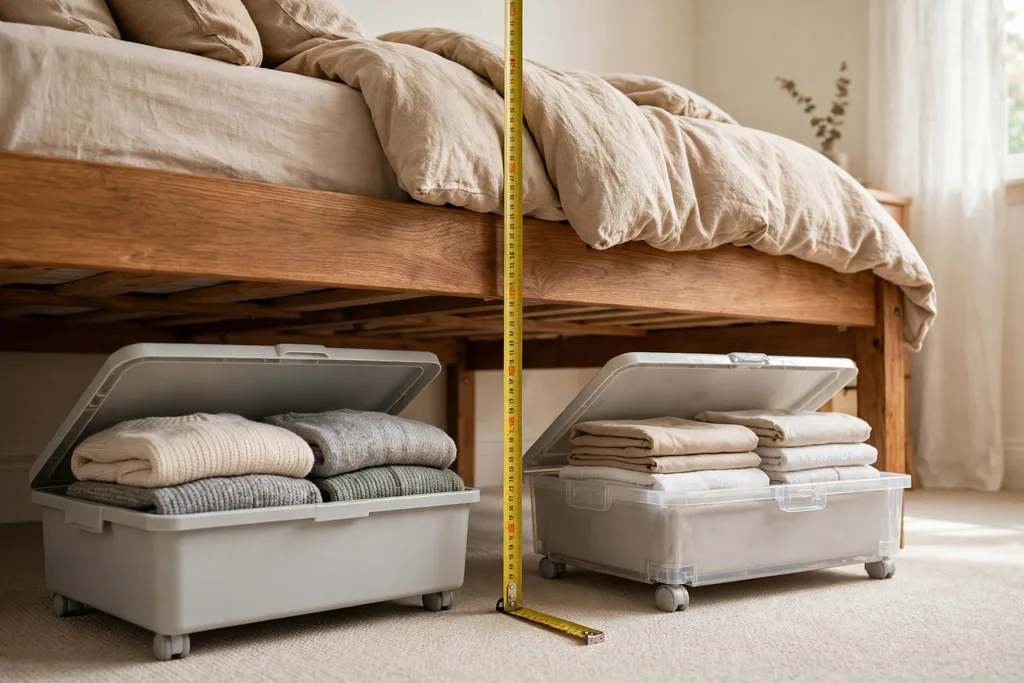
Under bed storage ideas are the most-searched angle in this whole topic, and also the most-bought-wrong. Everyone buys the bins first and measures second. Do it the other way around. Get on the floor with a tape measure and measure from the floor to the underside of the bed frame, not to the mattress, not to the box spring, to the frame itself. That number decides everything. Small bedroom storage ideas for under the bed work best when the bin fits the clearance, not the other way around.
| Bed frame clearance | Bin height that fits | What goes in it |
|---|---|---|
| 6 to 7 inches (low platform frame) | 5 to 6 inch flat bins | Flat things only: out-of-season clothes in vacuum bags, spare sheets, a spare blanket |
| 10 to 12 inches (standard frame) | 8 to 9 inch rolling bins | Shoes, off-season clothes, spare bedding, a suitcase of seasonal things |
| 14 inches or more (tall frame, or bed risers) | 12 inch bins or shallow drawers | Bulkier items, two stacked layers of folded clothes, a small suitcase |
The rule is simple: the bin must be at least 1 inch shorter than the clearance, and rolling bins need that inch for the wheels. A 9-inch bin under a 10-inch frame slides in and out with one hand. A 10-inch bin under a 10-inch frame has to be shoved, and you will stop using it within a month. If your frame is low, 6 to 7 inches, do not buy rolling bins at all. Use flat lidded bins or vacuum bags, which squash to about 4 inches and slide under anything. That one measurement decides whether these small bedroom storage ideas actually work day to day. IKEA’s under-bed storage range shows the sizes side by side, so you can match a bin to your clearance before you buy.
What you store under the bed matters as much as the bin. Under the bed is for things you need a few times a year: off-season clothes, spare bedding, the extra blanket, shoes you wear once a week at most. It is not for daily things. If you kneel on the floor every morning to get a sweater, the system has failed, move that sweater to a drawer or a hook and put something seasonal in the bin. Label the short end of every bin, facing out, so you can read it without pulling the bin all the way out. One label, three words: “winter sweaters,” “spare bedding,” “summer shoes.” Seasonal things are the safest bet for small bedroom storage ideas under the bed.
A note on what not to put under the bed: anything that cannot handle dust or a little damp. Leather, photographs, paper, electronics, and anything with sentimental value do not belong under a bed, even in a lidded bin. The floor is the coldest, dustiest place in the room. Keep it to washable things, clothes, linens, shoes, and you will never regret it.
If your bed sits on the floor with no clearance at all, bed risers are the cheapest fix: a set of four costs less than a pizza and lifts most frames 3 to 7 inches. Check first that your frame legs fit the risers and that the bed still feels steady when you sit on the edge. And if your bed has built-in drawers, the same clearance logic applies sideways: drawers need about 24 inches of clear floor in front of them to open fully. If the bed is against the wall, the drawers on the wall side are dead space, see the mistakes section for how to handle that. Risers are the cheapest of all small bedroom storage ideas, because they create clearance instead of buying furniture.
2. Over the door: the storage you already own
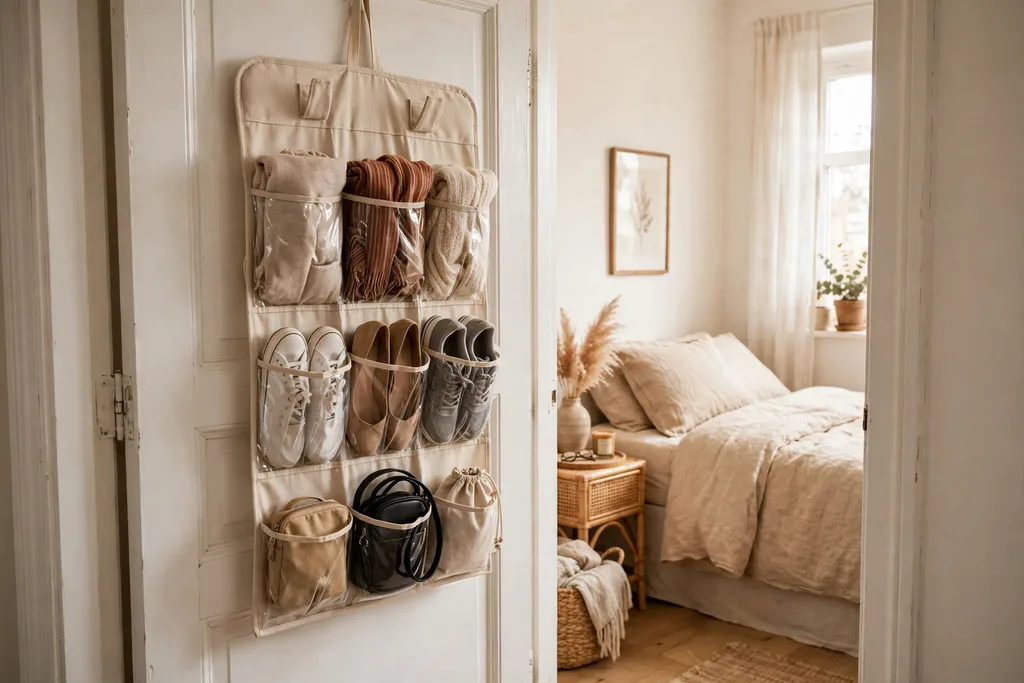
The back of the bedroom door is the most underused storage in the whole house, and it is already yours. An over-door organizer, a fabric panel with clear pockets that hangs from two flat hooks over the top of the door, holds two or three pairs of shoes, scarves, belts, small bags, and hats. It costs about $15, it takes five minutes to hang, and it uses zero floor space. Of all the storage ideas for small bedrooms, this one has the best return for the least effort. It is one of the simplest small bedroom storage ideas, because the door is already there.
But the door has rules, and they are not optional. First, measure the gap. Close the door and look at the top: the gap between the door and the frame is usually about 1/8 inch. The organizer’s hooks are flat metal for a reason, they have to fit in that gap without rubbing. If the hooks scrape the frame or the door sticks when you close it, the organizer is too thick for your door. Second, check the door’s swing. The organizer adds about 1 to 2 inches of thickness to the back of the door. If the door swings close to the bed or the dresser, the pockets can catch on the furniture. Open and close the door slowly the first time and watch the clearance. These rules are what keep small bedroom storage ideas on the door from damaging it.
Third, and most important: weight. Most bedroom doors are hollow-core, a thin skin over a cardboard core, and their hinges are not built for heavy loads. Keep the whole loaded organizer under 15 pounds on a hollow-core door. That is about two or three pairs of shoes plus scarves and accessories, not a coat collection. A solid wood door can take more, about 20 to 25 pounds, but the hinges still notice, and a door that sags will not close properly. If you are not sure what kind of door you have, knock on it: a hollow-core door sounds empty and light, a solid door sounds dull and heavy. When in doubt, assume hollow and keep it light.
What goes on the door? Light, flat, everyday things. Shoes in the lower pockets, where their weight sits closest to the floor and the door swings easiest. Scarves, belts, and small bags in the middle pockets. Hats and gloves up top. What does not go on the door: heavy coats, a full handbag, anything with a hard frame, and anything that swings when the door moves. If it bangs against the wall every time someone opens the door, it does not belong there. Light things are the rule for small bedroom storage ideas on the back of a door.
Over-door hooks are the smaller cousin of the full organizer: two or three individual hooks that hang over the top of the door, usually 3 to 5 pounds per hook. They are better when you only need a place for tomorrow’s outfit and a bag. If the full organizer feels like too much, start with the hooks, you will already know whether your door closes cleanly with something hanging on it. The same idea works on the inside of the closet door, where a row of hooks holds scarves, belts, and accessories without touching the bedroom at all. The weight rule still applies.
3. Vertical: three height zones
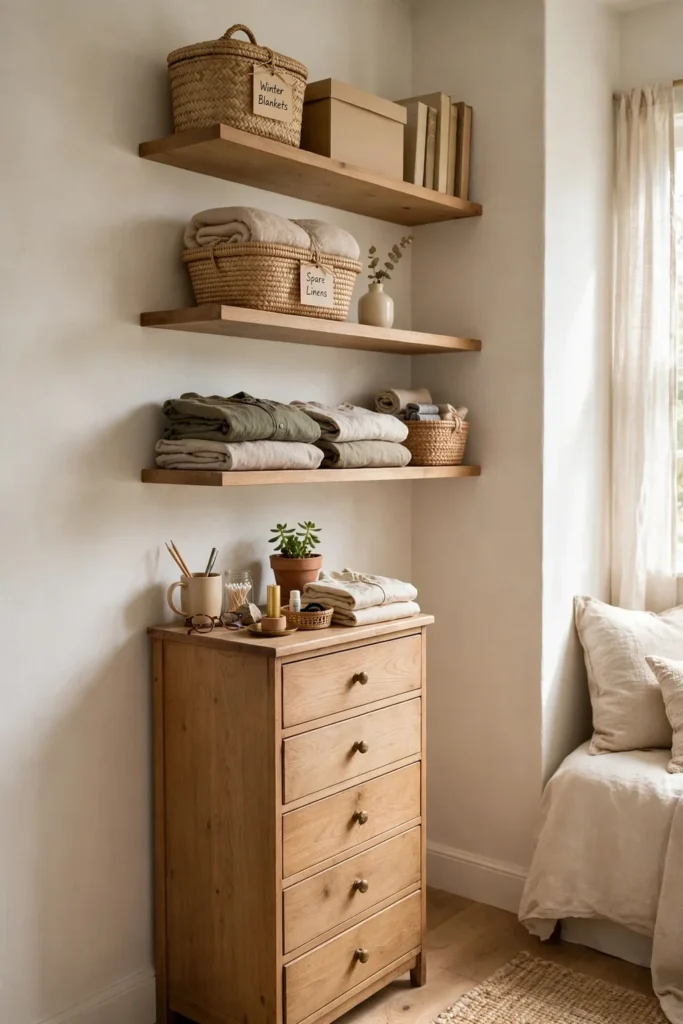
Vertical storage is where small bedrooms win or lose, because the wall above your head is the only space in the room that is genuinely empty. The trick is not to pile things up high. The trick is to sort the wall into three height zones and give each zone a job. Daily things live where your hands already are. Seasonal things live where you need a step stool. Nothing lives in between without a reason. The wall above your head is the biggest reason small bedroom storage ideas work without new furniture.
| Height zone | Height from the floor | What lives there |
|---|---|---|
| Daily zone | 30 to 60 inches (waist to shoulder) | Everyday clothes, the book you are reading, chargers, water, the bag you grab on the way out |
| Weekly zone | 60 to 72 inches (shoulder to just above your head) | Less-used clothes, extra linens, the bag you use on weekends |
| Seasonal zone | Above 72 inches (6 feet and up) | Off-season clothes, spare blankets, luggage, anything you touch twice a year |
Anything in the seasonal zone needs a step stool to reach, and that is fine, it is supposed to be hard to reach, because you only go up there twice a year. What is not fine is putting daily things up there. If you stretch for your everyday sweater every morning, the sweater is in the wrong zone. Move it down, move something seasonal up, and the room gets easier overnight. That is normal for small bedroom storage ideas in the seasonal zone, since you only reach them twice a year.
Shelves are the workhorse of the vertical zones. A storage shelf wants to be 8 to 12 inches deep, deep enough for folded clothes and baskets, shallow enough that things do not disappear behind other things. Display shelves can be 6 to 8 inches deep, but do not store clothes on a 6-inch shelf; they will fall off the front every time the door closes. Keep shelves away from the head of the bed: nothing heavy should hang above where you sleep. Shelves are the workhorse of small bedroom storage ideas, because they cost little and hold a lot.
The tall narrow dresser is the other vertical workhorse. A dresser about 18 inches deep and 36 to 48 inches tall holds as much as a wide dresser and takes half the wall. The trade-off is stability: tall and narrow tips more easily than short and wide. If you can drill, anchor it to a stud with the strap that comes in the box. If you rent and cannot drill, choose a shorter, wider dresser instead, or push the tall one into a corner or between the bed and the wall so it cannot tip forward. Never put a tall dresser on carpet with nothing behind it and a toddler or a large dog in the house, that is a genuine safety issue, not a style choice. A tall dresser is one of the few small bedroom storage ideas that also works as furniture.
The shelf above the door is the smallest vertical zone and the easiest to forget. A 12-inch-deep shelf mounted above the door frame holds light, rarely used things, the spare blanket, the off-season hat box, the luggage strap. Keep it light: the shelf is high, the things on it are above your head, and nobody wants a heavy box coming down. If you rent, a freestanding tall shelf does the same job without a single hole in the wall.
One rule for all vertical storage: leave one shelf empty, or at least half empty. A wall packed to the ceiling looks like a warehouse and makes the room feel smaller, not bigger. The empty space is what makes the full shelves look intentional, and it is where the next thing you buy will go. An empty shelf is what keeps small bedroom storage ideas from turning a room into a warehouse.
4. The closet: a second rod and a shoe shelf
Most small bedroom closets fail in the same two ways: one rod, and the floor is a pile. A single rod at about 80 inches high wastes the entire lower half of the closet, and the floor becomes a drift of shoes you have to dig through every morning. Fixing both costs less than $30 and takes twenty minutes, and it is the highest-return change in this whole guide. Two fixes solve most of it, and both are small bedroom storage ideas that cost less than a new closet.
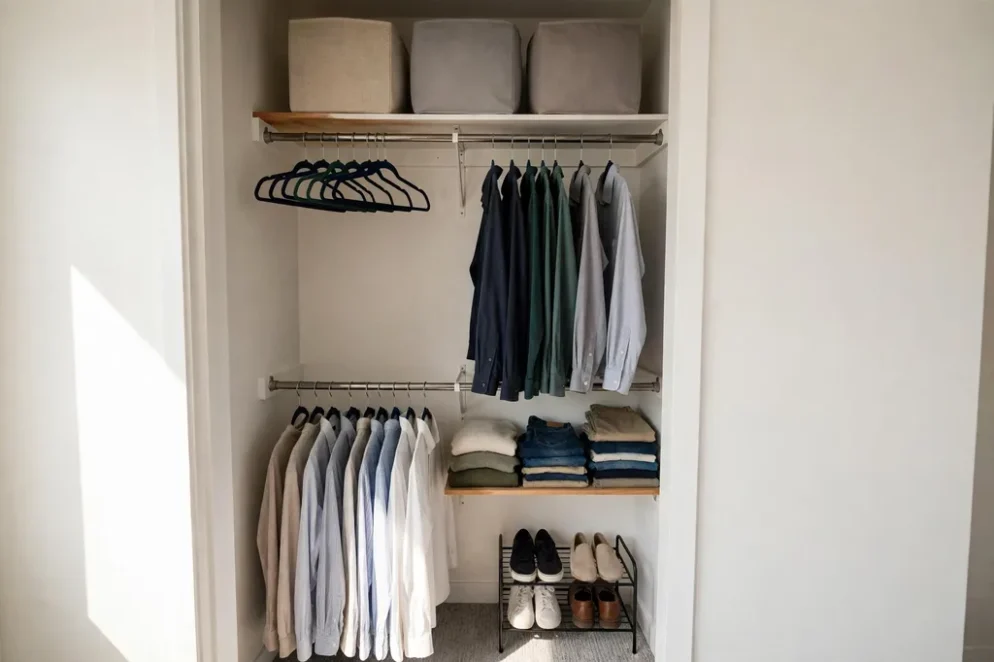
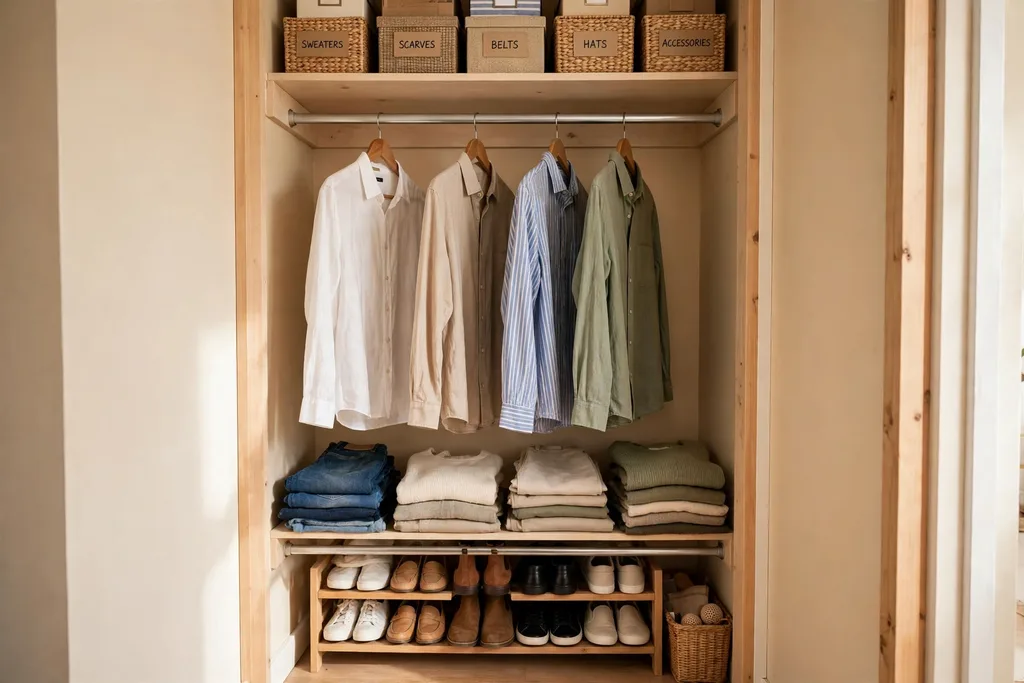
Small bedroom closet organization ideas start with a second rod. A tension rod, the kind that twists to lock between two walls, goes in at about 40 inches high, and suddenly the closet has two levels. Shirts and blouses hang on the top rod, pants and skirts on the lower rod. Shirts need about 40 inches of hanging length, so the math works out neatly: top rod at 80 inches, second rod at 40 inches, and the shirts on the lower rod end just above the shoe shelf. Measure your closet before you buy the rod: tension rods come in size ranges, and a rod that is an inch too short will not hold. Measure the inside width at the height where the rod will sit, and buy the rod whose range covers that number with room to spare.
Slim hangers are the second half of the closet fix. A row of slim velvet hangers holds noticeably more than the same length of bulky plastic hangers, because each hanger is about half as thick. They also grip: clothes do not slide off velvet the way they slide off smooth plastic. A pack of ten costs about $8. Use one type of hanger for everything, the same shape, the same color, and the closet looks twice as tidy without you changing anything else. Slim hangers are one of the cheapest small bedroom storage ideas for a closet.
The shoe shelf is the third piece. A low shelf or a small two-tier rack on the closet floor gets shoes off the pile and into a row you can actually see. One pair per space, toes out, and the shoes you wear most often go in the middle, not at the ends. If the closet floor is only 24 inches deep, the standard reach-in closet depth, a shoe shelf about 10 to 12 inches deep leaves room to stand in front of it without stepping on shoes.
Finish with the top shelf and the door. The shelf above the top rod is for things you use a few times a year: the spare blanket, off-season clothes in a labeled box, the bag you only take on trips. A small basket on that shelf keeps the pile from becoming a landslide. Hooks on the inside of the closet door, adhesive if you rent, hold scarves, belts, and the bag you grab most often. The closet door is the same hollow-core construction as the bedroom door, so the same weight rule applies: keep it light. The top shelf is where small bedroom storage ideas store the things you touch a few times a year.
If your closet is 6 feet wide and 24 inches deep, it holds about 80 cubic feet, more than all three hidden zones in this guide put together. Fix the closet first, before you buy anything for the room. Most people who think they need a new dresser actually need a second rod.
5. Clothes without a closet: rack, dresser, and hooks
Some small bedrooms have no closet at all, and some have a closet so small it might as well not exist. Clothing storage ideas for small bedrooms without a closet follow the same logic as the rest of this guide, one home per item, daily things within reach, just with different furniture. You need three things: somewhere to hang, somewhere to fold, and somewhere to hook. A room without a closet needs the same small bedroom storage ideas, just without the closet to hide them in.
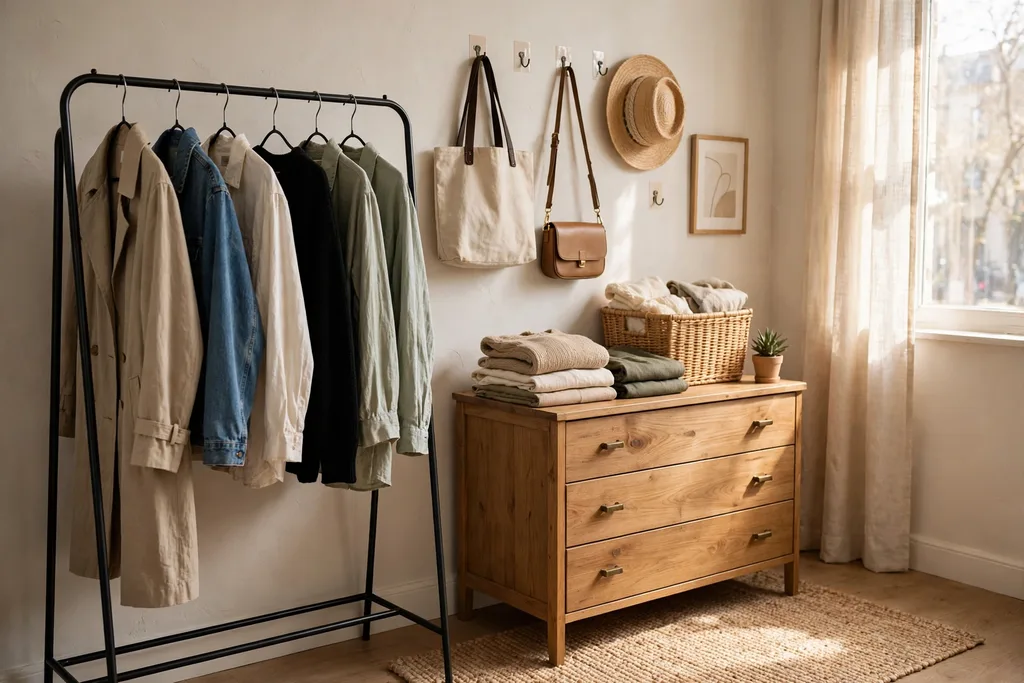
The hanging spot is a freestanding clothing rack. A simple metal rack with a bottom shelf costs about $25 to $80 and holds a surprising amount, but only if you do not overcrowd it. Leave a finger’s width between hangers. If the clothes are packed shoulder to shoulder, you cannot see what you own, and the rack starts to look like a laundry pile that learned to stand up. Group by type, shirts together, pants together, and put the clothes you wear most often in the middle. The bottom shelf is for shoes: two or three pairs, no more, or the rack gets bottom-heavy and hard to move.
The folding spot is a dresser. A tall narrow dresser, about 18 inches deep, 36 to 48 inches tall, is the right shape for a room with no closet, because it holds a full wardrobe in the footprint of a nightstand and a half. Assign each drawer a job and keep it: top drawer for daily things, middle drawers for folded clothes by type, bottom drawer for off-season or bulky things. Drawer dividers, about $10 a set, are what make this work, without them, a dresser drawer becomes a mixed pile within a week. Roll clothes instead of folding them flat: rolled clothes take less space, you can see every item from above, and nothing gets buried at the bottom. The dresser is the folding half of small bedroom storage ideas for a room without a closet.
The hooks are the third piece, and the cheapest. A row of adhesive hooks on an empty wall, about $8 for a pack of eight, holds bags, hats, scarves, and tomorrow’s outfit. Adhesive hooks are renter-friendly and hold a few pounds each, which is enough for anything you would hang on a hook. Do not hang a full bag of books on one adhesive hook; it will come off the wall at 2 a.m. For anything heavier, use a freestanding hook stand or the clothing rack itself.
A storage bench or ottoman at the foot of the bed can be the fourth piece if you have the floor space, about 48 to 60 inches long for a queen bed, holding spare bedding or off-season clothes. But it is optional, not essential. The rack, the dresser, and the hooks cover a full wardrobe on their own. If the bench would block the walkway at the foot of the bed, skip it: 24 inches of clear walkway matters more than one more storage box. A bench is the only one of these small bedroom storage ideas that also gives you somewhere to sit.
The no-closet bedroom also needs one habit that closet bedrooms do not: a weekly reset. Without a closet door to hide behind, clutter is visible, and visible clutter grows. Once a week, five minutes: everything back to its home, the rack straightened, the dresser top cleared. A small bedroom without a closet stays tidy by habit, not by furniture. That reset is the habit that keeps small bedroom storage ideas working after the first month.
6. The whole room, together: a 10×12 plan
Here is the whole system in one room, so you can see how the pieces fit instead of buying them one at a time. Take a 10×12 bedroom, 120 square feet, with a queen bed, a closet on one short wall, and a door on the opposite wall. This is the most common small bedroom shape there is, and the plan works in any room close to it. Seeing the pieces together is how small bedroom storage ideas stop feeling like separate purchases.
Put the bed against the longest wall, headboard centered, with 30 inches of walkway on the side you get out of and 24 inches at the foot. The queen bed takes 33.3 square feet; the walkways take the rest of the floor, and that is correct, walking space is not wasted space, it is what makes the room usable. For the layout side of this plan, where the bed goes, how the zones sit, and how much room each piece really needs, see Small Bedroom Layout Ideas, which works through the same 10×12 room from the layout angle.
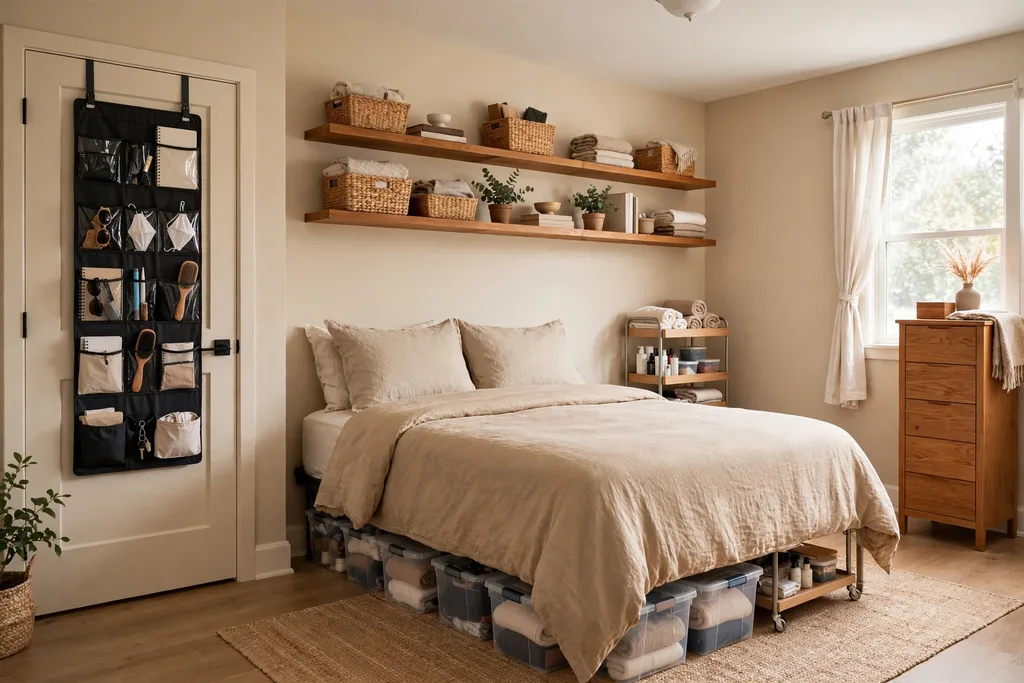
Now the storage, zone by zone. Under the bed: two 8-inch rolling bins, one for off-season clothes and one for spare bedding, both labeled on the short end facing out. Behind the door: an over-door organizer with two pairs of shoes in the lower pockets, scarves and belts in the middle, hats up top, about 12 pounds total, well under the hollow-door limit.
On the walls: a tall narrow dresser in the corner by the closet, 18 inches deep and 42 inches tall, and two floating shelves above it, daily things on the lower shelf at about 55 inches, weekly things on the upper shelf at about 68 inches, nothing above 72 inches except the spare blanket in a basket on top of the dresser. In the closet: a second tension rod at 40 inches, slim hangers throughout, and a shoe shelf on the floor with three pairs. Between the bed and the wall: a slim rolling cart, about 5 inches wide, holding the book, the charger, and the water bottle, a nightstand that fits where a nightstand cannot.
What goes where, in one rule: daily things at reach height, between 30 and 60 inches, within two steps of the bed. Seasonal things under the bed and above 72 inches, where you only go twice a year. Everyday things on the door, because the door is the last thing you touch on the way out. If an item does not fit that rule, it is in the wrong place, move the item, not the rule.
The room still has to breathe. After all of this, the 10×12 room has a clear 30-inch walkway beside the bed, a clear 24 inches at the foot, and a door that opens fully without hitting anything. If any piece of storage blocks a walkway or the door swing, it comes out, storage that blocks walking is not storage, it is clutter with a price tag. The plan leaves one wall mostly empty on purpose: the wall opposite the bed, with nothing on it but a mirror. A small bedroom needs one empty wall the way a sentence needs a pause. Breathing room is the test that small bedroom storage ideas have to pass, not just storage capacity.
7. Small bedroom storage ideas under $150
Here is the whole system priced out, item by item, at typical US store prices. Nothing here is a single expensive piece: the most expensive item is $36, and the total stays under $150 with room to spare. Prices move around by store and by week, so treat these as planning numbers, not quotes, the point is the total, not any single line. The total is what makes these small bedroom storage ideas realistic on a tight budget.
| Item | Price |
|---|---|
| 2 under-bed rolling bins with lids ($18 each) | $36 |
| Over-door organizer | $15 |
| Tension rod for the second closet rod | $12 |
| Slim hangers, pack of 10 | $8 |
| Vacuum bags, 2-pack | $12 |
| Drawer dividers, set of 4 | $10 |
| Adhesive hooks, pack of 8 | $8 |
| Woven basket for the dresser top | $9 |
| Slim rolling cart | $25 |
| Total | $135 |
If $135 is still more than you want to spend right now, the cheapest path is $101: skip the rolling cart ($25) and the basket ($9), and use a box you already own on the dresser top instead. The bins, the organizer, the tension rod, and the hangers are the core, $71 for those four, and they cover under the bed, the door, and the closet, which are the three zones that matter most. Buy the core first, live with it for a month, and add the cart and the basket later if you still want them. Half the things on this list are things people buy twice because they bought the wrong size first. Measure, buy the core, and the rest is optional.
What this budget does not include, on purpose: a storage bed, a new dresser, or a new wardrobe. A storage bed alone costs $200 and up, and a new dresser is $100 to $300. Those are furniture purchases, not storage fixes, and they are not needed to make a small bedroom work. The system above uses the bed, the door, the walls, and the closet you already have. If you already own a dresser, the total drops further, and if you already own bins, it drops further still. Start from what you own, buy only the gaps, and the budget takes care of itself.
8. The renter-only plan: zero drilling
If you rent, the rules are different: no holes in the walls, nothing screwed into a stud, and everything you buy has to come with you when you move or go back to the store. The good news is that almost everything in this guide already works that way. Here is the renter-only version, with nothing that needs a drill.
Under the bed: rolling bins and vacuum bags. Nothing is attached to anything, and the bins come with you when you move. Over the door: the organizer and the hooks, which hang over the top of the door and leave no mark at all. The closet: a tension rod, which twists to lock between the closet walls and comes down without a trace, and slim hangers. The walls: adhesive hooks, which hold a few pounds each, enough for bags, hats, scarves, and tomorrow’s outfit, and come off cleanly if you follow the removal instructions on the pack. Do not hang anything heavy on one adhesive hook, and do not put adhesive hooks on fresh paint or wallpaper; both will peel.
Vertical storage without drilling means freestanding: a tall narrow shelf unit that stands on the floor, or a leaning shelf that rests against the wall. A leaning shelf is the renter’s best friend, it holds as much as a wall of floating shelves and leaves no holes. The trade-off is the footprint: a freestanding unit takes floor space that a floating shelf does not. In a 10×12 room, one tall narrow unit in a corner is the right amount. Two is too many.
Two renter warnings that matter. First, the hollow-door weight limit from the over-door section: under 15 pounds total on a hollow-core door, and if you are not sure what kind of door you have, assume hollow. A door that sags will not close, and a door that does not close is a landlord conversation nobody wants. Second, tall furniture and tipping: if you cannot anchor a tall dresser or shelf to the wall, do not buy a tall narrow one. Buy shorter and wider, or push the tall piece into a corner or between the bed and the wall so it cannot tip forward. A little museum putty under the feet keeps a shelf from sliding on a hard floor.
Ask your landlord before you do anything permanent, and keep it in writing, a short message is enough. Most landlords say yes to a small shelf or a tension rod, and having the yes in writing means nobody argues about it later. Everything else in this guide needs no permission at all, because nothing is attached to the building.
9. Mistakes to avoid: what NOT to store
Every small bedroom storage plan fails in the same handful of ways. Here they are, so you can skip them.
1. Daily items under the bed. The most common mistake in this whole topic. Under the bed is for seasonal things, not for the sweater you wear every morning. If you kneel on the floor every day to get dressed, the system is wrong. Move daily things to a drawer or a hook and put something seasonal in the bin.
2. Heavy boxes on high shelves. Anything above 72 inches needs a step stool, and anything heavy up there is a falling hazard. High shelves are for light, rarely used things: the spare blanket, the off-season hat box, the luggage strap. If it hurts to lift it over your head, it does not belong over your head.
3. Drawers that cannot open. Storage beds and dressers need clear floor in front of them, about 24 inches for a drawer to open fully. If the bed is against the wall, the drawers on the wall side are dead space, and no amount of organizing fixes that. If your bed has to sit against the wall, put the drawers on the open side and use the wall side for things that do not open. Bed Against the Wall works through this exact layout, including where the storage goes when one side of the bed is blocked.
4. Buying baskets before measuring. The second most common mistake, and the most expensive. A basket that is half an inch too wide for the shelf is a basket that lives on the floor. Measure the shelf, the bin space under the bed, and the closet width first, then buy the container that fits the measurement, not the one that looked good in the store.
5. Overloading a hollow door. A full over-door organizer with heavy coats will sag the door, stress the hinges, and eventually stop the door from closing. Keep it under 15 pounds on a hollow-core door. If the door starts sticking or the gap at the top changes, take weight off immediately, a sagging door only gets worse.
6. Moisture-sensitive things under the bed. Leather, photographs, paper, electronics, and anything sentimental do not belong under a bed, even in a lidded bin. The floor is the coldest, dustiest place in the room. Keep it to washable things, clothes, linens, shoes, and the things you care about stay in a drawer or a closet.
7. Filling every shelf to the ceiling. A wall packed to the ceiling looks like a warehouse and makes the room feel smaller. Leave one shelf half empty. The empty space is what makes the full shelves look intentional, and it is where the next thing you buy will go. There is always a next thing.
FAQ
How can I add storage to a small bedroom?
Start with the three hidden zones: under the bed, behind the door, and above your head. The best bedroom storage ideas for small spaces all use those three zones first, because they add storage without taking any floor space. Measure your bed clearance and buy bins that fit it, hang an over-door organizer, and sort your walls into daily, weekly, and seasonal height zones. Then fix the closet with a second rod. Those four moves add about 57 cubic feet of storage without taking any floor space, and the whole system costs under $150.
How do I maximize storage in a small bedroom?
Measure first, then buy. A queen bed in a 10×12 room leaves about 80 square feet of floor, so the room is won in cubic feet, not square feet: under-bed bins at 12 inches of clearance hold about 33 cubic feet, the upper wall band holds about 20, and the shelf above the door holds about 4. Give every item one home, keep daily things between 30 and 60 inches high, and keep walkways clear, 24 inches minimum, 30 inches beside the bed.
What is the best storage for a very small room?
The storage that takes no floor space: under-bed bins and an over-door organizer. Both work in any room, cost about $50 together, and need no drilling. After those two, add vertical storage, one tall narrow dresser or a freestanding shelf in a corner, and a second rod in the closet. Skip the storage bed: it costs $200 and up, and bins under a regular bed hold nearly as much.
Can renters use these storage ideas?
Yes, nearly everything in this guide is renter-friendly. Rolling bins, vacuum bags, over-door organizers, tension rods, adhesive hooks, and freestanding shelves need no drilling and leave no marks. The only things that need a drill are wall-mounted shelves and furniture anchors, and the renter version swaps those for a leaning shelf and a shorter, wider dresser. Keep the over-door organizer under 15 pounds on a hollow-core door, and ask your landlord in writing before anything permanent.
What should I store under the bed?
Things you need a few times a year: off-season clothes, spare bedding, the extra blanket, and shoes you wear once a week at most. Use lidded bins or vacuum bags, label the short end facing out, and keep the bin at least 1 inch shorter than your bed clearance. Do not store daily items under the bed, and do not store leather, photographs, paper, or electronics there, the floor is the dustiest, coldest place in the room.
How can I store clothes without a closet?
Use three pieces: a freestanding clothing rack for hanging, a tall narrow dresser for folding, and adhesive hooks for bags, hats, and tomorrow’s outfit. Leave a finger’s width between hangers on the rack so you can see what you own, assign each dresser drawer a job and use dividers to keep it that way, and roll clothes instead of folding them flat so nothing gets buried. A storage bench at the foot of the bed is optional, skip it if it blocks the 24-inch walkway.
Start today
Small bedroom storage ideas only work when they start with measuring, not shopping, and measuring takes ten minutes. Today, do three things: measure the clearance under your bed, open and close your bedroom door and check the gap at the top, and stand in the middle of the room and pick the one wall that will hold your vertical storage. Those three numbers decide every purchase that follows. Then buy the core, two bins, an over-door organizer, a tension rod, and slim hangers, and live with it for a month before you buy anything else. The room will tell you what is still missing, and it will be one thing, not ten.