Table of Contents
- Why Renter Friendly Wallpaper Works in a Small Rental
- What “Renter Friendly” Actually Means
- How Much Wallpaper Do You Need?
- The Whole Project for $139
- Bedroom: The Accent Wall Behind Your Bed
- Living Room: The Wall Behind Your Sofa
- Entryway: A Narrow Wall, a Big First Impression
- Bathroom: Where It Works, and Where It Doesn’t
- Small Surfaces That Punch Above Their Size
- How to Pick the Right Roll
- What to Do About Textured Walls
- How to Install It So It Stays Put, and Comes Off
- How to Remove Peel-and-Stick Wallpaper Without Damage
- The Landlord and Deposit Checklist
- 7 Mistakes That Cost Renters Their Deposit
- Frequently Asked Questions
- Start Today: Your One-Wall Weekend Plan
You stare at the same blank white walls every morning and know what would fix them, but the lease says no painting, no nails, no “permanent changes.” So you do nothing, and the apartment keeps looking like a waiting room. Renter friendly wallpaper is the way out. One accent wall of peel-and-stick paper can make a small rental feel finished, personal, and genuinely yours, and when moving day comes, it peels off clean and your deposit stays put. This guide gives you the whole system: exact measurements for every room, a complete project for $139, and a removal method that protects your walls. In short, renter friendly wallpaper gives renters a finished room without a permanent change.
Why Renter Friendly Wallpaper Works in a Small Rental
It is the fastest big change you can make. A bedroom accent wall takes about two hours from the first measurement to the last trimmed edge, no drying time, no paint smell, no drop cloths. Hate the pattern once it is up? Peel it off and try another one. That reversibility is the whole point. For a first project, renter friendly wallpaper is hard to beat: one wall, one afternoon, no commitment.
The catch is that “removable” is a promise, not a guarantee. It only holds if you pick the right paper, test it on your walls, install it correctly, and remove it the slow way. The wrong renter friendly wallpaper turns that promise into a repair bill.
What “Renter Friendly” Actually Means
Not every peel-and-stick roll is safe for a rental. Before you buy peel and stick wallpaper for renters, check that the paper meets all three conditions, if any one fails, it is not renter friendly, no matter what the packaging says. If a roll fails any of these checks, it is not renter friendly wallpaper, whatever the box claims.
1. Low-tack removable adhesive. The paper should be labeled “removable,” “renter friendly,” or “clean removal.” Avoid “permanent adhesive” or “high tack”, those stay put for years and will fight you at move-out.
2. It releases from your paint, not just from perfect walls. Your walls are painted with whatever the last landlord chose, and that paint may be flat, old, or barely holding on. A truly renter friendly wallpaper releases cleanly from satin, eggshell, and semi-gloss paint that has fully cured. Flat and matte paint grips adhesive harder, which is why the test patch matters so much.
3. It survives your climate. Heat and steam make adhesive bond harder over time, so paper on a sun-baked wall or in a steamy bathroom is harder to remove than the same paper in a cool, dry bedroom. Choose vinyl for damp rooms and keep paper away from direct heat. In a hot or steamy room, even good renter friendly wallpaper bonds harder over time.
How Much Wallpaper Do You Need?
This is where most renters overspend or run out mid-wall. A standard US roll is 20.5 inches wide and 18 feet long, about 30.75 square feet. But square footage alone misleads you, because you buy panels, not square feet. Here is the math that works: The math below works for any renter friendly wallpaper, whatever the pattern.
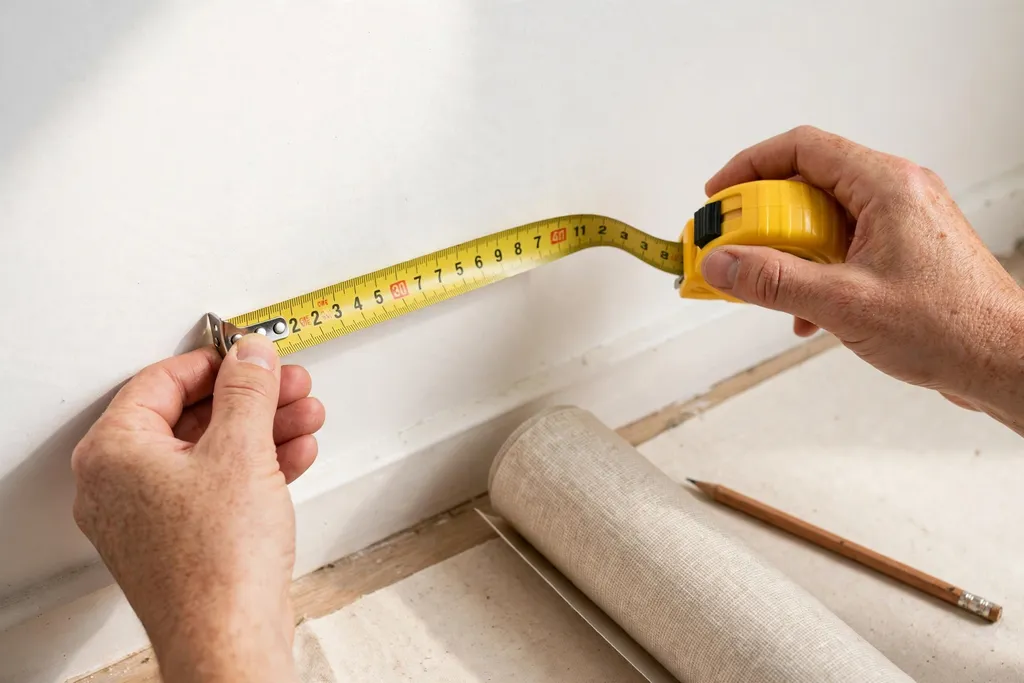
Step 1: Count your panels. Measure the wall width in inches and divide by 20.5, then round up. A 10-foot wall is 120 inches wide: 120 ÷ 20.5 = 5.85, so 6 panels.
Step 2: Count panels per roll. Divide the roll length (18 feet) by your wall height. For a standard 8-foot wall, 18 ÷ 8 = 2.25, so you get 2 full panels per roll; for a 10-foot wall, only 1.
How many rolls of renter friendly wallpaper per room
| Room | Wall size | Panels needed | Rolls to buy |
|---|---|---|---|
| Bedroom accent wall | 10 ft wide × 8 ft high | 6 | 4 (3 + 1 extra) |
| Living room sofa wall | 12 ft wide × 8 ft high | 8 | 5 (4 + 1 extra) |
| Entryway wall | 6 ft wide × 8 ft high | 4 | 3 (2 + 1 extra) |
| Bathroom accent wall | 8 ft wide × 8 ft high | 5 | 4 (3 + 1 extra) |
The extra roll is not waste. It covers pattern matching, a panel you trim wrong, and a spare strip for repairs. Unopened rolls can usually be returned; a half-finished wall cannot be fixed with a store run. Buy all your rolls from the same batch, the batch number is on the packaging, and different batches can be a shade apart. Think of it as cheap insurance for your renter friendly wallpaper project.
The Whole Project for $139
Most guides quote vague ranges, “about $100 to $300.” Here is the complete, itemized cost for one bedroom accent wall, 10 feet wide and 8 feet high, using mid-priced renter friendly peel and stick wallpaper at $28 a roll. At that price, renter friendly wallpaper beats a weekend of painting and drying time.
| Item | Cost |
|---|---|
| 4 rolls of peel-and-stick wallpaper ($28 each) | $112 |
| Plastic smoothing tool | $12 |
| Utility knife with spare blades | $9 |
| Painter’s tape (for the plumb line) | $6 |
| Total | $139 |
That is the whole project, paper, tools, and tape, for $139, under the $150 mark, with the extra roll included. For $139, renter friendly wallpaper is the cheapest room transformation in this guide.
The cheapest path: $99. If your pattern is a stripe or a small repeat that needs no matching, skip the extra roll and buy 3 rolls for $84. Swap the smoothing tool for an old credit card and you are at $84 + $9 for the knife + $6 for tape = $99. The trade-off: with no spare roll, one bad cut means a store run. For a first project, the $139 plan is the safer spend.
Bedroom: The Accent Wall Behind Your Bed
Measurements: For a queen bed, the wall is usually 10 to 12 feet wide. Paper the full width, floor to ceiling, stopping at the edges of the bed looks unfinished. Keep the headboard 2 to 3 inches off the wall, and hang art with its center 57 to 60 inches from the floor.
The one-wall rule: Paper one wall only. In a room under 150 square feet, a second papered wall stops feeling cozy and starts feeling crowded. Want more pattern? Put it on a small surface, a closet back or a bookshelf interior, instead of a second wall.
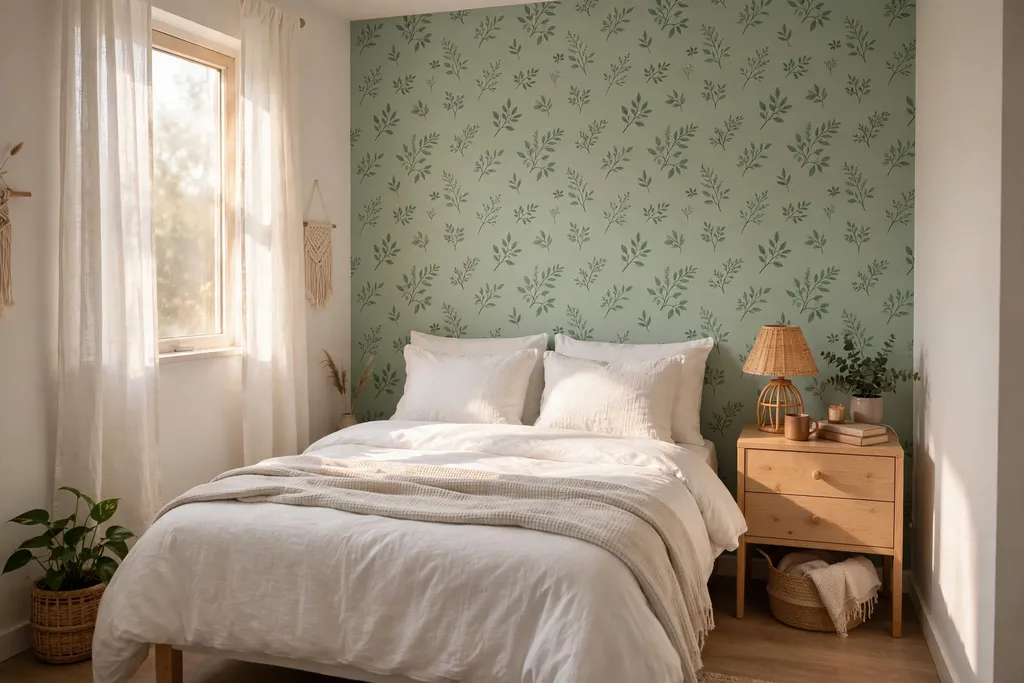
Which patterns work: In a small bedroom, a small or medium pattern reads bigger than a large one. Soft botanicals, thin stripes, and small geometrics open the room up; a huge dark floral closes it in. Patterned bedding? Choose a quiet paper. Plain bedding? Let the wallpaper carry the pattern. Keep the scale small and renter friendly wallpaper will make the room feel larger, not busier.
Living Room: The Wall Behind Your Sofa
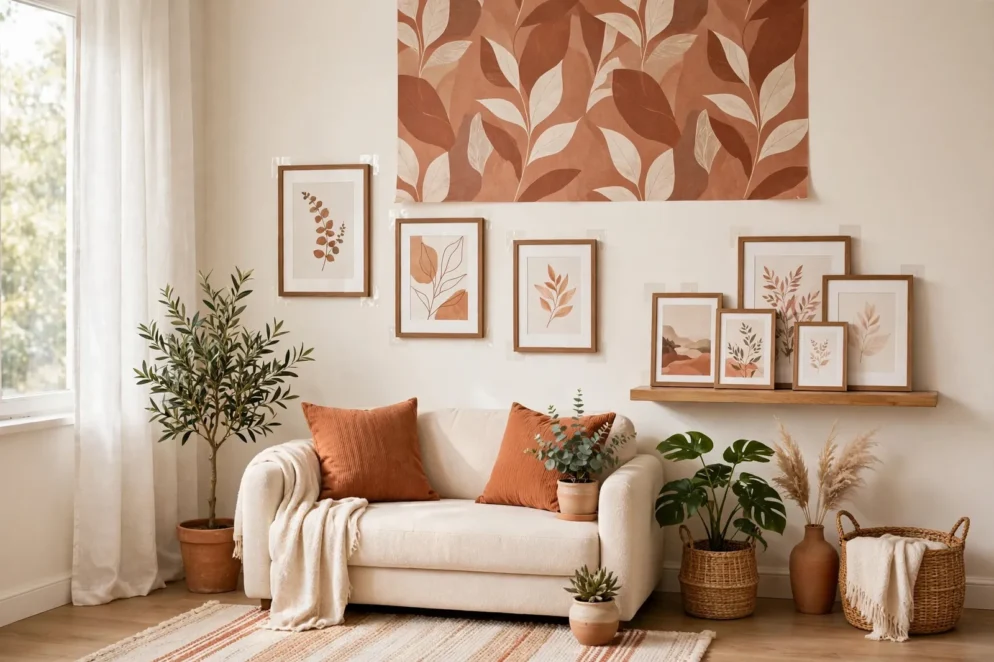
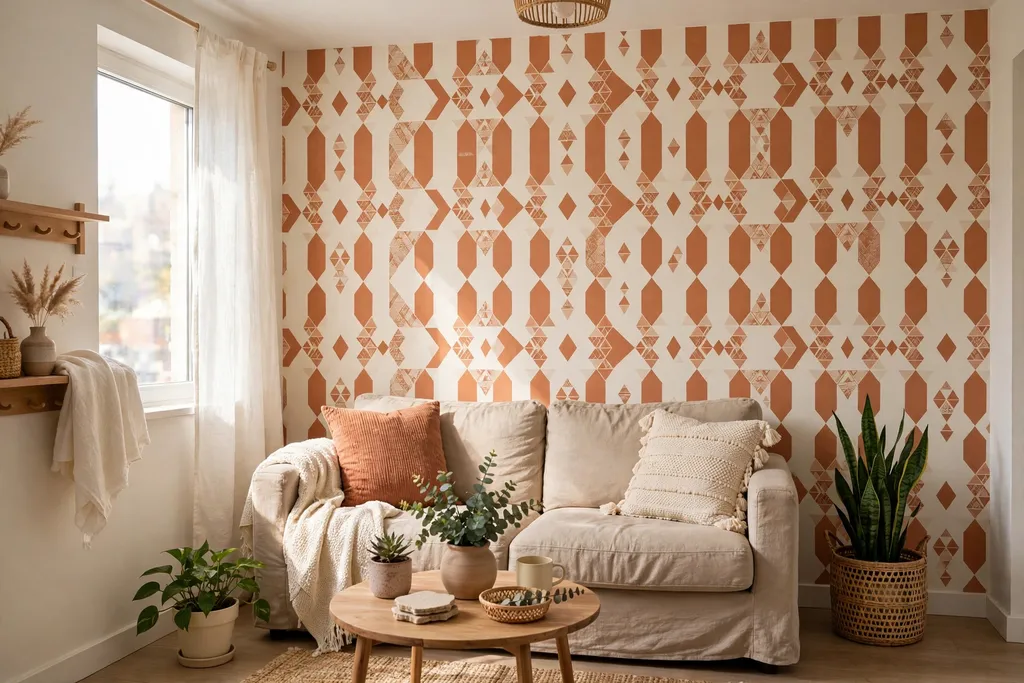
The sofa wall is the living room’s stage, the wall you face when you walk in and the wall behind you in every photo. One papered wall here does more than any single piece of furniture. Done well, renter friendly wallpaper is the room’s focal point, not just a backdrop.
Measurements: A standard sofa is 7 to 8 feet long, so the wall behind it is usually 11 to 12 feet wide. For a 12-foot wall, 8 feet high, you need 8 panels, 4 rolls plus 1 extra, 5 rolls total. Keep the sofa 2 to 3 inches off the wall so you can reach behind it at removal. Mounting a TV? Put the screws into the studs, the paper will need a patch when the TV comes down.
Which patterns work: Go bolder here than in the bedroom, the living room is bigger and gets more light. A warm geometric, a grasscloth-look texture, or a mid-scale botanical all work. Keep the other walls plain and let the paper be the only pattern, then repeat one color from it in a pillow or curtain.
For more no-damage ideas that pair with a papered wall, see our guide to rental-friendly wall decor.
Entryway: A Narrow Wall, a Big First Impression
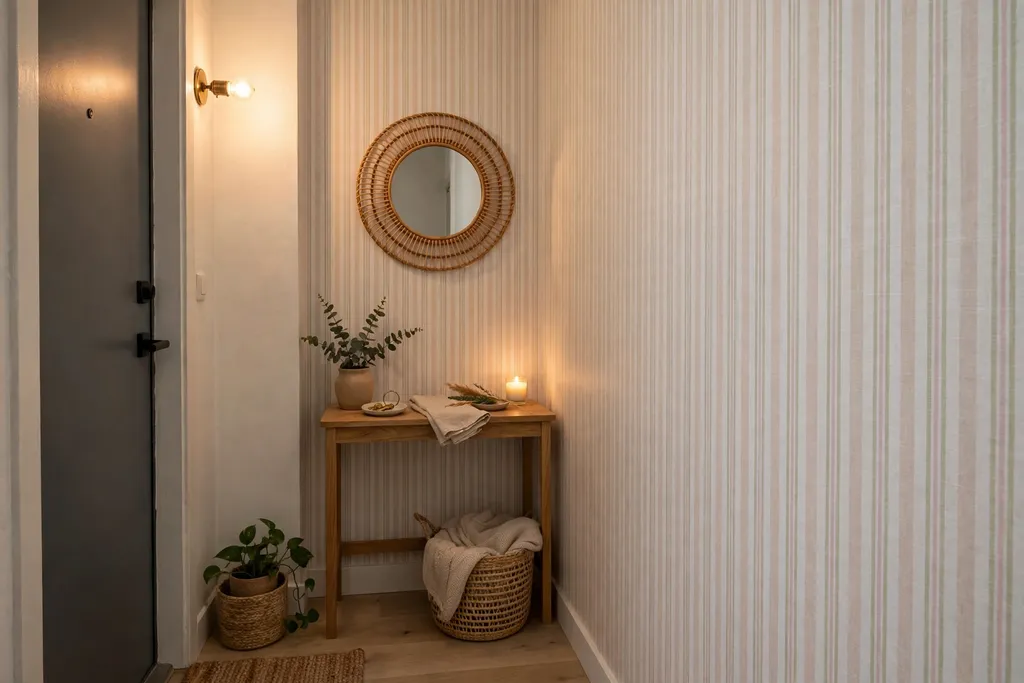
The entryway is the smallest room in the apartment and the one every guest sees first, the best return on a single roll of wallpaper. A narrow wall needs only 3 rolls, and the whole project takes about an hour.
Measurements: Most entryway walls are 5 to 7 feet wide and 8 feet high. A 6-foot wall needs 4 panels, 2 rolls plus 1 extra. Paper the wall you face when you walk in, not the wall behind the door, where it gets scuffed daily. If your entryway is a hallway, paper one long wall only and stop at the doorway trim so the edge looks intentional.
What to put on it: A small console table 10 to 12 inches deep, a round mirror 24 to 30 inches across hung with its center 57 to 60 inches from the floor, and one basket underneath. That is the whole entryway, the wallpaper does the decorating; the furniture just holds your keys.
For the full entryway plan, console, mirror, lighting, and storage, see our entryway wall decor ideas.
Bathroom: Where It Works, and Where It Doesn’t
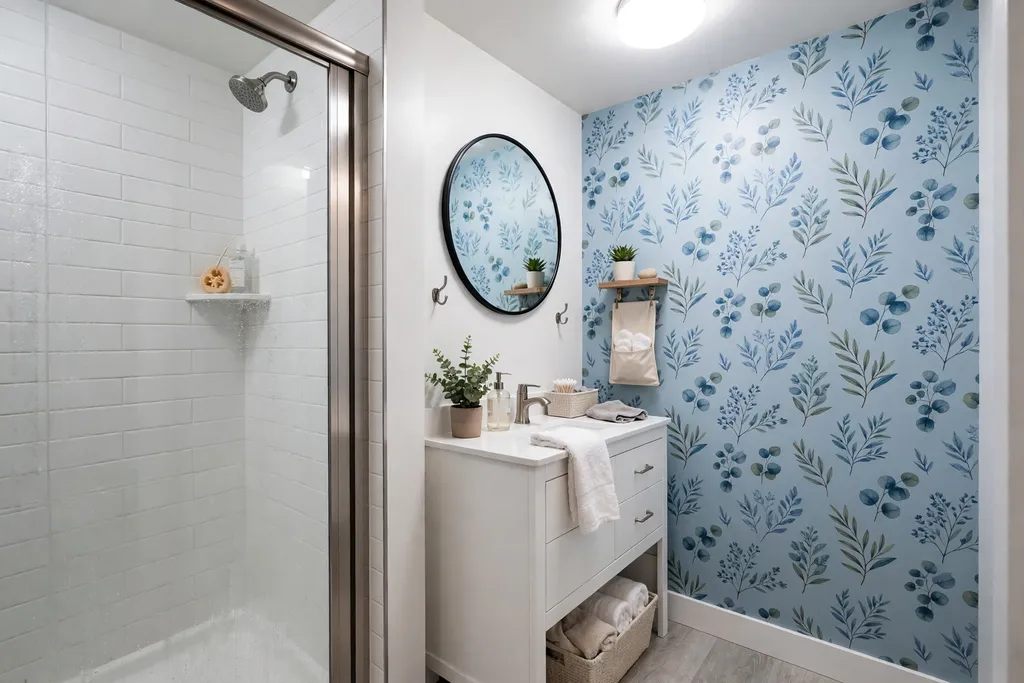
The bathroom is the one room where peel-and-stick wallpaper can go wrong, so the rules here are stricter. Used correctly, it turns a plain rental bathroom into the prettiest room in the apartment. Used wrong, it peels, bubbles, or traps moisture. Get the rules right and renter friendly wallpaper earns its place here; get them wrong and it peels.
Where it works: The wall opposite the shower or tub, the wall behind the vanity mirror, and the upper half of any dry wall. These spots get steam but not direct water, and vinyl handles that fine. A small bathroom needs only 3 to 4 rolls for one 8-foot wall, and a light pattern makes the room feel bigger.
Where it does not work: Inside the shower, on the wall directly above the tub, or on any surface that gets splashed daily. No peel-and-stick paper is made for that, and water will find the seams. Also skip the wall behind a radiator or heat vent, heat softens the adhesive and the paper will sag.
The bathroom rules:
- Vinyl only. Paper-based peel-and-stick absorbs moisture and will not survive. Check the label for “vinyl” and “moisture resistant.”
- Keep 3 feet from the shower or tub edge. If the wall is closer, paper a different wall.
- Run the fan for 30 minutes after every shower. Ventilation keeps the paper stuck and the wall dry behind it.
- Let the paint cure first. If the bathroom was freshly painted, wait a full 30 days, steam plus uncured paint is the fastest way to pull paint off at removal.
- Seal the edges. Run a thin line of clear, removable caulk along the bottom edge where the paper meets tile or tub, so steam cannot creep underneath.
Small Surfaces That Punch Above Their Size
You do not need a full wall to get the effect. Small surfaces use a single roll, take under an hour, and are the safest place to try a bold pattern. Each one is a low-risk way to try renter friendly wallpaper before committing to a wall.
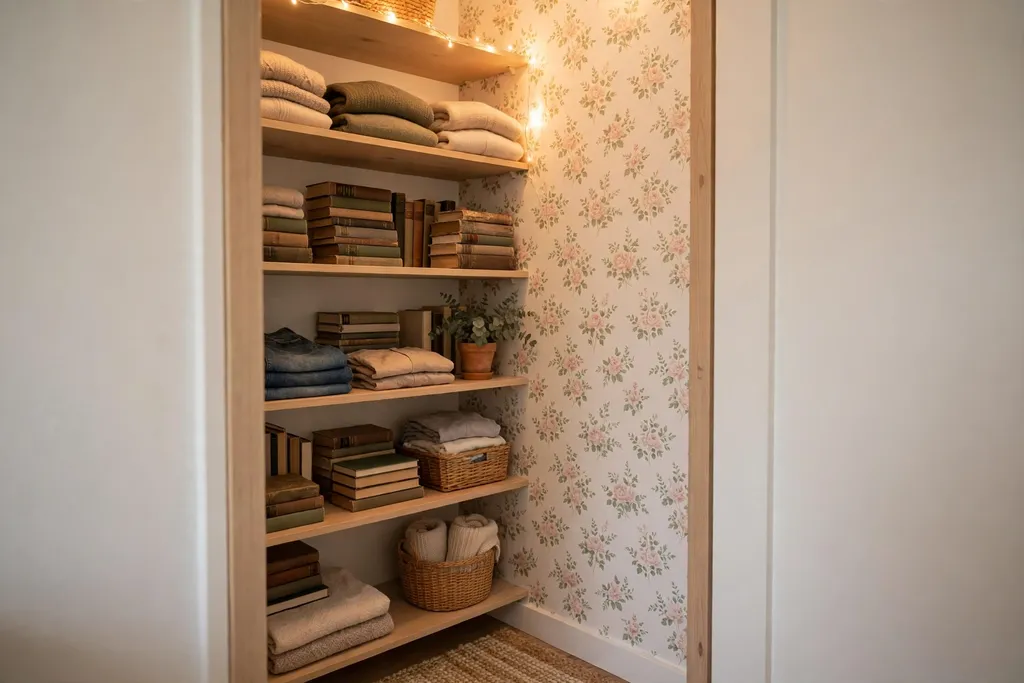
- Closet backs. One roll papers the back wall of a reach-in closet, open the door and the pattern is a surprise; close it and the room stays calm. Measure the closet interior, usually 4 to 5 feet wide and 8 feet high, and cut two panels.
- Bookshelf and bookcase backs. Remove the shelves, paper the back panel, and put the shelves back, the pattern shows between your books and makes a plain bookcase look custom. One roll covers two standard bookcases.
- Drawer bottoms and door panels. Line a dresser drawer or a flat interior door panel with a small-scale pattern, invisible most of the time, delightful every time you open it.
- A framed panel. If your walls are textured or your lease is strict, paper a lightweight foam board or thin plywood panel, 24 by 36 inches is a good size, and lean it on a dresser or hang it with removable hooks. A wallpaper moment with zero wall contact, and it moves with you.
- Stair risers. In a townhouse rental, one roll covers the risers of a short flight. Measure each riser, usually 7 inches high and 36 inches wide, and cut strips to fit.
How to Pick the Right Roll
The pattern you love and the pattern that is easy to install are not always the same. Three numbers on the packaging decide how much you buy and how hard the install will be. Get these three numbers right and your renter friendly wallpaper goes up straight and stays put.
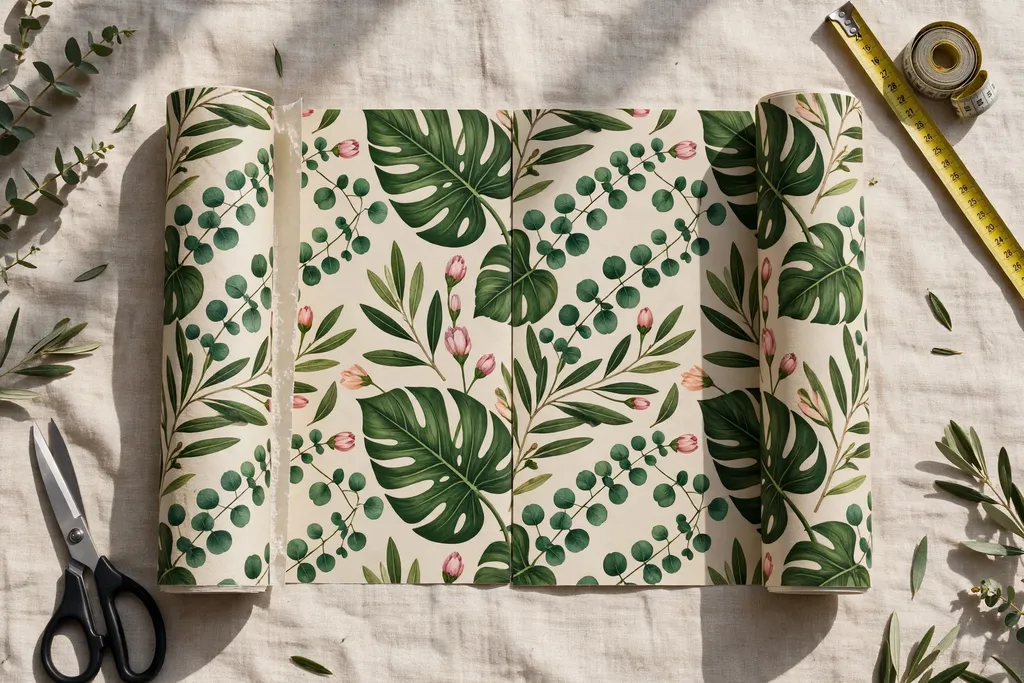
Pattern repeat. This is the distance before the pattern starts over, printed on every roll. A small repeat (under 12 inches) wastes almost nothing. A large repeat (21 inches or more) wastes up to 8 inches per panel, because each new panel must start at the same point in the pattern. Worked example: a 10-foot wall needs 6 panels, and 6 panels × 8 inches of waste = 48 inches, 4 feet of paper, roughly one extra roll. Large repeats get the 20 percent extra rule; small repeats get 10 percent.
Roll size. Do not compare rolls by price alone, compare by coverage. A standard roll is 20.5 inches wide and 18 feet long, about 30.75 square feet. Some premium rolls are only 16.5 feet long, which covers less. Always check the square footage, not the roll count.
Material. Vinyl is the default for renters: wipeable, forgiving, and the easiest to remove. Paper-based peel-and-stick looks softer but tears more easily and hates bathrooms. First project? Choose vinyl.
Color and scale for small rooms. Light colors and small-to-medium patterns make a room feel larger. Dark, large-scale patterns make it feel smaller and moodier, beautiful in a big living room, heavy in a 10-by-10 bedroom. Love a dark pattern? Use it on one wall in your brightest room.
What to Do About Textured Walls
Texture is the single biggest reason peel-and-stick wallpaper fails in rentals, and the advice online is confusing, because “textured” covers everything from faint orange peel to heavy popcorn. Here is the decision table. Knowing your texture before you buy renter friendly wallpaper saves the most common failure.
| Wall texture | Can you paper it? | What to do |
|---|---|---|
| Smooth or light orange peel | Yes | Paper after a 48-hour test patch |
| Eggshell or satin paint | Yes | Paper directly; satin and eggshell release best |
| Knockdown texture | Maybe | Test patch for a week; if edges lift, do not paper |
| Sand swirl | No | Use a framed panel or furniture backs |
| Popcorn texture | No | Do not paper; use a framed panel or closet door |
| Flat or matte paint | Risky | Test patch for a week; flat paint grips adhesive hard |
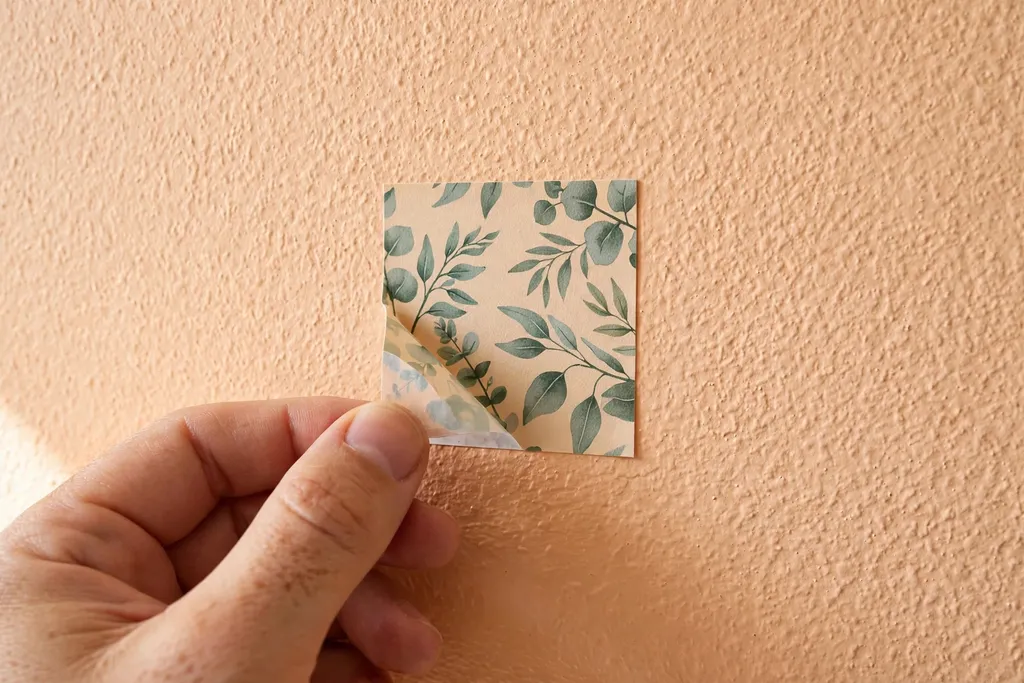
The test patch, done right: Cut a 10-by-10-inch square and stick it on a hidden spot, behind a door, inside a closet, low behind furniture. Leave it 48 hours on smooth walls, a full week on textured or flat-painted walls. Then peel it off slowly at a low angle. If the paint comes with it, the wall is not ready. If the paper lifts at the edges, the texture is too heavy. If it peels clean, you are good to go.
The workaround when the answer is no: Paper a smooth surface instead, a flat closet door, a bookshelf back, or a foam board panel leaned on a dresser. A 24-by-36-inch framed panel costs under $25 to make and moves with you.
Fresh paint is a different problem. Paint must cure for at least 30 days before you apply peel-and-stick paper, paper applied at 22 days has pulled paint off the wall. If you do not know when the walls were last painted, ask your landlord and test for a full week.
How to Install It So It Stays Put, and Comes Off
A good install is a good removal. Every step below protects the wall underneath as much as it makes the paper look good. Follow them and your renter friendly wallpaper comes off as cleanly as it went on.
1. Check the lease and the paint. Confirm your lease allows removable wallpaper and the paint has cured for at least 30 days. Wipe the wall with a damp cloth and let it dry for 24 hours, paper over dust peels within weeks.
2. Draw a plumb line. Walls are never perfectly straight, so do not trust the ceiling or the corner. Use a level and pencil to draw a vertical line 20 inches from your starting corner and line up your first panel to it, a crooked first panel means crooked panels after it.
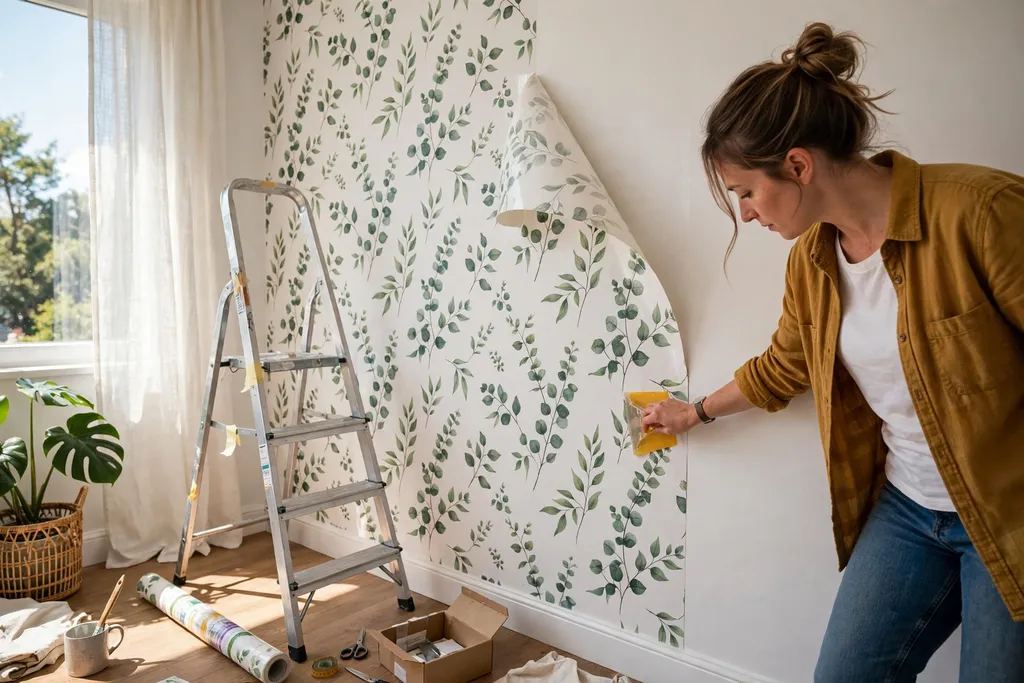
3. Peel a little at a time. Peel back 10 to 12 inches of backing at the top, stick the top edge in place, and smooth downward, then peel the next section and keep going. Peeling the whole backing off at once is how paper sticks to itself and creases.
4. Smooth from the center out. Push air bubbles toward the nearest edge with the smoother or an old credit card. Small bubbles usually disappear within a day or two, do not puncture them.
5. Match the pattern at the seam. Butt the next panel tight against the first, lining up the pattern before you smooth it down. Do not overlap the seams, overlapped edges catch dust and peel first. If a seam will not line up, peel the panel back and reposition it; you can lift and restick a panel two or three times.
6. Trim at the edges. Use a sharp utility knife and a straight edge to trim the excess at the ceiling, the baseboard, and around outlets. Change the blade often, a dull blade tears. For outlets, switch the power off at the breaker first, then cut a small X and fold the flaps back. Run the smoother along every edge and seam one final time; edges not pressed down on day one lift in month three.
How to Remove Peel-and-Stick Wallpaper Without Damage
This is the part your deposit depends on, and it rewards patience more than strength. Plan on 30 to 45 minutes for one accent wall. For the same method shown step by step, see the WallpaperMural removal guide.
Step 1: Start at a top corner. Pick a seam or a top corner, never start in the middle of a panel. Lift a small flap with your fingernail or a plastic scraper, never metal on drywall.
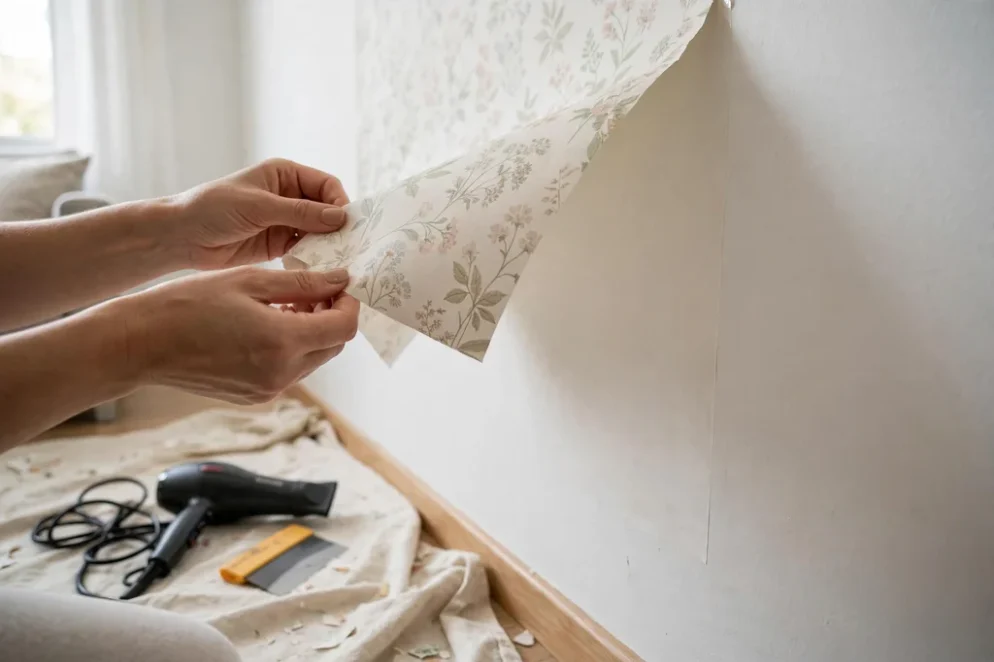
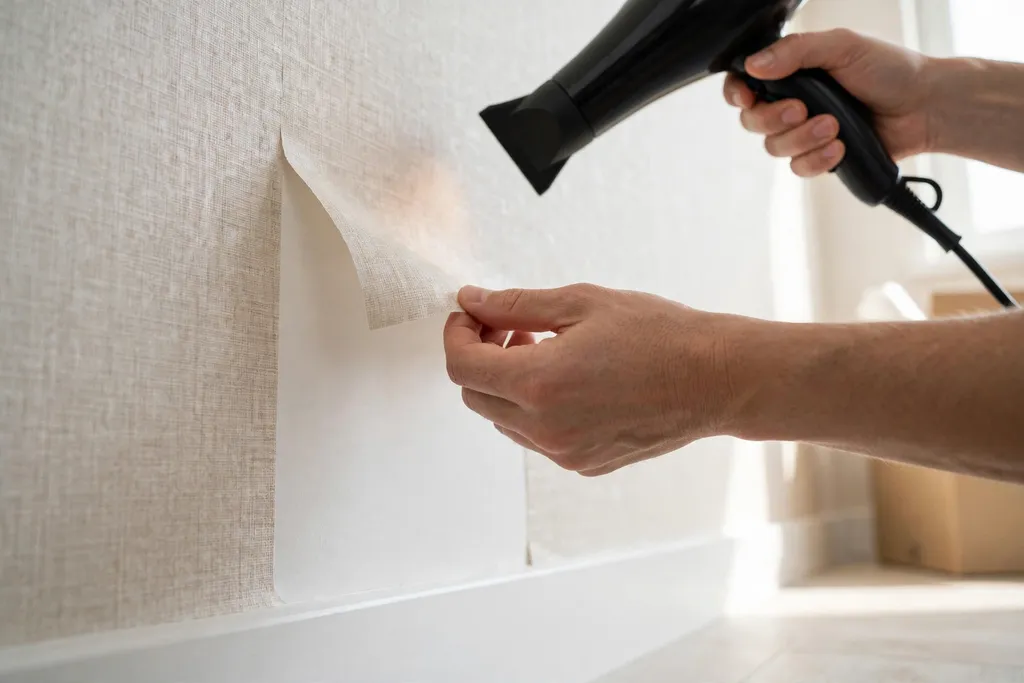
Step 2: Warm it first. Hold a hair dryer on medium heat 6 to 8 inches away and warm one section for 10 to 15 seconds, heat softens the adhesive so the paper releases instead of pulling. Work in 18 to 24 inch sections: warm, peel, move on.
Step 3: Peel low and slow. Pull the paper down and away from the wall at a low angle, 30 to 45 degrees, with slow, steady tension. Do not yank. If you feel resistance, stop and warm that spot again, fast peeling pulls paint.
Step 4: Corners need extra care. Do the top panel first, give corners extra heat, and support the paper with your free hand. Peel exterior corners even more slowly, they are under tension.
Step 5: Clean up residue. If sticky residue remains, start with warm soapy water and a soft cloth. If that does not work, try rubbing alcohol, then an adhesive remover. Never scrub with an abrasive pad, it scuffs paint worse than the adhesive did.
Step 6: Fix small damage immediately. A small paint lift is a five-minute repair: a dab of spackle, a light sanding once dry, and a feathered touch-up of paint. Do it before your move-out inspection, not after the landlord finds it. Keep before-and-after photos as proof.
If the paper tears mid-peel, press a strip of painter’s tape over the torn edge to make a new flap, warm it, and start again. If drywall paper bubbles up, stop, score it flush and repair it with spackle.
The Landlord and Deposit Checklist
A little paperwork before you start saves an argument at move-out. Do these five things and walk into inspection with proof, not promises.
- Read the lease. Look for “wallpaper,” “adhesive,” “alterations,” and “decorations.” Many leases ban permanent wallpaper but say nothing about removable paper, get it in writing anyway.
- Email your landlord. One short email: the product name, the words “removable peel-and-stick,” the room, and a promise to remove it and restore the wall before move-out. Written approval beats a verbal “sure.”
- Take dated before photos. Photograph every wall you plan to paper, close up and wide, and note the paint finish and last paint date if your landlord knows it.
- Remove it early. Take the paper down 7 to 14 days before your move-out inspection, not the night before, that leaves time to fix any small paint lift and let touch-up paint dry.
- Take dated after photos. Photograph the same walls after removal and any repairs, if the landlord claims damage later, your before-and-after photos settle it.
If paint lifts anyway: Stop peeling, warm the area more, and peel even slower. Repair the spot with spackle and a feathered touch-up, and tell your landlord before the inspection. A small, disclosed repair costs a $6 tube of spackle.
7 Mistakes That Cost Renters Their Deposit
- Skipping the test patch. The patch takes a week and costs one square of paper; skipping it can cost a wall of paint.
- Papering fresh paint. Paint needs 30 days to cure, paper applied sooner can pull paint off at removal.
- Ripping the paper off fast. Speed is the top cause of paint damage at removal. Low angle, slow pull, heat first.
- Ignoring the pattern repeat. A large repeat wastes up to 8 inches per panel. Buy the extra roll or choose a smaller repeat.
- Papering heavy texture without testing. Knockdown, sand swirl, and popcorn hold adhesive in every dip. Test for a week or use a panel workaround.
- Putting paper where steam and heat live. Inside the shower, above the tub, next to the stove, behind a radiator, heat and steam bond adhesive harder and shorten the paper’s life.
- Buying rolls from different batches. Two batches can be a shade apart, and the seam will show it. Buy every roll at once and check the batch numbers.
Frequently Asked Questions
Is peel-and-stick wallpaper renter friendly?
Yes, if it is labeled removable or low-tack and you test it on your walls first. Peel-and-stick vinyl with a removable adhesive is designed to come off cleanly. Permanent-adhesive and high-tack papers are not renter friendly.
Is peel and stick wallpaper apartment safe?
Yes, for most apartments. It will not damage walls applied to cured paint on a smooth or lightly textured surface and removed slowly with heat. The exceptions: fresh paint under 30 days old, heavy texture, untested flat paint.
Will removable wallpaper damage the paint or wall?
It can, but usually does not when conditions are right. Risk is highest on fresh, old, or peeling paint, flat or matte finishes, and heavy texture. A test patch left for a week tells you how your walls will behave.
Does renter friendly wallpaper really come off without damage?
Yes, if you remove it the right way: warm each section with a hair dryer for 10 to 15 seconds, peel at a low 30 to 45 degree angle, and pull slowly. Most damage happens when people skip the heat and yank the paper off.
Can you put wallpaper in an apartment without asking the landlord?
You can in many leases, since removable wallpaper is not a permanent alteration, but ask anyway. One short email naming the product and promising removal before move-out takes two minutes and protects you.
How long does renter friendly wallpaper last?
Two to five years on a dry interior wall. Sun-facing walls and steamy bathrooms shorten its life, because heat makes the adhesive bond harder over time, remove it before it gets harder to peel.
Can you use removable wallpaper in a bathroom or kitchen?
Yes, with limits. In a bathroom, use vinyl only, keep it at least 3 feet from the shower or tub, and run the fan for 30 minutes after every shower. In a kitchen, keep it off the wall behind the stove. Never put it inside a shower.
What is the difference between temporary and removable wallpaper?
The terms are used almost interchangeably. “Temporary” describes how long you keep it up; “removable” describes the adhesive, a low-tack glue made to release cleanly. What matters is the adhesive type on the label.
Can you reuse peel and stick wallpaper when you move?
Sometimes. Peel it off slowly with heat and, if the adhesive is still tacky, stick the backing paper back on, roll it loosely, and store it flat in a dry place. Large panels reuse better than small ones, and paper up for years usually will not restick.
What is the best renter friendly wallpaper for a small space?
A light-colored vinyl peel-and-stick with a small or medium pattern repeat. Light colors and small patterns make a room feel larger, vinyl handles humidity and wipes clean, and a small repeat wastes less paper. Paper one accent wall.
Where can I buy renter friendly wallpaper pieces on a budget?
Big-box stores, home improvement stores, and online retailers carry budget rolls in the $23 to $35 range. Buy sample squares first, a $5 sample saves a $30 mistake, and check the return policy before you open the rolls.
How much does a renter friendly wallpaper makeover cost?
One accent wall costs about $99 to $139 including tools, as the table above shows. A whole small room with two papered walls runs $200 to $300. The paper is the main cost: $23 to $35 per roll for budget options, $45 to $96 for premium brands.
Can I create renter friendly wallpaper on a budget?
Yes. Choose a stripe or small-repeat pattern so you need no extra roll for matching, paper one wall instead of a room, use an old credit card instead of a smoothing tool, and start with a small surface like a bookshelf back. The cheapest finished accent wall here: $99.
Is renter friendly wallpaper worth it in a small space?
Yes, one of the highest-impact changes you can make in a small rental. One wall changes how the whole room feels, it costs under $150, it takes an afternoon, and it comes off when you leave. Few renter projects give that much change for so little money and risk.
Is renter friendly wallpaper a good idea for a rental?
Yes, if you follow the system: check the lease, get written approval, test a patch, apply it to cured paint, and remove it slowly with heat before move-out. Renters who lose deposits skip the test patch and rip the paper off the night before.
What is the best temporary wallpaper for renters?
The best temporary wallpaper for renters, the best peel and stick wallpaper renter friendly option, is a low-tack vinyl in a light color with a small pattern repeat. Vinyl is wipeable and releases cleanly, and a small repeat wastes the least paper. Check the label for “removable” and confirm the roll size before comparing prices.
What is a renter friendly backsplash?
A renter friendly backsplash is a removable covering for the wall behind a sink or counter, usually peel-and-stick vinyl wallpaper or removable tile decals, that protects the wall from splashes and peels off without damage. Keep it away from stove heat and seal the bottom edge.
Can renters use peel and stick floor tiles?
It is risky, and most guides advise against it. Floor tiles use a stronger adhesive than wall paper because they take foot traffic, and it can bond hard to the floor over time. If your lease is strict about floors, skip them and use a rug instead.
How many rolls do I need for one accent wall?
Two to three rolls for most accent walls, plus one extra for pattern matching, 3 to 4 rolls total. A 10-foot-wide, 8-foot-high wall needs 6 panels: 3 rolls plus 1 extra. A 12-foot wall needs 5 rolls. Measure your wall, divide the width by 20.5, and round up.
What should I check before buying wallpaper on sale?
Four things: the pattern repeat (large repeats waste paper), the roll size (compare square footage, not price), the material (vinyl for bathrooms and kitchens), and the return policy. Check that all rolls share the same batch number and the adhesive is labeled removable.
Can you paint over peel-and-stick wallpaper instead of removing it?
You can, but it defeats the purpose in a rental. Painted-over paper is much harder to remove later, and your landlord will almost certainly count it as damage. Tired of the pattern? Peel it off and start fresh.
Does a wallpaper steamer or fabric softener work for removal?
A steamer works on traditional pasted wallpaper, but it is overkill, and risky, for peel-and-stick: steam can soften drywall and loosen paint. Fabric softener leaves a residue that makes touch-up paint fail. A hair dryer, warm water, and patience do the job.
Can you remove peel and stick wallpaper without a hairdryer or heat gun?
Yes. Peel slowly at a low angle, work in small sections, and use warm water from a spray bottle on stubborn spots. It takes longer than the hair dryer method, but it works. Skip the heat gun, it gets hot enough to damage paint.
Is it harder to remove peel and stick wallpaper in cold weather?
Yes. Cold adhesive gets stiff and grips harder, so the paper is more likely to tear or pull paint. Warm the room first, then warm each section with a hair dryer for 10 to 15 seconds before peeling. Never remove paper in an unheated room.
Will removal leave a color stain on light paint?
It can leave a faint shadow line where the paper’s edge sat, because the covered paint fades less than the exposed paint around it. The line usually fades within a few weeks. If not, a light wash with warm soapy water, or one feathered coat of touch-up paint, takes care of it.
Start Today: Your One-Wall Weekend Plan
You do not need a renovation. You need one wall, one afternoon, and a plan. Measure your bedroom wall tonight, width in inches, divided by 20.5, rounded up, then order your rolls. Test-patch a hidden spot while they ship, and by Saturday you will be smoothing the first panel into place. Two hours later, the room you have been staring at looks like yours. And when moving day comes, warm it, peel it slow, and walk out with your deposit intact. That is what renter friendly wallpaper is for: a home that feels like yours while you live in it, and a clean goodbye.