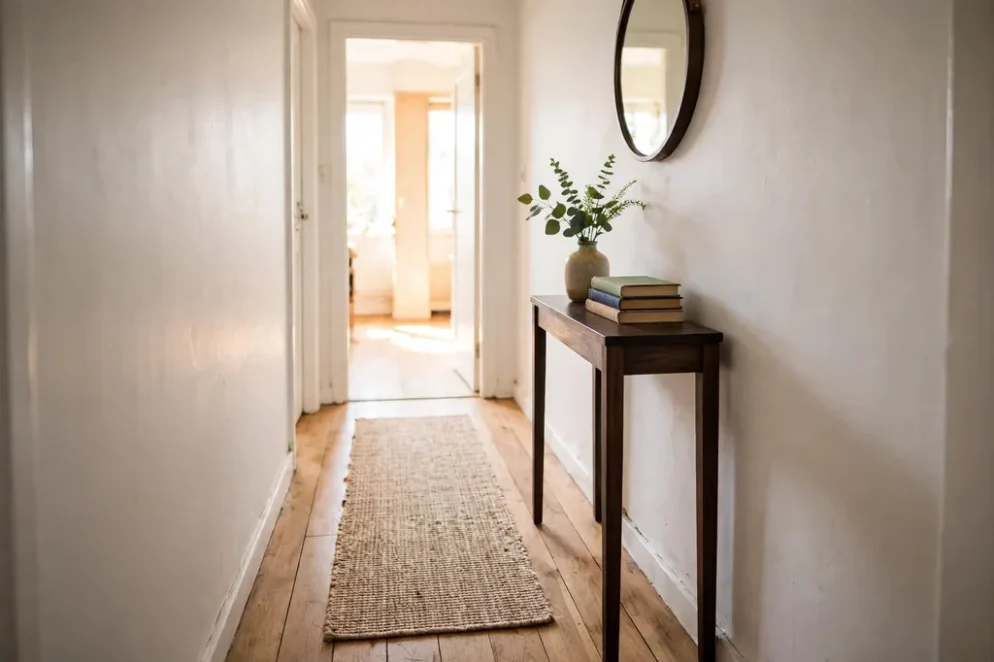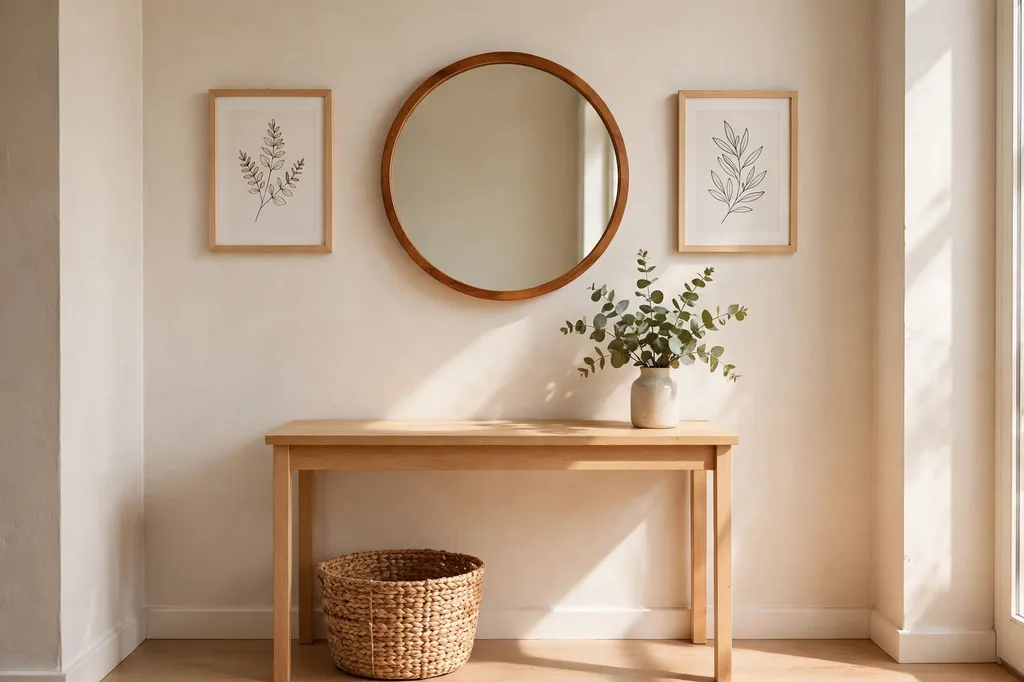
Entryway wall decor is the first thing anyone sees when they walk into your home, and in a small entryway, the wall is the only surface you can decorate without stealing floor space. The wall has to do the work: one mirror, a few frames, hooks that hold real things, and nothing that sticks out into the walkway.
This guide gives you 7 entryway wall decor ideas with exact measurements: how high to hang art, how wide it should be, how far apart frames go, and what it all costs. Every idea is renter-friendly, strips, hooks, and leaning pieces, no drilling, and the whole wall comes in under $150. For the full entryway plan, the console, the bench, the rug, and the 8 setups, see Entryway Decor Ideas for Small Spaces.
Table of Contents
The numbers first
Best for: every idea in this guide, measure the wall before you buy anything.
Five numbers decide whether entry wall decor works in a small space: Keep these five numbers handy whenever you plan entryway wall decor for a small wall.
- Center height: hang art and mirrors so the center of the piece sits 57 to 60 inches from the floor. That is eye level for most adults, and it is the one number every source agrees on. Note it carefully: 57 to 60 inches is the height of the center, not the bottom edge. A frame whose bottom edge sits at 57 inches hangs far too high. Framebridge confirms the same 57-inch center rule for entryway wall decor in its framing guide.
- Width rule: a piece or grouping above a console table should span about two-thirds of the table’s width. On a 36-inch console, that is art about 24 inches wide. Narrower looks stranded; wider crowds the edges. That is the first rule of entry wall art: size it to the furniture, not to the wall.
- Gap above furniture: leave 6 to 10 inches between the top of a console or bench and the bottom of the frame above it. A mirror can sit a little lower, its bottom edge 4 to 6 inches above the tabletop. Closer and the art crowds the table; higher and it floats away from it.
- Frame spacing: in a gallery wall, leave 2 to 3 inches between frames. That gap is in inches, not centimeters, two to three centimeters would push the frames so close together they touch.
Measure the wall, the console, and the distance to the nearest door swing before you buy anything. Measuring first is what makes entryway wall decor look intentional instead of improvised.
1. One anchor mirror
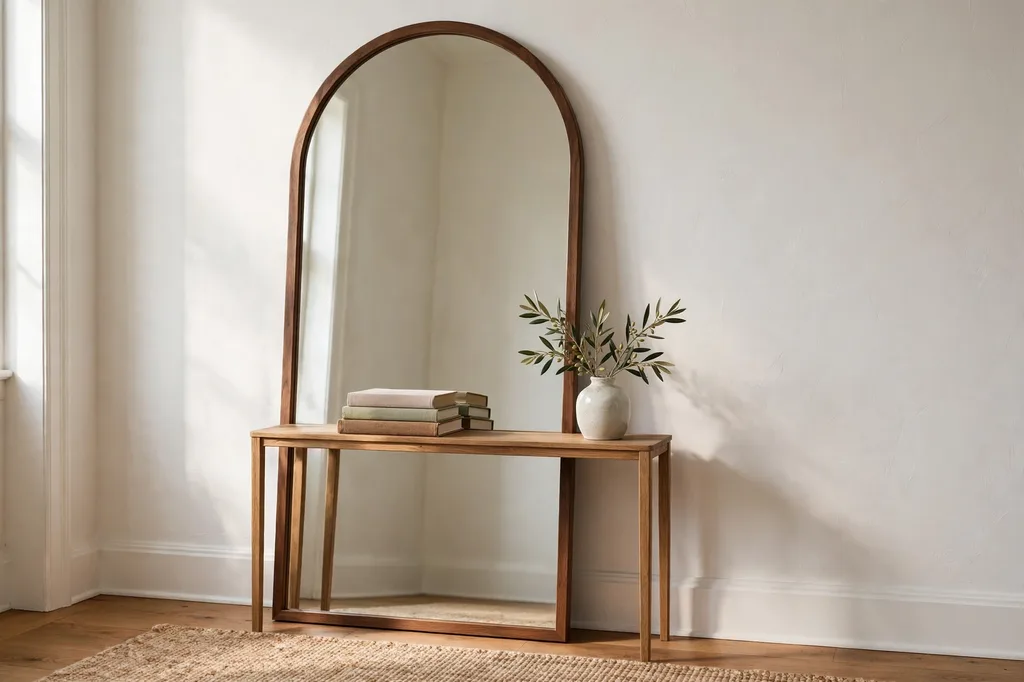
Best for: the focal point, one mirror does the work of five small things.
A large mirror is the single best anchor for a small entryway wall. It fills the vertical space above the console, it throws light down the hall, and it makes a narrow entry feel twice as wide. A mirror 24 by 36 inches or larger is the right size for a small entry, smaller than that looks like a bathroom mirror, and it will not anchor the wall. That single choice sets the tone for the rest of your entryway wall decor.
- Size: the mirror should be about two-thirds of the console’s width and at least 24 inches tall. On a 36-inch console, a 24-inch-wide mirror is the right proportion.
- Position: hang it so its center sits 57 to 60 inches from the floor, with its bottom edge 4 to 6 inches above the console tabletop. Or lean it, a leaning mirror needs no hook at all.
- Where not to put it: do not hang a mirror directly opposite the front door. A mirror facing the door creates a tunnel effect, you see yourself the moment you walk in, and the hallway feels longer and colder. Hang it on the side wall, or opposite a window, so it bounces light instead of reflecting the door.
- What to watch: do not hang a mirror where it reflects clutter. A mirror above a console should reflect ceiling and window light, not the mess by the door. Do not pair a big mirror with a second big thing on the same wall. One anchor, then small things. A woven wall hanging is the lightweight alternative to a second mirror: a textile hangs from two small hooks instead of a heavy anchor.
Renter note: a leaning mirror needs no hook, no hole, and no permission, just floor space and a wall to lean on. A 24-inch round mirror costs $20 to $40 secondhand, $40 to $80 new. If you hang a heavy mirror instead, use a proper wall anchor, never adhesive strips. A tall leaning mirror should get an anti-tip strap at the top, fixed with a removable adhesive pad, so it cannot slide forward. A leaning mirror is one of the easiest entryway wall decor wins for renters.
2. A gallery wall that fits
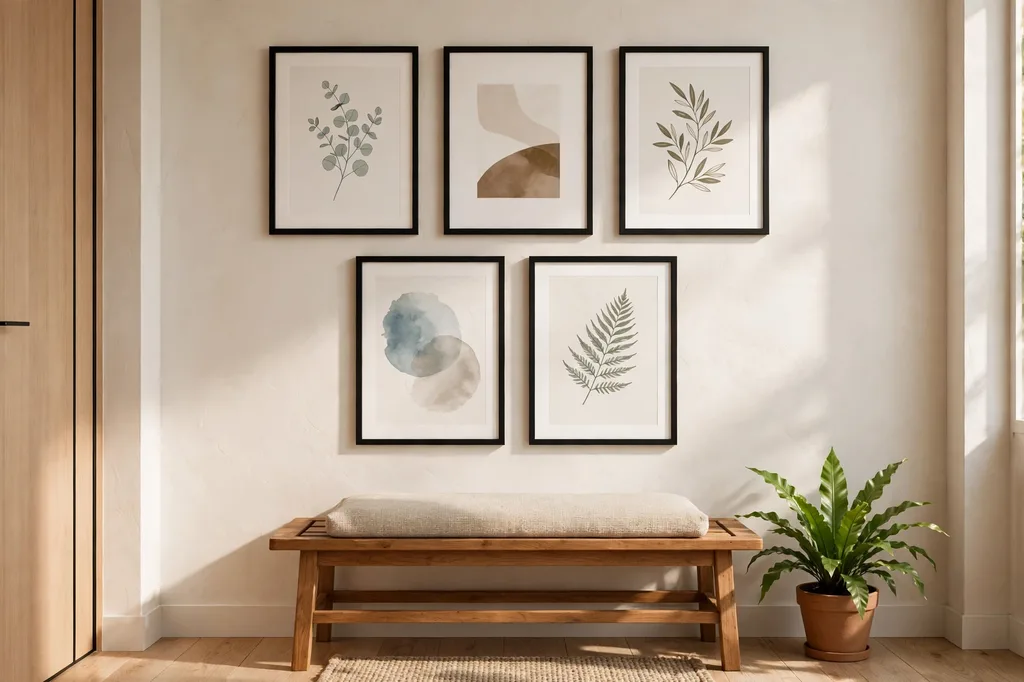
Best for: a blank wall that needs personality, a gallery wall is the only idea here that fills a wall without a single piece of furniture.
A gallery wall in a small entryway works when it is treated as one unit, not as a collection of separate frames. Three to seven pieces, one frame finish, one color story, that is the whole recipe. Ten tiny frames in five different finishes is not a gallery wall, it is a noticeboard. Treat the grouping as one piece and your entryway wall decor will read as calm, not crowded.
- How many: 3 to 7 pieces. Three frames make a clean row above a console; five make a small grid; seven is the maximum for a small wall. More than seven, and the wall reads as clutter from the doorway.
- Frame sizes: use uniform frames, all 8 by 10 inches or all 11 by 14 inches, for a grid, or mix two sizes (one 11 by 14, the rest 8 by 10) for a loose arrangement. Uniform frames look calm; mixed sizes look collected. Either works, but do not mix more than two sizes.
- Spacing: leave 2 to 3 inches between frames, and treat the whole grouping as one piece: its center sits at 57 to 60 inches from the floor, and its total width is about two-thirds of the furniture below it. On a 36-inch console, the grouping should be about 24 inches wide in total.
- Layout: for a narrow hall under 4 feet wide, use a vertical stack of 3 to 4 frames instead of a wide row. Vertical stacks are the narrow entryway decor ideas that work best here, they fit a wall a horizontal row never will. Lay the frames on the floor first and arrange them there, it is much easier to move a frame on the floor than to re-hang it.
- What to watch: do not mix more than two frame finishes. Black frames with one wood frame is a look; black, white, gold, and wood together is a yard sale. And do not hang the gallery so high that you have to step back to see it, the center of the grouping is 57 to 60 inches.
Budget: three 8 by 10 frames cost $15 to $25 with prints, and printable art costs $5 to $10 per print. A gallery wall is the cheapest personality in this guide. That low cost is why a gallery is such a popular entryway wall decor starting point.
3. A picture ledge instead of nails
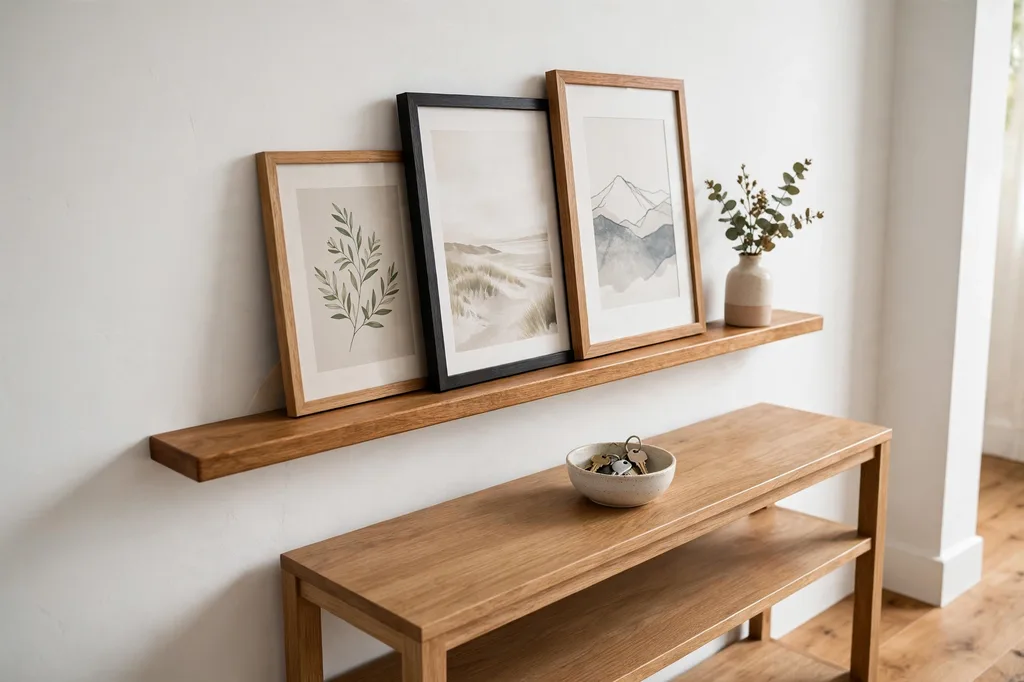
Best for: renters and changers, a ledge lets you swap art without a single new hole.
A picture ledge is a shallow shelf that holds leaning frames, and it is the best no-drill compromise on an entryway wall: one ledge, fixed once, and the art on it changes whenever you want. Frames lean on it instead of hanging from nails, so rearranging the wall takes thirty seconds instead of an afternoon with a hammer. For renters, a ledge is the most flexible entryway wall decor you can buy.
- Size: a ledge 24 to 36 inches long fits above most small consoles. In a high-traffic entryway, the ledge should be 3 to 4 inches deep, deep enough to hold a leaning frame, shallow enough that nobody brushes it walking past. A standard shelf is 10 to 12 inches deep; a ledge is not a shelf, and a deep ledge in a narrow hall is a bruised shoulder waiting to happen.
- How to build one: a 1 by 2 or 1 by 3 board, 24 to 36 inches long, with a small groove 1/4 inch from the front edge to stop frames sliding off. One board, two brackets or adhesive mounts, and paint to match the wall.
- What goes on it: two or three leaning frames (8 by 10 is the sweet spot), plus one small thing, a bud vase, a tiny ceramic, a small stack of books. Three layers is the maximum. Four layers is clutter, and a ledge full of clutter is worse than a bare wall.
- How to mount it without drilling: an adhesive-mounted ledge holds about 5 pounds per 24-inch length, enough for two or three light frames. Heavier ledges need screws into a stud, so in a rental, keep the ledge light and the frames light. Check the weight table below before you load it.
- What to watch: do not overload a ledge, one that sags in the middle will fall. And do not put anything breakable on a ledge where bags and coats swing past it every day. Paper prints and light frames only.
Budget: a ready-made 24-inch adhesive picture ledge costs $15 to $30. A DIY board ledge costs $5 to $10 in timber plus $8 to $15 in adhesive strips.
4. Hooks that do the decorating
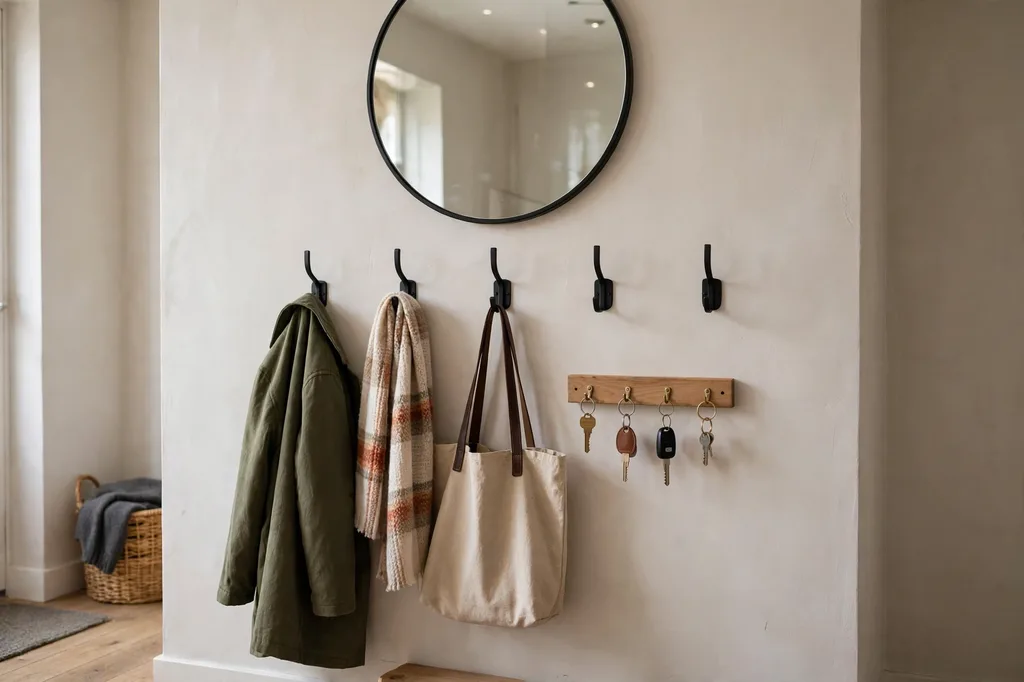
Best for: the wall that has to work, hooks are decor that holds your coat.
An entryway wall without hooks is a wall that looks nice and does nothing. Hooks are the one piece of entryway wall decor that earns its place twice: they fill the wall, and they hold the things that would otherwise pile up on the console or the floor. A row of hooks with a coat, a scarf, and a tote bag on it is a styled wall, no art required. Hooks prove that useful entryway wall decor does not have to be purely decorative.
- Height: adult coat hooks sit 60 to 66 inches high. Kids’ hooks sit 36 to 48 inches high. A key rail sits lower, at 54 to 60 inches, so keys are in reach without stretching. A hook rail mounted at 60 inches with a small shelf above it is the classic drop-zone setup.
- How many: three to five hooks on a rail 24 to 36 inches long. One hook per person, plus one spare, that is the rule. Five hooks on a 24-inch rail is crowded; three hooks on a 36-inch rail looks empty.
- Spacing: hooks 8 to 12 inches apart, so a coat on one hook does not cover the hook next to it. Leave at least 6 inches clear of door trim and light switches.
- What to hang on them: one coat, one bag, one scarf per hook, and nothing else. Keep one hook free, or the wall never looks finished.
- What to watch: do not mount hooks with adhesive rated below the load. A coat weighs 2 to 4 pounds; a wet winter coat weighs more. A large adhesive hook holds about 5 pounds, a medium one about 3, check the weight ratings table below. And do not hang a heavy bag on a small hook. It will hold for a week, then fail at 2 a.m.
Budget: a 3-hook adhesive rail costs $10 to $20. A set of adhesive hooks costs $8 to $15.
5. The modern small-wall system
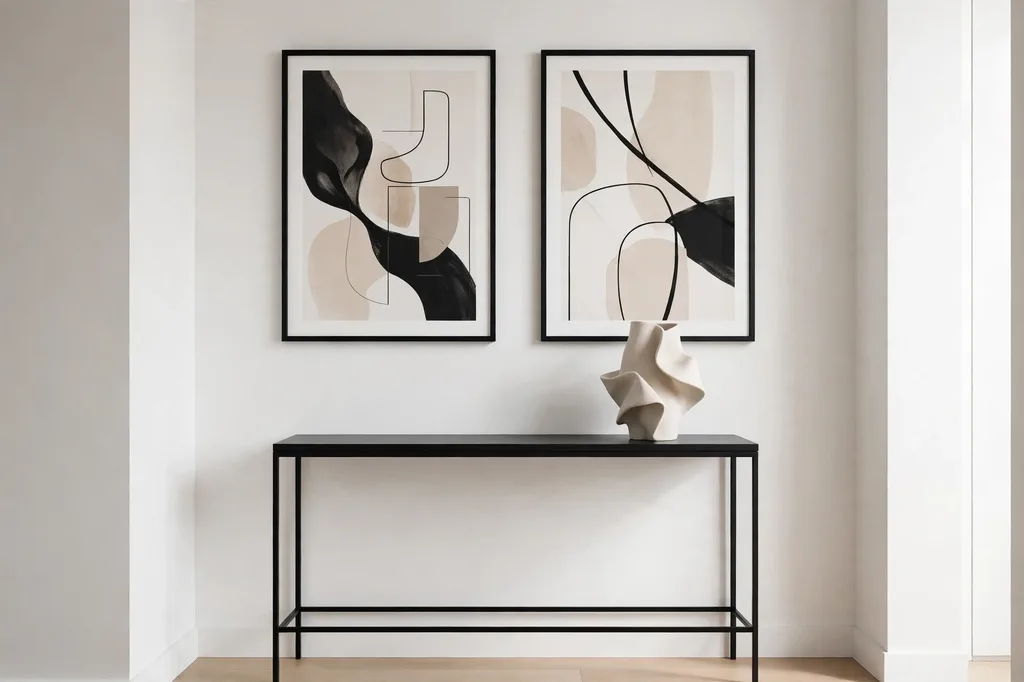
Best for: a clean, modern look in a small or narrow entry, one system, measured, no guessing.
Modern entryway wall decor is not a style label, it is a system: two large frames, one slim ledge, one round mirror, all measured to the wall. Most modern entryway photos show the look but never give the numbers. Here are the numbers. Stick to the system and the entryway wall decor stays calm even in a narrow hall.
- The frames: two frames, each 16 by 20 inches, hung side by side with 2 to 3 inches between them. Two 16-inch frames plus a 3-inch gap is 35 inches wide in total, about two-thirds of a 54-inch console, and the right width for a wall 48 to 60 inches wide. Centers at 57 to 60 inches from the floor.
- The frames themselves: black frames, white mats, one abstract print each. One frame finish, one mat color, two prints from the same series. Modern means edited, two finishes is the maximum, and one is better.
- The ledge: one slim ledge, 24 to 36 inches long and 3 to 4 inches deep, mounted 6 to 10 inches above the console. One small sculptural vase, 10 to 12 inches tall, on the ledge. Nothing else on it.
- The mirror: one round mirror, 20 to 24 inches in diameter, on the facing wall or at the end of the hall, not on the same wall as the frames. Two focal pieces on one wall fight each other; one wall, one focal piece.
- The console: a slim black metal console, 10 to 12 inches deep and 30 to 34 inches high. A deep console in a narrow entry steals the walkway; a slim one disappears against the wall.
- What to watch: do not shrink the frames to fit the wall. Two 8 by 10 frames on a 60-inch wall look like postage stamps. If the wall is wider than 60 inches, go bigger on the frames (18 by 24), not smaller. And do not add a third frame to “fill the gap”, the gap is the design.
Budget: two 16 by 20 frames with prints cost $25 to $40. A 24-inch ledge costs $15 to $30. A 20-inch round mirror costs $20 to $40. The modern system costs $60 to $110 as a set.
6. A removable wallpaper accent wall
Best for: a plain wall that needs color, wallpaper is the fastest transformation in this guide, and the removable kind comes down cleanly.
A removable wallpaper accent wall is the renter’s version of a painted feature wall: one wall, one pattern, and no paint to undo when you leave. It works best on the wall you face when you walk in, the wall that would otherwise be blank plaster. One patterned wall can carry the whole entryway wall decor scheme, so keep everything else plain.
- How much: one wall only, the wall opposite the door or the longest wall in the entry. A full entry in wallpaper is too much in a small space; one wall is a feature, four walls is a box.
- Pattern: a small-scale pattern reads better in a small entry than a large one. A large-scale print needs a large wall to breathe; on a 4-foot wall it gets cut off at the edges and looks like a mistake. Small geometrics, small botanicals, and subtle textures are the safe choices.
- How to hang it: peel-and-stick wallpaper goes up panel by panel, top to bottom, smoothing as you go. Test a small piece behind furniture first, adhesives struggle on textured walls. Leave the paper 24 to 48 hours to settle before you hang anything on top of it, and never stick adhesive strips directly onto fresh wallpaper, stick them to the painted wall beside it instead.
- What to pair it with: one mirror or one row of frames, not both. A patterned wall plus a gallery wall is two focal points on one wall, the wallpaper is the decor, the mirror or frames are the accent.
- What to watch: do not put removable wallpaper on freshly painted walls, paint needs at least 30 days to cure, or the paper will pull it off when you remove it. And do not use it on textured walls. Peel-and-stick paper needs a smooth surface; on orange-peel texture it bubbles, peels at the edges, and looks worse than the blank wall did.
Budget: one wall in a small entry takes one to two rolls of peel-and-stick wallpaper at $15 to $65 each.
7. Small entryway, no console table
Best for: the entry that is too small for furniture, when there is no room for a console, the wall is the whole entryway.
Some entries have no room for a console table at all, a door that opens straight into the living room, a hallway under 3 feet wide, a wall that is barely wider than the door itself. Most small entryway wall decor ideas assume you have a console; this one assumes you do not. In that case, skip the table entirely. A console table in a 3-foot hall steals the walkway and gets bumped every day. The wall does the whole job instead. In a doorway-only entry, entryway wall decor has to do the work of furniture, so keep it to three pieces.
- The setup: one sculptural wall hook rail (3 hooks, 24 inches long) at 60 to 66 inches, one small round mirror 16 to 20 inches in diameter above it, and one small framed print (8 by 10 inches) beside the mirror. That is the whole entryway: hooks, mirror, one print, and nothing on the floor.
- The mirror: a 16 to 20-inch round mirror is the right size for small entryway wall decor with no console below it. Bigger than 24 inches overwhelms a narrow wall; smaller than 16 inches looks like a hand mirror. Center at 57 to 60 inches from the floor.
- The hooks: three hooks, 8 to 12 inches apart, at 60 to 66 inches high. One hook for a coat, one for a bag, one free, and a key hook lower, at 54 inches.
- The print: one framed print, 8 by 10 inches, hung 2 to 3 inches from the mirror’s edge, its center at the same 57 to 60-inch height. One print, not a gallery, a gallery needs a wall wider than the door, and this wall is not.
- What to watch: do not add a floating shelf to “make up” for the missing console. A shelf at console height in a 3-foot hall is a shelf at hip height in a walkway, it will be bumped, and everything on it will fall. If you need a surface, use a wall-mounted key rail with a 2-inch lip, not a shelf. And do not hang the mirror opposite the front door, on a wall this small, the mirror goes on the side wall.
Budget: a 3-hook rail costs $10 to $20, a 16-inch round mirror costs $15 to $30, one framed print costs $5 to $10. The no-console entryway costs $30 to $60.
The long entryway plan
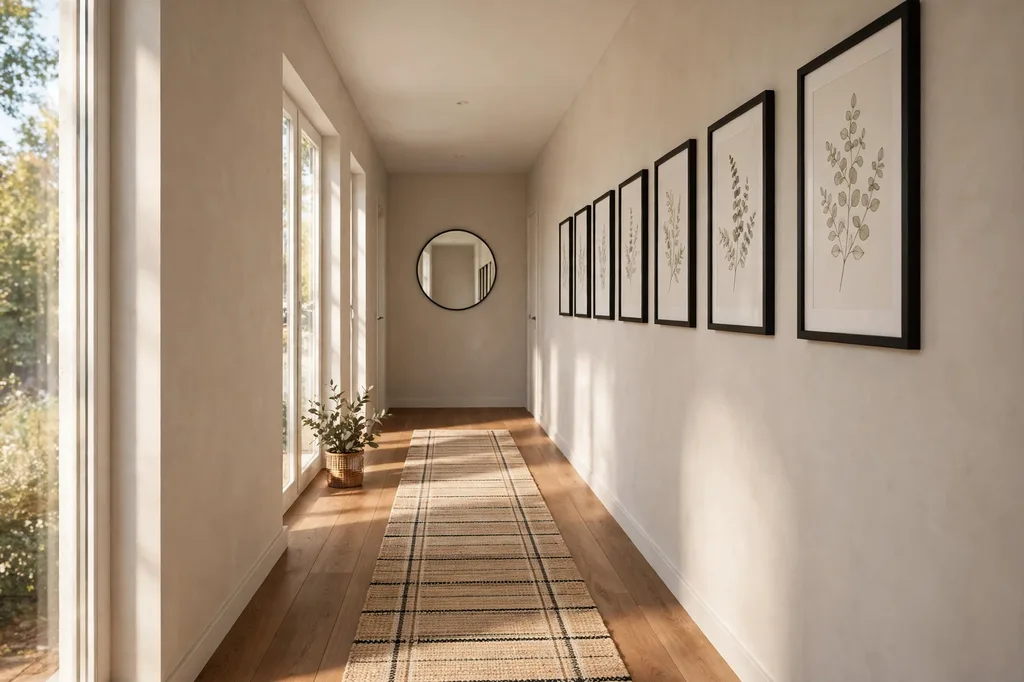
Best for: a long hallway entry, the wall that runs 8 feet or more with no natural stopping point.
A long entryway wall is the hardest wall in a small home to decorate, and most long entryway decor ideas skip the numbers entirely. One small frame on a 10-foot wall looks lost; ten frames in a row look like a corridor in an office. The answer is zones: break the long wall into sections, decorate each section once, and leave empty wall between them. Zoning is what keeps long entryway wall decor from turning into a cluttered corridor.
- The zones: divide the wall into zones of 36 to 48 inches each, a 10-foot wall makes two, a 12-foot wall makes three. Each zone gets one thing: a mirror, a pair of frames, or a short ledge. Never two things in one zone.
- The gaps: leave 12 to 18 inches of empty wall between zones. The empty wall is what makes each zone read as a separate moment instead of one long line. A wall with no gaps is a wall with no rhythm.
- Within a zone: frames sit 2 to 3 inches apart, and the zone’s total width is about two-thirds of the zone itself, a 36-inch zone holds a grouping about 24 inches wide. Centers at 57 to 60 inches, the same as everywhere else.
- The end wall: the wall at the far end of the hall gets one large piece, a 24 by 36-inch mirror or print, centered at 57 to 60 inches. The end wall is the focal point you walk toward, it should be the biggest moment on the wall.
- The floor: a runner rug 2 feet by 8 feet, leaving 3 to 4 inches of floor visible on each side in a narrow hall. Its length should match the zones above it, one zone of wall, one length of rug.
- The walkway: keep 36 inches clear. A long entry fails when decor sticks out into the walkway, deep shelves, leaning frames on deep ledges, hooks with swinging coats. In a long hall, everything stays within 4 inches of the wall’s surface.
- What to watch: do not hang a continuous row of frames down the whole wall. A continuous row has no focal point, and the eye slides off the end of it. Zones with gaps, one big piece at the end.
No-drill weight ratings: what holds what
Best for: every renter, read this table before you hang anything with adhesive.
Every competitor says “check weight ratings” and nobody prints the numbers. Here they are, typical manufacturer ratings for the common no-drill products, assuming a smooth, clean, fully cured painted wall. Always check the pack; ratings vary by brand. These numbers are the safety net behind any entryway wall decor hung without drilling.
| Method | Typical rating | What it holds in an entryway |
|---|---|---|
| Small adhesive strips, 1 pair | Up to 3 lb | One small frame, 5×7 or 8×10 |
| Medium adhesive strips, 1 pair | Up to 6 lb | One medium frame, 11×14 |
| Large adhesive strips, 1 pair | Up to 9 lb | One large frame, 16×20, use 2 pairs over 6 lb |
| Small adhesive hook | Up to 1 lb | Keys, dog leash |
| Medium adhesive hook | Up to 3 lb | Light tote, cap, scarf |
| Large adhesive hook | Up to 5 lb | One light coat, one bag |
| Adhesive picture ledge, 24 in | Up to 5 lb | Two or three light leaning frames |
| Leaning mirror or art | No wall load | Any size that fits, floor bears the weight |
| Over-door hook, each | Up to 5 lb | One coat or bag per hook |
| Over-door rack, total | Up to 10–15 lb | Three to four coats and bags |
| Tension rod + fabric panel | Up to 5 lb | One lightweight tapestry or fabric panel |
Three rules sit behind the whole table. First, weigh the frame before you hang it, a framed 11 by 14 print weighs more than you think, and glass weighs twice what acrylic weighs. Second, use two pairs of strips on anything over 6 pounds, one pair at the top, one pair at the bottom, so the load does not peel from one edge. Third, adhesive holds nothing on a fresh or textured wall: paint needs at least 30 days to cure, and a strip stuck to a dusty wall holds about half its rating. Follow all three and your entryway wall decor will stay up, and come down cleanly.
A mirror is the exception to the whole table: never hang one on adhesive strips, no matter the rating. A mirror is heavy, it is glass, and it hangs above a walkway. Lean it, or hang it from a proper wall anchor.
Renter-friendly rules
Most entryway wall decor is renter-friendly by nature, a wall is decorated with things that hang, lean, and stick, not with things that are built in. For the full no-drill wall method, strips, hooks, and what each one holds, see Rental Friendly Wall Decor Ideas.
- Lean, don’t drill: the mirror leans, the art leans on a ledge, the frames lean. A leaning mirror needs no hook and no hole. If you must hang something light, use adhesive strips rated for at least twice the piece’s weight, and only on smooth, fully cured paint.
- Wait 24 hours: adhesive strips and hooks need 24 hours to cure before you load them. Hang the strip today, hang the frame tomorrow. Loading a strip the same hour you stick it is the most common reason strips fail.
- Test a patch first: stick one strip in a hidden spot, behind the console, behind the door, and leave it 48 hours. If it holds, the wall is fine. If it peels, the paint is too fresh or too textured. A test patch costs one strip; a failed gallery costs a wall.
- Pull straight down: to remove a strip, pull the tab straight down, slowly, never sideways and never fast. A hairdryer on low for 20 to 30 seconds softens the adhesive first. Yanking a tab sideways is how paint peels off in a strip.
- Don’t paint the wall: painting an entryway wall, even an accent wall, is a permanent change. If you want color, use removable wallpaper, it comes down cleanly, and the paint underneath stays the landlord’s, not yours.
Entryway wall decor under $150
Best for: the whole wall, every idea in this guide, added up into one plan.
| Item | Cost |
|---|---|
| Round mirror, 24 in (secondhand) | $20–$40 |
| Three frames, 8×10 + prints | $15–$25 |
| Picture ledge, 24 in (adhesive) | $15–$30 |
| Coat hook rail, 3 hooks (adhesive) | $10–$20 |
| Adhesive strips + hooks pack | $8–$15 |
| Small vase + eucalyptus bunch | $8–$15 |
| Total | $76–$145 |
That is the whole wall, mirror, gallery, ledge, hooks, and the vase, for $76 to $145, under $150 at the top end. If the budget is tight, buy the mirror and the hook rail first ($30 to $60), use frames and books you already own, and add the ledge next month. A wall styled in two rounds looks better than one styled in one rushed round. That total is the whole entryway wall decor plan, not just one wall.
The free ideas: taking three things off the wall, leaning a mirror you already own, and rearranging frames you already own cost nothing, and change the wall more than any purchase. That is the cheapest entryway wall decorations there are: the ones you already own. Free changes are the fastest way to improve entryway wall decor without spending anything.
5 mistakes to avoid
1. Hanging art too high. The most common entryway wall mistake, and the one even decor sites get wrong: the 57 to 60-inch rule is for the center of the piece, not the bottom edge. A frame whose bottom edge sits at 57 inches hangs with its center at 70 inches or more, above eye level and impossible to see properly from the doorway. Measure to the center, not the edge. Getting the height right is the single biggest entryway wall decor win in this guide.
2. Art too small for the wall. A single 8 by 10 frame on a 5-foot wall looks like a postage stamp. Art above a console should span about two-thirds of the console’s width; art on a bare wall should span about two-thirds of the wall’s width. If the piece is smaller than that, go bigger, one 24 by 36-inch piece beats four small frames every time.
3. Frames in the door swing. A frame hung inside the arc of the front door gets hit every time the door opens, and a frame that gets hit falls eventually. Keep art at least 6 inches clear of door trim, and measure the swing arc before you hang anything near a door. A frame on the wall beside the door is fine; a frame on the wall the door swings toward is not.
4. Ten tiny frames instead of one big piece. A wall covered in small frames reads as clutter from the doorway, and each frame is too small to see properly. Three to seven pieces is the maximum for a small wall. If the wall feels busy, remove frames until it feels calm.
5. A heavy mirror on adhesive strips. A mirror is heavy, it is glass, and it hangs above a walkway where people pass every day. Adhesive strips are rated for frames, not for mirrors, and a strip that holds for a month can fail without warning. Lean a mirror, or hang it from a proper wall anchor. Never trust a mirror to a strip.
FAQ
How high should I hang a mirror or art in an entryway?
So the center of the piece sits 57 to 60 inches from the floor, eye level for most adults. The rule is for the center, not the bottom edge: a frame whose bottom edge sits at 57 inches hangs far too high. That center-height rule is the foundation of all entryway wall decor in this guide.
How big should wall art be above a console table?
About two-thirds of the console’s width, with its bottom edge 6 to 10 inches above the tabletop. On a 36-inch console, that is art about 24 inches wide. A mirror above the same console can sit a little lower, with its bottom edge 4 to 6 inches above the table. That two-thirds proportion is the starting point for all wall decor for entryway consoles. Use the same two-thirds rule for every piece of entryway wall decor above furniture.
What if my entryway is too small for a console table?
Skip the table. Use a sculptural wall hook rail at 60 to 66 inches, a small round mirror 16 to 20 inches in diameter above it, and one framed print beside the mirror. That is the whole entryway, hooks, mirror, one print, and nothing on the floor.
Will adhesive hooks and strips damage my rental walls?
Not if they are used correctly: stick them only on smooth, fully cured paint (at least 30 days old), wait 24 hours before loading, and remove them by pulling the tab straight down slowly, a hairdryer on low for 20 to 30 seconds softens the adhesive first. Test one strip in a hidden spot for 48 hours before you hang a whole gallery. Done right, adhesive entryway wall decor leaves no trace when you move out.
How much weight can no-drill adhesive products hold?
A pair of small strips holds up to 3 pounds, medium strips up to 6 pounds, large strips up to 9 pounds. A large adhesive hook holds about 5 pounds, one light coat. A 24-inch adhesive ledge holds about 5 pounds. Never hang a mirror on adhesive strips, no matter the rating. Check the table above before hanging any entryway wall decor on adhesive.
Can I use removable wallpaper in a rental entryway?
Yes, peel-and-stick wallpaper is made for rentals. Test a small piece behind furniture first, because it needs a smooth wall, and do not use it on paint less than 30 days old. One accent wall is enough in a small entry; a full entry in wallpaper is too much.
Start today
Entryway wall decor does not need a shopping trip, it needs a tape measure and an edit. Measure the wall, mark 57 to 60 inches for the center, and take three things off the wall. Then lean a mirror against it and hang one row of hooks. That is the whole first round of wall decorations for entryway walls, and it takes an afternoon.
Start by taking away. The wall will tell you what it needs next. A clear wall is the best starting point for entryway wall decor that actually works.