Small living room ideas with TV all solve the same problem: the TV is the biggest black rectangle in the room, and the room is too small to pretend it is not there. The fix is not a bigger room or a smaller TV. It is the right size TV, hung or stood at the right height, on the wall that fits the seating, with the cords hidden and the walkway clear.
This guide gives you 8 small living room ideas with TV with exact measurements: which TV size fits which distance, how high the centre of the screen should sit, how wide the console must be, and what the whole setup costs. Every idea is renter-friendly, a stand first, a mount only with permission, and the whole setup comes in under $150.
Table of Contents
The numbers first
Best for: every idea in this guide, measure the room and the seating distance before you buy anything. Small living room ideas with TV start with these six numbers.
Six numbers decide whether a TV works in a small living room:
- Viewing distance: sit about 1.5 times the TV’s diagonal away. A 43-inch TV wants 5.5 to 6 feet; a 55-inch TV wants 7.5 to 8 feet. Closer and the screen fills too much of your vision; farther and you lose the detail you paid for.
- Screen centre height: the centre of the screen should sit about 42 inches from the floor, roughly seated eye level. The comfortable band is 40 to 45 inches. Higher than that, and your neck tilts up every time you watch.
- Console width: the console should be at least as wide as the TV, ideally the TV’s width plus 3 inches on each side. A TV wider than its console looks like it is about to fall off, because it nearly is.
- Console depth and height: 12 to 16 inches deep, 16 to 20 inches high. That height keeps a TV standing on top with its centre near 42 inches.
- Sofa to coffee table: 16 to 18 inches. Closer and your knees hit the table; farther and you cannot reach your cup.
- Walkway: 30 inches minimum behind or beside the seating. A room that forces you to squeeze past the sofa is a room that feels small, whatever the TV size.
For the budget-first version of the whole room, the same under-$150 thinking applied to the rest of the space, see Small Living Room Decor on a Budget. That budget-first thinking is part of good small living room ideas with TV.
What size TV for a small living room?
Best for: the first decision, size before style, because the wrong size breaks every layout that follows. Small living room ideas with TV begin with size, not style.
The question everyone asks is what the best TV size for a small living room is, and the honest answer is that it depends on one measurement: how far your eyes sit from the screen. Measure from the front of the sofa cushions to the TV wall, then match the distance to the size. That is why small living room ideas with TV start at the tape measure. For the science behind these distances, see the RTINGS TV size-to-distance calculator.
| TV size (diagonal) | TV width (about) | Ideal viewing distance | Maximum distance |
|---|---|---|---|
| 32 in | 28–29 in | 4–5 ft | 5.5 ft |
| 43 in | 38 in | 5.5–6 ft | 7 ft |
| 50 in | 44 in | 6.5–7 ft | 8 ft |
| 55 in | 48–49 in | 7.5–8 ft | 9–10 ft |
| 65 in | 57 in | 9–10 ft | 11 ft |
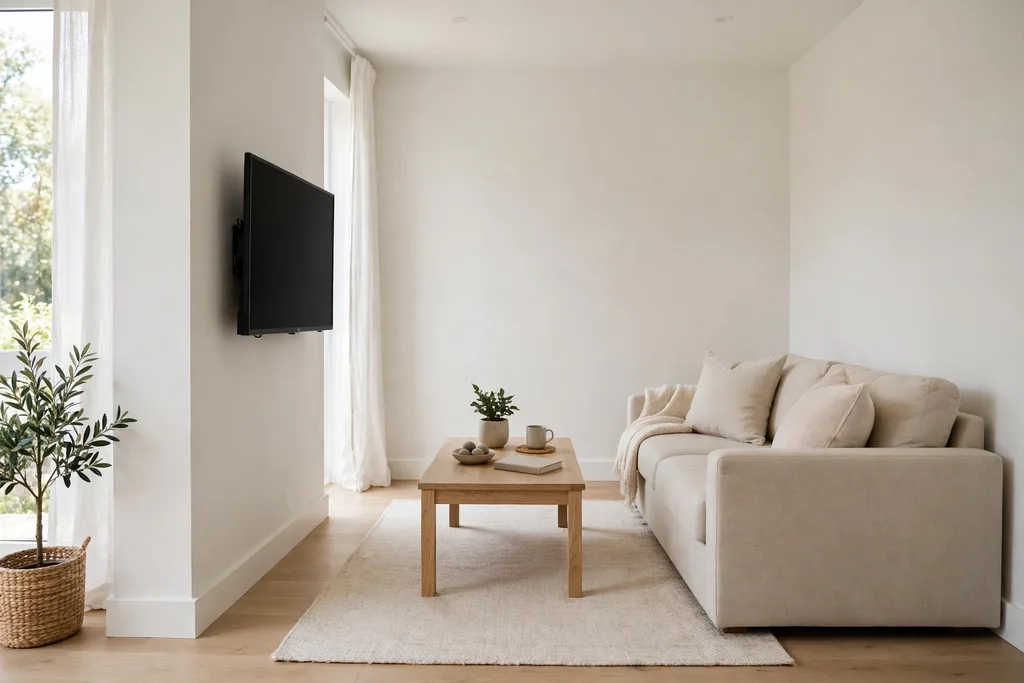
Three rules behind the table:
- The 1.5× rule: viewing distance in inches should be about 1.5 times the screen diagonal. A 43-inch TV at 1.5× is about 65 inches, just under 5.5 feet. For a 4K TV you can sit a little closer, about 1 to 1.5 times the diagonal, because the extra pixels hold up at short range.
- The sweet spot is 43 to 55 inches. In most small living rooms the sofa sits 6 to 8 feet from the TV wall, and that distance fits a 43-inch TV at the near end and a 55-inch TV at the far end. A 32-inch TV is right only when the sofa is under 5 feet from the wall, a 10 by 10 foot room, or a bed-sit corner.
- Over 55 inches feels disproportionate in a small room. A 65-inch TV needs 9 to 10 feet of distance, which most small living rooms do not have, and it dominates the wall even when it is off. If the room cannot give the TV its distance, the TV is too big, not the room too small.
What to watch: do not buy the TV first and the sofa second. Measure the distance, pick the size from the table, then place the sofa to match. A TV bought on sale and a sofa bought on comfort will disagree about the distance, and the TV always wins the argument. In small living room ideas with TV, size comes before the purchase.
1. TV on the longest wall
Best for: the default layout, the one that works in most small living rooms. This is the default in small living room ideas with TV.
Put the TV on the longest wall and the sofa opposite it. The longest wall gives the TV its full width without crowding the corners, and the sofa facing it gets the straight-on view instead of a neck-twisting angle. Few small living room ideas with TV beat this simple layout.
- Centre on the seating, not the wall: the centre of the TV should line up with the centre of the sofa, not the centre of the wall. In a small room these are rarely the same point, because the door, the window, or the radiator pushes the sofa off-centre. Centre on the seating line and the picture feels right from every seat.
- Distance: use the table above. In a 10 by 12 foot room, the sofa front sits about 6 feet from the TV wall, a 43-inch TV. In a 10 by 15 foot room, the sofa can sit 7 to 8 feet back, a 50 or 55-inch TV.
- The window rule: do not put the TV on the wall opposite a window, or in front of one. Glare on the screen is the one problem no curtain fully fixes. Put the TV on the least-sunny wall, and put the sofa with its back to the window if you have to choose.
- Long, narrow room: in a long narrow living room, put the sofa on one long wall and the TV on the other, with the 30-inch walkway running behind the sofa. Do not put the TV on the short end wall, the viewing distance becomes the length of the room, the TV looks tiny, and the far end of the room becomes dead space.
What to watch: a TV on the longest wall still needs a console or a mount (idea 6), a rug under the seating (the rug’s front edge under the sofa’s front legs), and the cords hidden (see the 10 by 12 plan). The wall is only the first decision. That balance is what makes small living room ideas with TV feel calm.
2. The corner TV layout
Best for: square rooms and rooms where the longest wall is taken, by a window, a door, or a fireplace. Small living room ideas with TV often start in a square room.
A corner TV turns the deadest spot in a small room into the media wall. The TV sits at a 45-degree angle in the corner, the sofa angles toward it or sits in an L-shape, and the two long walls stay free for the sofa, the bookshelf, and the dining table. A corner layout is one of the smartest small living room ideas with TV.
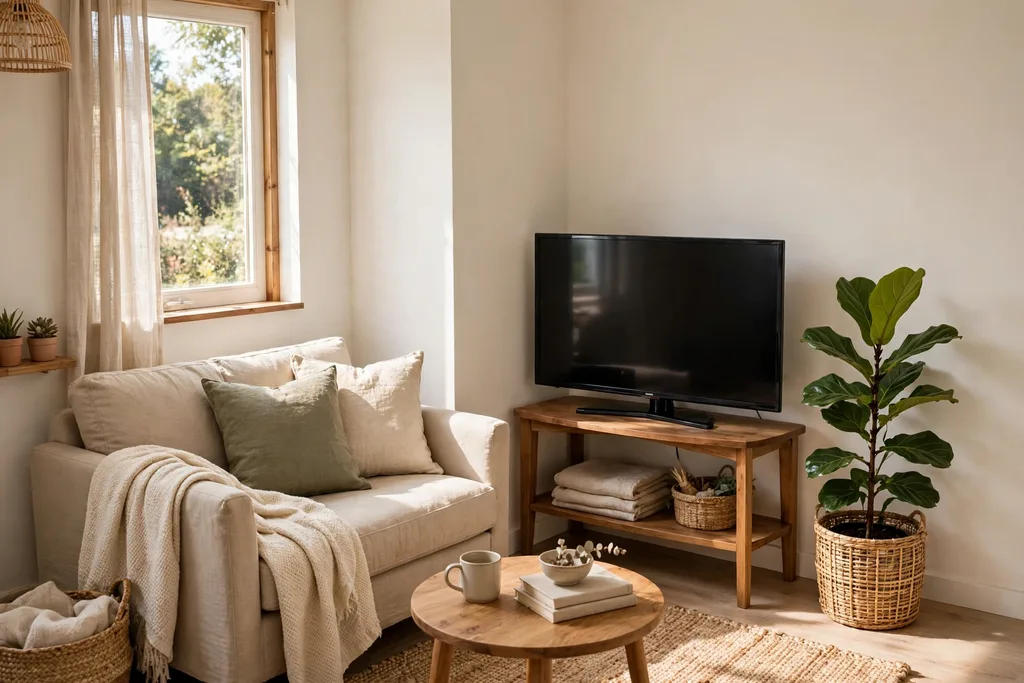
- The stand: a compact corner TV stand, about 30 to 36 inches wide, fits the corner without jutting into the room. A regular rectangular console in a corner wastes the triangle behind it and sticks out 12 to 16 inches farther than a corner stand.
- The angle: the sofa does not need to face the corner dead-on. An L-shaped sofa, or a loveseat with one armchair angled in, gives every seat a view within about 30 degrees of straight-on. Past 30 degrees off-centre, the picture washes out and necks start turning.
- The distance: measure from the sofa to the corner, not to the wall. In a 10 by 10 foot room, a corner TV with a 43-inch screen puts the sofa about 5.5 to 6 feet from the screen, the right distance, because the diagonal of the room is longer than any wall.
- What to watch: a corner TV eats the corner, so do not also put the bookshelf or the plant there. One thing per corner. And a corner TV with a swivel stand is worth the extra money, a fixed corner TV cannot turn toward the dining chairs or the second seat, and a swivel of 45 degrees each way fixes that.
3. TV above the fireplace
Best for: rooms where the fireplace wall is the only wall, and for renters who cannot move the fireplace. Small living room ideas with TV must work around a fireplace wall.
A TV above the fireplace looks tidy in photos and feels wrong in real life, because the height is wrong. The mantel puts the bottom of the TV at about 48 to 54 inches, and the centre of a 55-inch TV ends up near 60 inches from the floor, a foot and a half above the 42-inch eye level. Your neck tilts up for the whole film. That height problem is why small living room ideas with TV rarely put the screen there.
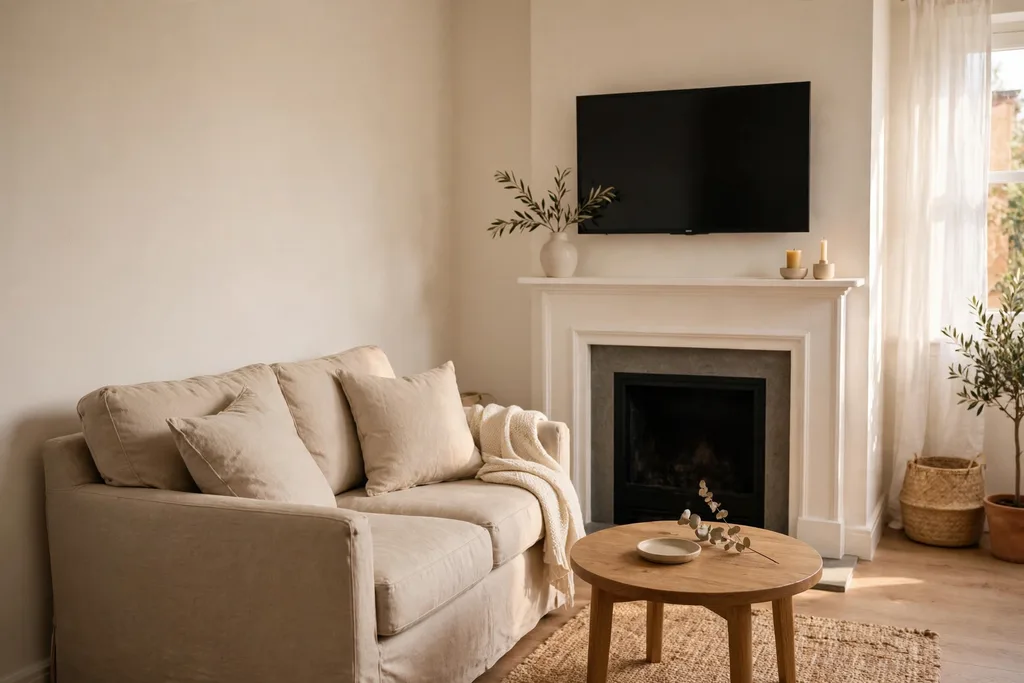
- The gap: leave 6 to 12 inches between the top of the mantel and the bottom of the TV. Less than 6 inches and the TV crowds the mantel decor; more than 12 inches and the TV floats away from the fireplace entirely.
- The tilt: if the TV must go above the mantel, use a tilting mount and angle the screen down 5 to 10 degrees. It does not fix the height, but it takes the worst of the neck strain off. A fixed mount above a fireplace is the worst of both worlds.
- The better answer: put the TV on the side wall and let the mantel be the mantel. The fireplace wall stays the focal wall, the TV wall gets the seating line, and neither one fights the other. For styling the mantel itself around a TV, low decor, one tall piece on one side, everything at least 2 inches clear of the remote sensor, see Fireplace Mantel Decor Ideas for a Small Living Room.
- What to watch: heat. A working fireplace sends heat straight up the wall, and a TV sitting 6 inches above the mantel sits in it. If you light the fire regularly, keep the TV off the mantel wall, or keep the fire low and the TV tilted. Heat shortens a TV’s life faster than any other placement mistake.
4. TV and dining table in one room
Best for: the studio-style living room, one room that has to be a living room and a dining room at the same time. Small living room ideas with TV must also feed people, not just viewers.
This is the combination almost nobody layouts properly: a TV wall and a dining table sharing one small room. The trick is zoning, the TV zone and the dining zone each get their own footprint, and neither one borrows the other’s walkway. Getting both zones right is the test of small living room ideas with TV.
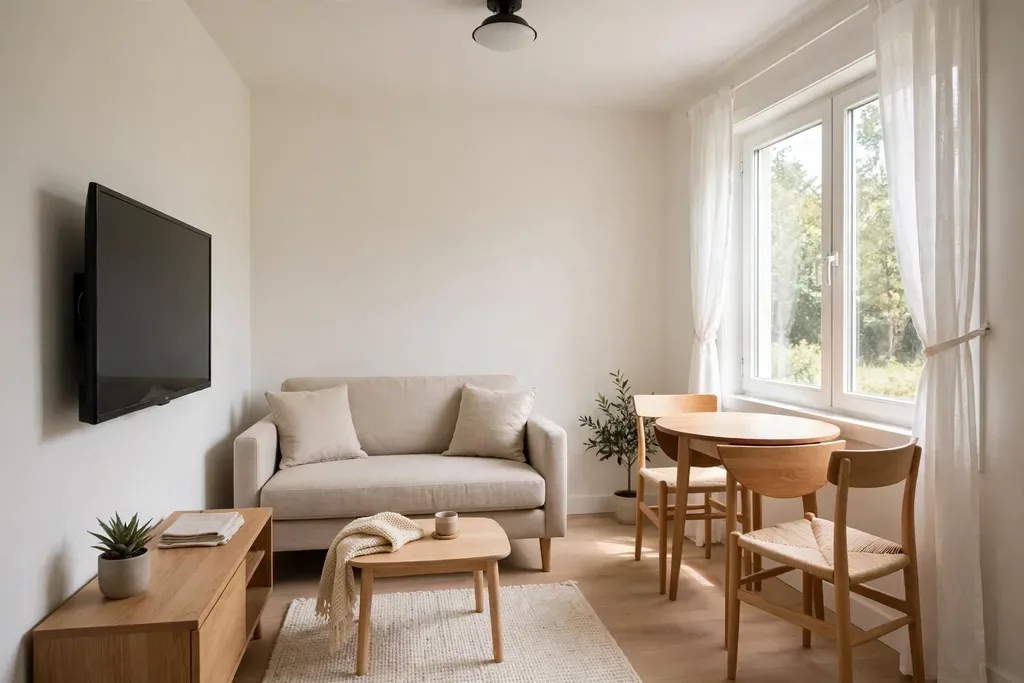
- The table: a round drop-leaf table, 30 inches across (seats 2) or 36 inches (seats 2 comfortably, 4 tight), is the right shape. Round has no corners to catch hips in a tight room, and the drop leaf folds to 18 to 20 inches deep against the wall when dinner is over.
- The placement: put the dining table near the window or behind the sofa, never between the sofa and the TV. Between the sofa and the TV, a table blocks the view and the walkway at the same time. Behind the sofa, the sofa back becomes the divider between the two zones.
- The clearances: leave 24 inches behind each dining chair so it can pull out, and 30 inches of walkway between the dining chairs and the sofa back. A 36-inch table with two chairs needs a zone about 6 feet by 5 feet, measure it before you buy the table.
- The TV angle: the TV stays on the living-room wall, centred on the sofa. The dining chairs get a side view of the TV, which is fine, nobody watches a film from the dinner table. A swivel stand (idea 2) lets the TV turn 45 degrees toward the table for the occasional match or news bulletin.
- What to watch: one rug per zone, not one big rug for both. The living-room rug (5 by 8 feet) goes under the coffee table and the sofa’s front legs. The dining zone stays on bare floor, or gets a second small rug that the chairs can slide on without catching.
5. A slim console, not a bulky unit
Best for: the renter-first setup, a console holds the TV, hides the cords, and moves with you. Small living room ideas with TV often prefer a console a renter can move.
A slim console is the most forgiving TV support in a small room. It needs no drilling, it holds the TV at the right height, and it gives you closed storage for the console, the remotes, and the tangle of cables. No drilling is needed for these small living room ideas with TV.
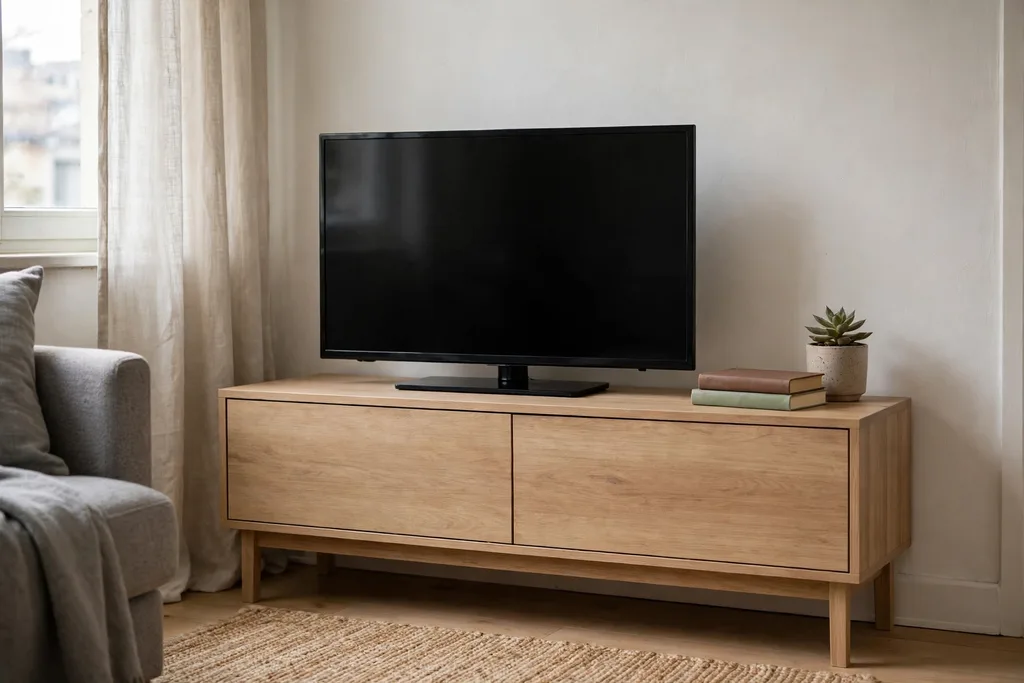
- Width: at least as wide as the TV, ideally the TV’s width plus 3 inches on each side. A 43-inch TV is about 38 inches wide, so the console should be 44 inches or wider. A 55-inch TV is about 48 to 49 inches wide, so the console should be 54 inches or wider. Check that the TV’s feet sit fully on top, not half off the edge.
- Depth: 12 to 16 inches. Deeper than 16 inches and the console eats floor space for nothing, a TV is only 2 to 3 inches deep, and the feet need about 10 to 12 inches. Shallower than 12 inches and the feet do not fit.
- Height: 16 to 20 inches. That height puts a TV standing on top with its centre near the 42-inch eye level. A console taller than 20 inches pushes the screen too high; shorter than 16 inches and you are looking down at it.
- Storage: closed storage beats open shelves. Doors hide the console, the router, and the cable box, and a closed console hides the cords entirely. Open shelves display the clutter you are trying to hide.
- What to watch: ventilation. A console or cable box inside a closed cabinet needs air, leave the back open or drill-free vent gaps, and do not stack the router on top of the console. Overheating kills electronics faster than dust does.
6. Mount or stand? The renter decision
Best for: the decision every renter gets wrong, a mount looks cleaner, a stand is safer for your deposit. Small living room ideas with TV ask this question before any drilling.
Mounting almost always wins in owner-focused guides. In a rental, the stand wins unless you have written permission and two solid studs. Here is the decision, in order. For renters, small living room ideas with TV usually choose the stand.
- Start with the stand. A slim console (idea 5) or a freestanding rolling stand holds the TV at the right height, needs no holes, and moves with you. For most renters, this is the whole answer. A rolling stand that holds 50 to 70 lbs and TVs up to 65 inches costs about the same as a good wall mount, and it leaves no trace.
- If you mount, get permission first. Drilling a wall mount without checking your lease is against most damage policies, and a mount is the one TV decision that can cost you a deposit. Written permission, not a verbal “probably fine.”
- Find two studs. Studs are usually 16 inches apart. A proper fixed mount uses four lag bolts, two into each of two studs. Never hang a TV from drywall alone with a standard mount; drywall holds pictures, not televisions. If you cannot hit two studs where the TV needs to go, use a stand instead.
- Match the rating to the TV, with margin. Check three numbers on your TV first: screen size, weight, and VESA pattern. Then pick hardware rated for at least 1.5 times your TV’s weight. Typical TV weights: a 43-inch TV is about 17 to 22 lbs; a 50-inch TV about 22 to 28 lbs; a 55-inch TV about 28 to 35 lbs. Always check the label on the back of your own TV, these are typical ranges, not your TV’s weight.
| No-drill / low-impact method | Weight rating | TV size it supports | Deposit risk |
|---|---|---|---|
| Adhesive mount / strips | 15–30 lbs | 32 in and under | Low, residue possible, needs 24-hour cure |
| Command strips (small screens only) | Up to 16 lbs | Small screens only | Low |
| Tension-pole stand | 60–75 lbs | Up to 70 in | Minimal, rubber marks possible |
| Freestanding / rolling stand | 50–70 lbs | Up to 65 in | None |
| Nail-bracket mount (tiny pinholes) | Up to 99 lbs | 12–55 in | Low, pinholes patch in minutes |
- The 20-second tug test. After the mount is up and before the TV goes on it, pull down and out on the mount with steady force for 20 seconds. If it moves, creaks, or flexes, stop, the mount is not seated in the studs. A mount that passes the tug test holds the TV; a mount that fails it drops the TV.
- Anti-tip is not optional. A freestanding TV on a console in a home with children or pets needs an anti-tip strap, and most anti-tip straps need one small screw into the wall or the furniture. If your lease forbids even that, put the TV low on a wide, heavy console and keep the console against the wall. A TV that cannot tip is worth more than a TV that looks floating.
What to watch: adhesive is the weakest method on this table, and it fails exactly when it is overloaded, a 43-inch TV on strips rated for 30 lbs is a TV on the floor within a month. Adhesive is for small screens on smooth, fully cured paint, with a 24-hour cure before you hang anything. When in doubt, the stand is the answer. That caution is part of safe small living room ideas with TV.
7. Hide the TV when it is off
Best for: the look of the room, a black rectangle dominates a small wall even when it is off, and hiding it makes the room feel bigger. Small living room ideas with TV should hide the screen, not the remote.
You do not need to build the TV into the wall to hide it. Four renter-friendly moves make the screen disappear into the room: Each of these small living room ideas with TV keeps the remote working.
- The gallery wall: hang art and prints around the TV, or lean them on the console, so the screen becomes one dark rectangle among many framed ones. The TV stops being the focal point and becomes part of a wall. Keep frames at least 2 inches clear of the remote sensor.
- The dark wall: paint is a landlord decision, so use removable wallpaper or a large leaning print in a dark colour behind the TV instead. A black screen on a dark background vanishes; a black screen on a white wall shouts.
- The art-display mode: many modern TVs have a mode that shows art or photos when idle. It does not hide the TV, but it turns a black rectangle into a framed picture, and in a small room that is most of the battle.
- Plants on both sides: a tall plant on one side of the console and a shorter one on the other breaks up the rectangle and softens the corners. Keep plants at least 6 inches from the screen so leaves do not touch it, and keep the watering can away from the electronics.
What to watch: do not hide the TV behind a cabinet door that blocks the remote sensor, and do not cover the TV’s vents. A hidden TV that overheats is a dead TV. Hiding means blending, not burying. That is the golden rule in small living room ideas with TV.
8. The simple setup: four pieces
Best for: the “simple” angle, a small living room with a TV needs four things, and everything else is optional. Small living room ideas with TV need only four pieces to work.
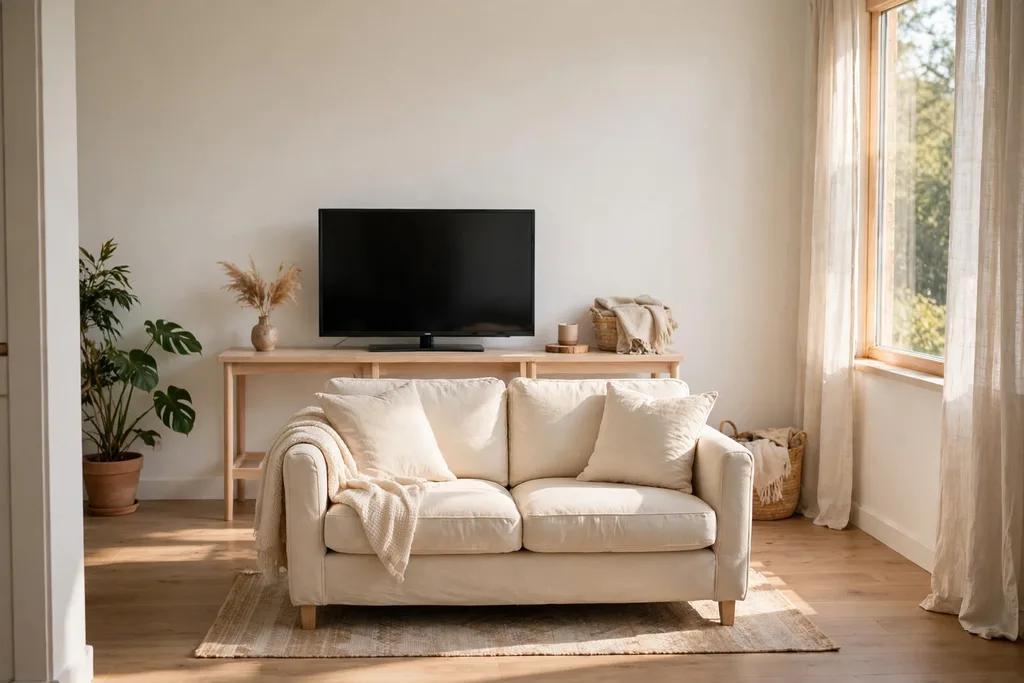
A simple small living room with a TV is a TV, a console, a loveseat, and a rug. That is the whole setup. No gallery wall, no floating shelves, no accent wall, no second seating. That is the whole point of small living room ideas with TV.
- The TV: 43 inches on a slim console, centre at 42 inches, 5.5 to 6 feet from the loveseat.
- The console: 44 inches wide, 12 to 16 inches deep, 16 to 20 inches high, with closed storage for the cords and the console.
- The loveseat: 52 to 58 inches wide, facing the TV dead-on. A loveseat, not a three-seater, a three-seater in a small room pushes the walkway under 30 inches and the room feels crowded from the door.
- The rug: 5 by 8 feet, under the coffee table, with the loveseat’s front legs on it. The rug marks the seating zone, and a marked zone reads as a room, not a corner of a room.
- One plant, one throw. A plant in the corner and a throw over one arm of the loveseat. That is the decoration. A simple setup stays simple by stopping here.
- What to watch: simple does not mean empty. An empty room with a TV feels like a waiting room. The rug and the plant are what make four pieces feel like a living room instead of a showroom.
One small room, fully planned: the 10 by 12 foot layout
Best for: the whole room, every piece, every clearance, in one place. Small living room ideas with TV come together in this one layout.
Take a 10 by 12 foot living room. The TV goes on one 10-foot wall; the sofa faces it; the dining table (idea 4) goes behind the sofa if you need one. Here is the plan, measured: Every clearance in these small living room ideas with TV is measured.
| Piece | Size | Position |
|---|---|---|
| TV | 43 in (about 38 in wide) | Centred on the sofa, centre 42 in from the floor |
| Console | 44 in wide × 14 in deep × 18 in high | Against the TV wall, TV centred on it |
| Loveseat | 54 in wide × 36 in deep | Front edge 6 ft (72 in) from the TV wall |
| Coffee table | 36 in × 20 in | 18 in from the loveseat, 34 in from the TV console |
| Rug | 5 × 8 ft | Under the coffee table, loveseat front legs on it |
| Walkway | 30 in | Behind the loveseat (12 ft room − 9 ft to sofa back = 36 in, so 30 in clear with room to spare) |
| Plant | 1 tall, about 4 ft | Corner beside the console, 6 in from the screen |
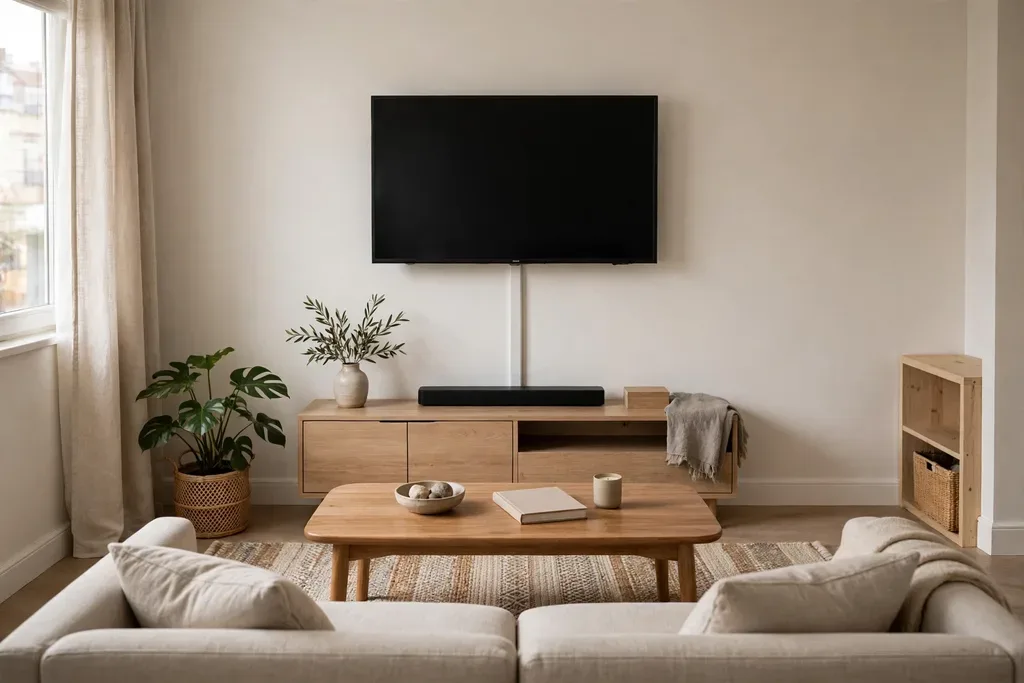
The cords: this is where small rooms fail, the TV is on the wall, the outlet is behind the console, and the cables hang in between. Run a paintable adhesive cable raceway straight down the TV wall from the bottom of the TV to the top of the console, then route every cable behind the console to a power strip inside the cabinet.
Measure the raceway before you buy it: from the TV’s bottom edge to the console top is usually 18 to 24 inches. Add cord clips inside the console so cables do not slide out when you open the doors, and a small cable box on the console for the router and the power strip. No visible cables, no drilling, and the whole cord job costs under $20.
The light: put the sofa with its back to the window if the window is on the long wall, and the TV on the least-sunny wall. A 2700K warm bulb in the floor lamp beside the sofa keeps the evening light warm, and a USB bias light strip behind the TV (about $10 to $15) softens the contrast between the bright screen and the dark wall, easier on the eyes, and it makes the TV look like it floats.
Soundbar without drilling
Best for: the sound, a small room with bare walls echoes, and a soundbar fixes it without a single hole. Small living room ideas with TV sound better with a soundbar.
A soundbar is the one audio upgrade that fits a small living room, and it needs no drilling at all. Put it on the console, directly under the TV. That is why small living room ideas with TV often add a soundbar first.
- The size: the soundbar should be no wider than the TV, a 36 to 40 inch soundbar under a 43-inch TV, a 44 to 48 inch soundbar under a 55-inch TV. Wider than the TV and it sticks out past the screen; narrower by more than a few inches and it looks like an afterthought.
- The placement: on the console, centred under the TV, with the front edge flush with the console’s front edge. Do not put it behind the TV or inside a closed cabinet, the sound needs a clear path to your ears, and a closed door eats the treble.
- The clearance: leave 2 to 3 inches between the top of the soundbar and the bottom of the TV screen, so the soundbar does not block the screen’s bottom edge or the remote sensor.
- The budget answer: if a soundbar is not in the budget yet, a small Bluetooth speaker on the console does most of the job for a fraction of the price, and it moves to the kitchen when dinner is ready. The TV’s own speakers, firing backward off a bare wall, are the worst sound in the room; anything facing you is better.
Renter-friendly rules
Most small living room ideas with TV are renter-friendly by nature, a TV on a console needs no permission at all. The rules are about what you do NOT do.
- Stand first, mount only with permission: a console or a freestanding stand is the renter-first answer. A wall mount is a drilling decision, and drilling is the landlord’s decision. Get it in writing before the drill comes out.
- Adhesive only for small screens: adhesive mounts and strips are for TVs 32 inches and under, on smooth, fully cured paint, with a 24-hour cure before you hang anything. Adhesive on textured walls, fresh paint (under 30 days), or damp walls fails, and a failed adhesive mount drops the TV.
- Test one hook first: before you stick a whole raceway or a row of cord clips to the wall, test one piece in a hidden spot for 24 to 48 hours. If it peels paint, you have learned it on one small patch instead of a whole wall.
- No in-wall cables in a rental: in-wall cable kits need holes cut in the drywall. Use a surface raceway instead, paintable, adhesive-backed, and removable when you leave.
- Everything moves with you: the console, the stand, the raceway, the rug, the plant. A TV setup that leaves nothing behind is a TV setup that costs you nothing at move-out.
Small living room with TV under $150
Best for: the whole setup, every item in this guide, added up.
| Item | Cost |
|---|---|
| Slim console, 44 in (secondhand) | $30–$45 |
| 5 × 8 ft rug (budget) | $20–$35 |
| Adhesive cable raceway kit | $8–$12 |
| Cord clips + velcro ties | $4–$6 |
| USB bias light strip (behind TV) | $8–$12 |
| Small plant + pot | $8–$12 |
| Two throw pillows | $8–$15 |
| Total | $86–$137 |
The TV and the loveseat are not in this table, you already own them, and no honest under-$150 table can include a television. This is the setup around the TV: the console it stands on, the rug under the seating, the cords hidden, and the light behind the screen. Small living room ideas with TV can stay under $150 this way.
The first round: if the budget is tight, buy the console, the raceway, and the rug first ($58–$92), use pillows and a plant you already own, and add the bias light and the cord clips next month. A TV setup finished in two rounds looks better than one finished in one rushed round, because the second round is the one where you know what the wall actually needs. That order is the smartest way to buy small living room ideas with TV.
The free ideas: moving the sofa to the right distance, centring the TV on the seating instead of the wall, and taking the bulky unit out of the room cost nothing, and they change the room more than any purchase. A TV setup starts with moving things, not buying them.
5 mistakes to avoid
1. A TV too big for the distance. A 55-inch TV at 6 feet fills too much of your vision, and a 65-inch TV in a 10 by 12 foot room dominates the wall even when it is off. Measure the distance first, then pick the size from the table. The sale price is not a measurement.
2. A TV mounted too high. A screen centre above 45 inches means your neck tilts up for the whole film, and a TV above the fireplace without a tilt is the worst version of this mistake. Centre at 42 inches, or use a stand and let the console set the height.
3. Centring the TV on the wall instead of the seating. The TV should line up with the centre of the sofa, not the centre of the wall. In a small room these are rarely the same point, and a TV centred on the wall while the sofa sits off-centre makes every seat a side seat.
4. A console narrower than the TV. A TV wider than its console looks like it is about to fall, and its feet, hanging half off the edge, are the first thing to go when someone bumps the console. The console should be the TV’s width plus 3 inches on each side.
5. Drilling without checking the lease, and ignoring the cords. Drilling a wall mount without checking your lease is against most damage policies, and a tangle of visible cables makes any layout look cluttered, however good the furniture is. Stand first, raceway always, permission before the drill.
FAQ
What size TV should I get for a small living room?
The sweet spot is 43 to 55 inches. A 32 to 43-inch TV fits seating under 6 feet; a 50 to 55-inch TV fits seating at 6 to 8 feet. Over 55 inches feels disproportionate in a small room, and a 65-inch TV needs 9 to 10 feet of distance that most small living rooms do not have. Measure from the sofa to the TV wall, then pick the size from the table, about 1.5 times the screen diagonal.
Is it better to mount a TV or use a console in a small living room?
For a renter, a console or a freestanding stand is the better answer, no drilling, no deposit risk, and it moves with you. Mounting looks cleaner, but it needs written landlord permission and two solid studs, with hardware rated for at least 1.5 times the TV’s weight. If you cannot hit two studs where the TV needs to go, use a stand.
Where should the TV go in a small living room?
On the longest wall, opposite the sofa, centred on the seating line, not the centre of the wall. Put it on the least-sunny wall, never opposite a window or in front of one, because glare is the one problem no curtain fully fixes. In a square room or a room where the long wall is taken, the corner layout works just as well. That placement is the first rule of small living room ideas with TV.
How far should a sofa be from the TV in a small room?
About 1.5 times the TV’s diagonal. A 43-inch TV wants 5.5 to 6 feet; a 50-inch TV wants 6.5 to 7 feet; a 55-inch TV wants 7.5 to 8 feet. For a 4K TV you can sit a little closer, about 1 to 1.5 times the diagonal.
How can I hide cables and wires in a small living room?
Run a paintable adhesive cable raceway straight down the wall from the TV to the console, then route every cable behind the console to a power strip inside the cabinet. Add cord clips inside the console and a small cable box on top for the router. No visible cables, no drilling, and the whole job costs under $20.
Can I put a soundbar in a small living room without drilling?
Yes, put it on the console, directly under the TV, no wider than the TV, with 2 to 3 inches of clearance below the screen. Do not put it inside a closed cabinet, or the door eats the sound. A small Bluetooth speaker on the console is the budget version of the same fix.
Can I put a TV above the fireplace?
You can, but the height is the problem: the mantel puts the screen centre near 60 inches, a foot and a half above the 42-inch eye level. Leave 6 to 12 inches between the mantel and the TV’s bottom edge, use a tilting mount angled down 5 to 10 degrees, and watch the heat, a working fireplace sends heat straight up into the TV. The side wall is usually the better answer.
Can a small living room fit both a sofa and a TV?
Yes. A loveseat 52 to 58 inches wide and a 43-inch TV fit a 10 by 10 foot room with a 30-inch walkway to spare. The room fits both when the TV is the right size for the distance and the sofa is a loveseat, not a three-seater, and when the dining table, if you need one, goes behind the sofa instead of between the sofa and the TV.
Start today
Small living room ideas with TV do not need a shopping trip, they need a tape measure. Measure from the sofa to the TV wall, check the size against the table, and move the sofa to the right distance. That is the whole first round, and it takes an afternoon. Small living room ideas with TV reward measuring before buying.
Start by measuring. The room will tell you what size TV it actually fits.