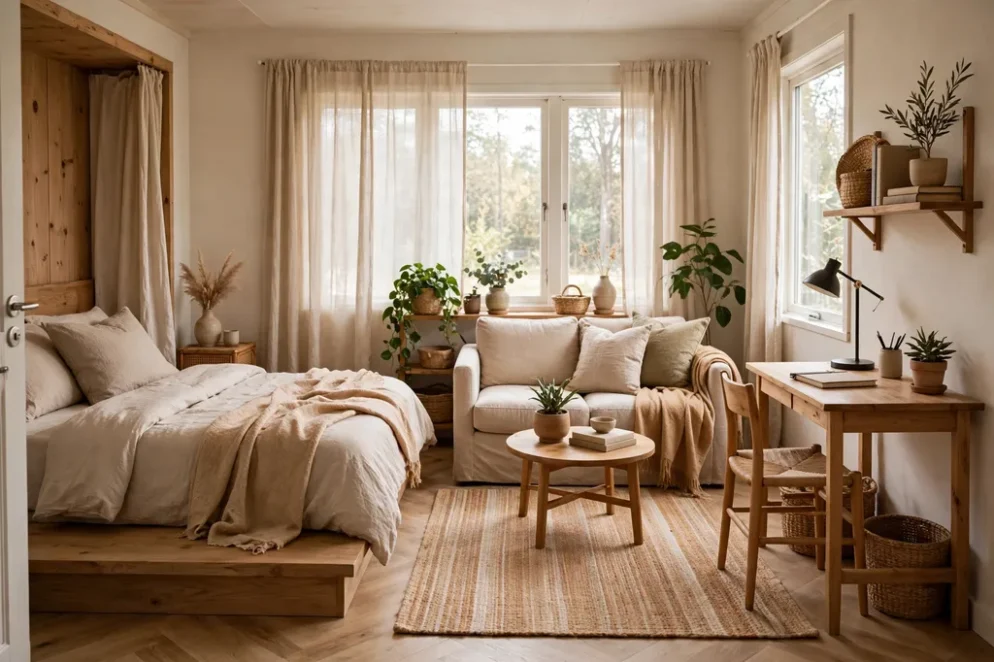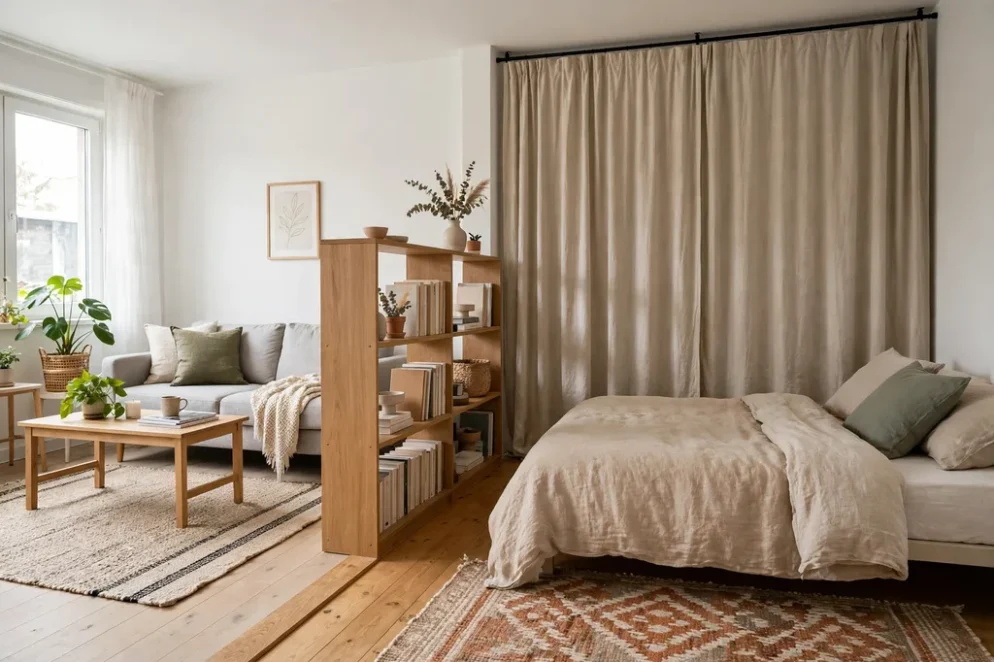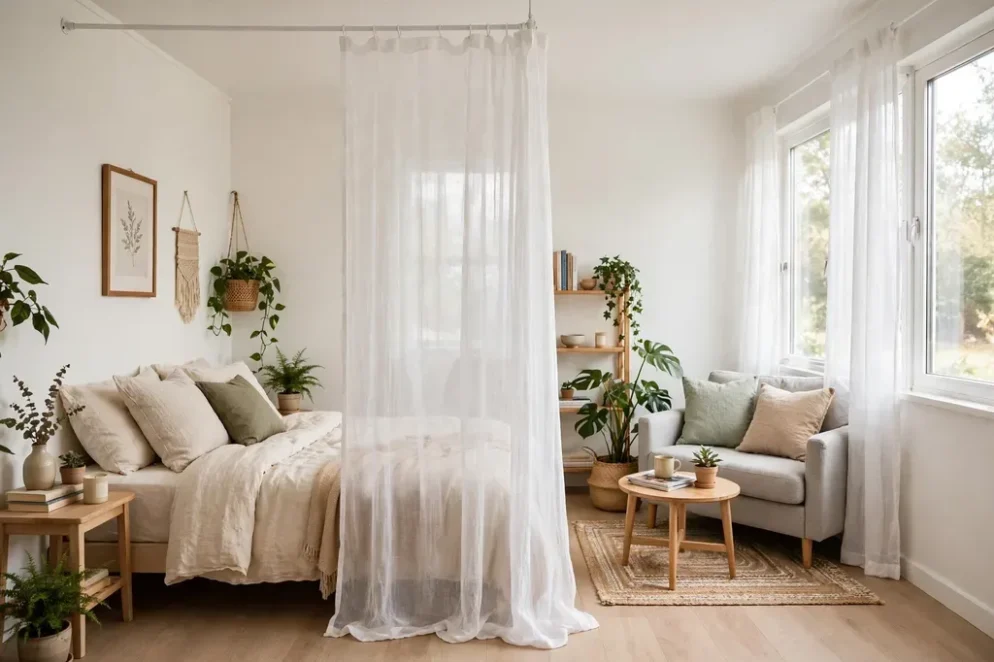
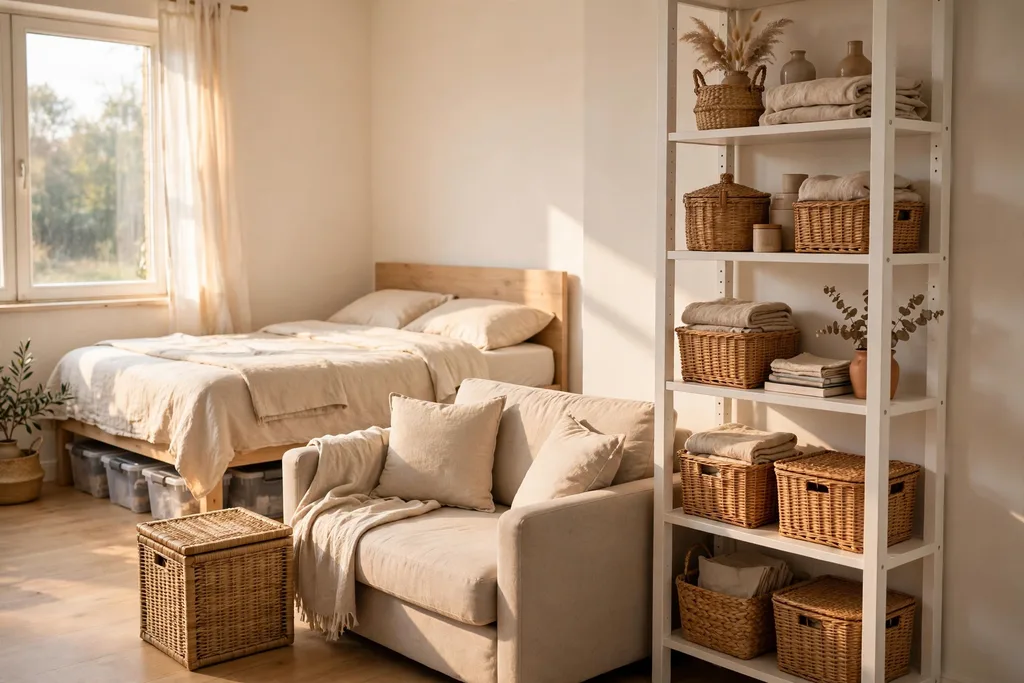
Studio apartment storage ideas start with one honest fact: a studio has no spare rooms to hide things in. The bedroom, the living room, the office and the kitchen are all the same room, so every storage choice is visible, and every bad one shows. The fix is not buying more organizers. It is giving everything a zone, going up instead of out, and using furniture that hides things.
This guide gives you 8 studio apartment storage ideas with exact measurements: how tall the shelves go, how deep the bins fit, how high the second closet rod hangs, and what the whole setup costs. Every idea is renter-friendly, no drilling, no permanent changes, and the whole studio comes in under $150.
Table of Contents
The numbers first
Best for: every idea in this guide, measure before you buy anything. Measuring first is what makes these studio apartment storage ideas work in a real one-room home.
Five numbers decide whether studio apartment storage works in one room:
- Under-bed clearance: measure the gap under your bed before buying bins. If it is under 6 inches, skip under-bed bins entirely, they will not slide. Bed risers add 5 to 8 inches of clearance, and flat bins are 5 to 6 inches tall. Bin height must be at least 1 inch shorter than the clearance, or the bin jams.
- Shelf depth: wall shelves for storage should be 10 to 12 inches deep. Shallower than 10 inches and folded clothes fall off; deeper than 12 inches and things disappear at the back. The top shelf can sit 12 to 18 inches below the ceiling, that is the dead zone most studios waste.
- Double-rod heights: in a closet with a double rod, the top rod hangs at 80 inches from the floor and the second rod at 40 inches. Each zone is 40 inches tall, exactly right for shirts, blouses and folded pants. Dresses and coats need the full 60 inches, so keep one single-rod section for them.
- Walkway: keep 30 to 36 inches of clear walking space between storage furniture and the bed or sofa. A studio fails when the storage eats the path from the door to the window.
- The 20-percent rule: leave 20 to 30 percent of every open shelf empty. A shelf packed edge to edge reads as clutter even when it is organized. Empty space is what makes storage look like design.
Measure the clearance, the wall width and the walkway before you buy anything. The best storage in a small studio is the storage you measured for. That measured-first habit is the backbone of these studio apartment storage ideas.
1. Build a closet wall (no closet? no problem)
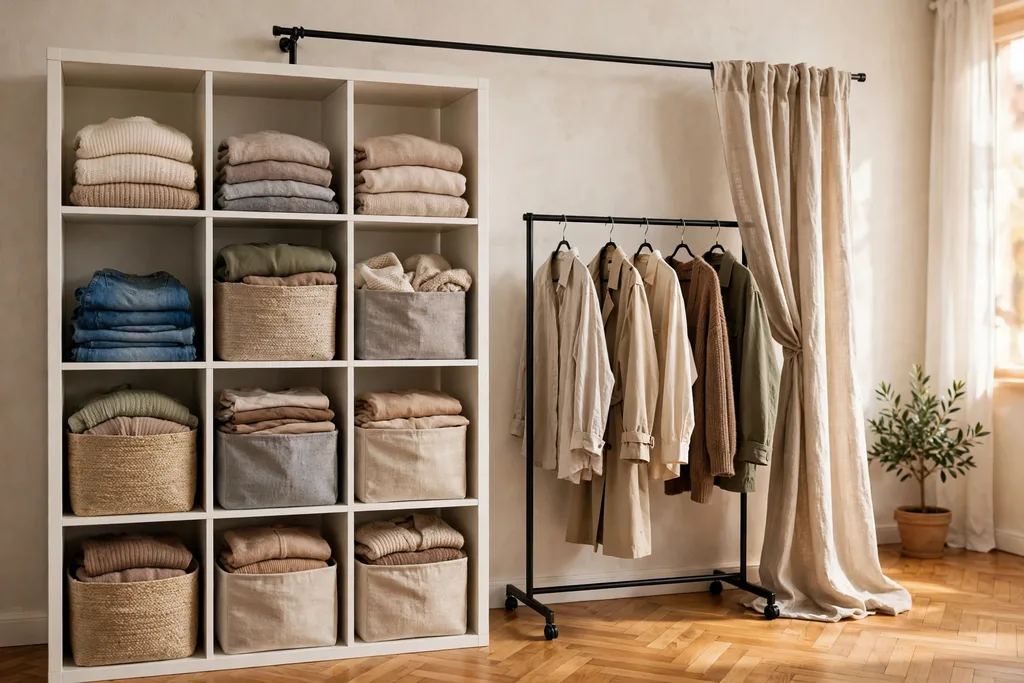
Best for: studios with no built-in closet at all, the most common studio storage problem.
If your studio has no closet, you do not need a closet system. You need a closet wall: one stretch of wall, 48 to 72 inches wide, turned into open storage with furniture that moves with you. A row of cube shelves, a tension rod and a curtain, and a slim garment rack, that is a closet, and it costs less than a wardrobe. A closet wall like this is one of the most flexible studio apartment storage ideas for renters, because every piece moves with you.
- Cube row: a 6-cube organizer (48 inches wide, 24 inches tall when laid horizontally) holds folded clothes, shoes and bins. Each cube is about 11 to 13 inches square, big enough for a stack of folded sweaters, small enough that nothing gets lost. Put daily clothes in the middle cubes, at eye level; out-of-season clothes go in the top cubes.
- Tension rod + curtain: a tension rod across the front of the cube row, hung at 66 inches, with a linen curtain, hides the whole wall when you want it hidden and opens it when you need it. A tension rod holds a curtain and light clothes only, never hang heavy coats on it. It needs no drilling and leaves no holes.
- Garment rack: a slim garment rack (36 to 48 inches wide) holds the clothes that wrinkle, shirts, dresses, work clothes. Look for a rack rated 200 to 400 pounds with lockable wheels. A cheap rack that wobbles will tip; a rated rack with locked wheels will not. Keep it against the wall, not in the middle of the room.
- What to watch: do not buy a full closet system before testing the cube-and-curtain wall for a month. A full system is a commitment; cubes are a test. And do not put the closet wall on the window wall, tall storage blocking the only window kills the light in the whole studio.
Budget: a 6-cube organizer costs $25 to $40. A tension rod and curtain cost $15 to $25. A garment rack costs $20 to $80, the rated ones with lockable wheels sit at the top of that range, and they are worth it. All three pieces together are the cheapest way to start with these studio apartment storage ideas.
For the full room plan, where the closet wall sits in a one-room layout, and how the bed zones away from it, see Studio Apartment Decorating Ideas. That layout shows where these studio apartment storage ideas fit in the whole room.
2. Go vertical: shelves to the ceiling
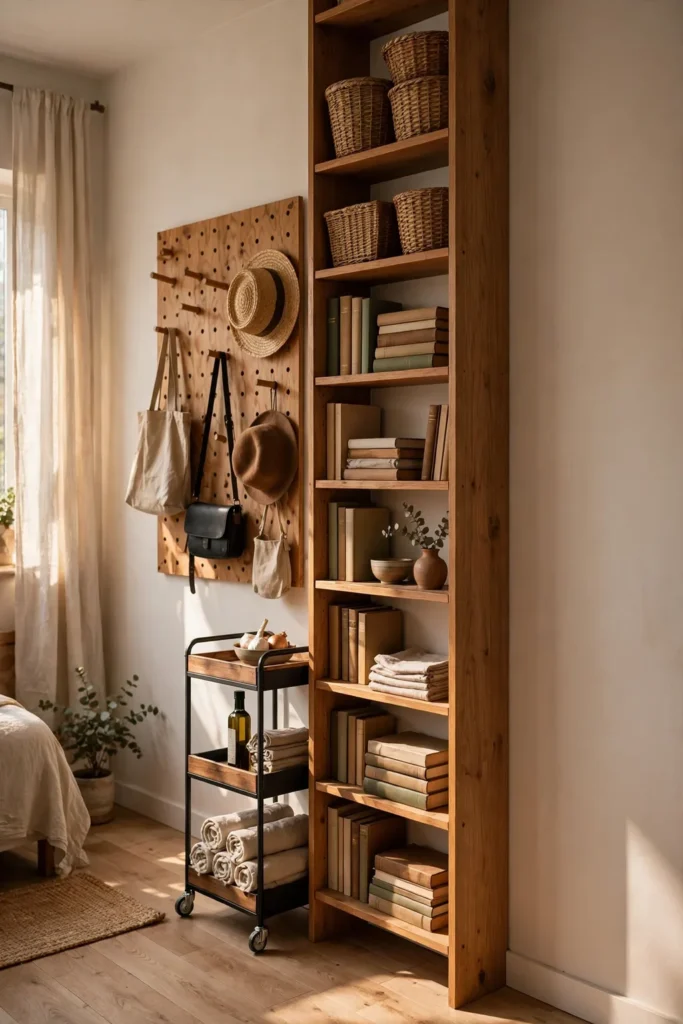
Best for: the wall space above eye level, the biggest unused storage area in any studio.
A studio has about 8 feet of wall height and most people use the bottom 5. The top 2 to 3 feet is free storage, and it is the only storage that costs no floor space at all. Tall, narrow shelving is the single highest-value move in this guide. For ready-made pieces that fit these studio apartment storage ideas, see the IKEA storage ideas to maximize any space.
- Tall narrow shelves: a shelving unit 24 inches wide and 70 inches tall holds more than a wide low bookcase and takes a quarter of the floor. Put daily things at eye level (48 to 60 inches), weekly things above, and seasonal things on the top shelf. The top 12 to 18 inches below the ceiling is for things you touch twice a year, not daily clothes.
- Pegboard: a pegboard 24 by 36 inches on the wall holds bags, hats, keys and tools on hooks, and it moves with you. Hang it with adhesive strips rated for its weight, or lean a large one against the wall behind a desk. A pegboard turns a blank wall into storage without a single shelf.
- Over-door storage: an over-the-door organizer ($10 to $18) on the front door or the bathroom door holds shoes, cleaning supplies or accessories. It needs no drilling, no hooks, no permission, and it uses a door you already have.
- What to watch: tall storage on the window wall blocks natural light, put it on a solid wall instead. And keep 20 to 30 percent of each shelf empty. A shelf packed full looks like a warehouse; a shelf with breathing room looks like a home.
Budget: a tall narrow shelving unit costs $30 to $60. A pegboard kit costs $25 to $35. An over-the-door organizer costs $10 to $18. Vertical storage is the cheapest square footage in the apartment, because it was already yours. That is why vertical storage leads so many studio apartment storage ideas for small rooms.
3. Under the bed: the biggest hidden space
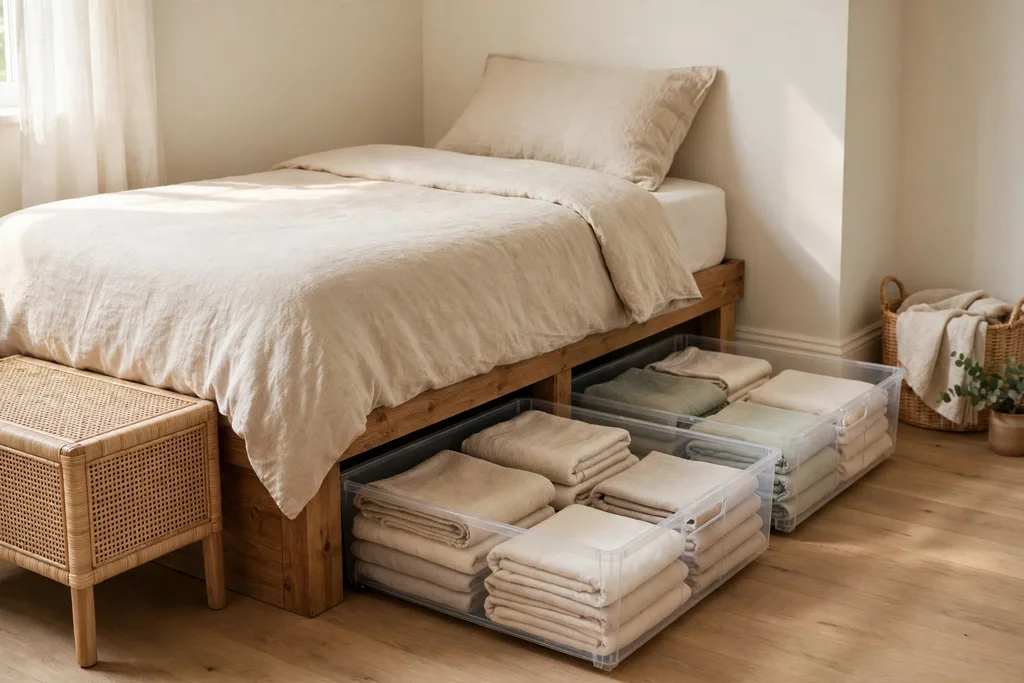
Best for: the space you already own, under the bed is roughly 30 square feet of storage in a studio, and most people waste it.
A solid bed frame with no storage underneath throws away the largest hidden space in the room. Under-bed storage is the highest-capacity, lowest-effort idea in this guide, but only if the bins actually fit. Reclaiming that space is one of the highest-impact studio apartment storage ideas in this guide.
- Measure first: slide a tape measure under the bed. If the clearance is under 6 inches, skip under-bed bins, they will jam. Bed risers add 5 to 8 inches of clearance and cost $10 to $20 for a set of four. With risers, a standard bed gives you 11 to 14 inches of clearance, enough for two layers of flat bins.
- Match the bin to the clearance: flat under-bed bins are 5 to 6 inches tall. Your bin must be at least 1 inch shorter than the clearance, or it will not slide in and out. A bin that fits is storage; a bin that jams is a drawer you can never open. Buy one bin first, test the slide, then buy the rest.
- What goes under the bed: out-of-season clothes, spare linens, shoes you wear weekly, not daily clothes. Daily clothes under the bed means kneeling on the floor every morning. Label every bin on the end you can see, so you never pull out three bins to find one sweater.
- What to watch: clear bins with no labels are a trap, you can see everything and find nothing. Label the short end. And vacuum-seal bags work for bulky winter clothes, but they are a bad idea for anything you need weekly: unsealing and resealing a bag every week is a chore you will stop doing.
Budget: two flat under-bed bins cost $20 to $28. A set of bed risers costs $10 to $20. Under-bed storage is the cheapest big space in the studio, it was already there. For the money, few studio apartment storage ideas beat bins you already have room for.
4. Double the closet you do have
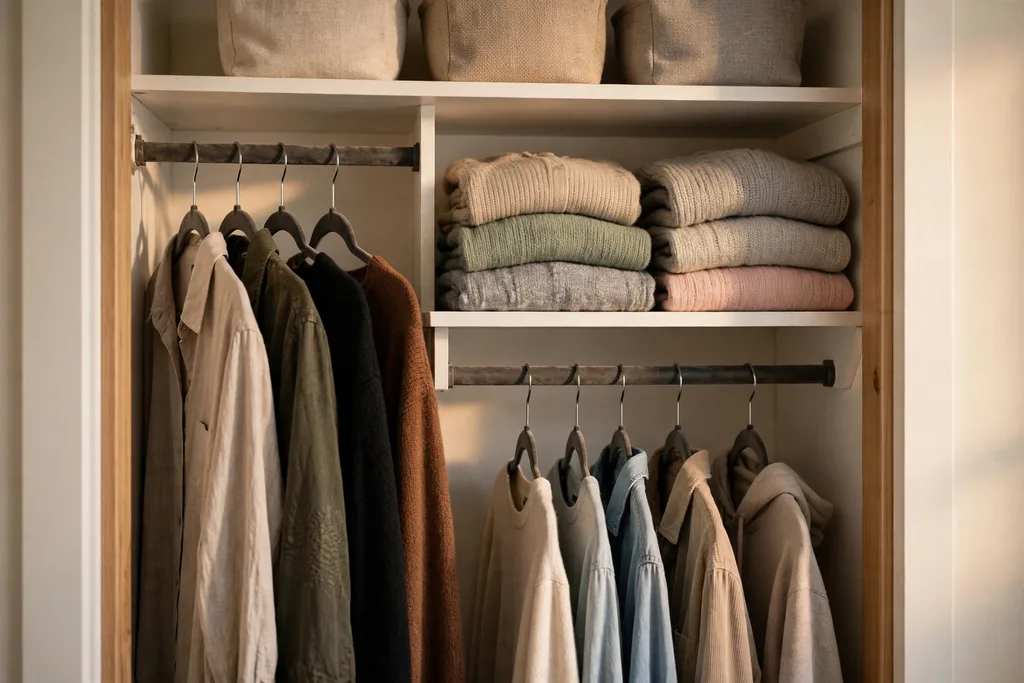
Best for: studios that do have a small closet, most closets waste half their height on one rod.
A standard closet has one rod at about 66 inches and a shelf above it. Everything below the rod, roughly 3 feet of height, is dead space with a pile of shoes in it. A second rod doubles the hanging space in the same closet, with no drilling. A second rod is one of the quickest studio apartment storage ideas to install, and it needs no drilling.
- Rod heights: the top rod hangs at 80 inches from the floor, the second rod at 40 inches. Each zone is 40 inches tall, right for shirts, blouses and pants folded over a hanger. A tension rod works as the second rod if the closet is narrow; a no-drill closet rod that braces between the walls works in wider closets. Neither needs a screw.
- Slim hangers: swap bulky plastic hangers for slim velvet hangers and you fit 30 to 40 percent more clothes on the same rod. Slim hangers are about 1/4 inch thick versus 1/2 inch for plastic, across a 36-inch rod, that is the difference between 25 shirts and 35.
- Shelf risers: a shelf riser on the closet shelf doubles the shelf, folded sweaters below, folded jeans above, with a 10 to 12 inch gap between the layers. A riser costs $10 to $15 and needs no installation at all.
- What to watch: keep one single-rod section for dresses and coats, they need the full 60 inches of hanging length and will crush on a double rod. And do not hang heavy coats on a tension rod. A tension rod holds light clothes; a coat will pull it down overnight.
Budget: a no-drill second rod costs $15 to $25. A pack of slim hangers costs $10 to $15. A shelf riser costs $10 to $15. Doubling a closet costs less than one new piece of furniture. That is the cheapest way to double hanging space among these studio apartment storage ideas.
5. Furniture that hides things
Best for: the living zone, furniture that stores things is the only storage that does not look like storage.
In a studio, storage furniture is not a luxury, it is the difference between a room that looks lived-in and a room that looks like a warehouse. Every piece of furniture should do two jobs, or it should not be in the room. Choosing pieces that hide things is one of the most practical studio apartment storage ideas for the living zone.
- Storage ottoman: an ottoman 17 to 20 inches wide holds blankets, chargers and clutter, and it is a seat, a footrest and a side table. It costs $30 to $50 and it hides the mess that has no other home.
- Storage bench: a bench 30 inches wide with a lift-up seat holds shoes, bags and out-of-season clothes at the entry or the foot of the bed. Seat height 17 to 19 inches, depth 10 to 12 inches, deep enough for shoes, shallow enough for a walkway.
- Lift-top coffee table: a lift-top table hides remotes, notebooks and chargers inside, and the top lifts to desk height for laptop work. In a studio with no separate office, that is two pieces of furniture in one. For a full desk setup that fits a small studio, see Small Desks for Small Spaces.
- What to watch: do not fill every inch with storage furniture. One ottoman, one bench and one lift-top table is enough, a fourth storage piece turns the room into a furniture showroom. And keep the storage furniture where you use the things: blankets near the sofa, shoes near the door, chargers near the desk.
Budget: a storage ottoman costs $30 to $50. A storage bench costs $40 to $70 secondhand. A lift-top coffee table costs $60 to $100 secondhand, the one item in this guide worth buying used, because it is the most expensive and the easiest to find. Buying it used keeps these studio apartment storage ideas under budget without losing the hidden storage.
6. The entryway drop zone
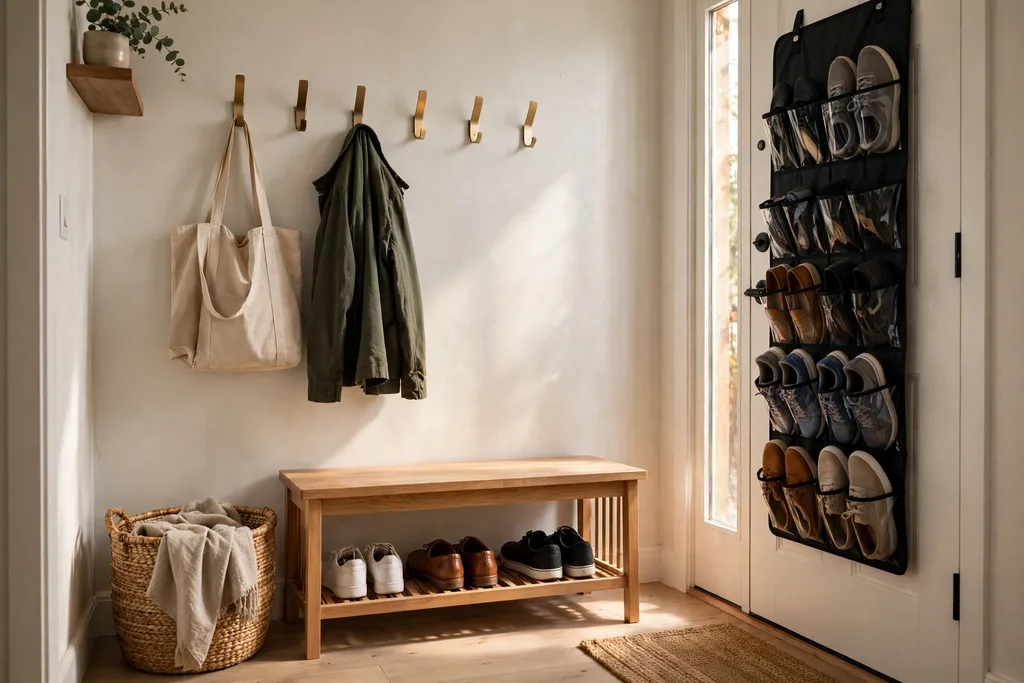
Best for: the first 24 to 36 inches inside the front door, where studio clutter is born.
A studio has no hallway to absorb the mess of coming home. Keys, bags, shoes and coats land in the first three feet inside the door, and if there is no system there, they spread across the whole room. A drop zone is a 24 to 36 inch stretch of wall with three things: hooks, a bench and a basket. A drop zone like this is one of the smallest studio apartment storage ideas, and also one of the most used.
- Hooks: a row of adhesive hooks at 65 inches, high enough for a coat, low enough to reach, holds bags, jackets and keys. Small hooks hold 1 to 3 pounds, medium hooks 3 to 5 pounds, large hooks 5 to 7 pounds. Match the hook to the weight: a winter coat is 3 to 5 pounds, a loaded tote is 5 to 8 pounds. Use two hooks for anything over 5 pounds.
- Bench + shoes: a slim bench 10 to 12 inches deep with shoe storage underneath holds 6 to 8 pairs of daily shoes. The rest of your shoes live in the closet or under the bed, the entry holds the daily pairs only. A 10-tier shoe rack holds 30 to 50 pairs, but it belongs in a closet, not in a 36-inch entry.
- Over-door organizer: an over-the-door shoe organizer on the front door holds shoes, cleaning supplies or accessories for $10 to $18. It needs no drilling and no wall space at all.
- What to watch: the drop zone fails when it holds more than the daily load. If the hooks hold five coats and the bench holds twelve pairs of shoes, it is not a drop zone, it is a second closet. Daily things only; the rest goes to its zone.
Budget: adhesive hooks cost $10 to $15 for a set. A slim bench costs $30 to $50. An over-the-door organizer costs $10 to $18. The drop zone is the cheapest clutter fix in the studio. Few studio apartment storage ideas fix daily clutter for less than a set of hooks and a bench.
7. Kitchen and bathroom nooks
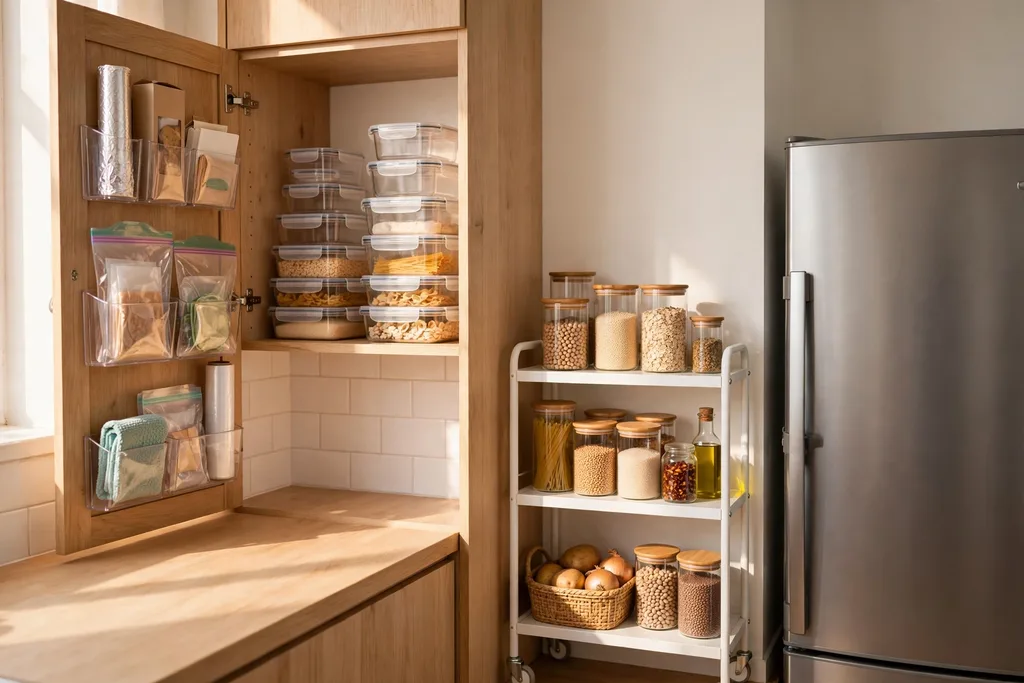
Best for: the two rooms every storage guide forgets, the kitchen and the bathroom in a studio are one wall each, and they overflow first.
Kitchen and bathroom storage is thin in almost every studio guide, but it is where the daily mess lives. The fixes are small, cheap and measured. Slim carts and inside-door racks are the studio apartment storage ideas that cover the rooms other guides forget.
- The slim cart: a slim rolling cart 6 to 10 inches wide fits the gap between the fridge and the wall, the gap every studio has and nobody uses. It holds pantry jars, oils and cleaning supplies, and it rolls out when you need it. Measure the gap first: if it is under 6 inches, the cart will not fit.
- Inside the cupboard doors: adhesive hooks and small racks on the inside of cupboard doors hold measuring cups, lids and cleaning supplies, $10 to $15 for a set, no drilling, and they use space that was already wasted. A pull-out tray under the sink ($15 to $25) doubles the usable space under a studio sink.
- Bathroom: a slim freestanding cabinet 10 to 12 inches deep fits beside the sink, and a shower caddy that hangs from the shower head needs no drilling at all. Stackable containers inside the bathroom cabinet keep small things from spreading across the counter.
- What to watch: do not put open shelving in the kitchen if you cook daily, open shelves above a stove collect grease and need wiping every week. Closed bins and inside-door storage stay clean. And keep the walkway 30 inches clear in front of the kitchen counter, a cart that blocks the cooking path will be shoved aside within a week.
Budget: a slim rolling cart costs $20 to $35. Inside-door organizers cost $10 to $15. A pull-out tray under the sink costs $15 to $25. Kitchen and bathroom storage is a $45 to $75 fix, not a renovation. That small spend is typical of the studio apartment storage ideas in this guide: cheap, no-drill and reversible.
8. The 5-minute reset and seasonal rotation
Best for: keeping the system working, storage fails in week three, not on day one.
Every storage system in this guide works on the day you build it. The question is whether it still works a month later. Two habits decide that: a 5-minute daily reset and a seasonal rotation. The reset is what keeps these studio apartment storage ideas working in week three, not just on day one.
- The 5-minute reset: every evening, five minutes, one loop of the room: coats on hooks, shoes in the bench, dishes in the sink, the ottoman lid closed. Five minutes a day is the whole maintenance plan, and it is the reason the system survives. A studio that gets a 5-minute reset every night never needs a weekend deep clean.
- Seasonal rotation: twice a year, swap the bins. Winter clothes go into the labeled under-bed bins, summer clothes come out, and the reverse in spring. Label every bin with what is inside and the season it belongs to. Rotating by season is the only way a small closet holds a full wardrobe: only the current season lives at eye level.
- The capsule rule: keep 25 to 35 items in the daily wardrobe and store the rest. A capsule wardrobe removes 30 to 40 percent of the volume from the closet wall, and it makes the morning decision faster, not slower.
- What to watch: do not buy storage before you declutter. The rule is simple: if you have not used it in a year, it leaves before the bins arrive. Storage for things you do not need is just organized clutter.
Budget: free. The reset costs five minutes and the rotation costs an afternoon twice a year. The cheapest storage in this guide is the habit, not the purchase. Free habits like these are the studio apartment storage ideas that cost nothing and save the most time.
Small studio layout: a 400-square-foot storage plan
Best for: the whole room, where every zone goes in a 400-square-foot studio.
A studio works when it has four zones and the storage lives inside them, not scattered across the room. Here is the plan for a 400-square-foot studio, roughly 20 by 20 feet: Zoning the room this way is how these studio apartment storage ideas stay organized instead of scattered.
- Sleep zone (one corner, about 8 by 10 feet): the bed against one wall, under-bed bins underneath, the closet wall on the adjacent wall. Daily clothes at eye level in the cubes; out-of-season clothes in the under-bed bins. Nothing else in this zone, the sleep zone is for sleeping, not for storing the kitchen overflow.
- Live zone (opposite the bed, about 10 by 12 feet): the sofa, the storage ottoman, the tall narrow shelf on a solid wall. The ottoman holds blankets and chargers; the shelf holds books and baskets. The window wall stays clear, no tall storage blocking the light.
- Work zone (near the window, about 6 by 6 feet): the desk, the pegboard above it, the lift-top coffee table doubling as a second work surface. Chargers and notebooks live in the ottoman or the desk drawer, not on the floor.
- Entry + kitchen (the door wall, about 6 by 8 feet): the drop zone in the first 24 to 36 inches inside the door, the slim cart in the gap beside the fridge, the pull-out tray under the sink. The walkway from the door to the window stays 30 to 36 inches clear, it is the spine of the room, and nothing storage-related crosses it.
- What to watch: a studio fails when the zones blur, when the kitchen overflow lands on the bed and the work papers land on the sofa. The zones are the system. If something does not have a zone, it does not have a home, and it will end up on the floor.
Renter-friendly rules
Studio apartment storage in a rental has one hard rule: everything must come down cleanly when you leave. No holes, no paint damage, no lost deposit. These are the no-drill methods that actually hold, with the weight ratings printed on the packaging, read them, and stay under them. Every one of these studio apartment storage ideas follows that rule: no holes, no damage, no deposit risk.
- Adhesive strips: small strips hold 1 to 3 pounds per pair, medium strips 3 to 5 pounds, large strips 5 to 7 pounds. Always use strips rated for at least twice the item’s weight, a 4-pound frame needs strips rated for 8 pounds or more, which means two pairs of medium strips. A pegboard 24 by 36 inches with hooks and bags can weigh 8 to 12 pounds loaded, that is three to four pairs of large strips, not one.
- Adhesive hooks: small hooks hold 1 to 3 pounds, medium 3 to 5 pounds, large 5 to 7 pounds. A winter coat is 3 to 5 pounds; a loaded tote is 5 to 8 pounds, use two large hooks for a tote, one medium hook for a coat. Never hang a heavy mirror or a shelf from adhesive hooks. Hooks are for coats and bags, not for furniture.
- The 30-day paint rule: never put adhesive strips or hooks on paint less than 30 days old, the paint has not fully cured, and the strip will pull it off the wall. If you have just moved in and the walls were freshly painted, wait the 30 days, or use freestanding storage until then.
- Cure time: after sticking a strip or hook, wait 24 to 48 hours before hanging anything on it. The adhesive needs time to bond. Hanging a bag on a fresh hook is the fastest way to find it on the floor in the morning.
- Removal: pull the tab straight down, slowly, never pull it toward you. If a tab snaps, warm the strip with a hairdryer for 20 to 30 seconds and peel gently. Test one strip first on a hidden patch of wall before you commit to a whole pegboard.
- Lean, don’t drill: mirrors, art and frames lean against the wall. A leaning mirror needs no hook and no hole. Tension rods brace between two walls and need no screws. Over-door organizers hang from the door. If a storage idea needs a drill, there is a no-drill version of it, and that version is the one for a rental.
- What NOT to do: do not drill and spackle on move-out. One competitor tells renters to use drywall anchors and patch the holes later, that is a repair job, a paint-matching job, and a deposit risk. Everything in this guide comes down cleanly, with no patching and no painting.
Studio apartment storage ideas under $150
Best for: the whole studio, every idea in this guide, added up, in buy order. Every one of these studio apartment storage ideas earns its place by cost per use.
Buy in this order. Round 1 is the biggest win per dollar; round 2 finishes the room. If the budget is strict, round 1 alone fixes the worst of the mess. Following that order is how these studio apartment storage ideas stay under $150 in total.
| Buy order | Item | Cost |
|---|---|---|
| 1 | Over-the-door shoe organizer | $10–$18 |
| 2 | Two flat under-bed bins | $20–$28 |
| 3 | 6-cube organizer | $25–$40 |
| 4 | Tension rod + linen curtain | $15–$25 |
| 5 | Slim rolling cart (kitchen gap) | $20–$35 |
| Total (round 1) | $90–$146 |
That is the whole studio storage setup for under $150, closet wall, under-bed storage, entry organizer and kitchen cart, with the honest range: $90 if you buy the cheapest of each, $146 at the top end. If you already own bins or a cart, the total drops further. That total is the whole point of these studio apartment storage ideas: a full setup, not one expensive piece.
Round 2 (next month, another $55 to $85): a storage ottoman ($30 to $50) and a pegboard kit ($25 to $35). Round 2 is the polish, the room works without it, but it works better with it.
The free ideas: the 5-minute reset, the seasonal rotation, and taking three things off every shelf cost nothing, and they change the room more than any purchase. Storage starts with taking things away, not adding them. Free moves like these belong in any list of studio apartment storage ideas, because they cost nothing.
5 mistakes to avoid
1. Buying before measuring. The single most common studio storage mistake is buying bins, shelves and racks before measuring the clearance, the wall and the gap. A bin that is 1 inch too tall jams under the bed. A cart that is 1 inch too wide does not fit beside the fridge. Measure first, buy second, every time. Measuring first is the rule behind every one of these studio apartment storage ideas.
2. Buying a full closet system before testing cubes. A full closet system is a commitment of money and wall space. Test the cube-and-curtain wall for a month first. If the cubes work, you saved the money. If they do not, you know exactly what the system needs to fix, because you lived with the problem first.
3. Storing daily clothes in the hardest place to reach. Daily clothes go at eye level, in the middle cubes, on the easy rod. Out-of-season clothes go up high and under the bed. If getting dressed means kneeling on the floor or climbing for a bin, the system is backwards, and you will stop using it within a week.
4. Clear bins with no labels. Clear bins show everything and help you find nothing. Without labels, you pull out three bins to find one sweater, and the other two never get put back properly. Label the short end of every bin with what is inside. Labels cost nothing and save the system.
5. Tall storage blocking the window light. The tallest shelf in the room does not belong on the window wall. Tall storage there kills the only natural light in the studio, and the whole room feels smaller and darker. Put tall storage on a solid wall. The window wall stays clear, light is worth more than shelf space. Light matters as much as storage, so keep these studio apartment storage ideas off the window wall.
FAQ
How do you add storage to a studio apartment with no closet?
Build a closet wall: a row of cube shelves 48 to 72 inches wide, a tension rod with a curtain across the front, and a slim garment rack for clothes that wrinkle. It needs no drilling, it costs $60 to $145, and it moves with you when you leave. That closet wall is the first of these studio apartment storage ideas most studios should try.
What furniture gives the most storage in a studio?
A storage ottoman and a storage bench give the most hidden storage per dollar, an ottoman 17 to 20 inches wide holds blankets and clutter, and a bench 30 inches wide holds shoes and bags. After that, a tall narrow shelf 24 inches wide and 70 inches tall holds more than any wide low bookcase.
How do you keep a studio apartment from looking cluttered?
Give everything a zone, and leave 20 to 30 percent of every open shelf empty. A shelf packed edge to edge reads as clutter even when it is organized. Add the 5-minute nightly reset, coats on hooks, shoes in the bench, the ottoman lid closed, and the room never gets ahead of you. Zones and breathing room are what make these studio apartment storage ideas look calm instead of cluttered.
Can I install wall shelves if I live in a rental apartment?
Yes, with no-drill methods. Use adhesive strips rated for at least twice the shelf’s loaded weight, and only on smooth, fully cured paint (older than 30 days). For anything heavy, use a tall freestanding shelf instead of a wall shelf: it needs no holes at all and holds far more.
Can a closet wall work in a rental studio?
Yes. Cubes, a tension rod and a curtain need no drilling and leave no holes, that is the whole point of the closet wall. Check the lease for any rules on window coverings or door organizers, and keep the wall off the window so it does not block the light.
What should I buy first on a small budget?
Buy in this order: an over-the-door organizer ($10 to $18) and two under-bed bins ($20 to $28) first, the cheapest items with the biggest immediate win. Then the 6-cube organizer ($25 to $40), then the tension rod and curtain ($15 to $25). The whole first round comes in at $90 to $146.
What is the best renter-friendly way to hang clothes without a closet?
A garment rack rated 200 to 400 pounds with lockable wheels, plus a tension rod with a curtain for the cube wall. Slim velvet hangers fit 30 to 40 percent more clothes on the same rod. Never hang heavy coats on a tension rod, it holds light clothes only.
How do I store shoes in a tiny studio?
Keep 6 to 8 pairs of daily shoes in the entry bench or an over-the-door organizer, and store the rest in the closet or under the bed. A 10-tier rack holds 30 to 50 pairs, but it belongs in a closet, not in a 36-inch entryway.
Start today
Studio apartment storage ideas do not need a shopping trip, they need a tape measure. Measure the gap under your bed, the wall where the closet will go, and the gap beside the fridge. That is the whole first round, and it takes ten minutes. Start with the tape measure, and the rest of these studio apartment storage ideas will follow the numbers.
Start by measuring. The room will tell you what it needs next.