
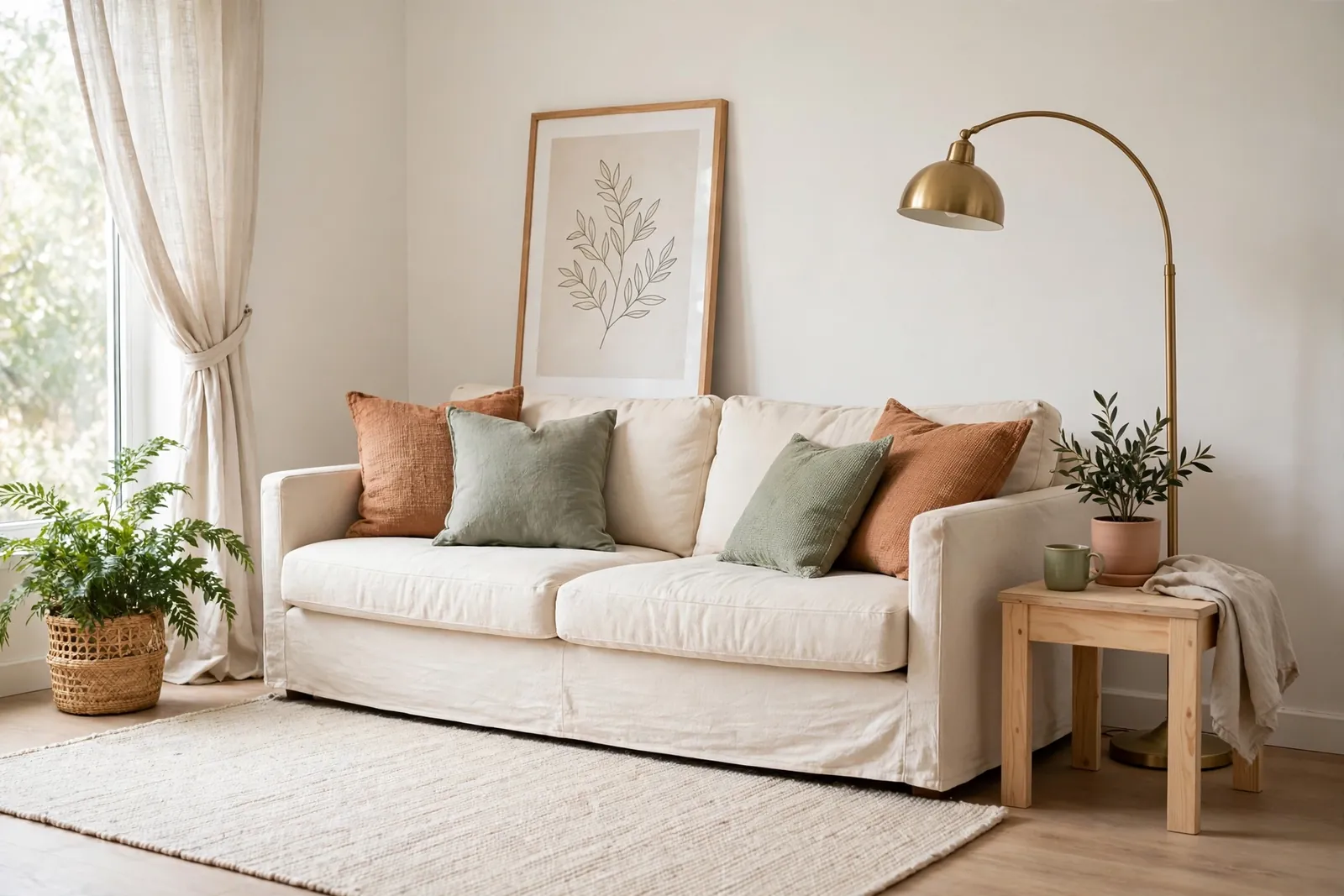
A small living room usually isn’t ugly — it’s just unfinished. The sofa is pushed against the wall, the rug is too small, the ceiling light does all the work, and the one blank wall makes everything feel temporary. The good news: none of that needs a renovation, a landlord’s permission, or a big budget. It needs the right order of fixes.
This guide works through 9 ideas in the order a decorator would do them — layout first (free), then the two purchases that change everything (rug and lighting), then the styling formulas that make it look intentional. Everything here is renter-safe: no drilling, no paint commitments, nothing you can’t undo on moving day. Total budget if you do it all: roughly $150–$300, and most rooms only need three or four of the nine.
Quick glance
- Budget: $0 (layout only) up to ~$300 for the full refresh
- Time: one afternoon for layout + walls; a weekend if you’re shopping too
- Difficulty: beginner — no tools beyond a tape measure
- Renter-safe: yes, 100% — every idea is removable
1. Rearrange the layout first — it costs nothing
Before buying anything, fix the floor plan. The most common small-room mistake is pushing every piece against the walls, which leaves a dead empty centre and makes the room feel like a waiting area. Pull the sofa just 2–4 inches off the wall — that sliver of shadow behind it instantly reads as “placed” rather than “stored.” Face the two best seats toward each other (or at a conversational angle), and keep a clear walkway of at least 30 inches through the room.
Anchor the seating zone around one focal point — a window, the TV, or the largest art you own. If your sofa is oversized for the room, swap the positions of the sofa and the armchair before concluding you need new furniture; the smaller piece often belongs on the longer wall.
Budget tip: “Shop” your other rooms first. A side table, lamp or basket currently wasted in a bedroom often completes the living room for $0.
2. Lock a 3-colour palette before you spend a dollar
Budget rooms look cheap when every purchase is a different colour story. Decorators use the 60-30-10 formula: 60% one dominant neutral (your walls, sofa, rug — keep them in the same warm or cool family), 30% one supporting colour (curtains, chair, throw), 10% one accent (pillows, art, one object). For small rooms, warm whites and light neutrals as the 60% keep it feeling open; terracotta, olive, navy or mustard all work as the 10%.
Write your three colours down and check every candidate purchase against them. If it doesn’t match one of the three, it doesn’t come home — this single rule is why styled rooms look expensive at any budget.
Budget tip: Pillow covers and a throw are the cheapest way to install your 30% and 10% — a full palette change for $25–$40.
3. Buy the right-size rug — this is where the money should go
If you can only afford one real purchase, make it the rug. A too-small rug (the classic 3×5 ft “postage stamp” under the coffee table) is the number-one reason small living rooms look unfinished. The rule: at least the front legs of the sofa and chairs sit on the rug. For most small living rooms that means 5×8 ft minimum, 6×9 ft if the room allows it, with 12–18 inches of bare floor between the rug edge and the walls.
Budget reality: a decent 5×8 low-pile or washable rug runs $60–$130. Low pile is the right call in small spaces — it’s easier to clean, doors clear it, and it layers well later (see our rug layering formula). Leave 2 inches of clearance under any door that swings over it.
Budget tip: Check the rug’s price per size before ordering — the jump from 4×6 to 5×8 is often only $15–$25 and it’s the difference between “almost” and “right.”
4. Layer the lighting — never rely on the ceiling light alone
One overhead light flattens everything and makes budget furniture look cheaper than it is. Rooms that feel expensive have three light sources at three heights: one floor lamp (55–65 inches tall, beside the sofa), one table lamp (on a side table, shade at eye level when seated), and one low glow (a small lamp, candle-style LED, or light over a shelf). Put them on a loose triangle around the seating zone.
Use warm bulbs — 2700K — in every lamp, and match the colour temperature across all three; mismatched bulbs are a subtle “cheap” signal most people can’t name but everyone sees. Second-hand lamps are the best budget buy in decor: solid older lamps run $10–$25 thrifted, and a new shade ($10–$15) makes them look current.
Budget tip: If you own exactly one lamp, place it in the darkest corner, not beside the TV — it pulls the eye across the whole room and makes the space read larger.
5. Dress the wall above the couch — with the sizing formula
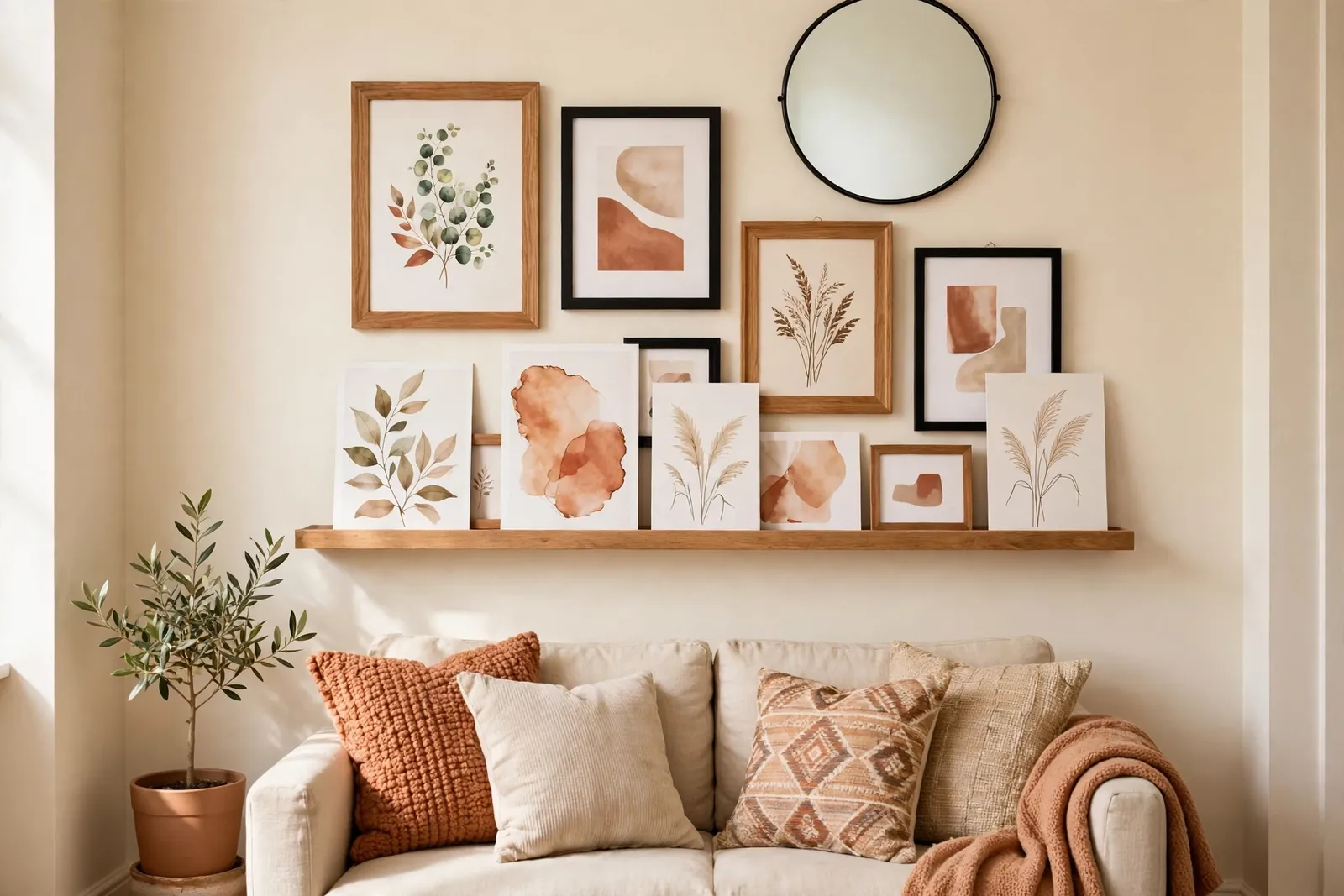
The blank wall behind the sofa is where small rooms lose the most. The formula that settles every argument: your art (or art arrangement) should span about two-thirds the width of the sofa, and its centre should hang at roughly 57 inches from the floor (eye level). On an 84-inch sofa, that’s a ~56-inch-wide piece or gallery arrangement, hung so the bottom edge sits 6–8 inches above the sofa back.
Renter-safe ways to hang it, in order of wall-friendliness:
- Large picture-hanging adhesive strips — use the strips rated for the frame’s weight, and use two pairs per frame, not one; follow the pack’s weight rating honestly and let them set for the stated hour before hanging.
- Lean it — a large framed print leaned on a picture ledge or even on the sofa-back console table needs zero wall contact, and looks deliberately casual.
- One big piece beats six small ones on a budget: a single 24×36 inch print in an off-the-shelf frame ($25–$45 total) reads more expensive than a scattered mini-gallery.
Our full breakdown of arrangements, spacing and heights is in the above couch wall decor ideas guide.
6. Hang curtains high and wide — the cheapest “bigger room” trick
Curtains hung just above the window frame shrink the wall. Hang them 4–6 inches below the ceiling (or as high as the rod allows) and extend the rod 6–10 inches past the frame on each side, so the panels cover wall, not glass, when open. Panels should just kiss the floor or puddle by half an inch — “high-water” curtains cut to sill length are for kitchens, not living rooms.
No-drill options for renters: tension rods inside the frame for lightweight sheers, or ceiling-mount adhesive brackets rated for curtain weight for a higher hang. Linen-look polyester panels deliver 90% of the linen effect at $15–$30 a pair, and in a warm white they double as a light diffuser that makes the whole room softer.
Budget tip: Buy the longer length. A 96-inch panel hemmed (or clipped with ring clips) looks custom; a too-short panel can’t be fixed at any price.
7. Style the pillows with the 3-2-1 formula
Random pillows look like clutter; formula pillows look like a magazine. Work in odd groups and descending sizes: Two 20×20 inch pillows at the corners (your accent colour or pattern), two 18×18 in front of them (supporting colour, different texture), one lumbar (about 12×20 inches) in the centre. That’s it — five pillows, three fabrics maximum, all tied to the palette from Idea 2.
You almost never need new inserts. Pillow covers ($8–$15 each) over the inserts you already own are the highest-impact-per-dollar purchase in this whole guide. Mix one pattern, one solid, one texture (bouclé-look, woven stripe or linen) and keep the pattern’s colours inside your palette.
8. Add one “hero” — and let everything else be quiet
Styled rooms have a hierarchy: one piece you’re proud of, everything else supporting. In a budget room the hero is rarely furniture — it’s the largest or most colourful thing at eye level: the big art piece from Idea 5, a vintage-look mirror, a striking thrifted chair re-covered with a $12 throw, or a tall plant in the corner. Pick one, spend the biggest slice of your budget there, and deliberately keep the surrounding items plain.
This is also the fix for the “everything is from the same big-box store” feeling: one older, textured or handmade object breaks the showroom look for almost no money.
Budget tip: Thrift stores price chairs, mirrors and brass/gold frames far below decor stores. A $20 mirror with a cleaned-up frame outperforms a $60 new “statement piece” almost every time.
9. Hide the clutter in closed storage — the finishing step
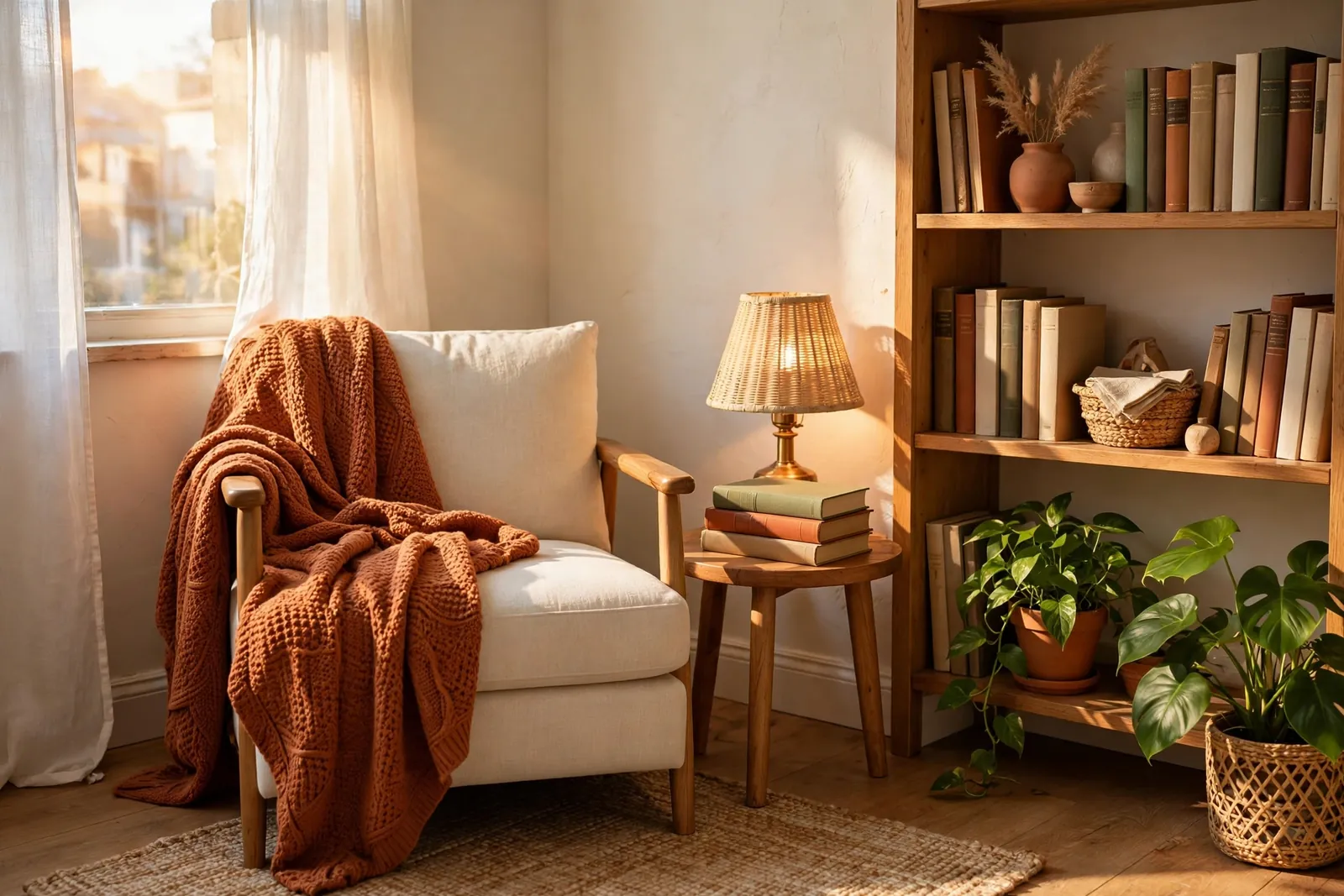
Small rooms forgive almost everything except visible clutter, because there’s nowhere for the eye to rest. Work through the room and give every loose category a closed home: remotes and chargers in a lidded box or basket on the shelf, blankets in one woven basket beside the sofa (not draped over three surfaces), paperwork and games inside the coffee-table’s lower shelf or a storage ottoman. Storage ottomans and cube stools ($30–$60) are the budget workhorses here — seating, side table and hiding place in one piece.
Edit surfaces with the tray rule: anything staying out sits on one tray, one stack of books or one basket. If it doesn’t fit the tray, it gets a home or it leaves. Ten minutes of this does more for “expensive-looking” than another $50 of decor.
Our Budget Picks for a Small Living Room
Links below are affiliate links — the price is the same for you; see our Affiliate Disclosure for details. Placeholders are marked for the final product links.
- Washable low-pile rug, 5×8 ft — the foundation purchase; washable matters in small, high-traffic rooms. Look in the $60–$130 band.
- Large adhesive picture-hanging strips (multi-pack) — the renter’s toolkit for Idea 5; buy the weight rating above your heaviest frame. $8–$14.
- Linen-look curtain panels, 96-inch, pair — warm white; the high-and-wide hang from Idea 6. $15–$30.
- Throw pillow covers, set of 4 (18×18 and 20×20) — one pattern, one solid, two textures, inside your palette. $20–$35 the set.
- Woven seagrass storage baskets, set of 2 — blanket storage + surface control from Idea 9. $20–$35.
- Warm-white 2700K LED bulbs, 4-pack — match every lamp in the room to the same temperature (Idea 4). $8–$12.
FAQ
How much does it actually cost to decorate a small living room?
A visible transformation is realistic at $150–$300: one right-size rug ($60–$130), pillow covers and a throw ($25–$40), curtains ($15–$30) and hanging strips and bulbs ($20). The layout changes in Ideas 1–2 are free, and lighting can start with one thrifted lamp ($10–$25). Below $150, prioritise the rug and the free fixes.
What should I buy first for a small living room?
The rug, sized by the front-legs rule (5×8 ft minimum in most small rooms). It defines the seating zone, and every other decision — curtain colour, pillow palette, art width — gets easier once it’s down. Second: lighting, because it changes how everything you already own looks.
Is all of this really renter-safe?
Yes. Nothing in this guide requires drilling, painting or permanent fixtures. Walls use weight-rated adhesive strips or leaning; curtains use tension rods or adhesive brackets; the rest is furniture placement and textiles. Always follow the strip/bracket maker’s weight ratings and removal instructions to protect your deposit.
What colours make a small living room look bigger?
A light, warm neutral as the dominant 60% (walls, sofa, rug in the same family), one mid-tone supporting colour at 30%, and one accent at 10%. Contrast should live in texture — woven, matte, nubby — rather than in dark colours on big pieces. One darker accent (the 10%) is fine and keeps it from feeling washed out.
Where should I save, and where is it worth spending?
Spend on the rug (you see and touch it daily, and the wrong size can’t be styled around) and on the one hero piece. Save on pillow covers instead of new pillows, thrifted lamps with new shades, linen-look instead of real linen, and prints in standard frames instead of custom framing.
Keep Going (internal links)
- Decorating one room that does everything? → Studio Apartment Decorating Ideas
- The full sizing and spacing breakdown for the sofa wall → Above Couch Wall Decor Ideas
- Every no-damage wall method, rated → Rental Friendly Wall Decor Ideas
- When you’re ready to layer a second rug → Rug Layering Ideas for the Living Room
- More pillow combinations by sofa colour → Throw Pillow Combinations for the Couch
- Planning the wall from scratch → Gallery Wall Layout Ideas