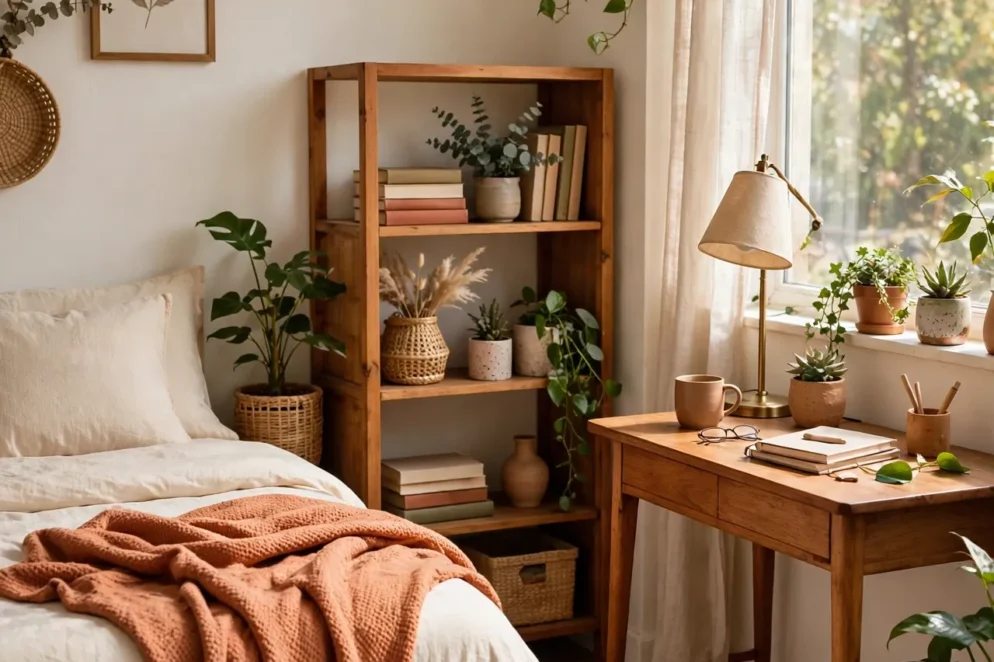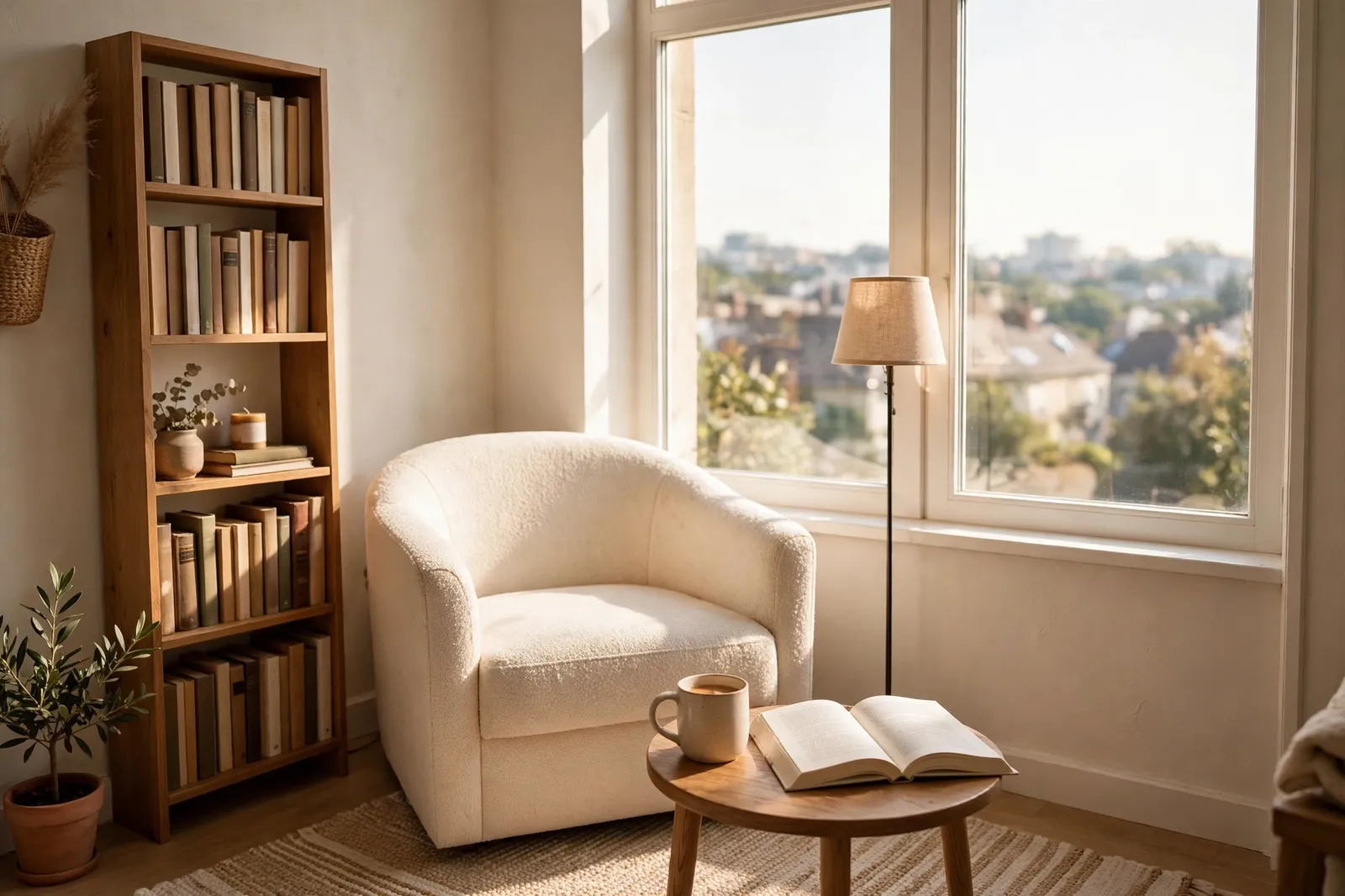
Every small home has a dead corner — the awkward triangle behind the door, the gap beside the sofa, the wide end of a hallway that collects nothing but dust and good intentions. A reading nook is how that corner pays rent. It needs almost nothing: a seat, a light, a surface for a mug, and enough of a boundary that your brain agrees this square metre is off duty.
This guide builds the nook the way it actually gets used: corner first, then the chair that genuinely fits, then the light (the part most nooks get wrong), then the layers and storage that make a corner feel like a destination. Everything is renter-safe and removable, and the full setup runs $35–$220 depending on how much you already own — most people are one chair and one lamp away from done.
Quick glance
- Budget: $35 starter version up to ~$220 for the full chair-and-lamp setup
- Time: one afternoon, including rearranging
- Difficulty: beginner — a tape measure and honest light-checking at dusk
- Renter-safe: yes — adhesive, plug-in and freestanding throughout
1. Claim the right corner — you need 3×3 feet, not a room
A reading nook fits in a 3×3 ft square (about 1 m²) — the chair footprint plus knee room. The corners that work: beside a window (best light wins), the dead end of a living room behind the sofa’s arm, the wide corner of a bedroom, an under-stairs triangle, or a closet with the door removed or left open. The corners that fail: anything inside a walkway (you’ll resent squeezing past your own chair) and anything facing the TV, unless TV is also your reading plan.
Test before you commit: put any chair — a dining chair works — in the corner for two evenings and actually read there. Check the three things photos can’t tell you: the light at the hour you read, the draught or heat from the nearest vent or window, and whether the spot feels sheltered or exposed. A nook you have to talk yourself into using is just furniture storage.
Budget tip: The corner audit is free and saves the classic mistake — buying a chair for a corner with no plug socket within reach of a lamp. Check the socket map before the chair hunt, not after.
2. Choose a chair that fits the square — 32 inches wide or under
Standard accent chairs run 33–38 inches wide, which swallows a 3-ft corner whole. Shop the small-space range instead: 26–32 inches wide, 30–34 deep, with a seat height of 16–18 inches (low enough to curl, high enough to stand up from without a negotiation). Armless or slim-arm designs buy back 4–6 inches of visual and actual room; a swivel base is a genuine small-nook luxury because you turn toward the light instead of dragging the chair.
No chair budget? The floor nook is legitimate and very Pinterest: a firm floor cushion or folded futon pad (24–30 inches square) against the wall, a lumbar pillow behind you, and the wall does the backrest’s job. It reads intentional the moment there’s a rug under it and a lamp beside it — and it stores flat when guests come.
Budget tip: Accent chairs are the most-discounted furniture category in second-hand listings ($30–$80 typical) because they’re the first thing people sell when moving. A $6 throw over a tired fabric chair hides a multitude of previous owners.
3. Light it like a reading lamp, not a room lamp
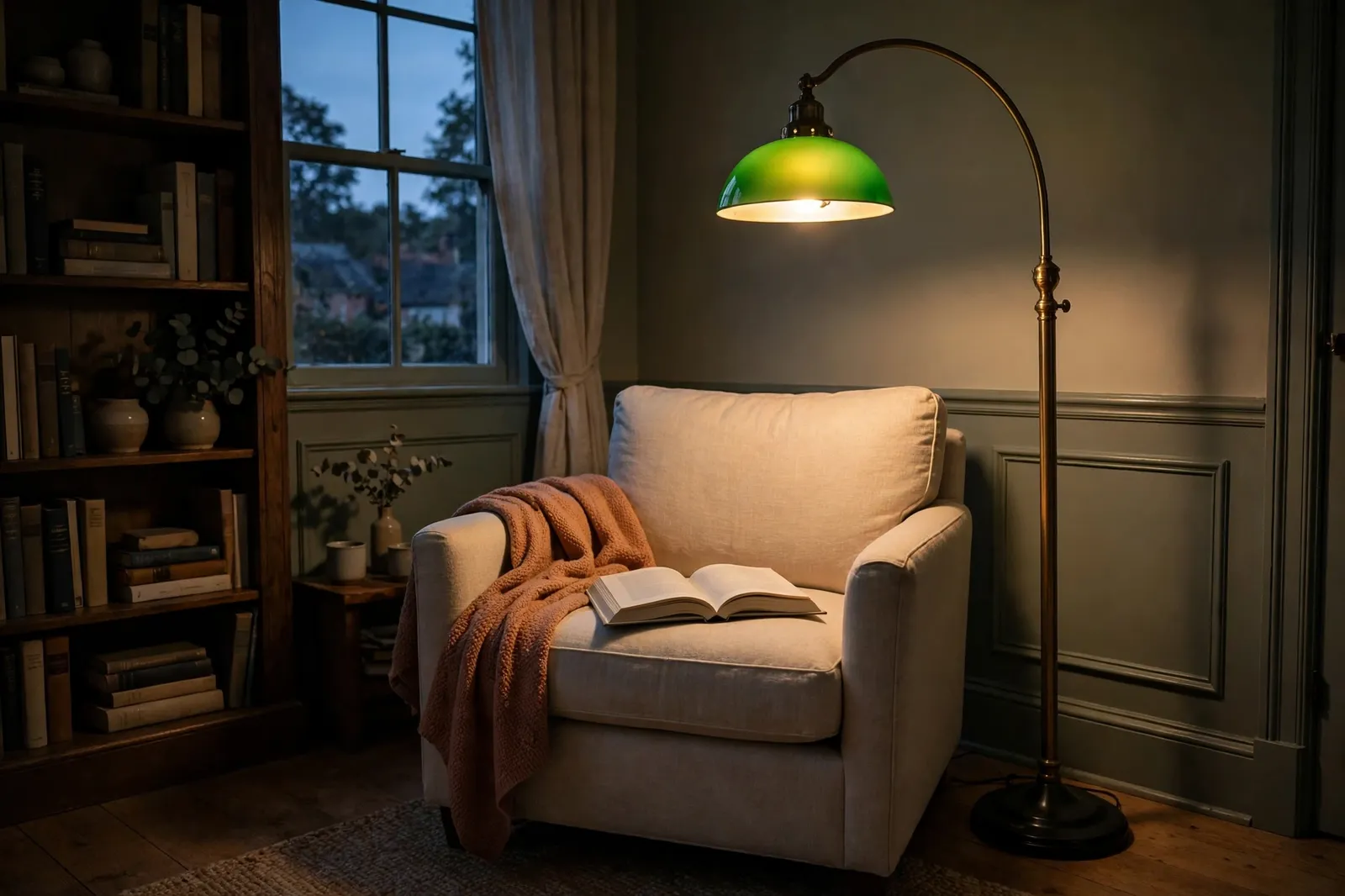
This is the idea that separates nooks that get used from nooks that get photographed. Reading light should land over your shoulder at about seated shoulder height (roughly 40–48 inches from the floor to the bulb), aimed at the page, in the 2700–3000K range at around 450 lumens — bright enough for print, warm enough to feel like evening. A ceiling light behind a shade rarely does any of this.
Three renter-safe ways to get it: a slim arc or pharmacy floor lamp (footprint under 12 inches, reaches over the chair, $35–$80); a plug-in wall sconce mounted with adhesive brackets, cord hidden in a paintable cord cover — the hardwired look for $20–$35, zero holes; or the humble clip-on book light ($8–$15), which is honestly enough light for the page if the budget is doing other work. Whichever you choose, test it at reading hour with the “one page” rule: if you squint or shift the book hunting for light, move the lamp before you blame your eyes.
Budget tip: Put the lamp on a plug-in dimmer or a smart bulb ($8–$12) and one lamp does both jobs — full brightness for reading, low glow for the room’s evening layer.
4. Give the mug a home — a surface within arm’s reach
A nook without a surface fails by Thursday: the mug goes on the floor, the book goes on the mug, and the corner dissolves. The surface only needs to hold a mug, your book and your glasses — 12–16 inches across is plenty. Best small-space options: a C-table that slides under the chair’s base (top at roughly 22–24 inches high, $25–$45) so it floats over your lap edge; a plant stand or stool doing double duty; or a wall shelf at 24–26 inches high beside the chair — renters mount it with heavy-duty adhesive shelf brackets rated for the load, or lean a small ladder shelf against the wall instead.
The measurement people skip: your hand should reach the mug without leaning forward out of the chair. Sit down, hold an imaginary mug, and place the surface where your hand naturally lands — that’s the spec, whatever the catalogue photo says.
Budget tip: Garden stools and plant stands are the same table with a cheaper label — a $15 plant stand has held more bedtime tea than most $60 side tables.
5. Layer the softness — rug, throw, one cushion
A nook is made of layers, in this order. First, a small rug, 3×5 ft or a 4-ft round, under the chair with its front legs on — the rug is the boundary line that tells the household (and your own brain) that this square is a place, not a passage. Second, a throw over one chair arm, in your room’s accent colour, because a nook should look inviting from across the room. Third, one lumbar cushion — one, not a pile; nook chairs are small and cushion collections evict the reader.
Texture matters more than colour here: this is the one corner where you sit still and touch everything, so mix one nubby weave, one smooth cotton and one soft knit and the corner feels rich at thrift-store prices. If the chair is a floor cushion, the rug is non-negotiable — it’s what stops the setup reading as a pillow on the floor.
Budget tip: Buy the throw and cushion cover in the same trip as the rug, from the same colour family on the same shelf — mismatched “bargains” from five stores is how nooks end up looking like lost property.
6. Store the books where the reading happens
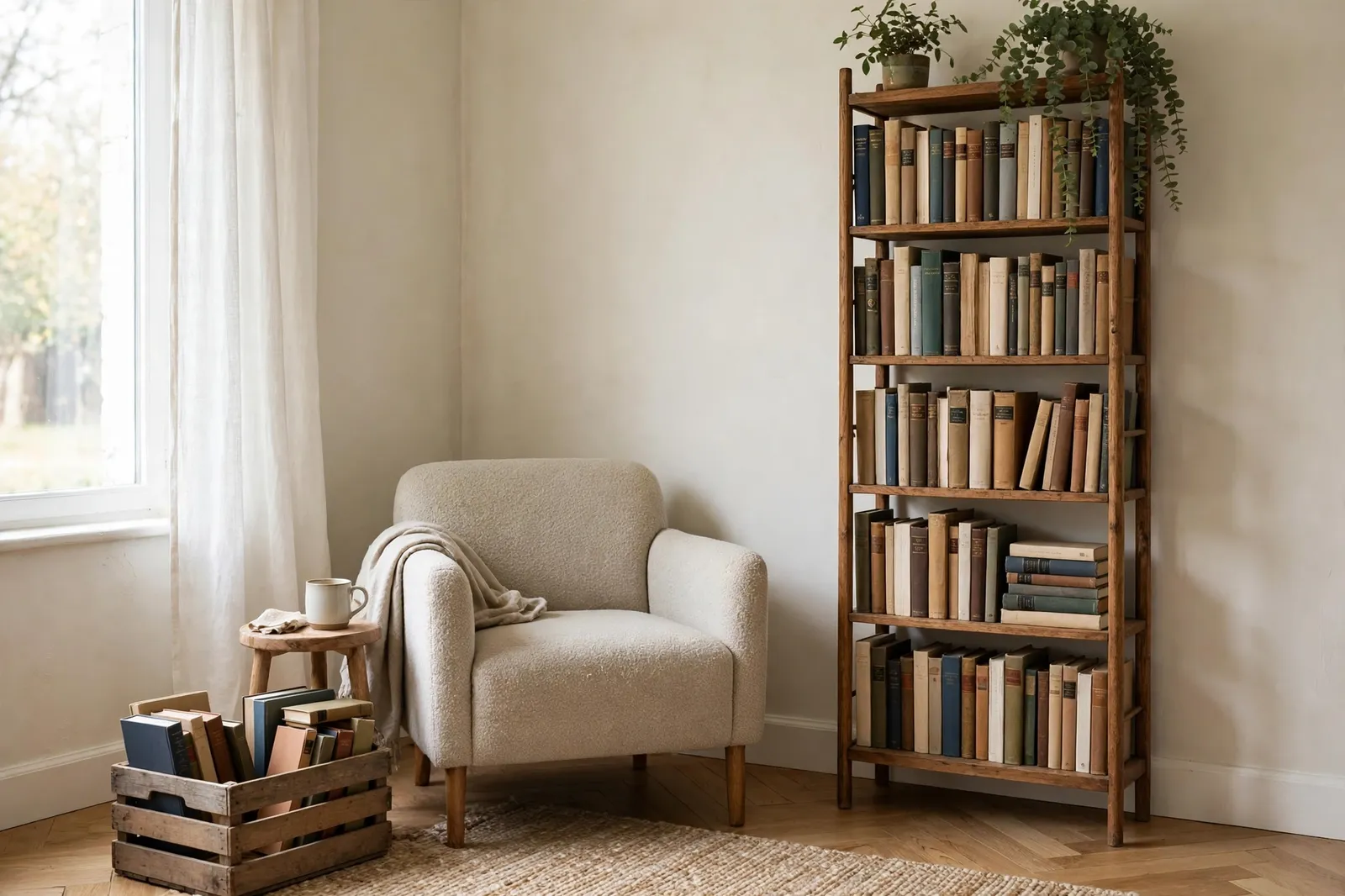
Books stored in another room quietly end reading habits; the nook keeps its own small library. Small-space storage that works: a narrow tower shelf (12–16 inches wide, 4–5 tiers, $30–$60) in the sliver between chair and wall; two short floating shelves above the chair (adhesive-rated brackets for paperbacks only — keep hardcovers low and freestanding); a rolling book cart ($20–$40) that parks beside the chair and moves for cleaning; or a simple crate or basket for the current stack.
One discipline keeps it charming instead of cluttered: the nook holds a maximum of about 10–15 books — the current read, the next few, and the comfort re-reads. Everything else lives on the main shelf. When the nook stack overflows, it stops looking like a library corner and starts looking like a to-do list.
Budget tip: A wooden crate on its side ($8–$15) is a bookcase, a side table and a footrest in rotation — sand the splinters, and it’s the hardest-working object in the corner.
7. Give the nook an edge — so it feels like a separate place
The difference between “chair in a corner” and “nook” is a boundary you can sense. The cheapest edge is the one from Idea 5 (rug + lamp pool of light). The next level: a curtain panel on a tension rod across an alcove or closet opening ($15–$30 all-in), which closes for full cave-mode reading and opens so the room keeps its size; a folding screen or an open bookcase placed perpendicular to the wall at the nook’s open side; or a tall plant filling the gap between chair and wall, which softens the corner and muffles sound a little.
Renters: skip the paint and paper versions of this trick. A boundary made of objects and light comes with you when you move; a painted arch, however lovely, is a repaint job at deposit time.
Budget tip: Test the curtain idea with a $5 thrifted panel or even a bedsheet on the rod for a week. If you never close it, the screen/plant route is your answer and you saved the panel money.
8. The $35 starter nook — build it this weekend
For the smallest budgets and the most undecided corners, the starter version is: a firm floor cushion ($15–$20), a clip-on book light ($8–$15), and a crate or basket you already own ($0) for books and the mug’s parking spot, all on any small rug or throw you can spare. Total new spend: roughly $35, one afternoon, zero furniture delivery.
Then upgrade in the order you’ll feel it: first the lamp (light is the nook), then the chair (comfort is the habit), then the C-table and the tower shelf. Every starter piece keeps a job in the final version — the cushion becomes the footrest, the crate stays the book box — so nothing spent is wasted.
Budget tip: Set the starter nook up where the good chair will eventually go. Living with the cheap version for a month tells you if the corner is right before the chair money moves — corners, like chairs, should be auditioned.
Our Budget Picks for a Small Reading Nook
Links below are affiliate links — the price is the same for you; see our Affiliate Disclosure for details. Placeholders are marked for the final product links.
- Compact accent chair, 26–32 inch width — the anchor; measure the corner first and buy the width, not the photo. $70–$150.
- Pharmacy / arc floor lamp, slim base — reading light at shoulder height with a sub-12-inch footprint. $35–$80.
- C-table side table — slides under the chair base so the surface floats within reach. $25–$45.
- Washable nook rug, 3×5 ft — the boundary line; low pile so chair legs and doors behave. $20–$45.
- Narrow tower bookshelf, 12–16 inch — a real library in a sliver of wall. $30–$60.
- Firm floor cushion, 24–30 inch — the starter seat and later the footrest. $15–$30.
FAQ
How much space do you actually need for a reading nook?
A 3×3 ft square (about 1 m²) is the working minimum: a compact chair at 26–32 inches wide, knee room, and a small surface beside it. A 4×4 ft corner feels generous and fits a tower shelf as well. Door-swing triangles, the space beside a sofa arm, and closet alcoves all qualify — if a chair fits and a lamp reaches it, it’s a nook.
What is the best chair size for a small reading nook?
Shop the small-space range: 26–32 inches wide, 30–34 inches deep, seat height 16–18 inches. Standard accent chairs (33–38 inches wide) overwhelm a small corner. Slim arms or armless designs save several inches, and a swivel base lets you turn toward the light instead of moving the chair.
Can I make a reading nook without a spare corner?
Yes — borrow the space instead. A closet with the door open (or removed), the foot of a bed with a floor cushion and clip light, a wide hallway landing, or a window bay all work. The formula doesn’t change: a seat, task light at shoulder height, a small surface, and a rug to draw the boundary.
What lighting is best for reading in a nook?
Warm light at 2700–3000K, around 450 lumens, positioned over your shoulder at roughly 40–48 inches from the floor and aimed at the page. A pharmacy or arc floor lamp does this best in one purchase; a plug-in sconce on adhesive brackets is the wall version; a clip-on book light is the honest budget option. Overhead ceiling light alone is the one choice that reliably fails.
Can renters build a reading nook without drilling?
Completely. Every element has a no-drill route: freestanding or adhesive-bracket lamps, tension-rod curtains, leaning or freestanding shelves, and rugs as boundaries. Keep adhesive shelves to paperback weight, follow the strip ratings exactly, and the whole nook packs up on moving day without a single hole to fill.
How much does a cozy reading nook cost?
The starter version is about $35: a firm floor cushion, a clip-on book light and a crate from around the house. The full version — compact chair, floor lamp, C-table, small rug and a tower shelf — lands between $180 and $220 bought new, and well under that with a second-hand chair, which is the easiest piece to thrift.
Keep Going (internal links)
- The room most nooks live in → Small Living Room Decor on a Budget
- A nook inside a one-room home → Studio Apartment Decorating Ideas
- Start the visit in style → Entryway Decor Ideas for Small Spaces
- The rug under the chair, done properly → Rug Layering Ideas for the Living Room
- The other small room everyone judges → Small Bathroom Decor Ideas on a Budget
- Style the shelf beside the chair → Bookshelf Styling Ideas