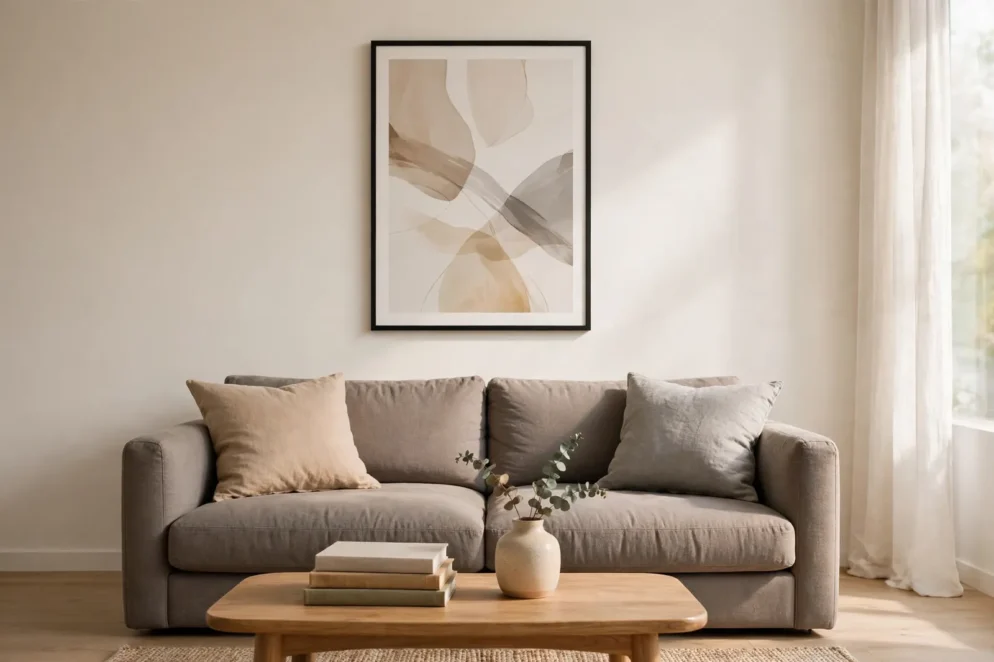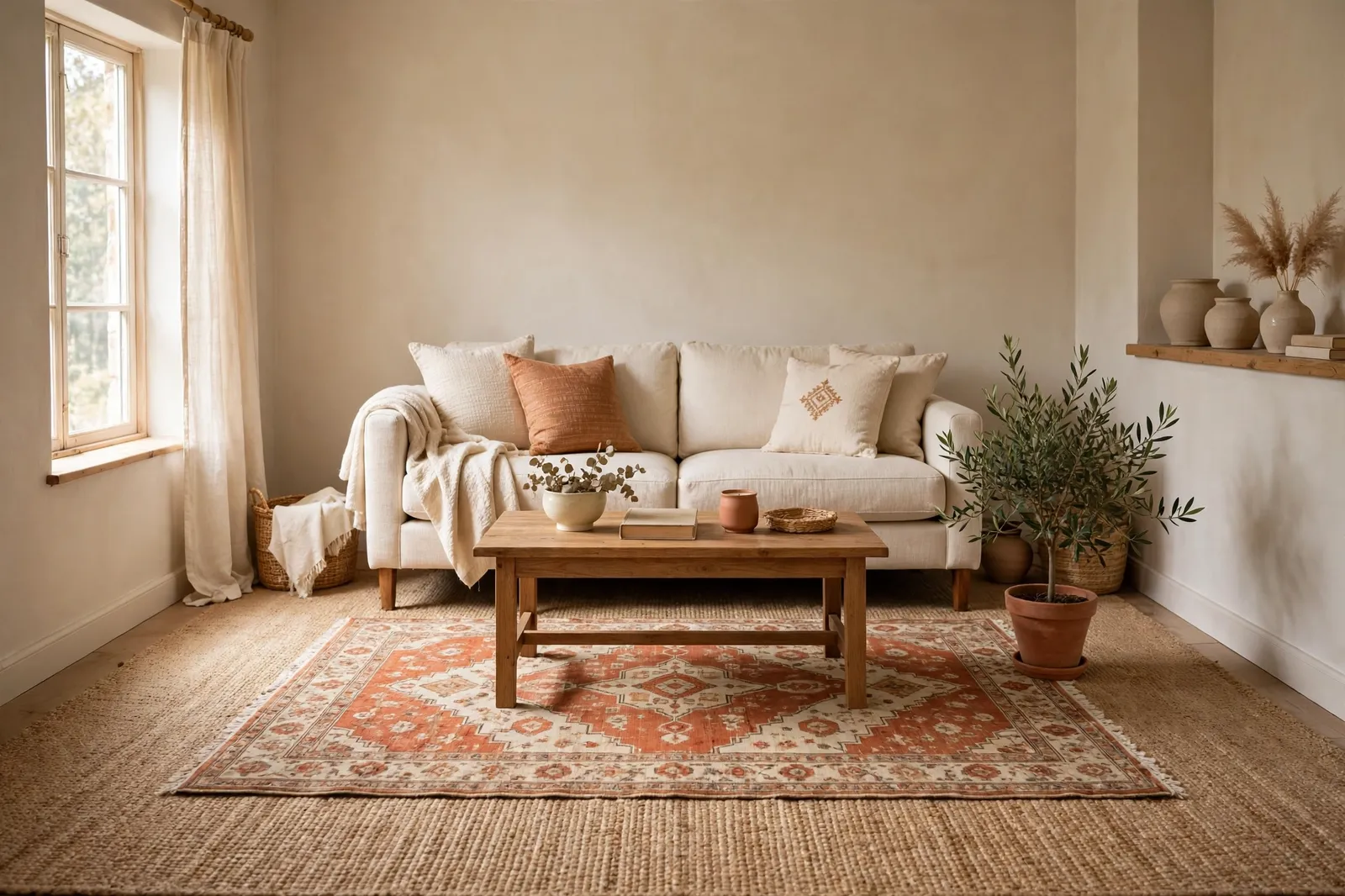
One rug can be perfect on paper — right size, right colour — and the room still looks flat. That’s because a single rug is a single note: one colour, one texture, one rectangle. Layering a second, smaller rug on top is the decorator’s shortcut to depth. It adds pattern without commitment, texture without new furniture, and it solves two practical problems at once: it makes a too-small rug usable, and it puts the wear exactly where your feet actually land.
The good news is that layering is a formula, not a talent. There is a base size that works, a top-rug ratio that works, and a short list of pairings that almost never fail. Everything here is renter-safe — no tape on floors, nothing fixed down permanently — and a full second layer starts around $25–$60 if you shop the top rug smart.
Quick glance
- Budget: $0 (re-layer rugs you own) to ~$60 for a new top rug, up to ~$190 if you’re buying both layers
- Time: 20–40 minutes, including the furniture shuffle
- Difficulty: beginner — a tape measure and a friend for the sofa lift
- Renter-safe: yes — pads and grip layers only, never adhesive on flooring
1. Start with the base rug — big, flat and boring on purpose
The base layer is the foundation, and its job is size, not personality. Apply the standard rule: at least the front legs of the sofa and chairs sit on the rug — for most small living rooms that means 5×8 ft minimum, 6×9 or 8×10 ft if the room allows, with 12–18 inches of bare floor between the rug edge and the walls.
Choose the base in a low-pile flatweave or natural-fibre look (jute, sisal-look, or a flat cotton/poly weave) in your room’s dominant neutral. Two reasons: pile height matters — a plush base makes the top rug lumpy and mobile — and a quiet base lets the top layer carry all the pattern. If you already own a plain rug that’s the right size, congratulations: your base is bought. If your existing rug is too small, it doesn’t retire — it becomes the top rug in Idea 2, and only the base is a new purchase.
Budget tip: The base is the one to buy plain and large rather than small and fancy — a no-pattern flatweave in 8×10 often costs less than a patterned 5×8, because pattern is where the price lives.
2. Size the top rug at one-half to two-thirds of the base
This ratio is the whole formula. The top rug should cover roughly half to two-thirds of the base’s area, centred under the coffee table, so a frame of base rug stays visible on every side — aim for at least 8–12 inches of base showing all the way around. Too big and you’ve just stacked two rugs for no effect; too small and it reads as a bath mat that escaped.
Working pairings: 3×5 ft over 5×8, 4×6 over 6×9, 5×8 over 8×10. Centre the top rug under the coffee table, and let the table’s legs pin it — a top rug held by furniture doesn’t wander. In most rooms the top rug sits inside the seating zone only; the sofa’s front legs stay on the base, not the top layer.
Budget tip: Your too-small rug from a previous apartment is the ideal top layer — the classic layering photo is almost always a “wrong” 3×5 or 4×6 rescued by a big flat base underneath. Cost of this idea: $0 if the small rug is in a closet.
3. The pattern-on-plain formula — the one that never fails
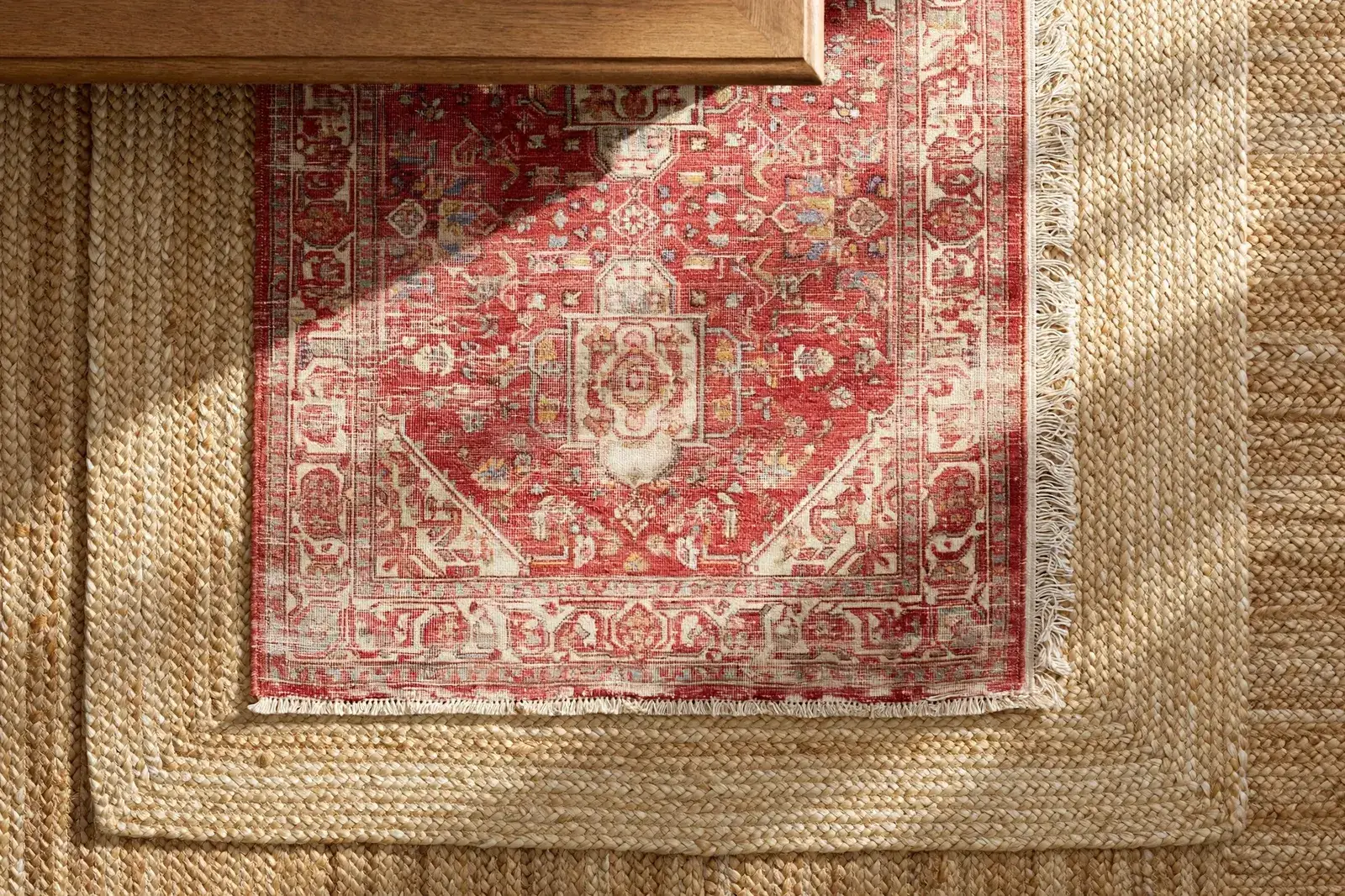
If you copy one look, copy this: plain natural base + patterned top. A vintage-look or Persian-style top rug over a jute or flatweave base is the most-pinned layered combination for a reason — the pattern brings the colour and history, the base brings the size and calm, and neither fights the other.
Keep the pattern’s colours inside your room’s palette: pull two colours from the top rug and repeat them once each elsewhere (a cushion, a throw, a book spine) and the layering looks planned rather than piled. Patterns earn their keep practically, too — a busy vintage pattern hides crumbs, pet hair and the coffee drip zone between the sofa and the table better than any solid colour ever will.
Budget tip: Vintage-look top rugs in 4×6 run $35–$70 washable — and washable matters, because the top layer is the one that takes the spills. Buy the beauty as the cheap, washable layer; keep the expensive size underneath it.
4. The texture formula — same colour, different surfaces
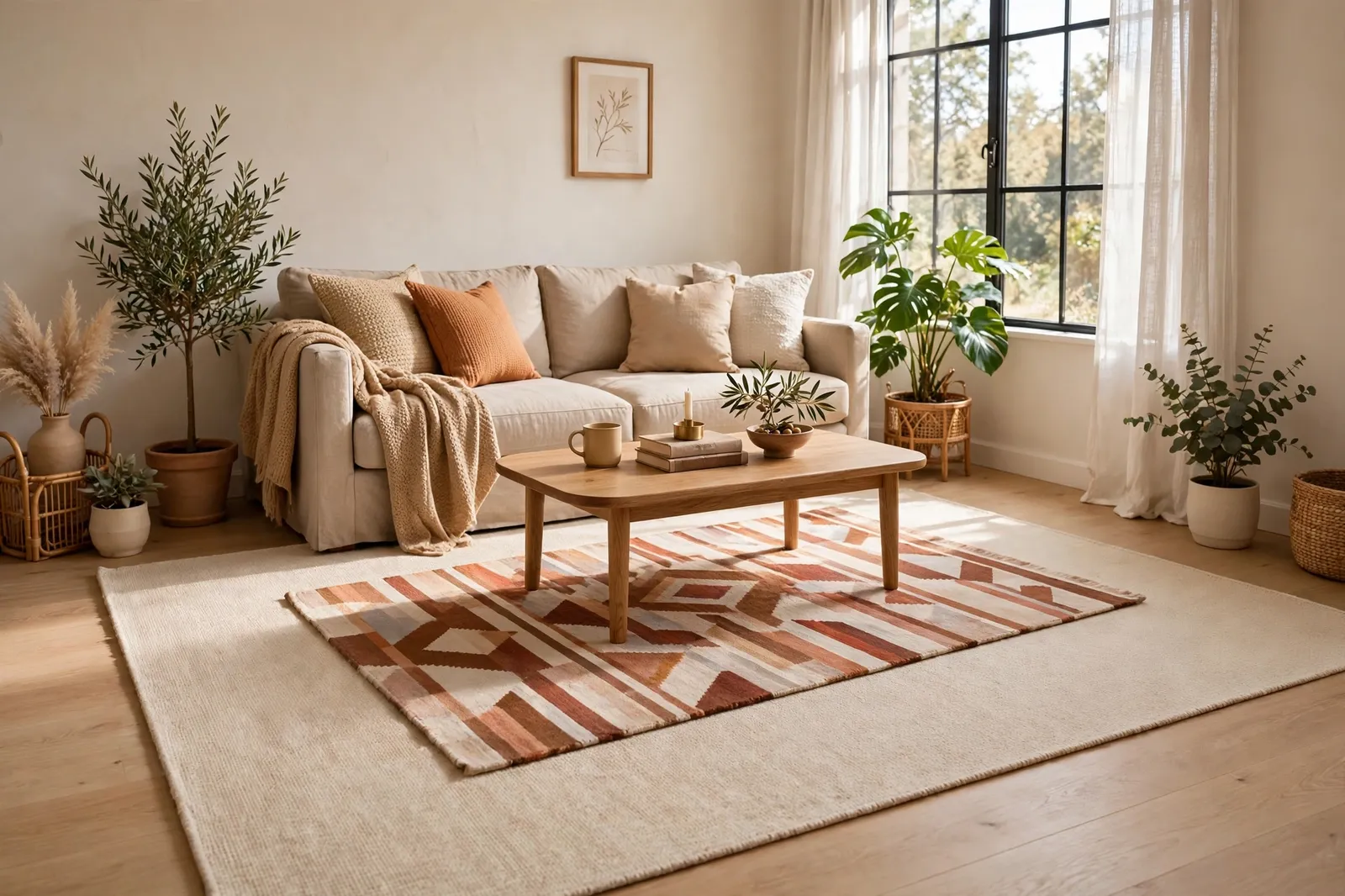
For calm, neutral rooms, layer tone on tone: base and top in the same colour family, separated by texture instead of colour. A flat jute-look base under a soft high-low or wool-look top in the same warm white; a smooth flatweave under a nubby woven cotton. The eye reads the edge between the two surfaces, which is what creates the depth — no pattern required.
The rule that keeps it sophisticated instead of invisible: the two layers must differ in at least two of these — pile height, weave scale, or sheen. Same colour and same texture disappears into one rug with a seam. A small faux sheepskin or shag accent (2×3 ft, $15–$30) draped at one corner of the top rug or under a reading chair is the mini version of this formula.
Budget tip: Texture shows best in natural light — check both rugs by the window before committing. Under warm evening lamps, near-identical beiges can flatten into one; if they do, swap the top for one shade deeper.
5. Angle the top rug when the room feels boxy
In a small or awkward room — everything rectangular, everything parallel — lay the top rug at a deliberate angle of about 15–30 degrees under the coffee table instead of squared to the base. The diagonal breaks the grid, makes the seating zone feel larger, and turns a plain pairing into a styled one.
Two disciplines make it work: the angle must look chosen, so commit to a clear rotation (a timid 5 degrees just looks crooked), and anchor it — the coffee table sits fully on the top rug, its legs pinning the corners. Keep the base rug squared to the room; only the top layer rotates. Skip the angle in a walkthrough path: a rotated corner in a traffic lane is a trip invitation.
Budget tip: This is a $0 styling change — try it for a weekend with the rugs you own before buying anything. Photograph the room both ways; the camera shows boxy-vs-styled more honestly than your eyes do.
6. Layer to build a zone inside the room
Layering isn’t only for the main seating rug. A small second rug creates a room within the room: a 3×5 ft layer under a reading chair and side table in the corner, a runner layered over the base along a long narrow room, or a small rug under the desk end of a living-room-that’s-also-an-office. Your eye files the layered patch as a separate place, even though nothing else changed.
Match the zone rug to its job: flat and firm under a desk chair (wheels and chair legs hate plush), soft and high-pile where bare feet land. Keep every zone layer inside the same colour family as the main pairing — the room should read as one palette with several textures, not several competing rugs.
Budget tip: Offcuts and “rug remnants” in 2×3 and 3×5 sizes are the cheapest textiles in the store ($10–$25) and exactly zone-sized. One remnant under the reading chair is a whole corner makeover.
7. Keep it renter-safe — grip without glue, thickness without trips
Two rugs stacked will travel unless you plan the grip. The correct stack, floor up: thin non-slip rug pad under the base (cut 1–2 inches smaller than the base on each side), the base rug, then a second thin pad or a non-slip mesh layer between base and top if the top rug’s backing is smooth. Never use double-sided rug tape directly on hardwood, laminate or vinyl — it can lift finishes and your deposit with them; tape belongs on the underside of the top rug, sticking rug-to-pad, never rug-to-floor.
Watch the total thickness: base + top + pads should stay under about ¾ inch anywhere a door swings, and under ½ inch is safer — check every door that crosses the rug with a swing test before you call it done. Feather the edges in traffic paths, vacuum the top rug weekly and lift-and-shake both layers monthly; grit trapped between layers is what wears the base rug out early.
Budget tip: One $12–$20 roll of non-slip mesh, cut to fit both the under-base and between-layer spots, replaces two separate pads — and it washes in the machine when it loses its grip.
Our Budget Picks for Layered Rugs
Links below are affiliate links — the price is the same for you; see our Affiliate Disclosure for details.
- Flatweave / jute-look base rug, 8×10 ft — the size purchase; plain, low-pile, in your room’s neutral. $80–$160.
- Vintage-look washable top rug, 4×6 ft — the pattern layer; washable because it takes the spills. $35–$70.
- Faux sheepskin accent rug, 2×3 ft — the texture mini-layer for a chair corner or top-rug corner. $15–$30.
- Non-slip rug mesh roll — cut to fit under the base and between the layers; no adhesive touches your floor. $12–$20.
- Thin felt rug pad, cut-to-size — for under the base on hard floors; keeps the stack quiet and flat. $20–$40.
FAQ
What size should the top rug be when layering?
About one-half to two-thirds of the base rug’s area, centred under the coffee table, with at least 8–12 inches of the base visible on all sides. Reliable pairings: 3×5 ft over a 5×8 base, 4×6 over 6×9, and 5×8 over 8×10. The visible frame of base rug is what makes it read as layering rather than stacking.
Can you layer rugs on top of carpet?
Yes — and it’s a classic renter move for covering carpet you can’t change. Use a firm, low-pile rug as the “base” layer (skip the separate base rug; the carpet is the base), and put a rug pad made for rug-on-carpet between them to stop the top rug creeping and wrinkling. Avoid thick plush on plush — the stack gets spongy and the top rug will never sit flat.
Will two layered rugs slide around?
Not if the stack is built properly: a non-slip pad under the base, a non-slip mesh between the layers when the top rug has a smooth backing, and furniture weight doing the final pinning — the coffee table on the top rug, sofa front legs on the base. Never fix rugs with tape directly on the floor; it risks the finish and your deposit.
How thick can layered rugs be before doors jam?
Keep the total stack — both rugs plus pads — under about ¾ inch anywhere a door swings, and under ½ inch if the door clearance is already tight. Flatweave bases and low-pile tops layer to roughly ⅜–½ inch combined. Always do a swing test with every door that crosses the rug before settling the furniture.
Does rug layering work in a small living room?
It’s one of the best small-room tricks there is. The base rug makes the seating zone read as one generous area, the smaller top layer adds the pattern and colour a small room can’t take on its walls, and layering rescues a too-small rug you already own instead of replacing it. Keep the base light and plain so the room stays calm.
How much does it cost to layer rugs?
If you own a too-small patterned rug, the only purchase is the base: $80–$160 for a plain 8×10 flatweave, plus $12–$20 of non-slip mesh. Buying both layers new lands around $130–$230. The $0 version — re-layering two rugs already in the house at the angle from Idea 5 — is worth trying first.
Keep Going (internal links)
- The full room, start to finish → Small Living Room Decor on a Budget
- One room, three zones → Studio Apartment Decorating Ideas
- What’s above the sofa matters too → Above Couch Wall Decor Ideas
- The layer that goes on the sofa → Throw Pillow Combinations for Your Couch
- Finish the wall the rug points at → Gallery Wall Layout Ideas