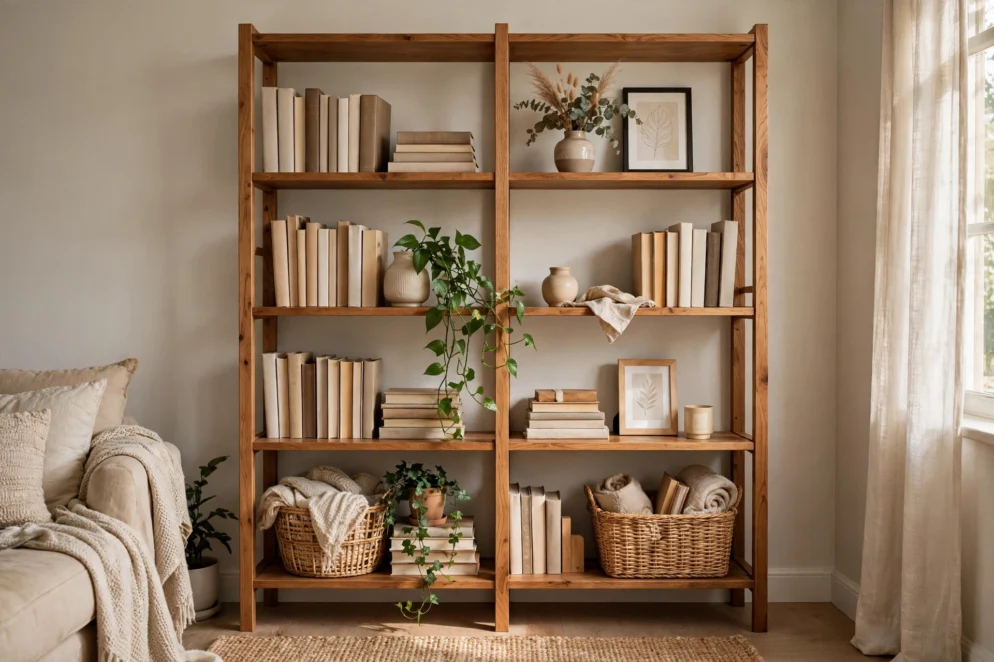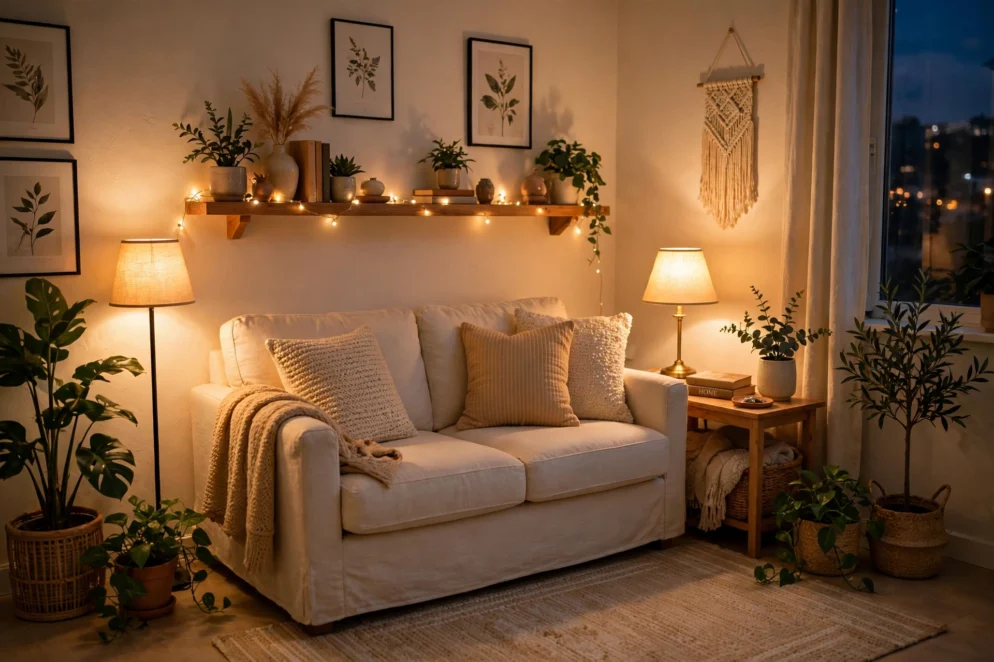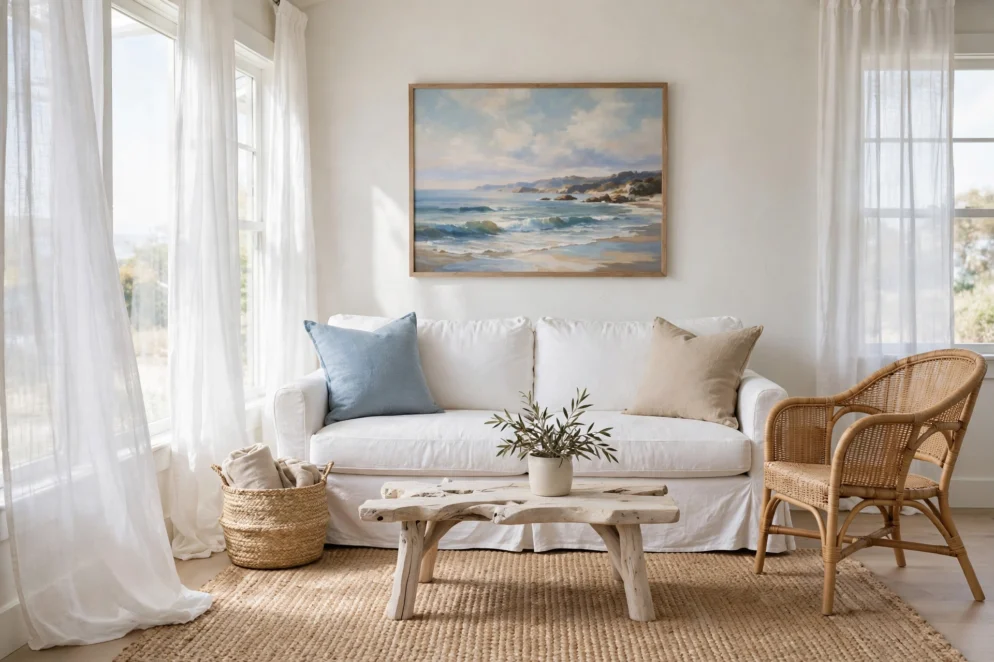
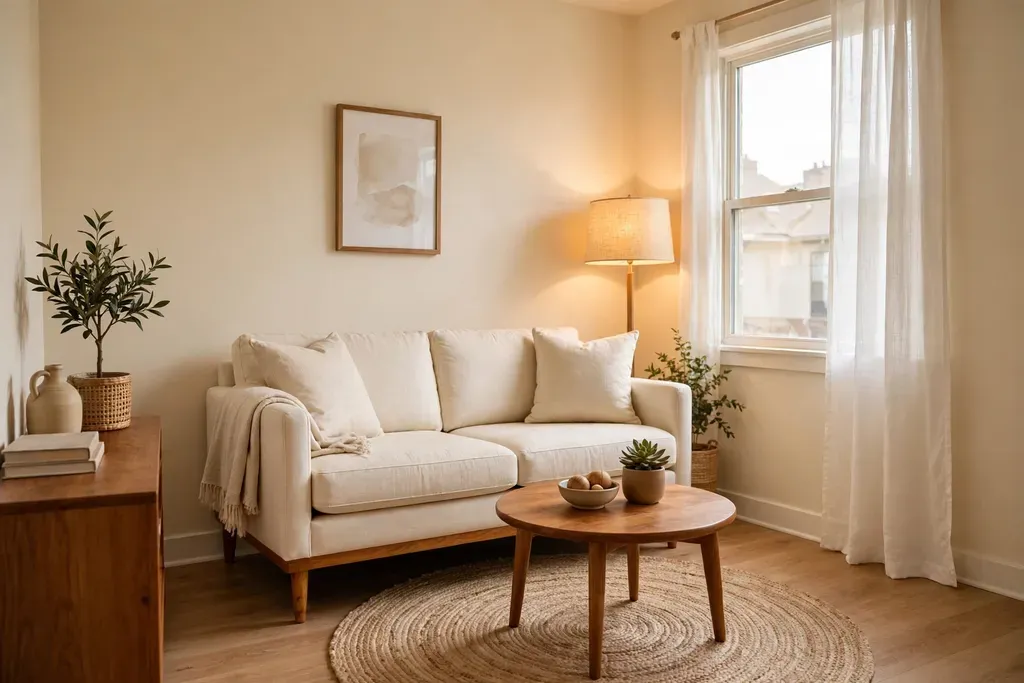
Small living room furniture ideas are not about buying less furniture, they are about buying the right sizes. A standard three-seat sofa is about 84 inches wide and 36 to 40 inches deep. In a 10 by 12 foot living room, that one piece eats a third of the floor. An apartment-size sofa at 66 to 80 inches wide and 32 to 36 inches deep seats the same two or three people and leaves room for a chair, a table, and a walkway.
This guide gives you 8 small living room furniture ideas with exact measurements: how wide each piece should be, how deep it can go, how much clearance it needs, and what the whole room costs. Every idea is renter-friendly, freestanding pieces, no drilling, and the whole room comes in under $150 on the secondhand path.
Table of Contents
The numbers first
Best for: every idea in this guide, measure the room and the door before you buy anything. Every one of these small living room furniture ideas starts with those two measurements.
One table holds every number that matters when you choose furniture for a small living room. Widths and depths are the piece itself; clearances are the space it needs around it to work. Use it to compare small living room furniture ideas side by side before you buy.
| Piece | Width | Depth | Clearance / rule |
|---|---|---|---|
| Apartment sofa | 66–80 in | 32–36 in | Longest wall minus 24 in; 14–18 in to the coffee table |
| Loveseat | 48–72 in | 32–36 in | 58–72 in is the most useful range; seat height 17–19 in |
| Accent chair | 28–36 in | 30–36 in | Seat height about 18 in; armless saves 6–8 in per side |
| Sectional, long side | 90 in max | 32–36 in | Only in rooms 12 ft or wider; chaise over 60 in blocks the walkway |
| Recliner | 28–36 in | 30–36 in upright | Clearance by type, see section 5; 4 in from the side table |
| Storage ottoman | 30–40 in | 16–20 in | 16–18 in tall doubles as a coffee table |
| Coffee table | Two-thirds of the sofa | 16–18 in tall | 14–18 in from the sofa |
| Rug | 8×10 ft for a 10×12 room | , | Minimum 5×8 ft; front legs of all seating on the rug; 6–12 in bare floor at the edges |
| Walkways | , | , | 30–36 in main walkway; 18 in secondary |
Three rules sit behind the table. First, measure the door, not just the room: the number-one sofa-buying mistake is a sofa that fits the living room but not the doorway, hallway, or stairwell, measure the narrowest point and the diagonal, and check the largest box or module the doors accept. Second, slim arms and raised legs are free space: slim or track arms under 5 inches save 6 to 10 inches against rolled arms, and legs raised 4 to 8 inches off the floor make the same sofa look lighter.
Third, seat depth decides comfort: about 20 to 22 inches of seat depth fits most people; under 30 inches of overall depth feels cramped, over 40 inches eats the floor. Those three rules are what make small living room furniture ideas work in a real room, not just on paper.
For the whole room these pieces go into, see the Budget pillar: Small Living Room Decor on a Budget.
What is apartment-size furniture?
What is apartment-size furniture? It is furniture scaled for rooms under about 200 square feet, smaller in every dimension than the standard version, not just shorter. An apartment sofa runs 66 to 80 inches wide and 30 to 35 inches deep, against a standard three-seater at 84 to 96 inches wide and 36 to 40 inches deep. It usually weighs under 120 pounds, against 120 to 180 pounds for a standard sofa, which matters when the piece has to go up a narrow stairwell or through a 30-inch doorway. That scaling is the whole point of small living room furniture ideas: smaller in every dimension, not smaller in comfort.
Is apartment-size furniture just smaller, or is it worse? Smaller, not worse. The seat height stays the same, 17 to 19 inches, and the seat depth stays about 20 to 22 inches, so it sits the same. What shrinks is the frame: slimmer arms, a shallower back, shorter length. A 72-inch apartment sofa with slim arms seats two people as comfortably as an 84-inch sofa with rolled arms, and it leaves a foot of wall free on each side. That is why small living room furniture ideas keep the seat height and depth, and shrink everything else.
How do I know if a piece is apartment-size? Check three numbers before anything else: width under 80 inches, depth 35 inches or under, and weight under 120 pounds. If a listing gives only one of the three, ask for the rest, a sofa that is 72 inches wide but 40 inches deep still eats the floor. Most furniture ideas for small living room spaces skip the weight entirely, which is how a sofa ends up stuck in the stairwell. If a piece passes those three numbers, it belongs among your small living room furniture ideas.
1. The apartment sofa
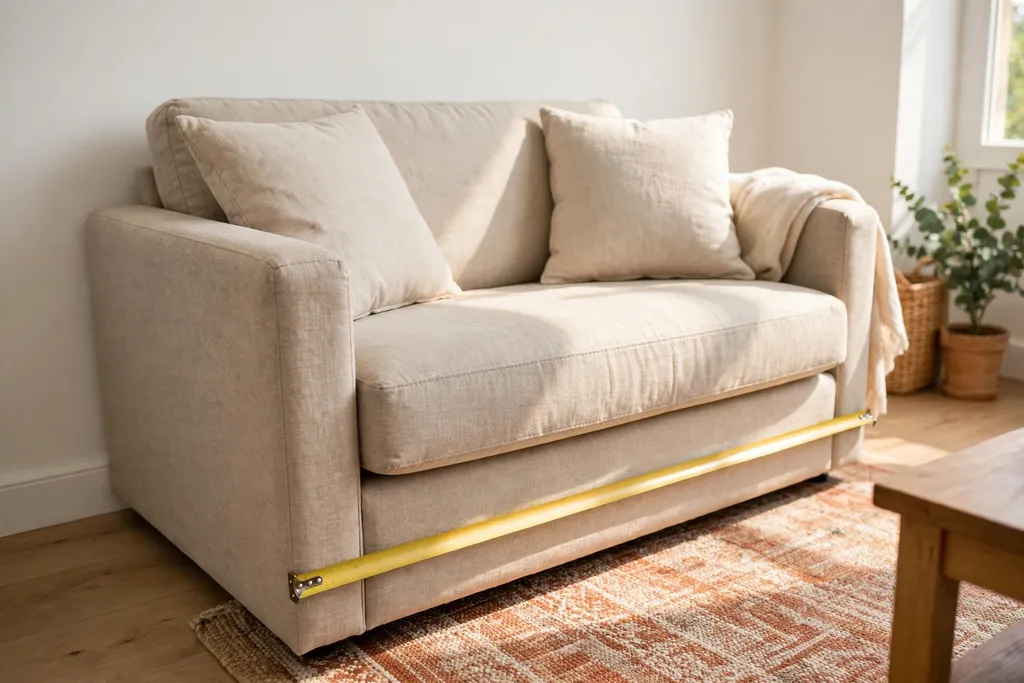
Best for: the anchor piece, one sofa, sized to the wall, not to the showroom.
The sofa is the biggest piece in the room and the one most often bought too big. The rule is simple: the sofa should be no longer than the longest usable wall minus 24 inches. On a 10-foot wall, that is a sofa up to 96 inches, but in a room under 200 square feet, 80 to 84 inches is the practical ceiling, and 66 to 80 inches is the sweet spot. Get the sofa right and the rest of these small living room furniture ideas fall into place.
- Size: apartment sofa 66 to 80 inches wide, 32 to 36 inches deep. A 12 by 14 foot room takes a 78 to 84 inch sofa; a 10 by 12 foot room takes 66 to 72 inches. Over 84 inches in a small room starts crowding the traffic lanes, especially if you want an armchair across from it.
- Depth: 32 to 36 inches is ideal. Under 30 inches feels cramped to sit on; over 40 inches eats floor space and pushes the coffee table into the walkway. A deep 36 to 38 inch sofa is worse than a 78-inch shallow one.
- Arms: slim or track arms under 5 inches wide save 6 to 10 inches against rolled arms. On a 72-inch sofa, that is the difference between fitting a side table or not.
- Legs: raised legs 4 to 8 inches off the floor. You can see floor under the sofa, which makes the room look bigger, and a robot vacuum or a storage bin slides underneath.
- What to watch: measure the door before you buy. A sofa that fits the room but not the doorway is the single most common furniture-buying mistake, measure the door width, the hallway, the stairwell, and the diagonal of the sofa’s largest piece. Modular sofas that ship in boxes are the easy answer for narrow hallways: each module fits through a 30-inch door on its own.
Budget: new apartment sofas start around $279 for the cheapest flat-pack loveseats and run to $1,500 and up for modular brands. The under-$150 path in this guide is secondhand, a 66-inch loveseat in good shape runs $50 to $70 at a thrift store or marketplace, and it is the same piece, just already broken in. On that budget, these small living room furniture ideas still leave room for a rug and a table.
2. Loveseat and one chair
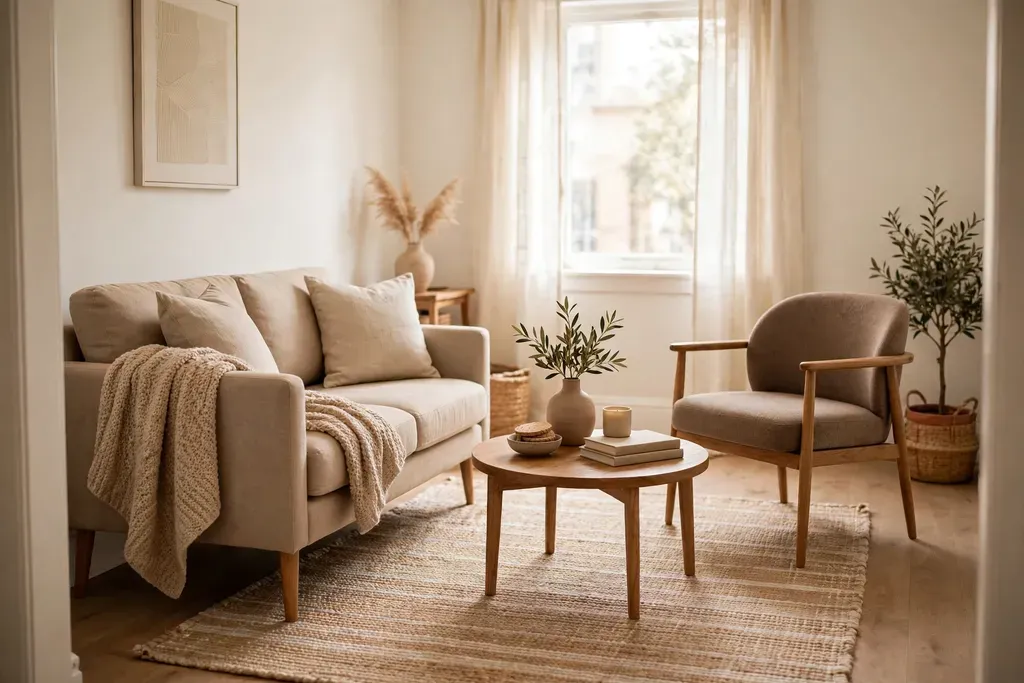
Best for: the seating plan, two seats on the sofa, one in a chair, and the room still breathes.
A loveseat plus one accent chair seats three people in less wall than a three-seat sofa, and it seats them better: the chair angles toward the sofa, so people face each other instead of sitting in a row staring at the same wall. It is one of the most forgiving small living room furniture ideas, because every piece can move on its own.
- Loveseat: 48 to 72 inches wide, 32 to 36 inches deep. The most useful range is 58 to 72 inches, wide enough for two adults, narrow enough to leave wall for a chair and a table. Seat height 17 to 19 inches, seat depth about 20 to 22 inches.
- Chair: one accent chair, 28 to 36 inches wide and 30 to 36 inches deep, seat height about 18 inches. One comfortable chair instead of two: two chairs need 56 to 72 inches of wall between them, and in a 10-foot room that wall does not exist.
- The math: a 60-inch loveseat plus a 32-inch chair plus 6 to 12 inches of breathing room on each side takes about 104 to 116 inches of wall, just under 10 feet. A three-seat sofa plus one chair takes 116 to 120 inches and leaves no room for a side table.
- What to watch: do not buy a matching three-piece set. A sofa, loveseat, and chair in the same fabric can easily eat 12 feet of wall and 8 feet of depth, and the room ends up furnished like a showroom, every piece the same height, the same color, the same shape. One loveseat and one chair in different-but-related fabrics look designed; a matching set looks bought.
Budget: a secondhand accent chair runs $20 to $35. Buy the loveseat first, live with it for a week, then buy the chair, the week tells you whether the chair belongs across from the sofa or angled into the corner. That week of living with it tells you which of these small living room furniture ideas to buy next.
3. Sectional only when it fits
Best for: one room in three, a sectional is the right answer only when the room is wide enough to hold it.
Sectionals are the most returned piece in small living rooms, because they look efficient and measure badly. A sectional works in a small room under three conditions, and all three have to hold. That is why sectionals are the riskiest of these small living room furniture ideas, and the easiest to get wrong.
- Room width: sectionals work best in rooms 12 feet wide or wider, 13 feet is the comfortable minimum. In a 10-foot-wide room, the long side of the sectional plus the walkway behind it leaves no floor at all.
- Long side: 90 inches is the realistic ceiling for the long side. Longer than that and the sectional crowds the traffic lanes on both ends.
- Chaise: a reversible chaise is the small-room choice, the long side can face either way, so the sectional survives a move or a rearrangement. A chaise sticking 60 inches or more into the room blocks the walkway; measure the chaise, not just the sofa.
- What to watch: a three-seater plus a loveseat is more flexible and less dominating than a large L-shaped sectional in the same room. The sectional saves you one piece of furniture; the sofa-plus-loveseat saves you the room. If the room is under 12 feet wide, take the sofa and the loveseat.
Budget: sectionals are almost never an under-$150 piece, even secondhand, a compact sectional runs $150 to $300. If the budget is strict, the loveseat-and-chair plan in section 2 is the answer, not a cheap sectional. If the budget is strict, the loveseat-and-chair plan in section 2 is the answer among these small living room furniture ideas, not a cheap sectional.
4. Accent, swivel and barrel chairs
Best for: the third seat, one chair, sized like the room, not like the showroom.
The accent chair is where small rooms go wrong most quietly. A 40-inch-wide club chair with rolled arms eats the same wall as a loveseat and seats one person. The right chair is 28 to 36 inches wide, and the style matters as much as the size. The chair is where small living room furniture ideas go wrong most quietly, one wide arm at a time.
- Accent chair: 28 to 36 inches wide, 30 to 36 inches deep, seat height about 18 inches. That is the size that fits beside a loveseat without blocking the walkway.
- Armless slipper chair: no arms at all, which saves 6 to 8 inches per side against an armed chair. A 28-inch slipper chair seats one person in the footprint of a large cushion, the best third seat in a room under 150 square feet.
- Swivel chair: turns within its own footprint, so it needs no extra floor space to use, one chair that serves the sofa, the TV, and the window without being dragged across the rug. Worth the small premium (about $50 to $100 more than a fixed chair) in a room where every piece has to do two jobs.
- Barrel chair: a curved back that hugs the sitter, usually 28 to 34 inches wide. The curve reads soft in a room full of straight lines, and the footprint is the same as an accent chair.
- What to watch: one chair, not two, and never a chair that faces nothing. A chair pushed into a corner with its back to the room is a storage unit, not seating. Angle it toward the sofa, 45 degrees is the classic, so it joins the conversation instead of watching it.
Budget: secondhand accent chairs run $20 to $35; a new barrel or slipper chair starts around $100. The chair is round two in the under-$150 plan, buy it after the sofa and the rug, when you know where the empty corner actually is. That order is what keeps these small living room furniture ideas inside the $150 room budget.
5. The recliner question
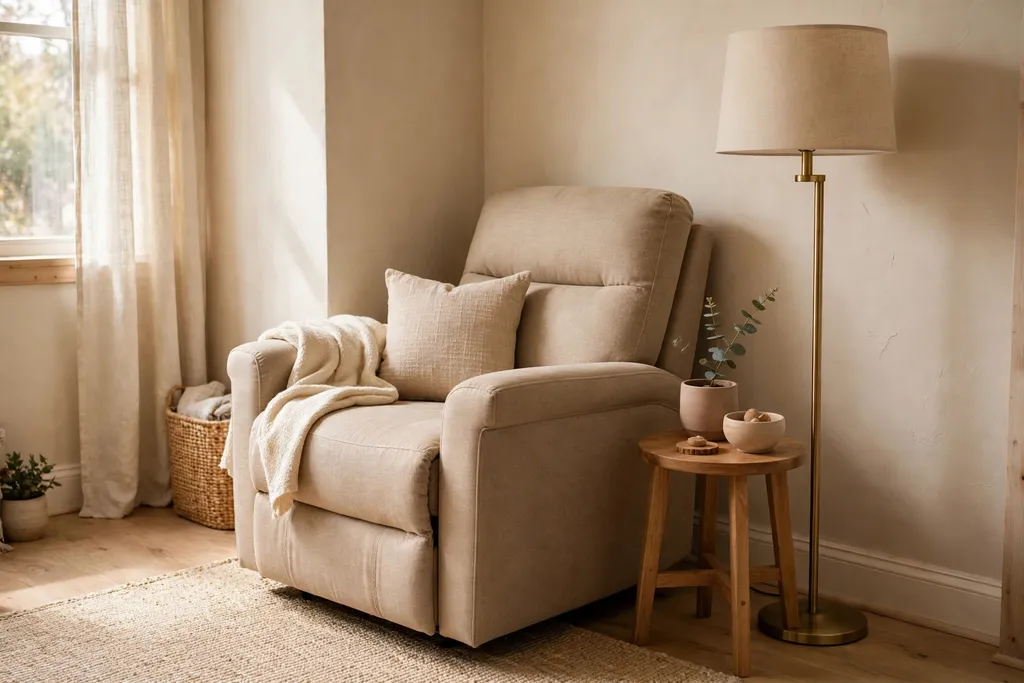
Best for: one dedicated sitter, a recliner is a personal chair, not shared seating.
Recliners are the one piece where the advice contradicts itself, so here is the straight answer: there is no single clearance number, because there are three different mechanisms, and each needs different space behind it. Among small living room furniture ideas, the recliner is the piece most people buy twice, so measure first.
- Traditional recliner: needs 12 to 18 inches of wall clearance behind it, the back swings backward as it opens. Some deep reclining sofas need even more, up to 36 inches; check the product spec, not the marketing photo.
- Wall-hugger recliner: needs only 3 to 6 inches behind it. The seat slides forward as it opens instead of swinging back, so the chair can sit almost against the wall. This is the small-room recliner.
- Push-back recliner: needs 4 to 8 inches. It looks like an accent chair, no handle, no visible mechanism, and you open it by pushing back with your body weight.
- Side clearance: leave 4 inches between the recliner arm and the side table, or the arm will hit the table every time the chair opens.
- What to watch: a recliner is for one dedicated user. For shared seating, an armchair wins every time, two people cannot share a recliner, and a recliner in the middle of the seating group faces the TV while everyone else faces each other. And measure the chair fully reclined, not just upright: the footprint doubles when it opens, and the footrest needs 24 inches of clear floor in front of it.
Budget: wall-hugger recliners start around $200 new and $60 to $90 secondhand, over the $150 room budget on their own, so a recliner is a swap, not an addition: it replaces the accent chair in the plan, it does not join it. In these small living room furniture ideas, a recliner is a swap, not an addition: it replaces the accent chair in the plan.
6. Coffee and side tables that tuck away
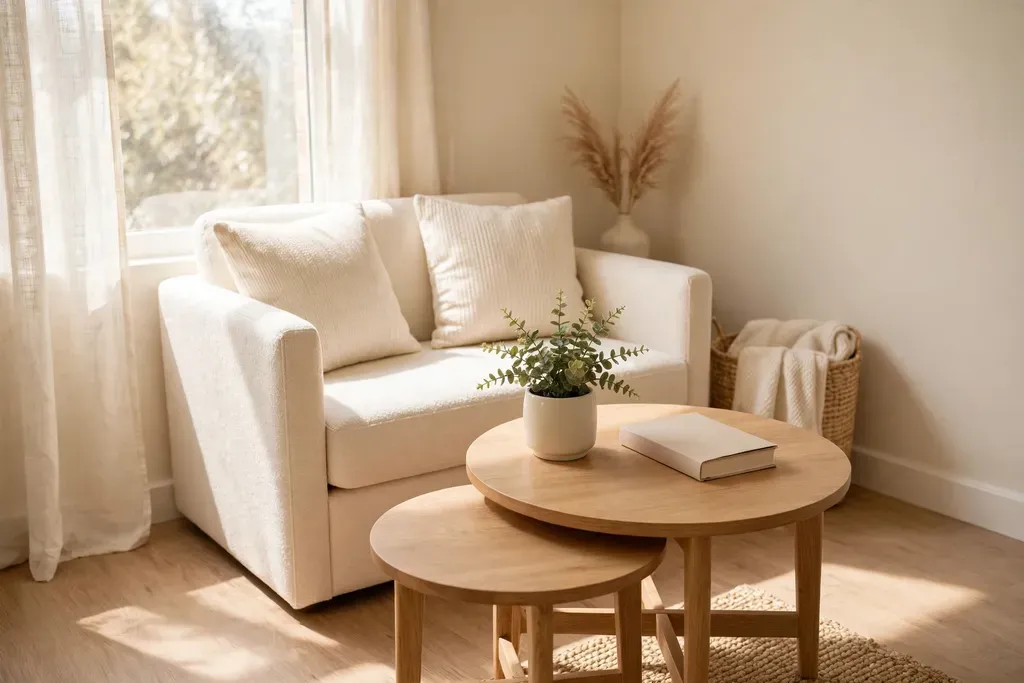
Best for: the surface problem, a small room needs table space, but a big coffee table is a wall in the middle of the floor.
The coffee table rule is the simplest in this guide: the coffee table should be about two-thirds of the sofa’s length. On a 72-inch sofa, that is a table about 48 inches long. Longer than that and the table becomes the room; shorter and it looks stranded. The coffee table rule is the simplest among these small living room furniture ideas, and the easiest to check with a tape measure.
- Coffee table: two-thirds of the sofa length, 16 to 18 inches tall, sitting 14 to 18 inches from the sofa. A round table saves the corners, no sharp edges in a 30-inch walkway, and a 30 to 36 inch round table seats two people with drinks without crowding.
- Nesting tables: a set of two or three that tuck under each other. One table out for everyday, two or three out when guests come. A nesting set takes the floor of one small table and does the work of three.
- C-shaped side tables: slide under the sofa arm, so the surface hovers over the seat instead of beside it. A laptop, a book, a coffee, all within reach, none of it on the floor.
- Slim console: under 14 inches deep behind the sofa or against the wall. A console deeper than 14 inches in a small room is a shelf that eats the walkway.
- What to watch: do not buy a coffee table before the sofa. The table is sized to the sofa, not to the room, two-thirds of the sofa, 14 to 18 inches away, 16 to 18 inches tall. Buy the sofa, measure it, then buy the table.
Budget: nesting tables run $15 to $25 secondhand, $40 to $80 new. A round tray table, 17½ inches across, about 20⅝ inches tall, costs about $25 new and does the same job as a side table in a third of the floor. A tray table is the cheapest of these small living room furniture ideas, and the first to buy secondhand.
7. Storage furniture that earns its floor
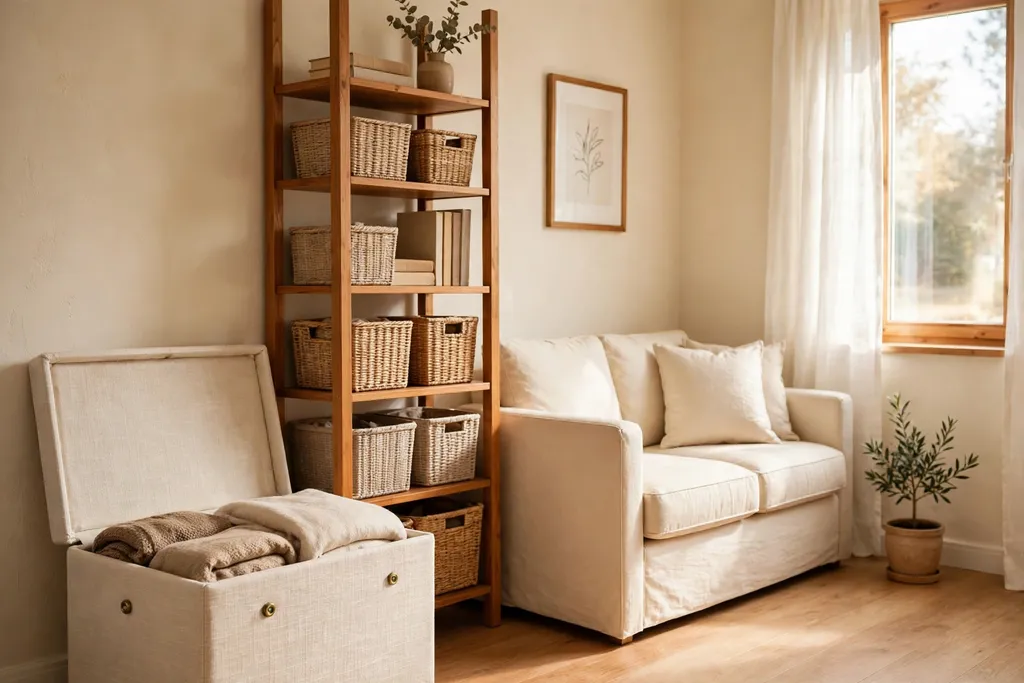
Best for: the clutter problem, in a small room, every piece of furniture has to do two jobs, or it has to go.
A small living room has no spare floor for single-purpose furniture. The storage pieces below each earn their footprint twice: once as furniture, once as storage. Every piece below is one of those small living room furniture ideas: a surface on top, storage inside.
- Storage ottoman: 30 to 40 inches long, 16 to 20 inches deep, 16 to 18 inches tall, the same height as a coffee table, so it is a coffee table, a footrest, and a blanket box in one piece. The best storage furniture for a very small living room, and it moves with you when you leave.
- Slim bookcase: tall and narrow beats short and wide. A bookcase 72 inches tall and 30 inches wide holds as much as a low console twice its width, and it uses wall space instead of floor space. Baskets on the lower shelves hide the clutter; books and one plant on the upper shelves do the decorating.
- Storage bench: a bench with a lift-up seat under the window or against the wall, shoes, throws, and board games inside, seating on top. About 36 to 48 inches long, 14 to 16 inches deep.
- Under-sofa bins: flat bins slide under a sofa raised 4 to 8 inches on legs, out-of-season throws, spare cushions, the things you need twice a year. Measure the clearance first: the bin must be at least an inch shorter than the space under the sofa.
- What to watch: open storage full of clutter makes a small room look smaller, not bigger. One basket with a lid beats three open shelves of stuff. And tall furniture in front of a window blocks the light, the bookcase goes on a solid wall, never across the window.
Budget: a storage ottoman runs $15 to $25 secondhand; a slim bookcase $20 to $40 secondhand. Baskets cost $8 to $12 for two and do more for the look of the room than any other $10 in this guide.
8. The whole room in 10 by 12 feet
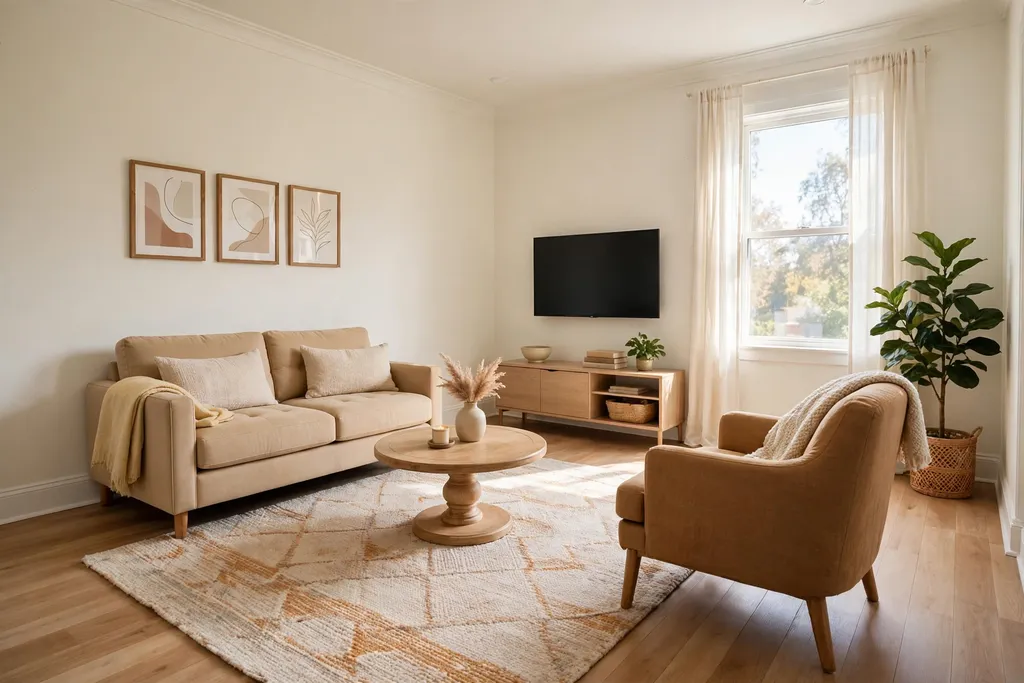
Best for: the proof, every piece in this guide, placed in one real room, with the walkways still clear.
A 10 by 12 foot living room is 120 square feet. Here is the whole room, piece by piece, with each footprint in inches. Nothing here is arranged by theory, this is which pieces, and how much floor each one takes.
| Piece | Size | Footprint |
|---|---|---|
| Loveseat | 66 × 34 in | 15.6 sq ft, against the long wall |
| Accent chair | 32 × 34 in | 7.6 sq ft, angled at 45° across from the loveseat |
| Round coffee table | 30 in diameter | 4.9 sq ft, 14–18 in from the loveseat |
| Rug, 8×10 ft | 96 × 120 in | Under the front legs of the loveseat and the chair |
| Slim TV console | 48 × 14 in | 4.7 sq ft, on the wall opposite the loveseat |
| Storage ottoman | 36 × 18 in | 4.5 sq ft, doubles as extra seat and coffee table |
| Floor lamp | 10 in diameter base | 0.5 sq ft, in the corner behind the chair |
| Slim bookcase | 30 × 12 in | 2.5 sq ft, on the solid wall, never across the window |
| Furniture total | About 40 sq ft, one-third of the room |
The remaining 80 square feet is walkway and breathing room: a 30 to 36 inch main walkway from the door to the far wall, an 18-inch secondary path between the coffee table and the TV console, and 6 to 12 inches of bare floor between the rug edge and the walls. Four seats in the room, two on the loveseat, one in the chair, one on the ottoman, and nobody’s knees touch the coffee table. That breathing room is the test of these small living room furniture ideas: if the walkways are clear, the room works.
What to watch: tape the footprints on the floor before you buy. Painter’s tape, the measurements from the table above, ten minutes. A room that looks right on paper and wrong in tape is a room you have not bought yet, and tape is free. Tape the footprints first and these small living room furniture ideas become a plan you can walk through, not a guess.
Renter-friendly rules
Most small living room furniture ideas are renter-friendly by nature, furniture is movable, not installed. The rules are about what you do NOT do, and about one honest caution.
- Freestanding first: every piece in this guide stands on its own feet. No wall-mounted TV console, no floating shelves, no bolted bookcase. If a piece needs the wall to work, it is the wrong piece for a rental.
- No wall-mounting without written permission: wall-mounted furniture and floating shelves need holes, and holes need the landlord’s written yes. A freestanding console under 14 inches deep does the same job as a floating one, and it moves with you.
- Adhesive has limits: adhesive strips and hooks are rated by weight, small 1 to 3 pounds, medium 3 to 5 pounds, large 5 to 7 pounds per pair, and they need 24 to 48 hours to cure before you load them, and 30 days on fresh paint. Rate every hook at twice the weight of what hangs on it. And adhesive can still lift paint: test one strip in a hidden spot first, and pull the tab straight down to remove it.
- Freestanding does not automatically mean no-drill: some furniture and TVs still require anchoring by the manufacturer’s safety instructions, a tall bookcase in a home with children, for example. Read the instructions that come with the piece; if it says anchor it, ask the landlord before you drill, or choose a shorter, wider piece that does not need it.
- Pieces that move with you: modular sofas ship in boxes and fit through a 30-inch door one module at a time; a loveseat under 120 pounds goes up the stairs without a crew; nesting tables and ottomans fit in a car. Buy furniture you can carry out, not furniture you have to leave behind.
Small living room furniture ideas under $150
Best for: the whole room, every piece in this guide, added up honestly. Every one of these small living room furniture ideas is in that total, at secondhand prices, with nothing left out.
| Item | Cost |
|---|---|
| Secondhand loveseat, 58–66 in | $50–$70 |
| Rug, 5×7 ft flatweave | $15–$20 |
| Nesting tables, secondhand | $10–$15 |
| Storage ottoman, secondhand | $12–$18 |
| Floor lamp, secondhand | $8–$12 |
| Two baskets | $6–$10 |
| Total | $101–$145 |
That is the honest version, and here is the honest framing: the under-$150 room is a secondhand room. A new apartment sofa alone starts around $279, and the cheapest new loveseats run $279 to $349, so a whole room of new furniture for under $150 does not exist, and any guide that prices one is hiding the sofa. Buy the loveseat secondhand, buy the tables and the ottoman secondhand, and the room totals $101 to $145. That secondhand room is still the same set of small living room furniture ideas, just bought used instead of new.
Round one, if the budget is tight this month: the loveseat and the rug first ($65–$90), then the nesting tables and the ottoman next month ($22–$33). The accent chair is round two as well, $20 to $35 secondhand, because the room works with two seats while you save for the third. A room furnished in two rounds looks better than one furnished in one rushed round, because the second round is the one where you know what the room actually needs.
The free ideas: moving the sofa 4 to 6 inches off the wall, taking one piece of furniture out of the room, and turning the chair 45 degrees toward the sofa cost nothing, and they change the room more than any purchase. Furniture ideas start with taking things away, not adding them. Those free moves are the cheapest small living room furniture ideas in this guide, and they cost nothing.
5 mistakes to avoid
1. A sofa that fits the room but not the door. The number-one furniture-buying mistake: the sofa measures right against the wall and will not fit through the doorway, the hallway, or the stairwell. Measure the narrowest point and the diagonal before you buy, or buy modular, which ships in boxes that fit through a 30-inch door one at a time.
2. A recliner without a clearance check. A traditional recliner needs 12 to 18 inches behind it; a wall-hugger needs 3 to 6 inches. Buy the wrong type and the chair either cannot open or eats a foot and a half of floor. Check the mechanism, not just the width.
3. A chaise blocking the walkway. A chaise sticking 60 inches or more into the room cuts the main walkway in half. Measure the chaise, not just the sofa, and if the room is under 12 feet wide, skip the sectional entirely.
4. The matching three-piece set. Sofa, loveseat, and chair in the same fabric can eat 12 feet of wall and 8 feet of depth, and every piece is the same height, the same color, the same shape. One loveseat and one chair in different-but-related fabrics look designed; a matching set looks bought.
5. Too many small pieces. Five small accent tables, three small chairs, and a tiny bookshelf fill a small room faster than two big pieces. Fewer, bigger pieces: one loveseat, one chair, one table, one ottoman. Small pieces do not make a small room look bigger, they make it look busy. Fewer, bigger pieces are the simplest of these small living room furniture ideas, and the hardest rule to stick to in a shop.
FAQ
How do I furnish a small living room?
Buy the sofa first, an apartment sofa 66 to 80 inches wide and 32 to 36 inches deep, then the rug, then the tables. One loveseat and one accent chair seat three people in less wall than a three-seat sofa, and a storage ottoman adds a fourth seat plus storage. Measure the wall, the door, and the walkway before you buy anything. Measure the wall and the door before you buy anything, because that order is what makes these small living room furniture ideas work.
What size sofa fits a small living room?
In a 10 by 12 foot room, a sofa 66 to 72 inches wide and 32 to 36 inches deep. In a 12 by 14 foot room, 78 to 84 inches works. The rule is the longest usable wall minus 24 inches, and never over 84 inches in a room under 200 square feet. Depth matters as much as width: under 30 inches feels cramped, over 40 inches eats the floor.
Can a sectional work in a small living room?
Yes, but only when the room is 12 feet wide or wider, the long side is 90 inches or less, and the chaise is reversible. In a room under 12 feet wide, a three-seater plus a loveseat is more flexible and less dominating than a large L-shaped sectional.
What furniture should you avoid in a small living room?
Deep lounge sofas over 40 inches deep, oversized sectionals, skirted or boxy bases that hide the floor, matching three-piece furniture sets, large media walls, and too many small accent tables. Every one of them eats floor without adding seating.
How much wall clearance does a recliner need?
It depends on the mechanism: a traditional recliner needs 12 to 18 inches behind it, a wall-hugger needs only 3 to 6 inches, and a push-back recliner needs 4 to 8 inches. Some deep reclining sofas need up to 36 inches, check the product spec for your exact model, and measure the chair fully reclined, not just upright.
How many seats fit in a 10×12 living room?
Four seats, comfortably: two on a 66-inch loveseat, one in a 32-inch accent chair, and one on a 36-inch storage ottoman, with a 30 to 36 inch main walkway still clear. A fifth seat means a second chair, and a second chair means the walkway goes.
What furniture can I get for a small living room under $150?
On the secondhand path: a loveseat ($50–$70), a 5×7 rug ($15–$20), nesting tables ($10–$15), a storage ottoman ($12–$18), a floor lamp ($8–$12), and two baskets ($6–$10), $101 to $145 for the whole room. New furniture cannot do it: the cheapest new loveseats alone start around $279.
Can I furnish a rental living room without drilling?
Yes, every piece in this guide is freestanding and moves with you. The only cautions: do not wall-mount anything without the landlord’s written permission, adhesive strips are rated by weight and can still lift paint, and some tall furniture still requires anchoring by the manufacturer’s safety instructions, read them, and choose a shorter, wider piece if anchoring is not an option. That is what makes these small living room furniture ideas renter-friendly by nature: furniture, not fixtures.
Start today
Small living room furniture ideas do not need a shopping trip, they need a tape measure. Measure the longest wall, measure the door, and tape the sofa’s footprint on the floor. That is the whole first round, and it takes an afternoon.
Start by measuring. The room will tell you what fits, and what does not, before you spend anything. For more small-space