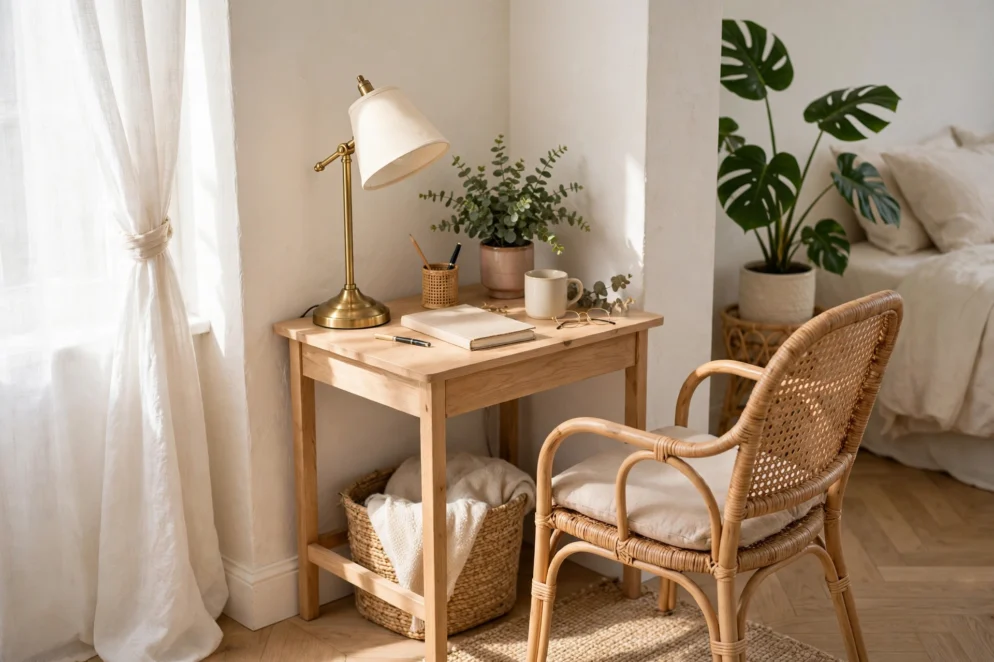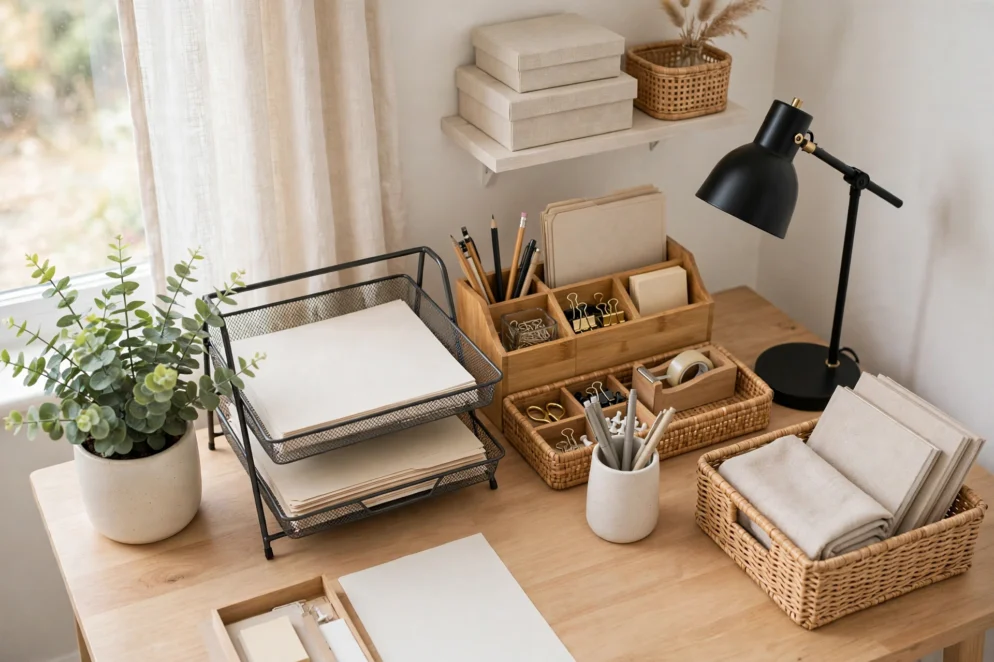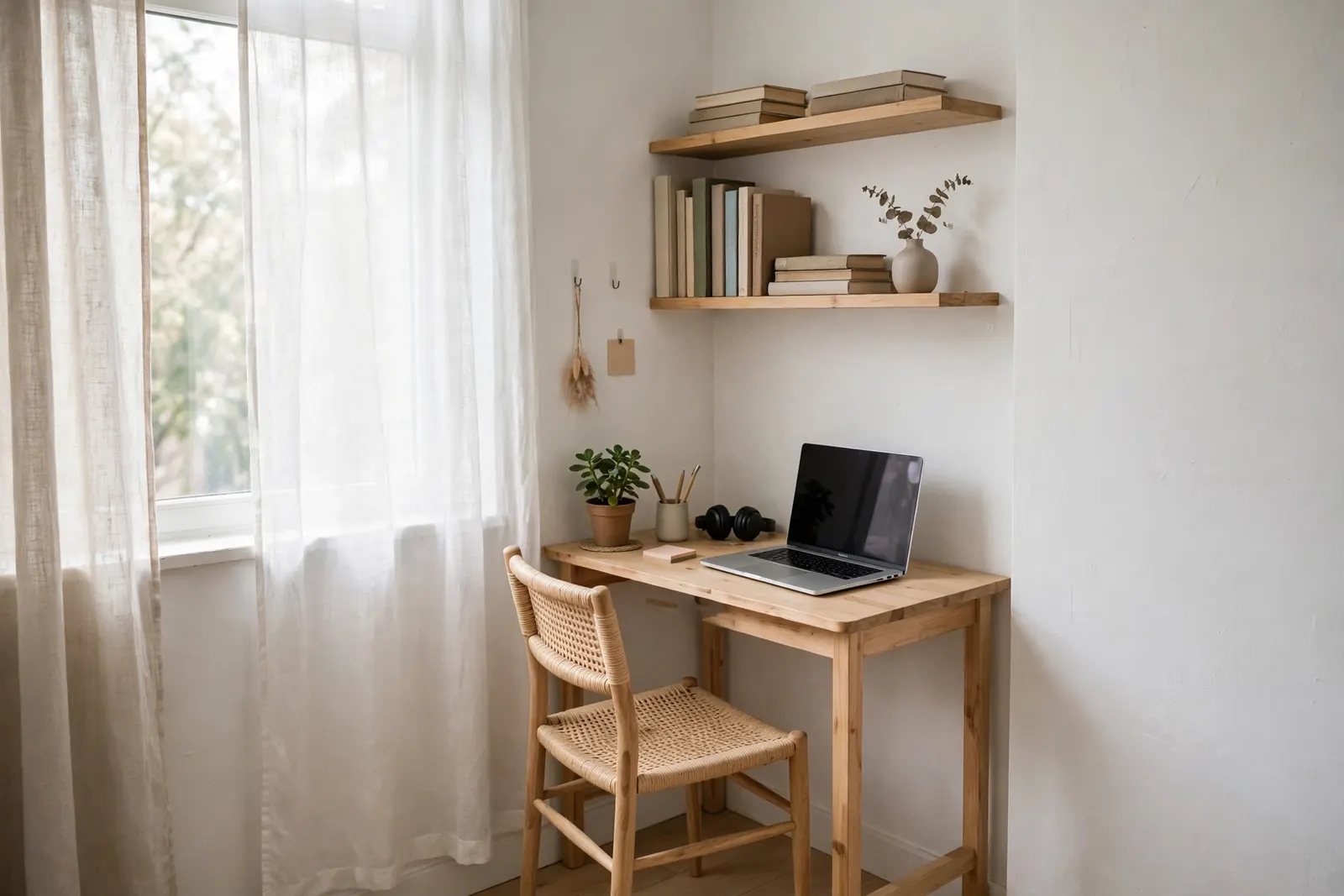
A tiny corner is not a wasted corner. These small desk nook ideas for tiny corners turn the easiest place in a small home to build a workspace, because two walls already do half the job: they hold your desk, your shelves, and your focus.
The mistake most people make is buying a desk first and measuring second. Do it the other way around, and almost any corner will work — that is the whole point of these small desk nook ideas for tiny corners. If you have not picked a desk yet, start with our desks for small spaces guide
This guide is for renters, students, and anyone working from a studio, a shared apartment, or a home with no spare room. Every idea below comes with the exact numbers you need: the corner width it fits, the desk width and depth to buy, the chair space to leave behind you, and the clearances that keep it comfortable. Measure once with a tape measure, match your numbers to an idea, and you will know exactly what fits before you spend a dollar.
Table of Contents
The measurement formula for small desk nook ideas for tiny corners
Use these numbers for every one of these small desk nook ideas for tiny corners:
- Desk height: 29 to 30 inches for most adults. If you are under 5’4″, aim for 28 to 29 inches, or use a footrest.
- Desk depth: 20 inches minimum for a laptop, 24 inches if you use a monitor. Less than 20 inches and your wrists run out of room.
- Desk width: 36 inches for laptop-only work, 42 to 48 inches if you add a monitor and a notebook side by side.
- Knee clearance: at least 25 inches high and 20 inches deep under the desk, with nothing blocking your legs.
- Chair pull-out space: leave 30 inches behind the chair from the desk edge to the wall or furniture behind you, so you can stand up without shuffling sideways.
- Monitor distance: screen 20 to 26 inches from your eyes, with the top of the screen at or just below eye level.
Measure your corner width, then subtract 2 inches on each side for breathing room. That final number is your maximum desk width. Write it down before you shop. That one measurement decides which of these small desk nook ideas for tiny corners will actually fit. For screen height and viewing distance, follow the guidance in the OSHA Computer Workstations eTool.
1. The classic corner desk nook
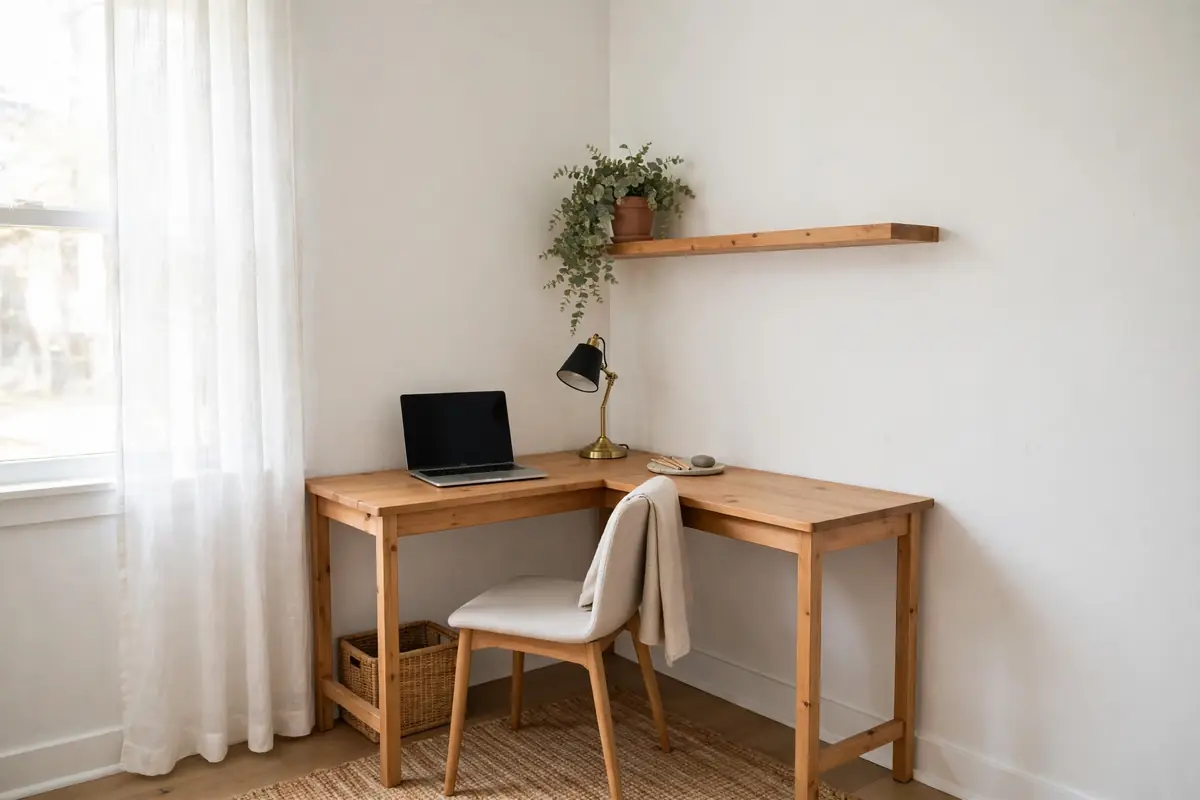
Fits: a 36-inch-wide corner. Desk: 36 inches wide × 24 inches deep × 29 inches high. Chair space: 30 inches behind the desk.
A simple L-shaped or triangular corner desk is the easiest of these small desk nook ideas for tiny corners: it uses both walls and leaves the middle of the room free. Add one floating shelf 18 inches above the desk for books and a plant, and keep the desktop to a laptop, a lamp, and one pen cup. This is the safest first nook if you have never set up a workspace before.
A corner desk works because it borrows both walls for support and stability, so even a light freestanding model feels solid while the angled footprint leaves the middle of the room open. Keep 2 inches of breathing room on each side and a full 30 inches of pull-out space behind the chair, or it will feel cramped the first time you push back. Renter tip: freestanding L-shaped desks need zero drilling, move with you, and are easy to find secondhand.
2. The window corner nook
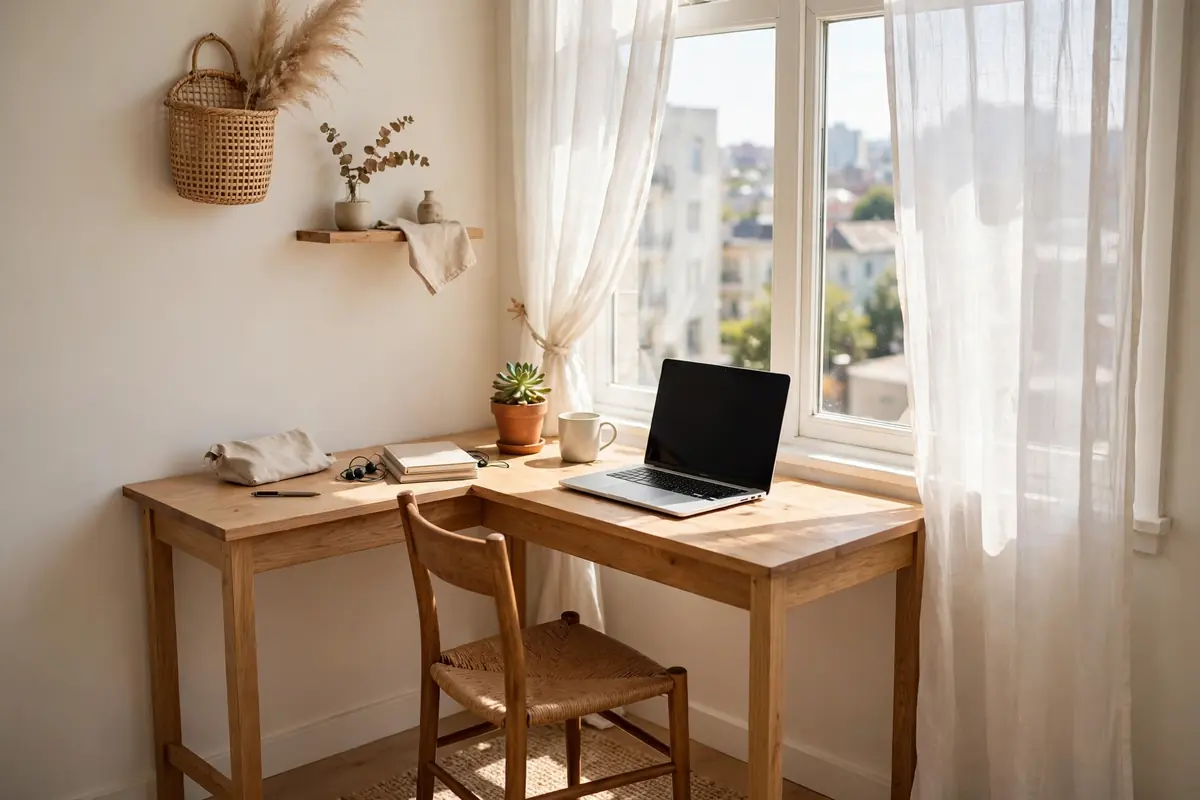
Fits: a corner beside a window, at least 42 inches wide. Desk: 42 inches wide × 20 inches deep, placed with its short side against the window wall.
Natural light does more for a tiny office than any lamp, which is why this is one of the brightest small desk nook ideas for tiny corners. Put the desk perpendicular to the window, not facing it, so glare does not hit your screen. A sheer curtain softens the light without blocking it, and a chair that slides fully under the desk keeps the walkway clear.
Daylight is free, flattering, and easier on the eyes than any bulb, so a window nook rarely needs more than a small task lamp for evenings. Place the desk perpendicular to the window with at least 24 inches between the desk edge and the window trim so curtains still close, and sit facing sideways to the glass to dodge screen glare. Budget tip: light-filtering sheer curtains cost under $20 and soften harsh midday sun without darkening the room.
3. The floating wall-mounted desk nook
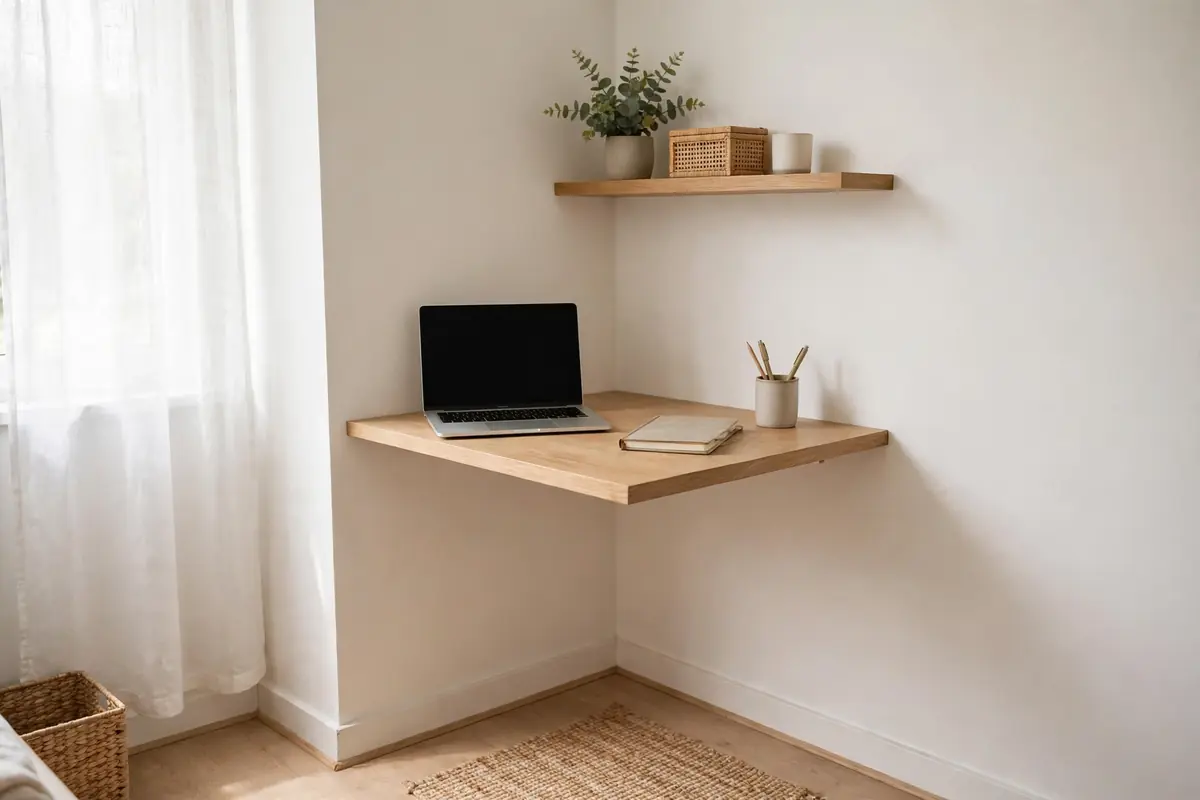
Fits: a narrow corner, 32 to 40 inches wide. Desk surface: 36 inches wide × 20 inches deep, mounted at 29 inches high. Clearance below: fully open, no legs.
A wall-mounted desk is the best trick for a truly tiny corner, and one of the simplest small desk nook ideas for tiny corners, because there are no legs eating floor space. Renter-friendly version: use a heavy-duty no-drill bracket system rated for your desk weight, or a leaning desk that rests against the wall instead of screwing into it. Keep the load light, laptop, notebook, and one shelf above, not a full monitor arm and printer.
With no legs, the floor stays visually open and your feet keep the full 25 inches of knee height, which makes a 32-inch-wide corner feel twice as big. Mount the surface at 29 inches high into studs with brackets rated for at least 50 pounds, and keep the wall below clear for a small rolling cart. Renter tip: if your lease bans drilling, use a narrow leaning ladder desk instead for the same leg-free look with zero holes.
4. The closet-corner nook
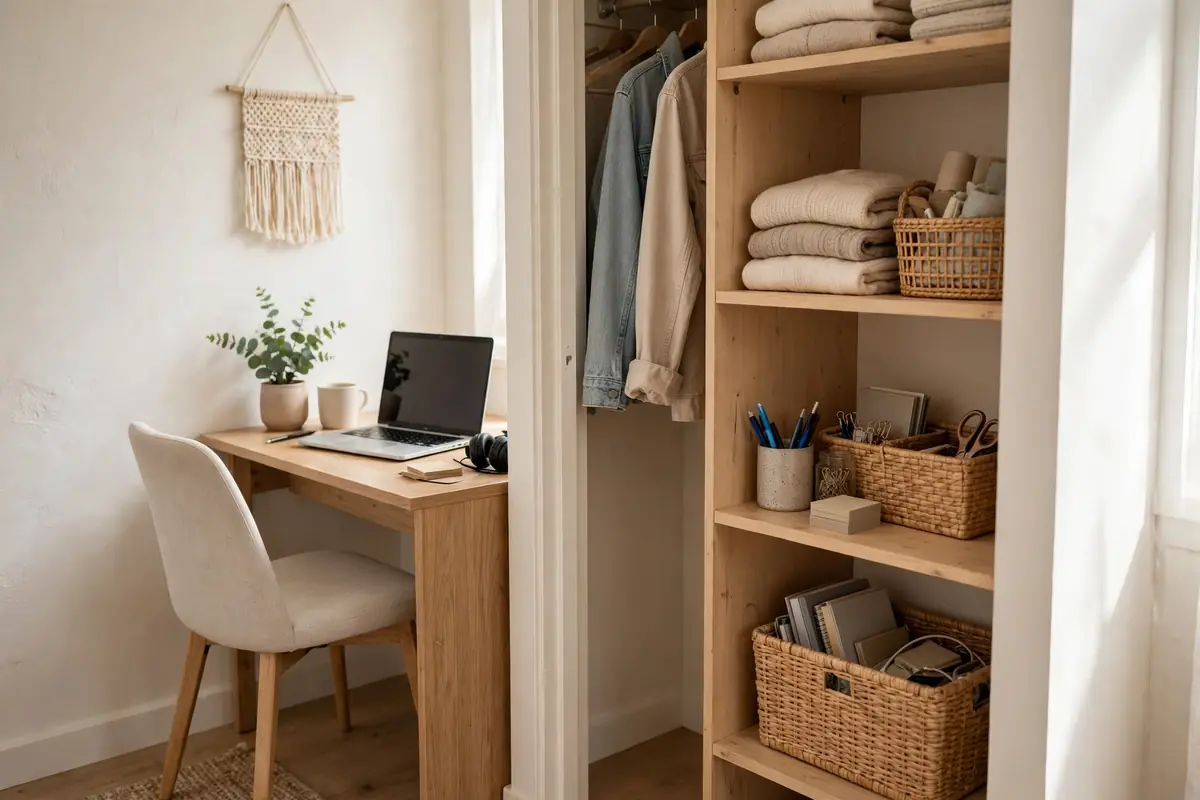
Fits: a corner next to a closet, or the end of a closet wall. Desk: 36 inches wide × 20 inches deep.
If your corner is beside a closet, let the closet do the storage work — that is what makes this one of the tidiest small desk nook ideas for tiny corners. The desk stays small because notebooks, chargers, and files live on the closet shelf, not on the desktop. A small basket on the closet floor holds office supplies, and closing the closet door at the end of the day hides the whole office.
The closet absorbs all the storage, so the desk can stay a slim 36 by 20 inches and hold only what you touch daily. Keep the closet door’s full swing clear and leave 20 inches of knee depth open under the desk, even when it is tempting to stash boxes there. Budget tip: a tension rod with a $12 curtain panel hides closet clutter instantly, and thrifted baskets on the closet shelf beat any filing cabinet.
5. The bedroom corner nook
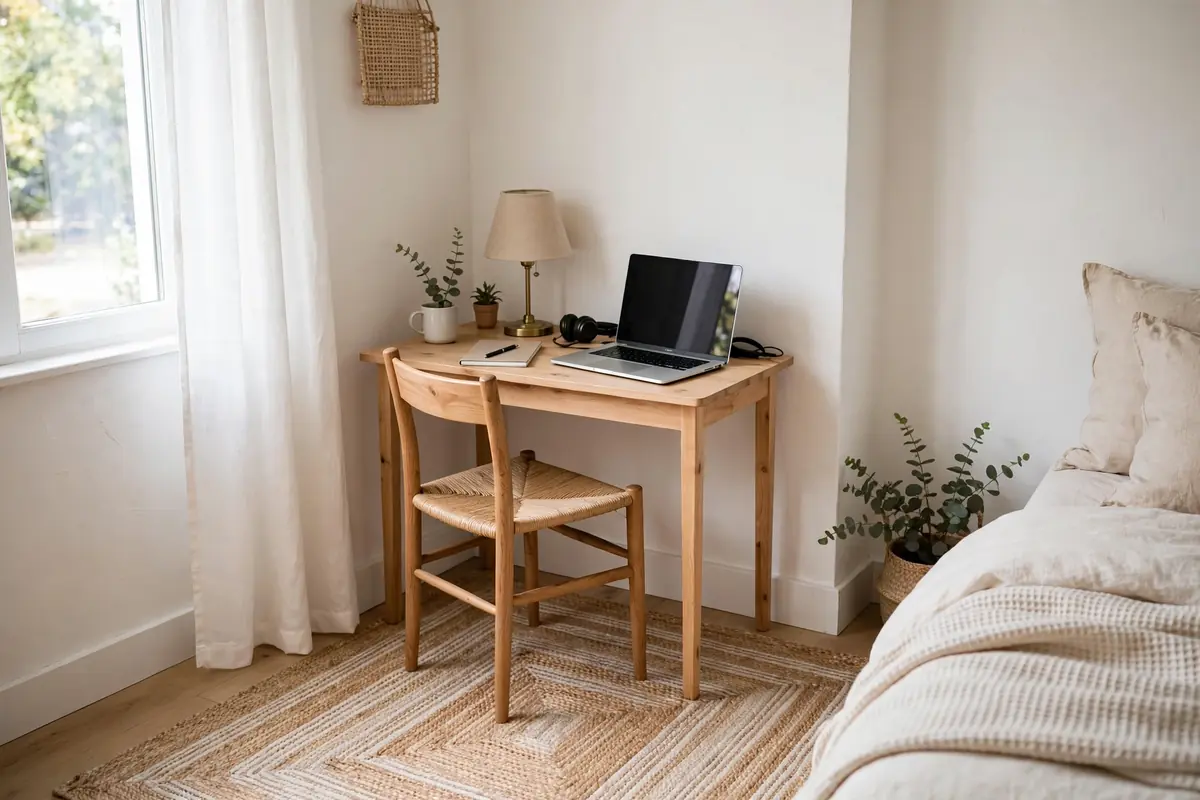
Fits: a bedroom corner, 48 inches wide. Desk: 42 inches wide × 24 inches deep. Distance from bed: at least 24 inches between the desk chair and the bed edge.
The trick here is separation, and it is what makes this one of the calmest small desk nook ideas for tiny corners. Use a rug under the desk and chair, a 3 × 5-foot rug is enough, to mark the work zone, and face the desk toward the wall, not the bed. A small lamp with warm light (not the bedroom’s main light) tells your brain this corner is for work, even though the bed is three steps away.
The 3-by-5-foot rug draws a visible line between sleep and work, which matters more than any organizer when your office sits ten feet from your pillow. Keep at least 24 inches between the chair’s back and the bed edge so you can stand and stretch without shuffling furniture. Renter bonus: the whole setup is freestanding, so there is nothing to patch at move-out, and a flatweave rug under $40 does the job.
6. The living room corner nook
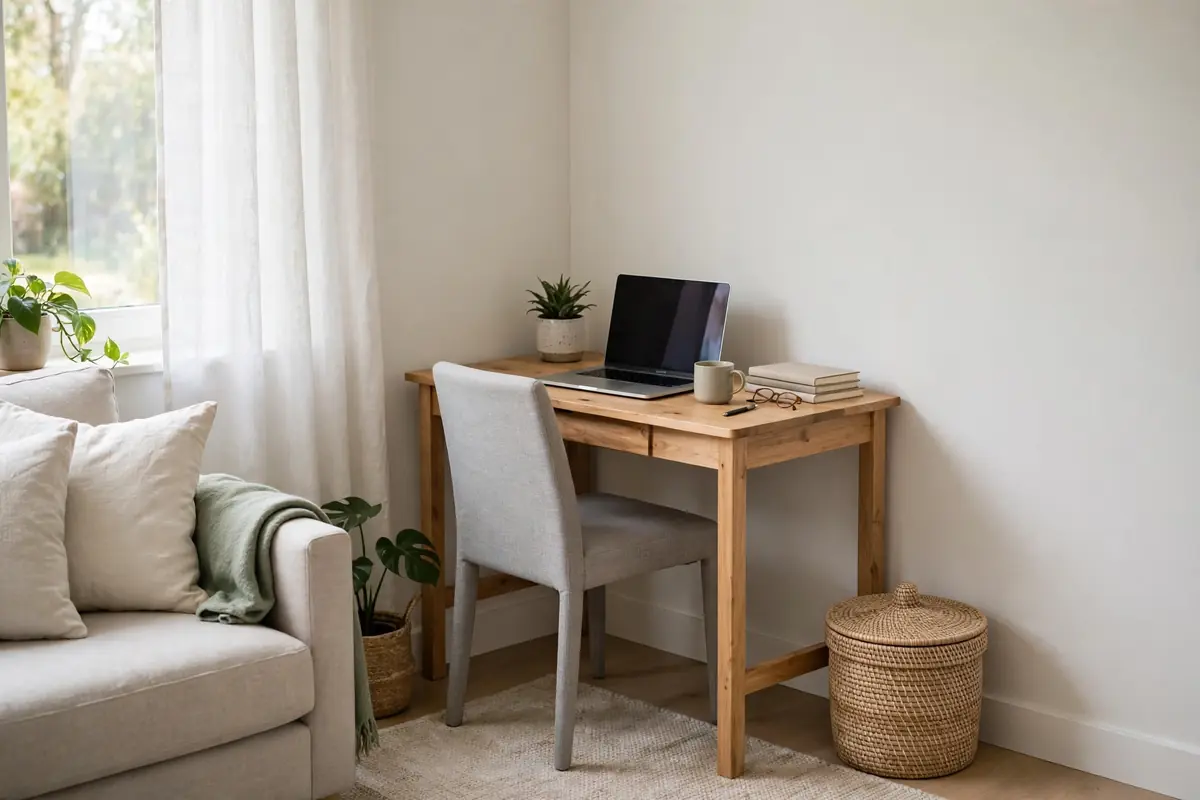
Fits: a living room corner behind or beside the sofa. Desk: 36 inches wide × 20 inches deep, with a backless stool or a chair that tucks fully underneath.
In a living room, the nook must disappear when you are not working, so the best small desk nook ideas for tiny corners here are the ones that blend in. Choose a desk in the same wood tone as your other furniture, keep the chair tucked in, and store supplies in a single lidded basket beside the desk. When guests come, the basket goes in a closet and the corner reads as a side table, not an office.
When the desk matches the room’s wood tones, the eye reads it as furniture instead of office equipment, so the nook visually disappears after hours. Pick a backless stool or an armless chair no wider than 22 inches that tucks fully under the desk, which needs 25 inches of knee clearance to swallow it. Budget tip: solid-wood 36-inch desks are common thrift finds, and a lidded basket beside the desk hides work clutter in one motion.
7. The hallway-end nook
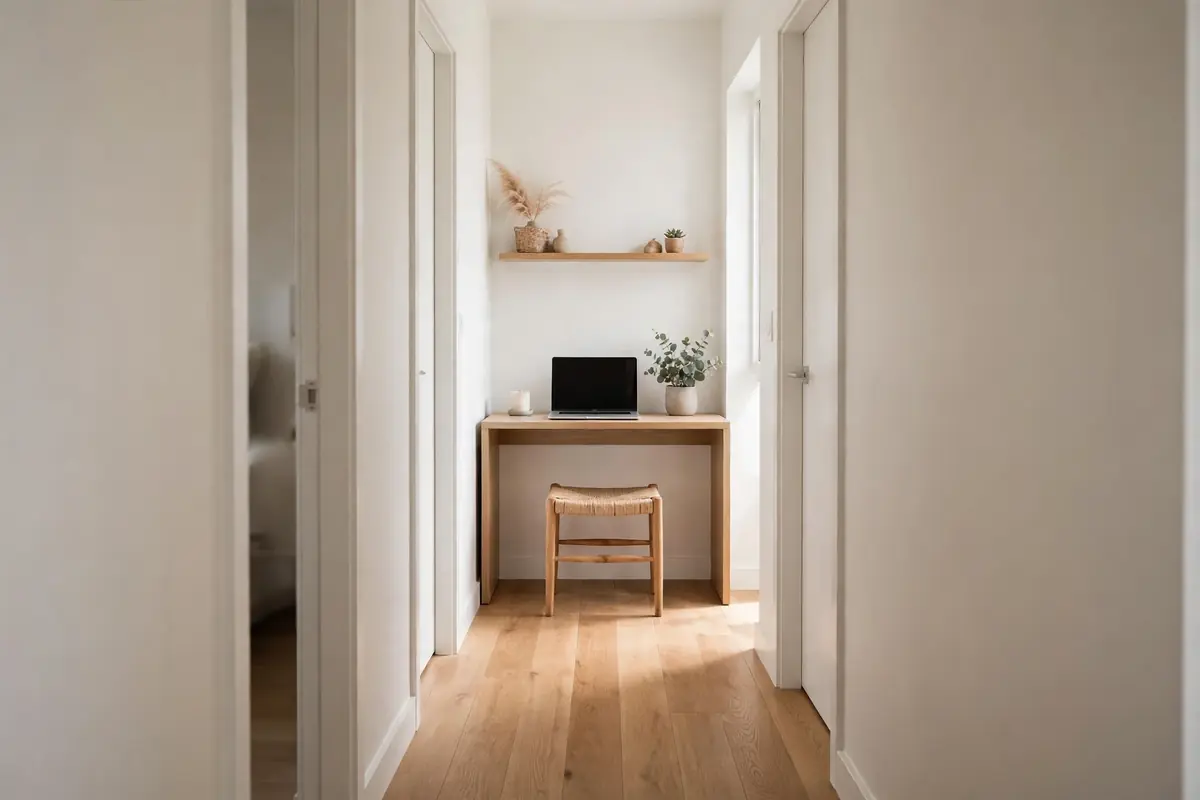
Fits: the end of a hallway or a passage corner, at least 30 inches deep. Desk: 30 inches wide × 16 to 18 inches deep, shallower than normal, on purpose.
A hallway nook is only for laptop work, not a full monitor setup, because the walkway must stay clear — that limit is what shapes these small desk nook ideas for tiny corners in a hallway. Use a narrow console-style desk, a stool that slides completely underneath, and a wall shelf instead of a desktop organizer. Measure the walkway after the desk is in: you still need 30 inches of clear passage.
The dead end of a hallway is square footage you already pay for, and a 16-to-18-inch-deep surface is plenty for laptop-only work. The non-negotiable number: keep 36 inches of clear walkway in front of the desk so the hallway still passes as a hallway. Renter tip: a freestanding narrow console table needs no mounting at all, and a stool slid fully underneath keeps the passage visually open.
8. The fold-down desk nook
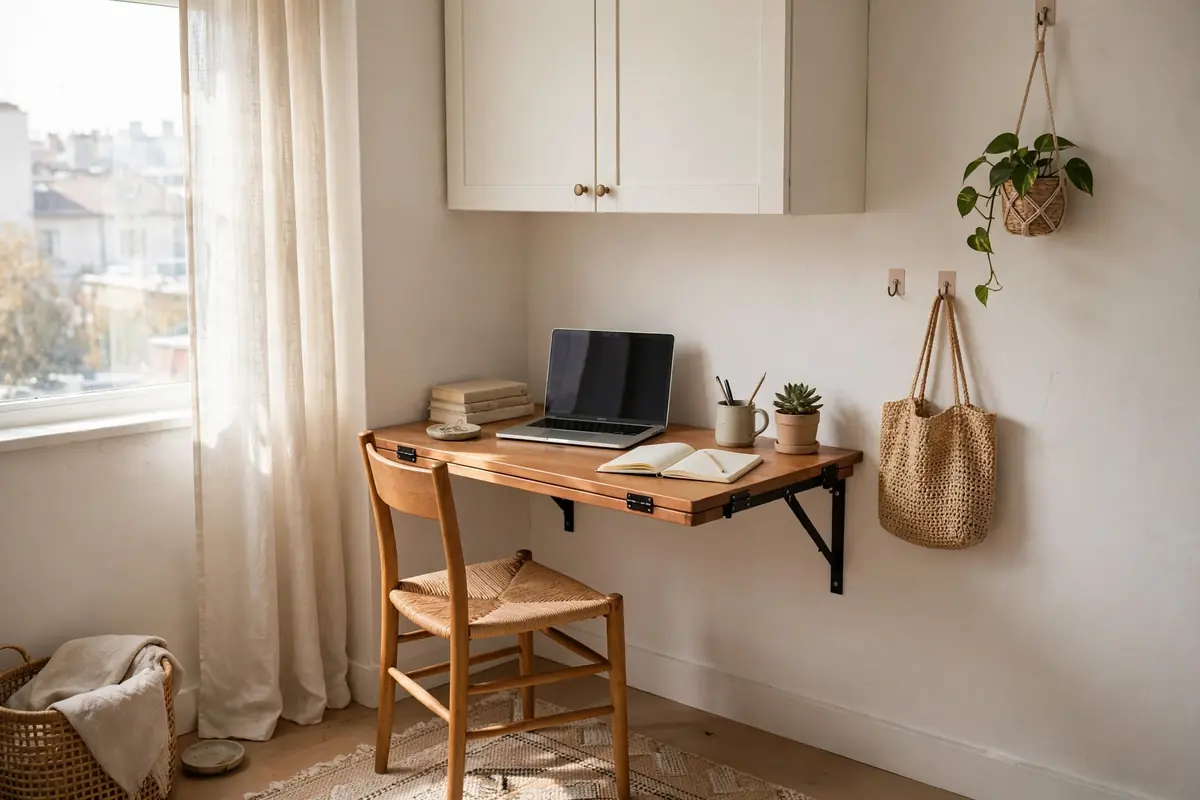
Fits: any corner, even one you cannot leave a desk in permanently. Desk surface when open: 32 inches wide × 20 inches deep, at 29 inches high. When closed: 0 inches of floor space used.
A fold-down desk is the best option if your corner is also a dining or guest space, and one of the most flexible small desk nook ideas for tiny corners. Mount it (or use a freestanding fold-down cabinet if drilling is not allowed), work, then fold it up and the mess disappears. Keep only what fits inside the cabinet when closed, if it does not fit, it does not live in this nook.
Zero floor space when closed means the corner can be a dining spot or walkway the other 16 hours of the day. Mount the 32-by-20-inch surface at 29 inches high, and confirm the brackets lock flat with no wobble before trusting it with a laptop. Renter tip: choose a model that hangs on just four screws (easy to patch with spackle), or use a freestanding folding table if you cannot drill at all.
9. The two-shelf vertical nook
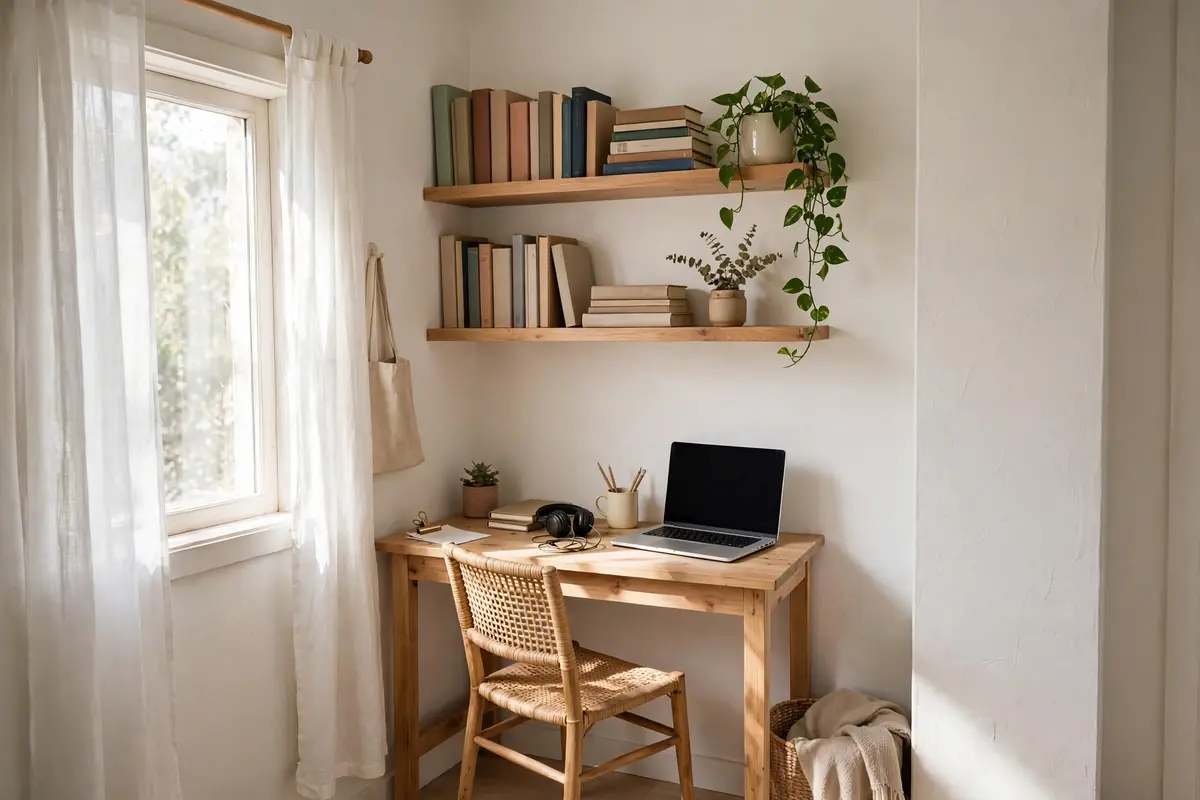
Fits: a very narrow corner, 30 to 36 inches wide, with tall walls. Desk: 32 inches wide × 20 inches deep. Shelves: two shelves, the first 18 inches above the desk, the second 16 inches above the first.
When you cannot go wide, go up — that is the rule behind these small desk nook ideas for tiny corners. Two shelves hold everything a small desk cannot: reference books, a printer on the lower shelf only if it is rated for the weight, and a plant on the top shelf. Keep heavy items low and light items high, and never put a shelf directly above your head at a height where you will bump it standing up.
Going up instead of out doubles storage without stealing an inch of floor, which is the whole game in a 30-inch-wide corner. Hang the first shelf 18 inches above the desk so a screen clears it, and the second 16 inches above the first, keeping everyday items within a 48-inch reach. Renter tip: a leaning etagere-style shelf gives the same vertical storage with zero wall holes and is easy to find secondhand.
10. The shared corner nook for two
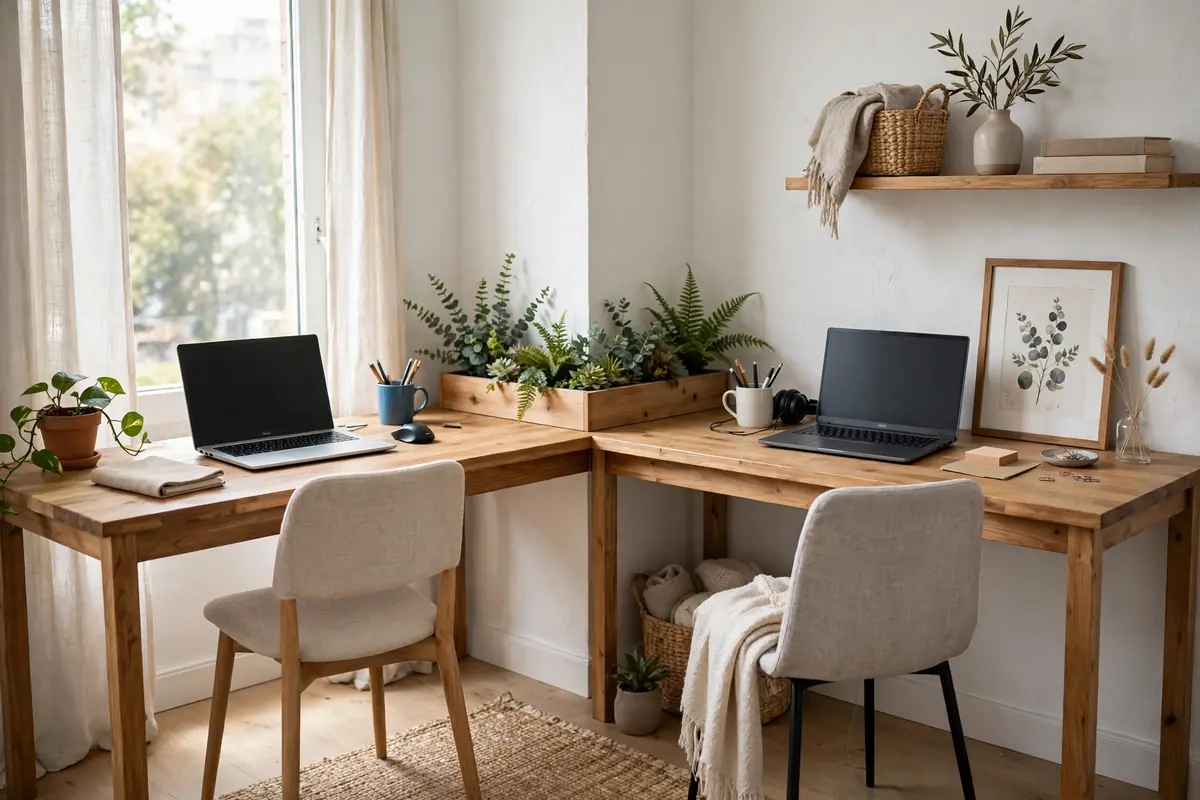
Fits: a wide corner, 60 inches or more. Desk: 60 inches wide × 24 inches deep, shared, or two 30-inch desks pushed together at a right angle.
Two people can share one corner without sharing one desk surface, and these small desk nook ideas for tiny corners work for two when each person gets their own zone. Give each person 30 inches of width, a small divider like a plant or a low shelf between the two zones, and separate cable baskets so chargers do not tangle. This works best when both people work at different times, or when one person mostly uses a laptop.
Thirty inches of width per person is the minimum for elbows and laptops to coexist, and one 60-inch surface costs less than two separate desks. Give each chair its own 30 inches of pull-out space behind the desk, and offset the two setups slightly so the monitors are not glaring mirror images of each other. Budget tip: two 30-inch folding tables pushed together at a right angle do the same job and split apart on moving day.
11. The budget corner nook under $150
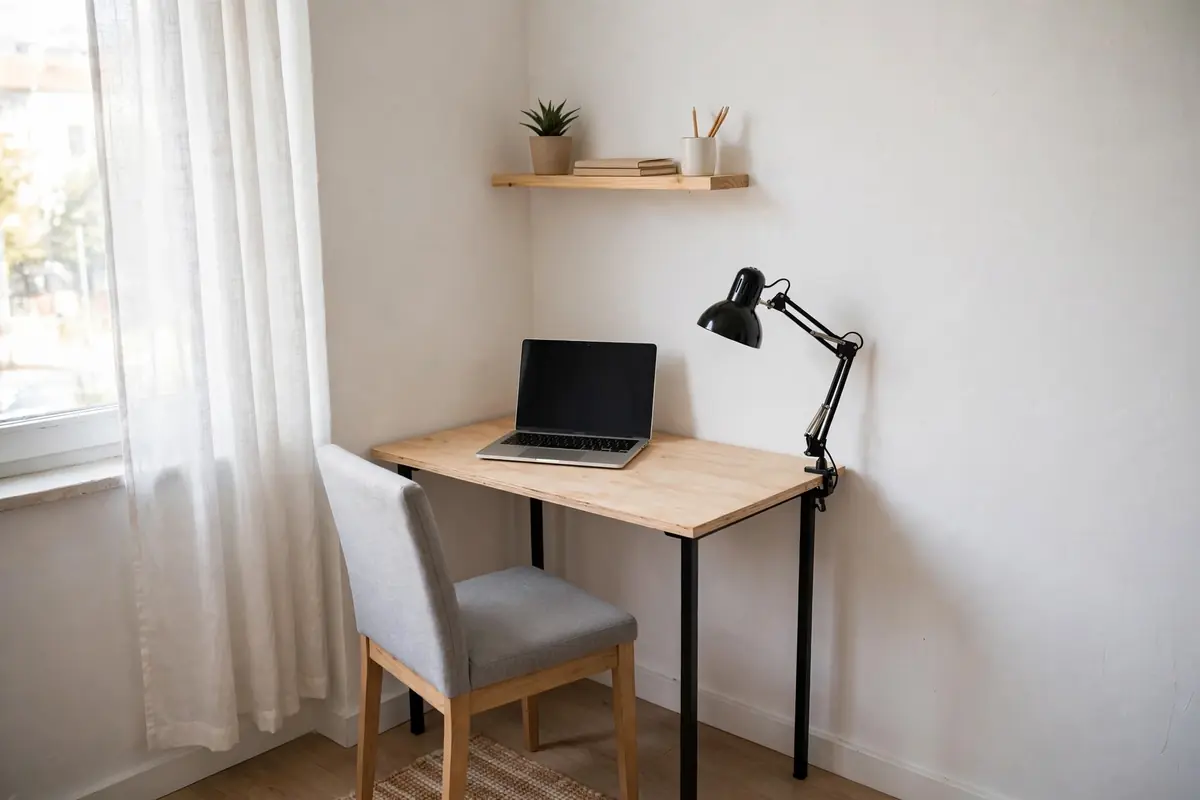
Fits: any corner, 36 inches wide. Desk: a simple 36 × 20-inch tabletop on legs, or a wall-mounted board at 29 inches high.
A budget nook is not a cheap nook, it is a small nook — and the cheapest small desk nook ideas for tiny corners still start with the chair. Spend on the chair first, the desk second, and lighting third. A secondhand table, a cushion on an existing chair, and a $15 clip lamp will beat an expensive desk with a painful chair every time. Add one shelf later, only after you have worked in the nook for two weeks and know what you actually reach for.
A small nook is a cheap nook, because every inch you skip is money you keep, and a 36-by-20-inch surface holds a complete laptop setup. Spend in this order: chair first, desk second, lamp third. A $60 used ergonomic chair beats a $60 desk upgrade every time. Renter tip: keep everything freestanding and skip wall mounting entirely, and check thrift stores first, where simple 36-inch tables often sell for under $25.
12. The video-call-ready corner nook
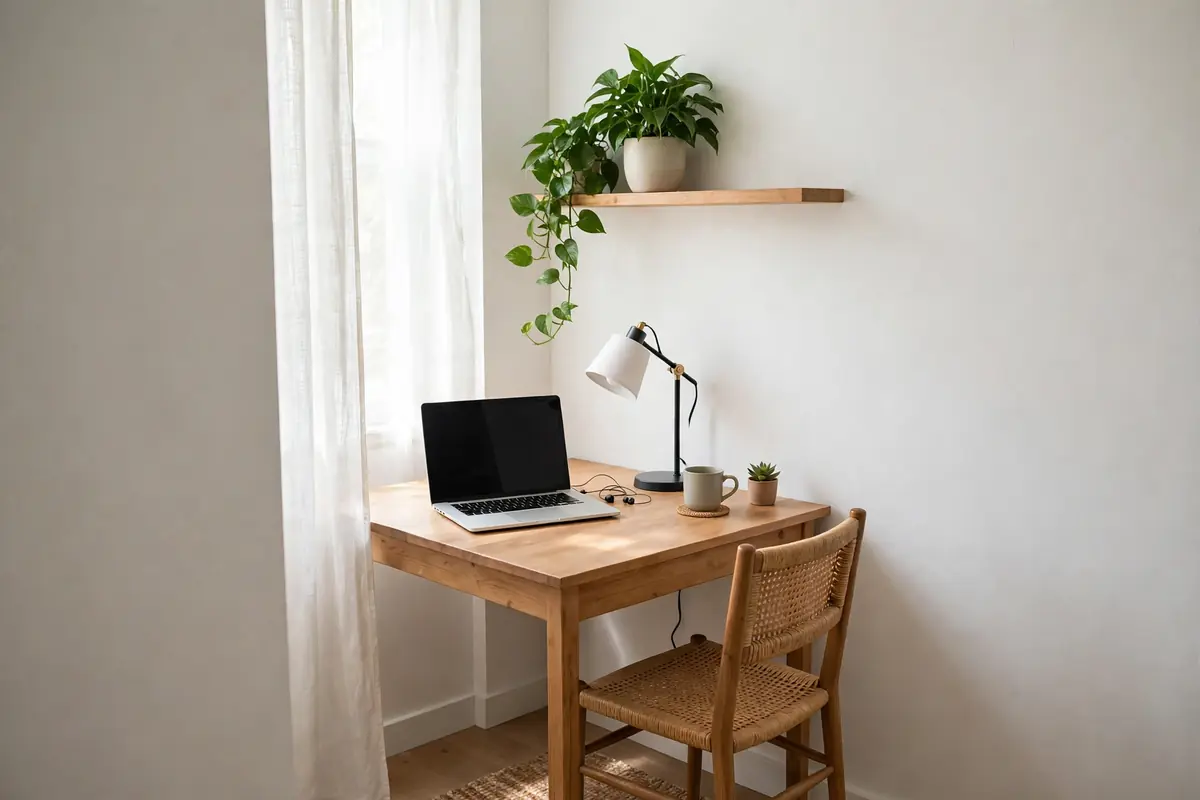
Fits: a corner with a plain wall behind you, 42 inches wide. Desk: 42 inches wide × 24 inches deep. Background: plain wall, one shelf, and one plant in frame.
For video calls, what is behind you matters more than what is on your desk, so the best small desk nook ideas for tiny corners for calls start with the background. Face the desk so the camera sees a tidy wall, not your bed or kitchen. Put a small lamp behind your laptop, facing you, not behind you, light on your face, not a bright window behind your head. Test it with one real call before you declare the nook finished.
On camera, the six feet behind you matters more than the desk itself, and a plain wall with one shelf and one plant reads as calm and intentional. Sit 24 to 30 inches from the camera with the lens at eye level (a $12 laptop stand fixes this), and keep the background to three elements max so it never looks cluttered. Budget tip: one trailing pothos in a $10 pot softens the whole frame, and a clip-on light under $15 beats any overhead bulb.
How to choose the right desk type for your corner
Match the desk type to your corner’s width and your lease, not to whatever looks good online. Each option below includes the width and depth to shop for.
Freestanding desks are the default choice: no drilling, easy to move, and right for any corner 36 inches or wider. Shop 36 to 48 inches wide, with 20 inches of depth for laptop work or 24 inches if a monitor is joining.
Wall-mounted desks win the tiniest corners, 32 to 40 inches wide, because no legs means the floor stays open. They need studs and landlord approval, so only choose this type if you can patch a few small holes at move-out.
Fold-down desks are for corners that moonlight as something else: dining areas, guest rooms, walkways. Plan on 32 inches wide by 20 inches deep when open, and zero floor space when closed.
Whichever type you pick, the math is the same: measure the corner width, subtract 4 inches (2 inches of breathing room per side), and that is your maximum desk width.
5 measurement mistakes that ruin a tiny nook
Tiny nooks fail on inches, not style. Dodge these five mistakes and their fixes:
- Buying the desk before measuring the corner. Fix: measure the corner width first, subtract 4 inches, and treat that number as your hard desk-width limit.
- Stealing walkway space. Fix: hallways and passages need 36 inches of clear walking width. If your desk depth eats into that, go shallower (16 to 18 inches) or pick another corner.
- Forgetting knee clearance. Fix: you need 25 inches of height and 20 inches of depth under the desk with nothing blocking your legs, or you will perch instead of sit.
- Skipping chair pull-out space. Fix: leave 30 inches from the desk edge to whatever is behind you, or you will not be able to push back and stand up comfortably.
- Parking the monitor too close. Fix: the screen belongs 20 to 26 inches from your eyes with its top at or just below eye level. Closer than 20 inches causes strain, which is why shallow desks pair better with laptops.
Renter-friendly checklist (no-drill where possible)
- Measure first, buy second, corner width minus 4 inches total is your desk limit.
- Prefer leaning, freestanding, or fold-down desks if your lease bans drilling.
- Use adhesive hooks only for light items (under the hook’s rated weight), never for shelves holding books.
- Keep one power strip with a short cord, and a cable basket under the desk, so cables never trail across the walkway.
- Photograph the corner before you set up, so move-out is a simple comparison, not a memory test.
What is the smallest chair that fits a tiny desk nook?
A backless stool about 17 to 18 inches across is the smallest comfortable option, and it slides fully under the desk when you are done. If you want back support, choose an armless task chair no wider than 22 inches. Anything wider with arms will not tuck in, and you will lose your 30 inches of pull-out space to a chair that lives permanently in the room.
Do I need a deeper desk for a monitor than for a laptop?
Yes. A laptop is happy on a 20-inch-deep desk, but a monitor needs 24 inches: the stand eats 8 to 9 inches, your keyboard needs its share, and your eyes still want 20 to 26 inches of distance from the screen. On a 20-inch desk with a monitor, you will end up craning back with nowhere to go.
How do I hide cables in a renter-friendly way?
Mount a small cable basket or lidded box under the desk with adhesive strips rated for the weight, and run everything into one power strip with a short cord so nothing trails across the floor. A pack of adhesive cable clips costs a few dollars and keeps cords along the desk’s back edge, and it all peels off at move-out with no holes to patch.
Frequently asked questions
What is the smallest desk that actually works in a corner?
A 32-inch-wide, 20-inch-deep desk works for laptop-only work, and it is the smallest size in these small desk nook ideas for tiny corners. Smaller than that, and you lose room for a notebook beside the laptop.
Can I put a desk nook in a corner with no window?
Yes. These small desk nook ideas for tiny corners work without a window too. Add a task lamp at desk height, keep the wall color light, and add one mirror or light-colored shelf to bounce light around. A dark corner with no lamp is the only version that does not work.
How do I keep a tiny desk nook tidy?
One rule: everything on the desk must be used daily. Everything else lives on a shelf, in a basket, or in a closet. If it has not been touched in two weeks, it moves out of the nook — that is how these small desk nook ideas for tiny corners stay tidy.
The bottom line
Start with your corner’s measurements, not a desk you fell in love with online. A 36-inch desk in the right corner beats a 60-inch desk squeezed into the wrong one, every time. Measure, pick one of these small desk nook ideas for tiny corners, and set it up in an afternoon, your tiny corner is already an office, it just needs a desk that fits it. If your corner is bigger than a nook, try our corner desk setup guide.
Start today in three steps. Step 1: measure your corner’s width and subtract 4 inches. That is your desk limit. Step 2: pick the one idea above whose numbers match yours. Step 3: buy the chair first, then the desk, and set up only what you will touch daily. A finished nook beats a perfect plan, and yours can be working by tonight.